




Abstract

Background
Galvanic current, also known as direct current, is one of the oldest forms of therapeutic electricity and has been utilized for centuries in the treatment of various musculoskeletal disorders. Medical galvanism uses direct current modalities that deliver a unidirectional, uninterrupted current flow within the tolerance of the patient and without the destruction of tissue. 1 Galvanic current exerts its therapeutic effects through several mechanisms. First, it can modulate inflammation by generating ions between the positive and negative electrodes. This ion movement has been shown to suppress chemical signals associated with inflammation, thereby reducing its intensity. Second, galvanic current enhances blood circulation when applied to the skin, leading to vasodilation and increased blood flow. This improved perfusion facilitates the delivery of oxygen and nutrients to damaged or injured tissues, promoting healing processes. In addition, galvanic current can modulate nerve conduction, effectively mitigating pain signals. By altering the electrical activity of nerves, it can disrupt the transmission of nociceptive signals, providing analgesic effects. Finally, galvanic current stimulates cellular activity, triggering cellular regeneration and tissue repair mechanisms. 2
The utilization of galvanic current in the treatment of musculoskeletal disorders has shown promising results across various conditions. In cases of acute or chronic inflammation, such as tendonitis or bursitis, galvanic current can effectively reduce swelling and alleviate pain. Moreover, positive outcomes have been demonstrated in the management of acute injuries, such as sprains or strains, which is believed to be through promotion of tissue healing and reduction of recovery time. Galvanic current has also been employed in the rehabilitation of musculoskeletal conditions, including muscle weakness or atrophy. By stimulating muscle contractions, it can aid in the restoration of muscle strength and function. In addition, the ability of galvanic current to enhance drug delivery through the skin has led to its application in localized pharmacological treatments for musculoskeletal conditions. 3
Percutaneous needle electrolysis therapy
One of the application methods of galvanic current, which is applied in several ways, is percutaneous needle electrolysis therapy (PNET). PNET is a minimally invasive technique used to treat musculoskeletal conditions, particularly tendinopathies. 4 It involves the application of a galvanic current through a fine needle electrode inserted into the affected area (Figure 1). During the procedure, a specialized machine delivers a low-intensity direct current to the target tissue. The electrical current creates an electrochemical reaction, promoting localized tissue repair and regeneration. PNET involves applying a galvanic current through an acupuncture needle and thus combining mechanical and electrical stimulation of the tissue that results in a controlled local microtrauma. This technique aims to enhance the healing process, reduce pain and improve the functionality of the affected area.
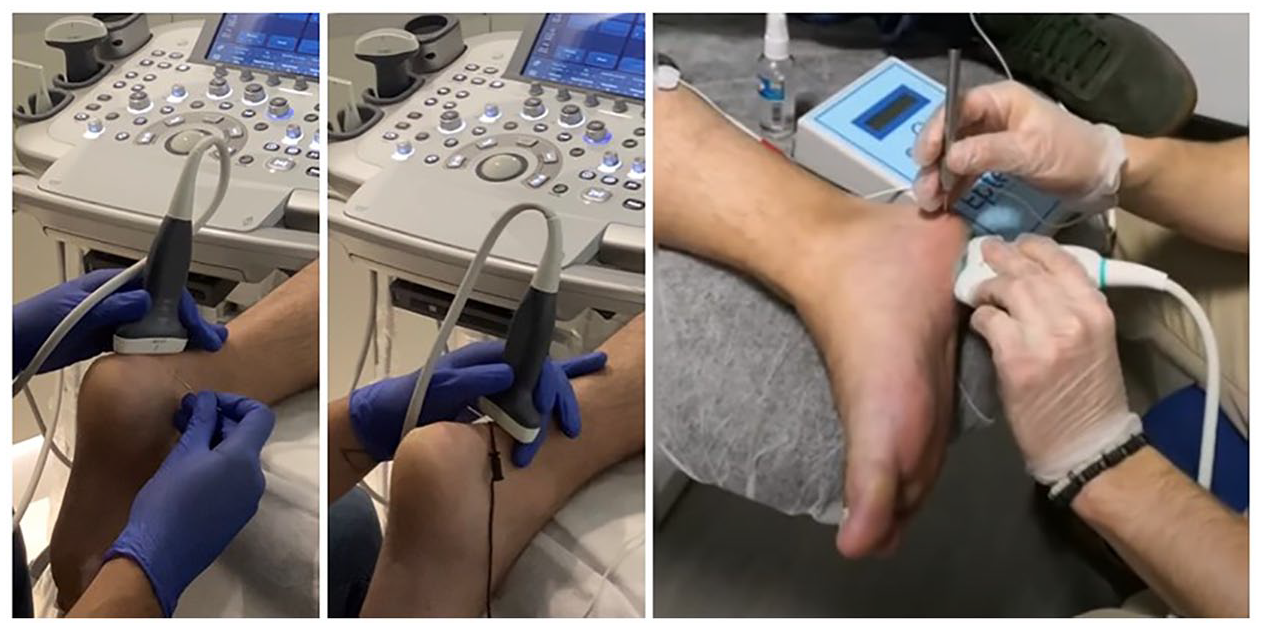
Percutaneous needle electrolysis therapy and its application.
PNET is commonly used in the treatment of conditions such as upper and lower body tendinopathies, enthesopathies, acute and chronic muscle injuries, temporomandibular myofascial pain, subacromial pain syndrome, plantar heel pain and whiplash syndrome; therefore, a specific treatment indication and timing for application is still unclear, so comparisons must be made with caution. The galvanic current is typically used at an intensity ranging from 1.5 to 6 mA in bouts of 3–5 s and repeated one to five times per session. It is usually performed by healthcare professionals with specialized training in the technique. 5 PNET therapy should be administered under ultrasound guidance to achieve targeted therapy and avoid complications.
Mechanisms
PNET is believed to exert its effects through several mechanisms. Although the exact physiological processes are still under investigation, the following are some potential mechanisms through which PNET may exert a therapeutic effect:
Conclusion
In conclusion, among the treatments that utilize galvanic current, PNET has recently emerged as a promising therapy for the treatment of musculoskeletal disorders, particularly tendon pathologies, and has multiple potential underlying mechanisms of action.
Footnotes
Declaration of conflicting interests
The authors declared no potential conflicts of interest with respect to the research, authorship and/or publication of this article.
Funding
The authors received no financial support for the research, authorship and/or publication of this article.