



Abstract

Background
Restless legs syndrome (RLS) is a common neurological disorder characterized by an uncomfortable sensation at rest and an urge to move the legs, which is relieved by movement or walking, with worsening of symptoms at night. 1 The prevalence of RLS in the population is 1.5%–2.7%. 2 Due to the aggravation of symptoms at night, during periods of rest or inactivity, RLS can significantly impact the sleep and quality of life of affected individuals. Herein, we report a case of RLS in which the patient’s symptoms appeared to be significantly improved by acupuncture treatment.
Case presentation
On 24 September 2022, a 23-year-old male patient visited the Acupuncture and Massage Department of Affiliated Sport Hospital of Chengdu Sport University, complaining of discomfort and pain in both lower limbs for the preceding 2 years. The symptoms were significantly worse at night and relieved by moving and walking. Based on diagnostic criteria, the doctor in the Acupuncture and Massage Department diagnosed the patient with RLS. Due to concerns about potential adverse effects of medication and the patient’s physical condition, the patient was unwilling to receive medication. Therefore, at the suggestion of the doctor, the patient underwent acupuncture treatment.
Acupuncture treatment
An experienced acupuncturist developed a 30-day acupuncture treatment plan for the patient, with a total of 10 sessions representing one course of treatment. As shown in Figure 1, after the skin was cleansed, stainless steel acupuncture needles (length 25 mm, diameter 0.25 mm; Hua Tuo brand, manufactured by Suzhou Medical Supplies Factory Co., Ltd. in Suzhou City, China) were inserted bilaterally to a depth of 25 mm at SP3 (Taibai), LR3 (Taichong), ST40 (Fenglong) and ST36 (Zusanli). The acupuncturist manually stimulated the needles to achieve de qi sensation at 10 min intervals, and the duration of each treatment was 30 min.
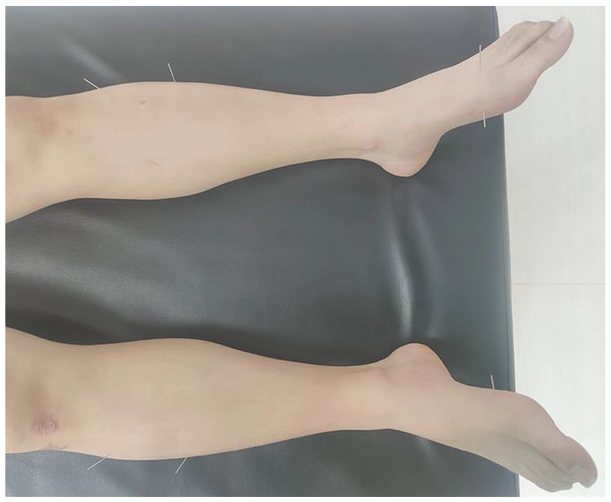
Acupuncture treatment for a patient with restless legs syndrome.
Clinical outcome
After 10 sessions of treatment, the patient’s nighttime discomfort/sensation in both lower limbs was reduced, and sleep quality improved. The International Restless Legs Syndrome Study Group Rating Scale (IRLS) was used to evaluate the patient before each treatment. As shown in Figure 2, the patient’s scores decreased over time after starting treatment. The patient’s RLS symptoms were dramatically improved after 10 sessions of treatment, with no adverse reactions to acupuncture observed. At a 3-month follow-up visit, the patient reported relief from RLS-related insomnia.

International Restless Legs Syndrome Study Group Rating Scale (IRLS) scores before each acupuncture treatment in a patient with restless legs syndrome.
Comment
Studies have shown that acupuncture can effectively treat neurological disorders.3 –5 RLS is mainly accompanied by an irresistible urge to move the legs and a sense of restlessness and discomfort, which often leads to decreased sleep quality. The main goal of treatment is to alleviate this discomfort and improve sleep quality. Compared with medications, acupuncture has an advantage of relative safety. At the 3-month follow-up, the patient was no longer experiencing the significant discomfort in the legs that had affected his sleep. Although no definitive conclusions can be drawn from this single case study without a control group, based on the progression of the patient’s condition and general clinical expectations, the relief of symptoms and improvement in sleep quality during the course of acupuncture treatment in this case of RLS case were relatively rapid, suggesting that they were less likely spontaneous.
Summary
This case suggests that acupuncture may have a potential role in the treatment of the discomfort caused by RLS. The major limitation of this report is that it represents only a single case, and further validation of the findings will require prospective controlled studies with an adequate sample size.
Footnotes
Acknowledgements
The authors thank the patient.
Declaration of conflicting interests
The authors declared no potential conflicts of interest with respect to the research, authorship and/or publication of this article.
Funding
The authors received no financial support for the research, authorship and/or publication of this article.
Ethical approval
The patient provided their written consent for the publication of this clinical case report.
