



Abstract
This article examines pronominal references to anthropomorphic animal characters in contemporary Finnish-language picture books for children (N = 531). In the Finnish language, the choice of third person pronoun is a key means of distinguishing humans from other animals. The study shows that animal characters in children’s literature are linguistically placed between humans and nonhumans: in about half of the analysed books, the pronoun typically referring to humans refers to the animal characters, whereas in the other half of the data, the pronoun referring to nonhumans is used. A quantitative analysis reveals that the use of the human personal pronoun correlates with the number of human-like traits the characters possess. The analysis shows that pronoun variation has a variety of functions in picture books. Different pronouns may refer to different characters, indicating their degree of humanity, and the treatment of characters as human or nonhuman may also change as the story progresses. The human pronoun can be used in dialogue to indicate that the characters treat each other as persons. On the other hand, since there are differences in the Finnish pronoun system between the spoken and written variety, pronoun variation can mark a dialogue as colloquial. The study compares original and translated Finnish literature, revealing some differences. Finnish authors use the stylistic values linked to the pronouns as a resource more widely than translators, which results in more book-internal variation. Conversely, translators orient towards the standard language and consider how human-liken the characters are when choosing pronouns.
1. Introduction
In this article, we investigate pronominal references to animal characters in Finnish-language original and translated picture books for children. The linguistic devices used to refer to animals in Finnish tell us about language users’ relationship to animals, and in children’s books, the means of reference chosen by authors and translators convey an image of the kind of animal characters they create in the fictional world of their works.
In the present article, by approaching animal characters in children’s books through a linguistic analysis of third-person pronoun references, we investigate the question of how authors and translators represent animals, whether as more human- or animal-like characters linguistically, and what factors influence their linguistic representation.
Animal stories have been examined from the perspective of literary and cultural research (e.g. Jaques, 2015; Lassén-Seger, 2009, 2022; Mallan, 2018; Ratelle, 2015) whereas the linguistic properties typical of children’s books featuring animal characters have been studied less. In translation studies, a shift from disciplinary anthropocentrism to a more ecocritical approach is a topical issue (Cronin, 2017) which has recently been approached from the perspective of representation of animals and human-animal relationship in translations (Taivalkoski-Shilov and Poncharal, 2020).
Anthropomorphic animals have a long history in fairy tales and fables. While animal characters have a satiric function in tales designed for an adult audience, they serve a pedagogical function for children (Flynn, 2004). Humanized animal characters combine human and animal traits in such a way that they offer possibilities for identification and empathy while, at the same time, they distance the readers from the characters so that difficult issues can be dealt with. In addition, humanized animals possess physical features that interest young readers (Flynn, 2004; Lassén-Seger, 2022).
The role of animals in modern societies has been the subject of many recent studies (e.g. Scanes and Toukhsati, 2018) and the relation between humans and animals in Finnish society has also been critically studied (Aaltola and Keto, 2015; Kainulainen and Sepänmaa, 2009; Räsänen and Schuurman, 2020). In Finnish linguistics, the focus has been on language use in establishing this relationship (e.g. Peltola et al., 2021).
The examination of animal characters in children’s books renews this prior research in an important way, because the animal characters have a hybrid and unstable nature: they exist ‘in a liminal space in between the categories’, as Flynn (2004) puts it. In this study, we show that, at least in contemporary Finnish picture books for children, characters that look like animals but talk and behave like humans are also situated between humans and animals linguistically in terms of pronominal reference.
Our research considers not only original Finnish children’s literature but also translations into Finnish, because more than half of the children’s picture books published in Finland in the 2000s were translated. The most frequent source languages are English, Swedish, and German, languages whose pronominal systems differ from those present in Finnish. In addition, we also consider translations from French, the fourth most important source language of children’s literature in Finland (The Finnish Institute of Children’s Literature/Kirjakori statistics, 2022).
In the description and comparison of the Finnish-language original and translated children’s picture books, we ask (1) how the animal characters are pronominally represented in the books, (2) how much variation there is between and within the books, (3) whether the choice of pronouns can be explained by the degree of anthropomorphism of the characters, and (4) whether there are differences in the use of pronouns between non-translated and translated books.
In the next section, we present the theoretical underpinnings on which our research is built. In Section 3, we introduce our data and describe how they were processed. Section 4 contains the results of our analysis: first, in 4.1, we present the quantitative findings between the non-translated and translated data and calculate the relationship between pronouns and the degree of anthropomorphism. Then, in 4.2, we describe the variation within books qualitatively. Finally, in Section 5, we discuss and summarize these findings.
2. Linguistic and theoretical starting points
2.1. Finnish third-person pronouns
The study of the pronominal devices used to refer to animal protagonists in children’s books is a fascinating endeavour because the Finnish pronominal system possesses properties not available to the Indo-European languages, which form the main source languages for translated Finnish literature. In Finnish, the third-person pronoun hän, ‘he, she’, as well as all other pronouns, are gender-neutral. Instead of gender, the humanity of the point of reference affects the choice of pronoun: in the Finnish standard language, human referents are referred to with the pronouns hän (‘s/he’) and he (‘they.human’), and, as a rule, only with them. Non-human points of reference – that is, animals, inanimate objects and abstract things – are referred to by three other pronouns and their plural forms, classified as demonstrative pronouns in Finnish grammar.
The main difference between personal and demonstrative pronouns in Finnish grammar is that personal pronouns cannot be used as determiners of a noun while demonstratives can (e.g. se nainen ‘the/that woman’; for discussion of the role of the pronoun se in Finnish grammar, see Laury, 1997). As determiners, demonstratives also occur with nouns referring to humans. In this study, we only focus on pronominal, not determinative, uses. Of the three pronouns referring to non-humans, the typical choice is the anaphoric pronoun se, ‘it’, or its plural equivalent ne, ‘they.nonhuman’. Following the usual convention, we translate the pronoun se into English with the word it, even if the pronouns are not grammatically equivalent.
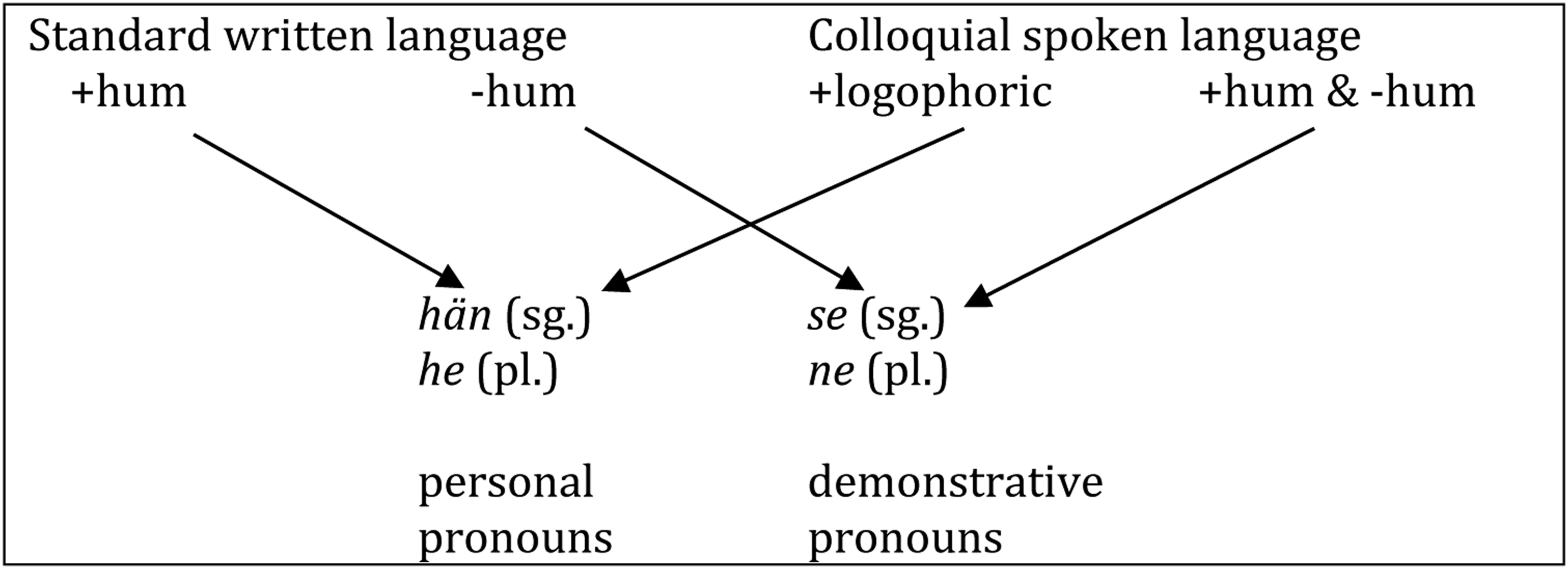
The system of third-person pronouns in Finnish.
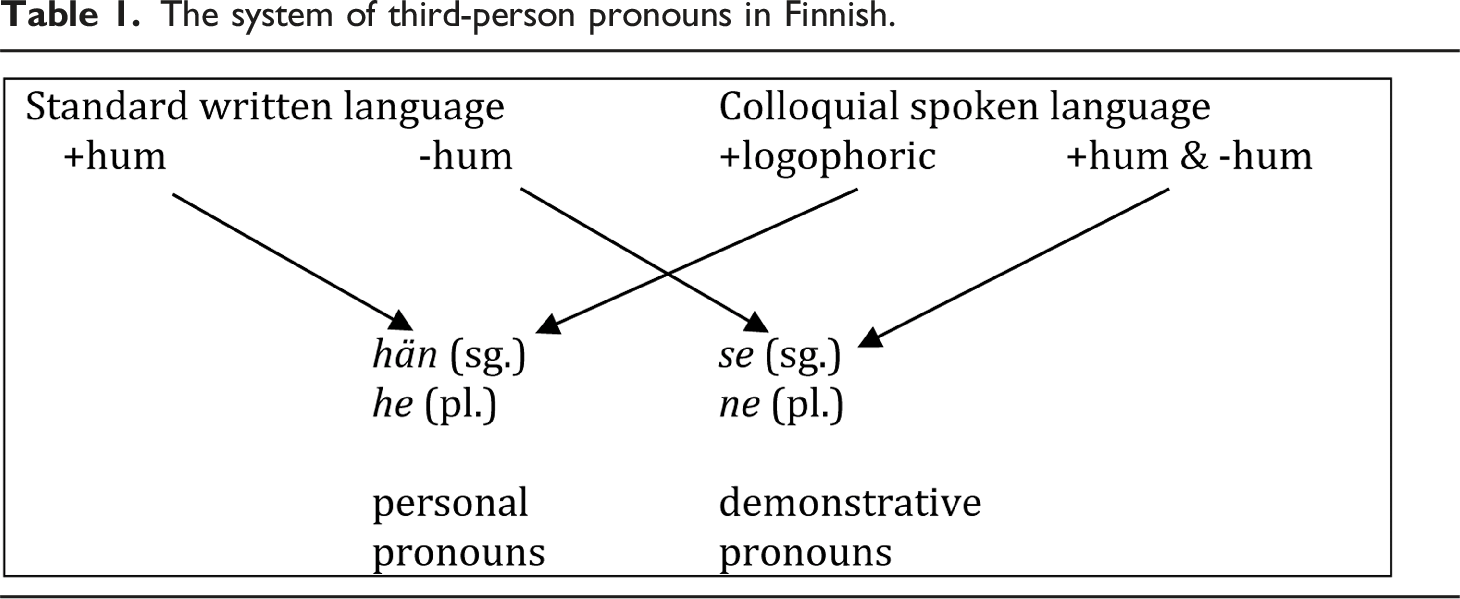
The variation is complicated by the fact that the use of pronouns is different in standard and colloquial Finnish. In colloquial language use, it is common to use the pronouns se and ne for all kinds of referents, including human ones. In literary texts, the use of demonstrative pronouns for human referents is a method for creating an illusion of spoken language. The pronouns hän (‘s/he’) and he (‘they.human’), which became established as personal pronouns in the formation process of the Finnish Standard language in the 19th century, traditionally served as logophoric pronouns. In this function, they referred to someone whose words, thoughts or feelings were reported (see e.g. Laitinen, 2005; Priiki, 2017). This function still exists in contemporary spoken Finnish.
In other words, when analysing the points of reference of third person pronouns in children’s books, the pronoun choice may be motivated by the interpretation of the character as an animal or a human, but also by the author’s or translator’s choice between different registers or narrative styles.
The system is further complicated by the fact that in fiction, pronouns also contribute to the regulation of narrative modes, in particular, to the creation of free indirect discourse (FID). Authors of Finnish fiction and Finnish translators of fiction utilize the different pronoun systems of written and spoken Finnish varieties to construct a narrative perspective: for example, the person whose point of view is taken is referred to using the personal pronoun hän and other characters with demonstratives (Kasso, 2017: 147–148). According to Kaiser (2018), this practice is also found in children’s books with anthropomorphized animal characters.
In Finnish literary texts, there is an additional level of variation in the use of plural pronouns. Namely, in the works of some authors, the demonstrative plural pronoun ne (‘they.nonhuman’) refers to a focused mass with indistinguishable individuals, while the personal plural pronoun he (‘they.human) refers to individuals extracted from the mass (Kasso, 2017). In sum, the pronoun choice by authors and translators is influenced in different Finnish varieties by several different factors.
2.2. Special features of children’s picture books and linguistic tendencies in translations
Picture books are a distinct genre of narratives written for children. The relationship between text and images, which is one of the most intensively examined subfields of translation of children’s literature (Alvstad, 2010), is special in them, as a story is told by two distinct media (Arzipe and Styles, 2003; Pantaleo, 2014). Oittinen and Davies (2008: 4) characterize picture books as ‘iconotexts, with the interaction of two semiotic systems, the verbal and the visual’. This means that character traits, such as the human- or animal-like features of animal characters, are also conveyed through both media.
The personification of animals is a typical feature of characters found in children’s literature. Cadden (2010) describes the animal characters as ‘people in fur’, because they often behave just as humans do. In some cases, the most human-like animal characters contrast with ‘real’ animals in the stories, for example when they keep pets or domestic animals or consume other animals as their food in a human-like manner.
The degree of personification is a continuum: although animal characters with the least anthropomorphic features may be described realistically, they can be interpreted as having human-like thoughts and feelings (Cadden, 2010). Clothing is a characteristic feature that distinguishes anthropomorphic animal figures from the ones with fewer human features (Flynn, 2004). However, the use of clothing by animal characters in children’s books is often partial: they may only wear accessories, or only a few of the story’s characters wear complete outfits (see Section 3).
Human-like animal characters have been shown to display several different functions in children’s literature. Cadden (2010) highlights that they can be used to obscure traits such as class and ethnicity typical of human characters and to engage child readers through fantasy elements. He concludes that since ancient times, animals in fairy tales have served as symbols for different aspects of human nature. Today, less human but sentient and thinking animal characters can teach children respect for wild animals.
As mentioned in the previous section, a large proportion of the children’s literature published in Finland is translated. Although Western children for the most part read the same stories in different countries, adaptation and domestication of stories is common in children’s literature (Oittinen, 2006: 42). What makes picture books special is that they are usually read aloud. Puurtinen (1995), who analyses the linguistic features of children’s literature translated into Finnish, shows that the language of the books must be suitable for reading aloud and accepted by the parents who choose the books as well.
Previous research in translation studies has shown that translated texts tend to follow the norms of the target language more closely than corresponding non-translated literature. The result of this tendency, which has been referred to by the largely synonymous terms of normalization, standardization, conventionalization, and conservatism, is an increased degree of conformity in translations compared to corresponding non-translated texts in the same language. Xia (2014), who provides a useful overview of previous research on this tendency in translation, chooses the term normalization and defines it as a ‘tendency of translators to conform to the conventionally established and standard practices typical of the target language’ (2004: 6).
Normalization has been shown to apply to children’s literature and to editors’ practices as well. For example, Moe and Žigon (2006: 129) claim that in picture book translations, editors’ corrections often involve normative replacements: more formal, neutral and exact expressions. Normalization and its intensity depend on the register and target audience (Delaere and De Sutter, 2013). Zhang et al. (2022) emphasize in their study on Chinese translations of English children’s literature that children’s literature is a genre in which normalization is particularly strongly present due to the acceptability expectations both those of the children to whom the texts are read and of the adults who buy the books.
Normalization effects have also been shown to occur in Finnish translations, in which the use of pronouns is a topic that has been studied intensively in earlier studies. Kolehmainen (2011) gives an overview of previous corpus-linguistic comparisons of Finnish non-translated and translated texts, which have been shown to differ from each other with regard to pronoun choices, frequencies and functions. This is attributed partly to source language influence, partly to the practice of translators following the target language norms more closely than Finnish authors do.
Later studies published after Kolehmainen’s overview confirm these previous findings and show for example that the techniques used to create the illusion of spoken discourse, for which pronominal devices play an important role, are partly different in original and translated Finnish literature (see e.g. Tiittula and Nuolijärvi, 2013: 571–572). Kuusi (2011) and Kasso (2017) additionally show that the differences also manifest themselves in free indirect discourse for which the available pronominal variation is utilized less frequently in translations than in non-translated literary texts. In fictional texts, the pronouns associated with FID and perspective taking derive from the colloquial system described above in 2.1.
3. Data
This study is based on a digital database containing data from 531 Finnish-language picture books with animal protagonists. In the books, targeted to small, under school-age children and published in 2005–2022, illustrations play a central role. In principle, a picture book can represent any genre from poetry to nonfiction, but in our study the books examined are fictional narratives.
Roughly half of the books (267) were originally published in Finnish; the rest (264) were translated into Finnish from English (181 books), German (60 books), Swedish (12) and French (11). The number of analysed picture books written originally in Finnish (267) corresponds to 11.5% of all non-translated picture books published in Finland during the period 2005-2022 (in total 2319 works); the number of analysed translations, in turn, corresponds to 4.7% of all translated picture books in Finland during the same period (in total 5570 works) (see The Finnish Institute of Children’s Literature/Kirjakori statistic, 2022).
The animals presented in these books represent diverse species from domestic to wild animals, mostly mammals but also birds, fish and invertebrates. In addition, animal-like fictional characters, such as dragons and unicorns, were considered, but they are rare in the data. When selecting the books, we relied on the library databases of The Finnish Institute of Children’s Literature, the University of Turku and the city of Turku. For the final selection of books, it was crucial that the works were available as physical books in the libraries of the city of Turku.
From the chosen books, we produced a MS Access database
1
, in which our research assistants recorded the bibliographical information (title, author, illustrator, translator, publisher, year of publication, source language), the use of third-person pronouns (only pronominal occurrences), and the characteristics of animal protagonists. On the basis of the illustrations and text, the following features of the animal characters were registered into the database (with yes/no) in order to study the possible correspondences between the characters and pronouns: 1. Do the animal characters communicate by using human language? 2. Do they walk on two feet (if the species in nature moves on four)? 3. Do they wear clothes? 4. Do they have a proper name typically given to humans? 5. Do they have family relations typical for humans (e.g. a nuclear family)? 6. Do they live in an environment typical for humans (e.g. a furnished house)? 7. Are they presented as having a job typical for humans (e.g. driving a bus)?
Each feature was given the mathematical value of 0 or 1. The features were combined into a sum of variables, which we refer to as the anthropomorphism index. This index, which has values from 0 to 7, describes the general human features of the characters in every book. For the whole dataset, the median value of this sum of variables is 4. Figure 1 shows the share of books in which the main character displays the coded features in the data. The proportion of main characters having the human-like features registered in the database.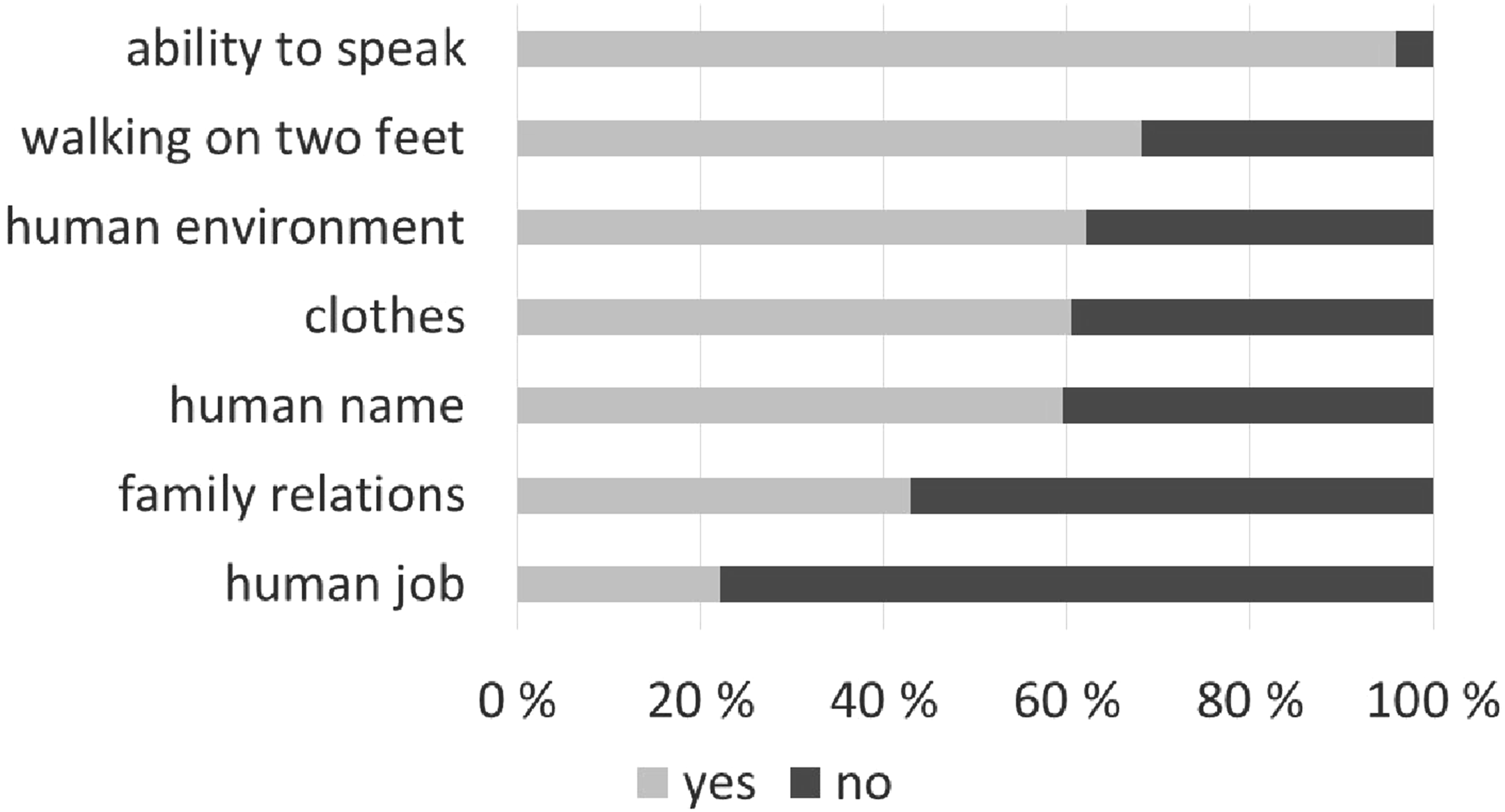
The database also included the possibility to add a freely formulated description, for example in a case where the various animal characters of a story differ with regard to their levels of anthropomorphism. Photographs of the characters were attached to the database.
For possible pronoun variation, the database entails an extra coding, which indicates whether the pronoun choice is systematic or whether it varies, and whether the only or the main option is to use demonstrative (se, ne) or personal (hän, he) pronouns. The variation was described in the database, and deviations from the typical pronoun choice for each book were documented by taking a photo of the context of the deviation.
The database collection and coding was executed with MS Access (2019) and the quantitative results with statistical significance tests were calculated with IBM SPSS Statistics (Version 27).
4. Findings: Pronouns in Finnish original and translated children’s literature
4.1. Quantitative results
The data confirms our preliminary hypothesis that the third-person pronoun choice for animal protagonists in Finnish children’s literature is a complex issue. The majority, 57.3% (304) of the examined books use mainly demonstrative pronouns (se, ne) to refer to animal characters, thus following the Standard Finnish language norm. However, the number of books that use personal pronouns (hän, he) systematically or with some exceptions, thus referring to animal characters as humans, is significant at 42.7% (227).
Usually the pronoun choice does not vary inside a story: 83.2% (442) of the books invariably use either demonstrative or personal pronouns. In 89 books, that is 16.8% of the data, pronoun use varies either in that some characters are systematically referred to with demonstratives, some with personal pronouns, or for the same character so that it is sometimes referred to as hän, sometimes as se. As these books are short, those with pronoun variation typically only include one or two exceptional pronoun occurrences.
Pronominal variation occurs more often when the main strategy is to use the personal pronoun hän (so that demonstrative pronouns occasionally accompany it); the variation is less frequent when demonstrative pronouns dominate (the difference is statistically significant both in non-translated and translated texts 2 ). We will return to the strategies of pronominal variation in Section 4.2.
Both in books written originally in Finnish as well as in translations, the use of the demonstrative se is more common than the use of hän. Figure 2 presents the relative frequencies of both systematic and varying pronoun use in non-translated and translated books. There is, however, a statistically significant difference so that in translated texts, the preference for demonstrative pronouns is stronger than in non-translated texts
3
. The share of systematic and varying personal pronoun use (hän/he) and demonstrative pronoun use (se/ne) in original and translated Finnish picture books.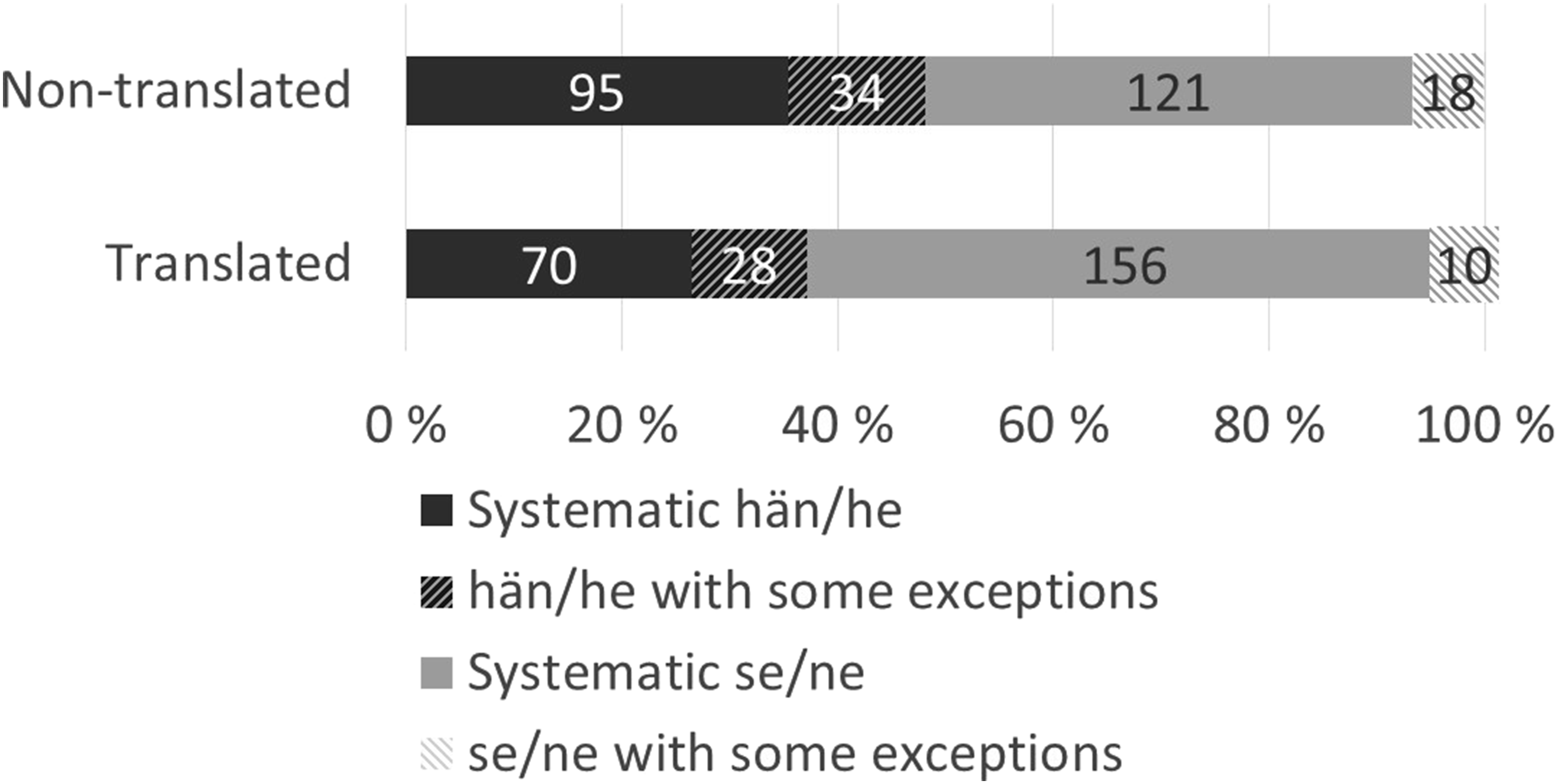
As already mentioned, the source languages of the translated books are English, German, Swedish and French, all languages in which the use of pronouns referring to animal characters differs from Finnish. Our analysis does not show significant differences between texts translated from different source languages. Notably, the datasets for the individual source languages were relatively small and would require a contrastive study to detect the differences related to source texts.
According to our data, the animal characters are as much anthropomorphised in translated books as in the books originally written in Finnish. Thus, the stronger preference for demonstrative pronouns in translated books cannot be explained for example, by cultural differences in depicting animals. The median value for both datasets is 4 (that is, the characters typically have four of the seven coded anthropomorphic features). No statistically significant difference can be found between original and translated Finnish books.
The anthropomorphism index turns out to be a relevant factor in explaining the variation in Finnish third-person pronoun references to animals: in both non-translated and translated books, the animals that are referred to using personal pronouns (hän, he) have more anthropomorphic features than characters referred to using demonstrative pronouns (se, ne). The median anthropomorphism index for personal pronoun references in both datasets is 5, for demonstrative references 4 in non-translated Finnish and 3 in translated Finnish. This means that the characters that are referred to by personal pronouns typically have five of the seven coded human features while those referred to with demonstrative pronouns only have three or four.
An example of a character with a low anthropomorphism index is the crocodile shown in Picture 1 from the book Krokotiili joka ei halunnut syödä (‘The crocodile that didn’t want to eat’
4
) written originally in Finnish by Ella Brigatti (2017). The crocodile has only one human-like characteristic, the ability to speak, and thus the anthropomorphism index for this book is 1. The crocodile and other animals are systematically referred to by demonstrative pronouns in this book. Ella Brigatti: Krokotiili joka ei halunnut syödä (‘The crocodile that didn’t want to eat’) 2017.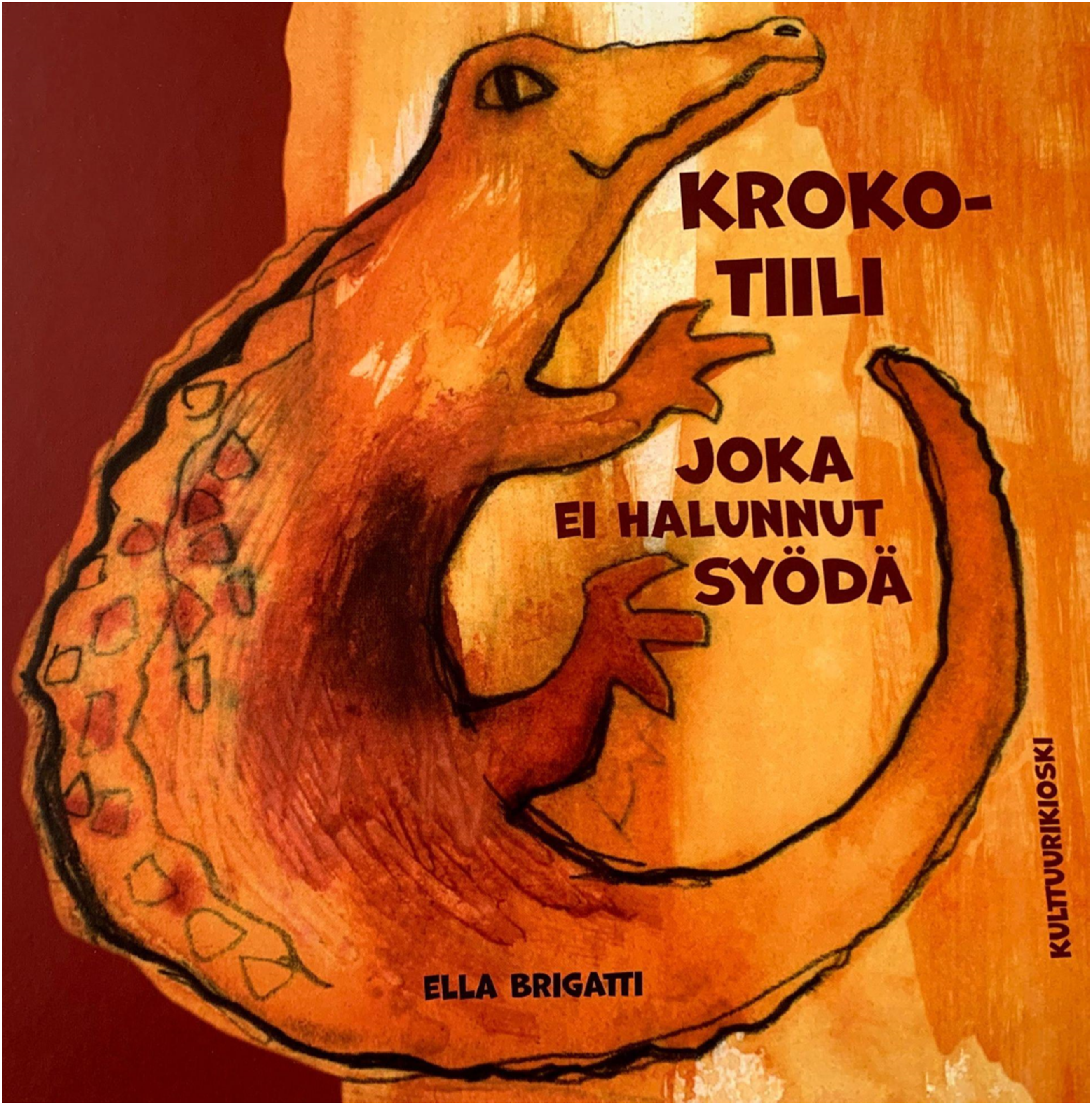
An example of strongly humanized animal characters (Picture 2) comes from the book Röh röh Pekka (Nöff nöff Benny [‘Oink oink Benny’]) by Barbro Lindgren and Olof Landström (2018), translated from Swedish into Finnish by Anna Warras. The pig-like characters live as a family in a human-like home, they talk and have names typical to humans, they wear clothes and walk on two feet. The only criteria they lack is a profession, as the main characters are presented as children, and thus, the anthropomorphism index for this book is 6. In this book, the pronoun choice does not display any variation. Barbro Lindgren and Olof Landström: Röh röh Pekka (Nöff nöff Benny [‘Oink oink Benny’]) 2018.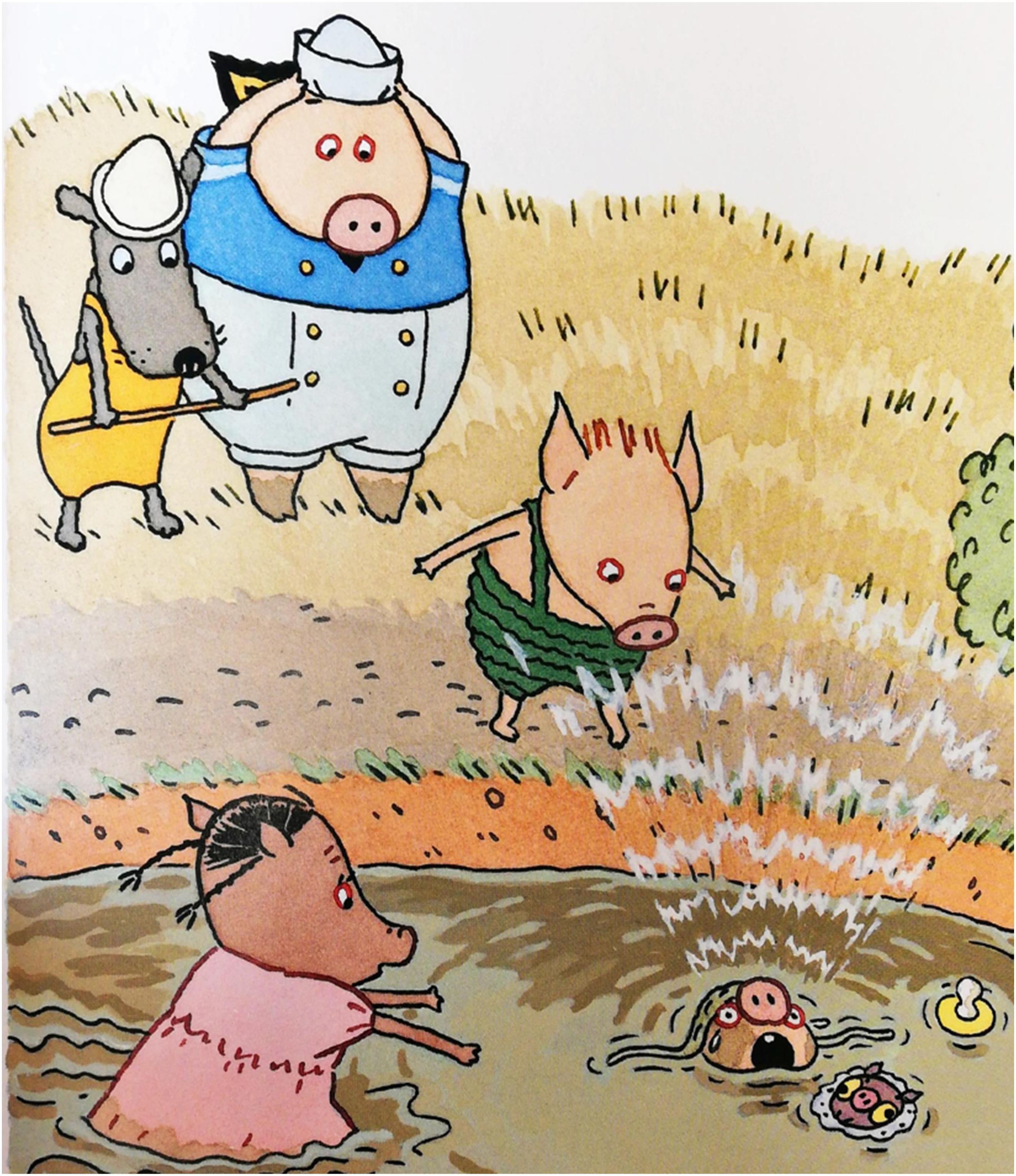
The example shown in Picture 2 reveals a need to further develop our anthropomorphism index, especially regarding the criterion of having an occupation. Some books in the database have characters described as children. In this case, of course, the characters do not yet have a profession. In addition to professions, criteria such as attending a school or nursery school or having a hobby could be considered. We estimate that child-like animal characters, for whom the occupation criterion is problematic, occur in approximately one-third of the books for which the occupation was coded as missing. Most of these characters are otherwise very human-like; thus, this shortcoming means that the index does not effectively separate characters scoring 6 or 7.
In translated books, the correlation between pronoun choice and anthropomorphic characteristics is even stronger than in non-translated books. The difference between the medians is statistically highly significant 5 in both datasets.
The quantitative results presented above show that the pronoun variation in children’s books does not result from transfer from the source languages (in our case English, German, French and Swedish) in which it is more common to refer to animals with personal pronouns than in Finnish. As has been shown in previous studies on Finnish translated texts (see Section 2.2), translators orient more strongly towards the Finnish Standard language norm than authors do. This is also the case in translated children’s books, in which the pronoun referring to animal characters is slightly more often a demonstrative pronoun than in non-translated books.
In books written originally in Finnish, there is more pronoun variation within the story. Personal and demonstrative pronouns alternate in both non-translated and translated texts, however, and in both text varieties the choice of pronoun is linked to the way in which the animal characters are portrayed as human- or animal-like agents. In translated books, this link is stronger, underlining the multimodal nature of picture book translation highlighted in translation studies (see e.g. Oittinen and Davies, 2008). Our result shows that translators rely both on the illustrations in the book and the clues in the story when deciding which pronoun to use for the characters. In the next section, we discuss the pronominal variation within the stories.
4.2. Qualitative analysis of book-internal pronoun variation
Overview of factors triggering pronominal variation.
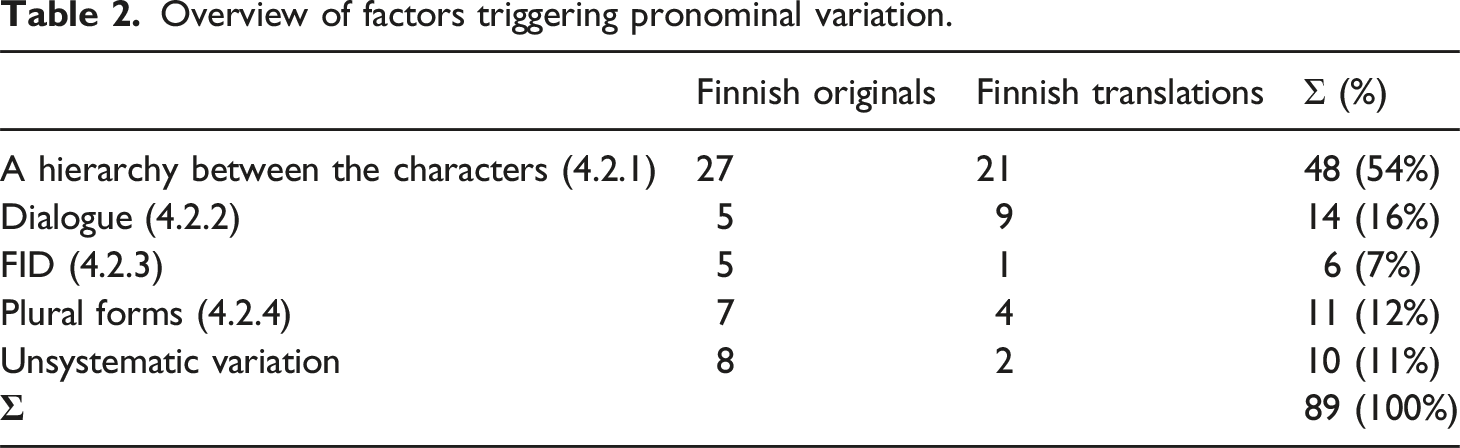
First, in 4.2.1, we describe cases in which different animal characters in the same story are systematically referred to by different pronouns, thus placing them in different categories and at different points in the anthropomorphism hierarchy. This is a fairly common strategy in the data, found in 48% (43) of all examined books with pronominal variation. Using personal pronouns is also connected to presenting characters as familiar and friendly. These perceptions can also change as the story progresses and the characters undergo physical or mental changes. More often, the characters’ attitudes towards others are expressed in dialogue, but the dialogue may also use pronouns differently than in the narrative text for other reasons. This kind of variation is found in 14 of the examined books, and it is discussed in Section 4.2.2.
In Section 4.2.3, we consider the occurrence of free indirect discourse, which, based on previous research, would be an expected explanation for the variation in pronouns in the literature. Specific issues related to plural forms are discussed in 4.2.4.
In a discussion of her own translation solutions, Kaski (2022) uses the example of a text whose source language does not distinguish between humans and non-humans. In order to strike a balance between a missing categorization and the norms of Standard Finnish, she has chosen to use personal and demonstrative pronouns interchangeably in her own translation. Since the Finnish language offers the possibility of using two different pronouns for animal characters with human features, we may assume that even in children’s books, authors and translators do not have an unambiguous intent behind choosing a particular pronoun option.
As we show in the following sections, the variation between personal and demonstrative pronouns can be difficult to explain. Nevertheless, variation is more common in original Finnish books than in Finnish translations. This suggests that Finnish authors utilize pronoun variation as a resource to express tone and emphasis. The lesser variation in translations, on the contrary, is a signal of their conventionality, as has already been noted in several previous studies (see 2.1 above).
In her study on pronominal references to humans in Finnish literature, Kasso (2017: 150–153) also noted that the pronoun choice is not always systematic even within a single book and the same author may use different variation techniques in different works. In the case of short stories such as picture books, it may be impossible, with the benefit of hindsight, to decipher what the underlying reason was for an author’s or a translator’s decision to use a particular pronoun. In the remaining 10 cases in Table 2, the pronominal variation is unsystematic and cannot be explained by the principles discussed in the following sections.
4.2.1. A hierarchy of characters
In 23 of the examined non-translated books and 18 of the translated books, there seems to be some sort of hierarchy between different characters which explains the variation in pronoun use: some characters are systematically referred to by personal pronouns, some by demonstrative pronouns.
In some cases, pronoun variation has a very straightforward connection to the degree of anthropomorphisation of characters. For example, in the Doghill (Koiramäki) book series by Mauri Kunnas the canine main characters are very human-like. They also keep pets and farm animals. The author and illustrator Mauri Kunnas said in a media interview (MTV 2018) that he thinks that the Doghill characters are not dogs but humans. The anthropomorphized dogs are referred to with personal pronouns, while less humanlike animal characters are referred to with demonstrative pronouns. Such a practice seems to be repeated in the books that we have by Kunnas in the material we examined.
Similar cases appear in translated books. For example in Oktonautit ja mököttäjäkala (The Octonauts and the frown fish), written and illustrated by design studio Meomi (2011) (Vicki Wong and Michael C. Murphy) and translated from English into Finnish by Tytti Träff, the Octonauts, who are the crew of an underwater base exploring the ocean and who represent several different animal species, are referred to by personal pronouns, while the other animals living in their natural environments in the sea and on the shore, such as fish and birds, are referred to by demonstrative pronouns. The example (1) illustrates this variation. In (1a), the Octonaut called Peso looks like a penguin but has many human-like features. He (in the original books Peso is male; in the Finnish translation, the gender is not expressed) can talk, he wears a hat and has a profession as a medic. The fish mentioned in (1b), in turn, does not have as many human features, even though, unlike a real fish, it can hold a drumstick. Picture 3 shows what the ‘frown fish’ and one of the Octonauts, a cat called Kwasii, look like. Meomi: Oktonautit ja mököttäjäkala (The Octonauts and the frown fish) 2011.
The English translations of the examples and the bolding in them are our own. As we mentioned in Section 2.1, the Finnish pronoun se is translated by its conventional counterpart it. To demonstrate the linguistic features of translated Finnish, the translation is ours even in those examples where the source text is English. (1) Meomi: Oktonautit ja mököttäjäkala (The Octonauts and the frown fish) 2011. a. ‘Minulle tulee aina hyvä mieli musiikista’, sanoi Peso ujosti. ‘Music always makes me feel good’,’ Peso said shyly. b. Ikävä kyllä mököttäjäkalalla ei tainnut olla sävelkorvaa. Unfortunately, the frown fish didn't seem to have an ear for music.
In picture books with this kind of divided practice, the pronoun variation supports the interpretation that some of the characters are genuinely depicted as animals, while others, despite their appearance, are rather meant to represent humans. We will reflect on this idea in more detail in the final section.
Laakso (2022: 72) highlights that mixing the categories of animal and human is a common way of feeding the imagination of young readers in children’s picture books, and it is one of the reasons why animal characters are so frequently found in this kind of literature. Humour is created through incongruence and the breaking of learned schemas when animals act in a human-like manner but retain their animal appearance and perhaps some of the characteristics typical of their species.
The categorical division may become absurd when animals are anthropomorphized. An example of playing with categories can be found in the book Aatu-possun uroteko (‘Labours of Aatu Pig’, originally La Crique de Por´zquen ‘Creek of Por´zquen’), written and illustrated by Armelle Boy (2008) and translated from French by Iisa Juva. At the beginning of the story, the animals live on a farm and do not wear clothes, and are referred to by demonstrative pronouns. When the animals go to the beach and dress in swimming costumes, the pronouns are switched to personal pronouns. The change in the referential device reflects a category shift: the animals change from animals to humans. This creates an impression of a kind of ‘secret life’ of the animals of which humans are unaware.
Sometimes the variation and changes in pronouns reflect degrees of familiarity rather than concrete human traits. For example, in the translation Jättiläisen jäljillä (from the German title Auf den Spuren des dicken Bumbu [‘In the footsteps of the fat Bumbu’], translated by Seija Kukkonen) by the author and illustrator Walko (2011), the main characters – a bunny and a bear – find weird tracks. The main characters are referred to by personal pronouns but the producer of the tracks with demonstrative pronouns. The pronoun choice reflects here the main characters’ attitude towards the minor character.
Similar practices are also found in non-translated Finnish books. For example, in Toivo ja hirveä hämähäkki (‘Toivo and a horrible spider’) by Riikka Jäntti (2009), a spider despised by the main characters, depicted as a squirrel, a hedgehog and a rat, is referred to by a demonstrative pronoun.
In two of the examined books, the change in pronoun use indicates a change from a less familiar character to a more familiar one. Simultaneously, the attitude of the main characters towards it becomes more positive. These books are Aamos ja jälkien arvoitus (‘Aamos and the riddle of the footprints’) by Anneli Kanto and Tuire Siiriäinen (2020) and Koira nimeltä Kissa tapaa kissan (‘Dog called Cat meets a cat’) by Tomi Kontio and Elina Warsta (2019), both written originally in Finnish. The example (2) comes from the latter. (2) Tomi Kontio & Elina Warsta: Koira nimeltä Kissa tapaa kissan (‘Dog called Cat meets a cat’) 2019. a. Kissa lähestyy. Ja lähestyy. The cat comes closer. And closer. b. Kissa kallistaa päätään, ensin vasemmalle ja sitten oikealle. Sininen taivas The cat tilts its head, first to the left and then to the right. The blue sky behind
In this story, an unknown cat is first referred to by the demonstrative pronoun se (2a), but when the main characters get to know it, the reference changes to the personal pronoun hän (2b). The cat and the dog (the latter is the narrator of the story) are similarly anthropomorphised, having, for instance, the ability to talk.
4.2.2. Pronouns in dialogue
The previous section dealt with pronouns appearing in the narrative text of a story. In our data, the picture books also include dialogue through which the authors create an illusion of real conversations, while the narrator fades into the background. However, the dialogue lines are always stylized in one way or another and do not correspond to actual spoken language (Rimmon-Kenan, 1983: 110).
Schwitalla and Tiittula (2009), who explore the linguistic features that distinguish the spoken and written mode, conclude that the devices can be completely unrelated in two languages and that direct equivalents matching each other are not necessarily available for translation (see also Tiittula and Nuolijärvi, 2013: 70). In Finnish literature, pronouns are an important way of signalling either a written, formal style or a colloquial impression in a text. The use of demonstrative pronouns for person referents is a feature of colloquial style that is commonly used in dialogues. It is also utilized in translated Finnish literature (Tiittula and Nuolijärvi, 2013: 264). In our data, the colloquial third person demonstrative pronouns are, however, used for person referents only in the non-translated part of the dataset.
In Postia pohjoisesta, Empo (‘Mail from the north, Empo’) by Pirkko Harainen and Ulla Virkamäki (2019), the demonstrative pronoun se is used (3) when the main characters talk about another character. In the narrative text, the personal pronouns are systematically used. (3) Pirkko Harainen & Ulla Virkamäki: Postia pohjoisesta, Empo (‘Mail from the north, Empo’) 2019. Sitten viestien tulo harvenee ja menee jopa viikko, ettei Paavosta kuulu mitään. Then the messages become less frequent and even a week goes by without hearing anything from Paavo.
In picture books featuring animal characters, there are other ways in which the use of pronouns in the dialogue differs from that of the narrative text. Variation between dialogue and narration is found in both Finnish originals and translations and in both directions: when there is a demonstrative pronoun in the narrative, there can be a personal pronoun for the same referent in the dialogue or vice versa.
When the personal pronoun in narration is in dialogue systematically changed to a demonstrative pronoun, the change creates the impression of spoken language, as shown above (3). When the change occurs in the other direction, that is, the demonstrative pronoun of the narration is changed to the personal pronoun in the dialogue, the shift indicates personification, as in (4).
The example (4) is from Kaneli Omenansiemen ja erityinen vieras: Kertomus ystävyydestä (Tilda Apfelkern und ein ganz besonderer Gast: Freundschaftsgeschichten [‘Tilda Appleseed and a special guest: A story about friendship’]), written and illustrated by Andreas H. Schmachtl (2016) and translated from German into Finnish by Maarit Varpu. In the narrative parts of this book, references take place with demonstrative pronouns. In the dialogues, on the contrary, when the animal characters talk about each other, they use personal pronouns – that is, they treat each other as persons. (4) Andreas H. Schmachtl: Kaneli Omenansiemen ja erityinen vieras: Kertomus ystävyydestä (Tilda Apfelkern und ein ganz besonderer Gast: Freundschaftsgeschichten [‘Tilda Appleseed and a special guest: A story about friendship’]), 2016. ‘Yleensä Sirppi kiinnittää lapun oveensa, kun ‘Usually Sirppi attaches a note to
Occasionally, the pronoun variation in dialogues occurs in both datasets, in Finnish originals and translations. As in narration (see Section 4.2.3), pronouns are also used in dialogue to express a certain attitude, for example anger or respect, towards the character being spoken about. While the occasional use of demonstrative pronouns in dialogue reflects a character’s negative attitude, such as the feeling of anger, the occasional use of personal pronouns brings a tone of respect and formality to the dialogue.
Siitonen’s (2008) and Priiki’s (2016) studies on language users’ perceptions show that Finnish speakers perceive the personal pronoun use in spoken language as referring to a person with whom the speaker has a distant but respectful relationship; the personal pronoun is considered a polite choice. Although the pronoun hän also has other functions in colloquial language, using it to show politeness and respect seems to be one of the resources that both Finnish writers and translators use in the dialogues of children’s books, thus passing on these language practices to juvenile readers.
4.2.3. Free indirect discourse
In 2.1, it was stated that, in colloquial Finnish, the typical context for the personal pronoun hän is indirect quoting and reporting of the thoughts and feelings of a third person. In addition (see also 2.1), the Finnish third-person pronoun variation can be linked to expressing free indirect discourse (for linguistic features and functions of FID in general, see Rimmon-Kenan 1983: 110–114).
Kaiser (2018) shows that in Finnish books featuring anthropomorphic animals, pronoun variation can be used to give ‘the reader a glimpse inside the mind of the animal’, as she expresses it (pp. 647). This kind of point-of-view technique is also used by writers who use colloquial person references in their works. According to Kasso (2017: 167), colloquial demonstrative pronoun use and the personal pronoun as a marker of the point of view also occur in works that otherwise follow the norms of Standard Finnish.
However, in our data, logophoricity or FID are not very common or even clear causes of variation. Logophoricity seems to be almost completely absent in our data. In the translations, we did not come across any examples where an indirect quote could be interpreted as the reason for using the pronoun hän. In the original Finnish books, there may be a tone of interpretation in a few passages (see Table 2), but no clear cases of using hän logophorically in indirect quotes were found.
With regard to FID, there are only 12 books in which the singular pronoun referring to one and the same character changes within the story from the pronoun se ‘it’ to the pronoun hän ‘she, he’, without a change in attitude towards the character or dialogue. In six of these, FID is a possible explanation.
The children’s picture books examined here are often quite short, and there are generally only a few pronoun references in the stories. It can be difficult to find a logical explanation for an occasional pronoun in a single story, as the use of personal pronouns in FID is by no means systematic in the data—the material includes a large amount of interpretation and empathy without pronoun variation. In a few passages, however, the use of the personal pronoun is justified by taking the point of view of a character or creating the impression of internal monologue.
Example (5) is from a translation (Barder et al., 2018) which contains the only clear case of an interpretive context as an explanation for the occurrence of an occasional personal pronoun. First, (5a) shows how the demonstrative pronoun is generally used in the story to refer to a humanized fish called Marina. In (5b), the systematic use of the demonstrative pronoun shifts to the use of a personal pronoun. The logophoric interpretation of the referent of the pronoun hän – that is, hän referring to the experiencer, the person from whose point of view the story is told – helps to identify the referential relations of the sentence correctly. (5) Gemma Barder, Ela Jarzabek, Robert Dunn & Emma Foster: Eläinsatuja (‘Animal stories’, originally My First Book of Animal Stories, translated by Sari Luhtanen) 2018. a. Marina uiskenteli valtameren syvyyksissä. Marina was swimming in the depths of the ocean. b. Marinan iloksi äidillä oli kaulassaan To Marina’s delight, mother was wearing the necklace
The fish Marina and her mother would be referred to by the same pronoun. Thus, as can be observed in the translation of the example (5b), the reference relations in the sentence – that is, who made the necklace – may be unclear. In Finnish, if the pronoun was the demonstrative se ‘it’ that is used elsewhere in this story, the reference point in (5b) would be unclear, as it could refer both to Marina and to the mother. The logophoric function of the pronoun hän is utilized in this story to make the reference clearer: it is more likely to be interpreted as referring to the person whose perspective and experience is being described, that is, Marina, who is delighted to see the jewellery around her mother’s neck.
Example (6) is from a book written originally in Finnish (Brigatti, 2020). In this case also, the pronoun hän refers occasionally to the main character when she is presented as an experiencer of emotions. (6a) exemplifies how the main character is typically referred to as se in this book; (6b) shows one of the occasions where the demonstrative pronoun changes to the pronoun hän. (6) Ella Brigatti: Amelie tahtoi lentää (‘Amelie wanted to fly’) 2020. a. Kun Amelie oli pieni, When Amelie was little, b. Amelie istui veneessään surullisena ja väsyneenä. Amelie sat in (her/its) boat, sad and tired.
In (6a), as in most parts of the story, the elephant called Amelie is referred to by the demonstrative pronoun se ‘it’. The passage describes Amelie’s actions. In (6b), in turn, Amelie feels sadness and tiredness. The sentence with the pronoun hän explains the reason for these feelings and can be perceived as a kind of indirect inner speech.
However, in this book, the pronoun hän is not used systematically in connection with the description of emotions. In many other passages, the demonstrative pronoun se is used in similar contexts, for example in the sentence Amelie toivoi, että jonain päivänä se voisi lentää taivaalla kuin pilvi ‘Amelie wished that 1 day it could fly in the sky like a cloud’. The sentence refers to Amelie’s thoughts, but in the quoted part, the pronoun is se, not hän.
In the previous example (5b), the logophoric use of the pronoun hän seemed to be triggered by the possibility of ambiguity in the pronoun reference within the context. In example (6b), there is also another target that is referred to by the demonstrative pronoun se ‘it’, namely the boat built by Amelie. This may indicate that the author had felt it appropriate to emphasize Amelie’s personhood by using a personal pronoun.
As Kaiser (2018) has shown, the logophoric function of the pronoun hän in spoken Finnish can also be found in written language as a resource that can be used, for example, to describe animal characters in children’s books. However, based on our large dataset, this phenomenon is not very common in children’s books, and it is more frequently used in books written originally in Finnish than in translated books.
4.2.4. Focalized plural references
Previous sections of this paper focused on the variation of singular pronouns. In children’s picture books, it is common for a story to feature a single protagonist. References to minor characters and plural references may be rare. However, the variation of plural forms in the data has peculiarities: plural pronouns follow a system of variation that is in some respects different from that of singular forms.
What is special about the variation of plural forms is that the group to which they refer can be composed of different characters humanized to different degrees. If two characters, one of whom is referred to in the story as hän and the other as se (see Section 4.2.1), are referred to together in plural, the human-form personal pronoun he ‘they.human’ is more typical than the non-human demonstrative pronoun ne ‘they.nonhuman’.
Some examples of this kind of practice are found in the Finnish original books. For example, in Lossi-Lassi etelänavalla (‘Ferry-Lassi at the South Pole’), written and illustrated by Anssi Keränen (2016), a heavily humanized bear character, Nepa, is referred to by the personal pronoun hän but a penguin in the wild by the demonstrative se. Together these two characters are he ‘they.human’.
According to Lappalainen and Priiki (2022), in spoken Finnish the occurrence of the personal pronoun he ‘they.human’ in plural references is clearly less frequent than that of the personal pronoun hän ‘he, she’ in singular references. Our data reveal a phenomenon that is remarkable in comparison with spoken language practice: in five books, two Finnish originals and three translations, the plural form of the personal pronoun, he ‘they.human’, is used, although in the singular all characters are referred to with the demonstrative pronoun se ‘it’.
Kasso’s (2017) analysis provides a possible explanation for this variation. She points out that the demonstrative pronoun ne ‘they.nonhuman’ is used when the point of reference is represented as a mass with indistinguishable individuals. Conversely, when the plural object is conceived as consisting of distinct individuals, the personal pronoun he ‘they.human’ is used (Kasso, 2017: 149–150).
Example (7) illustrates the different use of the singular and plural pronouns in the Finnish original Pikku-Tipun seikkailut (‘The adventures of Little Chick’) (Matilainen and Matilainen, 2018). Separately, both main characters, a chick and a dog, are referred to by the demonstrative pronoun se ‘it’ (7a), but when their actions together are described, they are referred to by the personal pronoun he ‘they.human’ (7b). (7) Aki Matilainen & Irmeli Matilainen: Pikku-Tipun seikkailut (‘The adventures of Little Chick’) 2018. a. Eräänä aamuna Pikku-Tipu heräsi kummalliseen meteliin. One morning, Little Chick woke up to a strange noise. b. Ensin First,
Similar usage is also found in the translations. In Kalle-karhun uusi ystävä (Bear’s New Friend by Karma Wilson and Jane Chapman (2017), translated by Sanna Niemi), a bear called Kalle and his friend, a mouse, are both referred to by the demonstrative pronoun se in singular, but together in plural by the personal pronoun he.
As we noted above, plural references are relatively infrequent in children’s picture books, and one short book rarely contains plural forms referring to different groups. Therefore, Kasso’s (2017) observation that different plural pronouns have differentiated functions is difficult to verify from our data. The examples above, however, seem to be compatible with her observations: the points of reference are pairs of two central characters, and the personal pronoun he highlights their individuality.
There are also two examples of variation in the other direction between singular and plural, so that in the singular, the characters are referred to by the personal pronoun hän but in the plural by the demonstrative pronoun ne. Kasso’s idea of focalized plural forms is supported by these examples: the plural of the demonstrative pronoun refers to an indefinite set of animals – in contrast to the pairs of protagonists. In addition, the examples also have a negative connotation, as the crowds described behave in a malicious manner. Example (8) describes an elephant called Heidi who is being bullied by other elephants (Nummi and Kinnunen, 2005). (8) Markus Nummi & Kati Kinnunen: Hiiri joka päätti olla norsu (‘A mouse that decided to be an elephant’) 2005. Heidikin yritti, mutta juuttui heti renkaaseen. Muut nauroivat Heidi also tried, but immediately got stuck in the hoop. The others laughed at
In the same book, there is another corresponding context in which the bullies are a group of mice, and there too the pronoun is the demonstrative pronoun ne ‘they.nonhuman’. As can be seen from example (8), in the singular the personal pronoun is hän. In the plural, the personal and demonstrative pronouns alternate.
5. Conclusion and discussion
In this article, we have looked at third-person personal and demonstrative pronouns referring to animal characters in 531 contemporary Finnish-language children’s picture books, analysing both books originally written in Finnish and translations into Finnish. The starting point of the analysis was the variation in the Finnish pronominal system that enables authors and translators to utilize the pronouns as a linguistic device for the representation of the animal characters either as more human- or animal-like.
In children’s literature, the animal characters have multiple pedagogic and other functions, a property which, together with the illustrations situate them between the categories of human and animal. Although they may have the external characteristics of animals, they can behave to a large extent like humans.
In the analysed children’s books, this duality is reflected in the choice of pronoun. In about half of the data (227 books, 42.7%), the most frequent pronoun was the personal pronoun hän (‘s/he’), indicating a human-like representation of the animal character. In the other half (304 books, 57.3%), the demonstrative pronoun se (it) was used in order to signal that the animal figure was treated as an animal.
In the quantitative analysis, we considered both the illustrations and the texts of the books in order to calculate an ‘anthropomorphism index’, a degree of human features of the characters, and to identify whether there was a dependency between the presented features of the animal characters and the choice of pronouns referring to them. Although explicit coding of human-like features was difficult in some cases, the anthropomorphism index indicated a correlation. Characters with a higher index value, —that is, possessing more human features—are more likely to be referred to by personal pronouns. This correlation is even stronger in translations than in original Finnish books, a result which underlines the multimodal nature of picture book translation repeatedly emphasized in translation studies.
Although the use of pronouns turned out to be largely similar in both subsets of our data, some important differences could be recognized between non-translated and translated texts. Firstly, translators were shown to be more faithful to Standard Finnish pronoun norms than Finnish authors: the translated books comply more often with the Standard language norm and refer to the animal characters more systematically with the demonstrative pronoun. In this respect, the translated picture books follow the findings of previous corpus linguistic studies, according to which lower variation, conventionality and stronger conformity to norms are typical features of translated texts. No source language influence was, however, observed in the data which entailed translations from English, German, Swedish and French. In this study, we did not aim to conduct a contrastive study between source texts and Finnish translations, and the potential impact of the source texts requires investigation in further studies.
Most of the books (442, 83.2%) in our data proved to be systematic in their use of pronouns and utilized either personal or demonstrative pronouns when referring to animal characters. However, there was also book-internal variation (89 books, 16.8% of the data), either in that the personal and demonstrative pronouns referred to different characters or that different pronouns referred to the same character at different points in the story. This book-internal variation was shown to be more common in non-translated texts, which is a result that is compatible with previous corpus linguistic studies on normalization in translated texts.
A palette of diverse factors was shown to trigger the variation. The most frequent factor was the hierarchy created between the characters by the use of different pronouns, the more human-like ones referred to by personal pronouns and the more animal-like ones by demonstrative pronouns. The highly anthropomorphized characters raise the question as to whether they are perceived as animals at all, or whether they are rather seen as human beings with some animal features in their appearance. As Flynn (2004) points out, some authors use animal characters mainly as substitutes for human figures. According to Pittock (1994: 167), children do recognize the anthropomorphized animals as a literary convention, understanding that animals do not really behave in such a human-like manner.
Anthropomorphism and pronoun choice were also linked to values and attitudes—the ‘human’ personal pronoun implying personhood, politeness and familiarity, and the ‘animal’ demonstrative pronoun otherness and strangeness. Fear or anger expressed by the characters as well as closeness and respect were also reflected through the choice of pronoun. Typically, pronoun variation of this kind occurred in dialogue, but in some books in narration as well. In dialogue, a pronoun different from narration could be used in a completely systematic way, either to emphasize the colloquial nature of the dialogue or the fact that the animal characters treated each other as persons, not as animals.
In Finnish literary fiction, pronouns are a key means of expressing free indirect discourse. In the short picture books of our data, it was, however, possible to identify only a few instances where the variation was clearly related to indirect mediation of a character’s thoughts. In the case of plural forms of pronoun variation, in turn, we could show how the variation was influenced by another phenomenon reported in earlier studies on literary language, where the pronoun choice depends on whether the characters are perceived as separate individuals or as an indefinite mass.
For both FID and focalized plurals, we recommend that future research analyse longer texts rather than picture books, as both the number of individual pronouns and the variation of pronouns is low in them. Alternatively, focusing on the works of selected authors or translators more broadly would give a better picture than the corpus we examined. What is also missing from our analysis are interviews with authors and translators. How do they see the norms of the Finnish language and how do they justify their choice of pronouns?
All in all, our analysis, with its comprehensive corpus, complements previous research on children’s books, on the one hand by clarifying the role and representation of animal characters, and on the other hand by providing practical information for authors, translators and editors on the linguistic features of these books. Xia (2014), who diachronically examined normalization in Chinese translations of English children’s literature, observed that the tendency towards normalization is stronger in more recent translations.
In the future, it would be interesting to carry out a comparative study of original and translated Finnish children’s literature and to investigate whether the use of pronouns and the linguistic representation of animal characters differs between different eras. In which roles are various species portrayed in different periods? The role of real animals in Western societies has undergone significant changes over the last 100 years. Some non-humans have been elevated to human companions, family members, and consumers, while others have been reduced to the role of goods through the intensive production of food of animal origin. Wild animal species, in turn, are affected by climate change and ecological disasters. Children’s picture books are a special genre that has a major impact on how growing new generations acquire language and understand the world. The study of pronouns referring to animal characters is therefore not only a study of language and literature, but also of how the role of animals themselves is perceived.
Footnotes
Acknowledgements
We would like to express special thanks to our research assistants Maisa Heikura, Leo Köninki and Linda Sirkiä for their invaluable help in collecting and coding the database.
Declaration of conflicting interests
The author(s) declared no potential conflicts of interest with respect to the research, authorship, and/or publication of this article.
Funding
The author(s) disclosed receipt of the following financial support for the research, authorship, and/or publication of this article: Priiki’s research of this article was supported by the Finnish Cultural Foundation and the Research Council of Finland (project number 348899).
