



Abstract
The study of linguistic variation in fiction often concerns the use of dialect features as a tool for characterization; however, its use in situating the author in the construction of the text is less remarked upon. This paper considers both of these uses by examining Lemony Snicket’s usage of four sociolinguistic variables in A Series of Unfortunate Events. ASOUE is of particular interest because it is metafictional, yet as a work of children’s literature has a didactic role in teaching its audience the importance of being well-read. I show that depending on the variable, variation in the dialogue may involve reflection of the author’s language-internal constraints, adherence to a prescriptive norm, or style shifting to distinguish protagonists and antagonists from one another. I argue that these three patterns of variability help to position Snicket as a character within the metafictional series while demonstrating ‘correct’ language usage to readers.
1. Introduction
The study of stylistics has quite often overlapped with that of sociolinguistics. One such area in which these two fields have overlapped is the study of linguistic variation in literature, particularly with respect to the use of dialect features in literary dialogue (Antieau, 2001; Burkette, 2001; Tamasi, 2001). In this context, the usual focus is on how these features are used for characterizing figures with respect to macro-social categories such as region, class, and ethnicity (e.g., Culpeper, 2001; Genette, 1980; Kretzschmar, 2001). Research into this usage often asks whether the author’s use of dialect features is authentic. Are the features and usage rates an accurate representation of linguistic production within the community that a character is written to be a member of (Dynel, 2011; Gardner-Chloros and Weston, 2015; Lambert, 2008)? Does the author’s usage align with positioning themselves as a member of a particular community (see Duncan’s (2017) discussion of country music)? This framing of research into linguistic variation has drawn critique for emphasizing the artificiality present in fiction writing (Stamou, 2014) and setting aside further social meaning of the variation (Stockwell, 2020) as well as the question of what constitutes appropriate usage within the form and society at large (Hodson and Broadhead, 2013).
An additional issue is simply that not all sociolinguistic variables are clearly linked to a macro-social category such as region. Yet this variation may carry social meaning (Moore, 2012); variable usage and the use of specific variants can index, or be associated with, a wide assortment of particular meanings (Eckert, 2008; Johnstone et al., 2006; Silverstein, 2003). In natural speech, speakers can draw on these indexical links between form and social meaning to position themselves within a conversation, stylize their speech and agentively convey social meaning.
In this paper, I suggest that particularly because of the nature of producing mediated language for an audience (Coupland, 2009; Coupland, 2011) an author may do the same through the deployment of linguistic variation in their writing. In this sense, even literature ostensibly in a standardized English variety may yet utilize variation for characterization or other purposes. This point effectively expands upon views of foregrounding as inclusive of linguistic usage deviating from a norm (Gregoriou, 2023; Van Peer et al., 2021). Whereas this may usually be seen in individual, highly salient divergences from usual usage, here I suggest that probabilistic differences in usage over the whole of a text may achieve a similar effect.
To this end, I use the toolkit of variationist sociolinguistics to explore variation in an author’s work. I use the dialogue in Lemony Snicket’s A Series of Unfortunate Events (Snicket, 1999–2006), a metafictional series of thirteen children’s novels, as a case study. In this series, there are clear, within-story social differences between characters. Given this, I examine whether Snicket uses four common sociolinguistic variables present in standardized English varieties to index these social differences and place characters into their fictional social categories. The results are mixed; while two variables do appear to distinguish character groups, the others show evidence of overt editing, as well as Snicket’s internal grammatical constraints. I suggest that by socially constraining variation with respect to fictional categories, Snicket takes up the didactic role of children’s literature writing (Burke and Coats, 2022) at least in part by modeling ‘correct’ language use to the reader. At the same time, I argue, echoing Toolan (1992) and Cooper (1994), that these results reflect Snicket’s positioning of himself as a character within the fictional setting and framing of the metafiction more generally. Given the mixed results, I call for further research using this approach into work across a larger range of authors and genres so that we may better understand the extent to which authors deploy stylized variability in their work.
2. Style shifting from a quantitative perspective
Before introducing the case study and data, I outline in brief the research framework of variationist sociolinguistics and discuss how style may be analyzed in this framework. Based on this, I discuss different ways of viewing fictional direct speech dialogue as sociolinguistic data. I suggest that these different views of dialogue as data correspond to different variation patterns, which means that analysis of variation in dialogue provides information about how the author approaches the text.
2.1. Style in variationist sociolinguistics
Variationist sociolinguistics is concerned with the ordered structure present in linguistic variation (Weinreich et al., 1968). As such, this mode of analysis pays particular attention to the relative frequency at which one variant of a linguistic feature or another (e.g., use of will vs be going to to express the English future) is used within a community. This variability is structured both by language-internal factors—aspects of the language itself—and language-external factors—aspects of social structure and/or speakers’ cognition, including speech style—that interact with the feature. For example, in English, word-final consonant clusters ending in /t/ or /d/ variably delete this sound. This variability is strongly influenced by the language-internal factor of the morphological status of the lexical item ending in the consonant cluster. The sound is deleted more often when used as a regular past tense affix than when it ends a monomorphemic item (Guy, 1991). The pronunciation of the English -ing affix, meanwhile, shows clear language-external influences in addition to language-internal influences. For example, Trudgill (1974) found in Norwich, UK, that working-class speakers were more likely to pronounce the affix with a final /n/ than middle-class speakers.
The factors that structure language variation are usually taken to be independent of one another (Labov, 1966/2006). As a language-external factor, speech style is thus one of these ostensibly independent factors. While initially conceived of as a distinction between careful and casual speech contexts (Labov, 1966/2006), it is well-known that speech style can be more agentive as well. For example, a speaker may change the relative rate at which they use a particular variant out of awareness of the expectations of their immediate or desired audience (Bell, 1984). Likewise, a speaker may style shift in order to perform or comment on an identity (Johnstone, 2011).
Because speech style is taken to be an independent factor that structures language variation, this would typically appear in variation data as a difference in the rate at which a variant is used by an individual between speech contexts, e.g., political speech versus interview speech (Holliday, 2017) or speech versus sung performance (Duncan, 2017). However, speakers who engage in agentive style shifting appear to target a particular variant regardless of linguistic context. For example, Guy and Cutler (2011) note that white New Yorkers who are part of the hip-hop community and presenting themselves as such do not have the typical morphological effects when deleting /t, d/ from word-final consonant clusters. Instead, these speakers delete /t, d/ at an increased rate while lessening the relative difference in deletion rate between monomorphemic lexical items and regular past tense verbs. Guy and Cutler (2011) suggest that this pattern occurs because the speakers are targeting more deletion overall and effectively hypercorrecting this increased rate across contexts. These results therefore suggest that cases of agentive style shifting will be evident in variation data as an interaction between speech context and language-internal factors: a speaker’s stylized target will display less between-context variability than their non-stylized speech.
2.2. What kind of data is dialogue?
In the following sections, I will be analyzing fictional dialogue from a variationist sociolinguistic perspective. Given how variation data and speech style are treated in this framework, it is worth outlining different patterns we may see in dialogue data, and what these patterns would indicate about the text. Although ‘dialogue’ may constitute a range of modes of speech and thought presentation (Leech and Short, 2007), here I am primarily concerned with direct speech. There is of course a degree to which any speech and thought presentation is only an imitation of spoken language (Genette, 1980; Leech and Short, 2007). However, the direct and free direct speech (insofar as it can be attributed to a specific character) inside quotation marks is most similar to spoken language. In this sense, a variationist analysis of (free) direct speech dialogue can be evaluated more along the lines of a variationist analysis of spoken language than an analysis of other modes of speech and thought presentation.
Within direct speech, I suggest that there are four general patterns we may see: variation structured solely by language-internal factors, variation structured with an interaction between language-internal factors and language-external factors, a lack of variation, and variation structured by independent language-internal and -external factors. In the context of appearing in literary dialogue, I argue that these four patterns indicate the kind of data represented by the text as well as the author’s language use. In this sense, a variationist analysis of literary direct speech dialogue can shed important light on an author’s approach to writing the text.
The first three of these patterns are found in direct speech dialogue constituting a corpus of text by a single speaker. In this sense, the text is written by a single author, and the direct speech dialogue in the text is simply utterances by that author. However, that author’s utterances may indicate different approaches to language use. One possibility is that the utterances show significant influences of language-internal factors only. This would reflect the author writing direct speech dialogue using the grammatical constraints on variation in their own idiolect. For example, Poplack and Malvar (2007: 155) show that popular plays written in Brazilian Portuguese show similar usage rates and the same constraints on production of the future as appear in recorded informal speech. This suggests that authors of these plays rely on their own language-internal constraints in writing direct speech dialogue.
An alternative approach to usage involves the appearance of an interaction between language-internal and -external factors. In this sense, the author is distinguishing a character or set of characters from others based on a social category. However, because this social distinction is made within a set of utterances by a single speaker, we can think of different social categories as different speech contexts. As such, this practice would constitute style shifting; the author changes style from one character group to another. Following Guy and Cutler (2011), we would expect to see an interaction between the social category and language-internal factor(s) as opposed to independent language-internal and -external factors. A final possible pattern of language use within a single-speaker corpus of direct speech dialogue concerns the nature of written text. As a mediated and editable form of communication, an author has a greater deal of control over the final text than an informal speaker does over conversational speech (cf. Coupland’s (2011) discussion of popular music). While this heightened awareness and control could lead an author to style shift in order to distinguish characters, it also makes it more likely that an author is aware of prescriptive grammatical norms while writing. As such, this final possibility is that the author shows heightened sensitivity to prescriptive norms and has edited the text to reflect this sensitivity. This may involve a shift towards or away from such norms, but in either case an overall lack of variation involving nearer-to-categorical usage of a variant than would otherwise be seen in informal speech would be indicative of clear editing of the text. 1
While the three patterns discussed above may indicate that the text should be treated as a set of utterances by a single speaker, an alternative view of the text would be to treat each character as a separate speaker. In this sense, while there is one author overall, it may be possible to view the text as a corpus of direct speech utterances by many speakers. There is one clear pattern which would indicate this; any variation would need to be constrained both by language-internal and -external factors independently of one another. This certainly seems possible, as evidenced by Old Norse sagas, which show clear effects of character gender on usage of sentential negatives (Blaxter, 2015).
3. Case study: A Series of Unfortunate Events
This paper uses A Series of Unfortunate Events (ASOUE, Snicket, 1999–2006) as a case study for exploring the use of morphosyntactic variation in fictional dialogue. This metafictional series of thirteen children’s books was written by Daniel Handler under the penname of Lemony Snicket. 2 The series on the whole makes use of multiple metafictive techniques, most notably including the use of an obtrusive narrator and the dramatization of the reader (Wydrzynska, 2023). More generally, it involves frequent narrative metalepsis (Genette, 1980). Metafictive techniques are not infrequent in children’s literature (McCallum, 1996; Wydrzynska, 2023), and can be quite complex. Wydrzynska (2023) explores this in Pseudonymous Bosch’s The Secret Series in particular detail, noting significant parallels to ASOUE. In order to maintain a focus on the author’s utilization of sociolinguistic variation, I intentionally limit my discussion of the metafictive writing to elements that particularly bear on this issue. As such, I will not cover the full complexity of metafictive techniques in the series.
ASOUE follows the travails of the Baudelaire siblings in the aftermath of a fire that left them orphaned. The series is ambiguous as to the setting and time period in which the books take place. 3 The Baudelaire siblings are apparently from a high-status background, as they are heirs to a large fortune and lived in a mansion prior to the fire. Over the course of ASOUE, the Baudelaires encounter a mysterious organization called VFD, which prior to the events of the series suffered a schism into ‘Noble’ and ‘Treacherous’ camps. Regardless of whether a character is explicitly a member of VFD, most allies to the children (and, by the end of the series, the Baudelaires themselves) are aligned with the Noble side of the schism, while antagonists are largely associated with the Treacherous side of the schism. Both the didactic nature of children’s literature (Burke and Coats, 2022; Hermansson, 2018) and the construction of Snicket as a character within the invented world of the series (Austin, 2013; Hermansson, 2018; Iglesias-Plester, 2020; McGee, 2010; Russell, 2010) make these texts particularly strong candidates for the kind of study conducted here.
3.1. Being well-read as a virtue
Children’s literature often involves the author using the text to teach a lesson to their audience (Burke and Coats, 2022). One such lesson may be moral; in part because ASOUE deconstructs a binary of good/evil (Langbauer, 2007) the series has been argued to be overtly opposed to this goal (Russell, 2010). However, one clear way in which ASOUE takes up the didactic role of children’s literature is through framing Noble and Treacherous characters through their love of reading (Hermannsson, 2018). Noble characters quite consistently are well-read, while Treacherous characters dislike reading and devalue expertise. As Langbauer (2007: 508) notes, ‘The value of reading and writing may be the most unironized, the least intentionally destabilized, in Handler’s series’. Snicket turns this distinction into an overt moral stance, voiced both by characters (1) and himself (2): 1. I know that having a good vocabulary doesn’t guarantee that I’m a good person, but it does mean I’ve read a great deal. And in my experience, 2. The burning of a book is a sad, sad sight…When someone is burning a book, they are showing utter contempt for all of the thinking that produced its ideas, all of the labor that went into its words and sentences, and all of the trouble that befell the author… (Snicket, 2005: 324)
The use of reading habits to distinguish good/evil characters extends to a broader stance surrounding language. For example, the ally to the Baudelaires encountered in The Wide Window, Aunt Josephine, has a strong interest in prescriptively correct grammar and punctuation and corrects what she perceives as grammatical errors in other characters’ speech. In a key plot point, she leaves the children a coded message, which they decode by correcting intentional grammatical errors that she deliberately inserted into the text (Snicket, 2000: 112–116). Before the children realize the message is coded, they initially assume that the primary antagonist, Count Olaf, wrote the message due to these errors (Snicket, 2000: 77–78). This assumption is not entirely unfounded, as Olaf was shown to use it’s for its earlier in the novel (Snicket, 2000: 50–51). Similarly, when Olaf and the children are forced to work together to open a text-based lock in The Penultimate Peril, the importance of correctly spelling the passcode is emphasized. Like in The Wide Window, in The Penultimate Peril Olaf is shown not to have mastered spelling norms as he does not know how to spell the word poison (Snicket, 2005: 308). Although Snicket is aware that a character such as Aunt Josephine takes a concern with prescriptivism to an extreme, being well-read, in his portrayal, nevertheless appears to coincide with a familiarity with prescriptive spelling and grammatical rules. At the same time, instances such as Olaf’s errors appear to foreground his role as antagonist through his deviation from prescriptive grammatical norms (Gregoriou, 2023).
In addition to the overt discussion of grammatical norms that appears in the novels, one way of teaching young readers correct language usage could be through modeling it. It is already clear that ASOUE takes up the didactic role of children’s literature in explicitly promoting reading, including through defining terms for the reader in the prose (Hermansson, 2018). Furthermore, metafictional devices in children’s literature help teach children ‘how’ to read, including strategies and literary codes (McCallum, 1996). In this sense, ASOUE is well-positioned to teach children about language and language usage. We have seen as well that this didactic role is extended to specific examples of what constitutes ‘correct’ spelling and grammar. As such, we might expect this teaching of language and correctness to be reflected in character dialogue. In this sense we may hypothesize that Noble characters, in keeping with being well-read individuals with a strong mastery of language usage, will use prescriptively correct linguistic variants more often than Treacherous characters, who do not value ‘proper’ language use. In other words, while any one instance of a grammatical feature may not provide evidence for it, the treachery of antagonistic characters may be foregrounded through flouting prescriptive norms when considering the work in its entirety (Gregoriou, 2023; Van Peer et al., 2021). This hypothesis inverts a question that Reynolds (2011: 1) notes is sometimes asked outside of academia regarding the suitability of a text for children: ‘Will grammatically incorrect or colloquial language or writing that includes swearing or abusive language or experimental writing counteract lessons taught in school or instil bad habits?’. Rather than model poor behavior, might associating such linguistic forms with poor behavior mediate a hegemonic cultural/sociolinguistic norm (cf. McCallum, 1997; Teubert, 2024)?
3.2. Snicket the character
In the context of ASOUE, Lemony Snicket is more than a penname; he is constructed as a character within the series who exists externally to the story (Austin, 2013; Hermansson, 2018; Iglesias-Plester, 2020; McGee, 2010; Russell, 2010). In this sense, he exists both as the internal and external author of the series (Currie, 2010; see also Wydrzynska, 2023 for additional examples in children’s literature). One way in which this is made clear to readers is through characters in the series being familiar with him (Austin, 2013). For example, the Baudelaires have read about and seen photographs of the author (3–6). Likewise, adult characters in the series, such as Captain Widdershins in The Grim Grotto, explicitly mention knowing the author to the children (7–8). 3. And on this page, it reads, ‘In photographs, and in each public place, Snicket rarely shows his face’. (Snicket, 2001: 75) 4. Standing next to Jacques was a man who was turned away from the camera, so the children could not see his face, only one of his hands, which was clutching a notebook and pen, as if the obscured man were a writer of some sort. (Snicket, 2001: 108). 5. Kit, of course, is the sister of… (Snicket, 2006: 209) 6. Lemony? They would have named me Lemony? Where did they get that idea? (Snicket, 2006: Chapter Fourteen 2) 7. Aye, and then what’s-his-name, Jacques’s brother. (Snicket, 2004: 43) 8. …The third sibling, with the marmosets— (Snicket, 2004: 99)
In addition to other characters referring to Snicket, in The Penultimate Peril the Baudelaires meet an unnamed man who is implied to be the author (Snicket, 2005: 244–252).
4
The way characters interact (however obliquely) with Snicket places him actively on the Noble side of the VFD schism. His asides to the reader also suggest he is Noble. For example, he writes of his own fear of two villainous characters (9): 9. And even I, after all this time, can feel their aura of menace so strongly, just by writing about these two people, that I dare not say their names… (Snicket, 2003: 123)
Another way in which Snicket is constructed as a character is that he frequently breaks the fourth wall by dramatizing the role of the reader (cf. Wydrzynska, 2023), making direct appeals to the reader to cease reading, defining terms for the reader, and describing his own actions. He is framed as writing the text after conducting research into the events of the series (Hermansson, 2018). As Iglesias-Plester (2020: 652) notes, this makes Snicket an unreliable narrator: all the reader knows is what he has uncovered in his research and his interpretation of the data.
Beyond this, Snicket’s construction as a person extends to the novels’ front and end matter, beyond simply being credited as the author. Each novel is dedicated to a Beatrice, revealed in The End to be the Baudelaires’ mother. More curiously, Snicket is in constant conversation with his editor and publisher, as the first twelve novels end with a communique directing the editor where to find the next installment in the series (see Iglesias-Plester, 2020 for further discussion). This communication occasionally occurs within the text as well. For example, Russell (2010: 33) notes that in The Wide Window (Snicket, 2000: 145–146), in the course of describing a scene in which the Baudelaires steal a boat and sail it in a hurricane, Snicket discusses a need to ‘mollify the publishers’ when overtly telling readers not to imitate the Baudelaires’ actions.
The way in which Snicket is constructed as the author/narrator of ASOUE makes overt that the text has been constructed and heavily mediated. After all, if the text is a research output compiled after the events of the story, the author was not present as they occurred. In this sense, any dialogue between characters is Snicket’s reconstruction or imagination of a conversation. At the same time, overt communication between Snicket and his editor calls attention to the point that the writing has been revised by the author and others. The near-explicit construction and mediation of the text is not a surprise in and of itself, as metafiction calls attention to the fact that the text was written by someone (Austin, 2013; Langbauer, 2007). However, the nature of the text may be of additional interest with respect to linguistic variation. In effect, it is more clear in ASOUE than in other texts that any character dialogue is written by a single character. If there is variation present (that is, if the overt editing of the text has not homogenized usage patterns), we would expect it to follow Snicket’s (i.e., Daniel Handler’s), own internal constraints. At the same time, that Snicket is himself on the Noble side of the VFD schism suggests that he may favor prescriptive norms while potentially stylizing dialogue uttered by Treacherous characters.
4. Methods
In this section, I describe the methodological approach as well as the specific sociolinguistic variables to be analyzed. I first outline the general approach and variables, before proceeding in subsequent subsections to give further background on factors which influence variation for each variable. In these subsections, I use this background to outline the specific treatment of each sociolinguistic variable.
Broadly speaking, most dialogue in ASOUE is direct speech, with little indirect speech or thought. Given this, as well as the previously discussed focus on direct speech for the purposes of variationist analysis, dialogue was extracted from the thirteen novels in ASOUE (Snicket, 1999–2006) on the basis of appearing in quotation marks.
5
This yielded a corpus of approximately 176,000 words that matches lines of dialogue to the characters who uttered them. The vast majority of this corpus consists of direct reported speech. Free direct speech occurs rarely, typically when unnamed members of a crowd are speaking. Direct thoughts are likewise rare. While free direct speech and direct thought are included in the corpus due to how the data was extracted from the text, they occur seldomly enough that the results reported in section 5 can safely be taken to represent direct speech. From here, the corpus could be searched for morphosyntactic variables. Because the Noble/Treacherous divide between characters is described as, among other things, a matter of being ‘well-read’, I initially searched for variables with clear prescriptive or formal norms. These included use of whom rather than who in object position, shall to indicate the future, and 10. We
Frequency of selected prescribed variants in ASOUE.
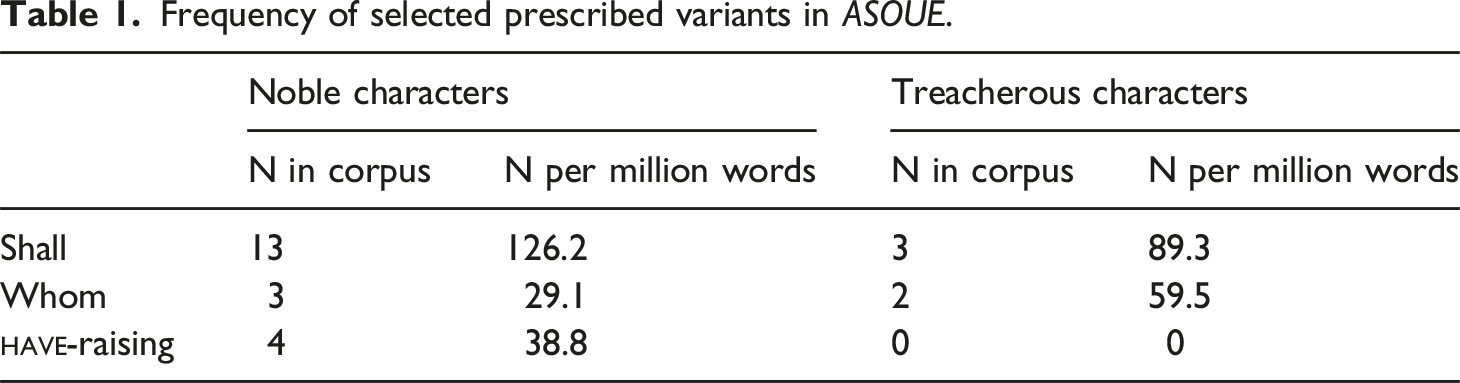
To obtain sufficient data, I instead analyze usage of four morphosyntactic variables which are reasonably common in spoken language and well-described in the variationist literature: usage of -body/-one in quantified pronouns, object relativizer deletion, subject relativizer form and complementizer that deletion (11–14). While not all of these variables have prescriptively normative ‘correct’ variants, there generally is a variant which English speakers take to at least be more formal (and potentially more correct) than the other(s). In this sense, the selected variables are comparable to those initially searched for above in that they reflect a formal/informal, and by extension correct/incorrect, distinction. While the variants fall along the same continuum as that for shall, whom, and 11. We’re not trying to trick 12. You are going to play the young woman 13. The lady 14. I think
For each variable, tokens were coded for language-internal factors, which may influence which variant surfaces, and the social categorization of the character uttering the line in which the token was found. Social categorization was coded in the same way for all variables: the
4.1. -body/-one
This variable concerns the ending of pronouns quantified with any, no, some, and every. Such pronouns vary between -body and -one endings in both UK Englishes and settler colonial varieties. Among these communities, there is a trend of change towards usage of -one (D’Arcy et al., 2013; Jankowski and Tagliamonte, 2021). In this sense, -body is the conservative variant, associated with older rural speakers (Jankowski and Tagliamonte, 2021). D’Arcy et al. (2013) suggest that -one is effectively the prescriptive norm as it is the more common variant in formal writing. Although regions differ with respect to the exact rates of usage, there are broad similarities in influences on usage. The specific 15. a. I’ll get someone b. I’d like to see someone thrown into the pit. (modifier absent)
In keeping with these previous results, I code the -body/-one data for the quantifier and presence or absence of a postnominal modifier.
4.2. Object and subject relativizers
These variables concern the form of the relativizer used to introduce a relative clause. Unlike the other variables analyzed here, the relativizer may take several forms rather than only two: that, a wh-word, or deletion (D’Arcy and Tagliamonte, 2015). In subject relative clauses, wh-words are particularly formal, while the deleted variant is evaluated as informal (Tagliamonte et al., 2005). Tagliamonte et al. (2005) demonstrate that several factors relating to the grammatical context in which the relativizer occurs influence which variant surfaces. Following their results, I code relativizers for
Although relativizers in both subject and object relative clauses were coded for the same factors, community-based studies of spoken data show that there are key differences in production between them. For example, wh-word variants (particularly who) are primarily restricted to subject relative clauses, while that and deletion provide the vast majority of tokens in object relative clauses (D’Arcy and Tagliamonte, 2015). For this reason, I analyze subject and object relativizers as separate variables.
4.3. Complementizer that
This variable concerns the form of the complementizer used to join a matrix clause to an embedded clause. Variable deletion of the complementizer that has been well described across several English varieties (Kearns, 2007b). Presence of the complementizer is evaluated as more formal speech (Tagliamonte and Smith, 2005: 290). Many factors have been found to robustly constrain this variation. The matrix verb itself is one influence on whether the complementizer overtly appears. For instance, matrix verbs that form common collocations such as I think favor deletion (Kearns, 2007a; Tagliamonte and Smith, 2005). More generally, shorter verbs with Germanic etymologies favor deletion regardless of collocation effect (Kroch and Small, 1978). At the same time, several factors reflecting the complexity of the utterance, such as the subject of the matrix clause, verb tense, and presence of additional material between the matrix verb and complementizer also influence whether the complementizer is present or deleted (Tagliamonte and Smith, 2005). Following such results, the complementizer data was coded for subject
5. Results
The main purpose of this section is to describe the variation present in ASOUE for each of the four sociolinguistic variables under study. Inferential statistics are used to determine which factors influence the rate at which a given variant occurs. As discussed in section 2, whether language-external factors such as VFD affiliation influence the variation and whether such effects interact with language-internal factors, will be indicative of how direct speech in the text is constructed. This in turn will be interpreted with respect to Snicket’s positioning as a author and construction of the text in section 6. Although each of the four variables under study displayed variation, only -body/-one, object relativizers, and complementizer that varied robustly enough for inferential statistics. For subject relativizers, I offer a brief distributional analysis of the variable. I analyze the other three variables using logistic mixed effects regression in R (R Core Team, 2020) using the lme4 package (Bates et al., 2015). This kind of statistical analysis tests whether the rate at which two variants of a dependent variable (here, the sociolinguistic variables) occur is affected by any of several independent variables (here, the language-internal and -external factors). To ensure that any attributed effect of language-external factors is reliable, for each sociolinguistic variable I first build a regression model using all language-internal factors, plus the character uttering the token as a random intercept. A regression model’s output depends on the factors tested; this means that how well the model fits the data must be assessed. For this reason, I step-down to a best-fit model by removing one factor at a time, using the Akaike Information Criterion as a guide. AIC is a measure used to compare models of the same data that rewards model fit while penalizing having additional parameters. A lower AIC indicates a better fit, which means that the model with the lowest AIC is the best fit for the data.
After obtaining an interim best fit using language-internal factors, I add one of the social categories (character age, gender, or side in VFD schism) and
5.1. -body/-one
Best fit logistic mixed effects regression model of -body/-one in ASOUE.
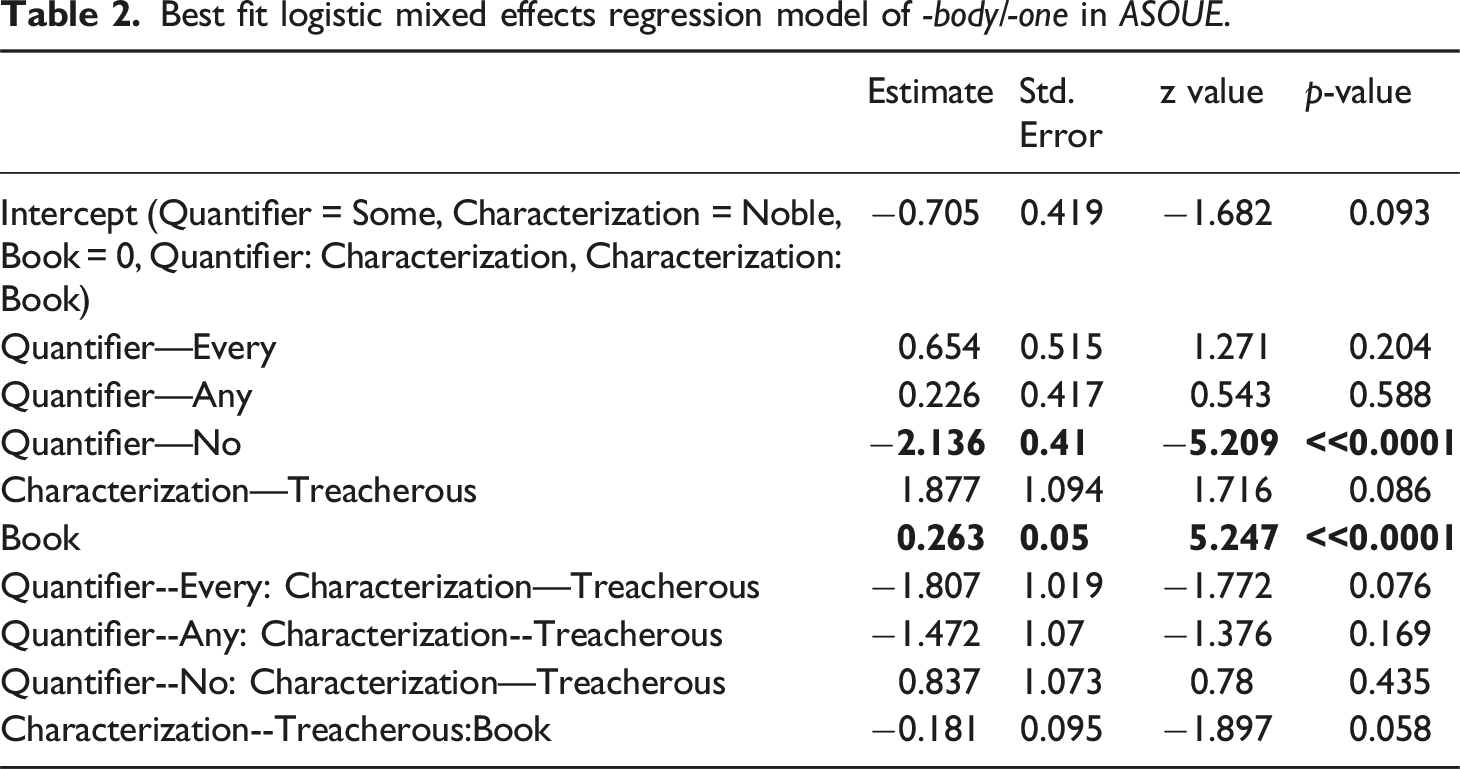
Although several factors are kept in the best fit model, relatively few significantly condition usage of this variable. The quantifier preceding the affix is one such effect; no significantly favors usage of -body in comparison to the baseline of some. The order of book publication is also significant. Later novels in the series have significantly more usage of -one than earlier novels. Characters’ affiliation within VFD, as well as interactions between this category and quantifier and order of book presentation, are kept in the best fit model but do not significantly affect -body/-one usage. The presence or absence of a following modifier was not selected in this model, perhaps due to relatively low token counts.
The order of publication effect indicates that Snicket changed his own usage of this variable over the course of writing the series. Figure 1 illustrates that this rate of change was steeper for Noble characters than Treacherous ones. This interaction, while kept in the model in Table 2, is not statistically significant. Interaction between publication order and VFD affiliation for -body/-one usage.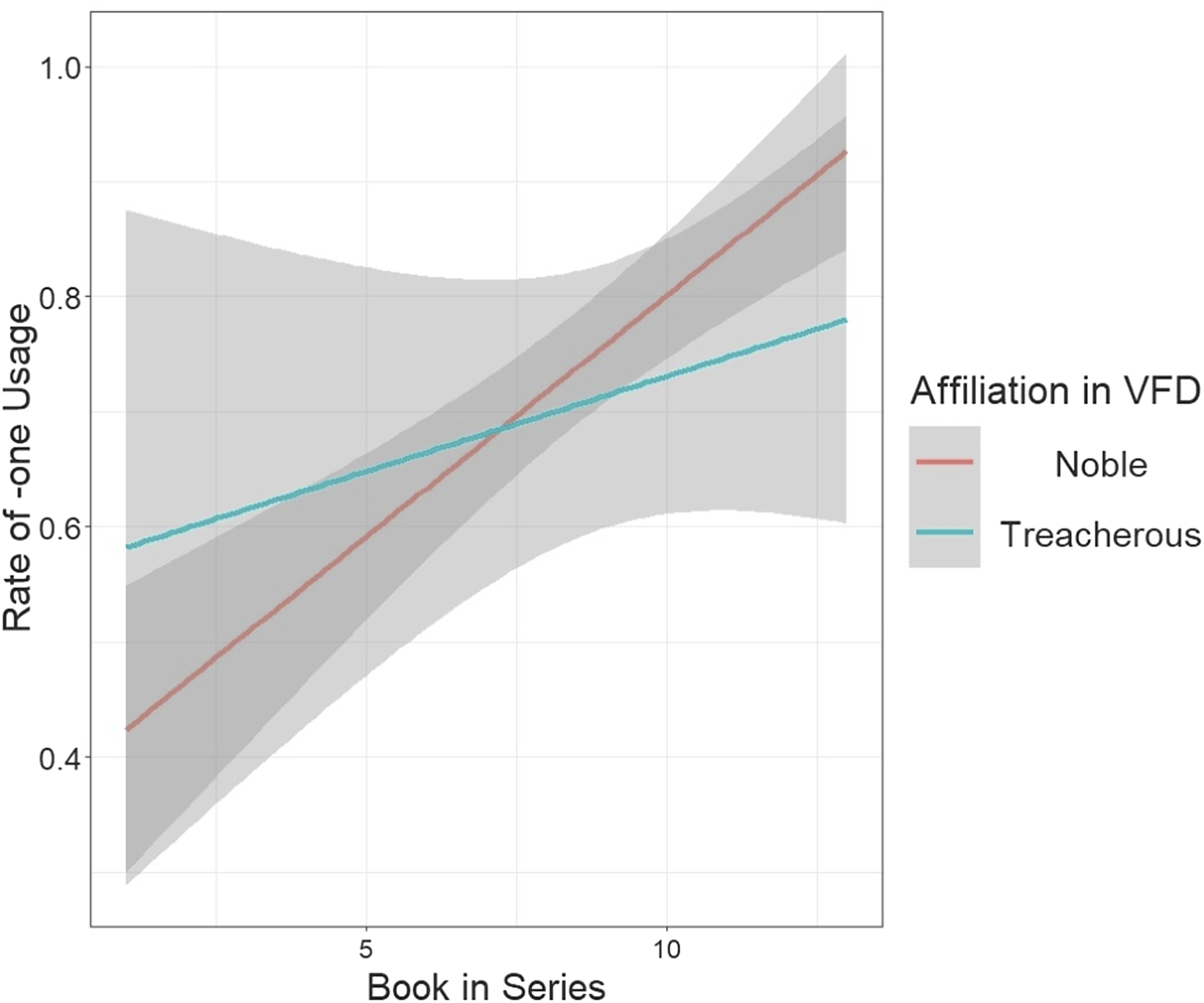
While I focus here on statistically significant effects, it is worth briefly noting what the nature of this data means for statistical significance testing. Typically, a test is conducted on a sample of data and significance is used to make a claim about the population at large. However, here we are working with the entirety of the direct speech dialogue in ASOUE. As such, any differences between Noble and Treacherous characters (or indeed for any other category) are ‘real’ in the sense that they are true representations of the dialogue in the series. This means that claims on the basis of significance testing are ultimately about the systematicity, which I take to involve intentionality, of the observed difference rather than the fact of difference. In the case of the novels’ order of publication, for example, we see that Snicket’s rate of change toward -one is faster for Noble characters. The lack of significance does not change this, but rather indicates that there is insufficient evidence that this is a systematic pattern that Snicket meant to be in the data. We see something similar with the interaction between VFD affiliation and preceding quantifier: Treacherous characters use -one less when following any and every, but there is not enough evidence to show that this pattern is systematic (Figure 2). -one usage by preceding quantifier and VFD affiliation.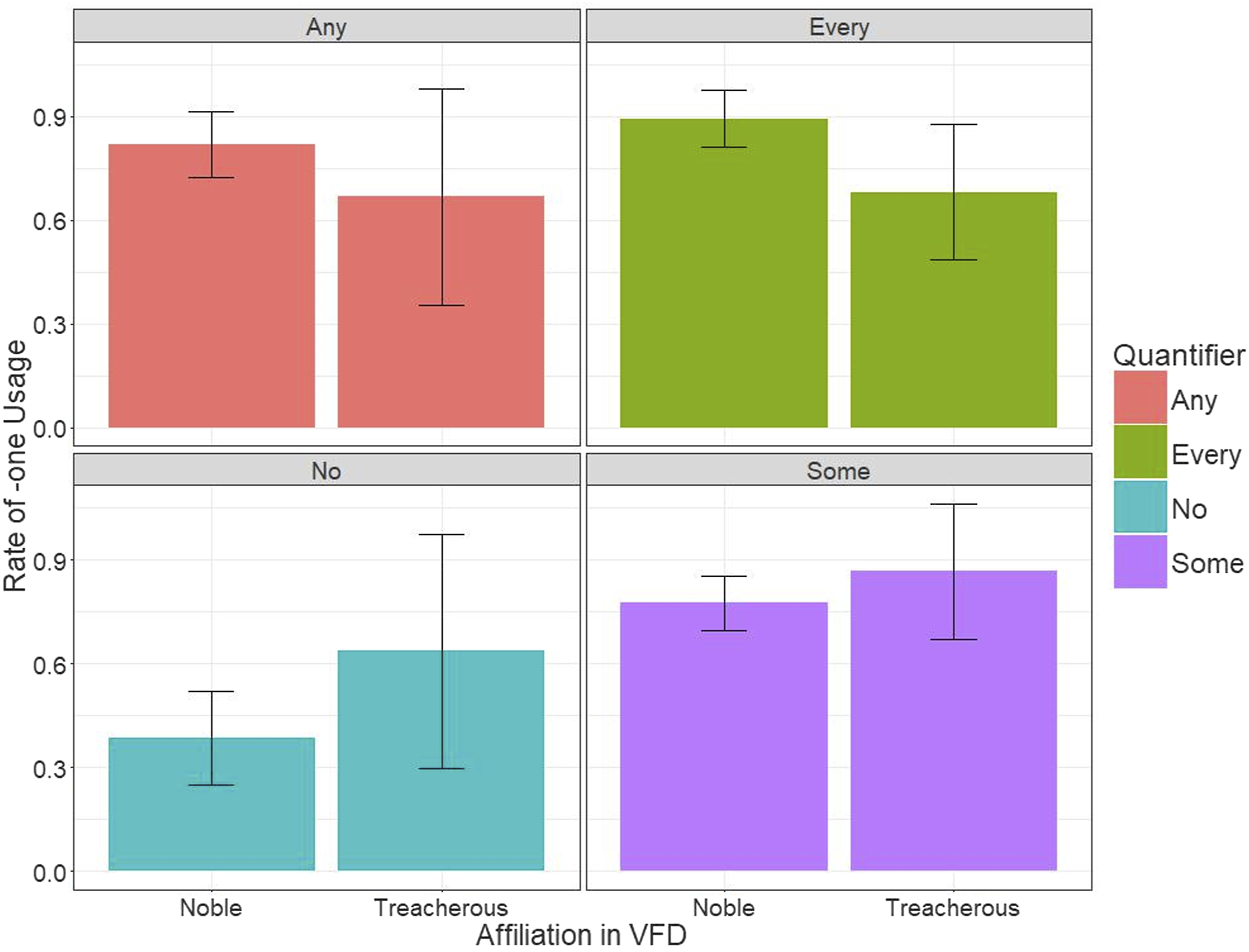
I raise this point because of how the Treacherous usage fits into the broader picture. Both of the significant effects in the best fit model are consistent with community studies of -body/-one. No consistently has the lowest rates of -one usage across English varieties (D’Arcy et al., 2013), and Snicket’s change toward -one mirrors recent trends in usage in North American varieties as well (Jankowski and Tagliamonte, 2021). This suggests that -one is an incoming norm. In this sense, that Treacherous characters use -one less when following any and every, and that Snicket’s change toward -one over the course of the series is slowed for Treacherous characters, is consistent with the non-normative usage appearing more often for Treacherous characters.
5.2. Object relativizers
Best fit logistic mixed effects regression model of object relativizers in ASOUE.
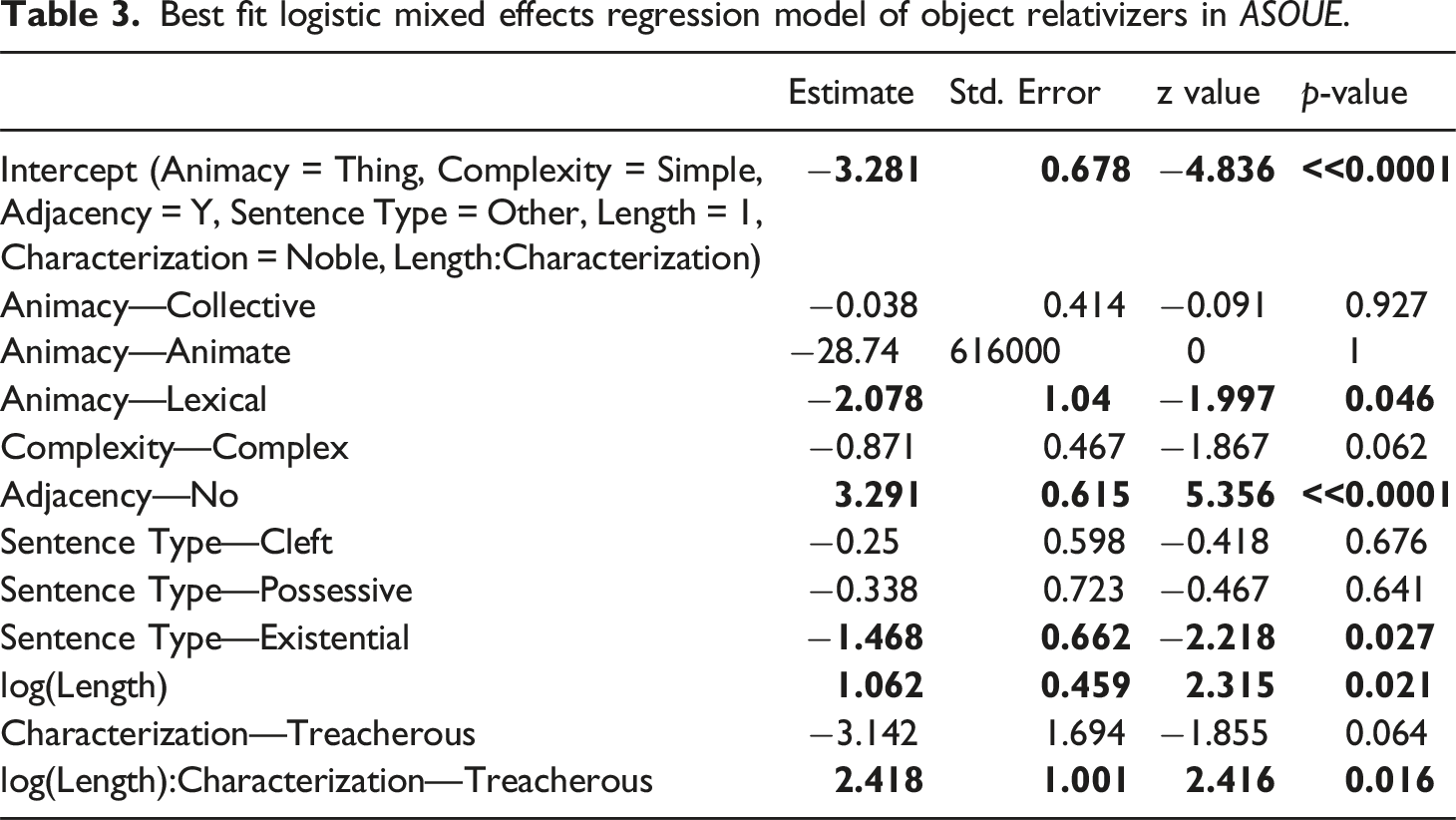
Figure 3 illustrates this interaction between VFD affiliation and relative clause length. Although long relative clauses are fairly uncommon, there is a clear difference between groups in usage of relativizer that. Interaction between VFD affiliation and relative clause length for object relatives.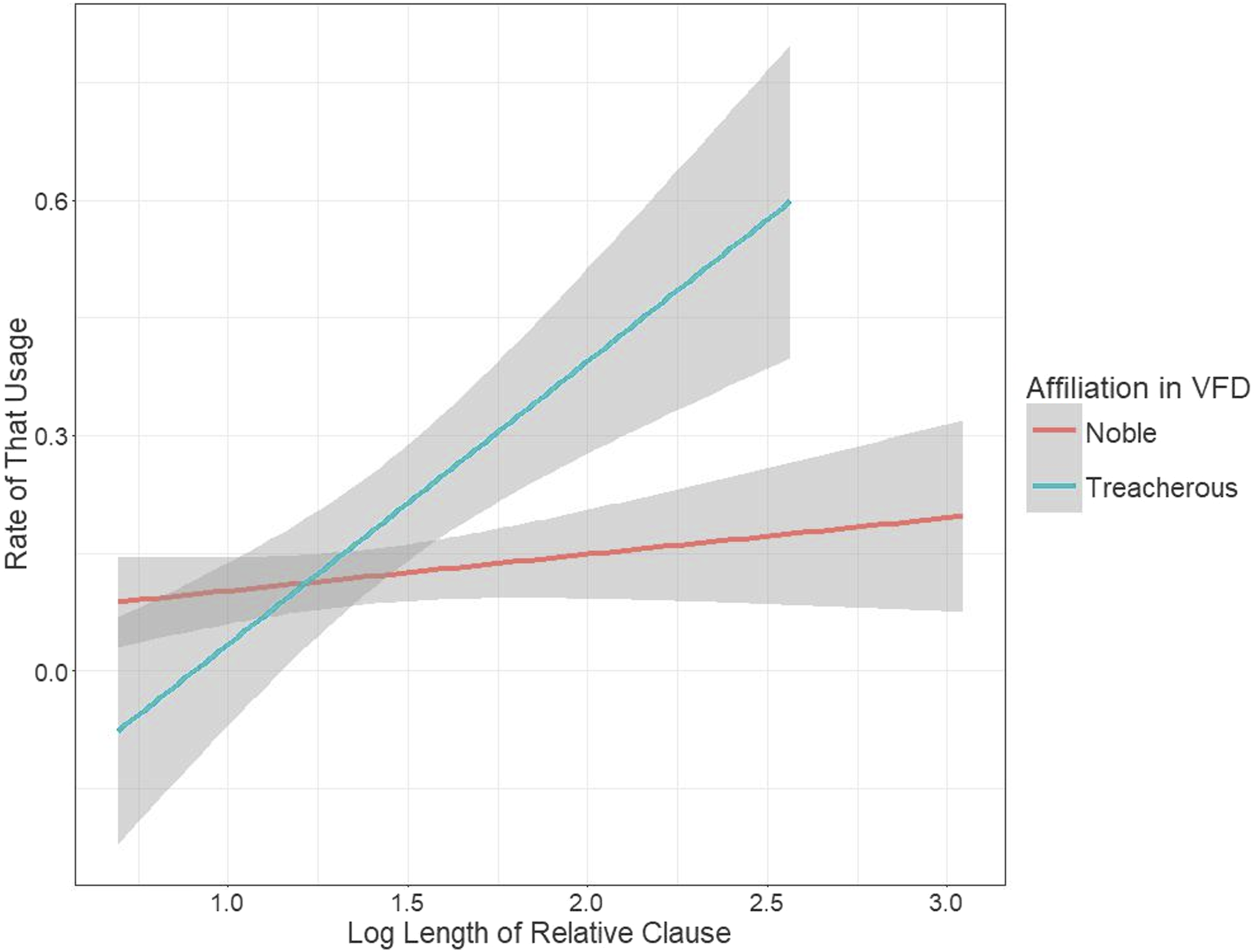
As with -body/-one, there is a non-significant main effect of VFD affiliation. This reflects the null relativizer being used more often in Treacherous character dialogue than in Noble character dialogue. Again, this result reflects Treacherous characters favoring the non-normative form in comparison to Noble characters. However, there is not sufficient evidence that this is a systematic difference between groups. Overall, the language-internal effects on object relativizer variation are similar to those found by Tagliamonte et al. (2005). For example, that existential sentences favor a null relativizer and that longer relative clauses favor that replicate community based studies. If we take having an overt relativizer as the normative form over the null one, the significant interaction between VFD affiliation and relative clause length is curious. While the difference between groups is noteworthy, the pattern is such that in long relative clauses, Treacherous characters would have higher usage of that than Noble characters.
Although I exclude wh-word relativizers from the main analysis, the two examples with who(m) as the relativizer are particularly noteworthy. In each, the example is uttered by a Treacherous character; however, in both the character is in disguise as someone non-Treacherous: a hospital’s head of human resources (16) and an impartial judge (17). 16. If you see any children whom you recognize from The Daily Punctilio, please capture them and notify the police. (Snicket, 2001: 131) 17. Search the entire hotel, and bring us anyone who you find suspicious! (Snicket, 2005: 301)
These are noteworthy because who is the formal variant in subject relative clauses (Tagliamonte et al., 2005). In this sense, the characters appear to be hypercorrecting their speech. That is, they are aware of a norm and are trying to follow it in order to not appear Treacherous, but have mistakenly extended the norm for subject relative clauses to object relative clauses. Given the rarity of these examples, I suggest that Snicket has deliberately stylized these characters’ utterances. In other words, this deviation from typical usage appears to constitute foregrounding in a more traditional sense.
5.3. Subject relativizers
Distribution of subject relativizers by animacy of antecedent.
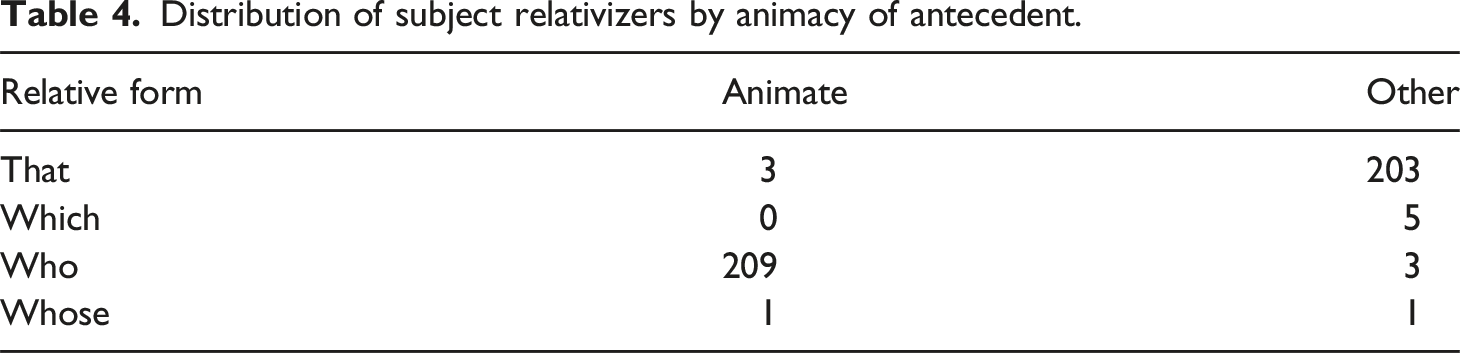
Overall, this distribution is the same regardless of social category (Figure 4). Relativizer who usage by antecedent animacy and VFD affiliation. 18. But here at Caligari Carnival, we don’t have a House of Normal People. We have a House of Freaks, with a brand-new freak 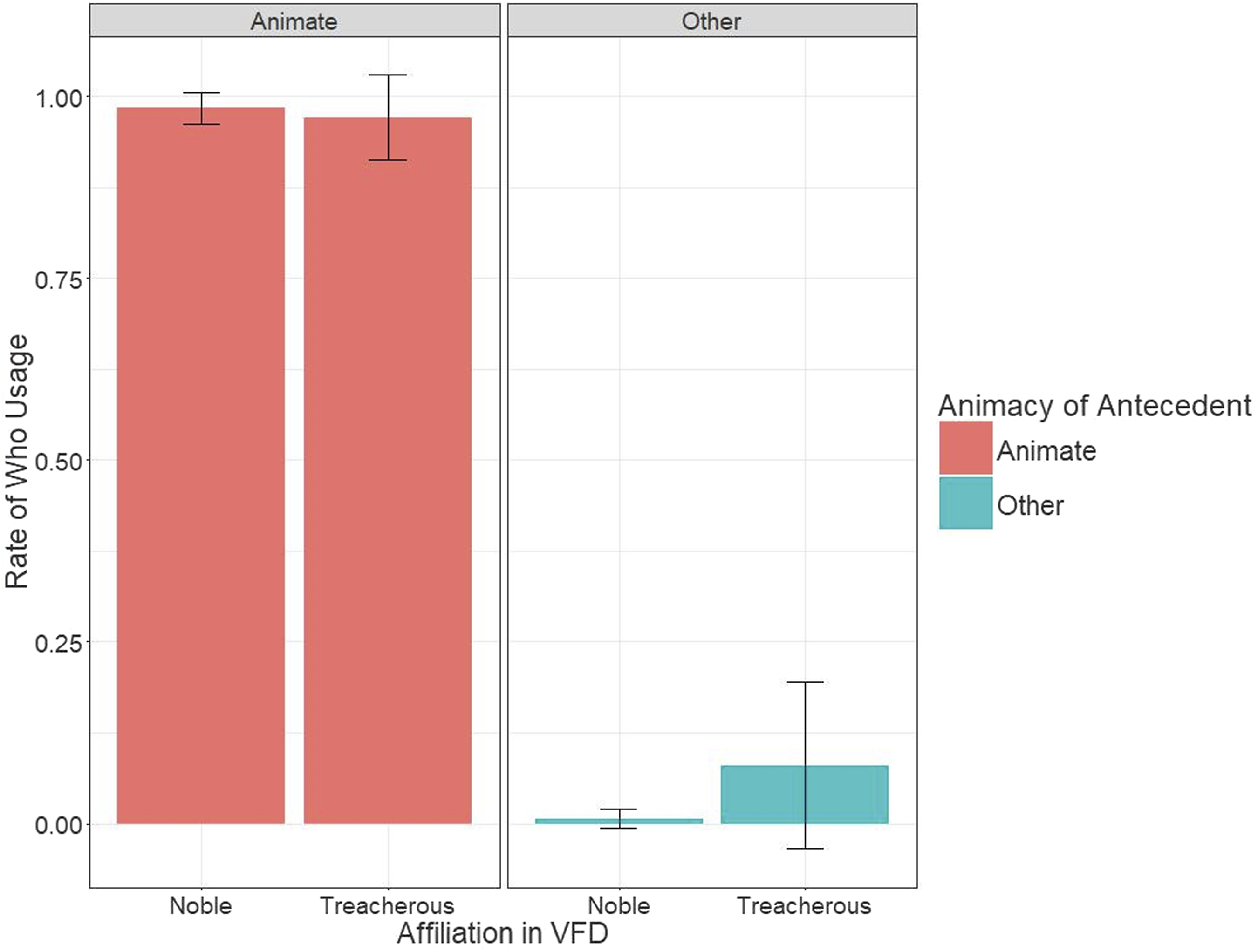
Given that subject relativizer usage with animate antecedents is nearly categorically who across the entire series, this instance stands out because in the context of the story, the character uttering the token is intentionally dehumanizing the antecedent. As with the examples with object relativizer who above, I suggest that this may be an instance of deliberate foregrounding by Snicket. In this sense, the abnormal relativizer usage here is a linguistic deviation which provides additional evidence to readers of the character’s treacherous ways (cf. Gregoriou, 2023; Van Peer et al., 2021).
5.4. Complementizer that
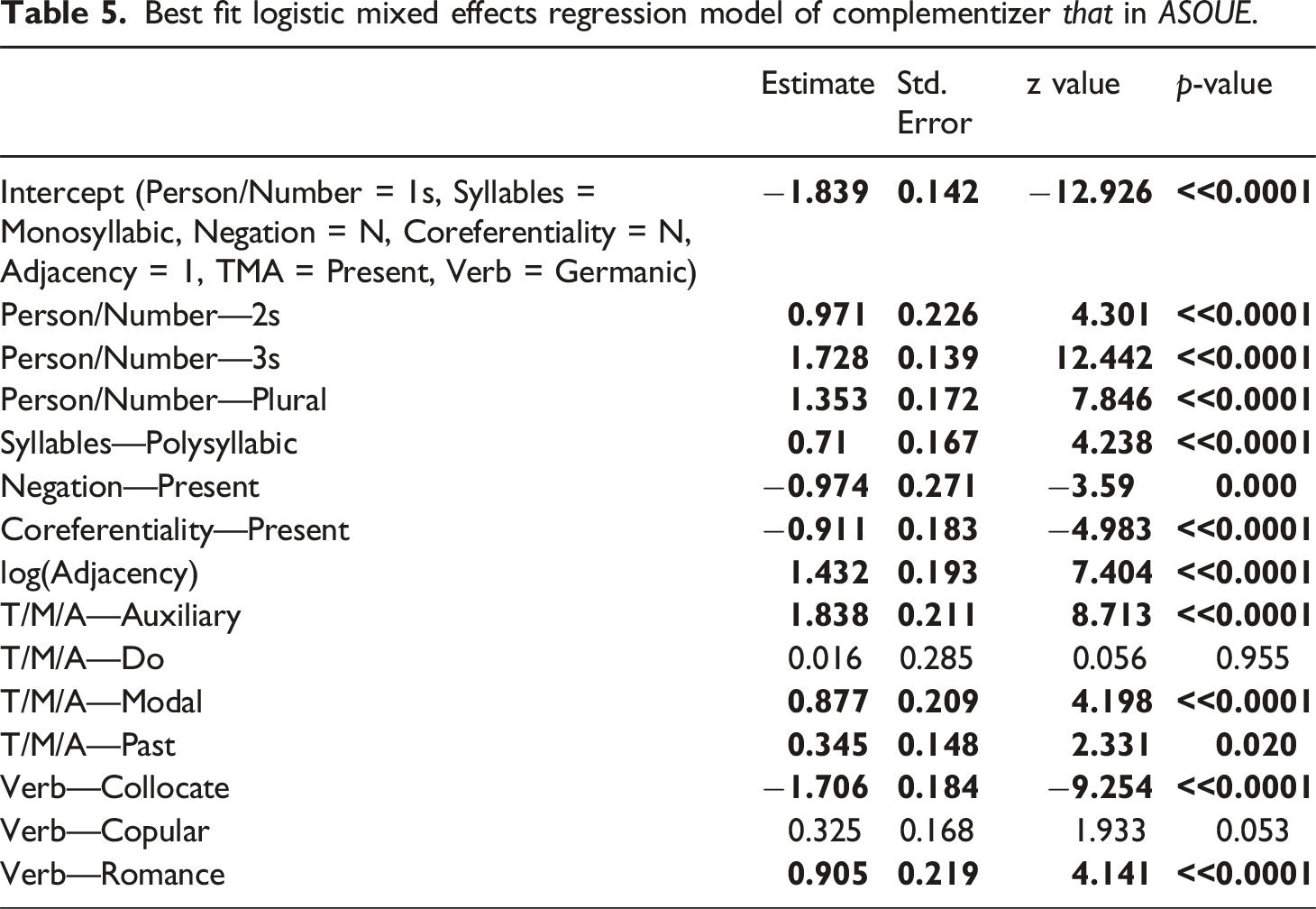
Best fit logistic mixed effects regression model of complementizer that in ASOUE.
5.5. Summary
The four variables analyzed here broadly follow three patterns of variation. Object relativizers and -body/-one both largely replicate spoken data from community studies, and additionally display interactions with the character’s side in the VFD schism. In the case of object relativizers, this difference between groups is statistically significant. Subject relativizers by and large do not display variation, but rather one variant appears near categorically with animate antecedents, with the other variant appearing elsewhere. However, what little variation there is is suggestive of intentional stylization and foregrounding by the author. Finally, complementizer that, even more so than object relativizers and -body/-one, replicates spoken data. However, this variable does not correlate with any social categorization of characters.
6. Discussion and conclusion
In section 2.2, I outlined several possible patterns of variation that we may encounter in fictional direct speech dialogue. These correspond to different interpretations of how the author is stylizing the dialogue. In short, categorical usage of a single variant would indicate that the work has been overtly stylized as a matter of editorial practice, variation solely conditioned by language-internal factors would reflect the author writing dialogue as an individual speaker of their language, variation with fixed effects for social categories would reflect the author writing dialogue as though it were a multi-speaker corpus, and variation with interactions between social categories and language-internal factors would reflect the author writing dialogue and distinguishing groups by style shifting.
In the data analyzed here, the only pattern not observed is that of variation with fixed effects of social category, that is, variation as though dialogue were a multi-speaker corpus. Near-categorical patterning of subject relativizers is suggestive of an editorial hand, while the lack of language-external conditioning for complementizer that is indicative of Snicket using his own language. Finally, the interactions between VFD affiliation and language-internal factors for object relativizers and -body/-one suggest that Snicket is style shifting between Noble and Treacherous dialogue. In this light, the results are quite messy. Is there anything that can be taken from four variables patterning in three ways? I tentatively suggest that there are two themes that emerge from these results.
In interpreting the data, we should note that the variables under study here, while robustly variable in speech, are not typically discussed in the variationist literature with respect to indexicality. That is, not all sociolinguistic variables are third-order indexicals. The four variables here were selected because their interpretations as formal/informal could be plausibly utilized as correct/incorrect. However, they have not been shown to be available for indexical work in the same way that local dialect features or variables like the -ing affix have been (Campbell-Kibler, 2005; Johnstone et al., 2006). In this sense, it is possible that alternate variables for analysis may have yielded more robust results (supposing, of course, that there were sufficient tokens in ASOUE to study them). At the same time, single variants can carry social meaning independently of their counterparts (Campbell-Kibler, 2005; Eckert, 2008). As such, the variationist approach taken here may obscure other patterns in the data.
Given these limitations, one striking theme that emerges from the data is that Snicket’s language use appears to involve style shifting. Relativizers and -body/-one appear to be available for this purpose, and object relativizers and -body/-one in particular seem to be used to distinguish types of characters from one another. That is, morphosyntactic variables not previously shown to be higher-order indexicals nevertheless appear to be a resource that authors can draw on to meaningfully develop characters in their work. The direction of style shifting is also relatively consistent. With respect to -body/-one, Treacherous characters are conservative in the face of language change in comparison to Noble characters. This illustrates and values an incoming norm for the reader; ‘good’ characters use the incoming ‘correct’ form. Similarly, the lone instance of subject relativizer that used for a human antecedent appears intentional, as do the two instances of object relativizer who. As with -body/-one, these stylized usages by Treacherous characters do not illustrate normative usage; the subject relativizer example flouts it, while the object relativizer examples suggest the characters do not fully understand prescriptive norms. Snicket’s style shifting, then, appears to model normative linguistic usage for the reader by foregrounding the treachery of its antagonists. In this way, ASOUE takes on a didactic role in teaching young readers appropriate behavior (cf. Burke and Coats, 2022).
The second theme that emerges from the results concerns the specific context of ASOUE. As discussed above, as a metafictional work the series is more overtly an edited single-author text than many other texts. Following Toolan’s (1992: 33) observation that fictional dialogue ‘may be serving a multiplicity of different authorial ends’, the results we find fit quite well with the positioning of Lemony Snicket as an author and the text overall. Consider, for example, that the framing of the series as a research output means that the dialogue is clearly constructed by Snicket himself. The variation we see with the complementizer, in which it is constrained by language-internal factors but not language-external factors, reflects that the text was composed by a single author. That is, this variable suggests the fact of the text’s construction. Furthermore, recall how the reader sees that Snicket is in communication with his editor, which makes overt how ASOUE is edited. We see evidence from his usage of subject relativizers that Snicket and his editor may indeed have revised the work in order to consistently use the variants in their animate/inanimate contexts. At the same time, Snicket’s style-shifting may reflect not just an author distinguishing two types of characters, but one shifting away from his normal usage patterns to performatively distinguish a group he is in opposition to. In other words, the multiplicity of patterns of variation in the dialogue reflect the multiplicity of ways in which Snicket positions himself as the author of the text. In this sense, the results represent an additional way in which Snicket is constructed as a character who has produced a particular kind of text beyond the clear elements in the form and content of the text (Austin, 2013; Hermansson, 2018; Iglesias-Plester, 2020; McGee, 2010; Russell, 2010; see also Wydrzynska, 2023).
Although the data suggests that the variation in ASOUE contributes both to playing a didactic role by equating usage of formal linguistic variants as morally correct and to situating Snicket as the creator of the metafictional text, the nature of the results does warrant caution. After all, the examination of ASOUE here represents a single case study. Perhaps the differing patterns of variation that we find are typical of fictional direct speech dialogue. In this case, while the interpretation I propose of variation in ASOUE fits the data, it would not necessarily be as intentionally executed by Snicket as I have implied throughout this paper. There is certainly a question of whether this distinction matters. For example, if the fact that Snicket’s usage of -body/-one reflects an incoming norm means that it can be interpreted as fulfilling a didactic role within the context of the series, does the degree of intentionality with which it was written matter? There is not a clear-cut answer here; while intentionality and agency are important contexts for understanding variation in language use, linguistic variation carries social meaning regardless of intentionality. In this sense, Snicket’s variation may be didactic and position him within the text regardless of his goals when writing the novels. A reviewer suggests, and I concur, that future work on this author in particular may shed light on his intentions. Snicket’s follow-up prequel series All The Wrong Questions, for example, involves him as both narrator and participant, meaning that direct speech dialogue in this series was ‘observed’ by the author directly as opposed to ‘reconstructed’ in ASOUE. Daniel Handler’s non-Snicket novels may shed light on his approach to direct speech among his characters as well.
Regardless, what is clear is that the methodological approach used here to analyze fictional dialogue is robust enough to illustrate authors’ patterns of language use, even with respect to features not linked to any specific dialect. For this reason, I suggest that additional research is necessary into works by other authors across a range of genres. This will shed light on crucial questions of whether a wide range of authors style-shift to some degree between groups of characters and whether a wide range of texts display variation indicative both of the author’s idiolect and overt editing. Understanding these questions will enable us to further understand the degree to which the three patterns of linguistic variation in Snicket’s fictional dialogue position him as the author of the metafictional ASOUE and serve a didactic purpose.
Footnotes
Acknowledgements
Thank you to two anonymous reviewers, as well as audiences at the Newcastle Variation Working Group and New Ways of Analyzing Variation 48, for helpful comments and feedback.
Declaration of conflicting interests
The author(s) declared no potential conflicts of interest with respect to the research, authorship, and/or publication of this article.
Funding
The author(s) received no financial support for the research, authorship, and/or publication of this article.
