



Abstract
Middle English is the essential stage in the development of English second-person pronouns. This is the time when honorific forms ye/you/your emerge, as commonly believed under French influence, gradually become default, and eventually oust the inherited singular forms thou/thee/thi(ne) to marked contexts and regionally restricted varieties. This paper addresses the initial stages of these developments dealing with the earliest attestations of honorific ye in two Middle English romances that make up the so-called ‘Matter of England’. More specifically, its focus is on Havelok the Dane (c.1300) and The Tale of Gamelyn (c.1350), which both have disinheritance as the central conflict and thus narrate stories of protagonists who are socially ambiguous. This essay investigates how this ambiguity is reflected at the level of second-person pronouns when they address, and are addressed by, other characters. Special attention is given to the notion of ‘interactional status’ theorised by Jucker (2006, 2020) and, in particular, to how it can enlighten several cases of switches between thou and ye pronouns in the chosen romances.
1. Introduction
The history of the second-person honorific pronoun ye/you/your (V forms) has enjoyed considerable attention in literature. Finkenstaedt (1963) was the first to provide a thorough overview of diachronic developments from Late Old English to Early Modern English, by also comparing the situation with address pronouns in the history of German. Much ground work was available even earlier (Kennedy, 1915; Skeat, 1867; Stidston, 1917). Since 1963, many other studies have offered more detailed analyses of individual Middle English authors and genres. Among them, Geoffrey Chaucer has attracted particularly close attention, but today we are also well informed about the use of ye and thou in other contemporary poets (Stenroos, 2010 on Piers Plowman; Jucker, 2014 on Sir Gawain and the Green Knight); mystery plays (Mazzon, 2009), private correspondence (Bergs, 2004), as well as the prose narrative attributed to Margery Kempe (Timofeeva and Kahlas-Tarkka, 2025). On one hand, these studies document how historically plural forms gradually become default and eventually oust the inherited singular forms thou/thee/thi(ne) (T forms), reducing their occurrence to marked contexts and regionally restricted varieties (Hickey, 2003). On the other hand, they also observe that the system of pronouns of address in Middle English differs from those that we find in modern languages (such as French, German or Russian) in that it is characterised by retractable pronominal choices, with the same interactants addressing each other with both ye and thou as well as switching between the two pronouns in the course of a single conversation (Honegger, 2003; Hope, 1994; Jucker, 2006; Mazzon, 2009). This dynamic situation has been approached from a variety of perspectives – that of the genre and the social standing of a particular character (Burnley, 1983, 2003; Mazzon, 2000); of intimacy and affect (Burnley, 2003); and of closeness to spoken versus written language (Bergs, 2004; Finkenstaedt, 1963; Hope, 1994).
More recently, however, Jucker has identified a set of parameters that seems to describe the system of pronominal choices in a more nuanced way, taking into account the relatively stable social status of the interactants and the relation between them as well as their temporary situational status. Together these three contribute towards creating an interactional status of the interlocutors. Hence, the first two parameters, though comparatively stable (such as superior/equal/inferior social status, more advanced/equal/less advanced age, familiarity/unfamiliarity of the addressee, gender), determine pronominal choices in many cases but do not establish clear-cut predictions. Instead, it is the variable situational status that ultimately influences the preference for using ye or thou (Jucker, 2006, 2014, 2020). For instance, seeking information or making requests often align with the use of V forms, while reproaches, abusive behaviour, or refusal to comply with requests typically correspond with T forms.
While adopting Jucker’s sociopragmatic framework with its emphasis on how power balance between the interlocutors develops and plays out in the course of an interaction, for the analysis of pronominal terms in this study, I modify it and introduce speech acts into the model, which may help explain some switches that happen independently of power dynamics. In particular, the distinction between head acts and supportive moves maintained in interactional pragmatics seems to be useful. In this approach, head acts refer to utterances that carry the primary illocutionary force in a given interaction, such as requests, permissions, complaints or apologies. These acts are typically explicit, directly conveying the speaker’s intention. On the other hand, supportive moves encompass a range of linguistic strategies employed to enhance, mitigate, or aggravate the force of head acts, thus facilitating more nuanced communication (for a recent typology and discussion, see e.g., House and Kádár, 2021). As illustrated in (1), an example taken from Havelok the Dane, supportive pre- and post-moves can also provide information and justification to help the addressee to interpret the request favourably.
(1)
“With swilk als ich byen shal: Information (mitigating supportive move)
Þer-of
Wile ich speke with non oþer reue Justification (mitigating supportive move)
But with
In gode borwes up and doun
And faren ich wile fro tun to tun.” Information (mitigating supportive move)
(Havelok, ll.1625–1631)
“[…]with such as I shall buy: therefore I now request your (V) permission, because I will speak to no other magistrate but you (T), who are a justice (here), that I might sell my wares in good boroughs up and down, as I travel from town to town.”
In this episode, Prince Havelok, disguised as a merchant, approaches a Danish earl, Ubbe, and requests his permission to sell merchandise in the towns under his authority. Non-verbally Havelok supports the request by the gift of a golden ring. At the verbal level, he gives information about his wares and travels and justifies the appeal to Ubbe by singling him out as the most suitable magistrate for his purposes. Thus, within this speech act sequence, ‘I request your permission to sell my wares’ is the head act, while the remaining speech acts are supportive moves (Elsweiler, in this Special Issue, adopts a similar approach to Request speech acts). I am going to argue that switches between T (l.1628) and V forms (l.1626) are likely to coincide with the division of speech act sequences into head and supportive pragmatic units.
My second departure from previous work is the focus on texts that predate Chaucer, Langland, and the Gawain-poet by nearly a century. Havelok the Dane, composed in the final decades of the thirteenth century, is among our earliest witnesses for the use of honorific ye; The Tale of Gamelyn is a few decades later. The common ground between them is the ambiguity of social status of their protagonists. Both Havelok and Gamelyn have been disinherited by the people who are supposed to act as their guardians and can be argued to be deprived of the privileges as well as honourable linguistic treatment bestowed on them by birth. This social vulnerability is reflected in how the protagonists are addressed by other people, a perspective that may enlighten not only linguistic but also philological and literary analyses of the romances.
Finally, I am also going to consider the contact origins of V forms and, in particular, the functional polysemy of ye and you that can be observed in our sources from their earliest attestations (MED, OED s.vv. ye, you). My aim is not to establish a direct relationship between the Anglo-Norman sources of the two romances and their English versions, which would deserve a separate study, but rather to understand how this functional polysemy came about and what English external and internal processes may have contributed to its emergence. The latter questions and the lexicographic evidence are going to be the starting point of my investigation, whence I shall proceed to the individual analysis of the two romances.
2. Ye with singular referent in dictionary data: Functions and first attestations
Functions and first attestations of ye with singular referent in MED.
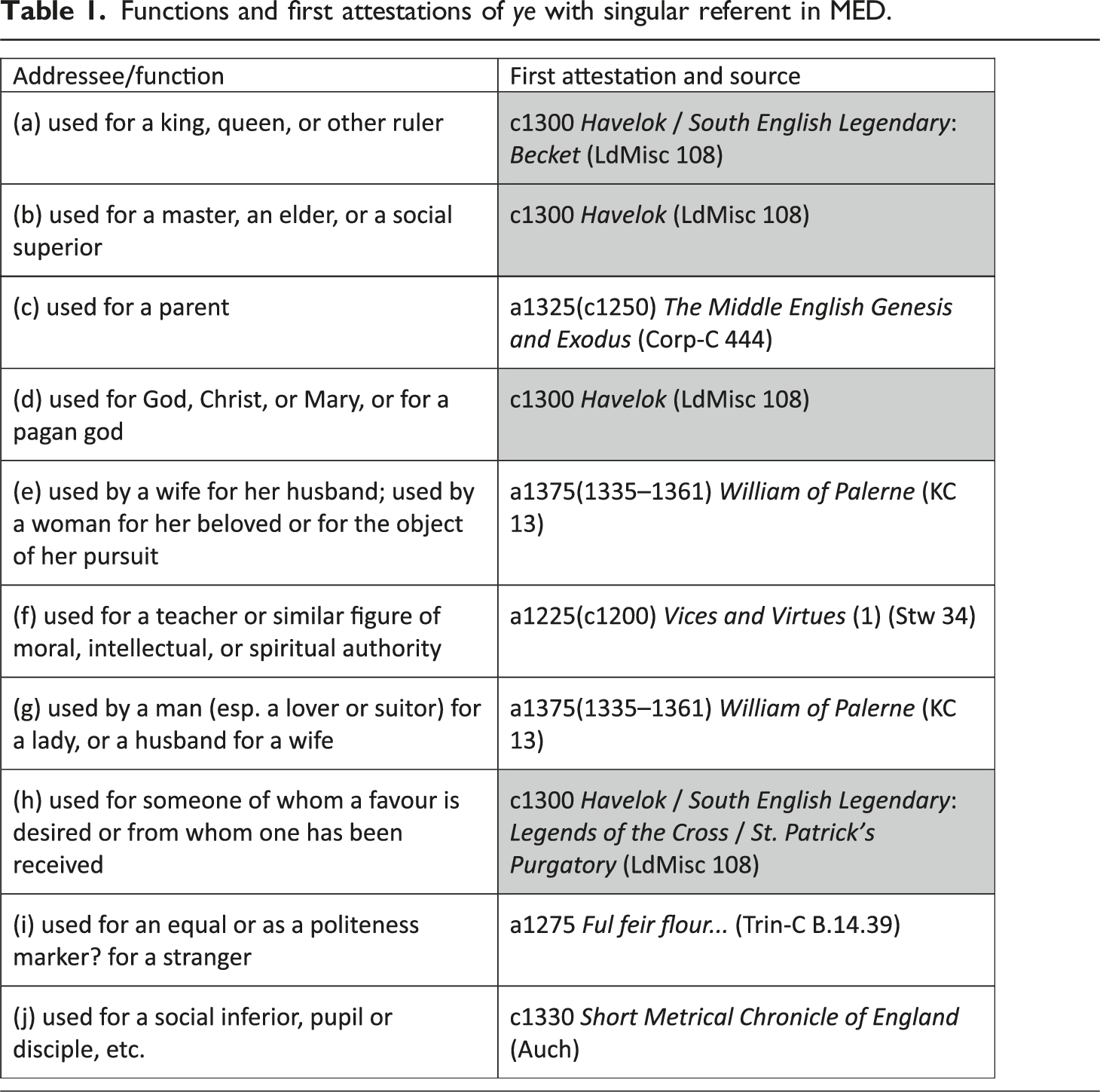
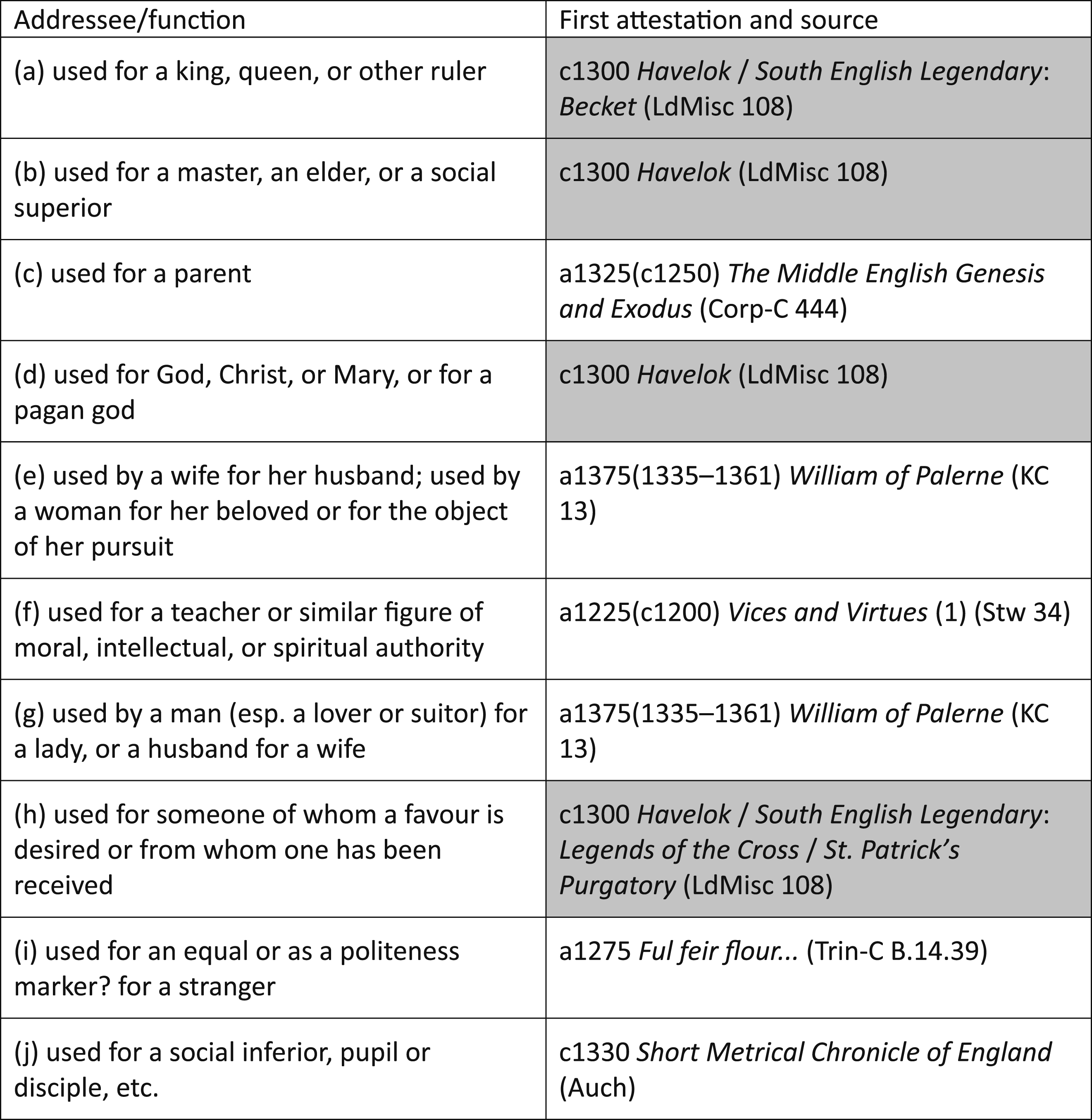
Table 1 records a roughly simultaneous emergence of most pragmatic senses in around 1300 +/− 25 years, with the outliers being the Vices and Virtues (sense (f)) in a1225 and William of Palerne (sense (e) and (g)) in a1375. 1 Having checked the example from the Vices and Virtues (31.18) more closely, I cannot agree with the interpretation of this <ʒe> form as honorific ‘you’; I think the plural meaning is more plausible in the context and seems to be in line with the way the form was tagged in A Linguistic Atlas of Early Middle English 1150 to 1325 (LAEME: #64). The next available MED attestation of sense (f) is from Chaucer, and, in entry you, sense (f) and sense (b) seem to be lumped together (MED s.v.). Thus, the majority of the senses surface around 1300, and the remainder is attested by the end of the fourteenth century. What is also remarkable is that senses (a), (b), (d) and (h) are attested in the same manuscript – Oxford, Bodleian Library, Laud Misc. 108, which contains not only Havelok the Dane but also the South English Legendary, copied by two distinct scribes, respectively, hand C from West Norfolk and hand A from West Oxfordshire (LAEME: #285 and #1600); senses (a) and (h) are used by both scribes. All of these pointers taken together suggest multifunctionality of ye/you with singular referent from the earliest stage of its development, although in a limited number of texts, as well as a rapid expansion during the fourteenth century (cf. Bergs, 2004; Finkenstaedt, 1963).
Although our datings converge at c.1300, the structure of the MED entries suggests a social hierarchy and a chronology. What it appears to reflect is the understanding of the evolution of V forms in the Romance languages as summarised by Finkenstaedt (1963: 15–47; cf. Kennedy, 1915; Burnley, 2003). The Latin V form, pluralis reverentiae (vos), is traced to the imperial and papal chanceries in the fifth century, whence it spreads to imperial, royal, and episcopal chanceries across early-medieval Europe, with the Latin of England as well as the vernacular lagging behind these developments. Presumably, chancery usage was a reflection of how emperors, popes, and kings were addressed by their officials and courtiers. The practice of reverentially addressing the head of state or church in the plural was then generalised, at first, to include other asymmetrical relations – those between heads of other communities and households and their subordinates, and, later, to any kind of relations. Accordingly, the MED starts with the royal V (Table 1: a), proceeds to the social-distance V (b–f) and the situational-distance V (g–h), towards a more general polite V (i–j). How far this hierarchy/chronology can predict pronominal choice in the Early Middle English data is going to be discussed below.
3. Havelok the Dane: Summary and provenance
Havelok the Dane (Havelok), composed at Lincoln between 1280 and 1310, is often regarded as a reworking of Anglo-Norman sources, in particular the ‘Haveloc episode’ in Geffrei Gaimar’s Estoire des Engleis (c.1135) and the anonymous Lai d’Haveloc (1190–1220) (Smithers, 1987: lxiv–lxix, lxxi, lxxxix; Herzman et al., 1997: Introduction). The narrative of the Middle English romance commences with the misfortunes of the English princess Goldeboru, orphaned by the demise of her father, King Athelwold. Left in the custody of Godrich, Earl of Cornwall, Goldeboru is deprived of her royal rights and imprisoned. The tale then shifts to Havelok’s childhood in Denmark, similarly marked by tragedy and usurpation under the treacherous rule of Earl Godard following the death of Havelok’s father, King Birkabein. Godard murders Havelok’s two sisters, and the prince himself faces certain death but negotiates his life in exchange for fealty. He is handed over to a fisherman Grim, who is secretly instructed to execute him. However, discovering Havelok’s royal birthmarks, Grim spares the boy, taking him to England, where Havelok grows into a young man and finds work helping the cook in Godrich’s castle. Mistaking him for a commoner, Godrich marries Havelok to Goldeboru, with the revelation of his true identity occurring on their wedding night. The couple journeys to Denmark, where Havelok reclaims the throne, avenging his sisters’ murder. Returning to England, he also restores Goldeboru’s kingdom, arranges marriages, and is crowned king of England. The narrative concludes with Havelok and Goldeboru living a long, contented life, blessed with fifteen children all of whom become kings and queens. The poem survives in two manuscripts: complete in Oxford, Bodleian Library, Laud Misc. 108 and in fragments in Cambridge University Library Add. 4407. The former is dated c.1300–1325 and the latter to the end of the fourteenth century (Smithers, 1987: xvi; Herzman et al., 1997: Introduction). Both are localised to Northeast Midlands (LAEME: #285).
4. The Tale of Gamelyn: Summary and provenance
The Tale of Gamelyn (Gamelyn) has many typological affinities to Havelok, also dealing with dispossession, captivity, and revenge. It is an outlaw romance, in which Gamelyn’s father, Sir John of Boundes, bequeaths his land to three sons: John, Ote, and Gamelyn. After Sir John’s death, however, the eldest son, John, seizes Gamelyn’s share, mistreating him and neglecting his portion. Growing into a fearless young man, Gamelyn discovers the injustice and confronts John, who, feigning apology, dupes Gamelyn with false promises. Soon Gamelyn wins a wrestling match and returns to John’s castle for celebration with his friends. Finding the gates bolted, he storms in, throws the porter into a well, and feasts for seven days and nights, with his brother hiding in a tower. After the feast, John is able to trick Gamelyn again; he shackles and binds him to a post proclaiming him mad. One of his father’s old servants, the spencer [meaning ‘steward, butler’], Adam, aids Gamelyn’s escape, and together they plan revenge. During a feast, Gamelyn retaliates against corrupt churchmen who were invited by his brother and ignored his appeals to justice. Gamelyn and Adam leave John in fetters and flee to the forest, where they encounter outlaws who recognise Gamelyn and eventually make him their king. Meanwhile, John becomes sheriff and declares his brother an outlaw. Gamelyn is imprisoned and soon to be hanged when the middle brother, Ote, intervenes and secures his release, by pledging himself as surety. Gamelyn goes back to the forest and awaits trial, while John turns on Ote and puts him into chains. Gamelyn returns with his men and holds his own trial, sentencing all corrupt lawmen, including John, to be hanged. The two brothers seek out the King to make peace. Ote is appointed justice and Gamelyn Chief Justice of the Forest. Gamelyn becomes heir to Ote, marries a good and fair woman, and they live together until his death.
The romance is preserved in twenty-five fifteenth-century manuscripts. In the majority of them, it is found alongside Chaucer’s Canterbury Tales (Vázquez, 2009: 12–23). Although Chaucer himself was not involved in the transmission of the text, he may have had Gamelyn among his papers and intended to rewrite it for one of his characters (a possibility revisited by Thaisen, 2011, 2013). Gamelyn’s composition date is generally placed at c.1350–1370, and its dialect is identified as Central to Northeast Midlands (Knight and Ohlgren, 1997: Introduction; Vázquez, 2009: 28). The poem, thus, comes from roughly the same area as Havelok and is between 40 and 90 years later than Havelok. Both romances deal with protagonists whose social standing is repeatedly questioned and whose situational status is predicted to be insecure. The present analysis now engages with how their interactions with other characters are reflected at the pronominal level and whether any diachronic development is observable between the two poems.
5. Results and analysis
Second-person pronouns with singular referent in Havelok and Gamelyn (p = .35).

For the second case study, I have analysed 178 examples of second-person pronominal forms with singular referent in the entire text of Gamelyn, obtained from Knights and Ohlgren’s critical edition for the TEAMS series (1997), 2 tagged manually and processed in AntConc 3.5.9 (Anthony, 2020). The distributions here were 170 instances of the singular T pronoun (c. 95.5%, Table 2) and eight instances of V form (c. 4.5%, Table 2). Additionally, 39 instances of ye referred to dual or plural persons. The relative portions of T and V forms in both texts are similar, and statistical testing suggests that there is no significant development taking place between Havelok and Gamelyn. This may not be surprising if we assume a minimal temporal distance, say 40 years (see above), between the two romances. If, however, the temporal distance is raised to 90 years, we may expect to observe some increase in the relative frequencies of V forms. By comparison, Geoffrey Chaucer’s romance, The Wife of Bath’s Tale, written in the 1380s and dealing with a protagonist whose situational status is similarly precarious, has the proportion of 35% T forms to 65% V forms, although in this case we are no longer concerned with the same regional variety (for a detailed analysis, see Jucker, 2006). The preference for V forms is even more pronounced in Sir Gawain and the Green Knight (Jucker, 2014: 19). These results may in fact suggest that Gamelyn was composed only a few decades after Havelok and before V forms became the default in romances. On the other hand, even though within the same genre, we are still examining poems by distinct authors and with distinct plots. The following sections therefore provide detailed analyses of the two individual texts and episodes.
5.1 Analysis of Havelok
As already observed, T forms are the default option in this romance. They are generally used both between equals and between interlocutors of different social standing, including between husband and wife, for example Havelok and Goldeboru. A handful of examples contain V forms (Table 2). I argue that in this subperiod V forms are always marked, in contrast to a hundred years later, when the situation is reversed: T forms become marked and V forms are default (Bergs, 2004; Timofeeva and Kahlas-Tarkka, 2025). Since royal V forms are suggested to be the origin of honorific ye (see above), it may make sense to begin the analysis with the episode from Havelok, 3 which features royalty as addressee. The lines in example 2 are found towards the end of the poem when six English earls ask Princess Goldeboru for forgiveness, having betrayed her as a child under the pressure from the usurper Godrich. It is indeed one of the few instances in which V forms are used consistently, that is without switches into thou, to address a singular person.
(2) Þe englishe men bigunne to falle O knes, and greten swiþe sore, And seyden, “ And Þat we ayen For englond auhte for-to ben And we The Englishmen fell to their knees and greeted her fervently and said, “Lady, we beg Christ’s and your mercy, we have done you much wrong, we have been disloyal against you; for England ought to have been yours and we your men and yours (completely).
By the time this happens, Havelok has been crowned king of Denmark, the evil Godrich deposed and imprisoned, and Goldeboru’s queenship re-established. Arguably, the latter’s situational status has changed so that the pronoun of address is now different too. Indeed, before this episode nobody ever addresses Goldeboru with V forms. However, we should also pay attention to the speech act in which all these forms occur. The Englishmen beg for forgiveness, as their life and possessions now depend on the benevolence of Goldeboru. So, the situational status and the speech act of Request work in tandem towards establishing a new power balance/new interactional status and their reflection in the pronominal use. Interestingly, two other scenes (recognition of Havelok as heir to the Danish throne by Grim and Grim’s wife Leve, and recognition of Havelok as royal offspring by Goldeboru during their wedding night) do not trigger switches from T to V forms, presumably because at those points in the narrative the recognition itself does not involve the balance of power – Havelok is yet to fight for his crown and to establish his social and situational status (for a diachronic analysis of recognition, see Duffield in this Special Issue).
The combination of speech act and situational status plays out similarly in example 3. This time, we find Havelok in Godrich’s castle. He is poor, unemployed, and hungry, his immense appetite being one other sign of royal birth. Havelok has to appeal to the castle’s chief cook to give him food and employment.
(3) “Goddot!” quoth he, “ But yeueþ me inow to ete – fir and water y wile … And don al þat Quoth þe kok, “wile i no-more! “God knows!” he said, “dear Sir, I beg you, hire none other, but give me enough to eat – and I will fetch firewood and water for you… and do whatever you wish.” The cook said, “I wish nothing else! Go and sit over there!”
We can observe how the superior status of the cook, Havelok’s submissiveness, the speech act of Request, specifically, begging for food and work – are all underscored at the pronominal level (the cook is addressed with ye, Havelok with þu) as well as the use of the nominal honorific leue sire (l.910) and dismissive imperatives go and sit (l.923). Havelok is treated as a servant at best, since nobody in Godrich’s household suspects his royal pedigree. Here, as in (2), the use of pronominal address is consistent throughout the interaction. This is not the case in example 4, which occurs much earlier in the text – Havelok has just witnessed the brutal murder of his sisters and is begging their killer Godard to spare his life.
(4) And seyde, “ Manrede, Al denemark i wile To þat forward Here hi [sic] wile on boke swere Þat neure-more ne shal i bere Ayen Ne oþer wepne bere þat may And said, “Lord, have mercy, I pay homage to you (V), lord, all of Denmark I will give you (V), on condition that you (T) let me live, I will swear here on the book that I shall never again bear a shield or a spear against you (T), lord, nor any other weapon that may harm you (V), lord, have mercy on me!”
As this is an uninterrupted utterance by Havelok, his situational status remains the same throughout the nine lines, even though he switches twice between the T/V forms in l.486 and l.495. Nor are the switches affected by the use of nominal address – honorific louerd ‘lord’, which collocates with both you (l.483) and þe (l.493). What seems to trigger V forms is rather head speech acts, such as biddi you (l.484) and haue merci of me (l.495), while in the supportive moves the choice tends to fall back to T. A similar distribution can be found in Havelok’s prayer to Jesus (5):
(5) Croiz and crist bigan to kalle, And seyde, “louerd, þat al weldes – Wind and water, wodes and feldes – For þe holi milce of … And Þat godard haldes in his hond, Þat is mi Rith, eueri-del – Ihesu crist, He began to call upon the Cross and Christ, and said, “Lord, who wields everything – wind and water, woods and fields, for your (V) pity’s sake, Lord, have mercy on me! … And bring me safely to the land that Godard holds in his hand, which is mine by right – Jesus Christ, you (T) know it well!”
Once again, we observe an uninterrupted utterance within which Havelok switches from you (l.1357) to þou (l.1385), seemingly with no change of interactional status. The speech act is that of Request – ‘have mercy and support me in my plight’ – whose head acts are realised as imperatives and supportive moves include a number of mitigations. It is, as before, close to the head act Haue merci of me (l.1358) that we find the V form; the supportive move contains T. One more switch from V in the head act to T in the supportive move is attested in ll.1626–1628 (example 1).
While in the majority of analysed cases V forms are found in the context of Request speech acts, there is one notable exception. In example (6), Havelok and Goldeboru are lodged at the house of a friendly nobleman, Bernard Brun. As they prepare to have supper, Bernard’s house is assailed by a gang of sixty men who are resolved to get in. The host attempts to scare them away.
(6) Summe of you shal ich drepen, And þe oþre shal ich kesten In feteres and ful faste festen! “Hwat haue “Wenes We shole at þis dore gonge Maugre [Bernard] “… I will kill some of you and the others I will throw into fetters and fasten fast!” “What did you (V) say?” replied one of the lads, “Do you (T) think we are afraid? We shall have a go at this door before long despite you (T), churl.”
In this case, we are dealing with a speech act of Resolve (House and Kádár, 2021: 107, 109) – ‘we will get in (no matter what you say or do)’, with the head act realised as We shole at þis dore gonge (l.1788) and the aggravating supportive moves containing rhetorical questions (ll.1786–1787) and a curse (l.1789). As in earlier examples, the head act defines pronominal forms that refer to the addressee – this time, T forms. Cliticised -tu (l.1787) and þin (l.1789) are found closer to the head, a switch to V is located further from the head, in the supportive move (l.1786).
All in all, the system of pronominal address in Havelok is a dynamic one. The default forms are T as suggested by the overall distributions (Table 2), and the switches from V to T as discussed in this section. The strongest predictors of V use are speech acts of Request, with V forms being likely to occur in heads (or close to them) and variation between V and T still available in supportive moves. The pronouns are also used to underscore the situational status of the protagonists: the royal status of Goldeboru is reflected at the pronominal level (the switch to V) only after the usurper is removed and she becomes the only legitimate ruler; although Havelok’s pedigree is recognised early in the narrative, he is addressed with T forms for much of the poem, because he still has to re-establish himself as the king of Denmark.
5.2 Analysis of Gamelyn
The distribution of T and V forms in Gamelyn generally aligns with the observations just made. We find an honorific use of V in a speech act of Request (7), in which the dying Sir John, Gamelyn’s father, is collectively addressed by his knights.
(7) Ther nas noon of hem alle that herd hym aright, That thei ne had routh of that ilk knyght, And seide,“ God may don boote of bale that is now ywrought.” (ll.30–32) There was none among those who heard him, that didn’t take pity of that same knight, and so, they said, “Sir, for the love of God, don’t trouble yourself, God may remedy the evil that has now happened.”
This is the social position Gamelyn himself is trying to affirm throughout the poem, as he navigates between his status of the youngest brother in the knightly household and the outlaw who commands scores of merry men. Most of the time, however, other people stay on T forms with him, even though some of them, like the spencer Adam, may otherwise be sympathetic to his fate and acknowledge the legitimacy of his land claims. It is only after Gamelyn shackles his wicked brother and assumes the role of the head of household that his servants’ attitude changes. When the porter in example (8) reports the arrival of the sheriff (speech act Tell) (House and Kádár, 2021: 107, 111–112), he displays the deference that is due to the knight.
(8) Inne went the porter to Gamelyn anoon, And saide, “ The shireves men bene at the gate, Forto take you both ye shul not scape.” (ll.569–572) The porter went to Gamelyn at once and said, “Sir, I warn you, your foes have come for you, the sheriff’s men are at the gate, they will arrest both of you, you shall not escape.”
Two other instances of V forms appear later in the romance, following Gamelyn’s elevation to the chief outlaw and coronation as their king (Made maister outlawe and crowned her kinge (l.690)). As in (8), Gamelyn’s men bring him bad news. They assume submissive postures and attempt to mitigate the impact of the announcement they are about to make.
(9) Whan thei had hym founden on knees thei hem setten, And adoune with here hodes and her lord gretten; “ For we han brought Now is And hath endited When they had found him, they stood on their knees, took off their hoods and greeted their lord, “Sir, for God’s sake, don’t be angry (V), we have brought you (V) tidings, but they are not good. Your (T) brother has become sheriff and has his own bailiff, he has indicted you (T) and declared you (T) an outlaw.”
In the speech act of Request – ‘don’t be angry’ – V form is used both in the head (l.703) and the supportive move that immediately follows (l.704). The announcement itself (speech act Tell), however, switches into T forms, possibly also to show the outlaws’ solidarity with their chief.
Gamelyn’s relationship with his eldest brother John is marked by lack of deference throughout the entire poem. Early in the narrative he seems to intentionally insult John with T forms that are clearly out of pitch with the latter’s status of knight, head of household and elder brother. John is predictably outraged (10).
(10) Afterward come his brother walking thare, And seide to Gamelyne, “Is our mete yare?” Tho wrathed him Gamelyne and swore by Goddys boke, “ “What? brother Gamelyne howe answerst Afterwards his brother [John] came there and said to Gamelyn, “Is our food ready?” Then Gamelyn got angry and swore by the book of God, “You (T) shall go cook it yourself (T), I won’t be your (T) cook!” “What, brother Gamelyn, how dare you (T) answer me like this? Don’t you (T) ever say such words again.”
Reciprocal use of T forms between John and Gamelyn continues until the former’s execution at the end of Fitt 6, no matter how their situational status changes between master/servant/prisoner/outlaw/sheriff, etc. This consistent strategy to emphasise the tension between the brothers, which is at the core of the plot, at the pronominal level is in sharp contrast to the way in which Gamelyn addresses his middle brother Ote (11)
(11) On the morowe seide Gamelyn to Sire Ote the hende, “ To loke howe my yonge men leden her liff, Whedere thei lyven in joie or ellis in striff.” (ll.751–754) In the morning Gamelyn said to the noble Sir Ote, “Brother, I must leave you (V) and check how my lads are doing, whether they live in joy or in strife.”
Both here and slightly later (l.759) Gamelyn underscores his deference and gratitude to the second brother, who has just solicited his release from John’s prison, by the use of honorific you. Outside interactive passages, Ote is consistently referred to as Sir(e) Ote, occasionally augmented with positive epithets, such as hende ‘noble’ above (l.751). Ote never reciprocates V forms and his relationship to Gamelyn continues to be asymmetrical at the level of pronouns and honorifics until the end, even when Gamelyn returns the favour and helps Ote’s deliverance from shackles and execution. Thus, the social status – Gamelyn’s lack of title and land – appears to override situational dynamics. It is interesting to note, though, that in l. 752 (11), four out of ten scribes, included in Vázquez’s synoptical edition, use T forms instead of V; in l.759, nine use T. 4 Into the fifteenth century Gamelyn’s social status of an outlaw and younger brother and his interactional status in this episode must have been interpreted differently by the scribes who were involved in the transmission of the poem, since they took different approaches to the pronouns addressed to Ote by Gamelyn. When the two elder brothers, John and Ote, interact, both consistently use T forms to address each other (12).
(12) “ “We bene but three bretheren shul we never be mo; And Such another brother evel mote hym byfalle!” “ By God, for To the kingges prisoun he is ynome, And ther he shal abide to the justice come.” “Par de!” seide Sir Ote, “better it shal be; I bid hym to maynprise that To the next sitting of delyveraunce, And lat than Gamelyn stonde to his chaunce.” “ Then Sir Ote said to the sheriff, “Sir, we are but three brothers, we shall never be more; and you (T) have imprisoned the best of us all; another brother such as you, may evil befall him!” “Sir Ote,” said the false knight, “let your (T) curse be; by God, he shall fare the worse for your (T) words; he will be taken to the king’s prison and stay there until the justice comes.” “By God!” said Sir Ote, “It shall be better than this – I demand bail for him, which you (T) grant me until the next session of the legal hearing and then let Gamelyn take his chances.” “Brother, in such an agreement I commit him to you (T) …”
Even though both brothers repeatedly employ face-threatening strategies during this dialogue, including accusations, threats, demands, oaths and curses, the reciprocal T forms at least seem to be acceptable between the two equals and collocate with honorific Sir in both interlocutors’ utterances.
My final example is taken from Fitt 2, in which Gamelyn rides out to a wrestling match and, encountering a franklin, whose two sons have just been killed by another fighter, decides to become the franklin’s champion:
(13) And ther he herde a frankeleyn “weiloway” singe, And bygonne bitterly his hondes forto wringe. “Good man,” seide Gamelyn, “whi mast Is ther no man that may […] “Good man,” seide Gamelyn, “wilt Holde my hors the whiles my man drowe of my shoon, And helpe my man to kepe my clothes and my stede, And I wil to place gon to loke if I may spede.” “By God!” seide the frankleyn, “it shal be doon; I wil myself be And wende And drede not of And there he heard a franklin cry out in despair and wring his hands bitterly. “Good man,” said Gamelyn, “What makes you (T) do this? Is there no one that can help you (V) in your grief?” […] “Good man,” said Gamelyn, “would you (T) kindly hold my horse, while my servant pulls off my shoes, and help him keep an eye on my clothes and the horse? And I will go to the market and see whether I may succeed in [vindicating your misfortunes].” “By God!” said the franklin, “It shall be done; I will myself be your (T) servant and pull off your (T) shoes (for you), you (T) go to the market, may Jesus Christ speed you (T), and don’t worry (T) about your (T) clothes, nor your (T) horse.”
The picture that emerges from Gamelyn is then, likewise, a dynamic one. Although the switches between T and V forms are not as frequent as in Havelok, they are similarly calibrated to the change of situational status and interactants’ attitude towards each other. Social hierarchy is a predictable factor in the choice of T/V forms, some of which nicely complement the evaluation of characters as noble or arrogant, loyal or aggressive. There is thus an interesting interplay of status, legitimacy and politeness, particularly in the distribution of pronominal forms in the interactions between the three brothers. Requests feature less prominently in Gamelyn but this may be an effect of the genre of outlaw romance, which simply does not include as many requests.
6. Conclusions
Functions of ye with singular referent in Havelok and Gamelyn.
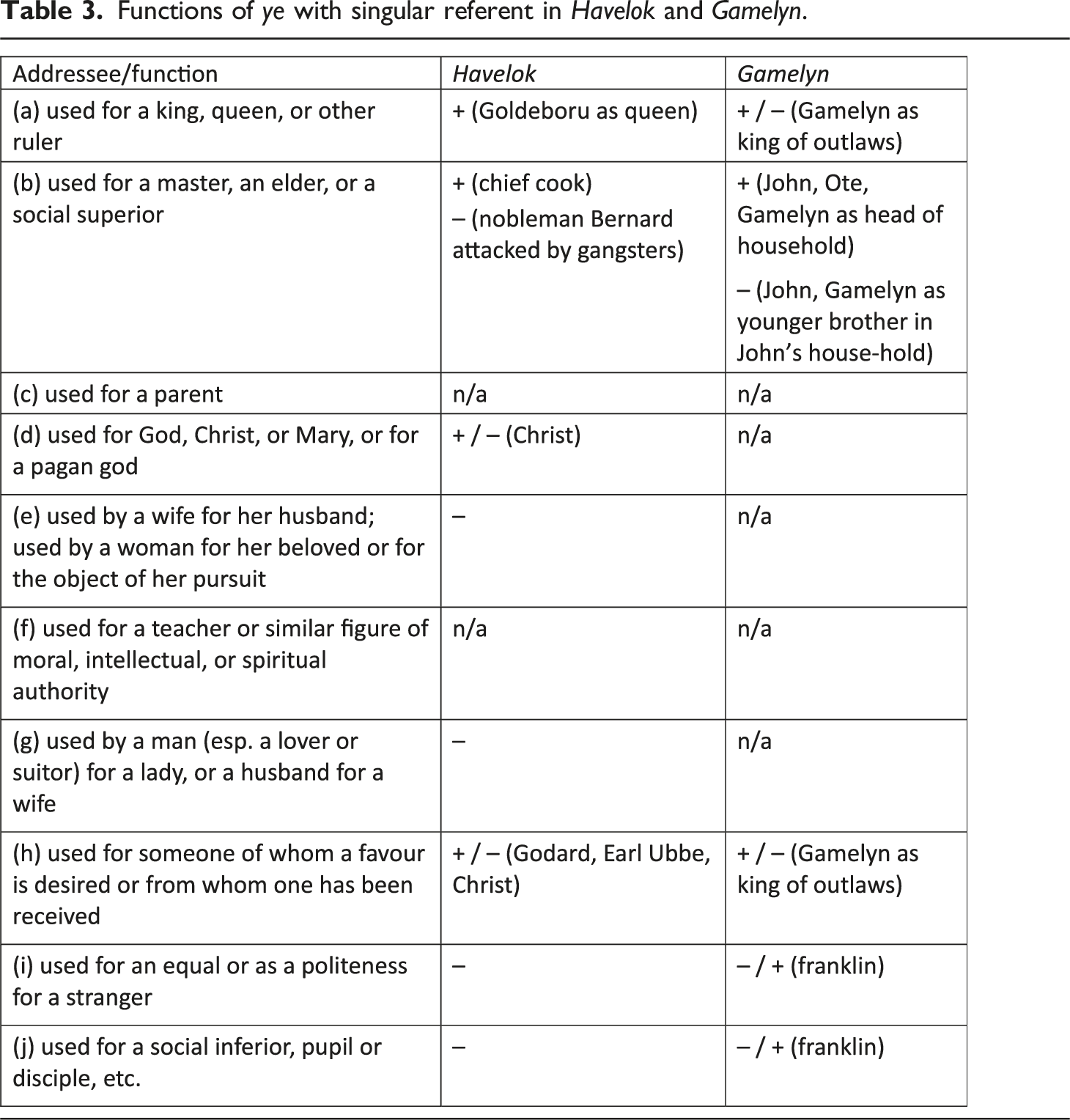
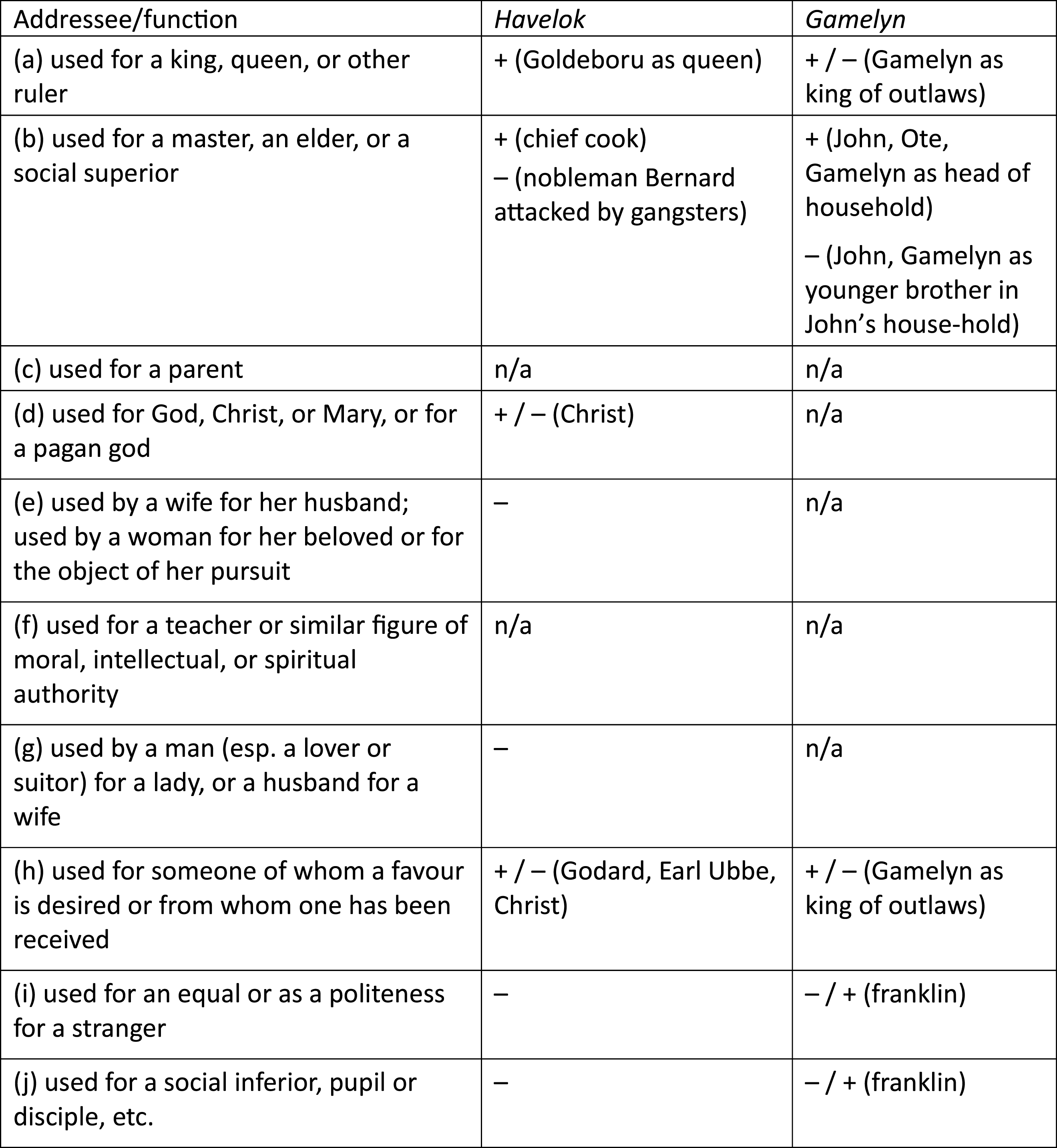
In Table 3, I have tried to highlight that V forms are multifunctional and often escape clear categorisation. The sign ‘+’ refers to addressees that correlate consistently with V forms; the sign ‘+/–’ marks variation between V and T forms referring to the same addressee (with the franklin the sequence is reversed because T forms dominate Gamelyn’s interaction with him); ‘–’ refers to the absence of V forms in those functions (and the attested use of T); and ‘n/a’ means that the function is not attested in one or in both romances. Clearly, some pragmatic functions show more variation than others, and, as already suggested by the general distributions, there is no significant development taking place between Havelok and Gamelyn. Thus, the relative chronology for the pragmaticisation of ye/you from the royal V down to other social pairings, offered in earlier work (Finkenstaedt, 1963; MED; Kennedy, 1915; Stidston, 1917), overall is borne out in my data. The affinity between the two romances at the level of pronominal use may be an indirect indication for the earlier composition date of Gamelyn. Nevertheless, all conclusions that take the social standing of Havelok and Gamelyn into account should be seen against the caveat that both protagonists are located at the centre of the inheritance conflict in the two romances, and the fluctuating use of T/V can be a deliberate strategy of the respective poets (and scribes) to further ambiguate their interactional status.
Footnotes
Declaration of conflicting interests
The author(s) declared no potential conflicts of interest with respect to the research, authorship, and/or publication of this article.
Funding
The author(s) received no financial support for the research, authorship, and/or publication of this article.