



Abstract
Poetry is often described as having ‘unusual syntax’. Based on a close study of nine cywydd poems by the fourteenth century Welsh poet Dafydd ap Gwilym, I identify attributive adjectives and preverbal particles as the loci of substantial departures in poetic language from the ordinary grammar of contemporary Welsh, providing an optimality theoretic analysis of the interaction between the linguistic and poetic grammars in Welsh cywyddau. I conclude that abnormally frequent noncanonical adjective ordering and omission of certain preverbal particles in poetry is a result of the domination of certain constraints on syntactic well-formedness by verse constraints.
1. Introduction
Poetry in many traditions and languages is defined or identified by its markedness—stylistic, linguistic, etc. Prior work (Fitzgerald, 2007; Youmans, 1983) has demonstrated a clear link between unusual word order in Shakespearean verse and the metrical constraints of iambic pentameter. Youmans (2009) extended this analysis to alliterative verse in the medieval English Morte Arthure. These researchers have shown that in both the syllabic and stress-metrical (i.e., alliterative) poetic forms of English verse, unusual word order typically repairs or improves metrical felicity. Adopting the formulations of Optimality Theory (OT), Fitzgerald (2007) and Youmans (2009) propose that metrical constraints outrank some syntactic constraints in the poetry under study. So far, however, inquiries in this vein have been mostly limited to English-language poetic forms.
In this paper I investigate the relationship between syntactic well-formedness (or deviations from it) and poetic constraints in the popular late-medieval Welsh poetic form known as the cywydd. 1 Based on analysis of a selection of cywyddau by the prominent 14th century poet Dafydd ap Gwilym, I find that use of noncanonical adjective-noun order and omission of certain preverbal particles is substantively influenced by constraints on poetic form. I argue that the poet’s license to stray from the rules of conventional prose syntax is determined by a definable series of verse constraints. Within the framework of OT, I posit that the set of acceptable cywydd lines can be identified by a reranking of the verse constraints before certain weaker syntactic correctness constraints. In conventional prose, the syntactic correctness constraints are undisturbed by verse considerations, and therefore syntactically unconventional phrases are not licensed.
2. Background
Prior work on the relationship between syntax and poetry has mostly focused on the phenomenon of inversions, that is, the marked reordering of syntactically defined constituents that would ordinarily be dispreferred or judged ungrammatical by speakers of a language. Such inversions, as exemplified in (1), are relatively common in English verse (note the patterning of weak (W) and strong (S) syllables).
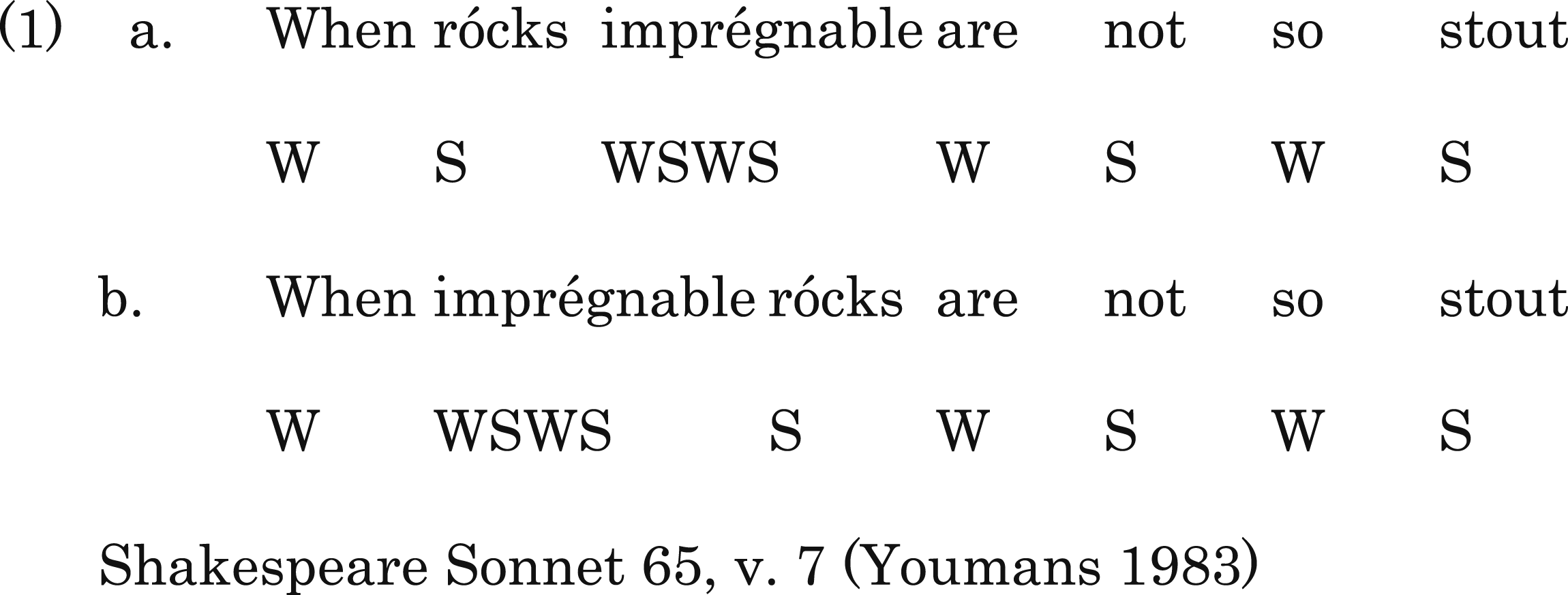
The form ‘rocks impregnable’ in (1a), which occurs in Shakespeare’s Sonnet 65, is less than fully grammatically felicitous to a native speaker of English, in which adjectives usually precede the nouns they qualify (not just in modern English, but also in 16th century prose). However, the reordered line given in (1b), where Youmans displays the non-inverted form ‘impregnable rocks,’ violates the basic principles governing the position of stress syllables in iambic pentameter (see Youmans, 1996 for a summary of these principles). Youmans (1983) finds that across the more than 500 inversions in Hamlet and the Sonnets, the overwhelming majority improve the meter of the verse, by repairing unmetrical positioning of stressed syllables.
Youmans (1996, 2009) also identifies rhyme as a motivator of inversions in Chaucer’s Canterbury Tales, as seen in (2). (2) Whan that Aprill with his shoures soote [soote shoures] ‘General Prologue’ to the Canterbury Tales, v. 1, Geoffrey Chaucer (Youmans, 2009: 116; see also Youmans, 1996)
As Youmans puts it, in this case ‘“rhyme enforceth”’ Chaucer’s inverted word order’, since the inverted noun-adjective order ‘shoures soote’ is preferred over the regular English order ‘soote shoures’ in order to provide a rhyme with ‘roote’ in the second line. Nonetheless, Youmans does not discuss this phenomenon in detail, being primarily concerned with the stress patterning in the Tales.
Fitzgerald (2007) reevaluates Youmans’ data on inversions in Shakespeare in light of the development of Optimality Theory (OT). As initially set forth in Prince and Smolensky (1993) in the domain of phonology, the grammar of OT consists of a set of ranked and violable constraints. Broadly speaking, OT attempts to describe all variation in linguistic form as reflecting the different possible rankings of such violable constraints. Given a single input and a (theoretically infinite) set of possible outputs, or ‘candidates,’ OT selects the ‘optimal’ output by ruling out candidates that violate higher ranked constraints until there is only one candidate left. If a constraint is high ranked, it is less likely to be violated by the optimal output; if it is outranked by many other constraints, it is more likely to be violated in the optimal output. The optimal output will thus vary depending on the ranking of the constraints.
This process is typically represented in tableaux, like that below which represents a simple set of constraints and candidates:
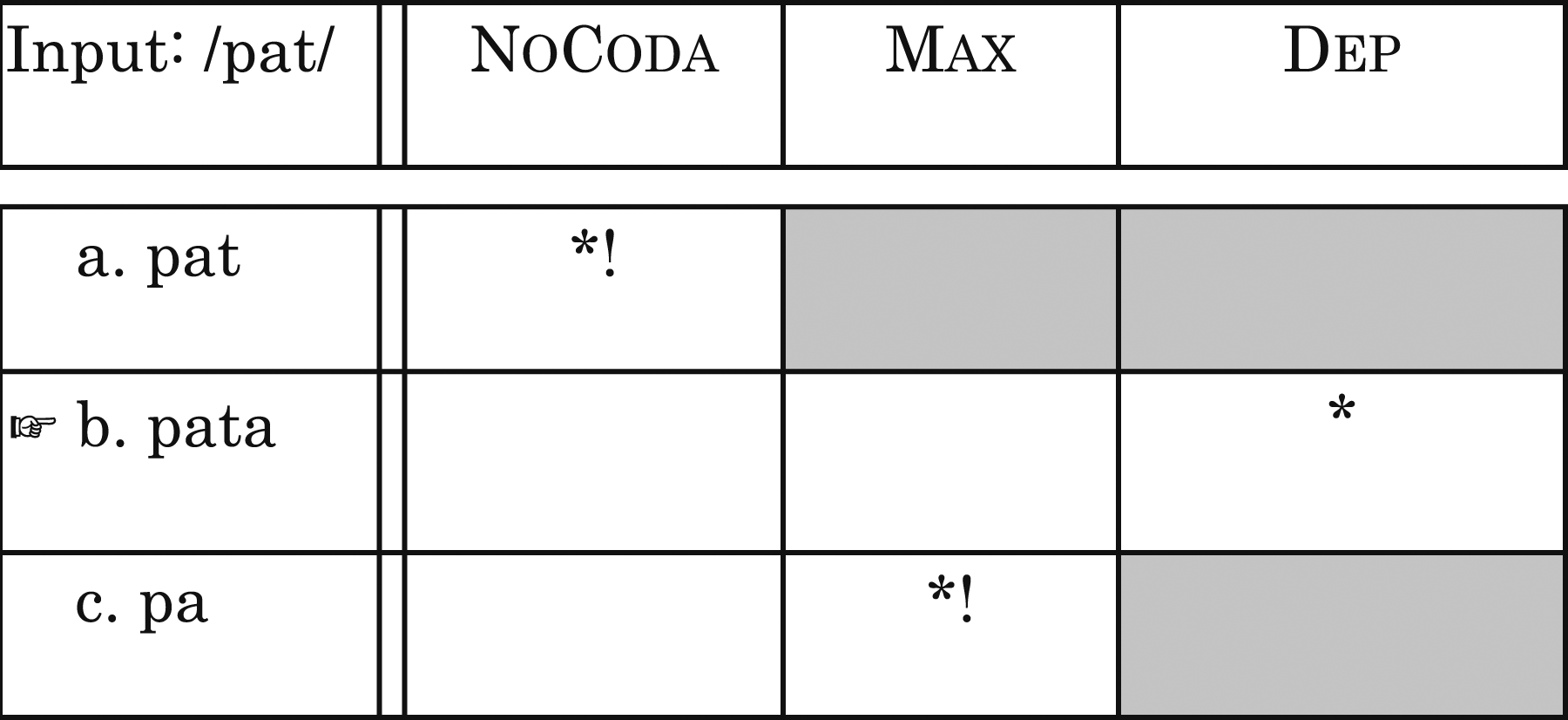
This example illustrates how an underlying morpheme/pat/in some fictional language is realized phonologically as [pata]. The constraints are
In applying the concepts and methodologies of OT to poetic data, Fitzgerald finds support for the basic schema of constraint rankings in (3): (3) Constraint Ranking Schema for Poetry S (Fitzgerald, 2007: 210)
In short, constraints on metrical well-formedness are interleaved between syntactic constraints in the poetic ranking, with less highly ranked constraints being violated when necessary to comply with the metre. This basic ranking accounts for the observation that not all inversions are permissible: for instance, inversions of nouns and their determiners are attested in nearly no English-language poetry (with the exception of e. e. cummings, see Youmans, 2009: 117), so the constraint that governs determiner-noun order must by high ranked.
Additional work by Youmans (2009) demonstrated a similar phenomenon in alliterative verse, using the alliterative Morte Arthure, a Middle English romance composed around 1400 (Benson, 1994). In the case of alliterative verse, the metrical improvements brought by inversions often involve ensuring an optimally alliterative arrangement of stressed syllables across the two halves of a line (for instance, lines whose stressed syllables alliterate AX/AX are preferred over those that alliterate AX/XA). Consider thus (4): (4) I may noghte wit of this woo, / for all this werlde ryche! … / [for all this ryche werlde] Alliterative Morte Arthure 708 (Youmans, 2009: 124)
The stressed syllables in (4) being wit, woo, werlde, and ryche, the line as in the original poem alliterates w-w/w-r while exhibiting the inversion ‘werlde ryche.’ Youmans’ regularised line with ‘ryche werlde’ instead alliterates w-w/r-w, which is not a preferred pattern.
Importantly, Youmans notes that the inverted form is preferred ‘if and only if the inversion optimizes the alliterative pattern’ (Youmans, 2009: 125). Thus, the line in (5), which alliterates r-r/r-s, opts for the expected ‘ryche stedys’ instead of the inversion ‘stedys ryche,’ since the inversion would less optimally alliterate r-r/s-r. (5) Arayede with his Romaynes / appon ryche stedys; … / *[appon stedys ryche] Alliterative Morte Arthure 11 (Youmans, 2009: 125)
We thus have clear evidence that inversions occur when certain syntactic constraints are outranked by metrical constraints, relating specifically to stress and rhyme in Shakespeare and Chaucer, and stress-alliteration in the Morte Arthure.
Most work on explaining (and not just describing) unusual syntax in poetry has focused on English—although see Devine and Stephens (2000) on hyperbaton in Greek and Latin, and Ferber’s (2019) overview discussion of syntactic quirks in English poetry, which refers to French, German, as well as Latin and Greek. Additionally, Thoms (2010) has criticized optimality theoretic and other generative approaches to unusual syntax in poetry (Fitzgerald, 2007, but also Dillon, 1975; O’Neil, 2001), arguing that such approaches, which posit a poetic grammar which interacts with the derivational core, are both empirically inadequate, and theoretically flawed. The generative project being fundamentally anchored in a theory of language acquisition (Chomsky, 1965 and subsequent work; see in particular Chomsky, 1995), Thoms (2010) argues it is anomalous to treat acquisition of poetic constraints on the same plane as acquisition of the basic constraints of grammar. Accordingly, I do not adopt any specific generative formula of syntactic constraints (eschewing Grimshaw’s 1997 more theoretically-motivated OT syntax), leaving open the possibility that the processes argued for here are not actually part of the core grammar, but rather driven by realizational concerns at or beyond the phonological interface of the grammar. However, as I will show, the descriptive adequacy of the optimality theoretic model is quite solid in (traditional) Welsh poetry, at least with respect to the two phenomena analysed here—I therefore adopt this approach, notwithstanding the broader question of what kind of process the model reflects.
3. The data
Turning to Welsh, the cywyddau of late medieval poets, foremost among them Dafydd ap Gwilym, provide fertile ground for extending an Optimality-based analysis of poetic language. Traditional Welsh poetry has always been very formally intricate, and never more so than in the era of the cywyddwyr. By the high medieval period (from the eleventh century on), all Welsh verse forms were syllabic at their core, having evolved from the accentual verse forms found in earlier texts, such as the Gododdin corpus (Klar and Sweetser, 1988). Accordingly, the cywydd is essentially syllabic, with stress-metrical influences: the specific form employed by Dafydd is composed of rhyming couplets of seven-syllable verses, in which the rhyming syllable is stressed in one verse and unstressed in the other.
Additionally, in its ideal form, all verses of a cywydd are composed in accordance with one of a set of styles of cynghanedd, or ‘harmony.’ These styles of cynghanedd, as described by Bromwich (1982: xv–xvi), can be broadly divided into those based on internal rhyme, and those based on alliterative patterns within the verse. In the following examples, and for the rest of the paper, I will indicate important rhymes (both internal and end-rhymes) in
Cynghanedd lusg, or ‘dragging’ cynghanedd, relies on internal rhyme, in which a stressed penultimate syllable must rhyme with a preceding syllable in the same line, as seen in (6). (6) Pell y clýw ‘far off across the lands is heard’ Y Ceiliog Bronfraith, v. 9
Hammond (2012) points out that the ‘penultimate syllable’ does not have to correspond to a conventional syllabic constituent, as indeed, -ir- crosses a syllable boundary in ti-roedd. See his discussion of how this can be accounted for as part of the mechanism of rhyme.
Cynghanedd groes and draws, that is, ‘cross’ and ‘across’ cynghanedd, rely on a repeating pattern of alliteration within the line, divided into two halves. In cynghanedd groes, illustrated in (7), the consonants in the first half of the line alliterate in order with those in the second half of the line. (7) Y ‘Fair Seagull on the tide, in truth’ Yr Wylan, v. 1
In (7), the line can be divided in two as indicated, whose consonants correspond exactly in the following sequence:/r-l-n-d/. In cynghanedd draws, illustrated in (8), the alliterated consonants in the second half of the line are preceded by one or more non-alliterated consonants. (8) ‘nor is there further word of him who scares off love’ Cystudd Cariad, v. 20
As we can see, the line in (8) repeats the consonant sequence/d-r-v-r-s/in both its halves, but the second sequence is preceded by an additional/m/.
Finally, cynghanedd sain, or ‘sound’ cynghanedd, invokes a combination of internal rhyme and alliteration within a line divided in three: the first two thirds of the line rhyme, while the last word alliterates with a word in the second third. This type of cynghanedd is illustrated in (9). (9) I’m clusti ‘in my ears—pennies of memory—’ Y Dylluan, v. 10
As can be seen by comparing the varied lines given in (6)–(9), a line does not need to obey all types of cynghanedd. However, nearly all lines in Dafydd’s cywyddau obey one of the types of cynghanedd (Bromwich, 1982: xvi), in addition to the other formal requirements of the form, that is, heptasyllabism and stress-alternating end-rhyme. 2
The following analysis is based on a selection of nine cywyddau totalling 398 lines of poetry, namely Parry’s (1952) poems nos. 22, 26, 28, 63, 90, 114, 115, 118, and 122. 3 The choice of poems was partly due to their forming (minus no. 90) a thematically-related section in Bromwich’s (1982) edition (III. Birds and Animals), and partly due to their containing less dialogue (thereby reducing another potential layer of discourse constraints). Written in Early Modern Welsh (1300–1600), these poems, like most of Dafydd’s work, all display nearly perfect adherence to the metrical and verse exigences of the cywydd form, and are thus well suited to the type of analysis I propose.
In the following sections I mostly rely on the text of the poems represented in Thomas Parry’s (1952) Gwaith Dafydd ap Gwilym and Rachel Bromwich’s (1982) translations, supplemented by my own glosses. I have however also taken advantage of the resources of dafyddapgwilym.net (Johnston et al., 2007), in particular for reference to manuscript discrepancies. As Parry’s edition presents the poems in contemporary Welsh orthography, which is largely phonemic, I do not provide IPA transcriptions of the poetry—see Evans (1964) or Hannahs (2013) for discussions of the relationship between Welsh orthography and phonology. As a control text attesting to contemporaneous fourteenth century Early Modern Welsh prose, I refer to the Gramadegau’r Penceirddiaid, specifically the recension contained in the Red Book of Hergest (Oxford, Jesus College, MS 111) and edited by G. J. Williams and E. J. Jones (1934). Michaela Jacques’ (2020) dissertation provided a useful translation of this text.
4. Analysis of the cywyddau
If we take the cywydd form, as described in Section 3, to constitute a distinct sub-variety of linguistic expression within the umbrella of Early Modern Welsh, the presence of verse requirements constitutes the main formal constraint on the universe of possible ‘correct’ utterances, beyond strict grammaticality. We can redefine these verse requirements in terms of OT constraints—the seven-syllable constraint, the end-rhyme constraint, and the cynghanedd constraint, as follows:
In addition to these constraints, which I will term ‘verse constraints’ hereafter, I rely on a catch-all !
A note here on violability and universality. Considering that practically the entire corpus of Dafydd cywyddau studied conforms to the requirements of !
4.1 Adjective inversions
In Middle and Early Modern Welsh, just as in Modern Welsh, attributive adjectives follow the noun by default, as in (10). However, this ordering is not inviolable, as all adjectives may precede the noun, and some adjectives do so by default, such as hen ‘old’ and prif ‘chief’ (Evans, 1964: 37). (10) y gath ddu the cat black ‘the black cat’ (Borsley et al., 2007: 153) (11) hen gathod old cat- ‘old cats’ (Borsley et al., 2007: 23) (12) y prif ddyn the chief man ‘the chief man’ (Morris-Jones, 1913: 261)
Despite these lexical exceptions, and the broad allowance for adjectives to precede the noun, it is
Number and frequency of pre- and post-nominal attributive adjective constructions.
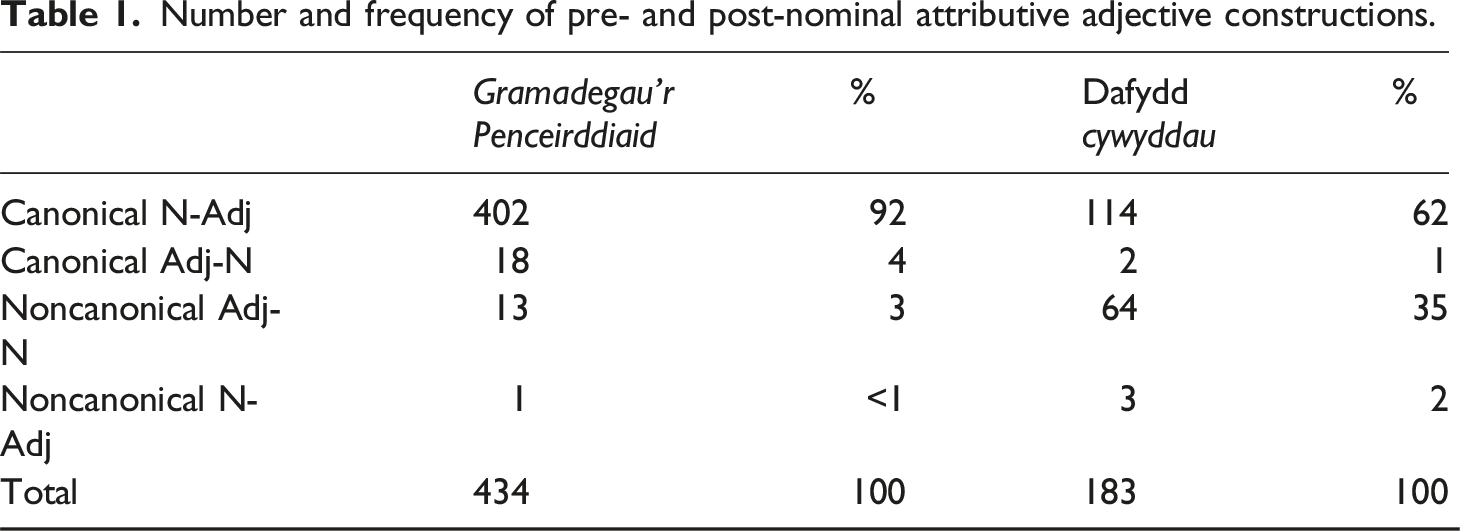
In fact, noncanonical adjective-noun order is over eight times more frequent in the poetry data than in the prose. An independent two-sample t test (t(8) = 5.97, p = .0003) confirms the significance of the difference in frequency of noncanonical adjective-noun order between the poetry and the prose. Although canonical order remains more frequent in the poetry, the difference is more than enough to warrant investigation into hypothetical verse motivations.
Take the line in (13), which exhibits the noncanonical adjective-noun order of the phrase deg loywiaith ‘diction fine and clear.’ (13) fair clear-language yesterday ‘[in] diction fine and clear, yesterday I heard [him];’ Y Ceiliog Bronfraith, v. 3 (Bromwich, 1982: 70–71, own translation)
The adjective teg (mutated to deg due to the morphosyntactic context) precedes the noun loywiaith, resulting in a clear instance of cynghanedd groes, with the repetition of the series /d-g-l/ in both halves of the line. The canonical order loywiaith deg, given in (14), would instead yield the mismatched sequences /l-θ-d/ and /d-g-l/, resulting in a line without cynghanedd. (14) Lóywiaith deg, doe a glýwais. clear-language fair yesterday ‘[in] diction fine and clear, yesterday I heard [him];’ Y Ceiliog Bronfraith, altered v. 3
To capture the fact that Dafydd opts for (13) over (14), we must split out a constraint N-A
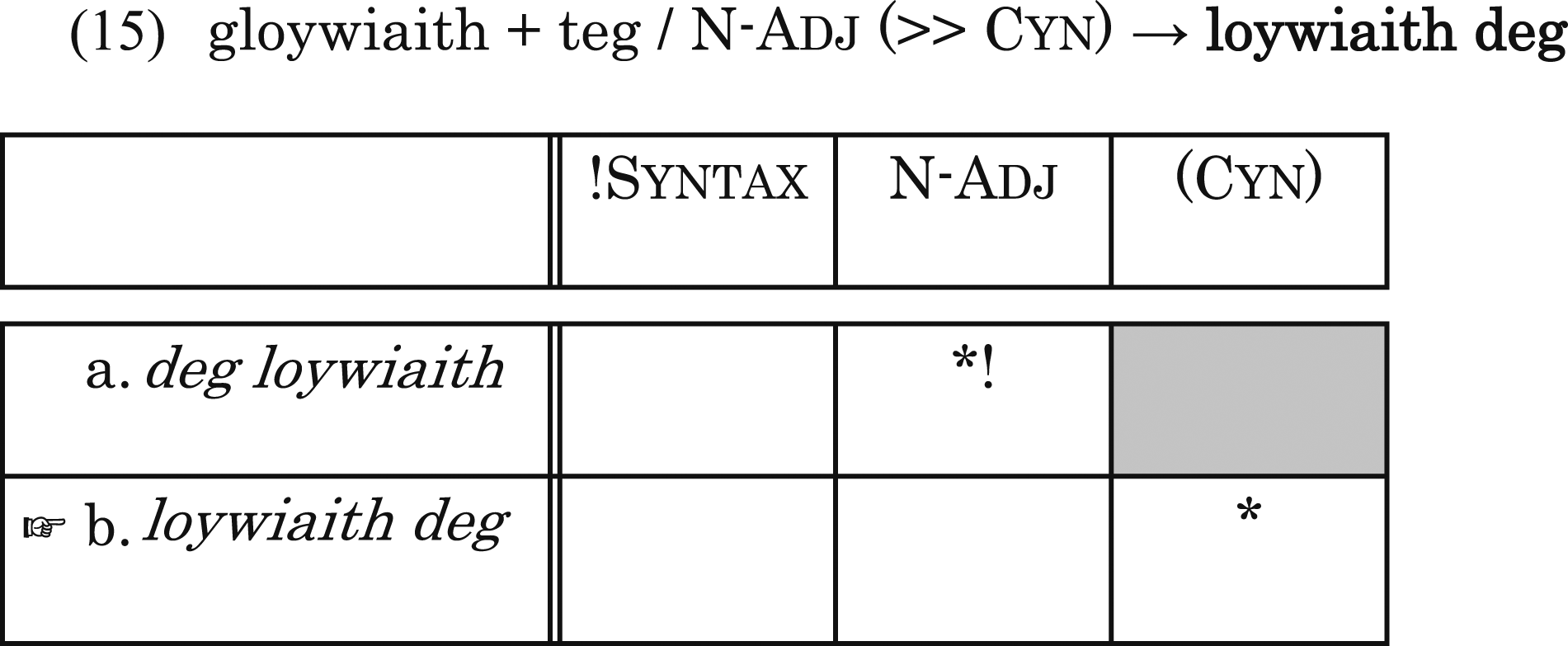
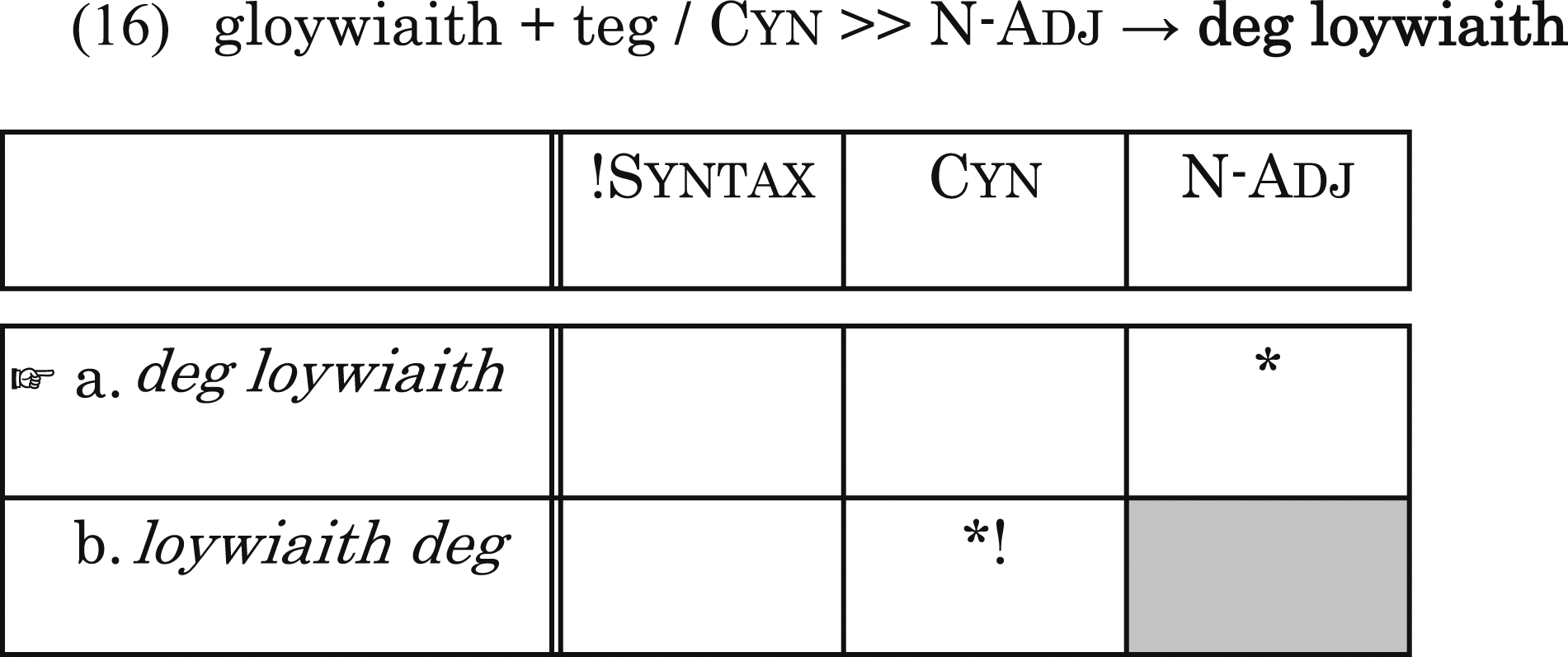
When
Now consider the line in (17), which displays two attributive constructions, cyfan fraint ‘completely privileged’ and aml gywraint gân ‘well-proportioned (lit. constant, ingenious) song,’ where both display one and two adjectives respectively noncanonically preceding the nouns braint and cân. In this case, both the original line in (17), and the alternative in which all adjectives are ordered after the noun they attach to, given in (18), fulfil (17) Cýfan fr whole privilege constant ingenious song ‘Completely privileged, with well-proportioned song,’ Yr Ehedydd, v. 29 (Bromwich, 1982: 76–77) (18) Braint cýf privilege whole song constant ingenious ‘Completely privileged, with well-proportioned song,’ Yr Ehedydd, altered v. 29
Although the alternative line in (18) is well-formed with respect to cynghanedd, it crucially fails to rhyme as a whole with its couplet partner, Copa llwyd yw’r cap llyd
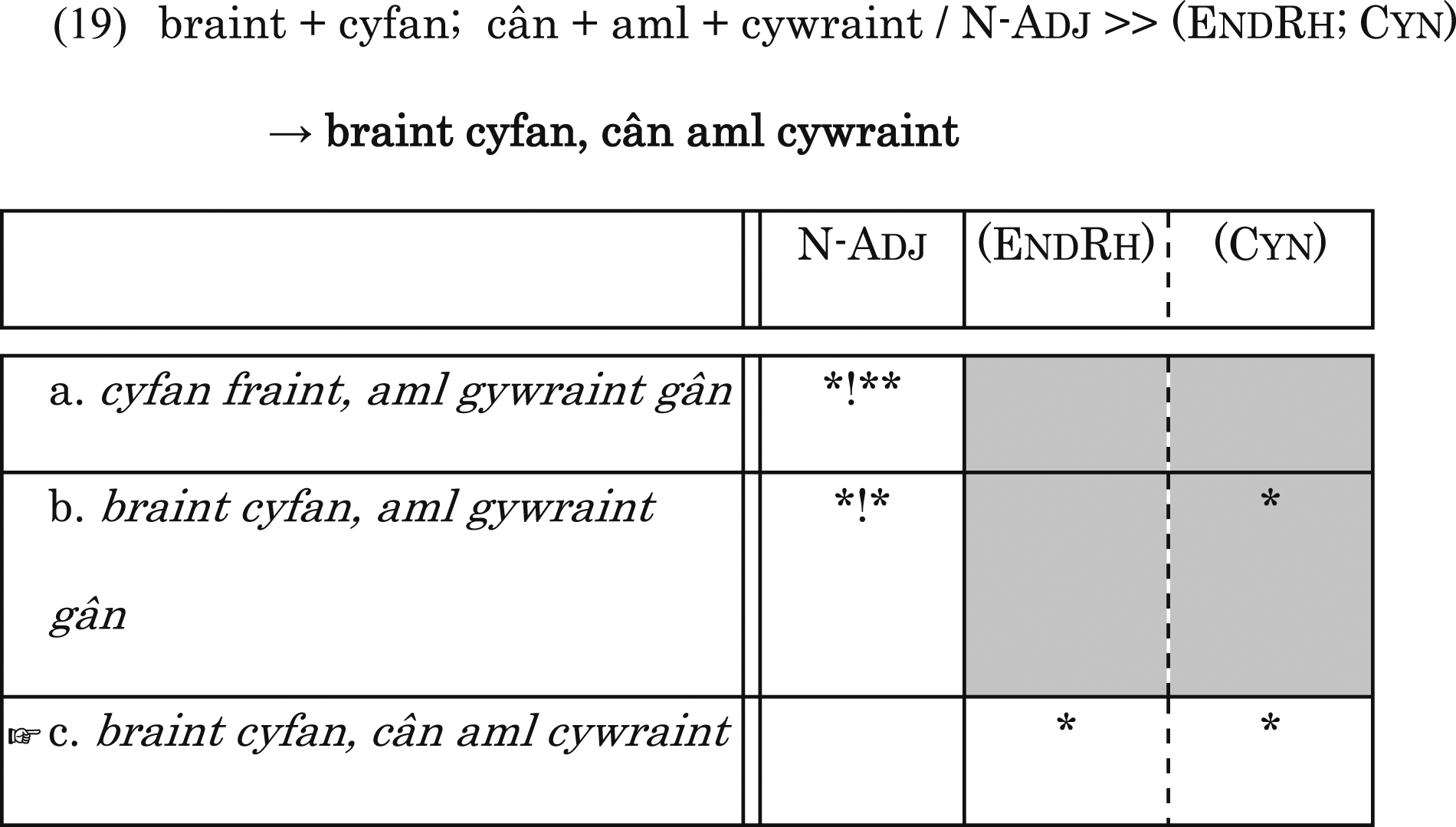
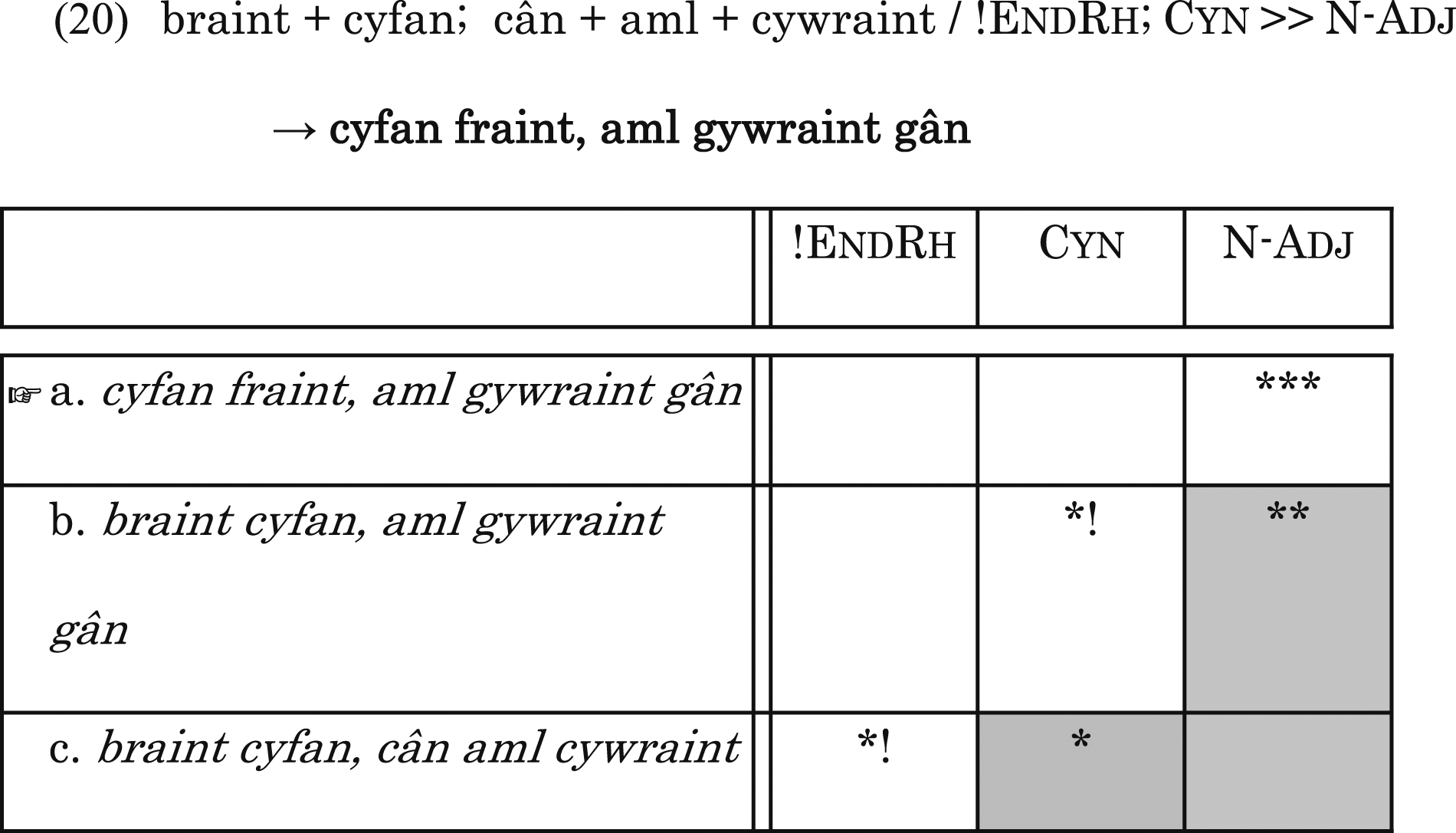
When
Take also the line in (21). As in example (13), this line violates (21) Cúriodd anwád pine- ‘My fickle heart has pined.’ Cystudd Cariad, v. 1 (Bromwich, 1982: 194–195) (22) Cúriodd cálon anwádal pine- ‘My fickle heart has pined.’ Cystudd Cariad, altered v. 1
While (22) satisfies
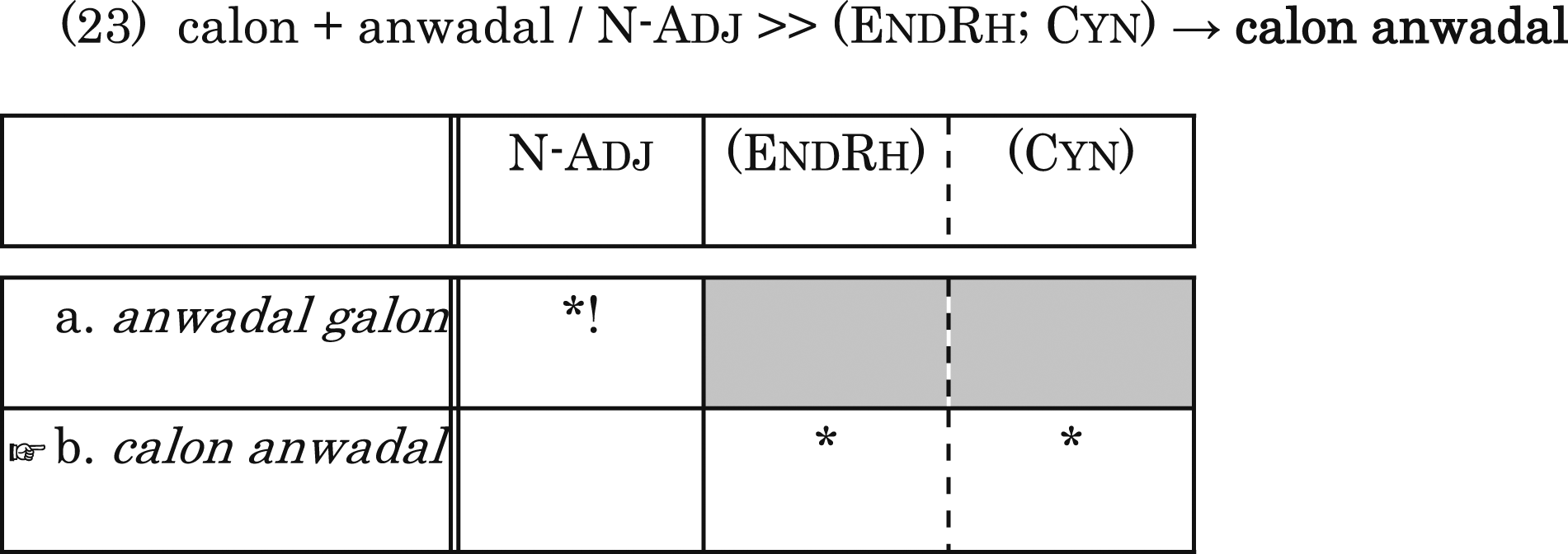
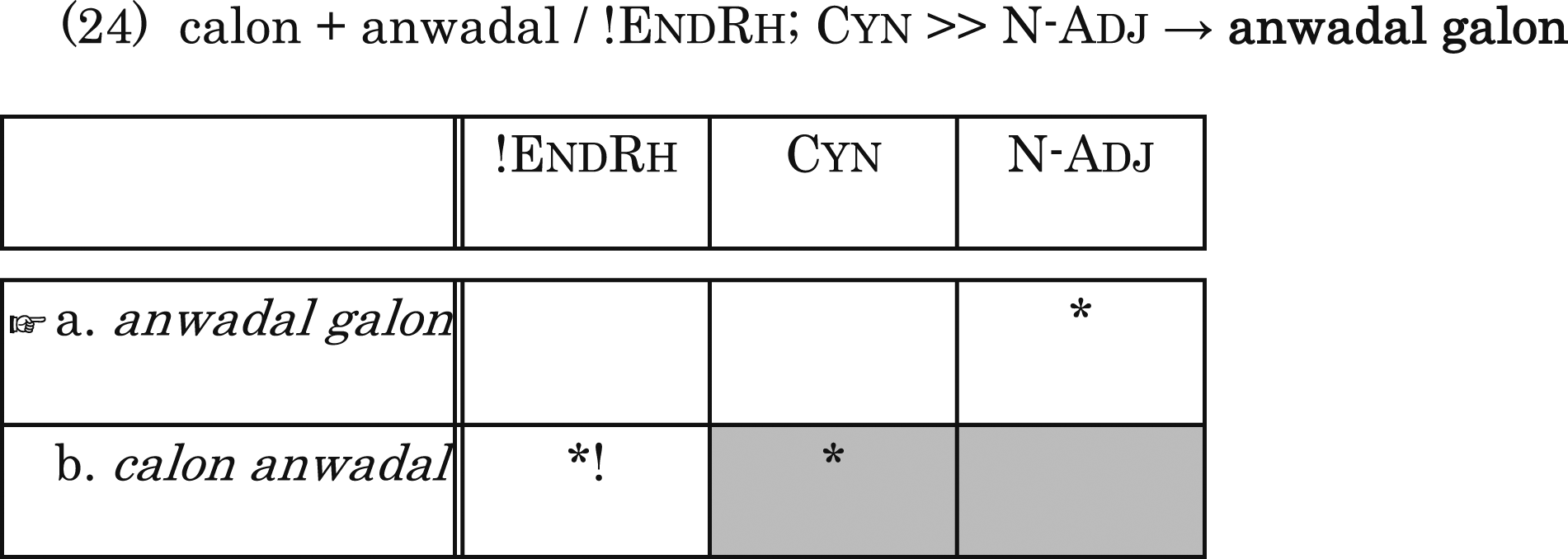
Comparing the tableaux in (23) and (24), we see that, when
To generalize, so far we have seen that ranking !
First, let us take the line in (25), which includes a canonically ordered attributive construction pencerdd gloyw ‘bright poet.’ The line also bears cynghanedd sain, and the end-rhyme (while of course fulfilled) does not depend on either of the words in the attributive construction, since the latter does not abut the right edge of the line. The line thus satisfies both (25) Pénc chief-bard bright passion glen-forest ‘bright poet of passion in the wooded glen.’ Y Ceiliog Bronfraith, v. 12 (Bromwich, 1982: 70–71) (26) Glóyw béncerdd ángerdd glýngoed bright head-bard passion glen-forest ‘bright poet of passion in the wooded glen.’ Y Ceiliog Bronfraith, alternate v. 12
Not only does (26) violate
A similar picture can be painted for (27). The line given in (27) includes the canonically ordered attributive construction swydd gu ‘dear office.’ Sitting at the right edge of the line, g (27) Bryd y s mind ‘You have a mind …[, dear office]’ Yr Ehedydd, v. 9 (Bromwich, 1982: 76–77, rearranged) (28) Br mind ‘You have a mind …[, dear office]’ Yr Ehedydd, v. 9 alternate
The alternative line in (28) in fact satisfies
Finally, take the line in (29), which contains a canonically ordered attributive construction, dylluan deg ‘handsome owl.’ The line bears cynghanedd sain, and d (29) Tru pitiful to the owl handsome ‘It is a pity that the handsome Owl’ Y Dylluan, v. 1 (Bromwich, 1982: 84–85) (30) Truan i 'r deg ddylluan pitiful to the handsome owl ‘It is a pity that the handsome Owl’ Y Dylluan, v. 1 alternate
In this case, the alternative line in (30) neither bears cynghanedd, nor rhymes in -eg, failing to satisfy either of the verse constraints. In these three pairs of examples, the alternatives which contain noncanonical ordering of the adjective obviously fail to satisfy
Indeed, in the Dafydd cywyddau corpus, whether the adjective appears before or after the noun in attributive constructions is governed strongly by whether or not the canonical (noun-adjective) order causes the line to violate a verse constraint (or several). Out of 64 instances of noncanonical order, 61 (95%) repair what would otherwise be a line in violation of one or more verse constraints. Where the adjective occurs in canonical position, the verse constraints are already satisfied, and in fact, in 94 out of 114 (83%) instances, the noncanonical alternative would violate one or more verse constraints. The overwhelming majority (20 out of 23, or 87%) of instances where the canonical and noncanonical alternatives are equal with respect to the verse constraints surface as canonical noun-adjective constructions, and there are no instances where a (canonical or noncanonical) construction that violates more verse constraints is preferred over an alternative that violates less.
To close this section, let us take a closer look at the interaction of (31) Gwell yt, myn M better to-2 near-hand fire the man grey old ‘better it were for you, by Mary of eloquent fame, to be beside the fire, you old grey man,’ Cyngor y Biogen, vv. 37–38 (Bromwich, 1982: 82–83)
We see in (31) that line 37 satisfies both
4.2 Dropped particles
Attributive constructions are not the only place where the verse constraints seem to interact with syntactic well-formedness in Dafydd’s cywyddau. Certain preverbal particles also appear to be sensitive to the verse constraints, being omitted when it is poetically expedient, since they invariably contribute a syllable to the utterance.
Conjugated, non-imperative verbs in Middle and Early Modern Welsh are canonically preceded by a preverbal particle, as is often the case in verb-initial languages (Bury, 2005), which may, but is not required to, encode aspect, polarity, or discourse function, depending on its form (Evans, 1964: 166–179). The most common form of the simple affirmative particle in Middle Welsh verb-first (V1) clauses is y or yd—increasing supplanted by yr in the Early Modern Welsh period. The particle a, which introduces certain relative clauses, also precedes the verb in verb-second (V2) sentences with a fronted subject or object. Y(d)/yr also introduces all other relative clauses and V2 sentences with a fronted adverb or adverbial expression.
The affirmative particles are replaced in negative clauses by negative particles: the default negative particle takes the form ny(t) (also spelled ni(d)), preceding the verb at the beginning of the sentence, when introducing a relative clause, and when preceded by a fronted element (Evans, 1964: 60–74, 166–179). Imperatives and the copula yw do not take affirmative particles, and are preceded only by the negative particle na(c). The particles are usually posited to occur in C (complementizer position) in the generative approach (Meelen, 2020; Willis, 1998), with affirmative particles merging as C heads and negative particles moving from their base-generated position in the T (tense, i.e., inflectional) domain.
However, the (regularly required, non-negative) particles have a tendency to be absent in Dafydd’s cywyddau. Out of 175 conjugated verbs in the Dafydd corpus, only 78 occur with a particle (45%). That said, there are multiple reasons for the presence or absence of particles that complicate matters. First, and most obviously, negative particles must surface since their absence would fundamentally change the semantics of the sentence, given that Middle (and Early Modern) Welsh relies on the negative particles to convey negation. Second, as stated above, (affirmative) imperative verbs never take particles. Third, and less obviously, the particles tend to be omitted when following another functional element such as the conjunctions (cysylltiadau) o(d) ‘if,’ cyn ‘when,’ pan ‘when,’ etc.: in the Dafydd corpus, only one out of 23 verbs preceded by such an element exhibits a particle.
When we leave out verbs with negative particles, imperatives, and verbs following cysylltiadau, 49 out of the 95 remaining verbs occur with a particle (52%). In the prose Grammadegau’r Penceirddiaid, on the other hand, 256 out of 280 (non-negative, non-imperative) verbs not preceded by a cysylltiad occur with a particle (91%). This large discrepancy—again, confirmed to be significant by an independent two-sample t test (t(8) = −5.65, p = .0005)—is enough to prompt an investigation into possible verse motivations for omitting the particle, heptasyllabism being the prime candidate.
Take the examples in (32)–(33). (32) Sy-gá-nai 'r bi, cý-ni cwyn, mutter- ‘The Magpie muttered—indictment of [my] anguish—’ Cyngor y Biogen v. 33 (Bromwich, 1982: 80–81) (33) Cy-wéir-glod bun, câi 'r glod bell, proper.order-praise maiden get. praise far-off ‘[There is] a properly-praised maiden, who receives far-off praise’ Yr Wylan v. 11 (Bromwich, 1982: 74–75, own translation)
Both of these lines, which conform to the heptasyllabic requirement of the cywydd form, include a conjugated non-imperative, non-negative polarity verb which lacks a preverbal particle. In (32), syganai heads a normal V1 main clause, while in (33), câi heads an embedded (proper) relative clause. If the particles were to appear, the lines would be too long.
It is worth noting that, (33) notwithstanding, nearly all verbs which lack a preverbal particle in the Dafydd corpus head normal (V1) main clauses, while, conversely, nearly all verbs which
Note that for the sake of clarity, I refer to y(d)/yr and a simply as preverbal particles, but this should be understood as including both their function as particles in normal and abnormal main clauses, and as relativisers in subordinate clauses—it is generally accepted that there is no difference in their morphophonological form between these functions (Borsley et al., 2007: 287), with the caveat that, as discussed in the previous paragraph, there do seem to be distributional differences between V1 main clausal and V2 main clausal/relative clausal particles.
Since it appears that the syntactic well-formedness of cywydd lines can be disrupted by the omission of one or more ordinarily required preverbal particles, we can conclude that at least one piece of syntactic well-formedness and syllabic verse requirements are potentially at odds here, since the syntax wants the preverbal particles, but the verse requirements may want to omit the particle(s).
5
We must again break out a constraint
Equipped with (34) Ád-waen ef o 'i fedw nẃy-foed (Syll = 7) know. ‘I know him, from his birch-wood trysting place’ Y Ceiliog Bronfraith, v. 23 (Bromwich, 1982: 70–71) (35) Yd ád-waen ef o 'i fedw nẃy-foed (Syll = 8) ‘I know him, from his birch-wood trysting place’ Y Ceiliog Bronfraith, altered v. 23
The actual line in (34) violates
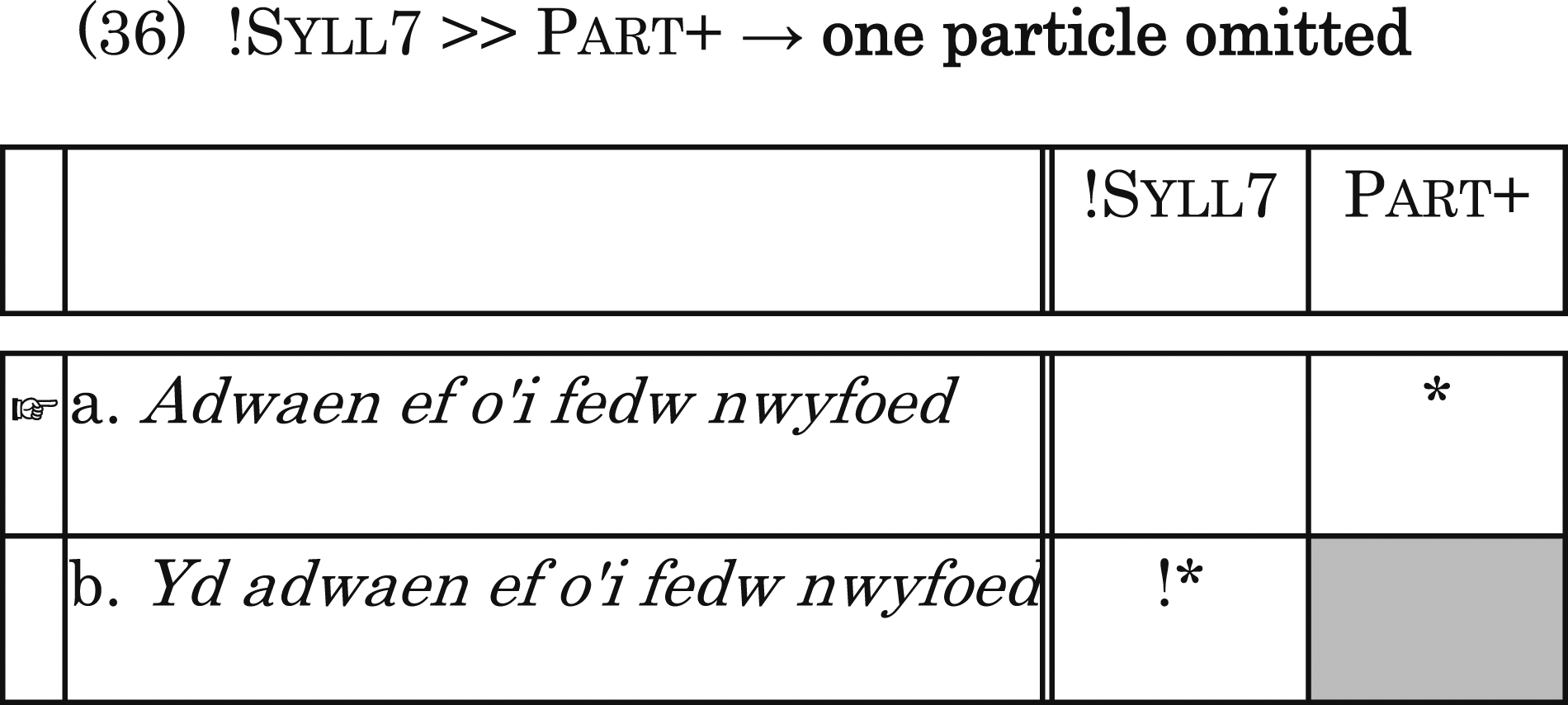
The requirements of ! (37) Gwé-lwn, pan ed-rý-chwn draw, (Syll = 7) see- ‘When I looked out yonder I saw’ Y Llwynog, v. 6 (Bromwich, 1982: 88–89)
Neither conjugated verbs in (37) occur with their appropriate particles (y and yr respectively): their absence however allows the line to obey !
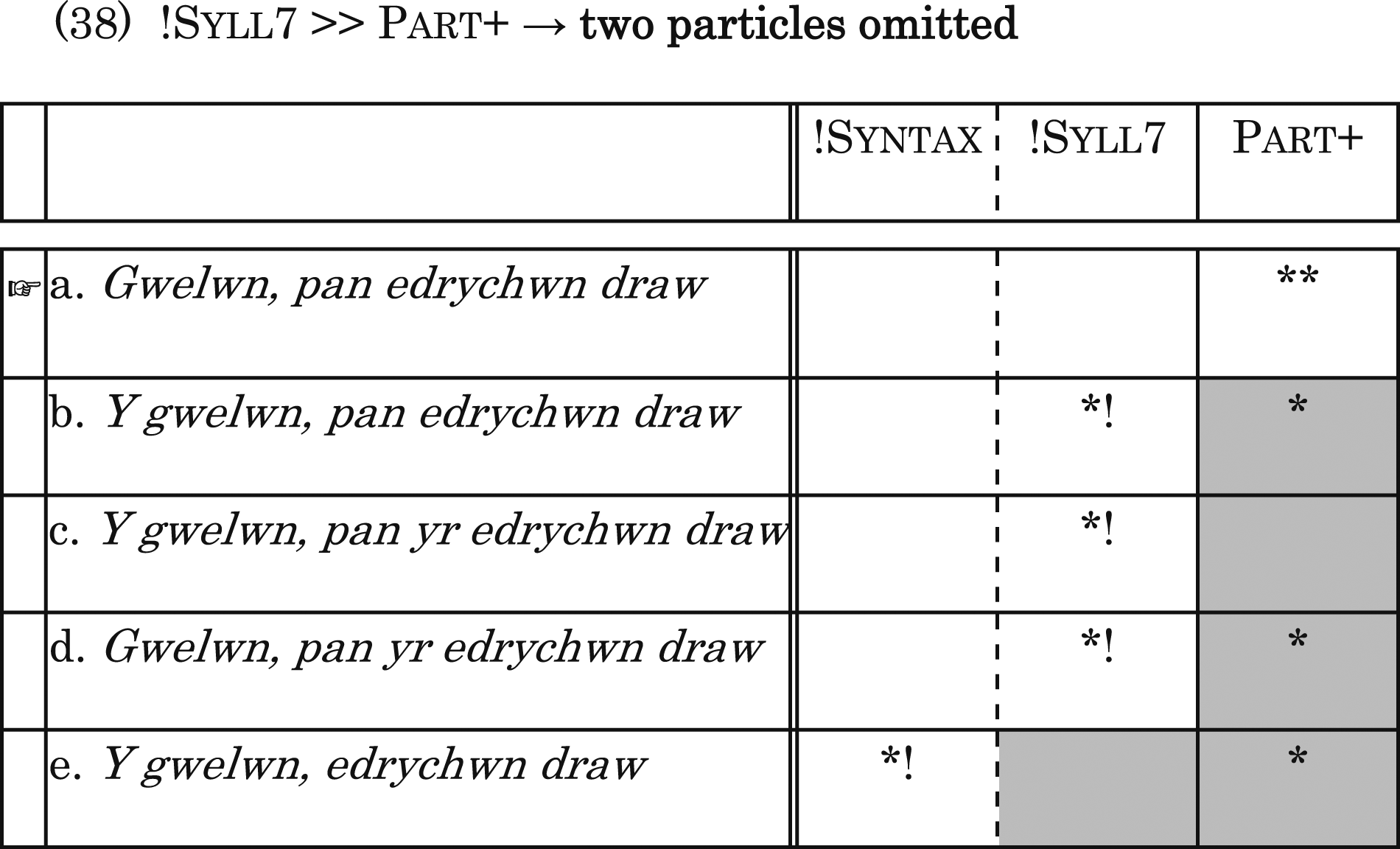
The option where neither verb is preceded by a preverbal particle is preferred over alternatives where either or both particle(s) appear(s), as well as the last option where another functional element (the preposition pan ‘when’) is absent, since the latter is indispensable to the interpretability of the utterance in Welsh.
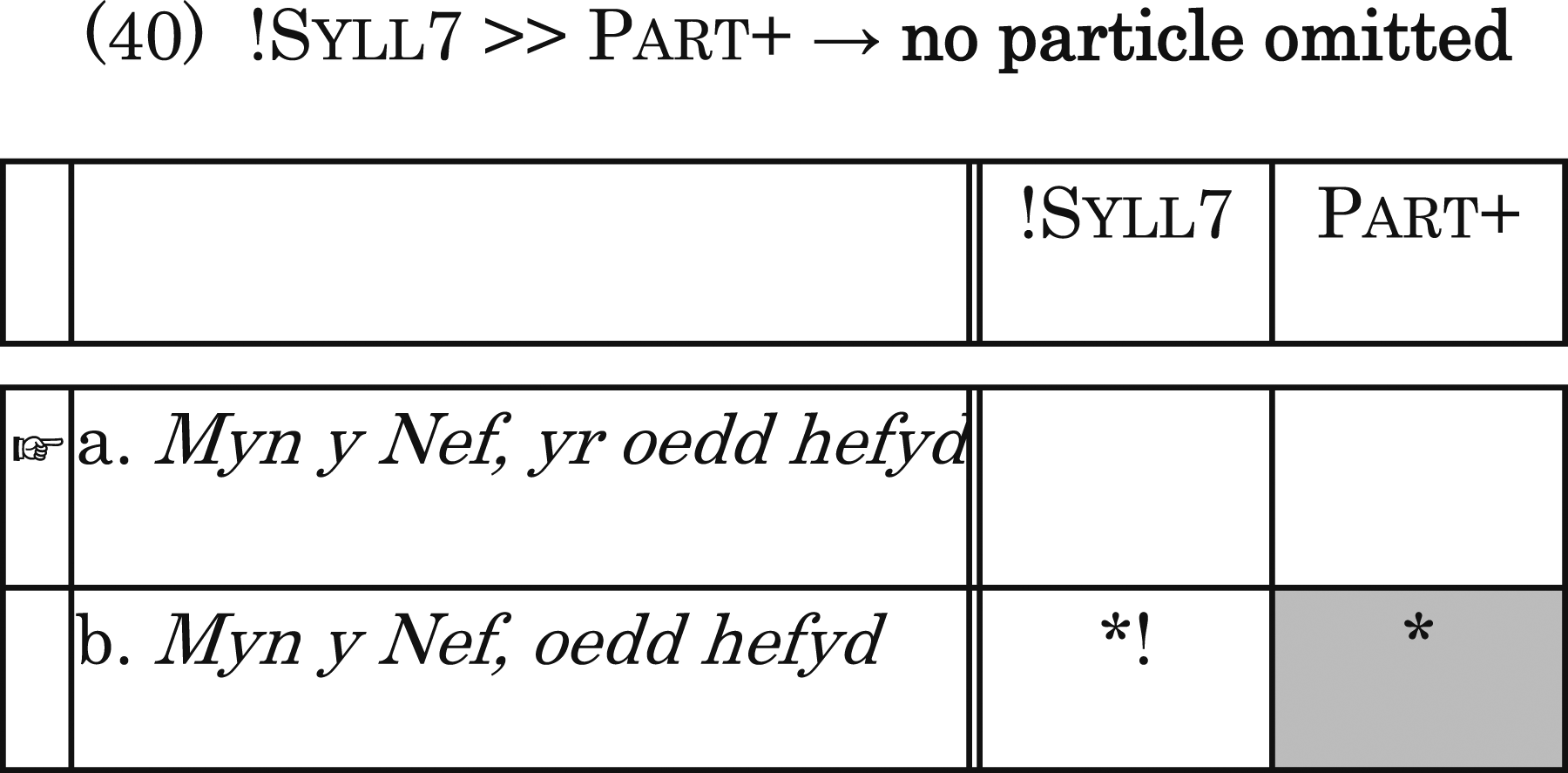
Once again, however, as pointed out with respect to the interaction of (39) Myn y Nef, yr oedd héfyd (Syll = 7) by the heaven, y bi… the magpie ‘By Heaven, there was also / the Magpie…’ Cyngor y Biogen, vv. 27–28 (Bromwich, 1982: 80–81)
The line in (39), Myn y Nef, yr oedd hefyd, fulfils
Finally, for the sake of completeness, we must see how the negative particles are preserved from omission. Take line 21 of ‘Y Llwynog,’ in (41). (41) Llíd-iais, nid ar-swý-dais hyn, (Syll = 7) become.angry- …wrth fadyn …at fox ‘I became [straightway] angry at the Fox, … but not dismayed at that’ Y Llwynog, vv. 21–22 (Bromwich, 1982: 88–89)
This utterance provides a useful illustration of how the constraint on negative interpretation !
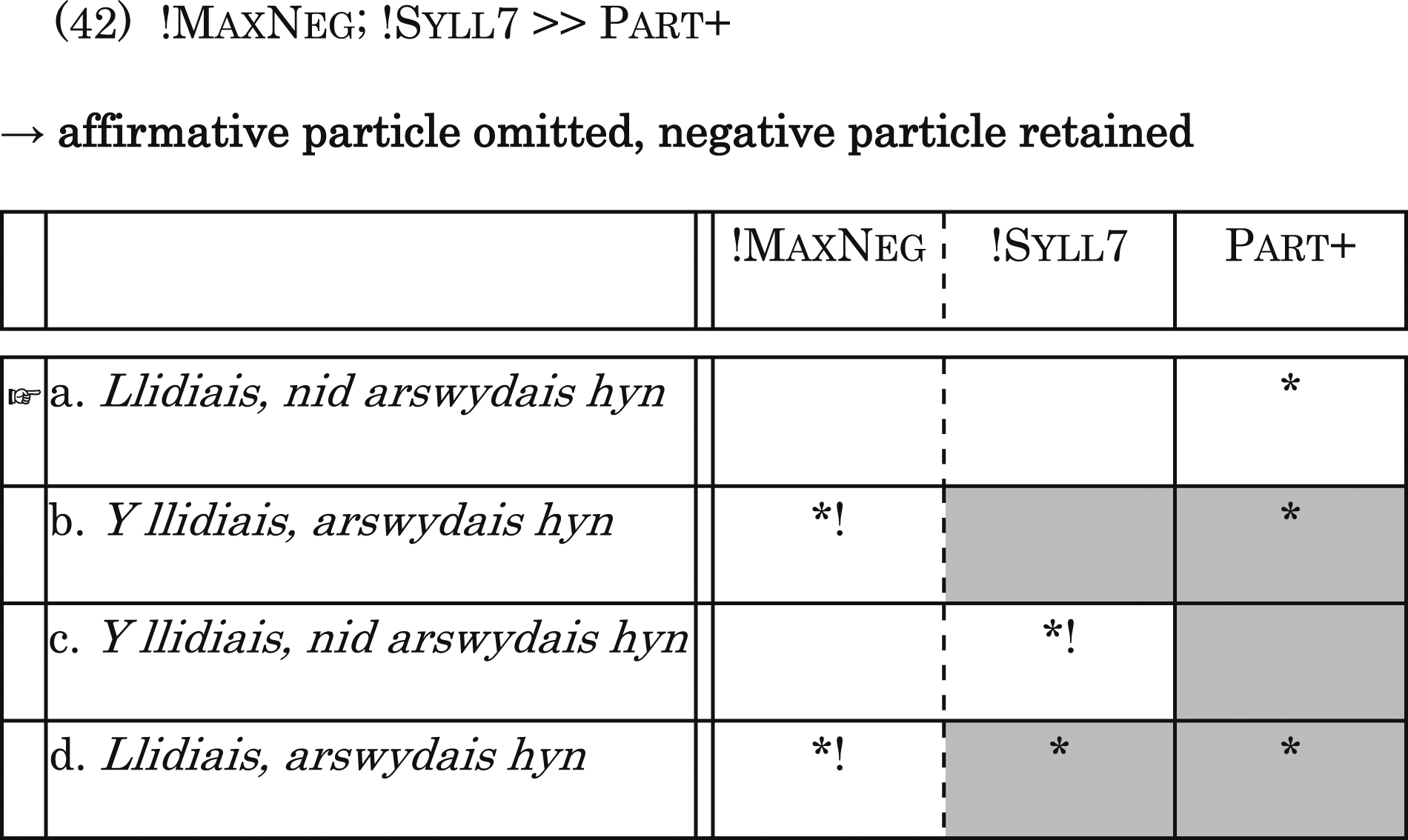
As illustrated by the tableau in (42), the options which retain either both or neither of the two verbs’ preverbal particles (y and nid) violate !
4.3 Summary of analysis
Ranking of syntactic and verse constraints bearing on Welsh poetry in the cywydd form.
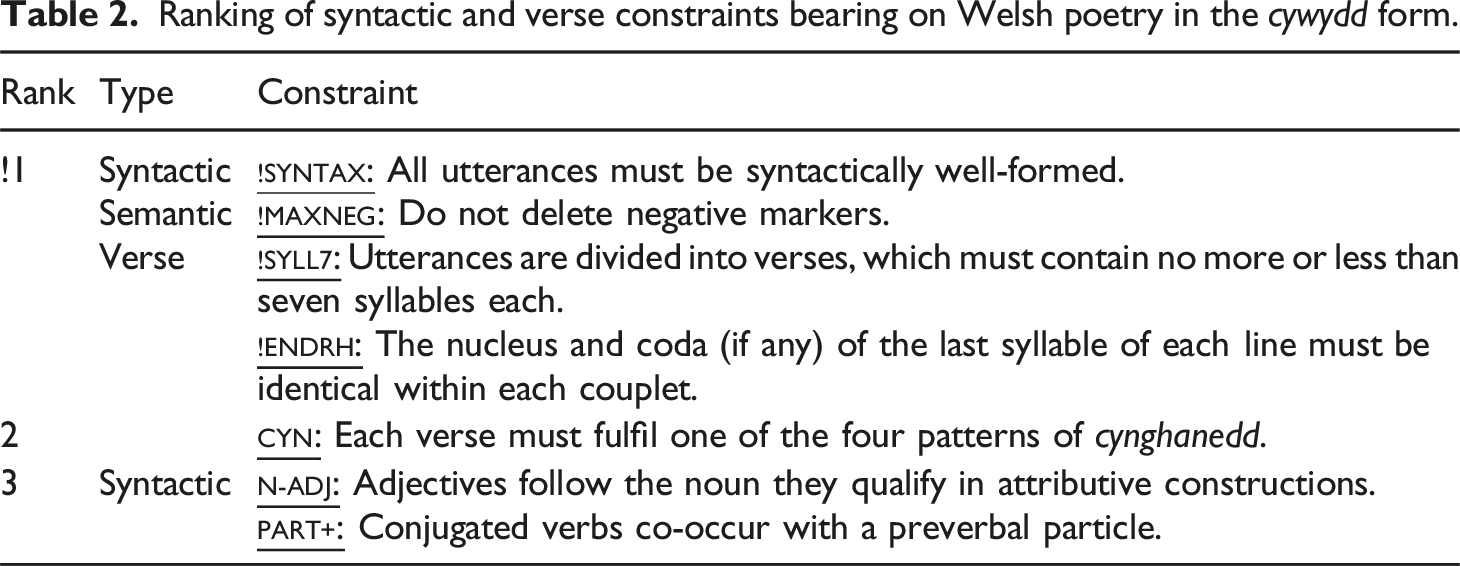
In the prose/spoken grammar, the weakness of the lower-ranked syntactic constraints is less apparent, because the verse constraints do not bear (either because they do not exist in prose/spoken varieties, or because they are violably ranked below all other constraints).
5. Conclusions and reflections
Interleaving verse constraints between higher and lower ranked constraints on syntactic well-formedness neatly accounts for the appearance of certain specifically defined deviations from the normative prose/spoken form of a language in its poetic forms. It also provides a useful diagnostic for
One interesting point for reflection is that, in manipulating the verse constraints (of which they are fully conscious, as trained professionals) and the lower ranked syntactic constraints, the cywyddwyr, and indeed all poets, display a clear consciousness of the stylistic import of grammatical rules—despite conventional linguistic theory considering the grammar to be a largely unconscious faculty of the brain. Poetic data thus appears to sit directly on the line between conscious and unconscious linguistic production, shedding light on the extent of poets’ (and speakers’) knowledge of their own language faculty.
Footnotes
Acknowledgements
I would like to thank Eve Sweetser, who advised my undergraduate honour’s thesis in the Department of Linguistics at UC Berkeley, for which the research in this article was originally performed. I would also like to thank Myriah Williams for her assistance with the Welsh, and Line Mikkelsen, Hannah Sande, Kristen Hanson, and two anonymous reviewers for their generous input and suggestions. Thank you also to Bryce Wallace, Franco Liu, and Louis Careri for helpful discussions over the course of this project.
Declaration of conflicting interests
The author(s) declared no potential conflicts of interest with respect to the research, authorship, and/or publication of this article.
Funding
The author(s) received no financial support for the research, authorship, and/or publication of this article.
