



Abstract
In Jane Austen’s novels conversation provides internal evidence of the nature of characters, both moral and social (Morini, 2009). Among the interplay of speech presentation forms (Bray, 2018; Page, 1972), Narrative Report of Speech Acts (Leech and Short, 2007) is still underresearched (Busse, 2020) as a characterisation resource. Research on speech reports in inquit formulae has focused on illocutionary features (Austin, 1962; Searle and Vanderveken, 1985). However, speech reports also introduce the intersubjective stances adopted by characters and by the narrator, i.e., their receptiveness to disagreeing positions. As engagement resources (Martin and White, 2005), they construct interpersonal styles and offer cues into the narrator’s own stance toward the characters. Such meaning complexes are a challenge for literary translators. For this study, 55 instances of NRSA were sampled from three chapters of Mansfield Park and their correspondences in two Spanish and two German translations. The original text and the translations display remarkable lexical richness, with 36 instances overtly expressing illocutionary force. Characterisation cues appear at the character level of discourse, through the illocutionary features and engagement types attributed to characters (e.g. monoglossic, heteroglossic), and also on the narrator level of discourse, through linguistic co-textual choices weakening the endorsement of the character. All four translations contain shifts affecting the characterisation potential such as changes in a character’s stance, the early disclosure of a character’s attitude, and the insertion of explicit narratorial evaluation of a character. These findings are applicable in stylistics as well as in translation assessment and pedagogy.
Keywords
1. Introduction
In Jane Austen’s Mansfield Park dialogue scenes materialise the confrontation of values and principles held by characters as they are tested by plot developments. 1 Conversation provides ‘internal evidence’ for the reader to judge the ‘moral and social nature of characters’ (Morini, 2009: 9), to form a ‘value picture’ (Leech and Short, 2007: 220), and ultimately to become educated about their own values and prejudices.
According to Page, 2011: 121), Austen was aware of the technical problem posed by dialogue-writing, namely ‘how to give the impression of a sequence of speeches without such loss of narrative pace as might be damaging to the rhythm of an episode.’ Of all speech presentation forms, Narrative Report of Speech Acts (Leech and Short, 2007: 260) is considered one of the ‘summarizing categories’ (Busse, 2020: 82). Semino and Short (2004: 12) define it, under the name Narrator’s Representation of Speech Acts, as the mode through which ‘the speech act value of the utterance presented is indicated, often with a specification of the topic of the speech act, but no more elaboration of what was said in the anterior discourse is made.’ NRSA nears full control by the narrator because his or her claim to faithfulness to the ‘original’ utterance is lower than in any other speech reporting or (re)presentation form. NRSA plays a wide range of roles, from narrative progression to the display of characters’ performance of social functions through speech acts, as Busse (2020: 78) found in her annotated corpus of 19th century narrative fiction. It is a frequent speech presentation form, as attested in corpus studies: it ranks second in the fiction subcorpus of Semino and Short (2004: 68) and third in Busse (2020). Despite its importance, it remains an underresearched form in Austen’s refinement of the ‘free mixture’ (Page, 2011: 123) or ‘subtle interplay of categories of speech representation’ (Bray, 2018: 34), already present in the writings of other 18th century authors (Spencer, 2009).
In literary fiction, where discourse is structured through many different layers (Leech and Short, 2007: 206–218 and 300–301), NRSA is a single source of input for characterisation that must be interpreted on two levels, the narrator-reader level and the character(-character) level. On the latter, speech reporting expressions (verbs and nouns) encode a character’s locution of an utterance, which in Speech Act theory (Austin, 1962) entails the performance of a function, an illocutionary act. Different types of functions are called ‘illocutionary forces’ (Austin, 1962: 100). Illocutionary force provides input for characterisation (Culpeper, 2001; Leech and Short, 2007; Locher and Jucker, 2017). As noted in Abrams and Harpham (2014: 373), ‘The utterances of the fictional characters—whether these are assertions or promises or marital vows—are held to be responsible to ordinary illocutionary commitments.’ Austen’s technique has been studied from this speaker-based perspective on the communicative act through Speech Act Theory (e.g. Nolan-Grant, 2009: 863) and related developments in pragmatics, such as Politeness Theory (e.g. Davidson, 2004; Morini, 2009).
On the narrator-reader level, the reader plays an active role in the construction of meaning because the significance of a given speech act reported by the narrator depends on the potential of the text to appeal to shared values and standards of evaluation between author and reader (Leech and Short, 2007: 222). This dialogic relationship is a key component of the meaning of NRSA, as the report projects the intersubjective stance of the author toward the contents of the report. This contribution to the ‘authorial tone’ (Leech and Short, 2007: 225) confers NRSA a distinctive advantage over other forms of speech presentation such as Direct Speech and requires for its analysis a combination of a speaker-based approach to deal with the illocutionary dimension and an addressee-based approach to discern the resources through which the narrator ‘engages’ with the reader and his or her value positions (Martin and White, 2005).
In Mansfield Park it is notoriously difficult to assess the narrator’s evaluative position, given the “web of ‘evaluative opacity’” (Morini, 2009: 65) weaved by means of unexpected lexical choices breaking an apparently predictable flow of discourse. This opacity challenges not only readers and analysts of the original work, but also literary translators aiming at the re-instantiation of the original text in its whole potential in another language (Farias de Souza, 2013: 580).
The reception of Jane Austen’s work in non-English speaking countries has been mediated through translations. These works offer valuable data concerning the extent to which the significance of her style is appreciated in different literary systems (see e.g. Mandal, 2009; Owen, 2018; Sørbø, 2018). Comparative translation research assesses the degree of equivalence between paired segments from the target and source texts, and identifies instances of variation on different levels, or ‘translation shifts’ (Van Leuven-Zwart, 1989, 1990). According to Rosa (2009: 231), ‘the most persistent pattern in the translation of narrative fiction is expected to be a transformation of participant profiles in general and of the narrator profile in particular, brought about by an accumulation of micro-structural shifts caused by translational procedures.’ This prediction seems to be borne out by the results of research on narrative forms such as Free Indirect Speech (FIS) in the translation of Austen’s works. For instance, in various Romance languages such as Catalan (Alsina, 2008), Portuguese (Rosa, 2009) and Spanish (Alsina, 2011; Zaro, 2006), FIS passages are rendered as either Direct or Indirect Speech, despite the respective target readerships’ familiarity with this form. Norwegian translations also modify FIS, with effects both on characterisation and on the ironic distance created by this form (Sørbø 2018, 2022).
NRSA sequences have never been specifically addressed in research on Austen’s translations, a knowledge gap compounding the scarcity of studies on this mode in the English original. The goal of the present study, at the intersection of stylistics, the pragmatics of fiction and translation studies, 2 is therefore two-fold: first, to investigate the role of NRSA as a characterisation device and secondly to observe the potential distortions to characterisation due to translation shifts.
The study focuses on a sample of Mansfield Park (chapters 1, 4 and 5). Chapter 1, amply commented on in the literature (see Doody, 2009: 175–176; Morini, 2009: 65–74), narrates the events and discussions leading to the decision to bring Fanny Price to the Bertram estate. Chapters 4 and 5 provide ‘brilliant introductory scenes’ (Wiltshire, 2006: 61) for the Crawford siblings, Mary and Henry, and the response by the inhabitants and acquaintances of the Park to the new interactions their arrival affords.
The corpus of translations involves works published in the last two decades of the 20th century, two into Spanish and two into German. 3 Because the focus is mainly on the use of reporting expressions, this two-fold comparison allows us to observe intralingual and interlingual variation with regard to the encoding of illocutionary force and intersubjective stance.
The paper is structured as follows. Section 2 presents the frameworks used in the analysis of speech reporting expressions as characterisation cues, as well as providing a succinct review of previous studies of their use. Section 3 presents the methodology of the study based on the identification and classification of translation shifts in the illocutionary features and engagement value of the reporting expressions. Section 4 presents a general overview of NRSA in the sample and its translation solutions. Section 5 provides a thorough analysis of characterisation in three selected fragments, in the original English version and in the Spanish and/or German translations that contain relevant shifts. Finally, Section 6 is devoted to an assessment of the methodology and results of the study with proposals for future work.
2. Theoretical background
2.1. The Speaker perspective in characterisation: Speech reporting expressions and illocutionary force
The goals of this study require the identification of instances of NRSA and a fine-grained lexical analysis of these instances and their translated versions.
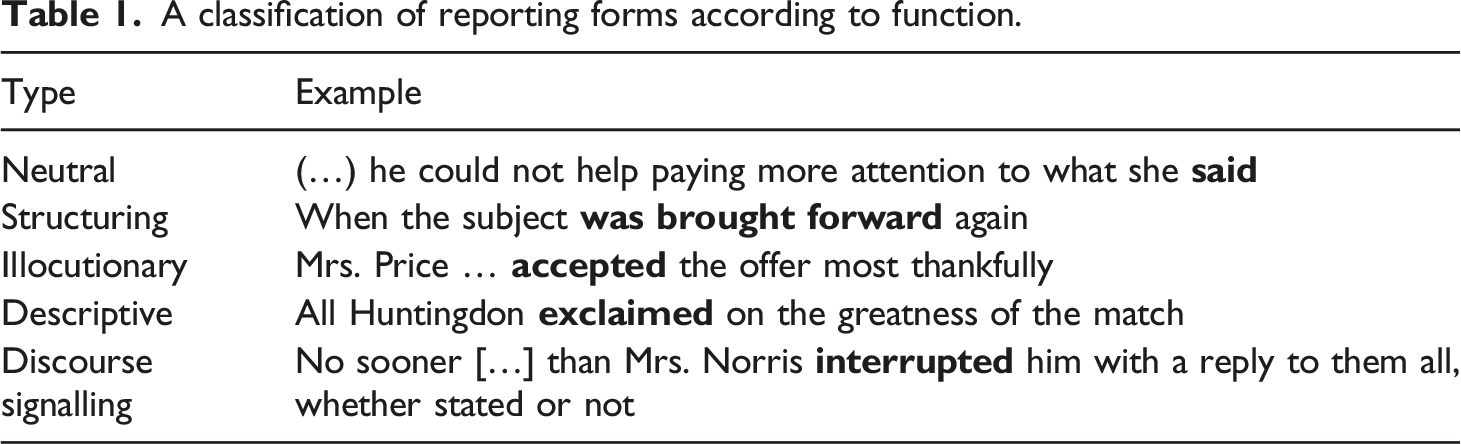
Previous studies on speech reporting expressions have noted that not all lexemes encode acts with an explicit illocutionary force. A very influential classification of ‘verbs of saying’ is provided by Caldas-Coulthard (1988, 1994), whose analysis of a corpus of discourse of the press identified a variety of contexts where speech is reported. She proposed a taxonomy of functions with three top-level categories, namely speech-reporting verbs, descriptive verbs and transcript verbs (1994: 306). The class of speech-reporting verbs in turn includes neutral reports that introduce the locutionary act (the act of speaking, e.g. ‘say’), structuring reports, those which signal the conversation turn (‘ask’, ‘reply’), and illocutionary reports, which indicate the illocutionary force of the speech act (e.g. ‘promise’). The descriptive verbs, by virtue of expressing prosodic and paralinguistic features, provide indirect clues about the attitude of the speaker (e.g. ‘cry’) but do not denote the illocutionary force of the act. Finally, the class of transcript verbs is not considered speech-reporting but marks the relationship of the reported speech act to other parts of discourse (e.g. ‘repeat’).
Caldas-Coulthard’s classes have been applied to the lexical analysis of speech presentation in narrative fiction, specifically to Narrative Report of Speech, i.e., the inquit formula introducing Direct Speech. Busse (2020) studies reporting verbs in her 19th century narrative fiction corpus, and finds that ‘most of the key verbs for stretches of NRS (…) can be classified either as neutral verbs or transcript verbs.’ (Busse, 2020: 169). 4 The lower frequency of illocutionary and descriptive verbs suggests that NRS in the corpus has less potential for characterisation than other speech presentation categories.
However, studies on specific authors have identified the use of descriptive and illocutionary verbs in NRS. Ruano San Segundo (2017: 107), in an exploration of Dickens’s Nicholas Nickelby, found verbs of those subclasses linked to the character Ralph Nickelby. Through the consistent use of certain descriptive speech reports such as ‘mutter’, amplified with adverbs (e.g. ‘sternly’), the character is portrayed as grumpy, while a repeated usage of explicitly illocutionary act reports such as ‘demand’ ‘highlights his inquisitive character’ (Ruano San Segundo, 2017: 118); furthermore, co-occurring manner adverbs (e.g. ‘sharply’) reinforce his bad temper. 5 The author concluded that ‘the cumulative effect created by the usage of these verbs can contribute to the portrayal of fictional characters’ (Ruano San Segundo, 2017: 107).
Both studies show the adequacy of Caldas-Coulthard’s distinctions to the analysis of reporting expressions in fiction. The present study extends the use of the taxonomy to the analysis of NRSA.
Furthermore, for a fine-grained analysis of the illocutionary class, the study adopts Searle and Vanderveken’s (1985) definition of illocutionary forces as sets of features related to the contextual variables of the communicative situation, particularly regarding its participants. Examples of features are the illocutionary point (the aim of the speech act), its degree of strength (e.g. ‘warn’ vs ‘threaten’); a specific mode of achievement, for those acts requiring a speaker in a certain capacity (‘marry’); a sincerity condition to be met by the speaker (‘promise’), among others. 6 Illocutionary features encoded by lexical items are cues for readers to interpret characters’ intentions in specific contextual situations as ‘bottom-up’ information that may be combined with ‘top-down’ social schemata associated with those characters (Culpeper, 2001, 2002; Culpeper and Fernández Quintanilla, 2017).
From a translation standpoint, equivalence of illocutionary force may be compromised if the target language lexical choice differs in one or more of the features, with potential effects on characterisation. Bourne (2002), in a case study involving a translation from English into Spanish, analysed 56 occurrences of the neutral reporting verb ‘say’ introducing an impositive directive speech act (commands and requests) in their inquit formulae. The Spanish ‘dictionary equivalent’ decir ‘to say’ occurred on 17 occasions; on four occasions the verb was omitted; the remaining 35 instances were translated by 15 different verbs, all of them specifying different illocutionary points. The conclusions stated that ‘Applied systematically […], the selection of speech-act verbs with specific illocutionary force can colour the reader’s perception of an entire personality as well as his or her relationships with others.’ (Bourne, 2002: 251). Rosa (2009: 231) reports similar changes in Oliver Twist’s Portuguese translations, from ‘said’ to more informative verbs like ‘exclaimed’ and ‘ordered’. Winters (2007) found evidence of specific usage patterns for speech report verbs in one of the German translations of Hemingway’s The Beautiful and Damned, with a tendency to highlight the emotional states of the characters (for example, from ‘insisted nervously’ to schäumte ‘fumed’, p. 422). However, since they are unsystematic, it is not likely that they would introduce changes in characterisation.
Translation shifts occur for diverse reasons, among them linguistic and stylistic differences between languages. First of all, the repertoire of reporting verbs and nouns, established in literary texts and reinforced through editorial practices, can vary among languages and cultures. Evidence of such contrasts between several European languages is presented in Nádvorníková (2020). Secondly, certain stylistic conventions, for example those regarding lexical repetition as inelegant and monotonous, as well as expectations to offer lexical richness, constrain translators’ choices, as suggested by Winters (2005, 2007) to account for the differences in lexical variation patterns of speech-act report verbs in her study. More lexical variation correlates with the translated text offering more specific meanings than those of the source text, which may give rise to unintended meaning deviations.
2.2. The Addressee perspective: Intersubjective stance
In the discourse of fiction, every level (including narrator-reader and character levels) has an addresser and an addressee. Each addresser may express his or her stance, defined as ‘the speaker/writer’s interpersonal style and their rhetorical strategies according to what sort of heteroglossic backdrop of other voices and alternative viewpoints they construct for their text and according to the way in which they engage with that backdrop’ (Martin and White, 2005: 93). In so far as these ‘viewpoints’ are value positions, associated with ‘socially constituted communities of shared attitude and belief’ (Martin and White, 2005: 95), intersubjective stance provides input for characterisation different from the illocutionary force of the speech acts.
Appraisal Theory (Martin and White, 2005) provides a framework for the identification of lexico-grammatical resources of stance. In the semantic subsystem of Engagement, a distinction is made between monoglossic and heteroglossic statements. The former present propositions as taken for granted, typically as presuppositions and categorical bare assertions. The latter present propositions as not taken for granted; typical linguistic realisations are related to the systems of modality and evidentiality and include modal verbs and modal adjuncts (mainly with epistemic meaning) and, crucially, verbs of reporting.
Within heteroglossic positioning, a distinction is made between dialogic contraction, formulations that ‘close down the space for dialogic alternatives’ (Martin and White, 2005: 103) and dialogic expansion, where propositions signal an open space to alternative positions at a small interpersonal cost. Each type of positioning has further subdivisions according to (a) the subjectivity that is presented as the source of the proposition (the addresser or a third person) and (b) the authorial alignment –or lack thereof (‘disalignment’) – with the source. The grammar of reported speech and thought is considered to be the typical resource to express different degrees of association between the text’s internal authorial voice and the external source. In dialogic expansion disassociation between them is expressed as ‘attribution’ (Martin and White, 2005: 111, 134). Depending on whether the authorial voice takes responsibility for the contents of the proposition, attributions may acknowledge (with verbs such as ‘say’ or ‘state’) or distance (with verbs like ‘claim’). As far as alignment with the reported proposition is concerned, the authorial voice can endorse it or distance itself from it. The co-occurrence of endorsing and distancing formulations can be used to signal a clash in values, leading to irony (see Leech and Short, 2007: 223). In Alsina et al. (2017) the evaluative opacity in Mansfield Park was accounted for by describing the narrator as simultaneously acknowledging propositions from other voices without committing him/herself to their truth and refraining from personal comment, while inserting subtle cues that overspecify emotional or epistemic aspects of the speech acts being reported (loudness, emphasis, tone, affect, frequency of topic) hence causing a distancing effect.
In dialogic contraction, the addresser can reject contrary positions (disclaim) or can include them in the discourse while limiting their scope (proclaim). Speech reporting verbs construe the authorial position as the correct one by appealing to external sources (e.g. ‘prove’).
In order to see how NRSA provides cues on a character’s intersubjective stance, consider (1). After a steady campaign by Mrs Norris, Lady Bertram proposes that the Bertram household take their eldest niece into their care. The narrator reports Sir Thomas’s reaction thus: 1) Sir Thomas could not give so instantaneous and unqualified a consent. He debated and hesitated; –it was a serious charge; –a girl so brought up must be adequately provided for, or there would be cruelty instead of kindness in taking her from her family. He thought of his own four children, of his two sons, of cousins in love, etc.; –but no sooner had he deliberately begun to state his objections, than Mrs. Norris interrupted him with a reply to them all, whether stated or not. (Austen, 1970: 4)
On the level of character discourse, the first instance is framed by ‘could not give’ as dialogic contraction, a denial by Sir Thomas against beliefs that he assumes his addressees to be subject to (Martin and White, 2005: 119), in this case Lady Bertram and Mrs Norris’s assessment of the costs of their charitable scheme. With ‘state his objections’, Sir Thomas is presented as countering his addressees or at least qualifying their proposals, and the manner adverb ‘deliberately’ reinforces his stance. According to Martin and White (2005: 120), this should enhance solidarity, as long as the addressee has no reason to reject the viewpoint being advanced. However, Mrs Norris rejects Sir Thomas’s stance through the foregrounded monoglossic ‘interrupted’ and the contractive pronouncement ‘a reply to them all, whether stated or not’, with which Mrs Norris sets herself as the warrant of the truth of the proposition. A stretch of dialogue in Direct Speech ensues with Mrs Norris featuring the longest interventions. Her first response is to downplay their financial duty toward Fanny as well as the ‘cousins in love’ possibility, judged as ‘morally impossible’ (Austen, 1970: 4). Through the entire exchange, Sir Thomas is presented by NRSA as having a heteroglossic interpersonal style, in contrast with Mrs Norris’s tendency to monoglossia or, at best, dialogic contraction, shown in her inability to entertain the possible outcomes of the action as presented by Sir Thomas. Such contrast of styles is particularly foregrounded in the first chapter.
On the narrator level, the stance is one of attribution and endorsement of the characters’ voices, except for a few textual cues of disalignment, such as the hyperbolic ‘whether stated or not’, an exhaustive conditional (Huddleston and Pullum, 2002: 761) distancing the narrator –and potentially the reader– from Mrs Norris. This ‘layering of stance expressions’ (Landert, 2017: 501) explains characterisation effects in terms of a ‘convergent alignment’ between the narrator and the reader in their stance towards a character and a ‘divergent alignment’ between the reader and the character.
The dialogic approach has been successfully applied to describe changes in narrator control due to translation shifts. In her study of Portuguese translations of Dickens’ works, Rosa (2009) analysed changes in narrator stance (evaluative vs. neutral), in the orientation of the narrator’s evaluation of characters (positive or negative), and in the explicitness or implicitness of evaluation, and found ‘a predominant increase of the narrator’s neutrality’ in translations for adult readers (Rosa, 2009: 240), with a narrator who is less evaluative, although more explicit, than the narrator in the source text. These results support Bosseaux’s (2007:17) claim that ‘features that are inconsistently translated or constantly translated in the same direction will cause shifts in the narrative point of view, focalisation and mind-style in the translations.’ Furthermore, shifts can be evidence of the translator’s attitude toward the characters (Winters, 2010: 181) and toward the narrator.
This section has presented the conceptual tools for a comprehensive analysis of NRSA in the sample of Mansfield Park and its translations. Next section presents the methodological implementation.
3. Methodology
The comparative method in translation requires identifying pairs of NRSA instances in the source text and their translation solutions. In contrast with reporting forms in NRS, identifiable through quotation marks and commas (see e.g. Busse, 2020: 158–159; De Haan, 1997; Winters, 2007), NRSA defies automatic identification. Austen’s masterful interplay of forms required a manual process with three researchers working in two stages: individual tagging followed by group sessions to ensure inter-annotator agreement. 7 The number of instances in the three-chapter sample is 55.
The range of structures or patterns is illustrated in (2). The default is a verb with a complement denoting the topic of the speech act. In a few instances the illocutionary point is distributed between the (support) verb and a noun heading the complement or subject (in passive clauses). Passive structures abound, with the subject denoting either the topic (2c) or the speaker (2d). NRSA may exist without topic, with the function of ‘announcing and introducing utterances which are then reported in more detail in the following text’ (Semino and Short, 2004: 75). The team also included one instance that is ambiguous between NRSA and the category of Narrative Voice (NV) in Semino and Short (2004: 45), presented in (2f). NV is a form of ‘minimal speech presentation’ that captures ‘summary references to speech events that involved a large number of participants’. Its ambiguity stems from the fact that it presents the illocutionary force and the topic, as NRSA, while uniting various speech acts in the collective ‘All Huntingdon’, as NV. Refraining from speaking, not being allowed to speak, being unable to stay quiet, also convey narrator presence (Toolan, 2001: 69), prompting the inclusion of ‘negative’ NRSA. Finally, a few instances of Narrator’s Report of Writing Acts (Semino and Short, 2004: 48) from letters are counted as well. 2) a. Henry bowed and b. but no sooner had he deliberately begun to c. The scheme was soon d. Few young ladies of eighteen could be less e. Sir Thomas could not give so instantaneous and unqualified a consent. He f. All Huntingdon g. Lady Bertram h. which could not be satisfied till she had written a long and angry letter to Fanny, to
A classification of reporting forms according to function.
The next stage was extraction of translation correspondences. Each Source Text – Target Text pair was classified into the following categories: (a) literal translation, i.e., lexically equivalent solutions for the verb or noun at the core of NRSA; (b) (translation) shifts in the speech act features and engagement value, dubbed ‘illocutionary changes’ in Chesterman (1997: 110); (c) omissions and insertions. Translation shifts in accompanying modifiers and distancing devices (e.g. formality, active/passive voice, etc.), dubbed ‘Interpersonal changes’ in Chesterman (1997: 112), were considered to contribute to a shift of type (b) even if the reporting expression was translated literally. The reason to include omission and insertion of a speech reporting expression is that such instances decrease or increase the input for characterisation.
4. Results
4.1. A classification of NRSA in the source text sample
A classification of the sample according to speech reporting functions.
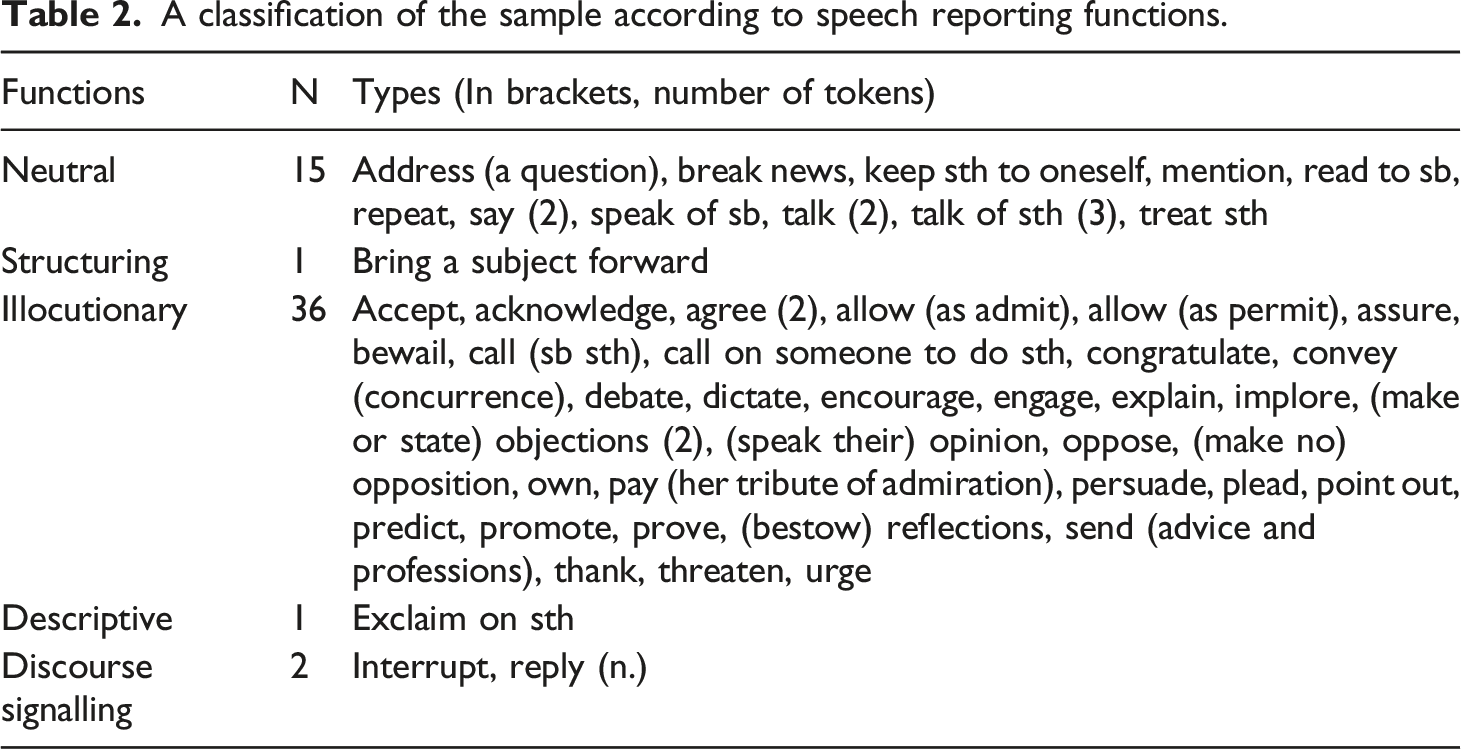
The sample contains remarkable lexical richness, with 50 types or lemmas. These findings disagree with Busse’s (2020: 105) regarding the occurrence of ‘say’ as ‘disproportionately often used and key in NRSA.’ Their functional classification confirms the significance of NRSA in narrator-controlled characterisation, as two thirds of the instances (n = 36) belong to the illocutionary class, including appeals from a character to another character to act on some issue (‘persuade’), commitments to act (‘engage’) and assertions of particular stances (‘agree’). In contrast, neutral reports of characters’ locutions occur in 27% of the sample and there is a single occurrence of a descriptive verb.
From the perspective of intersubjective stance, in most instances characters set themselves as the source of the reported proposition (‘assure’, ‘predict’, ‘prove’). In a few instances an external source is implicitly referenced, as in ‘he [Mr Crawford] was no longer allowed to be called so [plain] by anybody’, referencing the aesthetic values of the Bertram sisters to be shared by an unspecified social group.
The illocutionary features, such as strength, content conditions and illocutionary point, help to identify the characters’ stances. For example, strength can distinguish scales of willingness to entertain opposing views (e.g. ‘say’ vs. ‘plead’). Preserving the significance of both speaker and addressee perspectives can be a challenging task for translators, as the following sections show.
4.2. General overview of translation solutions
Types and frequencies of translation solutions.
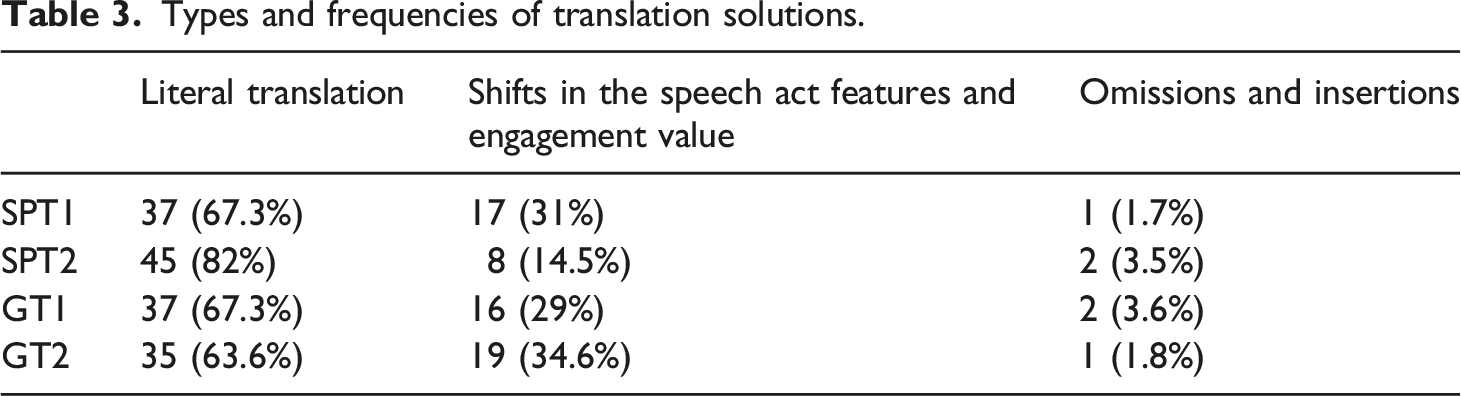
The Spanish translations bear stronger mutual similarity than the German ones. For literal translation, 19 instances coincide (e.g. predecir ‘to predict’), and in 15 instances there is synonymic variation between the translations (persuadir ‘to persuade’ vs convencer ‘to convince’). In German, the speech report verb coincides in 10 instances (e.g. überreden ‘to persuade’), and in 15 instances there is synonymic variation (gratulieren vs beglückwünschen ‘to congratulate’). This points at the influence on translation of interlingual contrasts in the repertoire of speech reporting expressions.
One such contrast involves verbs that are semantically ambivalent between speech and thought presentation; this ambivalence may be resolved in translation as unambivalent speech and/or unambivalent thought.
8
This is illustrated in (3), a fragment of the passage previously quoted in (1). 3) He debated and hesitated; (Austen, 1970: 4) a) Er widersprach und zögerte. (Austen, 1984: 8) Back translation: He disagreed and hesitated. b) Er überlegte hin und her und zögerte. (Austen, 1989: 8)
Back translation: He pondered and hesitated.
In the original, the pair ‘debated and hesitated’ contrasts Sir Thomas’s conscientiousness with his sister-in-law’s impulsiveness. However, the combination of verbs followed by the ‘deliberate’ spelling out of his arguments either in speech or in thought can be also interpreted as an instance of ‘overthinking’ the matter, ended by Mrs Norris’s interruption. This distancing overtone is reflected by the second German translation with hin und her (‘back and forth’) but is lost in the first.
Choosing the adequate speech reporting expressions is a challenge for translators as it has potential effects on characterisation, as illustrated in the next section.
5. Shifts in illocutionary features and engagement value
Modifications of illocutionary features and of engagement value can affect characterisation on the character level and on the narrator-reader level.
Shifts in illocutionary strength result in changes in engagement values, rendering characters more or less contractive. This is illustrated in the episode where Edmund confronts his mother and aunt for having denied Fanny the use of a mare for her riding exercise during his absence. The episode is reported in hyperbolic terms, a prominent feature of Mansfield Park, a novel where ‘we are never far from passion, even if concealed passion, and characters’ judgments find an outlet in excess.’ (Doody, 2009: 177). 4) Edmund was absent at this time, or the evil would have been earlier remedied. When he returned to understand how Fanny was situated, and perceive its ill effects, there seemed with him but one thing to be done; and that “Fanny must have a horse” was the resolute declaration with which he opposed whatever could be a) y con la resuelta declaración de que «Fanny necesita un caballo» se opuso a todo cuanto podía
Back translation: and with the resolute declaration that "Fanny needs a horse" he opposed everything that his mother's indolence or his aunt's thriftiness could argue in order to play down the matter.
b) «Fanny debía tener caballo»; ésta fue la decidida sentencia que opuso a todas las objeciones que
Back translation: “Fanny had to have a horse”; this was the resolute pronouncement that he opposed to all the objections that the indolence of his mother and the economy of his aunt raised, to show that they [sic] lacked any importance.
The first translation preserves ironic distance through the literal rendering of the quotation, the exhaustive todo cuanto (‘whatever’) and the clash between argüir ‘to argue’ and indolencia ‘indolence’, although argüir lacks the strength of ‘urge’. In the second translation, the ironic distance is reduced by the loss of the exhaustiveness implication through the choice of the perfective past tense in plantearon ‘raised’, and by the compatibility between objeciones and plantearon, and between plantearon and indolencia ‘supineness’.
On the character level of discourse, Edmund has a contractive style. The Narrative Report of Thought Acts (understanding Fanny’s situation) frames his stance that ‘there seemed with him but one thing to be done.’ The noun ‘declaration’ is an instance of the engagement category proclaim, signalling the unwillingness to consider alternative options, emphasized when the narrator reintroduces it a few lines later (p. 32) in reply to Mrs Norris’ first round of objections. The illocutionary point of his utterance is further identified by the verb ‘opposed’ in the heavy relative clause. Lady Bertram and Mrs Norris are also presented as contractive, countering his initial proclamation.
In the translations his family’s projected stance is less contractive, particularly in the second. In the first one, the debating illocutionary point of ‘urge’ is rendered in the weaker argüir ‘to argue’. In the second, the countering move is made explicit with the noun objeciones ‘objections’, supported by the verb plantearon ‘put forward’, weaker in illocutionary strength than ‘urged’. Raising objections signals the openness to consider alternative opinions, which renders participants as more expansive, less polarised in their exchange of opinions. For Lady Bertram, this agrees with the value picture offered in chapter 1 that she is ‘a woman of very tranquil feelings, and a temper remarkably easy and indolent’ (Austen, 1970: 2). Furthermore, the purpose clause para hacer ver que carecían de importancia is attributed to Edmund instead of his mother and aunt, as the plural carecían (‘lacked’) mistranslates the subject antecedent as ‘objections’ instead of ‘it’ (Edmund’s proposition).
The shifts in illocutionary strength in (4b) render characterisation input consistent with previous inputs on the characters involved. It is also possible for shifts to be forward-oriented, in the sense that they render a character’s stance more explicitly in line with information that has not yet been provided. This is illustrated in example (5), from the passage where the narrator introduces Mary Crawford: 5) [Matrimony was her object, provided she could marry well: and having seen Mr Bertram in town, she knew that objection could no more be made to his person than to his situation in life.] While she a) Sie Back translation: She therefore treated the matter as a joke, but did not take it lightly at all. a) wenngleich sie es als Scherz Back translation: although she dismissed it as a joke, she therefore did not forget to think about it in all seriousness.
In the preceding text, Mrs Grant has been scheming to marry her two half-siblings Mary and Henry Crawford into the Bertram family; the narrator reports Mary’s stance allowing the reader to see her psychological duplicity: while the outward speech act reported by the narrator suggests a lack of commitment to this particular plan (‘treat it as a joke’), the thought report suggests calculation.
On the narrator-reader level of discourse, the stance is monoglossic, signalled by the argumentative consequence marker ‘therefore’. At the character level, the interpretation of ‘treat it as a joke’ is not one of denial of the suitability of the match; hence her lack of commitment is expansive, an instance of entertain, grounded in her subjectivity.
In both German translations the narrator overdetermines the interpretation of Mary’s reaction on the character level. In the first one, with the explicit, more dismissive object choice die Sache (literally, ‘the thing’), and in the second one with the verb abtat ‘dismissed’, an explicit illocutionary point with more strength than ‘treat’. The dismissal anticipates information on Mary’s attitude towards Edmund which will surface in chapter V of volume II, as she reacts with anger when informed that Edmund, whom she had started considering as a match, is about to take orders and settle for a modest life instead of pursuing a more lucrative career, as she had recommended.
While shifts in illocutionary strength and point such as those in (4) and (5) result in changes in engagement value mainly on the character level, (6) illustrates a shift on the narrator-reader level, as the narrator makes an explicit value judgement on Tom Bertram, instead of the original’s implicit one. 6) Much was said on his side to induce her to attend the races, and schemes were made for a large party to them, with all the eagerness of inclination, but it would only do to be talked of. Von seiner Seite wurden Back translation: On his part, many words were wasted to get her to attend the races, (…) but at first that didn't achieve anything more than having been talked about
In this passage Tom Bertram aims at drawing Mary Crawford into attending the races away from Mansfield Park. On the character level, Tom is heteroglossic. Although no details of the contents of his interactions with Mary are given, his illocutionary point is clearly presented through ‘induce’, which suggests that he adapted his entreaties to consider Mary’s perspective. At the narrator-reader level, his actual speech report is vague and indirect (the verb ‘say’, the object ‘things’, and the passive voice), offering narrator distance particularly with the quantifier ‘much’ (implying persistence). This implication is not only made explicit in the translation with wurden viele Worte verloren (‘many words were wasted’) but also shifted from neutral to negative. This changes the ‘reticent’ narrator with ‘rather guarded opinions’ (Morini, 2009: 50) that characterises Mansfield Park and anticipates information on a character’s evaluation. Explicitness of implication hinders the reader’s access to irony and suggests that the translator was acting as a facilitator of meaning.
This section has presented a detailed analysis of three passages of NRSA revealing the means through which the narrator’s filter is construed from the combination of speech reporting lexis and co-occurring distancing resources. Translation shifts can affect narrator and character stance with potential changes in the inputs for characterisation.
6. Conclusions
The first goal of the present study is to understand NRSA as a source of input for characterisation. In the sample analysed, two-thirds of instances were of the illocutionary type, offering the reader cues to infer personality traits from the speech acts. The speaker-based perspective has been supplemented with a study of intersubjective stance, applied to characters as they speak with other characters, and also to the narrator as a voice that filters characters’ speech. NRSA emerges as a form deserving more scholarly attention (see Busse, 2020: 5) precisely for its potential for evaluative opacity.
Regarding Mansfield Park, NRSA proves the role of dialogue as a space for the confrontation of ideas. Characters display their skills in the art of persuasion to advance their agendas (from Mrs Norris’s ‘reply to them all’, to Edmund’s ‘resolute declaration’ and Tom’s ‘much was said’). Also important is the role of NRSA and dialogue in exposing the characters’ attitude towards their assigned roles in the social hierarchy. Mrs Norris monoglossia and contractiveness (‘interrupt’, ‘dictate’), in defiance of her status as a dependent relative in the household, will prove very damaging to the Bertram household in the absence of Sir Thomas. Edmund’s defence of Fanny’s welfare is an instance of his moral standing and an increasing social claim to the management of the household. Finally, dialogue scenes offer premonitory glimpses of later developments; Mrs Norris proclaiming love between cousins as ‘morally impossible’ is contested in the end; Edmund’s fight for Fanny’s use of a horse is a first step to lift Fanny up from her position as a poor relation.
The second goal is to examine translation solutions and particularly those shifts with potential effects on characterisation. Interlanguage comparison shows similarities in the percentage of shifts (with one exception). The figures do not lend themselves easily to interpretation without a comparison with other studies; however, that the most successful of the translators (Austen, 1995b, in Spanish) reaches 82% accuracy attests to the challenge of preserving the pragmatic richness of Austen’s NRSA. While literal translation is predominant in all four versions, instances of translation shifts involving illocutionary features and stance have been observed. There are various sources: introduction of an illocutionary point (English ‘treat’ – German ‘dismiss’); variation in illocutionary strength (English ‘urge’ – Spanish ‘raise’), and shifts in textual cues that serve as distancing devices (English ‘whatever’ – Spanish ‘all’). At the narrator-reader level, several effects seem possible. Firstly, overdetermining the evaluation of a character, or disambiguating it, leads to a distortion of narrator stance and a simplified reader experience; secondly, homogenising a character’s behaviour decreases nuance and ironical distance. The present study proves the advantages of a pragmatic analysis of Austen’s use of speech and thought representation categories as source of guidance for future translators aiming to preserve the evaluative opacity and irony of the original.
The study illuminates the translator’s relationship with the readers lending support to models of translated fiction including a distinct discourse level above the narrator-reader level (e.g. Rosa, 2003). In disambiguating speech/thought reporting expressions and in rendering implications explicitly, the translator is acting as a meaning facilitator. In this role it is possible for the narrator to impose his or her own stance towards the characters, for example with a translation of neutral reports as (negative) value judgements based on the illocutionary force of a character’s speech act. Widening the range of linguistic levels constructing NRSA (sentence structure, voice, tense and aspect, negation, among others) may lead to a deeper understanding of its insertion in the narrative and to the identification of sharper contrasts not only between languages but most importantly, between different readings of the role of the narrator shaping translated texts.
Footnotes
Declaration of conflicting interests
The author(s) declared no potential conflicts of interest with respect to the research, authorship, and/or publication of this article.
Funding
The author(s) disclosed receipt of the following financial support for the research, authorship, and/or publication of this article: Spanish Ministry of Economy and Competitiveness (Mineco) (FFI-2013-42751-P).
