



Abstract
This paper examines the manifestation of individual style through the lens of a specific language category: the interjection. The analysis considers how interjections are used as a resource in the dramatic dialogue of three Restoration playwrights: Aphra Behn, John Dryden and Thomas D’Urfey, and how their preferences and practices of use compare to previously identified trends in the history of English. Using the concept of the repertoire as a frame for situated language use, the paper examines how genre, time, and characterisation shape the selection and frequency of interjections in the plays of each author. Corpus linguistic methods are used to provide a quantitative and qualitative overview of each author’s interjection repertoire. The results suggest that whilst genre, time, and characterisation are influential in shaping the selection and implementation of interjection forms, the choice of expressive language in dramatic contexts is also distinctive and coherent at an authorial level.
1. Introduction
In her landmark monograph, The Linguistic Individual (1996), Barbara Johnstone provides an anecdote that illustrates the significance of individual variation for the study of language and style. She recounts her sister using aaah, uttered ‘at a low and very falling pitch’ which means ‘I think I understand what you’ve just said, and if I’ve understood you correctly, I’m disappointed’. For Johnstone, this linguistic expression was remarkable because it was, until that point, a style marker typical of her father in the same way ‘that short sentences with stative verbs are characteristic of Hemingway’s voice’ (Johnstone, 1996: 5). The individual use of aaah ‘expresses a meaning not fully captured in any conventional English word or sound’ (Johnstone, 1996: 5), but is (contextually) interpretable by interlocutors and familiar to those within that local network of speakers. For Johnstone, this example provides a notable illustration of distinctive, individual language, supporting her argument that linguistics has not sufficiently examined the relationship between individual utterances and variation and change within the speech community. Much linguistic (stylistic, sociolinguistic) research following Johnstone’s publication has reaffirmed and developed many facets of her thesis around the individual speaker and the role of individual style in the construction of identity and social meaning (e.g. Eckert, 2000; Moore, 2012; Hall-Lew et al., 2021).
I introduce Johnstone’s anecdote because it highlights two important dimensions of individual style that are addressed in this paper. Firstly, aaah is a type of interjection: a category of expressive language which marks ‘emotions, attitudes, values and ideologies, which all have a strong element of subjectivity’ (Bednarek, 2011: 10). Interjections have long been considered a problematic group for formal linguistic analysis. They lack a direct referential target, occur independently from co-textual clauses, are typically monomorphemic (excepting diminutive interjections (Lockyer, 2014)), and may use atypical phonological combinations, e.g., psst in English (Wilkins, 1992: 124). Their meanings are broad, spanning emotive, cognitive, conative and phatic functions (Ameka 1992), and, as Johnstone’s example shows, they are contextually dependent.
In English, some interjections (e.g. oh and ah) are evident in the oldest extant texts through to the present day. Other interjections are continually being coined, repurposed, and becoming obsolete. For example, the euphemistic zounds, a contracted form of ‘Christ’s wounds’ (OED Online, 2022), is first attested in the late sixteenth century, with a heyday in the seventeenth, before becoming specialised (literary and archaic) by the end of the eighteenth century. Interjections can therefore have currency within a restricted local network, be found in culturally-bound temporal and spatial settings, and/or have a wide transhistorical reach and longevity. The relationship between an individual’s use of interjections and the development of the wider interjection system warrants further scrutiny.
The second important aspect of Johnstone’s anecdote is the comparison between her family’s language and the stylistic attributes of Hemingway. This rightly implies that questions of style cut across literary and everyday language, according with more recent work that situates literary language within an individual speaker’s wider understanding of language resources and contexts of use. 1 Exploring literary language (in prose, film, verse, drama) provides a lens on how linguistic features are perceived and used, highlighting the complexity of stylistic choices and the connection between changing (or unchanging) style in literature and in other contexts (Bednarek, 2010, 2011; Evans, 2018; Reichelt and Durham, 2017).
The present investigation follows the spirit of Johnstone’s work that ‘[v]ariation in language use is ultimately explicable only at the level of the individual speaker’ (Johnstone, 1996: 8). This paper explores how that process of explication can operate when looking at individuals’ language in a creative, literary marketplace; namely, the English interjections used in the seventeenth-century dramatic dialogue of three Restoration playwrights: Aphra Behn, John Dryden and Thomas D’Urfey. Dramatic dialogue affords a particular perspective on how interjections are used, as the author must employ language forms to construct the voices of their characters, in ways that are (presumably intended to be) recognisable and meaningful to their audience, following generic conventions of that time and place.
The paper explores the following questions: 1. What similarities or differences are evident in the distribution and implementation of interjections in the plays of three Restoration dramatists? 2. To what extent does genre, time-period and characterization, as factors known to shape (literary) style, inform the selection and implementation of interjections in the historical texts for each individual? 3. Can interjections be aligned with distinctive authorial repertoires (at least in the case of Restoration dramatists)?
The discussion is organised as follows. Firstly, key concepts and findings relating to interjections (section 2), and the individual speaker and literary style (section 3) are introduced. In section 4, I explain the selection of authors and texts, and the method used to collect and categorise the interjections. The results are presented and discussed in sections 5–8, exploring authorial style, time, genre and character. I conclude by reflecting on the implications of the investigation.
2. Interjections
Interjections ‘serve as windows into the speaker’s mind; they express how the speaker feels or thinks in relation to the situation they are in’ (Stange, 2009: 7). Other terminology has been used to describe these lexical expressions. Goffman (1981) describes ‘responses cries’ as items used to show an affective response to a situation. Labels such as ‘response tokens’ and ‘change-of-state tokens’ similarly define forms used to show ‘how we understood prior talk and our current stance to said talk’ (Linneweber, 2016: 186). The expressivity function can lead to ‘descriptive ineffability’ (Blakemore, 2011; Potts, 2007), in which users of interjections may find it difficult to explain the meaning of forms (e.g. oh or wow), especially without a clear context of use (Blakemore, 2011: 3539). Their expressive scope is also reflected in the fact that interjections can have the same semantic scope as a full clause (e.g. yuck = ‘I feel disgusted’ (Stange, 2009: 7)). Culpeper and Kytö’s (2010) ‘pragmatic noise’ denotes forms that are used to convey an affective response only, rather than including items with other linguistic functions. This distinction reflects a widely-recognised difference between primary interjections – forms used only as interjections, e.g., oh, ugh, oops – and secondary interjections, which are borrowed from elsewhere in the language, typically from taboo domains such as religion and disease, e.g., god-a-mercy, pox; a categorisation initially proposed in Ameka’s (1992) landmark paper.
Sociolinguistic and pragmatic analyses of interjections have increased in frequency, scope and theoretical and methodological sophistication in recent years, both for present-day and historical language. This includes examinations of digital exchanges (Honkanen and Muller, 2021), animal communication (Smith, 2012), polyfunctionality in Q’eqchi’ Maya (Kockelman, 2003), and borrowing and exchange across languages (Andersen, 2014; Mišić Ilić, 2017). Studies of English interjections include examinations of their L1 acquisition (Stange, 2009), variation across genres (Taavitsainen, 1995, 1998) and their properties in different historical periods (Łodej, 2010; Traugott, 2015).
Interjections are a core resource for linguistic affect in English (Taavitsainen, 1995, 1997), and the evolution of the forms and their functions acts as a barometer for stylistic, literary fashions in the expression of emotion (Culpeper and Kytö, 2010). As with other expressive language features, the capacity for innovation and replacement is continuous and ‘the coexistence of different forms may mirror older and newer layers in the process of change’ (Tagliamonte, 2008: 362). On the one hand, core (primary) interjections are maintained for generations (Dingemanse et al., 2013). On the other hand, the word class is ‘potentially infinitely extendable’ (Norrick, 2009: 866). This predilection for growth is connected to the importance of innovation for expressive language, whereby the forms’ effectiveness are ‘only as good as their novelty’ (Roels and Enghels, 2020: 126). The emotive force of a form like zounds, for instance, is culturally and ideologically specific, and its impact will change as its community of users evolves.
As well as neologism and borrowing, interjections can also be recycled. This concept describes the process of lexical revivification, whereby many forms are available to a speaker, but they are not necessarily used – either at all, or in a sustained way, over time. Tagliamonte (2008) observes in her study of intensifiers in Toronto English, for example, that forms may remain dormant in a (partly) delexicalised state, ready ‘to be co-opted back into the active system’ when required. Thus, what may seem like a new development, such as the appropriation of so by Generation-X, may in fact have a much longer history (Tagliamonte, 2008: 390-1). The factors that cause a form to become dominant ‘at a given point in time and space’, however, are less clear (Tagliamonte, 2008: 392).
The individual speaker is a useful lens for exploring and understanding the chronological trajectory of specific interjections, and their evolution as a collective resource for verbal expressiveness. The sociolinguistic concept of ‘repertoire’ is valuable when thinking about interjections at this level. Repertoires denote an individual’s knowledge of language as a situated practice. Each utterance reflects that individual’s understanding of the forms available to them within a mediatised, situated context of communication (Blommaert and Backus, 2012: 4). Repertoires are dynamic, as an individual’s language choices are shaped by the technologies and relationships involved in each interaction (Androutsopoulos, 2014: 7), and they evolve as a user experiences language and develops new competencies, such as the acquisition of single words or the recognition of the linguistic practices of others (Androutsopoulos, 2014: 6). 2
Whilst studies of repertoires usually consider all levels of language holistically, I suggest that repertoires can be examined more restrictively, to identify how an individual uses a particular facet of language, such as interjections. This paper examines the interjection repertoires of three Restoration playwrights to better understand their distribution and role in their individual literary styles.
3. Interjections in restoration drama
Examining interjection repertoires using historical, literary evidence offers certain perspectives on the individual use of expressive language. Beneficially, historical evidence (literary or otherwise) makes it possible to study how an individual’s interjection repertoire evolves over time. Literary texts, particularly drama, also provide ample examples for analysis. However, literary texts complicate the interpretation of individual style preferences, because a literary writer creates the voices of multiple characters. Interjections in character dialogue is, on one level, an example of their use in context (albeit fictional or constructed), whilst at the same time, it may or may not reflect the kinds of interjection used by that writer in other (non-literary) contexts. Speculatively, literary uses may be more inclined towards innovation, for the purposes of adhering to, or transgressing social conventions around genre, or in achieving particular aims in characterisation. The analysis of an individual’s literary usage may therefore reveal a broader repertoire than that found in other contexts.
Restoration drama is a particularly suitable dataset for the analysis of English interjections. Culpeper and Kytö (2010) found that ‘pragmatic noise’ occurred with ‘remarkable frequency’ in early modern drama (5.5/1000 words), compared with other genres such as prose fiction (1.7/1000 words), or depositions (0.3/1000 words). There is also change over time, with ‘something of a surge [in frequency] after 1680’ (Culpeper and Kytö 2010: 270). The authors hypothesise that this may reflect a shift in attitude that promotes the expression of emotion in dramatic domains (Culpeper and Kytö, 2010: 270). Their study does not consider secondary forms, such as heavens. These have the potential to be more local and transitional in their behaviour than primary interjections, because the borrowed forms bring with them explicit cultural baggage (see Łodej, 2010).
(Historical) dramatic language has advantages and limitations as a data source. The traditional sociolinguistic focus on the vernacular as the ‘unconscious ideal’ (Pentrel, 2017) has been firmly contested (e.g. Hall-Lew et al., 2021). Sociolinguistic analyses of fictional dialogue provide important perspectives compared with other kinds of language (Bednarek, 2012; Reichelt and Durham, 2017). Drama captures a writer’s understanding of a broad set of interactional contexts (comic, tragic), making it a (typically) more diverse text-type than other historical sources (e.g. correspondence, diaries), with expressive language a key resource for characterisation (Bednarek, 2011: 4). Dramatic dialogue must serve both the interests of the characters – signalling their relationships, motivations, and feelings – but also attend to the audience, using the double articulation facility of language (Bednarek, 2012). Restoration playwrights like Behn, Dryden and D’Urfey would only be paid if the play reached its third night of performance, and every third night thereafter (Kewes, 1998: 18). The effectiveness of their writing was therefore paramount for their professional success, and the expressiveness of interjections plays a small but important contribution to their literary work.
The analysis of interjections in drama cannot simply consider them from the broad perspective of ‘authorial style’. Individual language use is, as the concept of the repertoire emphasises, a situated practice. Two key dimensions are evaluated in the present study: genre and character.
Previous stylistic analysis has shown that language choices change according to dramatic genre (i.e. comedy, tragedy, tragi-comedy or history), although the boundaries between each sub-type are fuzzy rather than firm (Hope and Witmore, 2010). Interjections are closely keyed to generic conventions, likely because of their connection to the emotional and expressive situations experienced by the characters. Busse (2002: 199) suggests that early modern interjections are so stylistically marked, they can securely differentiate genres from each other – a suggestion that requires further validation. Previous research of early modern texts has shown that dramatic comedies tend to use interjections more frequently than other (non-dramatic) genres (Culpeper and Kytö, 2010; Taavitsainen, 1995). Culpeper and Oliver (2020), focussing on dramatic sub-genres, find that Shakespeare’s tragedies contain more pragmatic noise forms (cf. primary interjections) than the comedies or histories. With the acknowledgement that the external labels of dramatic genre are in themselves rather artificial, the following analysis of three Restoration playwrights considers whether each author’s interjection repertoires modulate, and how, across comedies and tragedies.
Language (alongside other semiotic modes) is vital for characterization (Culpeper, 2001). The multiple voicing of dramatic dialogue means that character utterances “speak” to an audience, as well as to the characters within the story-world. Audience interpretations of linguistic forms may draw on top-down models (social schemata, or more fine-grained impression), which enables them to construct potentially complex mental models of a character based on sparse or incomplete information (Culpeper and Fernandez-Quintanilla, 2017: 99). At the same time, interpretations of character involve bottom-up information, constructed from situation-specific language use (e.g. address forms, slang terms) that conveys, for instance, stance towards a specific event or person (Culpeper and Fernandex-Quintanilla, 2017: 104).
As expressive resources, interjections are particularly well suited to conveying to an audience the interior experience of a character, such as their fear, shock, surprise or elation. Computational stylistic analysis shows that, on the one hand, the linguistic style of one character is generally distinguishable from another; on the other, characters can be united by shared properties connected to the individual style of their author. Burrows and Craig (2012) show that early modern character idiolects are often identifiable using the most frequent words in a corpus (i.e. a, and), for instance. Interjections are a small but significant component of character dialogue, and warrant further scrutiny in terms of how they are used for the purposes of characterization, and the extent to which this stratifies by authorial style.
As a precedent, Culpeper and Oliver (2020) explore the social correlations between pragmatic noise and character demographics (e.g. sex, social status) in Shakespeare’s plays. Using a list of 21 types, they find that female characters make a greater use of pragmatic noise than their male counterparts. The authors suggest this is not merely a reflection of female stereotyping (women = more emotional), but that Shakespeare uses his female characters, like Desdemona in Othello, to articulate the emotional resonance of the actions of their male counterparts (Culpeper and Oliver 2020: 25-6). When Shakespeare’s use of pragmatic noise is explored by categories of social status, professional types and ‘ordinary commoners’ have the highest normalised frequencies (4.3 and 4.1/1000 words) (Culpeper and Oliver 2020: 23-5); a characteristic that is attributed to the tendency for this social group to have ‘colloquial interactions’ and act ‘as foils for the main characters’ (Culpeper and Oliver 2020: 25). As will be shown, both explanations are relevant to the analysis and interpretation of interjections in Restoration drama, inflected by the authorially-distinctive practices of Behn, Dryden and D’Urfey.
4. Methodology
Corpus details for each restoration playwright.
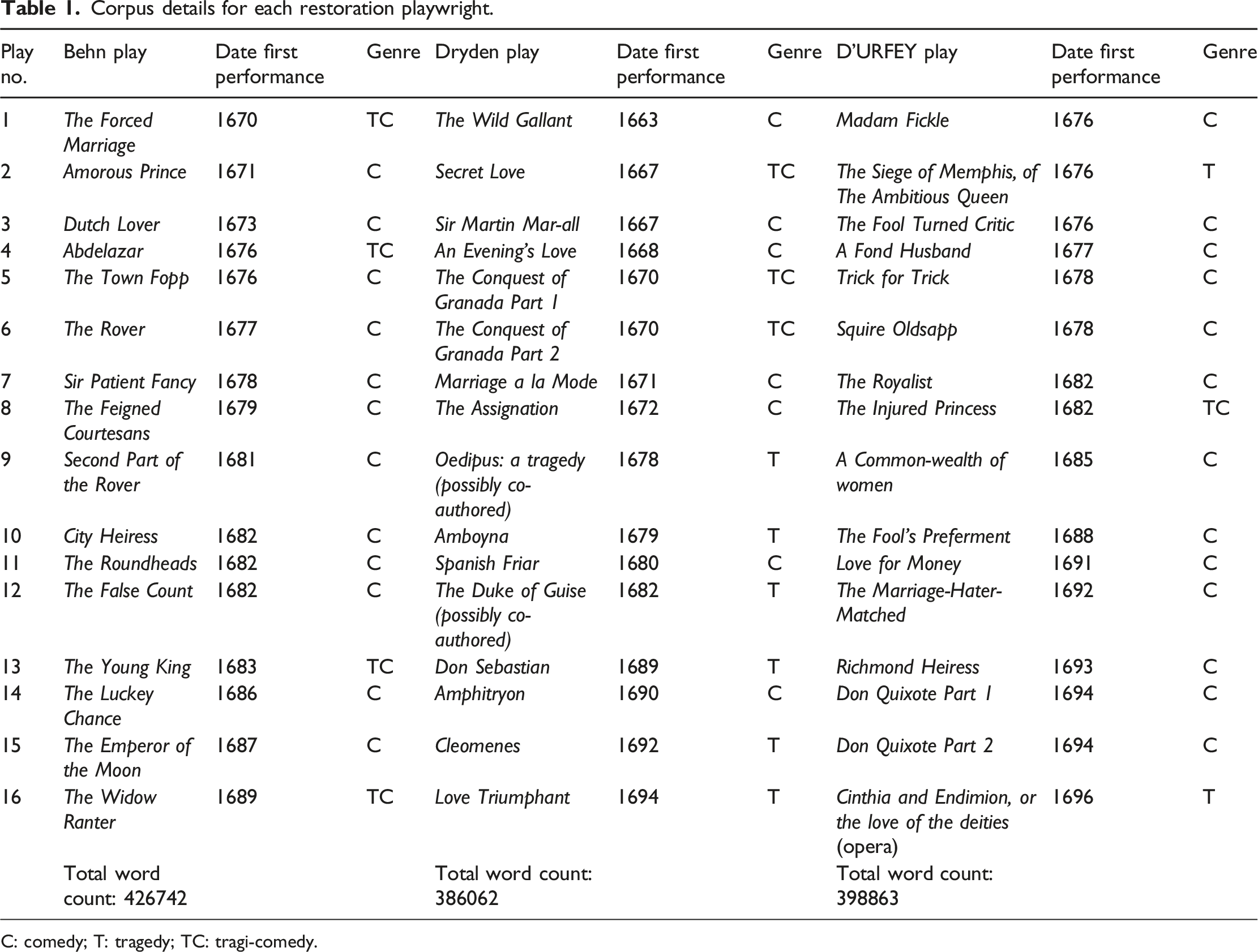
C: comedy; T: tragedy; TC: tragi-comedy.
The identification of interjections combined top-down and bottom-up approaches. Firstly, a wordlist for the full corpus was manually analysed to identify all potential interjection forms. Identification was based on comparison with the 642 OED entries with the classification ‘interjection’, first attested between c.800 and 1750. The resultant shortlist was checked in context using AntConc (Anthony, 2021), and forms were added to a masterlist if they met one or more of the following criteria: clause-separate; phonologically atypical; independent word or phrase followed by an exclamation point (!), or marking affect (emotion, attitude, values and ideologies). Markers of agreement/disagreement (yes/no) were excluded (Taavitsainen, 1995; also Norrick 2011). Orthographic variants of these interjections were regularised to one form in all the plays, using VARD 2.0 (Baron, 2017): for example, ads bud and ods bud are regularised to godsblood, adsheartlikins to godsheartlikins and so on. The frequencies of each interjection were identified in each play using Intelligent Archive, a tool that extracts word/character frequencies according to pre-set properties (e.g. text, segments of text, a collection of texts), and makes them available in.csv format (Pascoe et al., 2020). All secondary forms were checked in context to correct for erroneous counts, such as marry used as a verb. Duplicative forms are counted as discrete units, to reflect their functional differences; for example, ha is exclamatory, whereas ha ha and ha ha ha mark laughter.
5. Individual interjection repertoires
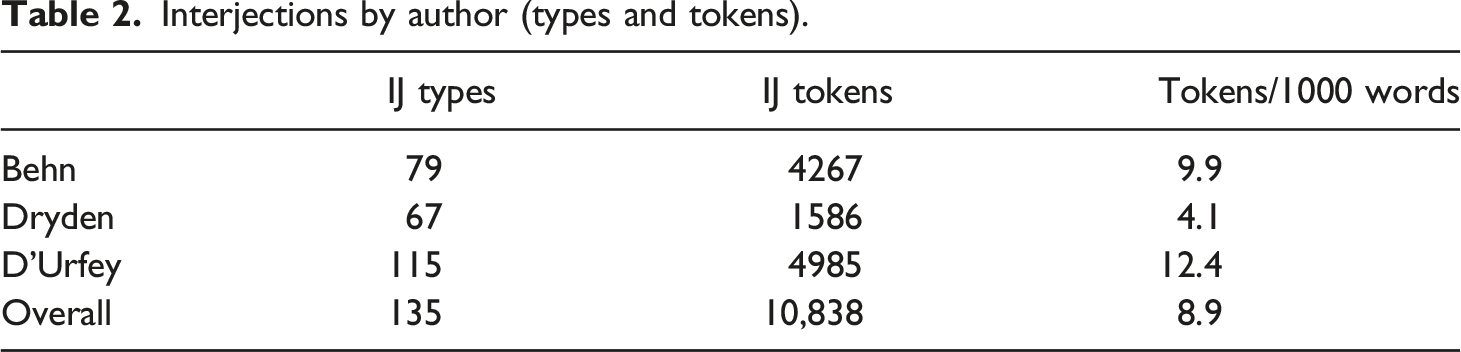
Interjections by author (types and tokens).
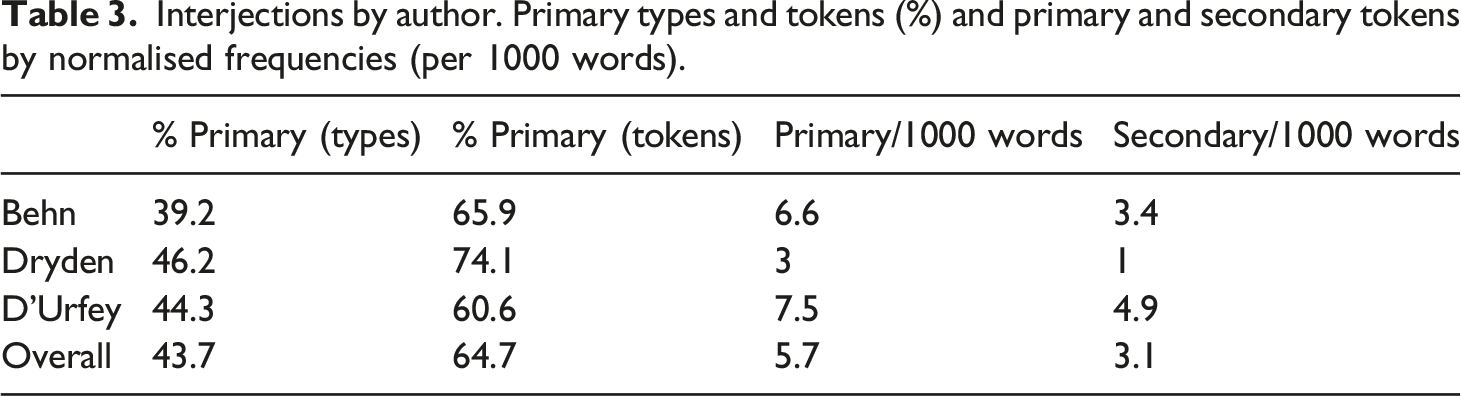
Interjections by author. Primary types and tokens (%) and primary and secondary tokens by normalised frequencies (per 1000 words).
Top-ten most frequent interjections (primary and secondary) by author.
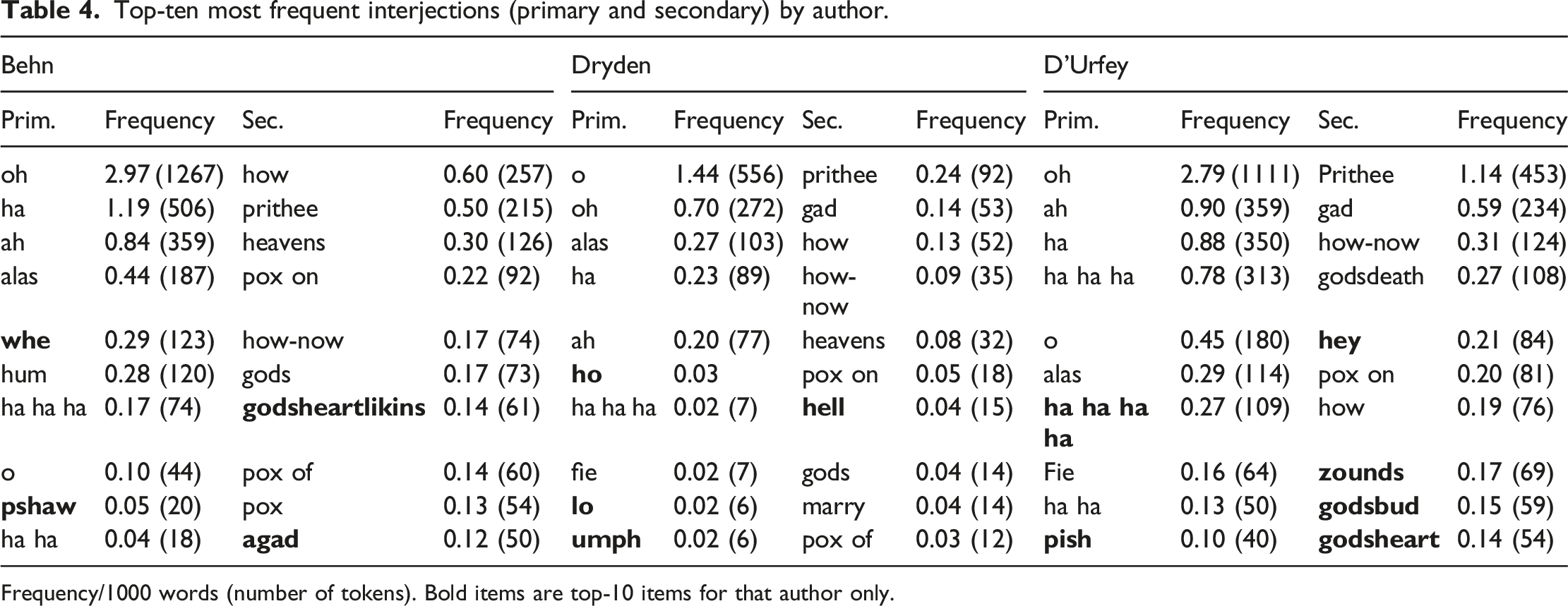
Frequency/1000 words (number of tokens). Bold items are top-10 items for that author only.
Top-ten pragmatic noise forms in the CED drama sub-corpus.
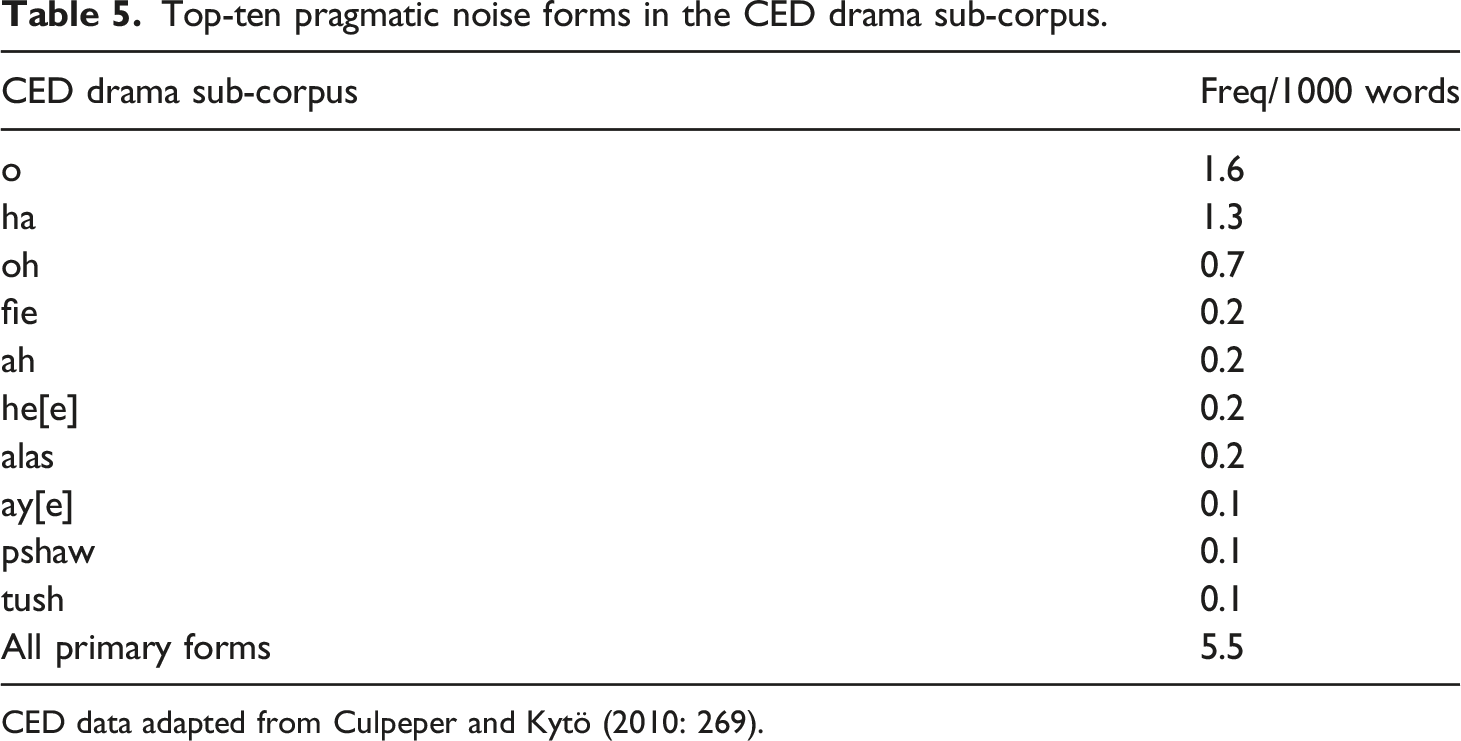
CED data adapted from Culpeper and Kytö (2010: 269).
Four interjections largely dominate the data: oh, ha, ah and o. The precise rankings show authorial differences: whilst oh is the most frequent interjection in the plays of Behn and D’Urfey, o is more frequent in Dryden’s plays, and also the CED drama (Culpeper and Kytö, 2010: 269). The different preferences for oh or o reflect these interjections’ status as a linguistic variable, and is discussed in more detail below. Top-ten interjections with lower frequencies are more likely to be characteristic of that individual’s repertoire. Items in
Repertoire distinctiveness is predominantly one of degree rather than exclusivity. All the primary interjections in bold occur in at least one of the other author’s repertoires, with the possible exception of whe. The fifth-ranking interjection in Behn’s plays is not found with that spelling in Dryden or D’Urfey’s dramatic dialogue, although a potential variant wheigh occurs once in Dryden’s play, The Conquest of Granada Part 1 (1670) and two tokens in D’Urfey’s plays (The Fool’s Preferment (1688) and Don Quixote Part 1 (1694)). Whe is listed in the OED Online (2022) as a Middle English interjection, used for attention or to mark emphasis, and is not attested after the fifteenth century. Behn’s whe could therefore be an example of lexical recycling (Tagliamonte, 2008). Its position in Behn’s repertoire is considered further below.
The secondary interjections can be classified according to their semantic domains: religion, e.g., heavens; phatic, e.g., prithee; health, e.g., pox; foreign, e.g., basta; nature, e.g., monstrous; and miscellaneous, e.g., good-lack. Religious-derived interjections are the most frequent for all three authors, accounting collectively for 77% secondary types and 49% secondary tokens, and this is reflected in the top-ten list (Table 4). However, there are possible register differences in individual preferences. Dryden mainly uses religious interjections with a long heritage in English, such as marry (from ‘Mary’, first attested 1375 (OED Online, 2022)). D’Urfey prefers interjections that are more recent coinages, and have a shorter span of active use in English: e.g., godsbud <ads bud>, first attested 1675. Behn’s top ten shows a mixture, including the interjection godsheartlikins which, despite the prominence of god’s + N interjections in his repertoire, is used infrequently by D’Urfey.
The top-ten lists provide a helpful perspective on the interjection repertoires of each author, demonstrating the convergence and distinctiveness of these expressive lexical items among individuals working within the same literary and linguistic marketplace. The descriptive comparative analysis of each playwright raises further questions about the factors underpinning the identified variation and similarity. As noted above, early modern interjections have stylistic associations that are thought to correlate with different kinds of dramatic work, and two such factors are explored in the following sections: genre and time.
6. Interjections, repertoires and genre
Whilst we know that dramatic comedies make greater use of interjections than other genres, including speech-like texts such as court depositions (e.g. Taavitsainen 1995: 442-444; Culpeper and Kytö 2010), studies have not focussed on potential differences between dramatic sub-genres. 4 Speculatively, the need to mark character expression through interjections may be high in tragedies, due to the intense and often negative emotional situations these plays depict. Compared with comedies, tragedy interjections may therefore be more frequent and also more negative, due to the severity of events in a tragic narrative (e.g. death, betrayal, loss). This section considers how genre informs the selection and frequency of interjections in the plays, and whether there is a shared understanding between authors in the expressive resources deemed appropriate for comedies and tragedies.
Frequency of interjections in comedies and tragedies/tragi-comedies.
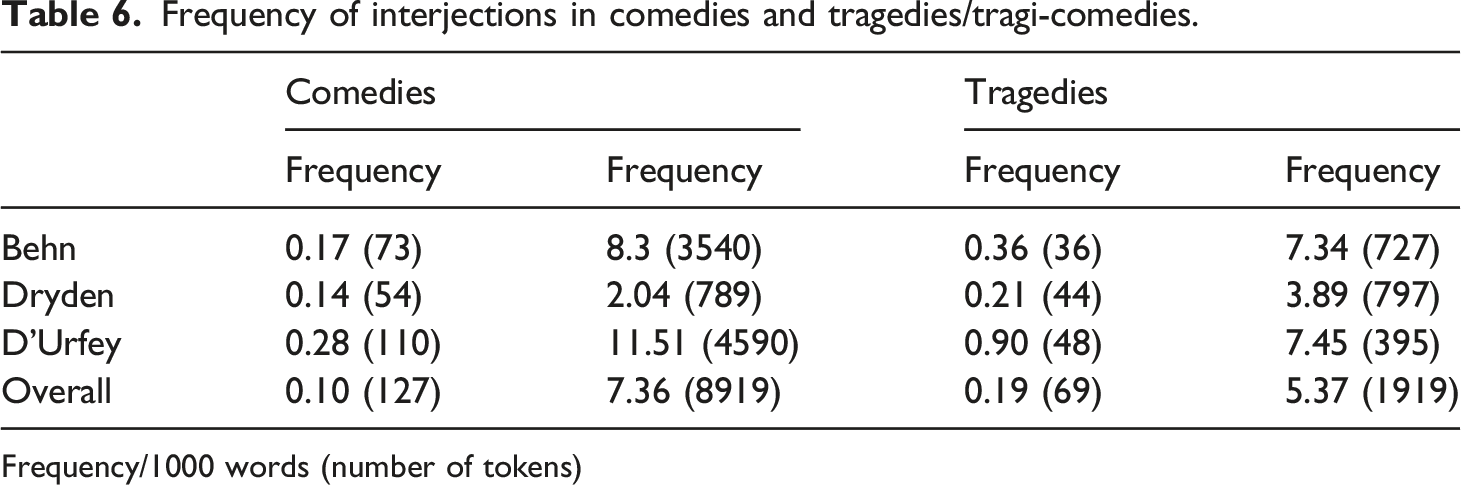
Frequency/1000 words (number of tokens)
Overall, dramatic comedies contain more interjections than tragedies: 7.36 interjections/1000 words compared to 5.37/1000 words. However, the number of interjection types is proportionally higher in tragedies than comedies. This means that interjections are more diverse in the tragedies and may suggest that a greater range of expressive functions are needed for this dramatic sub-genre. However, the amalgamation of the results flattens important inter-author differences. Dryden’s plays show an inverse genre distribution to Behn and D’Urfey. Interjections occur more frequently in his tragedies (3.89/1000 words) than in his comedies (2.04/1000 words). This pattern is further complicated by the greater representation of tragedies in Dryden’s 16-play corpus, which reflects his preference for this dramatic genre over the course of his career. That said, both genres reflect his dispreference for interjections in dramatic dialogue when compared with his two contemporaries. Dryden’s approach to interjections thus appears different to that of his two contemporaries, at both a quantitative level and in their stylistic distribution.
D’Urfey uses interjections substantially more frequently in his comedies (11.51/1000 words) than his tragedies (7.45/1000 words. Behn’s practice falls between the results for her male contemporaries, with comedic interjections (8.3/1000 words) only slightly more frequent than the number in her tragedy/tragi-comedies (7.34/1000 words). Consequently, the overall picture provided by the corpus is misleading, as the preferences of each author fall differently and distinctively across the stylistic spectrum.
Top-ten interjections for each author by genre: frequency per 1000 words.
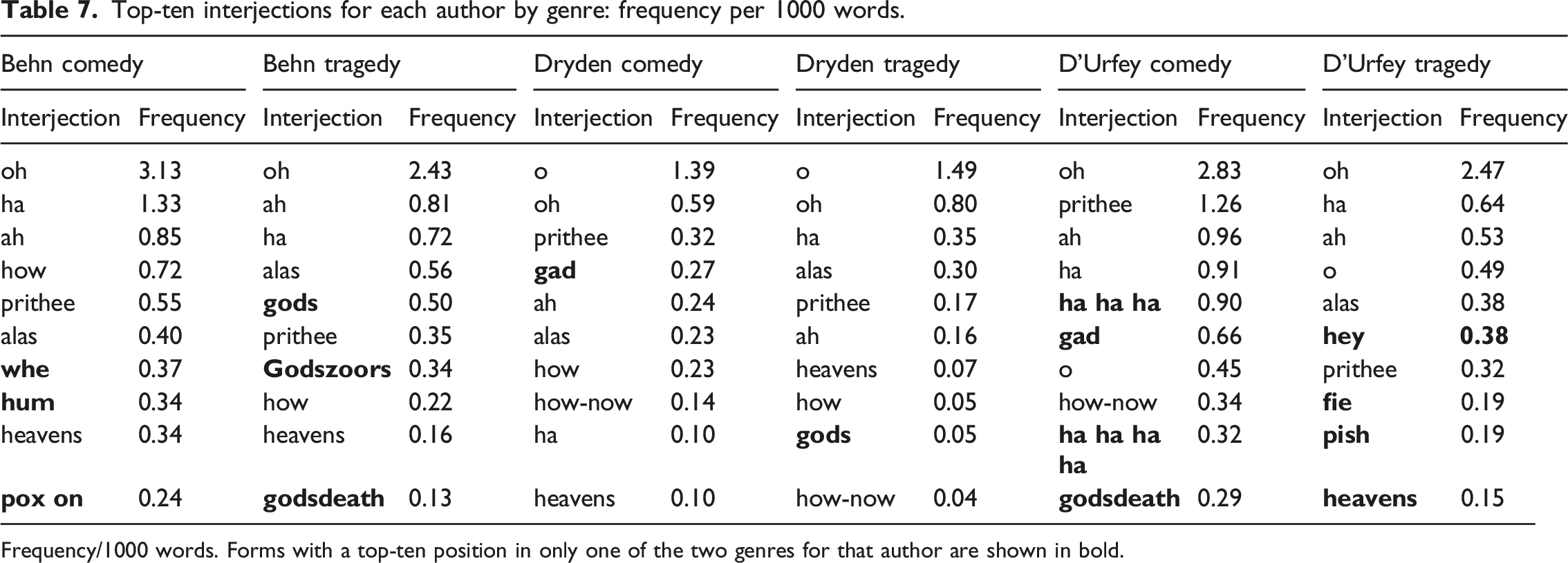
Frequency/1000 words. Forms with a top-ten position in only one of the two genres for that author are shown in bold.
Conversely, the items in bold in Table 7 are interjections that are preferred by that author in one genre specifically. These examples attest to the link between interjection selection and context of use. Thus, D’Urfey’s comedies (perhaps unsurprisingly) make greater use of duplicative ha forms, marking laughter, than his tragedies, whereas religious-derived interjections are more characteristic of his tragedies. Gods in Behn and Dryden’s plays is a product of a Classical setting (relatively infrequent in the corpus), reflecting the culturally-sensitive nature, and world-building role, of secondary interjection forms. Other religion-derived interjections appear to reflect negative contexts of interaction. Hence, godszoors and godsdeath in Behn’s tragedies, and fie and pish in D’Urfey’s tragedies have a similar function, as forms used to mark frustration and contempt.
To take a closer look at interjection choice and genre, the discussion now focusses on two interjections: o and oh. The orthographic difference reflects distinctive stylistic connotations. O represented a literary, rhetorical, high-register form ‘of refined lineage’, whereas oh was associated with everyday conversation (Freeman, 2015: 291). Consequently, o is more frequent in Jacobean tragedies, with oh preferred in comedies (Freeman, 2015: 291). Freeman appears to conceive of the two forms as a (partial) linguistic variable, whereby they are functionally equivalent. Other research suggests that O is narrower in scope, used in vocative functions, with oh having a broader expressive remit. Culpeper and Kyto (2010: 238), for example, find that the functional behaviour of oh is more like ah than the alternative o form. Whilst for the audience, the orthographic forms had little relevance to their play-going experience, the selection of o and oh (as distinctive spellings) may have had meaning for the writers, and their positioning within the literary/linguistic market of the London stage. Freeman notes that Ben Jonson adjusted his practice to include more o examples, as a marker of his learnedness. That said, by the Restoration, oh was emerging as the preferred form overall, suggesting that the classical and colloquial meanings were decreasing in salience.
Table 7 shows authorial differences in the frequencies of o and oh. Dryden uses o more frequently than oh in both his tragedies and comedies. The higher number of o tokens occur in his tragedies, in-keeping with the distribution observed in late Elizabethan and early Jacobean drama (Freeman, 2015). D’Urfey prefers oh over o in both his comedies and tragedies, with the frequency of oh slightly higher (2.83 to 2.47) in the comic plays. O occurs less often, but at a similar rate (around 0.47; a fifth as frequently as oh) in both genres. Finally, in Behn’s plays oh is the most frequent interjection in comedies and tragedies, with o far less frequent: 0.08/1000 words (34 tokens) in the comedies, and only slightly higher at 0.1/1000 words (10 tokens) in the tragedies.
The distribution of o and oh, at a quantitative level, suggests that the three authors’ repertoires use oh and o in stylistically distinctive ways, with each author at a different stage in the orthographic and stylistic convergence of the two interjection forms. Adopting a sociolinguistic perspective, we might turn to the social background of each speaker to understand this distribution. Dryden is the oldest of the three individuals, he received a formal Classical education and was also the poet laureate from 1668 (Hammond, 2021). These factors might inform a conservative use of oh and o, due to his age shaping his perception of the two spellings, and in particular the social meaning of o and its correlate with literacy and learning (Nevalainen et al., 2011). Behn and D’Urfey participate in the generalisation of oh, which could be attributed to their younger age, and potentially their lack of Classical training. What is interesting is that D’Urfey uses o so much more frequently than Behn, and, in both comedies and tragedies. Whilst the potential for compositor interference is always a consideration, this could suggest that D’Urfey was more aware of, or receptive to, the literary market value of o than Behn. Behn’s unusual position as a professional woman writer suggests that, were o socially beneficial to her, she would have implemented it more substantially, if linguistic capital was a similar resource in the seventeenth century as in subsequent centuries (cf. Trudgill, 1972). More work is needed on the sociolinguistic profile of individual style in historical literary contexts to verify these speculations.
Genre analysis indicates how each author uses interjections differently in comedies and tragedies, However, this picture does not acknowledge potential diachronic changes in individual repertoire, despite interjections as a resource showing changes in frequency and form over time (Culpeper and Kytö, 2010). The diachrony of individual style is considered in the next section.
7. Interjections and time
Linguistic analysis (quantitative and qualitative) attests to the flexibility of individual style over time. Sociolinguistic research has documented how specific forms (e.g. quotative like (Gardner et al., 2021)) can be acquired or lost by an individual across their lifespan (see discussions in Sankoff, 2018, Evans, 2013). Stylometric research (computational stylistics) has observed the capacity for similar shifts across a collection of features (e.g. most frequent words), not necessarily tied to a wider, societal level linguistic change. The present analysis of interjections considers the stability of how individuals conceive of and use interjections as a resource in their commercial drama.
Plotting the frequency by plays (numbered 1-16; see Table 1 for play titles), the frequency of interjections increases modestly over time in D’Urfey and Behn’s plays, whereas the use of interjections declines over the course of Dryden’s dramatic career. There is a shared increase in frequencies in the very late 1670s and early 1680s, including in Dryden’s plays, before a decrease in the late 1680s and 1690s; a trend that contrasts with the general expansion in interjection frequencies observed in the CED from 1680 (Culpeper and Kytö, 2010).
As Figure 1 shows, each author has plays in which interjections are used at a frequency higher than the average, as well as a play (or two) where interjections are comparatively sparse. This can, in part, be linked to genre. The majority – although not all – of the plays with the lowest frequencies in Behn and D’Urfey’s corpora are tragedies or tragi-comedies (marked T and TC, respectively). Dryden’s plays do not show such a clear distinction, and the difference becomes less apparent over time. Whilst it could be proposed that the decline in interjections over time in his plays is a consequence of the greater number of tragedies in his corpus, the similarity of interjection frequencies in the late comedy Amphitryon (play 14) with his tragedies, suggests that the trend may reflect more than corpus composition. Dryden’s preference over time is to move away from the interjection as a dialogic device. Interjection tokens (per 1000 words) for each author by play. Tragedies/tragi-comedies marked with T/TC.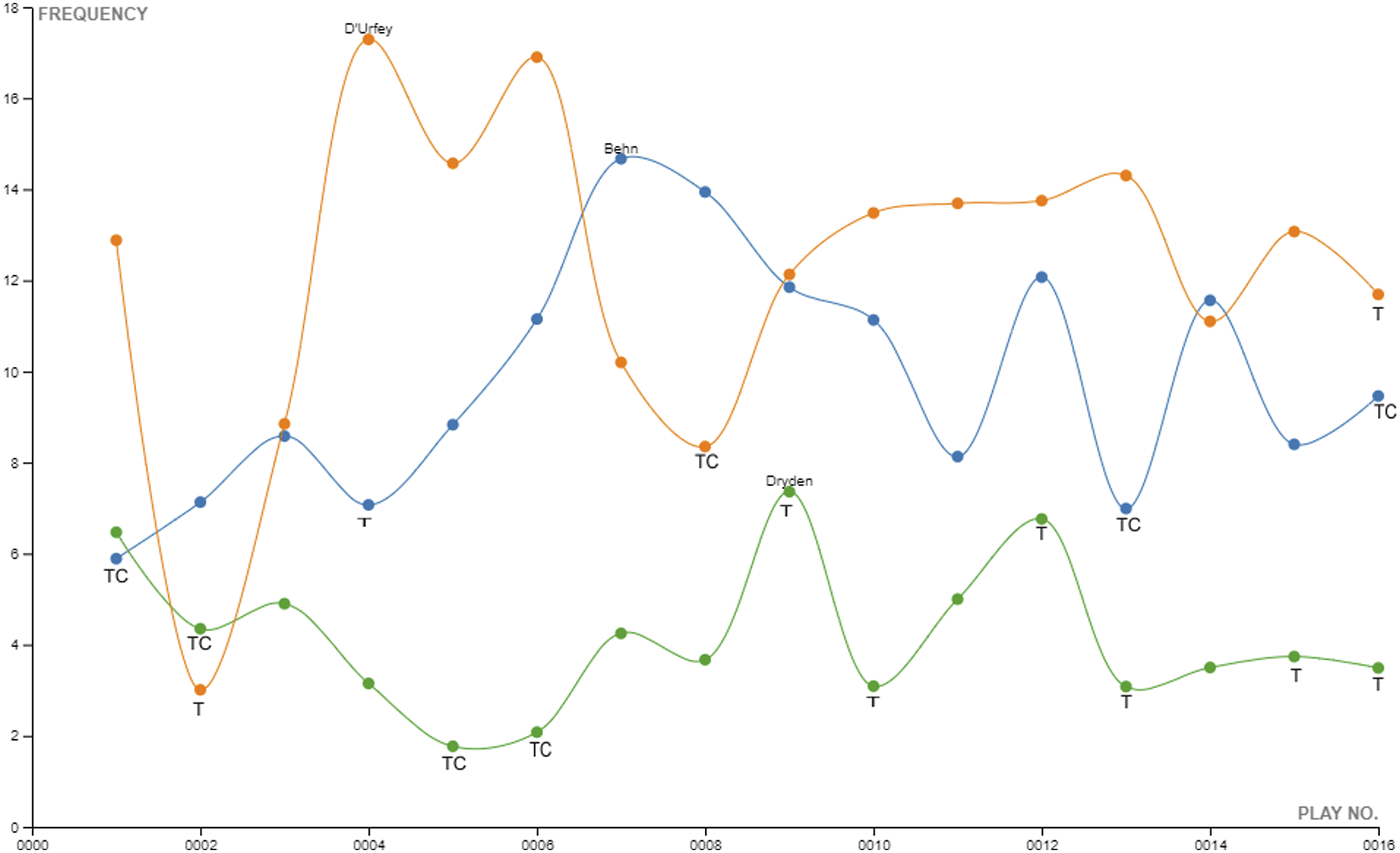
Focussing on the most frequent interjections in the earliest play in each author’s corpus, it is possible to track the frequencies of these forms over time (Figure 2). This analysis reveals the longevity, or not, of interjections characteristic of the early style of the playwrights. To remove the confounding influence of genre, this analysis focusses on the comedies of the three authors. The earliest play for Behn is therefore her second play, The Amorous Prince (1671), rather than her preceding tragedy, The Forced Marriage (1670). (a) Top five interjections in Behn’s earliest comedy tracked over time (per 1000 words). (b) Top five interjections in Dryden’s earliest comedy tracked over time (per 1000 words). (c) Top five interjections in D’Urfey’s earliest comedy tracked over time (per 1000 words).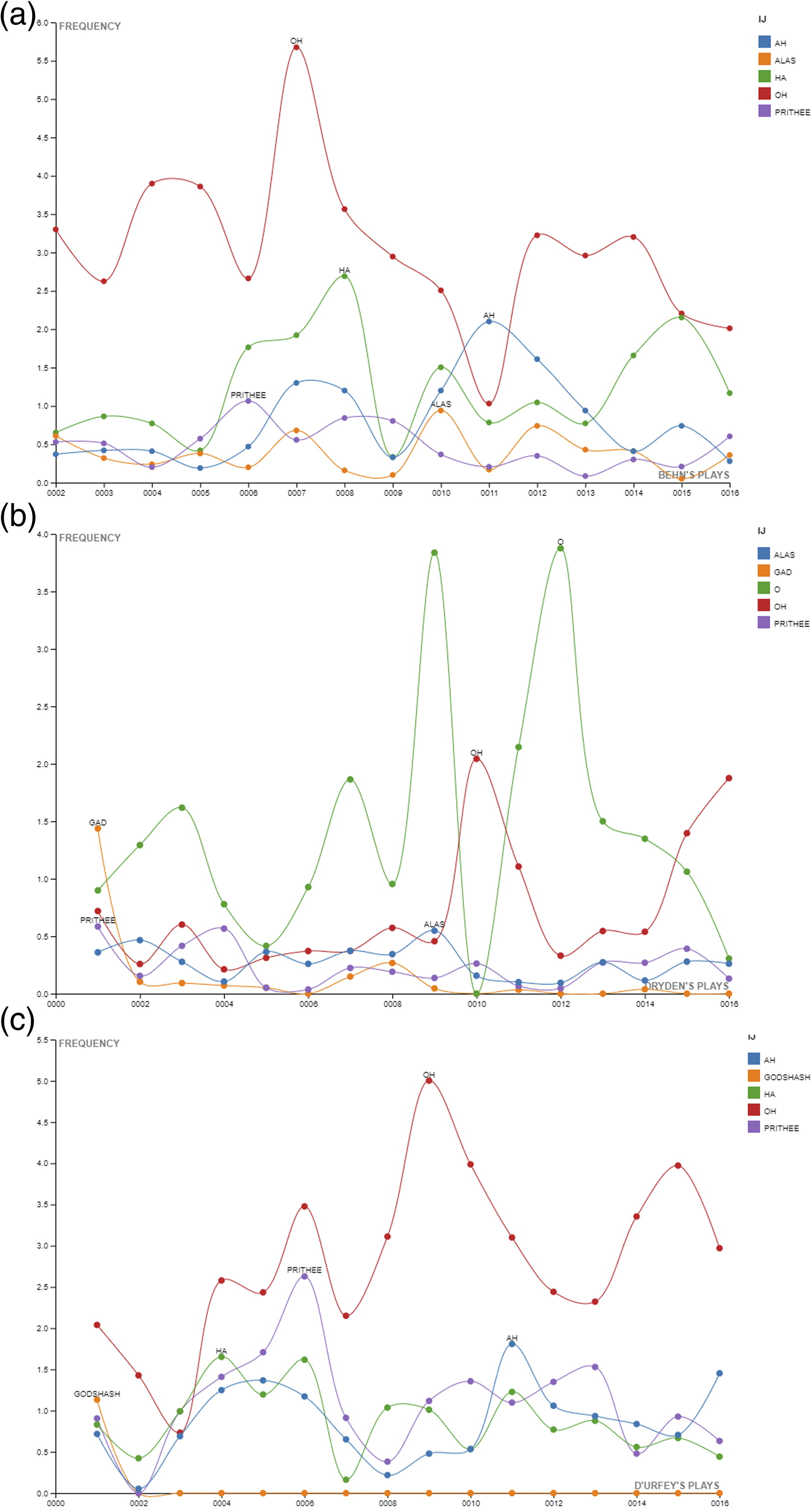
Primary interjection oh occurs in all three lists, and the distribution over time indicates its core position within the English set of interjections in the latter-half of the seventeenth century, despite competition with o. Prithee, too, is prominent in the three authors’ earliest plays. Irrespective of the dis-alignment of the dates of the sixteen plays between the three authorial corpora, there is a decrease in prithee over time. Behn and D’Urfey use prithee most often in their 1677 rake-featuring comedies, The Rover and The Fond Husband, respectively (section 8, below).
Ah shows a similar frequency profile in Behn and D’Urfey’s plays, being higher in the 1670s than the 1680s. To get a better sense of what functions underpin the distribution of this interjection, I used the AntConc collocates tool to identify the top 40 collocates in the R1-3 position with a frequency >3 for each author’s plays, ranked according to their MI score. Address terms feature prominently in the lists. ‘Madam’ ranks in the top twenty (MI scores between 4.3 and 5.8) in the lists of all three authors, and other words from the address term category, such as ‘father’, ‘rogue’, ‘monsieur’ and ‘seignior’, are used more restrictively in the plays indicative of the plot, the setting, and the characters’ language(s) of specific works. Other collocates of ah include duplicative forms, and other interjections, e.g., ‘heavens’. It is frequently used as a precursor to a question, directed either towards another character or as a rhetorical form towards the speaker themselves, reflected in the prominence of wh- forms in the collocates lists. Wh- collocates are proportionately most populous in Dryden’s plays, comprising six of the twenty collocates that meet the criteria set for the AntConc collocate tool, compared with c.80 total collocates of ah identified in the plays of Behn and D’Urfey. In D’Urfey and Behn’s plays, ah is also used to preface more general asseverations, such as the Dutch character Hanse, in Behn’s The Dutch Lover (1673) ‘Ah, ah, a pox of all sea voyages’. D’Urfey’s play-texts also include explicit instructions for how ah was to be realised. His comedy The Richmond Heiress (1693) includes stage directions in which the actor ‘shrieks out’ following duplicative ah in the dialogue.
The particular combination of ah + address term highlights the fine-grained layers of interjection repertoires and their developments over time. In Behn’s plays, the earliest uses of ah + name are limited to two kinds of interaction: the expression of heterosexual romantic love and desire (example 1); and antagonistic exchanges conveying disagreement and contempt between parties (example 2). From 1677, examples of ah + name are used in a more jocular fashion – what might be considered ‘banter’, and other contexts, including to attract attention, seek help, express pleasure, show deference and affection, seek confirmation of understanding, and express sorrow and fear. The early use as a marker of romantic discourse seems to have been superseded by its role as an indicator of sorrow, contempt and recognition/understanding. 1) Frederick: Ah Cloris! can you doubt that heart, / To whom such blessings you impart? (Amorous Prince, 1670) 2) Hippolyta: Ah Traitor, by how base a way / Thou would evade thy fate? (Dutch Lover, 1673)
The ah + name structure may also have indexed stereotypes of particular (Romantic language-speaking) nations. It occurs very frequently in the dialogue of Italian Petro in Behn’s Feigned Courtesans (1679), and Frenchman Le Prate in D’Urfey’s Love for Money (1691). Such examples testify to the important short-hand interjections provide in the process of characterisation in drama dialogue (Culpeper 2001), and the nature of individual repertoires as layered systems of micro- and macro-level stylistic choices.
The interjections also show temporal restrictions. Godshash appears restricted to D’Urfey’s early play (although other gods+ forms are characteristic of his dramatic interjections throughout). The form is associated with a particular character, Toby, a ‘cloddish country[man]’ (Coppola, 2016: 52), and the religious interjection presumably indexes some kind of parochial foolishness, both through the form itself, but also by its frequency: 30 occurrences in the play, all in Toby’s dialogue. Similarly, gad is a feature of the dialogue of Failer, the side kick of the protagonist in Dryden’s The Wild Gallant. These examples highlight the potential for interjections to shape character idiolects, thus explaining their narrow timeframe of popularity within the authorial corpus. Yet not all interjections with a brief ‘lifespan’ are associated with specific characters. In Behn’s plays, the form whe has a restricted temporal frame, found in five plays, performed between 1677 (starting with The Rover) and 1683 (her tragi-comedy, The Young King) – but is not limited to a particular character in each play.
Craig and Kinney suggest that ‘[w]riters tend to remain within a defined band of style, but this is a propensity, not an iron law’ (Craig and Kinney, 2009: 24). This assertion leaves unspecified the factors that might make an author inclined, or not, to stick within the trammels of their stylistic preferences. The analysis of the interjection repertoire over time further highlights how, in dramatic writing, expressive language forms are sensitive to contexts of use. Such diachronic shifts may reflect broader stylistic changes in the authorial repertoire, or potentially more local differences as a writer responds to the topic, plot or character needs of their dramatic writing. To better understand the relationship between stylistic need and authorial interjection repertoire, the final section focusses on the possible relevance of character on the authors’ interjection profiles.
8. Interjections and character dialogue
The analysis of character and interjections examines to what extent the differences between the repertoires of each author can be associated with the kinds of characters they create within their plays. Discussion focusses on the dialogue of a particular character type, the rake, which was especially popular in 1670s and 1680s comedies. The analysis considers how interjections are used in rake(-ish) dialogue to see whether there is an inter-authorial consensus in how interjections contribute to their characterisation.
The rake is a virile and licentious male character who, typically, engages sexually with the play’s heroine(s) (often complicitly), ridiculing their old, misogynistic husbands in the process (Hume, 1977: 36). The rake’s activities are generally a satirical commentary on wider Restoration culture, including a critique of marriage. During the latter-half of the seventeenth century, the rake, whilst inspired by the libidinous kingship of Charles II, undergoes a shift from a class to gendered character type, whose masculinity is integral to, and constructed by, their activities (Mackie, 2005). The rake is both gentlemanly and amorous, a fraternal figure as well as one versed in romance. Language, and linguistic skill, is vital for the rake character and their negotiation of relationships in the progression of the plot. The character therefore provides an interesting focus for interjection use.
Details of three plays with rake characters.
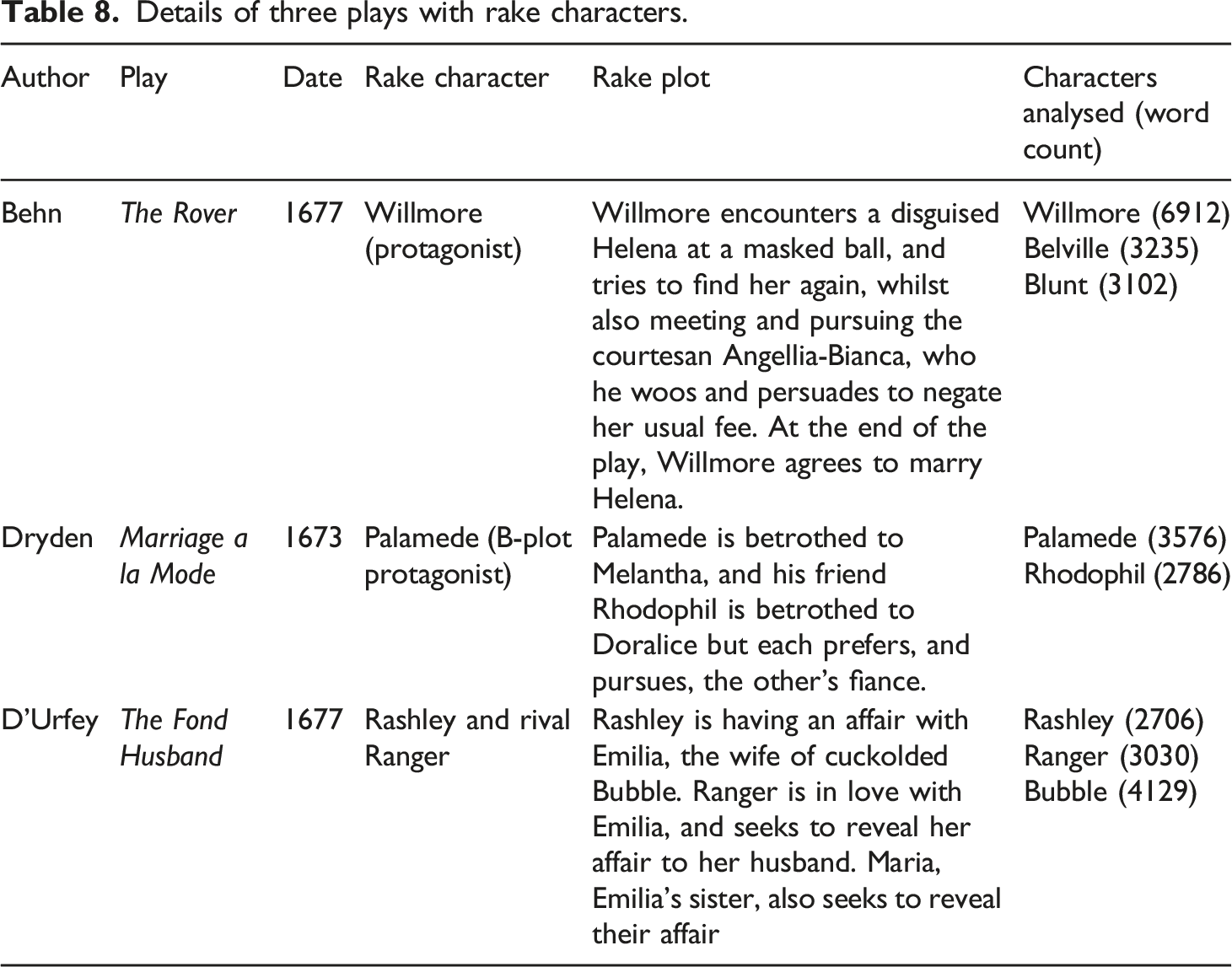
Intelligent Archive was used to construct the interjection profile for each rake, noting any forms shared between the three authors. The function of the interjections was then assessed qualitatively by looking at their situated meanings and conducting an appraisal of forms with local significance.
Interjection profiles for rake characters and their foils/companions in three plays by Behn, Dryden and D’Urfey.
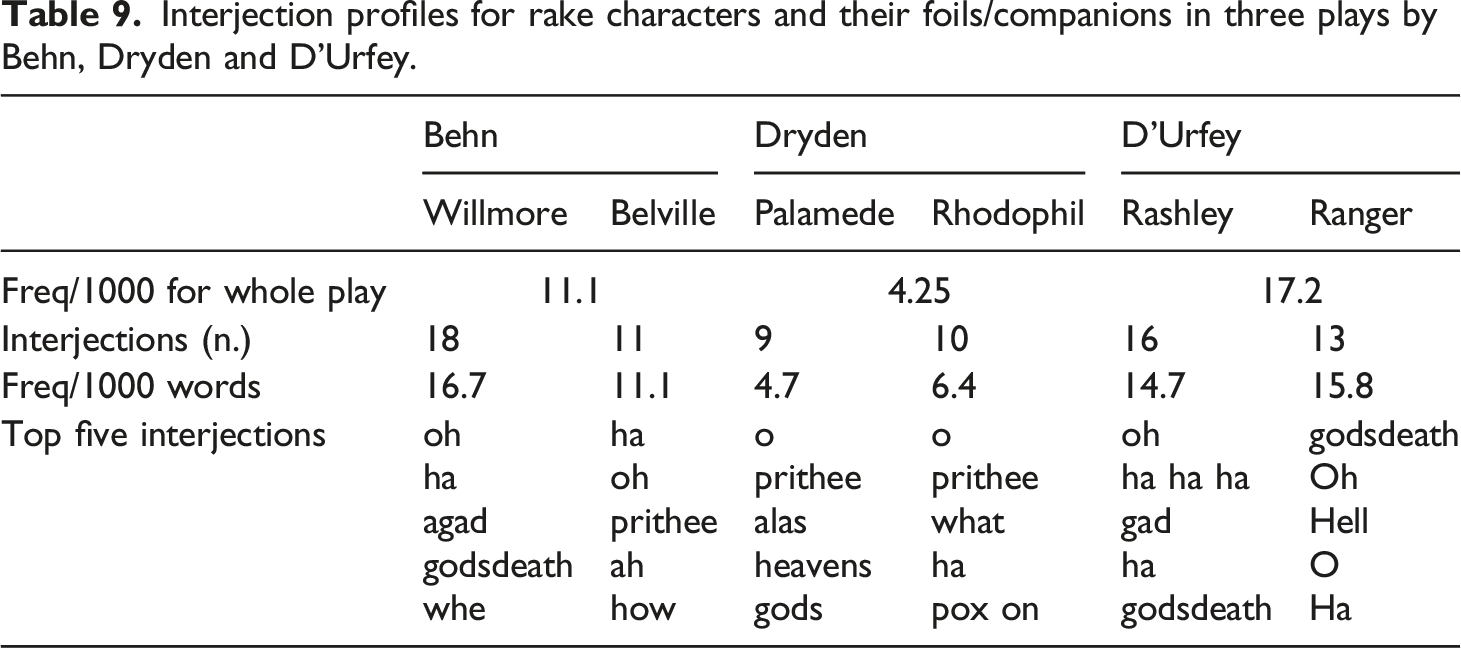
The top five interjections across the rake characters show similarities. For instance, oh is ranked first or second in the dialogue of Behn and D’Urfey’s rake characters, and Dryden’s rakes use the author’s preferred o. Both interjections preface negative exclamations, implying anger or frustration (e.g. ‘Oh insufferable stupidity!’, ‘O this subtle Devil!’). More positive expressions (e.g. ‘oh happy minute!’) appear only with oh, but the number of examples is too small to be conclusive. More specific to these characters is the religious interjection godsdeath, which ranks highly in three rake characters, and may be indicative, through its more colloquial, blasphemous register, of traits associated with ‘rakeish’ interaction, such as rebelliousness and willfulness. Also notable is the absence of prithee from the top-five rake-interjections in Behn’s and D’Urfey’s plays, despite the secondary interjection being in the top-ranked forms as a whole. The interjection is used by Dryden, however. The convergence of interjection forms observed in Behn and D’Urfey’s rake’s dialogue is further evidence of the stylistic similarities between their repertoires observed elsewhere in this investigation. It might also reflect the presence of Smith in the role of both Willmore and Rashley; a possibility that needs further research.
The rake dialogue includes interjections representative of their respective author’s interjection repertoires. Whe appears in Willmore’s dialogue often enough to be ranked fifth (although it is not a rake-specific interjection), and duplicative ha ha ha is the second-most frequent interjection in D’Urfey’s dialogue for Rashley. These forms are representative of their author’s preferences as a whole, according with previous studies that show authorial preferences manifest within the idiolects of individual characters (Craig, 1999). To gain a clearer sense of how interjections contribute to the characterization of the rake characters, each play is now discussed in turn. The findings are considered alongside the trends in genre and authorial style discussed in the preceding sections.
8.1. Dryden’s Marriage a la Mode (1671)
The rake character, Palamede, and his friend/competitor, Rhodophil, use interjections above the average frequency for Dryden’s plays, but at a rate comparatively lower than the other authors’ plays discussed here. The most frequent interjections for these characters are those typical of dramatic dialogue in the corpus as a whole: o, prithee, ah and oh. However, the interjections found in the dialogue of Palamede and Rhodophil contain a great proportion of secondary interjections than those of their female counterparts, for instance, and also some less common interjections. Basta appears in an aside by Palamede, expressing his decision-making and determination, and can be read as an inflection of the play’s Sicilian setting: ‘But
In Marriage a la Mode, interactions often involve amorous exchanges. In the opening conversation between Palamede and Rhodophil’s fiancé, Doralice, o is used to mark Palamede’s frustration, although perhaps with a hint of affection and desire (example 3): 3) Doralice: Then, to strike you quite dead, know, that I am marry’d too. Palame de: Art thou marry’d;
The rake-ish characters, when not pursuing their female targets, also engage in male-to-male conversation. In these interactions, the proportion of interjections increases (example 4), and are more likely to feature secondary interjections. 4) Rhodophil: Palamede: Rhodophil: In one word, I am married; wretchedly married; and have been above these two years. Yes,
The collective, and more intensive, use of interjection forms, particularly secondary types that are more transient and sensitive to social (religious, political) change, may therefore denote a more informal, conversational register. Research suggests that other types of affective language, such as discourse markers, may index particular functions, e.g., the indexical field for eh signals a positive interpersonal stance in New Zealand English (Vine and Marsden, 2016), even if it is used for particular functions, such as signalling attentiveness, in any given context. In the case of these co-occurring (secondary) interjections, it is feasible that their clustering indicates a shared orientation, and a shared means of expressing that orientation, by the characters towards ongoing events. In this reading, the clustering interjections construct solidarity between interlocutors, perhaps in a similar way to that observed between present-day users of teenage slang (Fajardo 2019). The Restoration stage permitted more emotive and blasphemous language than in the preceding or following dramatic eras, although this is not especially evident in Dryden’s plays. However, his use of interjection clustering adds a colloquial dynamic to his character dialogue that is not as apparent in more singular examples.
Interjections are also a notable feature in dialogic asides, likely because of the expositional function of the forms, revealing a character’s interior experiences. They can also be seen to contribute to comic satire, giving the audience access to information not available to the characters (example 5): 5) Melantha: Let me die, Philotis, but this is extremely French; but yet Count Rhodophil A Gentleman, Sir, that understands the Grand mond so well, who has hanted the best conversations, and who (in short) has voyaged, may pretend to the good graces of any Lady. Palamede (aside):
The examples from Marriage a la Mode demonstrates the relative paucity of interjections in Dryden’s rake-ish dialogue, suggesting that Dryden does not put aside his general preferences when creating this character type. Palamede and Rhodophil are egocentric, amorous, confident and humorous, as befits the Restoration rake, but their characterisation is not notably reliant on interjections. This contrasts with the creative strategies of D’Urfey and Behn.
8.2. D’Urfey’s The Fond Husband
Hume’s (1977) summary of D’Urfey’s ‘bed romp’ suggests that the characters “talk the talk” of rake-ish and libertine behaviour, but that the play proceeds without any real critical substance. What constitutes rake-ish talk in The Fond Husband, from the perspective of interjections, are expressions of anger, frustration, and amorousness. Rashley uses 16 interjection types, Ranger uses 14 types, and overall frequencies are just under the play average (17.2/1000 words): Rashley (14.7/1000 words) and Ranger (15.8/1000 words). Their preferred forms include the core primary forms (oh, o, ah), and forms typical of D’Urfey’s interjection repertoire (e.g. ha ha ha). The interjections reflect the characters’ situation and orientation towards events.
Rashley’s interjections align with the interpersonal, interactive activities of the character, particularly his amorous relationship with Emilia. The vocative ‘Oh my Dearest!’ (example 6) is typical of amorous oh. As discussed below in relation to The Rover, oh acts as a register marker for the language of love. In Rashley’s dialogue, at least, it appears to be used un-ironically (or could be plausibly performed as such). 6) Emilia: Our Intrigue as yet goes well. Rashly: I swear to admiration; and had I not seen each passage, I shou’d have thought 't had been impossible.
The old husband, Bubble, is the butt of the joke in The Fond Husband, and interjections mark his foolishness, creating a character to be mocked by characters and the audience. Bubble’s dialogue contains 25 different interjections, occurring 27.8/1000 words: a third more forms, occurring 30% more frequently, than in Rashley or Ranger’s dialogue. The cumulative effect of these interjections is to create a character of affect (varied emotional reactions) with little cognitive or interpersonal substance; see example 7: 7) Bubble: Holloway? —a Rashley: Bubble: A Ninny, a Fool.— Rashley: Ay, and the most credulous of all the Cuckolds I ever met with. Bubble: Poor Animal!
Ranger, by and large, experiences endless frustrations in his attempts both to woo Emilia and reveal Rashley’s cuckoldry to Emilia’s husband, Bubble. This is quantitatively reflected in the most frequent interjection in his dialogue being godsdeath, used to convey frustration and anger, often as part of dialogic asides (also a preferred location for rake interjections in Dryden’s Marriage a la Mode).
Interjections thus play an important role in characterisation. As in Dryden’s plays, they indicate the speaker’s stance towards their interlocutors and situation, but D’Urfey uses them more extensively for character (stereo-)typing. Over-expressiveness, marked by high frequency interjections, indexes Bubble’s foolishness, for example. For the rake character Rashley, the interjections signal his confidence and amorous endeavours, both of which are part of the fabric of the rake character-type. D’Urfey does not use particular interjection types, however, to demarcate rake dialogue from other characters.
8.3. Behn’s The Rover
Behn’s most famous rake, Willmore, is active and amorous, and interjections are important for his characterisation. His first scripted word is ha. Quantitatively, Willmore has a diverse set of interjection forms (18 types; although also the largest word count in the play >6000 words), and their frequency (16.7/1000 words) is above the play average (11.1/1000 words). In context, interjections in Willmore’s dialogue are more distinctive compared to the other rakes analysed here; not because he uses idiosyncratic or exclusive forms, but rather because of how forms are used differently across different contexts. As a rake, Willmore’s activities orient around amorous encounters, male-to-male ‘banter’, and more serious moments of strife. Some interjections are more prominent in specific situations, suggesting register-related choices. This is most apparent in his conversations with the female characters, Helena and the courtesan Angellica-Bianca, in which interjections such as oh and agad are used. As in D’Urfey’s The Fond Husband, oh appears to index an amorous register.
5
In The Rover, however, this can be seen as satirical. Willmore is an extravagant rake, meaning the character is self-aware in his licentious behaviour (Hume, 1977). Oh is part of the self-conscious performance of wooing of Helena and Angellica, perhaps with one eye to the audience as he goes through the social script of heterosexual masculine desire (and conquest). In (8), Willmore and Helena’s flirtatious exchanges include oh to signal his alignment and agreement, whilst heightening the affective intensity: 8) Hellena: Can you storm? Willmore: Hellena: What think you of a Nunnery Wall? for he that wins me, must gain that first. Willmore: A Nun!
Later in the play, Willmore makes his move on Angellica. In an extended speech designed to woo her, interjections are conspicuously absent: ‘Yes, I am poor — but I’m a Gentleman’, he begins, as his discourse of love draws on the language of finance. Later in the scene, interjections are used more frequently, but with a distinction observable between those used towards Angellica, and those in asides: 9) Willmore: (Aside.) Angellica: And will you pay me then the price I ask? Willmore:
Later in the play, when his libertine activities are discovered by Angellica, the interjections key his stance towards different people and events. In example 10, amorous oh is used as he reflects on his desire for Helena, but ha and pox mark his anger and frustration with Angellica: 10) Willmore: Two Hundred Thousand Crowns! what Story’s this? — what Trick? — what Woman? — Angellica: How strange you make it; have you forgot the Creature you entertain’d on the Piazo last Night? Willmore (Aside.):
What marks out Willmore’s interjections therefore is how they are keyed to context, not just as a reflection of his situation, but as a facet of the character’s self-awareness of how he can use language to shape his relationships and better negotiate his way through the circumstances in which he finds himself. As another example, whe appears most frequently in Willmore’s (drunken) dialogue during and after his near-rape of Florinda. The form intermixes with other interjections (ha, oh) and indexes the character’s agitation and confusion. Thus, whilst D’Urfey’s Ranger and Rashley showed some register-sensitive interjection choices, it is much more pronounced in Willmore’s language. As a rake, especially an extravagant rake, Willmore fulfils the brief as a man of rhetoric with a strong sense of linguistic appropriacy, as well as providing cues to the audience at moments of ridicule, satire and social commentary.
The analysis of the three rake characters reveals only modest similarities between the three dramatists’ design, with nothing to suggest that specific interjection forms were (perceived as) indexical of this social identity. However, there is greater evidence of shared techniques in the creation of the foolish husband – or, in the case of The Rover, the foolish friend, Blunt. Like Bubble in D’Urfey’s The Fond Husband, interjections occur most frequently in the dialogue of Blunt, a foolish country bumpkin, who is tricked by his amour, robbed of his clothing and possessions, and ends up drenched in sewage. Blunt’s interjection profile includes distinctive forms godsheartlikins and whe, both of which occur more often in his dialogue than the period-dominant interjections oh and ha. Like Bubble, he only partly comprehends what takes place, with a misplaced understanding of his status and personal relationships. Godsheartlikins signals his emotional, rather garrulous nature, and occurs 13.8/1000 words, which is roughly equivalent to one occurrence every 17 seconds of dialogue. As an expressive language feature, the affective impact of interjections is sensitive to frequency of use. In Blunt’s dialogue, the interjections are used so frequently their meaning is diluted (cf. bleaching – (Tagliamonte, 2008)), and their pragmatic force reduced. These high-volume, low value interjections are indexical, in a way, of Blunt's personality; a man lacking the substance, richness and creativity of his peers, like Willmore.
In summary, the analysis of the rake characters indicates that each author uses interjections in a way that reflects their overall style preferences. The low occurrence of interjections in Dryden’s character, Palamede, or the high volume and range in Bubble’s dialogue are strategies recognisable from the authorial-level findings discussed in the preceding sections. The results suggest that, rather than specific character types skewing the overall trend and distribution data at the level of genre or author, the authorial repertoire holds across the character dialogue. This findings supports the observations of Craig (1999) on the situating of character idiolects within the broader markers of authorial style. The current analysis has shown this to be applicable to a particular linguistic category, the interjection.
9. Conclusion
The investigation of interjections in the dramatic dialogue of three Restoration authors has demonstrated that their use is shaped by factors of genre, characterization, and time, but that inter-speaker preferences are also detectable in the selection and distribution of forms. The results support previous studies that have shown interjections to be a prominent feature in Restoration drama, and have further refined this view in indicating their stylistic sensitivity to genre, with a greater appreciation of their role in tragedy versus comedy.
The analysis of each authors’ preferences over time highlights how the distinction between ‘core’ interjections and more culturally-aligned, fleeting forms was used in these dramatic texts, with some interjections associated with specific characters, or particular time-periods within an author’s literary career (e.g. whe in Behn’s plays). The analysis of character, moreover, indicated that interjections may have had register associations, which made them a valuable resource for characterisation. Not only can interjections provide insights into a character’s emotional response to their situation, they can also contribute to the signalling of the interpersonal relationship between characters, or key in a particular kind of register, such as the amorous interactions of Rashley or Willmore.
The three authors use interjections in similar ways, in that quantity can index foolishness, or that certain forms can become idiosyncratic markers of a particular character’s voice. However, the choice of specific forms, outside of a core set of primary interjections, is amenable to each individual’s preferences. The dramatists' repertoires are distinctive and follow their own trajectory of forms and frequencies of use, and this individual profile can be traced across or within the other facets explored here, namely genre and characterisation. This includes the identified examples of revivification, of short-lived active usage, and of creativity and coinages; strategies presumably employed when the existing wordstock did not fulfil the requirements of a dramatic context. Of course, our knowledge of the three author’s interjection repertoires is incomplete. This paper offers insight into their active use of interjections in dramatic literary contexts. Further work is needed to understand the relationship between the role of interjections, and other expressive language, in drama and other (literary and non-literary) communicative environments.
Footnotes
Acknowledgements
The author wishes to thank Professor Elaine Hobby, Professor Julia Snell, and audiences at Hudderfield and Lancaster University research seminars for their invaluable feedback on this paper. All remaining errors are my own.
Declaration of conflicting interests
The author(s) declared no potential conflicts of interest with respect to the research, authorship, and/or publication of this article.
Funding
The author(s) disclosed receipt of the following financial support for the research, authorship, and/or publication of this article: Research for this article was supported by AHRC research grant ‘Editing Aphra Behn in the Digital Age’ (AH/N007573/1).
