



Abstract
This article represents the first illustration of the tools of disability stylistics on a literary text. It does so by examining the representation of blindness in an extract from Robert Louis Stevenson’s novel Treasure Island in which the character Pew is introduced. The article outlines concepts relating to the othering of disabled people before describing two major cultural stereotypes of disability that scholars argue persist to the present day. These are the pathetic and pitiful disabled person and the disabled individual as evil. Disability scholars have identified language as a key area for the construction and perpetuation of stereotypes of disability. However, scholarship has tended to focus on labels, or discourse with language use considered in context. This article confirms that labels and basic description are crucial elements through a consideration of noun phrases. Nevertheless, the article also utilises the models of transitivity, speech acts and im/politeness, and elements of the framework of appraisal. The article identifies a pivotal moment in the extract in which Pew is transformed from a potentially (though ambiguous) pitiful figure into a realisation of the evil stereotype, and shows that all stylistic frameworks outlined permit these depictions to be analysed. The article calls for the tools to be used to test the claims that stereotypes persist into the present day. It also concludes that disability stylistics should be tested on representations of other disabilities. It argues that the tools need also to be used to analyse other disability stereotypes.
Keywords
1. Introduction
This article offers an illustration of the analysis afforded by a stylistics of disability, using a representation of blindness from Robert Louis Stevenson’s novel Treasure Island, first published in 1883. The article will demonstrate that the stylistics of disability which I am developing (Hermeston, 2017) can reveal in detail the linguistic construction of otherness and well-worn stereotypes of disability. Disability scholars maintain that such stereotypes are still to be found in literature and the media and I believe disability stylistics will aid in testing such claims in future work. I will first introduce some fundamental issues in the field of disability stylistics in the context of cultural disability studies, before conducting an analysis of the first encounter with the character Pew, taking into consideration the noun phrase, the transitivity framework, speech acts, im/politeness, and conversation analysis, and aspects of Martin and White’s (2005) model of appraisal to demonstrate that these are highly suited to help us understand the othering of disabled people and the construction of two major stereotypes.
2. Disability stylistics and cultural disability studies
I outline here some fundamental concepts underpinning disability stylistics before relating them to disability studies. Among linguists, of course, language is seen as being capable of encoding ideology. Within texts, Simpson argues, ideology and point of view are constructed because ‘a particular style represents certain selections from a pool of available options in the linguistic system’ and ‘privileges certain readings, certain ways of seeing things, while downplaying others’ (Simpson, 1993: 8). I shall give an account of ideologies related to disability shortly. However, I also wish to draw on the fundamental theory of foregrounding which underpins stylistics.
Foregrounding has long been a concept used in stylistics, usually to convey the idea that language which somehow violates norms through repetition, parallelism, or deviation is noticeable or artistic (Gregoriou, 2014: 87–9; Short, 1996: 10–14). Gregoriou (2014: 87) states that at its most basic the concept of foregrounding captures the ‘perceptual prominence that certain things have against the backdrop of other, less noticeable things’. I set aside discussion of repetition and parallelism here. Gregoriou (2007: 18–34, 2014: 88, 96) expands on narrow linguistic considerations to give a three-level framework of deviation that covers the linguistic or textual, the social, and deviation by genre. Crucially, Gregoriou’s (2007: 91–122, 2014: 96) description of perceived deviation at the social level undoubtedly includes depiction of disabled people, who may not meet the ‘norms’ of society. This, of course, demands that we understand the cultural basis of the depiction of such supposed deviation and its consequences. For this I turn to cultural disability studies.
This article focuses on a depiction of blindness. Nevertheless, it must be understood that blindness is theorised by scholars as part of the wider category of disability and frequently receives the same or similar cultural treatment (cf. Bolt, 2014: 4; Cameron, 2011: 259–260). Disability is seen overwhelmingly as otherness and abnormality in many societies. This is often theorised by disability scholars as ‘ableism’, a concept first described in detail by Campbell. It refers to a set of ‘beliefs, processes and practices’ whose product is a ‘corporeal standard’ typifying what is ‘fully human’ and hence casting disability as a ‘diminished’ and ‘inherently negative’ state of humanity (Campbell, 2009: 5). Related to this, Garland-Thomson (1997: 8) has used the concept of an illusory ‘normate’ minority identity, to which people strive and which relies on an ‘array of deviant others whose marked bodies’ sustain its integrity. These concepts of ableism and normalcy, of course, are dominant ideologies as envisaged by Simpson (1993: 5). As with other scholars Garland-Thomson (1997: 6) implicates ‘legal, medical, political, cultural, and literary narratives that comprise an exclusionary discourse’ which constructs physical disability. Davis (2013: 9) too has argued that venues like the novel reveal the need of a ‘hegemony of normalcy’ to be upheld through its comparison with the ‘abnormal’. Thus cultural disability studies emphasises the cultural corresponding construction of disability as ‘abnormal’ but also the construction of ‘normalcy’ itself (see Mallett and Runswick-Cole, 2014: 23). This all implies that in literature and elsewhere the depiction of disability is highly likely to be foregrounded as other in some way.
The othering of disabled people can lead to stereotyping. Link and Phelan (2001: 366–368) argue that the labelling of deviation from supposed human norms, including disability, is causally related to stereotyping and stigmatisation. Garland-Thomson (1997: 10–11) also notes a tendency for depictions of the otherness of disability in literature to lead to stereotyping. I will link this shortly to Van Leeuwen’s (1996) ideas about overdetermination. I have noted also in my previous research, informed by cultural disability studies that ‘curiosity, doubt, presuppositions, suspicions and even fear about what disabled people can or cannot do are central to ableist cultural representations’ of them (Hermeston, 2017: 49). The existence of stereotypical representations of disability in literature and the media more broadly relates very often to such preoccupations about ability or lack of it. The stereotypes have been documented repeatedly and many have persisted into the recent past and even the present day. The lists given by Rieser and Mason (1990: 98–104) and Barnes (1992), have close similarities and according to Mallett and Runswick-Cole (2014: 57), they are still the most extensive range of identified media stereotypes. I have outlined them in some detail in my earlier work (Hermeston, 2017: 40–42). I will list a range of them here but give details of only the two most relevant to my present analysis. The stereotypes include the disabled person as pathetic and pitiable, sinister or evil, a burden, a ‘super cripple’ or superhuman who triumphs over adversity or has extraordinary ability, a victim of crime or violence, and the self-pitying disabled person as his or her own worst enemy (Hermeston, 2017: 41–42; cf. Barnes, 1992; Rieser and Mason, 1990: 98–103).
The pathetic and pitiful disabled stereotype is very common, and Tiny Tim in Dickens’ A Christmas Carol is an oft cited literary example (Barnes, 1992; Cameron, 2011: 260, Dolmage, 2014: 40–41; Rieser and Mason, 1990:98). Nevertheless, this stereotype based on the idea of dependency continued throughout the 20th century in funding campaigns run by disability charities, and such campaigns are still found today (Barnes, 1992; Cameron, 2011: 260; Rieser and Mason, 1990: 99). The sinister or evil disabled figure is another common stereotype and Shakespeare’s Richard III is a highly prominent example (Barnes, 1992; Dolmage, 2014: 41–42). The evil stereotype is still to be found, for instance, in the crime novels analysed by Gregoriou (2007).
I have stated that blindness should be situated within a wider context of disability. In fact, it is clear that blindness has been attached to the pitiable or evil stereotype (among others) historically and this appears to continue. Writing of the 19th and early 20th Century, Langworthy (1930: 270–271, 276–277) notes the pitiable and evil stereotypes of blindness in culture and fiction. Bolt (2014: 10–11) notes that blind people are subjected to metanarrative[s]’, in essence over-riding tropes or stereotypes imposed upon them, and discusses these in relation to twentieth-century fiction. These include the persistent image of the blind beggar (Bolt, 2014: 10–11). It is noteworthy that the character Desmond Bates in Lodge’s (2008: 13–14) novel of 2008 Deaf Sentence states that blindness invokes ‘pathos’ and ‘compassion’ and gives historical and literary backing for his albeit comic argument. While Pew is used in the current article to illustrate the evil stereotype, it should be noted that Stevenson (2014: 93–96) drew also on the sinister blind stereotype in the 1886 story Kidnapped with the character Duncan McKeigh. Nevertheless, Bolt (2014: 79), argues that the blind figure and associated groping hand are associated with lechery and the monstrous in twentieth-century fiction. In Atwood’s (2000: loc.470–472, 2421–2428, 4967–5025) The Blind Assassin published in 2000, a group of sightless killers with extraordinary abilities are ruthless, pitiless and dreaded, regardless of any mercy shown by one of their number and their own history of being abused. Thus, primarily they may fit the stereotypes of the blind or disabled person as sinister or evil but also as ‘super cripple’ or superhuman. Finally, Murray (2014: 252) in a consideration of blindness alongside other forms of disability states that most cultural depictions of disability continue to ‘misrepresent those with disabilities in ways that simply would not be tolerated were they modes depicting ethnicity or gender’, for instance.
I have outlined a range of stereotypes that are applicable to disability and blindness more specifically. Nevertheless, there does not appear to be a systematic understanding of how particular linguistic structures may build and encode such stereotypes. Often, consideration of disability and language seems not to extend beyond discussion of ‘correct’ labels (cf. Mallett and Runswick-Cole, 2014: 4–5, 9) or of discourse, the contextual use of language as it may be politically, socially and historically determined (cf. Corker and French, 1999: 11; Grue, 2015: 7; Mills, 2004: 6, 2005). The concentration on labels may fail to identify a much wider range of linguistic structures that encode and construct ideology. Likewise, contextual analysis in the absence of close attention to linguistic structures is precisely the type of which Jeffries (2010: 1–2, 2014: 410–411) has been critical in her claim that greater scientific rigour is needed in critical discourse analysis. Much the same might be said of Dolmage’s (2017: 214–215, 223) ‘disability rhetoric’, which focuses on bodies and communicative strategies, that underlie power relations, setting aside close scrutiny of texts. While Nickels (2016) does apply transitivity analysis and analysis of the representation of social actors to two texts dealing with the ‘d/Deaf’ population in America, her aim is restricted mainly to promoting use of the term ‘d/Deaf’ as opposed to ‘hearing impaired’ in order to stress the ‘agency’ attached to the former. In doing so, Nickels (2016: 4–5) also distances the terms ‘d/Deaf’ and ‘disabled’ in favour of associating the former with a cultural community. Thus, by definition, she does not seek to develop an umbrella stylistics applicable to a range of disabilities based on the linguistic construction of an array of widely attested stereotypes and ideologies. It is this which I am seeking to provide. While I acknowledge that the tools I outline next will need to be tested in relation to other disabilities, I contend that they will help also to ascertain in a rigorous manner whether stereotypes do persist to the present day, as many scholars claim.
3. The tools and the text
In this paper I deal briefly with description and the noun phrase and the representation of social actors, and more extensively with the transitivity model, and speech acts and im/politeness from pragmatics, along with conversation analysis. I deal also with aspects of attitude from the framework of appraisal. These frameworks have a broad unity in terms of what they can reveal about ideologies of disability. Description can capture notions of the normal and otherness, the tendency to label and categorise disabled people and the potential for stereotyping. Transitivity, pragmatics and conversation analysis can capture notions of relative activity, inactivity, power and powerlessness (central to conceptions of disability and ability). We will see that the model of appraisal contains, among other things, judgements about capacity and normality – thus having a direct relevance to cultural conceptions of disability. I will explain each of the models in turn as I progress through the article. The structure of each section may vary according to its perceived suitability. This article will not focus explicitly on linguistic or generic foregrounding as this would involve additional extended commentary. In all cases, however, I will note the implications of analysis for social foregrounding.
I have chosen the extract from the novel Treasure Island because it is so stark in its depiction of disability and stereotypes. In fact, the extract is quite notorious among disability scholars, being identified repeatedly for its stereotyped depiction of blindness and disability as evil or sinister (Barnes, 1992; Cameron, 2011: 260; Langworthy, 1930: 276; Rieser and Mason, 1990: 99). Indeed, the analysis that follows is intended primarily to illustrate techniques for analysis facilitated by this text in a compacted form to show that they could be applied to other texts. Nevertheless, the tools do help to explain the more nuanced understanding of the text offered in this article, which recognizes linguistic forms used in the depiction of the pitiful, in addition to the more well recognized evil stereotype attached to this character. While Treasure Island is a nineteenth-century novel, it is still widely available and well-known. Thus, it has the potential to perpetuate or construct stereotypes. As noted above also, scholars state that the stereotypes in question are widespread and still to be found today. The extract from the novel provides both a test and a stark illustration of the tools of disability stylistics. I hope that this will facilitate analysis of other texts both old and new in order to test the claims that the stereotypes continue to exist and further assess the efficacy of the tools themselves. The extract is quite short at just over 300 words. Nevertheless, Jeffries and McIntire (2010: 18) make clear that stylistic analysis can be restricted to short texts such as single poems. In addition, the extract is comparable in length to the single 230 word extract from Plath’s The Bell Jar, which Burton (1982) analysed in her landmark chapter demonstrating the role of transitivity in what became feminist stylistics.
The extract is from early in the novel. This passage is taken from the third chapter, ‘The Black Spot’, and represents the first occasion on which the first-person narrator Jim encounters the blind character Pew (Stevenson, 2006). We learn subsequently that Pew is a murderer, in league with pirates, and had been a pirate before he was blinded (Stevenson, 2006). Nevertheless, it must be remembered that for new readers, unaware of this wider context within the novel, Pew is simply a new character. We will see that his blindness itself is used as a signal or trigger for stereotyped depictions in this absence of context. The extract is reproduced in Appendix 1 to this article. I detect a pivotal moment in the text when, at Pew’s request for assistance, Jim offers his hand. At this point Pew transforms from the pitiful figure that he has attempted to project for himself (albeit a rather ominous one given the narrator’s description), to an evil and sinister figure.
4. Overdetermination and the noun phrase
A key point about Pew in this extract is that he is blind. The adjective ‘blind’ is used four times in the passage (Stevenson, 2006). I have adapted Van Leeuwen’s (1996: 57) notion of ‘physical identification’, modifying it to ‘attribute identification’ to capture the notion that individuals may be identified and categorised by description of physical characteristics or impairment specific description (including the non-physical) in a given context, whether a character is named or not (Hermeston, 2017: 47). Van Leeuwen (1996: 57–58, 61–65) argues that in the absence of naming such description is ‘always overdetermined’, meaning that such attributes come to have additional social meanings related to character, behaviour and so on. Garland-Thomson (1997: 10–11) also identifies this tendency to overdetermine impairments and impairment attributes. Thus, blindness is ripe for over-determination and association with a range of stereotypes (cf. Garland-Thomson, 1997: 10–11), though I would argue this can occur even when characters are named.
Noun phrases contain information and ideology. Pew is merely ‘someone’, a ‘figure’ (Stevenson, 2006) at first, perhaps depersonalising him and lending him mystery. But we are quickly told of his blindness and he refers to himself as ‘“a poor blind man”’ (Stevenson, 2006) clearly attempting to harness the potential of the pitiful persona. However, after the pivotal moment when Jim the narrator offers his hand he is described as a ‘horrible, soft-spoken, eyeless creature’ (Stevenson, 2006). As Jeffries (2010: 20–21) notes, naming by metaphor can carry ideological meaning, and this is clearly the case here. Pew is made to be a non-specified but ‘horrible’ (evil) and presumably unnatural ‘eyeless’ being that is not fully human (Stevenson, 2006). The adjectives reinforce this. However, it is noteworthy that this description comes before the point in the same sentence when Pew actually grips Jim’s hand, and overdetermination makes this seem unsurprising. The othering, foregrounding and overdetermination of Pew as potentially pitiful or evil during the passage is clear. In addition, this brief analysis helps us confirm the more nuanced conclusions contained in the analysis that follows, and I turn first to transitivity.
5. Transitivity
Simpson (1993: 96) explains that the model of transitivity, at its most basic, makes explicit ‘who or what does what to whom or what’. It is about agency. As noted, ‘curiosity, doubt, presuppositions, suspicions and even fear about what disabled people can or cannot do are central to ableist cultural representations’ of them (Hermeston, 2017: 49). Thus the transitivity framework seems highly suited to an exploration of agency for disabled people. In turn, levels of agency may be linked also to stereotypes. To view disabled people as pitiable or pathetic may imply they are deemed to lack capacity to act, while to depict disabled figures as evil or sinister may imply the opposite, and an ability to take harmful or threatening actions. In both cases the disabled figure may be othered and thus foregrounded socially.
The model describes clauses in terms of a range of processes which can be broken down into three potential elements (Simpson, 1993: 88). These elements are the specific process represented by a verb phrase, the participants expressed by noun phrases, and finally circumstances which are realized as prepositional phrases or adverbial phrases (Simpson, 1993: 88). I also treat adverbial clauses as circumstances.
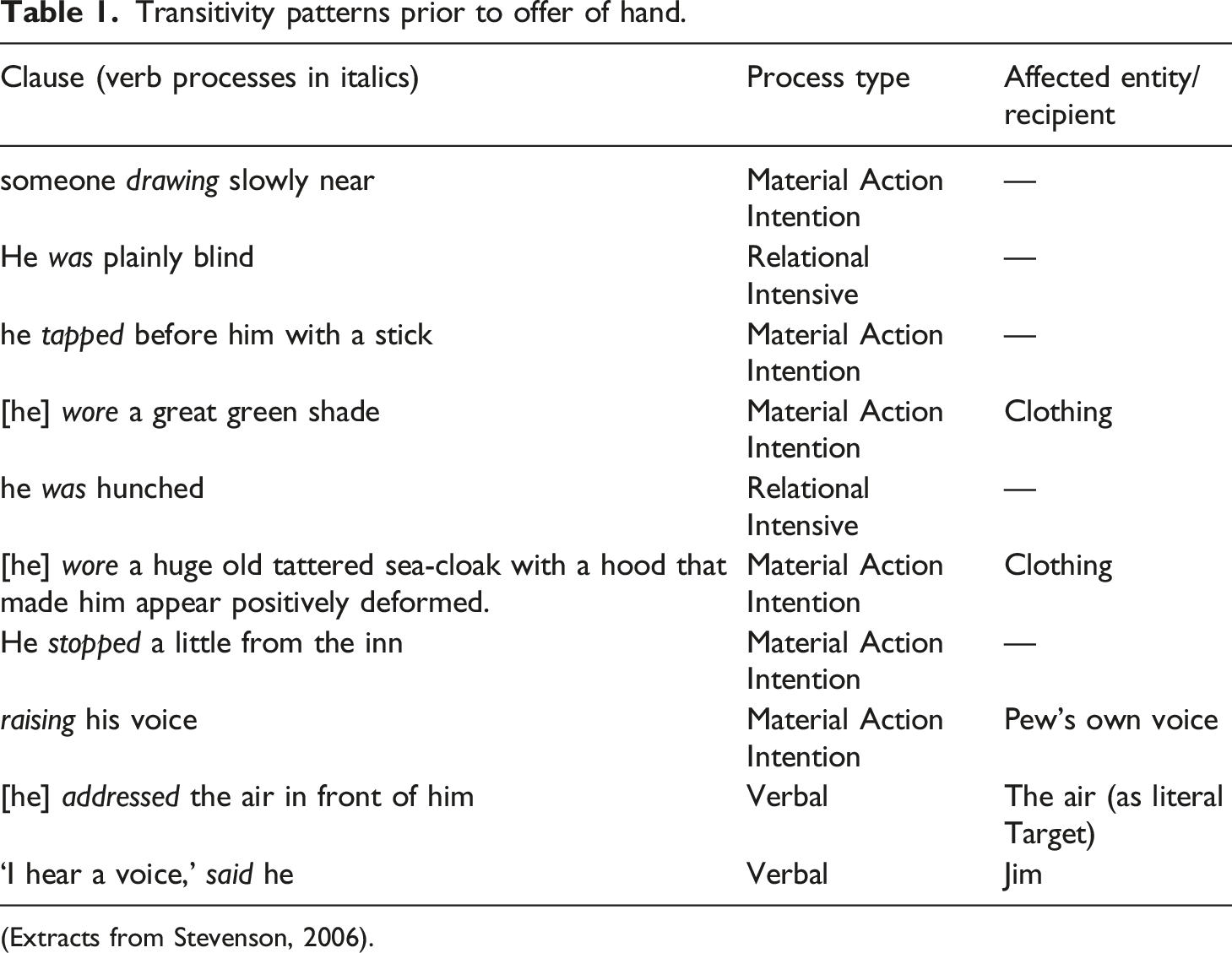
Transitivity patterns prior to offer of hand.
(Extracts from Stevenson, 2006).
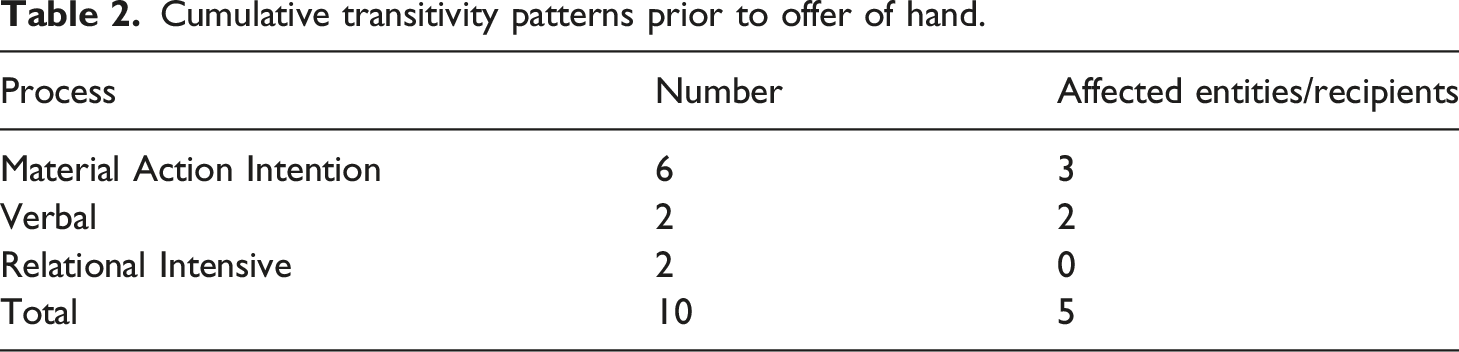
Cumulative transitivity patterns prior to offer of hand.
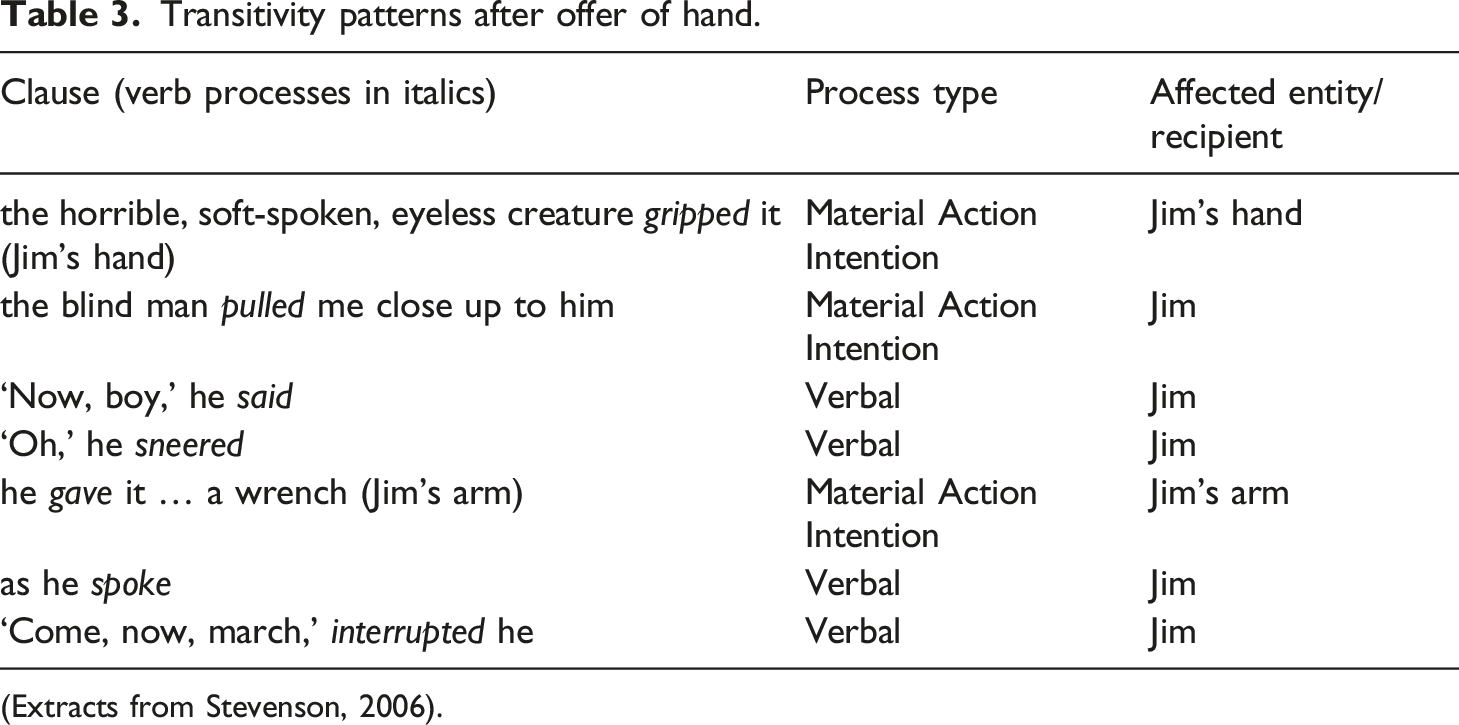
Transitivity patterns after offer of hand.
(Extracts from Stevenson, 2006).
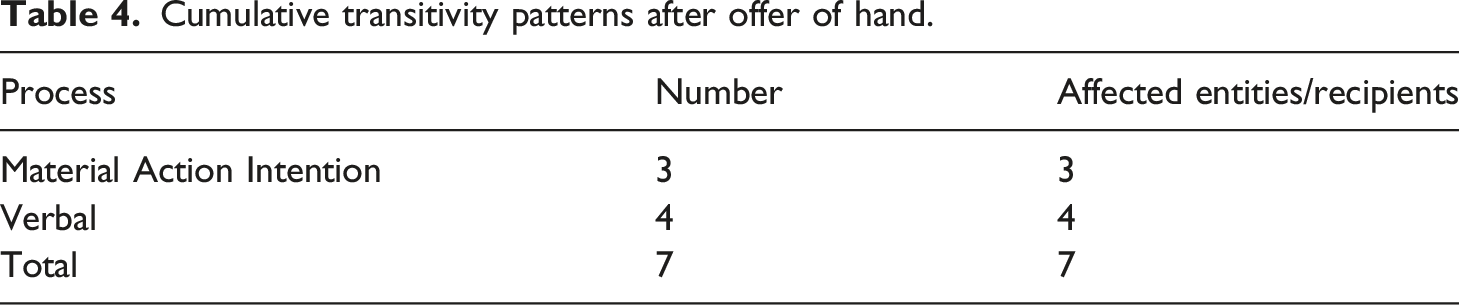
Cumulative transitivity patterns after offer of hand.
Material Processes are basically ‘processes of doing’ (Simpson, 1993: 89). They always include an Actor or ‘do-er’, and may include a Goal, a person or a thing which the process affects (Simpson, 1993: 89). Material Processes include Actions where the Actor is animate and Events where the Actor is not animate (Simpson, 1993: 89). Actions in turn can be split into Intentions in which actions are performed deliberately, and Superventions where the Action is unintentional (Simpson, 1993: 89). Prior to the pivotal moment in the text (Jim’s offer of his hand) there are six Material Processes (all of them Intentions) performed by Pew. This is more than the number that occur after the pivotal moment. Nevertheless, when the affected entities are considered it is clear that Pew actually affects nobody and has little impact on his environment either. Thus, for instance, when Pew first approaches we are told: he tapped before him with a stick …
There is no Goal here for Pew to affect and we are merely told of the Circumstances of where he tapped and what with. Likewise, when we are told Pew ‘stopped a little from the inn’ to speak to Jim (Stevenson, 2006) he has affected no-one in the stopping. In addition, we are told of Pew ‘raising his voice’ (Stevenson, 2006). Inferring Pew as the Actor in this non-finite clause, it is clear that the affected entity is merely his own voice. Information is given about his appearance and clothing through two of the Material Action Intentions. For instance, we are told: [He] wore a huge old tattered sea-cloak with a hood that made him appear positively deformed.
Although wearing is an Intention process the affected entity is merely the clothing and indeed the clothing appears to have more impact on Pew himself within the circumstance element.
If we compare the three Material Action Intentions performed by Pew after the key point of Jim’s offer of his hand, we see that Pew does have an effect on another person – Jim or parts of his body. For instance, when Jim offers his hand the horrible, soft-spoken, eyeless creature gripped it …
Likewise, Pew affects Jim when we are told: the blind man pulled me close up to him with a single action of his arm.
Pew has transformed from an individual whose actions have little or no effect on others or his surroundings to one who acts upon another and exerts control.
Verbal Processes are basically processes of saying (Simpson, 1993: 90). The participants are the Sayer and a non-obligatory Target (the addressee), and, also optional, the Verbiage, or the thing that is said (Simpson, 1993: 90).
There are again contrasts between the passage prior to Jim offering his hand and after that. We see this even setting aside for the moment the Verbiage or what is said. The latter will be dealt with in the section on dialogue (Section 6). Prior to the offer of Jim’s hand there are two verbal processes. The first is the most interesting because of the specified Target: [He] addressed the air in front of him …
The Target here is the air, a highly unconventional addressee, which makes it marked and in ableist terms ‘abnormal’. Specifically, this is intended to convey that Pew does not know which way to look when speaking. The supposed failure to engage people directly in speech implies a powerlessness on the part of Pew. While there is another Verbal Process prior to the offer of the hand, it is again after this pivotal point that Pew is represented exerting more power. While Jim is not grammatically an explicit Target of the four subsequent Verbal Processes the Verbiage makes this clear given that Pew addresses the boy and gives commands to him. This is seen, for instance, in the following: ‘Now, boy,’ he said, ‘take me in to the captain.’
There are also relevant points in terms of the actual processes or reporting words used. Thus, we are told, Pew ‘sneered’ at and ‘interrupted’ Jim (Stevenson, 2006). I will deal with this in more detail shortly, but it is clear that a consideration of Verbal Processes supports the shifting dynamic from the pitiable figure with lower power to the evil figure with greater power.
The only other relevant processes in terms of Pew as the subject of the sentence are two Relational Processes. Relational Processes represent the idea that participants relate to each other but do not suggest that one participant is affected by the other (Simpson, 1993: 91). There are two participants the Carrier and the Attribute. Examples from the text will help, where Pew is the Carrier and the adjective/adjective phrase the Attribute: He was plainly blind … [H]e was hunched …
These occur before the offer of the hand. While it is not surprising that these occur to aid initial description, it is also relevant that the Carrier in a Relational Process does not affect the other participant – nothing actually happens between them (see Jeffries, 2010: 43). In other words we see reduced agency, which is again compatible with a pitiable and powerless stereotype.
Thus, the transitivity model offers a means by which analysis of agency for disabled figures in texts can illuminate the construction of certain stereotypes. These stereotypes work together with the othering and social foregrounding of such figures. I will demonstrate next that well-known areas of pragmatics may also enhance understanding of this.
6. Speech acts, im/politeness and conversational power
The manner in which Pew and Jim interact in dialogue is relevant to the construction of both of their characters. However, my focus is again mainly on Pew. Bousfield (2014: 118) notes that the way characters interact verbally reveals information about them and their literal and symbolic meaning. Here I engage with issues of speech acts, im/politeness, and conversation analysis because all can be related to power dynamics and, in turn, characterization. After all, we would expect the pitiful stereotype to be powerless and the evil stereotype to be powerful. While these tools of analysis are applied most often to drama, they can be used also in the analysis of fiction (cf. Culpeper, 2014: 1–2).
Pew speaks twice before the offer of Jim’s hand: ‘Will any kind friend inform a poor blind man, who has lost the precious sight of his eyes in the gracious defence of his native country, England—and God bless King George! —where or in what part of this country he may now be?’ ‘I hear a voice,’ said he, ‘a young voice. Will you give me your hand, my kind young friend, and lead me in?’
After the offer of Jim’s hand we have the following: ‘Now, boy,’ he said, ‘take me in to the captain.’ ‘Oh,’ he sneered, ‘that's it! Take me in straight or I'll break your arm.’ ‘Come, now, march,’ interrupted he …
I first consider these extracts in terms of the notion of speech acts and their relationship to power. In a direct speech act the illocution (the intended meaning or outcome) matches the locution (or the form of the utterance), whereas in an indirect speech act there is no such match (Bousfield, 2014: 123). For the moment the illocution is of primary interest. Both of Pew’s two initial utterances are indirect given that the illocution in each case is a request for help, but they are in the form of questions. This is quite conventional but will merit further consideration in relation to im/politeness. Nevertheless, we might expect the illocutions of a pitiful figure to include requests for help and these can certainly be linked to powerlessness. Of course, we need to be aware that particularly in the first section Pew’s speech acts have deceitful and manipulative intentions known only to him. His three utterances after the offer of the hand are direct – the form and illocution being a mixture of commands and a threat. We might expect a stereotypical villain to make commands and threats, and again this relates to power. However, far more can be said about these utterances in relation to im/politeness.
The model of politeness and later models of impoliteness are relevant to the extract and to disability stylistics more broadly. Politeness arises from the idea that when we interact verbally we may damage each other’s sense of self. In terms of Brown and Levinson’s classic model this means we threaten each other’s Face, or perform a Face Threatening Act (FTA).. Face in turn subdivides as follows:
Positive Face: the desire to be ‘ratified, understood, approved of, liked or admired’ (Brown and Levinson, 1987: 62).
Negative Face: the desire for our actions to be ‘unimpeded by others’ (Brown and Levinson, 1987: 62).
In the Brown and Levinson (1987: 61, 68) model we usually attempt to mitigate damage to Face. With the exception of cases that remove this expectation, including those related to urgency, efficiency or the overwhelming superiority of the speaker, which allow the speaker to go ‘bald-on-record’ (Brown and Levinson, 1987: 94–101), we will employ a number of strategies to ameliorate the damage. The most important for present purposes are as follows. We may attend to Positive Face by showing approval and claiming solidarity, or we may attend to Negative Face by hedging, conventional indirectness, questions, and suggesting pessimism (Brown and Levinson, 1987: 70, 102, 131; see Culpeper, 2014: 243–44). For Culpeper (2014: 248–249) many of the features associated with politeness are linked to low power.
Prior to the offer of Jim’s hand, Pew adopts politeness strategies aimed, on the face of it, at minimising threat to Jim’s Positive and Negative Face. The questions in both of his utterances above are clear examples of Negative Face work. Thus the indirectness of his speech acts contributes to positioning Pew as powerless. There are also clear examples of Positive Face work. It could be argued that his claim to have come to the ‘“defence of his native country”’ and his utterance ‘“God bless King George!”’ (Stevenson, 2006) seek solidarity, common ground or shared group identity (cf. Brown and Levinson, 1987: 103). Likewise, Pew’s use of the expressions ‘“kind friend”’ and ‘“my kind young friend”’ (Stevenson, 2006) to Jim are examples of Positive Face work – seeking solidarity. The ostensible purpose of all this is to convey the deserving nature of his supposed dependency.
There are, nevertheless, circumstances in which we may be deliberately impolite, purposefully using ‘gratuitous and conflictive’ FTAs where mitigation would normally be expected ‘and/or’ by deliberately making the FTA aggressively strong in some way (Bousefield, 2014: 129–130). This can be used to account for Pew’s subsequent utterances. Culpeper (1996: 356–358; cf. Culpeper and Hardaker, 2017: 208–209) lists various strategies by which impoliteness might be achieved. Relevant strategies include bald-on-record, for instance, in situations where the need for Face work might not be reduced or absent, positive impoliteness, for instance showing lack of concern or interest in the other, seeking to disagree, using identity markers that are not appropriate, taboo words, and using insulting names. They also include negative impoliteness which includes frightening – threatening with the possibility of harm – belittling addressees by using diminutive names, invading another’s space in a metaphorical or literal sense, and associating the addressee with negative things by personalising and using the pronouns ‘you’ and ‘I’. For Culpeper and Hardaker (2017: 214) the key factor in deliberate impoliteness appears to be an attempt to seize or abuse power.
After Jim’s offer of his hand Pew employs aggressive and deliberate impoliteness strategies. Of course, as seen above, he gives orders and makes threats directly without any Face work. Threats and orders may damage Face, but these instances are bald-on-record in the severely impolite sense described by Culpeper (2014: 240, 356). However, even this strategy is exacerbated. Pew sneers at Jim, thus showing contempt through positive impoliteness, and he also uses negative impoliteness strategies by using the belittling or diminutive “boy”, physically taking Jim in his power and inflicting pain (Stevenson, 2006).
More could be said about issues from conversation analysis including length of utterances, topic control, control of turns, and interruption all of which can relate to power of the speaker (Short, 1996: 206–7, cf. Culpeper, 2014: 173). Pew controls the topic in both sections of the passage, possibly demonstrating his manipulative power in the first section, and does this aggressively to assert power and control in the second section interrupting Jim as he does so. Nevertheless, through the consideration of illocution, im/politeness and conversation analysis it should be clear that these well-established tools within stylistics can be used to assess levels of implied dependency or power and thus help in a precise analysis of the language structures that can build both the pathetic and pitiable stereotype and the sinister or evil stereotype. Closely related to this is the social foregrounding and othering to which the disabled character is subject.
7. Appraisal
7.1 An introduction to attitude
The final method of analysis offered here is from Martin and White’s model of appraisal to give an overall analysis of attitudes expressed about Pew, his behavior and appearance in the passage. However, it nevertheless intersects with all of the tools used above since it takes into account the main word classes – adjectives, adverbs, nouns, and verb processes, and may offer additional insights into the impact revealed by those other tools.
The most relevant elements for present purposes are the categories of attitude which I summarise from Martin and White (2005: 45–58). As will be seen, particularly in the tables below, attitudes can be recognized as positive or negative (see Martin and White, 2005: 46, 52, 56). It should be clear that elements of attitude such as those dealing with emotions triggered by others, or judgements about ‘normality’ and ‘capacity’ go to the heart of the appraisal of disabled people.
7.2 Affect
Affect relates to felt emotions and splits into three sub-types. Hence, ‘un/happiness’ codes for happy or sad feelings, along with loving and hating and can be triggered by other people; ‘in/security’ relates to emotions sparked by our surroundings and others and signals when we are trustful, confident, anxious or fearful. The other subtype ‘dis/satisfaction’ is not relevant to this article. Martin and White (2005: 47, 50) make clear that language which conveys a ‘paralinguistic’ or physical surge in behavior triggered by emotion, such as smiling or crying out, can convey affect.
7.3 Judgement
Judgement expresses our attitudes to other persons, their behaviour and character and includes the categories of Social Esteem and Social Sanction.
7.3.1 Social esteem
Social Esteem is split into the following sub-types. ‘Normality’ encodes whether an individual is usual or not; ‘capacity’ encodes capability; ‘tenacity’ shows whether they can be depended on or whether they are determined/resolute.
7.3.2 Social sanction
The other category of Judgement is Social Sanction. This in turn sub-divides into ‘propriety’ constituting a judgement of whether a person is ethical (good or bad) and ‘veracity’ relating to whether the person behaves truthfully and honestly.
7.3.3 Judgement and categorisation
Martin and White (2005: 42–44, 52) seem to align Judgement as a whole with ethical appraisal of behavior but it is clear that they position social sanction most securely under this alignment. Indeed, some of their examples make the ethical definition awkward. For instance, their examples of ‘sick’ and ‘crippled’ under ‘capacity’ (Martin and White, 2005: 53) focus primarily on illness or impairment. Such physical and behavioural differences may not be weighed overtly or strongly in ethical terms. Nevertheless, ultimately they often are judged negatively. A further point needs to be made in relation to these remarks. Martin and White (2005: 53; cf. Hermeston, 2017: 55–56) thus seem in their illustrative examples to place reference to impairment or disability categories under ‘capacity’ and I have followed this. The focus of ableist cultural representations on levels of agency or lack of ability among disabled people supports this (cf. Hermeston, 2017: 40, 49; Shakespeare, 2014: 36). Yet it must be acknowledged that such reference does blur also into perceptions about ‘normality’ from an ableist perspective in which the othering of disabled people is prominent (cf. Campbell, 2009: 5). Where reference is made to specific manifestations of behavior or appearance linked to disability itself, I have opted usually to place these under ‘normality’.
7.4 Appreciation
Finally, Appreciation relates to evaluation of material or abstract ‘things’, in particular human creations or performances, but also things that occur naturally. It relates to aesthetic issues and social value (Martin and White, 2005: 44; White, 2015: 13). It includes three sub-categories. These are ‘reactions’ relating to whether something catches our attention or is pleasing, ‘composition’ relating to ‘balance and complexity’, and ‘value’ or how ‘innovative, authentic, timely’ and so on something is (Martin and White, 2005: 56).
7.5 Analysing attitude
Martin and White (2005: 52) stress that a particular item of lexis will convey different attitudes depending upon its use in context. It is important to note that a human can be subject to Judgement when behavior is evaluated, but subject to Appreciation if evaluated more as an entity (White, 2015: 13). The latter implies an aesthetic or social valuation. This distinction accounts for the placing of ‘positively deformed’ in the ‘composition’ category due to it being an issue of Jim’s perceptions triggered by the way Pew is dressed. In other contexts one might expect the word ‘deformed’ to appear under ‘normality’. Martin and White (2005: 57–58) note also that there are close links between Affect and the Appreciation variable ‘reaction’, but they insist on the distinction between Affect, the description of individually felt emotions, and ‘reaction’, which relates to description of what triggers that emotion.
According to Martin and White (2005: 61–63), appraisal can be direct (inscribed by attitudinal words that overtly direct our feelings) or it can be indirect (invoked such that ideational terms have attitudinal meaning afforded by the inscribed attitudinal lexis occurring with them, or the wider text). I have considered both direct and indirect realisations of attitude as they are felt or expressed by Jim and in terms of the attitudes Pew triggers through his speech or physical actions. My selection of all features arises from a tactical reading that attempts to understand, but also step outside a naturalised reading, which would accept attitudes the text directs the reader to adopt (see Martin and White, 2005: 62–63).
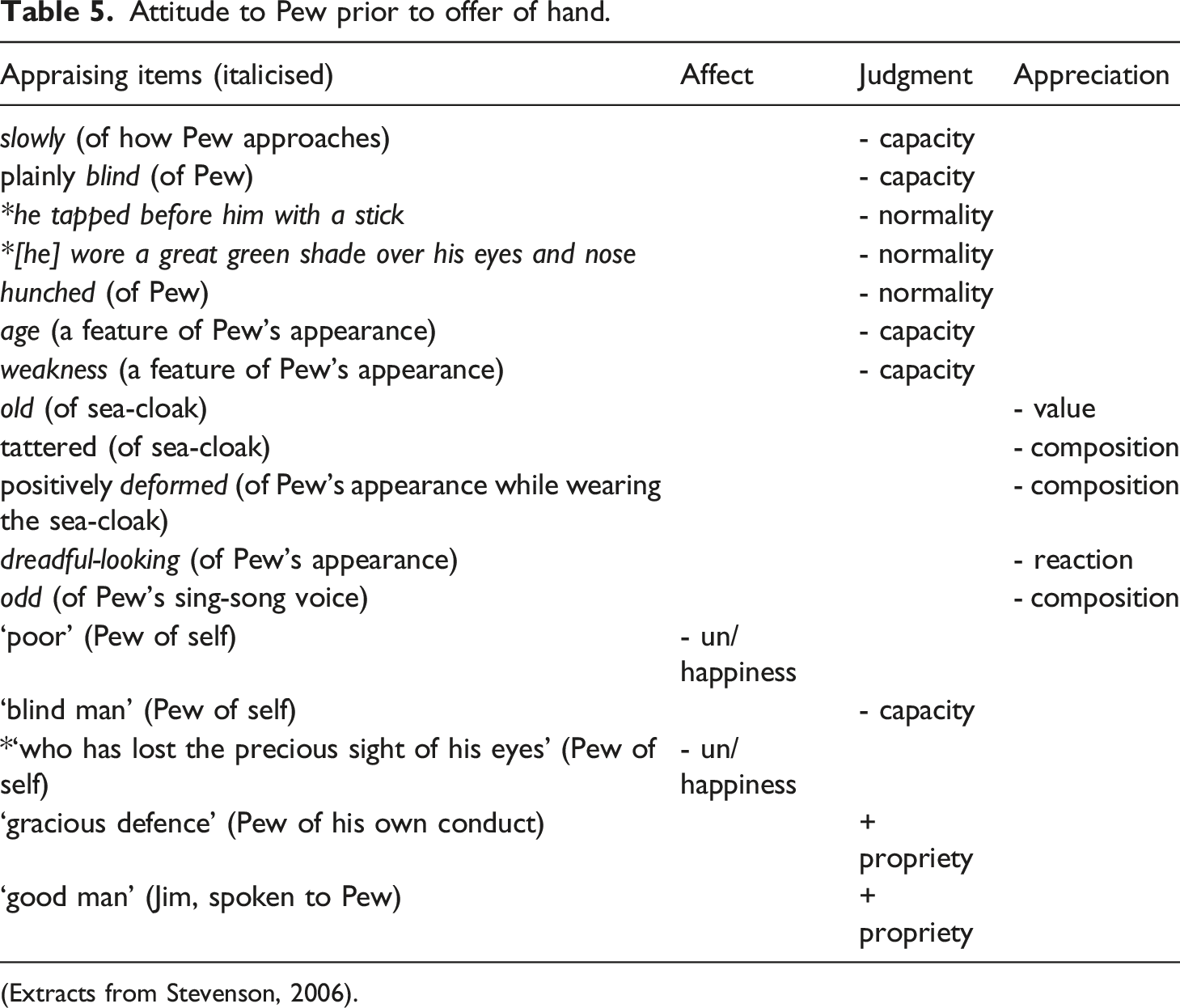
Attitude to Pew prior to offer of hand.
(Extracts from Stevenson, 2006).
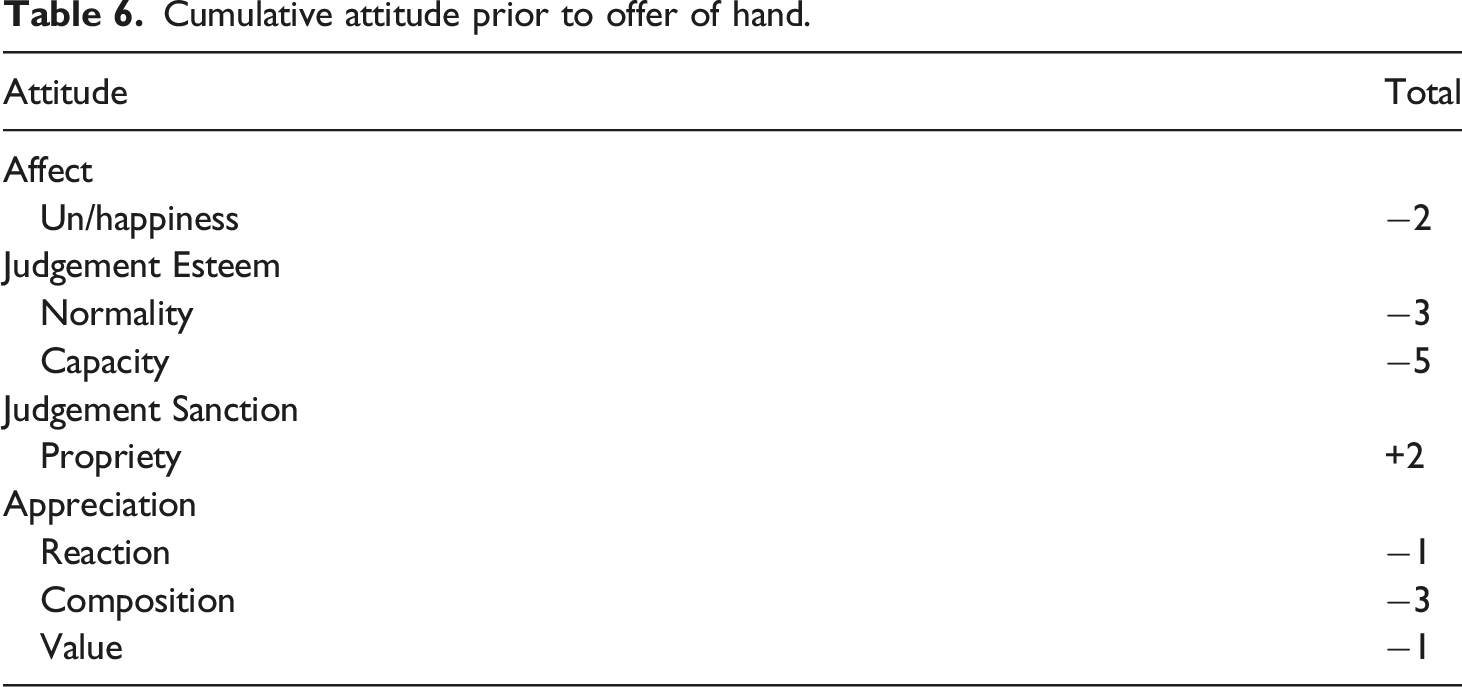
Cumulative attitude prior to offer of hand.
Attitude after offer of hand.
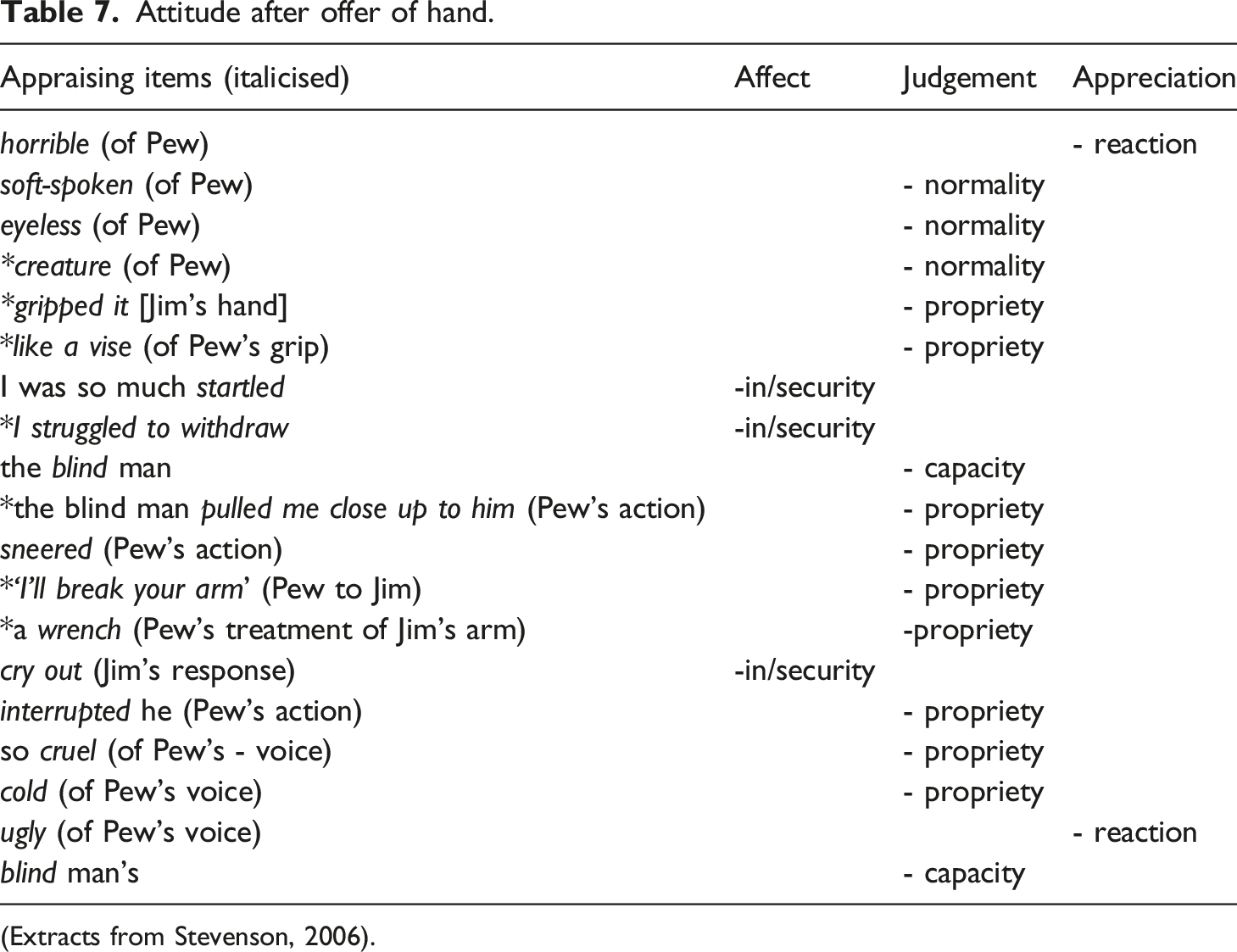
(Extracts from Stevenson, 2006).
Cumulative attitude after offer of hand.
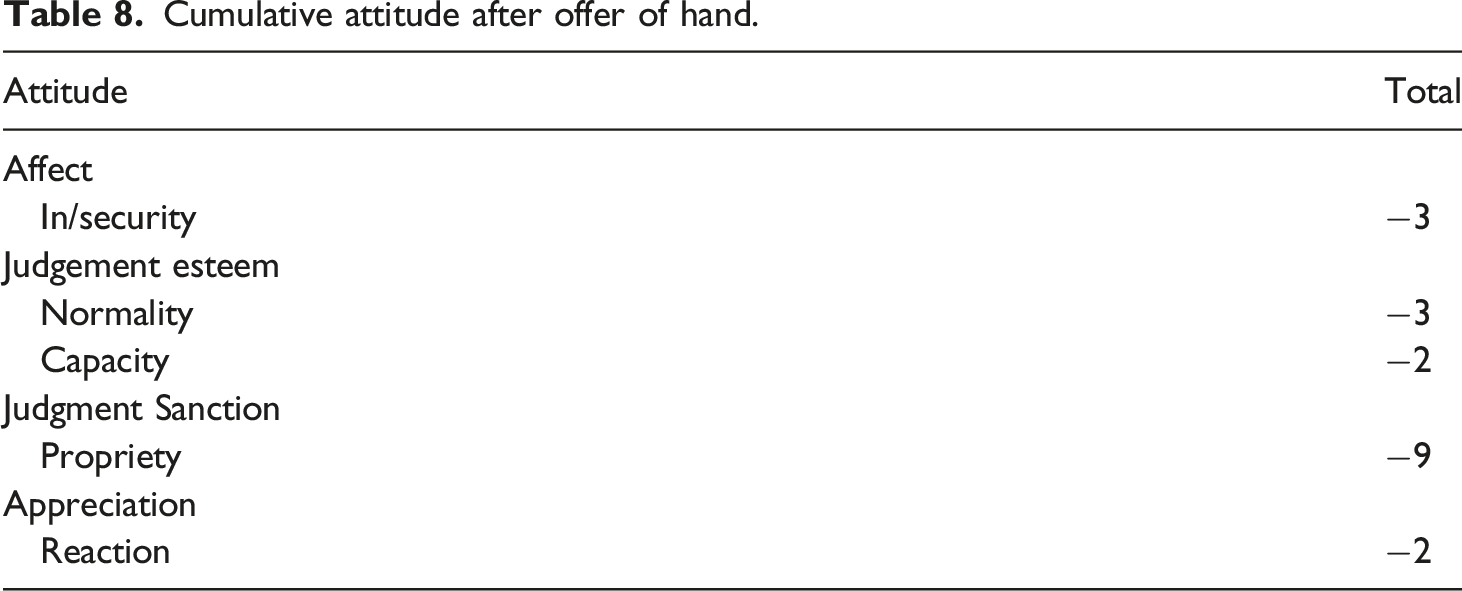
Most evaluation is made by Jim as narrator. Where evaluation appears in Jim or Pew’s speech this is indicated. When Pew is considered in relation to attitudes expressed by the narrator Jim (either as narration or speech) or by Pew himself, two major points are clear. Firstly, the evaluations are overwhelmingly negative both before and after the offer of the hand. This confirms that negative evaluation is paramount as Pew is depicted as other.
The second point is that the patterns differ prior to and after the offer of Jim’s hand. Before the offer of Jim’s hand the emphasis is on Social Esteem. There are five negative markers of ‘capacity’ including the repetition of the word ‘blind’ (Stevenson, 2006). Likewise, there are three negative markers of ‘normality’, including the points that ‘he tapped before him with a stick’ and was ‘hunched’ (Stevenson, 2006). Negative ‘reaction’ is expressed once by Jim who says Pew is ‘dreadful-looking’ (Stevenson, 2006). This is accompanied by other negative features of Appreciation of Pew’s appearance, clothing and ‘odd’ voice (Stevenson, 2006). The impact here appears to be an objectivization of Pew, but no overt emotional negativity towards him from the narrator. Pew attempts to manipulate the situation by emphasizing his negative ‘capacity’. He emphasizes that he is “blind” (Stevenson, 2006). Also, he deploys negative ‘un/happiness’ by lamenting the loss of his “precious sight” (Stevenson, 2006), while attempting to appear virtuous with use of the positive marker of ‘propriety’ in ‘“gracious defence”’ (Stevenson, 2006). The overall impression is of a potentially pitiful figure who never-the-less causes some disquiet. Jim’s use of the term ‘“good man”’ (Stevenson, 2006), it should be noted, is a ‘formulaic’ term and thus the positive ‘propriety’ is somewhat ‘bleached’ (see Martin and White, 2005: 85).
After the offer of the hand the emphasis is primarily on Pew’s immorality with nine markers of negative ‘propriety’ including features describing his physical aggression to Jim, and his ‘so cruel’ and ‘cold’ voice (Stevenson, 2006). Pew’s physical handling of Jim also provokes three markers of negative ‘in/security’ realized as physical and paralinguistic surges. Jim is ‘startled’, struggles to escape, and is forced to ‘cry out’ (Stevenson, 2006) underlining his negative emotions. There are also two negative markers of ‘reaction’. Pew is ‘horrible’, his voice ‘ugly’ (Stevenson, 2006) identifying him as a negative trigger of Jim’s emotional responses. There is a continued use of negative markers of Social Esteem. Thus, for instance, Pew’s negative ‘normality’ as an ‘eyeless’ subhuman ‘creature’ (Stevenson, 2006) is emphasized, along with his negative ‘capacity’ as ‘blind’ (Stevenson, 2006). The overall impact, of course, is that Pew is seen now as the evil and abnormal disabled figure who provokes fear in Jim.
As seen above Pew is devalued as other. Simultaneously, both the pitiable and sinister stereotypes are activated and constructed. Yet again this othering and stereotyping underpin the social foregrounding of the character.
8. Discussion of tools
This article has used a stark text to illustrate some tools of disability stylistics. The range of tools presented here are not intended to be exhaustive and I hope to augment them. I believe they can be used in isolation or in combinations. It may be that some analytical approaches overlap in the linguistic structures they investigate and in the ideological associations which they reveal. The researcher may wish to select a primary approach where this is the case.
Nevertheless, researchers may wish to consider the noun phrase and description alongside the transitivity model. They may wish to include aspects of pragmatics in the consideration of dialogue alongside these.
It may be that analysis of the noun phrase, description and representation of social actors can be supported by the model of appraisal. For instance, it is undoubtedly helpful to know that the term ‘blind man’ is an example of ‘attribute identification’ (see Hermeston, 2017:47) a term which, as noted, I have adapted from van Leeuwen’s (1996: 57) ‘physical identification’ to capture the idea that individuals may be identified and categorized by impairment in a given situation. It is also helpful to know that such identification is ripe for othering and over-determination (see Van Leeuwen, 1996: 57–58, 61–65) and association with a range of stereotypes (cf. Link and Phelan, 2001: 366–368; Garland-Thomson, 1997: 10–11). Nevertheless, it seems equally helpful to analyse noun phrases and wider texts according to the model of attitude where negative or positive evaluations can be carefully quantified for what they reveal about responses to disability. In the case of Pew, it is relevant to note how negative individual lexical items and other features are in terms of Jim the narrator’s response and their cumulative effect. Assessment of attitude may add to the understanding of how disabled figures are othered and of how particular stereotypes are constructed. Overdetermination may not in itself pin down specific stereotypes.
It may be, also, that the combination of transitivity and the model of attitude would be fruitful particularly where there appears to be some strong indication of attitude in the verb process or process in general. Thus, a mere consideration of transitivity will not in itself indicate the moral dimension of the verb ‘gripped’ when we are told ‘the horrible, soft-spoken, eyeless creature gripped it [Jim’s hand]’ (Stevenson, 2006) but the attitudinal lexis in the Actor role is enough to invoke negative ‘propriety’ for the verb. This may give greater precision to the understanding of the construction of the evil stereotype.
My purpose has been to illustrate a range of approaches which can reveal the construction of ideologies related to disability. In less stark texts these approaches may provide rigorous tests for the continued existence of stereotypes or misrepresentations. The tools should work to identify some of the other stereotypes. For instance, transitivity should contribute to identifying the burden and superhuman. Nevertheless, more tools may need to be added.
9. Conclusion
I have offered a range of analytical approaches to a short text to demonstrate that they can be used in its analysis in relation to ideologies of disability. I have shown that language works in tandem to both present disability as other and to construct stereotypes. Othering and stereotyping are in fact inextricably linked and they both work to foreground disabled characters socially. I believe that such analysis would be effective and applicable in a wider discipline of disability stylistics.
Analysis of noun phrases, transitivity analysis, dialogue, and appraisal through attitude can be used in disability stylistics. My intention is to test and augment approaches as I apply them more rigorously to visual impairment and other disabilities, and to other stereotypes such as the burden or ‘Super Cripple’/superhuman (see Barnes, 1992; Hermeston, 2017: 41–42; Rieser and Mason, 1990: 100, 102–103). I have suggested already that narrative mode will be fruitful in expanding the tools (Hermeston, 2017: 46) and indeed Rutter and Hermeston (2019) have considered the use of reflector mode in representations of Parkinson’s Disease. Issues of modality, the representation of speech and thought, and negation are among many issues that have yet to be addressed. At this stage, nevertheless, I believe that I have provided a range of tools allowing rigorous analysis to identify or test for stereotypes in historical and contemporary texts. My hope is that other scholars, particularly but not exclusively disabled linguists, will participate in the development of the field.
Footnotes
Declaration of Conflicting Interests
The author(s) declared no potential conflicts of interest with respect to the research, authorship, and/or publication of this article.
Funding
The author(s) received no financial support for the research, authorship, and/or publication of this article.

Author Biography
Appendix
I saw someone drawing slowly near along the road. He was plainly blind, for he tapped before him with a stick and wore a great green shade over his eyes and nose; and he was hunched, as if with age or weakness, and wore a huge old tattered sea-cloak with a hood that made him appear positively deformed. I never saw in my life a more dreadful-looking figure. He stopped a little from the inn, and raising his voice in an odd sing-song, addressed the air in front of him, “Will any kind friend inform a poor blind man, who has lost the precious sight of his eyes in the gracious defence of his native country, England—and God bless King George!—where or in what part of this country he may now be?”
“You are at the Admiral Benbow, Black Hill Cove, my good man,” said I.
“I hear a voice,” said he, “a young voice. Will you give me your hand, my kind young friend, and lead me in?”
I held out my hand, and the horrible, soft-spoken, eyeless creature gripped it in a moment like a vise. I was so much startled that I struggled to withdraw, but the blind man pulled me close up to him with a single action of his arm.
“Now, boy,” he said, “take me in to the captain.”
“Sir,” said I, “upon my word I dare not.”
“Oh,” he sneered, “that’s it! Take me in straight or I’ll break your arm.”
And he gave it, as he spoke, a wrench that made me cry out.
“Sir,” said I, “it is for yourself I mean. The captain is not what he used to be. He sits with a drawn cutlass. Another gentleman—”
“Come, now, march,” interrupted he; and I never heard a voice so cruel, and cold, and ugly as that blind man’s.