



Abstract
This article presents a pedagogical stylistics of intertextuality in interactive literary study talk. It analyses case study data representing one higher education seminar discussion, where a tutor and student interpret a focal text through reference to diverse intertexts. The article asks: How do participants enact intertextual literary analysis in conversation? How are intertextual voices introduced? How do intertextual voices relate to focal texts and position readers’ orientations to them? The transcript represents the interplay of participant and text voices around Pond by Claire-Louise Bennett. The article examines the intertextual invocations made by participants in interaction including their pedagogic function. It adopts a methodology combining pedagogical stylistics with a conversation-analytic mentality. Commentary adapts Lemke’s four categories of intertextual connection (cothematic, co-orienting, coactional and cogeneric) to describe functions of intertextual invocation in talk, adding two new categories of co-illumination and cogeneration. The results suggest participants in literary study talk use intertextual invocations to develop insights, position the responses of others and sustain co-constructed interpretation. The article proposes the term Talk as Heteroglot Intertextual Study (THIS) to describe this pedagogical format, with linked terminology to identify its multivocal, deictic and organisational traits. This pedagogical stylistics helps researchers and teachers describe and understand the development of intertextual analysis in literary study talk.
Keywords
1. Introduction
This article examines literary study conversation in higher education (HE). It demonstrates how one tutor and one student interconnect texts to perform analysis of a focal text in seminar discussion, examining transcripts from a perspective of pedagogical stylistics informed by the ethnographic method of conversation analysis. The article elaborates HE literary pedagogy by accounting for the co-constructed, intertextual and multivocal analysis of literature. Intertexts, that is, ‘all the other texts that we use to make sense’ (Lemke, 1992: 259) of a focal text, enter conversation through participants’ discourse representation (Fairclough, 1992) by means of deixis, paraphrase or quotation. Participants invoke them or elicit their invocation by others. The article addresses three research questions: a. How do participants enact intertextual literary analysis in conversation? b. How are intertextual voices introduced? c. How do intertextual voices relate to focal texts and position readers’ orientations to them?
Analysis of second year undergraduate seminar conversation at a UK university shows how talk-in-interaction enacts heteroglot literary analysis, calling on many intertextual voices with agility and apparent shared understanding. In a module on Contemporary Fiction and seminar focussed on Pond by Claire-Louise Bennett (2016), the tutor and student pair discuss the focal text in a plenary exchange where four other students listen but do not speak. The article considers their conversation as an example of vocalised meaning-making ‘through transaction with the text’ (Rosenblatt, 1978: 132) and explores the implications of the analysis for pedagogy. It concludes by proposing the term Talk as Heteroglot Intertextual Study to describe this interactive, multivocal and deictic mode of literary study conversation.
2. The focal text Pond and literary-critical intertexts
Claire-Louise Bennett’s Pond (2016) blurs the boundary between the short story and novel. Its narrator is an unnamed woman living in a remote cottage near Galway, Ireland. Intertexting stories in her voice describe recurring characters (the landlady of the cottage, the narrator’s social circle) and recurring locations including the pond of the title. In the story ‘The Big Day’ (2016: 37–71), the narrator reports that her landlady positions ‘a cautionary notice next to the pond… the word pond scrawled on a poxy piece of damp plywood right there beside it’ (2016: 40). The landlady’s action is deictic, a trait it shares with some features of talk about texts explored in this discussion of seminar conversation. The analysis of this exchange is also concerned with how students and readers orient to Bennett’s book and texts about it, such as a literary review which describes Pond’s ‘affectless’ narrative voice. The review considers it a salient feature consistent with the book’s ambiguous form: ‘One of the obvious sources of Bennett’s strange, compelling style is the way it exploits the intersection of two mismatches: between plotlessness and vocal excess, and between self-ignorance and self-narration’ (Hartley, 2016). In an interview for the Northern Ireland literary magazine The Honest Ulsterman, Bennett describes her own early writing as entry into an ‘ontological zone where I could dwell’ (Stich, 2015), elaborating her preoccupation with belonging and its relationship with language. She also contrasts the experience of dwelling in one ‘very elemental’ home ‘made of stone, straw and wood, very basic materials that I could actually point to and name’, with a more anodyne environment ‘where I can’t tell you what anything is made of’. Bennett is frustrated by the relationship between the world and humanity, and by undue emphasis on the human: ‘We live in a very anthropocentric culture, and the affiliated notion of convenience disgusts me’. That statement and the reviews described here are invoked by the seminar participants, and shape their reading of Pond.
3. Description of the module and the seminar
The seminar was the last session in a module of study called Contemporary Fiction. Across each week of the semester (12 weeks), students joined one lecture and one two-hour seminar (36 h in total). Four tutors contributed to the design of the module and its teaching. In this seminar, one tutor sought students’ responses to Pond and asked about their progress towards completing the module’s summative assessment task. The assignment task invited students to develop an argument around one question or title chosen from 15 options. In addition, students had agency to decide which fiction texts to focus on in their assignment, drawing on texts studied in the module, and to decide which intertexts and critical approaches would inform their writing.
The pedagogic challenge of the seminar lay in balancing attention to Pond with students’ free-ranging comment about individual essay permutations adopted from 10 module study texts, 15 essay questions and a wide variety of critical perspectives introduced in the module and wider degree course. Before the seminar, the tutor discussed the challenges of teaching about contemporary fiction with me, observing that ‘lecturing on contemporary fiction is quite a particular type of challenge because of the fact that there’s no canon of writing… There’s certainly not a rich and established critical literature behind the stuff that we’re looking at’. The module’s reading list was determined by criteria requiring texts’ publication within the last decade, and therefore, the titles for study changed each year. Tutors involved students in selecting the texts studied in the module, a process characterised by the seminar tutor as one of making ‘a virtue of the fact that [with] that choice… with contemporary writing, contemporary fiction, you really could read all sorts of things’. The team of tutors also recognised that there was only a limited amount of critical material available for students to consult about recently-published fiction studied on the module. They exploited these circumstances to meet teaching and learning goals, seeking to foreground students’ own responses to these contemporary fiction texts, which were consequently relatively uninfluenced by critical consensus. Tutors tried to replicate this innocent reading position in their teaching approach, illustrated in this explanation by the seminar tutor about plans for the final lecture where each tutor would participate in a panel discussion about a single module text chosen by the students: ‘We’re just going to get up there. I’m going to read it every weekend. Just going to see, talk about them completely unscripted, unthought, but as a way of kind of trying to suggest that engaging with contemporary fiction is dialogic, it’s ongoing, it’s… We’re with them, to a certain extent. Pedagogically, that’s a difficult position to be in, or at least it’s one you have to be careful about’. A related teaching challenge is mirrored and concentrated in the seminar discussion presented here, in conversation where only two participants invoke many texts spontaneously.
4. Towards a pedagogical stylistics of intertextual literary study conversation
The Contemporary Fiction module is founded on intertextuality, and Pond reflects a literary scene where texts are often playfully interanimated across fluid, hybrid genres. Responsive pedagogical stylistics will examine intertexuality’s capacity to foreground ‘relationality, interconnectedness and interdependence in modern cultural life’ (Allen, 2000: 5), including its functions in institutional talk about literature. The pedagogical stylistics theorised and applied here considers relationships between the focal study text, the interaction of participants and the many intertexts they invoke across the conversation. The object of this approach, the seminar discussion, is an instance of literary linguistics in action to explain how texts work (Hall, 2014), where the tutor and student adopt ‘a method of textual interpretation in which primacy of place is assigned to language’ (Simpson, 2004: 2). Applying stylistics to their exchange generates insight to the pedagogic function of intertexts invoked during HE conversations which consider the ‘representational language’ of literature (Carter, 2010: 117; McRae, 1996). This approach is an interdisciplinary conception of contemporary stylistics (Burke, 2014), acknowledging intertextuality (Allen, 2000; Mason, 2019), positioning theory (Harre and Moghaddam, 2015) and classroom interaction studies (Mercer, 2010).
We can locate this ‘open, evidenced and retrievable’ (Carter, 2010: 68) approach in a taxonomy identifying three broad interests of pedagogical stylistics (Clark and Zyngier, 2003). These interests (a) relate to the formal and linguistic properties of a text, (b) refer to points of contact between a text, other texts and their readers and (c) position the text within a socio-cultural context. The seminar participants share the first interest, exploring the linguistic potentials of the novels addressed in the module, their internal dynamics and how the novels position themselves and their worlds relative to their readers. The second interest investigates how individual readers hold and link details across a text, and how writers draw readers’ attention to other texts. My approach encompasses these first and second interests, and additionally addresses the third, concerning how readers call on their ‘cognitive environment’ as they interpret texts, linking them with social contexts at individual or universal levels. Clark and Zyngier assert that, at this level, the focus of pedagogical stylistics shifts away from a view of text as self-sufficient, monologic and static towards a ‘much more dynamic, cognitive, intertextual and interpersonal’ perspective (2014: 344). They also note that the relationship between this interest and the other two is underexplored and, citing Toolan (1998), state that the difficulties of describing these relationships is ‘sometimes used as an excuse for not engaging with it in a pedagogic context’ (Clark and Zyngier, 2003: 344). The pedagogic context is addressed here, where transcript data represents the vocalisation of students’ cognitive environments through talk. This data gives us partial access to students’ cognitive environments, akin to their availability to tutors and teachers afforded by talk, and allows us to consider how tutors frame texts and responses according to pedagogic goals. This approach reveals new aspects of textual interpretation formed in interaction (see Short 1995: 53) through participants’ invocation of intertexts, and differs from the text-oriented stylistic approaches to intertexuality applied in studies of poetry (Biermann, 1993), literary translation (Knutsson, 1995) and newspapers (Shie, 2016). This approach is a form of stylistic reader-response research that lends ‘equal attention to the text and data evidencing the text’s reception’ (Whiteley and Canning, 2017: 72), considering texts mediated as discourse representations, their mediation and use by speakers and how other participants respond to them.
4.1. Texts, dialogism and heteroglossia
Relationships between texts, agents and utterances are central to Bakhtin’s concepts of dialogism and heteroglossia (Bakhtin, 1986). In stylistics, their influence has shifted emphasis from Saussurean structuralism to recognition that interaction generates meaning (Carter, 2010: 116). Dialogism arises from Bakhtin’s conception of language as a chain where every utterance is ‘like the rejoinder in a dialogue’ (Bakhtin, 1986: 75). In any moment of expression, an utterance ‘cannot fail to become an active participant in social dialogue’ (1986: 277). Heteroglossia describes the entwining of several voices, discourses or styles in a single expression, as in literary prose fiction. Novels and short stories are multivocal hybrid constructions introducing ‘another’s speech in another’s language’ (1986:324), manifest in shifting narratorial voices, the traces of many text genres and speech attributed to characters whether direct or reported (Bakhtin, 1986: 304–305). All these voices are ‘dialogically interrelated, they – as it were – know about each other… they actually hold a conversation with each other’ (324).
4.2. Intertextuality
Introduction of the term intertexuality is credited to Kristeva (1980), who blended Bakhtin’s concepts with Saussure’s structuralism (Allen, 2000). Like dialogism, intertextuality has connectivity at its core: ‘the “literary word” is an intersection of textual surfaces rather than a point’ (1980: 64–65). Demonstrating that a text is not ‘a closed system’ (Alfaro, 1996), Lemke (1992) describes the intertexts of a text as all the other texts that we use to make sense of it. These texts may share ‘propositional content’ (cothematic), points of view (co-orienting), activity structure (coactional) or genre (cogeneric). Fairclough adapts intertextuality to Critical Discourse Analysis presenting ‘discourse representation’ as a form of intertextuality where ‘parts of specific other texts are incorporated into a text’ (1992: 174) and usually marked through reporting clauses or quotation. Echoing Bakhtin, Fairclough describes intertextual chains comprising verbal utterances and social practices, for instance when doctors link medical consultations and medical records. These ‘social institutions and practices are articulated together in particular ways… the study of actual intertextual chains is one way of gaining insight into this dimension of social structuring’. Intertextuality has also been explored in the visual arts, music, theatre, architecture and film (Allen, 2000), and in cross-disciplinary pedagogic practices of HE to support students’ academic writing (Bazerman, 2012) and literature reviews (Badenhorst, 2019). In literary study, pedagogy and conversational interaction during seminars continue intertextual chains connecting focal texts with intertexts such as author interviews, reviews, critical commentaries, essays, assessment documentation, popular culture texts, personal anecdotes, the content of other modules, lectures and other learning events. It is a discipline where texts ‘must always be related to other texts’ (McRae, 1996: 26) and students’ ability to make and articulate intertextual connections in response to representative language is a high-order skill (McRae, 1991, 1996).
4.3. Positioning and reading orientations
Positioning theory addresses dialogue in terms of ‘how people use words (and discourse of all types) to locate themselves and others’ (Moghaddam and Harré, 2010: 2). Its studies have embedded the concept of dialogism to describe the positioning influence of texts (Kayi-Adar, 2018) and the psychology of individuals’ self-conceptualisation (Hermans, 2001; Raggatt, 2015) including professional identity (Arvaja, 2016; Christensen et al., 2017). Describing intertextual positioning in writing about literacy practices, McVee et al. (2004: 4) assert that teachers convey their beliefs by invoking personal experiences, study texts, experiences voiced by authors and characters in texts and the experiences of students and colleagues. Their alignment of intertextuality with positioning theory (Holloway, 1984) for education research emphasises how texts guide and frame readers’ orientations to texts, and how readers account for their orientations to texts, consistent with attention to positioning theory in literary studies (Maynard, 2009; Stockwell, 2013). Where positioning theory is applied to face-to-face interaction in formal teaching (Harre and Moghaddam, 2015; Harré and van Langenhove, 1999), the matters of how speakers deploy texts to direct the readings of other participants, or to express their own position relative to those articulated by others, become objects of analysis. This social dimension of learning, of how students and teachers position themselves relative to one another, is established in studies of literacy events (e.g. Clarke, 1996; Evans, 1996) and of learning in other disciplines (see Ritchie, 2002; Wood, 2013; Kayi-Aydar, 2013). Positioning’s relationship with pedagogy extends to the teacher’s role in guiding interaction (Anderson, 2009; Garton, 2012) and exploration of ‘book talk’ (Hadjioannoua and Townsend, 2015), though application of positioning theory to HE pedagogy is rare. The origins of positioning theory in narrative inquiry (Depperman, 2013) and its application to conversational storytelling (Bamberg, 1997) suggest its potential for conceptualising literary pedagogy, first for its evident relevance to narrative texts (as frequent objects of literary study), and second for the correspondence of narrative to the notion of an intertextual chain extending across time in a seminar or lesson (which could be construed as a narrative, progressing from one point to another). Positioning theory can yield insights as to when, how and why participants introduce intertexts relative to reading and acts of interpretation.
4.4. Conversation in literary study, discourse representation and quotation
Bakhtin’s concepts have influenced social constructivist theories of learning through conversation, complementing the influence of Vygotsky’s work. They are traceable in many analyses of classroom discourse (Barnes et al., 1969; Mercer and Edwards, 1987; Nystrand and Gamaron, 1991; Wells, 1999) including those adapting conversation analysis (Sacks et al., 1974) to examine the architecture of talk teaching and learning in schools (Sahlström, 2009; Seedhouse, 2004). Curiously, though conversation analysis has been aligned with stylistics to examine the representation of talk as dialogue in literary texts (Lambrou, 2014), the two perspectives have not been aligned to analyse talk where literature is the focal object of conversation, and where the language of texts influences talk about them. My approach adapts conversation analysis to account for the central role of texts in literary studies interaction and pedagogy. It affords examination of the collective interpretive work of participants in conversation, and the emic understandings they arrive at together. In particular, it examines the entry of focal texts, literary novels, into the speech of participants during literary study conversations: a distinctive form of discourse representation.
Teachers introduce texts to their own speech in the form of spoken quotation, embedded in their own exposition about literary works they present to students. This phenomenon can be viewed as ‘the turn of the page’ in utterance and conversation, and can be explored with the methodology of ‘QuoTE analysis’ (Gordon, 2019a) I proposed to represent and better understand the unique orientation of talk to texts in literary study. I adapted conversation analysis to investigate pedagogical ‘quotation in talk and exposition’, highlighting the voice of the focal text by representing it as an individual speaker in transcripts. This made the heteroglot nature of teacher exposition visible, suggesting in-the-moment pedagogic functions and effects of teachers’ dialogic vocalisation of texts in their own speech. I found that teachers positioned students’ reading orientation to focal texts using spoken quotation according to four pedagogic functions. Using dramatising resources such as intonation, their use of spoken quotations realised students’ affective involvement and positioned them as inhabitants in the diegetic worlds of texts, relative to characters, places or events. Deictic resources of speech marked quotations as objects for students’ analysis from critical distance, positioning them as analysts. Prosodic features of teachers’ exposition foregrounded qualities of texts to position students as potential aesthetes. Finally, spoken quotation positioned students as critics, directing their attention to possible readings of the text or prompting new interpretive reading in response. These functions arise from heteroglot play in teachers’ utterances which direct reading orientations efficiently and subtly when they embed the discourse representations of quotation in speech. Teachers concurrently convey and shape reading orientations with differentiated pedagogic impacts, either declaratively (making overt verbal statements about texts) or tacitly (where resources of intonation, emphasis, pitch and silence mediate the quoted text).
The present analysis extends application of QuoTE analysis to HE literary pedagogy, looking beyond the focal text to examine how intertexts enter literary study conversation. Additionally, it explores positioning affordances of intertexts invoked by students and tutors relative to the focal text. This adaptation recognises that when participants invoke intertexts, they also refer to non-narrative texts: initial QuoTE analysis applied only to teacher presentation of narrative texts during Pedagogic Literary Narration (Gordon, 2019b). In HE literary study, participants may invoke texts other than the focal text, and text forms other than narrative for different positioning functions. This perspective is consistent with a conception of stylistics addressing ‘all texts, not simply or exclusively ‘literary’ texts’ (Carter, 2010: 116), in literary study conversation informed by texts as cultural products of many genres and forms. It recognises that the ‘basic question and method of pedagogical stylistics is comparative’ (Hall, 2014: 241), seeking means to explain the implications of juxtaposed text invocations for teaching and learning. One phenomenon of juxtaposition arising in the case presented by this article is the relationship between participants’ repeated use of a small number of text invocations, particularly of direct quotation, relative to the majority of text invocations that are made only once in the conversation by any speaker. My interest in these repeated text invocations draws on positioning theory, to account for this specific deployment of texts to direct the readings of others. The combination of positioning theory with conversation analysis makes it possible to consider the organising and pedagogic function of these repetitions in the structure of the conversation, and their role in a public forum as anchors for maintaining conversational focus amid numerous and diffuse single-use invocations. In this conversation, these operate where participants make no recourse to material or visual reference points. I call this phenomenon tethering, elaborating it from the transcript data in the discussion that follows its presentation.
5. Selecting this case of intertextual interaction in higher education study
Literary study talk in ‘Literature’s Lasting Impression’.
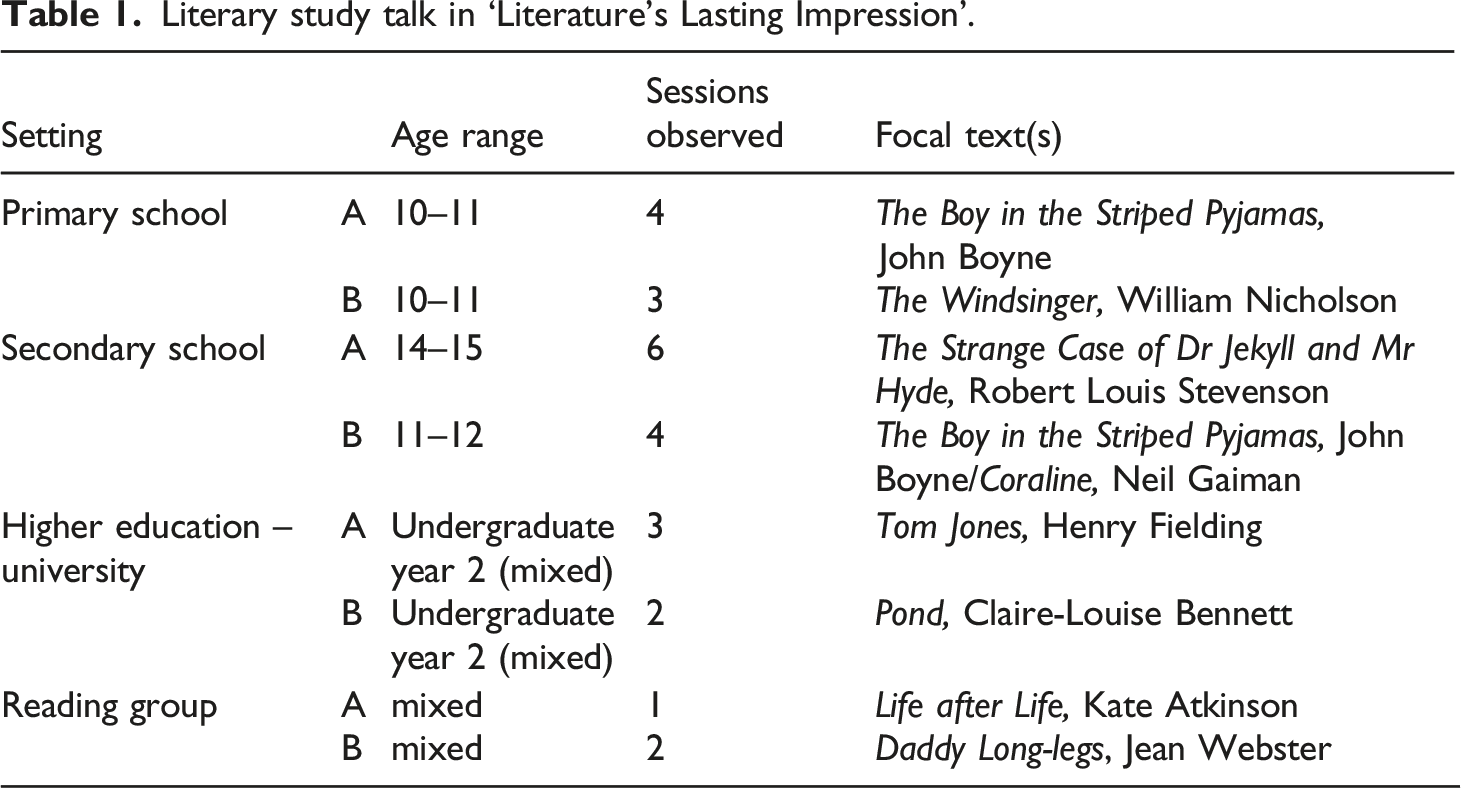
Across four transcripts of HE seminars, including this session and three in a module on eighteenth-century novels (on Fielding’s Tom Jones), intertexting was more common in HE seminar data than in lesson data from each school phase of literary study. My inductive analyses of school data in the wider research project from which this case is drawn prompted my conceptualisation of teachers’ pedagogic literary narration of focal texts and exploration of the pedagogic function of spoken quotation (Gordon, 2019a, 2019b). This phenomenon of intertexting is consistent with disciplinary progression suggested in current frameworks for HE (e.g. UKHEQC), and with persistent though longstanding challenges of learning in L1 and L2 traditions of the discipline at tertiary level (Zyngier, citing Gilroy-Scott, 1983; 2020: 1). I identified intertexting as a focus of attention through conversation-analytic ‘unmotivated looking’ (Psathas, 1995: 45) applied to each transcript, though the phenomenon was also identified by the tutor in the contextualising interview about this module. The transcript of the Pond seminar conversation revealed unusually concentrated intertextual discourse representations. The tutor’s remarks suggested that students and tutors ‘demonstrably’ oriented to intertexts ‘in the course of their action’ (Psathas, 1995: 46), also influencing my identification of this case and the research questions presented in this article. As my ‘unmotivated looking’ found its focus, it also required adaptation of QuoTE analysis to examine how text voices enter learning conversations. The adaptation extends interest beyond the quoted voices of single focal texts to trace the entry of many intertexts to talk, considering other forms of discourse representation. I use the term invocation to describe participants’ introduction of text voices to speech in literary study conversations. Invocations are deictic calls transforming texts from their original materiality to aurality in speech.
6. Methodology
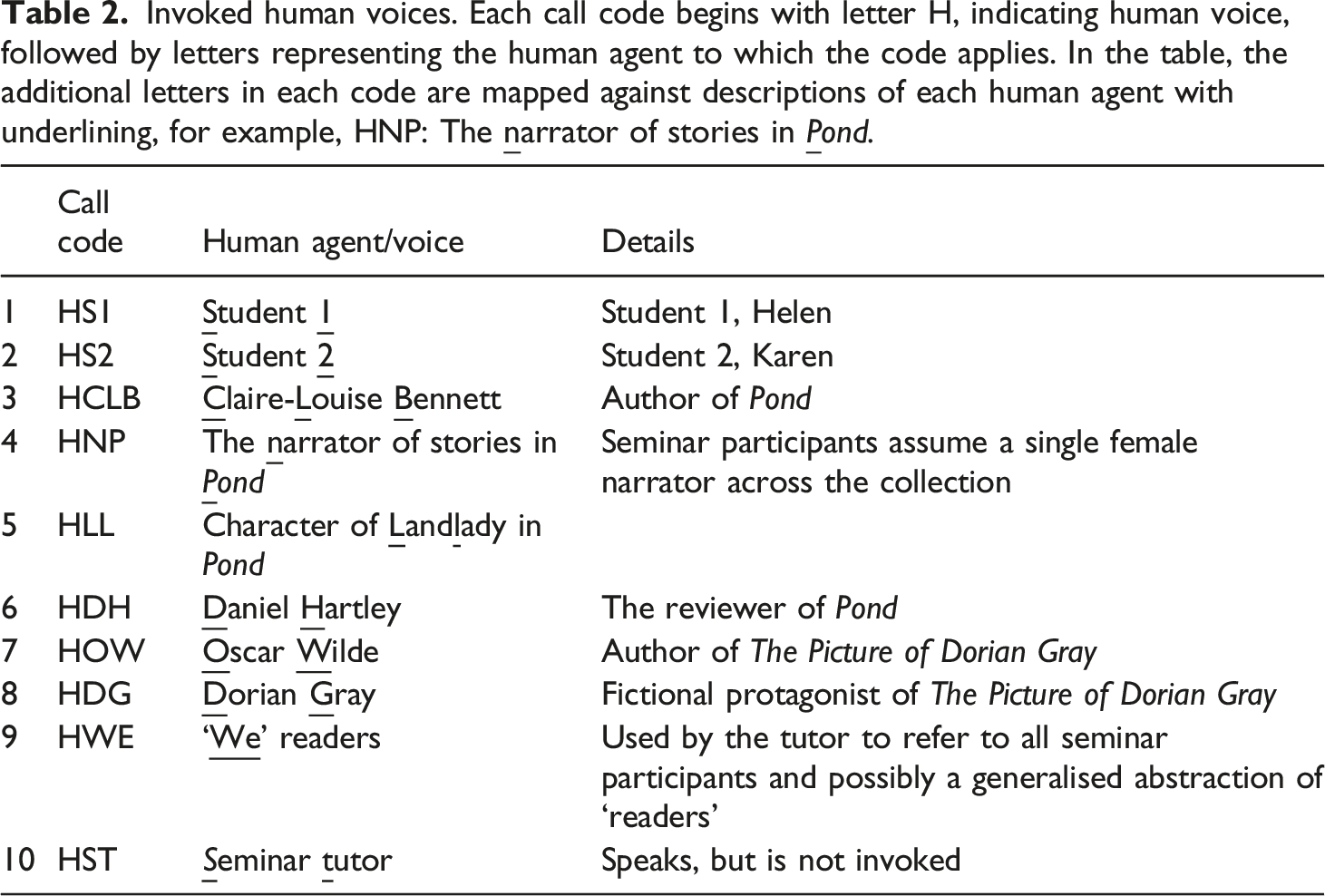
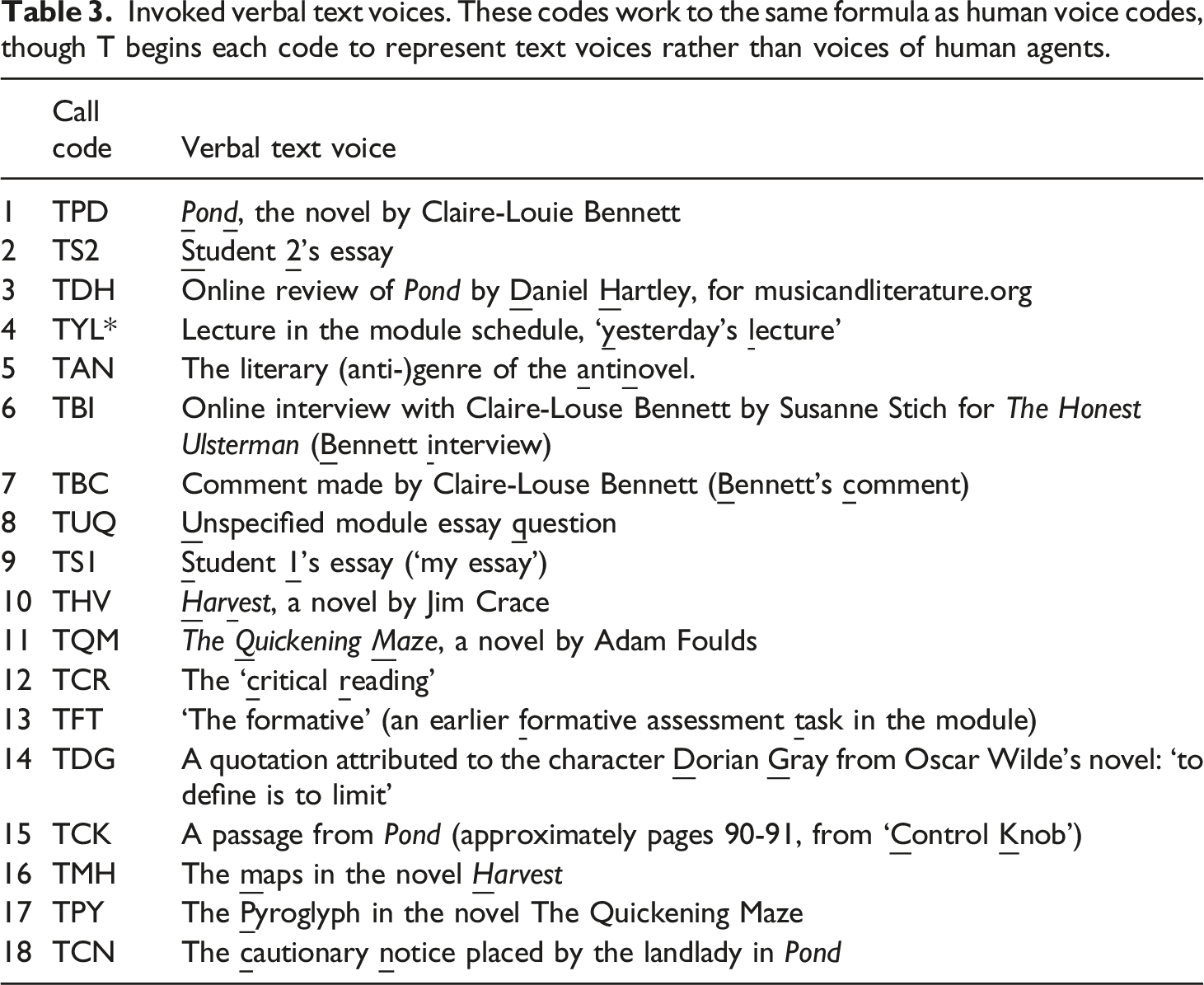
For this case of intertextual interaction, I coded transcript data to identify each instance where either of the speaking participants invoke text voices, at each moment where they refer to a text by name or pronoun overtly, where they paraphrase a text or where they bring the words of any text into their own speech by quotation. The transcript representing this single passage of conversation between one teacher and one student (with four more students present but silent) shows that both speaking participants often invoke more than one text voice in a single conversational turn. To identify and track these different text voices invoked by speakers, I have attributed to each an individual call code. When applied and tracked in the transcript, these call codes allow us to see where invocations cluster within turns, and where they are repeated by participants across turns. Applying the codes to transcript data with a conversation-analytic orientation also affords description of how participants understand these invocations, and how they function in talk for pedagogic effect. As discourse representations, invocations in the data call on the text voices of two types of intertext, either unitary fixed verbal texts (for example, Pond and its reviews), or utterances we can attribute to human agents which can be real (novelist Claire-Louise Bennett) or imagined (the narrator and characters in Pond). When participants invoke fixed verbal texts, they often make an appeal to style, as in ‘Bennett’s style’ and ‘the way it was written’. They use verbs such as says, mentions, refers, suggests and interprets when they invoke the text voices of human agents.
Invoked human voices. Each call code begins with letter H, indicating human voice, followed by letters representing the human agent to which the code applies. In the table, the additional letters in each code are mapped against descriptions of each human agent with underlining, for example, HNP: The
Invoked verbal text voices. These codes work to the same formula as human voice codes, though T begins each code to represent text voices rather than voices of human agents.
I coded the transcript by reading turns in the chronological order in which they were spoken, underlining each instance of speakers’ intertextual invocation of a text voice (human or textual) in the transcript and describing the form of each invocation in the right-hand margin of the transcript using call codes. I counted the number of invocations made by speakers in each line of the transcript, making tallies of the number of different invocations made (i.e. every time a previously unmentioned text voice was invoked) and of the cumulative number of invocations made line-by-line. Each invocation in the transcript is identified with underlining. Italics mark all utterances which can be traced to text voices as direct quotations. The ‘Tallies’ columns count each introduction of a new text voice through invocation (each ‘different’ voice), and the cumulative total of invocations.
The theoretical framework for analysing the transcripts contributes to pedagogical stylistics a new perspective on intertextual relationships. This approach draws on the four categories Lemke provided for describing links between verbal texts, and reframes them to examine how participants in literary study conversations do literary analysis together and get things done by invoking multiple intertexts across a conversation. Lemke described a. cothematic texts, sharing propositional content; b. co-orienting texts, sharing ‘the same interpersonal or value-orientational point of view’; c. coactional texts, sharing ‘the same activity structure’; and d. cogeneric texts, sharing the same genre.
This commentary adapts Lemke’s categories for analysis of conversation, using them to examine how participants invoke multiple text voices and present intertextual relationships to other participants. Speakers’ intertextual invocations are resources for expressing their individual interpretations of study texts and function to position the reading of others. Speakers may, for example, invoke several text voices in sequence – and even in one turn – because the text voices describe the same place, person or idea: they are cothematic. Such linking could have a synoptic pedagogic function, perhaps to organise texts prior to further comment and analysis. Alternatively, speakers might juxtapose two invocations to warrant an argument, with the force of the argument depending on the strength of comparison or opposition in the text voices called upon. This co-orientation could influence whether other participants find the argument compelling, thus shaping the progress of conversation beyond the initial invocation including possible repetition of one or both of the invoked text voices by other students joining the discussion. QuoTE analysis identified pedagogic functions of spoken quotation to position readers and shape their engagement with texts. Connecting that perspective with Lemke’s categories generates a more versatile framework for understanding intertextual invocation in literary study and pedagogy.
7. Results
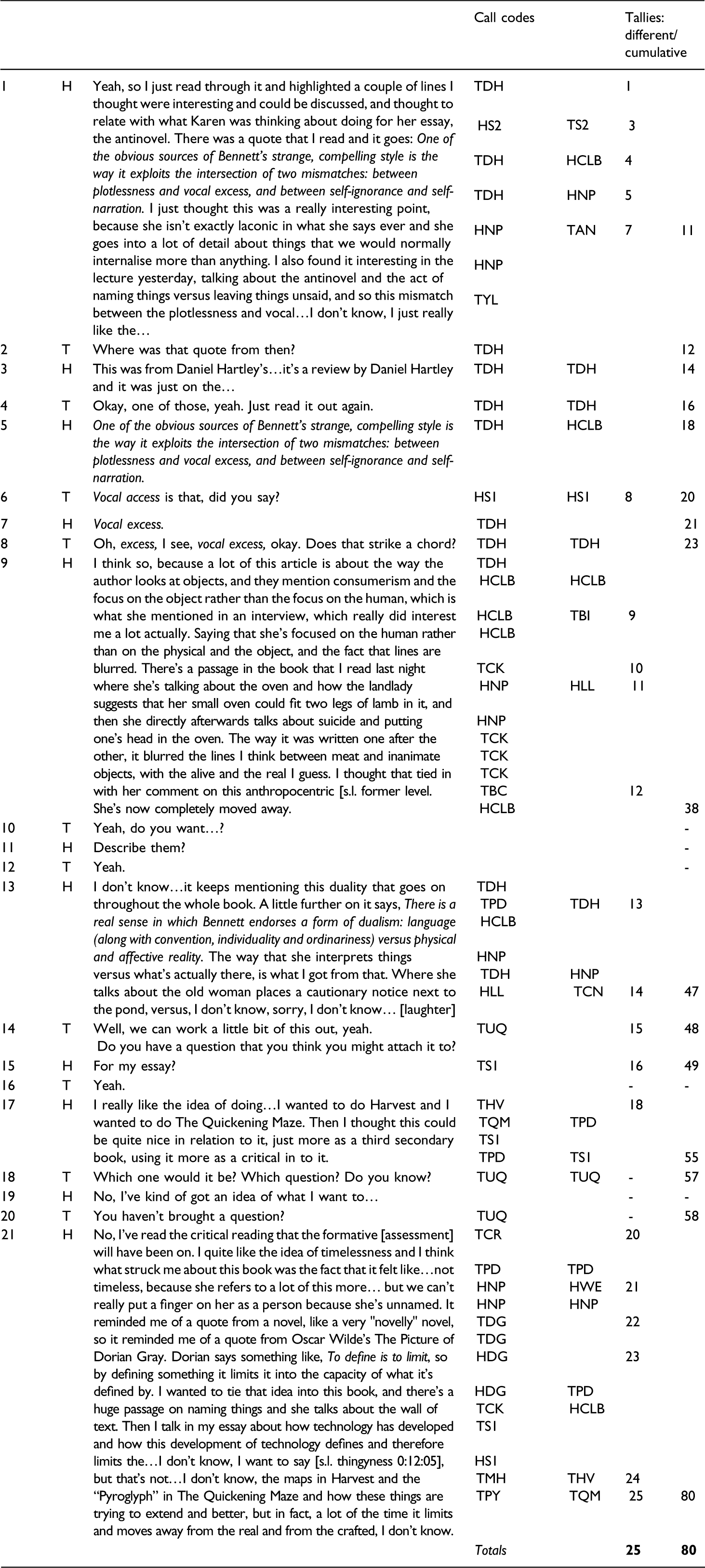
The column in which individual invocations are represented by call codes highlights their distribution, shows their frequency and suggests their varying density in individual turns across the conversation. The ‘Tallies’ column indicates that the two speakers invoked a total of 25 different voices during this short exchange, and by invoking some voices on several occasions made 80 separate invocations in all. Other students present in the seminar did not speak, or attempt to join the exchange. The exchange was therefore conducted publicly, with these students as an audience, suggesting its performative and pedagogic function gently determined and sustained by the tutor’s brief contributions to the conversation.
8. Discussion
8.1. How do participants enact intertextual literary analysis in conversation?
The pedagogic function of the exchange appears to be one of modelling analysis of Pond for the four students who are present but do not speak. The analysis elaborated by Helen and the tutor is intertextual according to the requirements of the summative assessment task, dense in invocation and nimble in how it positions the reading of other students through heterglot turns. The stylistic complexity of the analysis is suggested first by the number of voices invoked, where a new text voice is called, on average, at least at every turn (25 voices over 21 turns). Invocations of any type are even more frequent, averaging almost four per turn (80 in total).
The coded transcript suggests the pedagogic significance of invocation by revealing differing call patterns according to speaker role: the student invokes text voices frequently and expansively (calling 25 coded text voices), while the tutor invokes only two text voices (TDH, TUQ). The differentiated pedagogic function of invocation according to role is also suggested by the structure of interaction in which it is embedded, one of consistently alternating turns. Brief tutor contributions usually end in questions which prompt extended responses from Helen. It is a methodic pedagogy that uses invocation judiciously, highlighted by the conversation-analytic orientation to data, which notices patterns in turn length, and by stylistic analysis of invocation recognising their quantity and frequency. We see how the tutor elicits the student’s extensive invocation of intertexts as a basis for making ‘interconnections’, which generate and sustain literary analysis across the conversation.
8.2. How are intertextual voices introduced?
Helen’s invocations are numerous, introducing every intertext used in the discussion except the assessment question. Her turns are also densely intertextual, achieving both intensive and extensive (McConn, 2016) literary readings of Pond. Her first contribution embeds seven invocations. Turns 9 and 21 embed 32 separate invocations between them. Helen frequently invokes the novel Pond (TPD), its narrator (HPD) and its author (HCLB) – seven, eight and thirteen times, respectively – consistent with the book’s status as focal text in the seminar.
The frequency with which she invokes the literary review (TDH) is more surprising; these invocations demonstrating intertextual chaining where phrases quoted from the review also invoke Bennett (HCLB) and Pond (TPD) themselves. These utterances are part of heteroglot turns which layer at least three voices: those of the speaker, the review and that of either the author or the novel. We might think of this as a vertical intertextual chain, aligning intertexts momentarily in time.
The transcript also makes visible horizontal intertextual chains which extend over time, where variations in discourse representation (Fairclough, 1992) function pedagogically to guide progress in intensive or extensive reading across the conversation. To interpret each invocation, we must reflect on its place in the wider architecture of talk (Seedhouse, 2004) in the seminar. Helen’s quotation of the review (TDH) at Turn 1 begins a sequence of repeated invocation of the same item. The tutor asks about the provenance of the quotation, asks Helen to read it again and asks her to clarify a phrase it includes (Turns 2–8). This sequence establishes the salience of the quotation and its function as the anchor for an intertextual chain (beginning at Turn 9) that sees Helen paraphrase the review’s argument (TDH), link it to a report of the author interview (CBI) and then to a reported episode in the novel (TCK). The gradual movement across the conversation towards intensive reading of the focal text includes conceptualisation of the novel in terms of anthropocentrism also achieved by intertextual invocation (HCLB). A more dispersed extensive reading is apparent at Turn 21, where Helen makes 18 invocations to elaborate an argument about ‘this book’. Again, invocations by the tutor are focussed and few in number. They call both a quotation from the review (TDH: Turns 2, 4, 6 and 8), and the assessment task (Turns 14, 18 and 20).
8.3. How do intertextual voices relate to focal texts and position readers’ orientations to them?
During early turns in the exchange (1–9, 13), the review quotation (TDH) is both an object of readers’ scrutiny and an anchor for discussion within the wider architecture of this literary study conversation. In heterglot Turn 1, Helen glosses Bennett’s style (HCLB), elides it with Pond’s narratorial voice (HPD, ‘she isn’t exactly laconic…’) and links Hartley’s review (TDH) with lecture content (TYL, ‘talking about the antinovel and the act of naming things versus leaving things unsaid’). Before Helen utters the review quotation (TDH), she makes positioning moves to express her own reading orientation, to determine the reading orientation of others and to position texts relative to one another. Helen positions her own interestedness (describing motivated selection and annotation of quotations), then positions others by co-orienting them to the review quotation. She asserts the utility of the review and its potential as a critical resource ‘to be discussed’. She also co-ordinates the unfolding coactional analysis of texts relative to Karen’s essay (TS2). After the review quotation (TDH), Helen positions and develops her own reading orientation to Pond across three cothematic and cogeneric invocations of the novel’s narrator (HPD), and invokes yesterday’s lecture (TYL) to position her own reading relative to intertexts in the genre of antinovel (TAN).
We can understand the intertextual interpretation articulated by Helen as ‘an organising process’ of ‘selective attention’ (Rosenblatt, 1978: 167), a construction between reader and text. She vocalises the connections she is making in her own cognitive environment, making it accessible to others. The public nature of this expression is apparent when she links her own reading and that of her fellow students. She affiliates and elides her own position with a plural readership (‘we would normally internalise’), co-orienting all participants as abstracted and idealised readers. Helen’s invocations also position texts in co-orienting and cothematic relationships, linking review lines (TDH) with Kate’s essay (TS2) which she then binds to the lecture’s shared focus, the antinovel (TYL, TAN). Helen also uses invocation of Pond’s narrator to warrant the review quotation (TDH), and to propose an argument it shared (TDH) with the lecture (TYL). Helen’s positioning of intertexts in this way suggests a sensitivity to her peer audience, providing a coherent account of her own reading process and underlining intertextual complementarity.
The tutor’s turns are efficient and impactful. They invoke for pedagogic effect, positioning texts and students’ reading orientations. Asking about the provenance of the quotation (Turn 2), the tutor selects ‘that quote’ for Helen to explain, though he could have invited Helen’s comment on any of the other points she raised, whether on naming, the narrator or the antinovel (Turn 1). The phrase ‘that quote’ is overtly deictic, positioning it as a public object for interpretation by group members taking a literary-analytic orientation. The tutor also organises pedagogic roles around the invocation, designating the expert role to Helen by asking her to read it again. This briefly positions Helen as the embodied voice of the intertext in the public forum, so that momentarily her next invocation is also another vertical intertextual chain. It links the quotation and Helen’s interpretation of it, already evolved across intertextual invocations towards this heteroglot utterance. This second invocation also positions the quotation as salient, a quality accrued through deixis, repetition and now by marking out within the architecture of talk. The tutor’s turns gently orchestrate resources of intertextual invocation, interaction and temporality, transforming materially-unavailable texts into almost-objects of critical and aesthetic attention: judicious discourse representation is a pedagogic resource. The sequence represents a phenomenon of intertextual literary study talk I call tethering. Tethering anchors reading and interpretive work through selective invocation of text voices. It establishes a node for subsequent intertextual invocations and contributes to shared critical and conversational focus across the public interaction for learning.
The pedagogic functions of tethering to position reading are also suggested by the development of the conversation relative to the tutor’s interest in the distinction between ‘vocal access’ and ‘vocal excess’ (Turn 6). Helen clarifies the ambiguity around these near-homophones (Turn 7), and by Turn 8, this fragment is voiced six times. Repetition makes ‘vocal excess’ salient for participants. Again, the tutor establishes a specific discourse representation as a node for positioning students’ orientations to texts, for instance, where ‘vocal excess’ prompts and anchors Helen’s developed and otherwise intertextually-dispersed vocalisation of her response at Turn 9. In Lemke’s terms, the invocation is both pedagogically coactional, facilitating discussion of Pond, and cogenerative, stimulating Helen’s meaning-making using the resource of intertextual invocation. Another pedagogical effect emerging from tethering around ‘vocal excess’ appears to be Helen’s progress from qualified and provisional reading (‘I just’, ‘I found’ and ‘I don’t know’ – Turn 1) to more committed expression of her position (Turn 9), where she asserts authorial intent (HCLB) using invocations about efficiently glossed episodes of the novel (TCK). The tethering point of ‘vocal excess’ established by the tutor (Turns 6–8) supports the internal coherence of the turn and its intelligibility for others relative to the ongoing conversation.
Lemke’s categories also illuminate Helen’s vocalised meaning-making through intertextual invocation. The coherence of Helen’s turn builds around a cothematic intertextual chain invoking The Honest Ulsterman Bennett interview (TBI), the Pond episode ‘Control Knobs’ (TCK) and Bennett’s comment on ‘anthropocentricity’ and consumerism (HCLB). Helen builds an argument about forms of reification connecting consumerism with the ‘excess’ of the tethering invocation (Turn 8), and eventually its ‘vocal’ component, as the argument is completed at Turn 21. The sense of completion is reinforced where comment on the act of naming things recalls Turn 1. Helen’s reading of Pond builds around cogenerative relationships between the extended quotation (TDH), introduced at Turn 1 and repeated at 5, and across 17 cumulative invocations by Turn 8. Notably, it develops at Turn 13 when Helen invokes the review (TDH) to propose Pond’s dualism (Turn 13), intertexting with the detail of the ‘cautionary notice’ (TCN) placed by the pond. This vertical intertextual chain links Helen, the invoked text (TDH), Pond (TPD) and a further text represented in the novel, that ‘poxy sign’ (TCN). These intertexts co-illuminate one another, and this unique combination advance Helen’s interpretive work and make it accessible to others.
The seminar conversation as a whole relates to participants’ preparation for assessment, a context reflected in tutor questioning to reorient students’ attention to that context (Turn 14). A question the tutor directs to Helen realises this public function: has she chosen an essay question? His question repositions students’ orientation from intensive reading of Pond and its critical intertexts to the extensive reading required by assessment. Helen’s intertextual invocations from here are co-illuminating anaphoric references to novels (THV, TQM, TDG) encountered in the module’s long conversation across seminars. Drawing on Wilde’s The Picture of Dorian Gray (TDG), Helen tethers intertexts to express complex points on naming things (Turn 21), focussing a dense cluster of invocations of the novel and its narrator around the quotation ‘to define is to limit’. The invocation and action position her reading and its early expression as essay argumentation: ‘by defining something it limits it into the capacity of what it’s defined by’. Helen’s turn tethers intertextual invocations, to articulate concisely the complex inter-relations of the texts they represent and to make her argument an almost-object to which her peers can orient their reading and attention. It is concurrently cothematic and co-illuminating, mirroring pedagogic functions of intertextual invocation deployed by her tutor.
9. Implications for pedagogy
First, the transcript and analyses reveal features of talk that tell us something of individual reader-response as it is vocalised moment-by-moment, and of the role of intertexts in individuals’ publicly-expressed meaning-making. Second, the data suggest the pedagogic potential of intertextual invocation to support individual students’ progress in learning for literary analysis, and as a tool for organising learning conversations where reading orientations and complex text interpretations are expressed. While these are sometimes deictic, they are far more sophisticated than the action of the landlady in Pond, who directs attention with the crude and material device of the cardboard sign. These tools of intertextual invocation are transient and structural.
9.1. Students’ meaning-making using intertextual invocation
Student turns in the transcript articulate their unfolding meaning-making through intertextual invocation. In the terms of reader-response theory, we see the ‘total event’ of reading (Rosenblatt, 1978: 98) in a dynamic process where the reader expresses their own reading position relative to intertextual invocations and – tacitly – in interconnections they build between intertexts which are uniquely their own. Using Lemke’s terminology, these resources of intertextual invocation can be cothematic, co-orienting, coactional and cogeneric. However, in this transactional account of literary study, these qualities are not inherent in texts. They are functions of the expressive resource of intertextual invocation, determined by participants’ use of them. The emic perspective of this article’s conversation-analytic approach suggests two more categories to describe how participants use intertextual invocation. First, speakers’ use of intertextual invocations is co-illuminating, their juxtaposition expressing increasingly incisive intensive reading or broadening the scope of extensive reading. Second, the expressive resources of intertextual invocation are cogenerating, creatively proposing new links between intertexts and – where they stimulate additional links by others – cogenerating in the sense of sustaining talk between seminar participants. If we regard what is said in literary study seminars as an expression of cognition, albeit only partial, we can also understand this cogeneration as the development of ideas and as the conceptualisation of reading positions, whether individual or shared.
9.2. Pedagogic functions of intertextual invocation and tethering
The exchange represented in the transcript suggests differentiated pedagogic potentials of intertextual invocation according to the differing effects of invocations from one turn to the next, across the conversation and according to participant roles. Many student turns are dense with intertextual invocation, while tutor turns appear to be pedagogically selective in embedding only one or two invocations. The tutor realises the pedagogic potential of invocations, especially direct quotations, by manipulating the modalities of speech to hold them as almost-objects in the flow of conversation. Repetition is key to this holding action, as is efficient questioning, stalling and directing students’ attention to selected invocations which anchor multiple intertextual invocations. Tethering around invocations appears to assist students’ focussed expression of reading orientation. Where multiple invocations are dispersed and untethered, expression may not cohere sufficiently to express compelling or intelligible responses to texts. Invocation in the form of direct quotation seems to accomplish the pedagogic function of focalising students’ expression of their reading. When introduced to talk, direct quotations guide shifts in student orientation from extensive to intensive reading. Tethering is established as students assume new reading positions to interrogate the text fragment itself.
The words and sequence of tutor turns embody a literary study pedagogy that is cogenerative and co-illuminating according to the functions of intertextual invocation. The cogenerative effect intensifies around any tethering quotation that is repeated, where speakers elaborate comment around it from one utterance to the next. Across the conversation, tutor’s turns also appear to concentrate and accelerate students’ invocation of co-illuminating intertexts. The combination achieves participants’ co-orientation to Pond, for intelligible and nuanced expression of response and interpretation. Intertextual invocation is a core resource of literary study pedagogy.
10. Conclusion
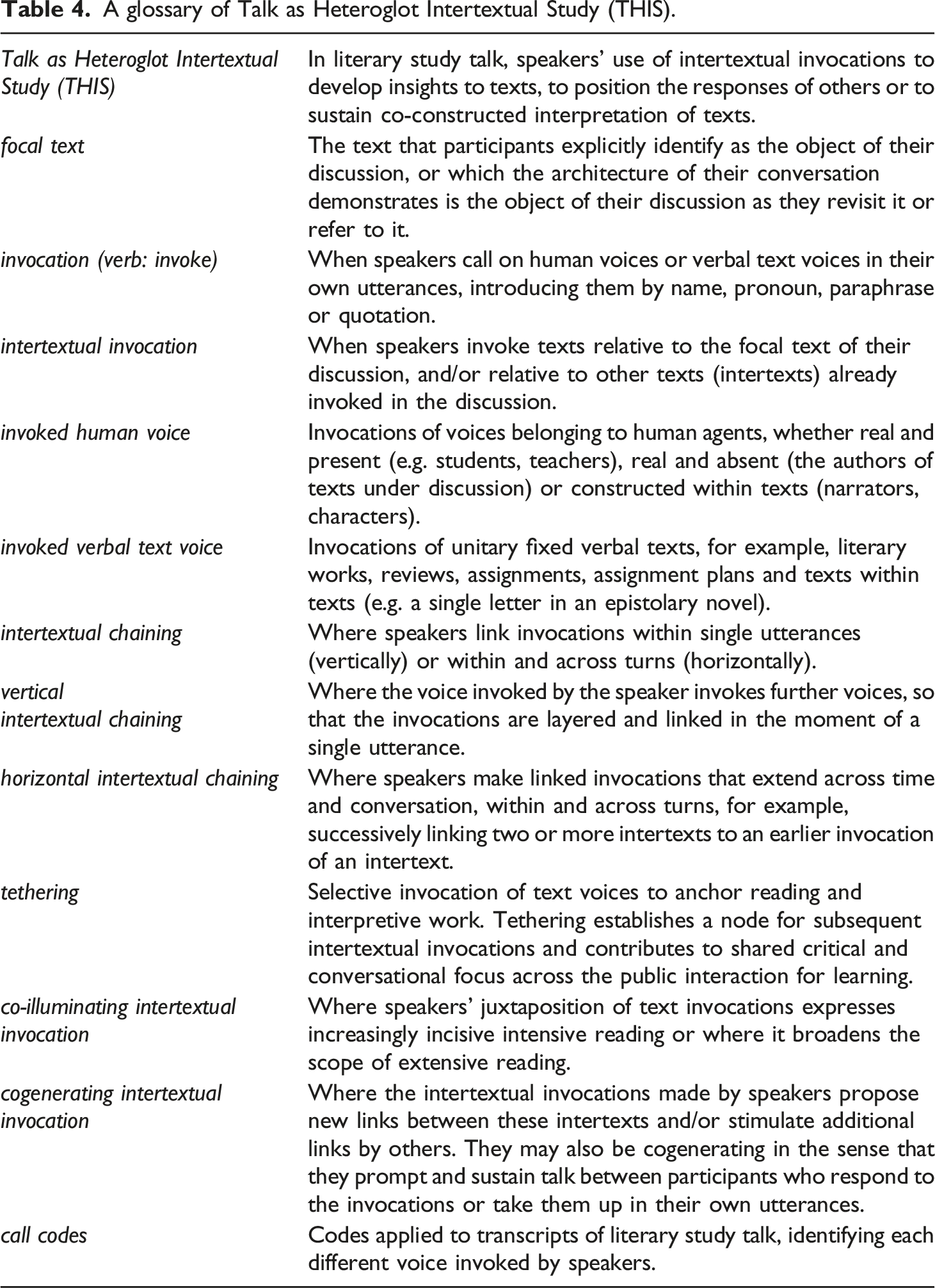
I propose the umbrella term Talk as Heteroglot Intertextual Study (THIS) to describe the form of literary study conversation represented in the transcript. As a pedagogic discourse, THIS embeds heteroglossia and intertextual invocation as core components in the teaching and learning achievements of literary study conversation. The term THIS corresponds with my treatment of literary study conversation as an object of pedagogical stylistics informed by a conversation-analytic perspective. The words of literary texts and their intertexts, or indirect discourse representations of those texts, have a bearing on the language and structure of conversation about them. Talk in this form of conversation is heteroglot when participants embed text voices in their own utterances. It is intertextual when speakers invoke more than one text and suggest links between them, or where they make links with texts introduced by other participants in other turns. Speakers may draw attention to intertextual invocations using deixis (for example, ‘that quote’), though quotations are also embedded in utterances without framing. Sometimes, intertextual invocations call on texts which themselves invoke other texts. These layered, heteroglot invocations in speech represent vertical intertextual chains. Horizontal intertextual chains extend across turns or a conversation, as speakers refer to earlier turns and the invocations in them.Where instances of THIS are the object of research, they are likely to be represented using transcription methods which show both the architecture of talk (informed by conversation analysis) and the introduction of intertextual invocations to talk by participants. Call codes distinguish multiple text voices embedded in the conversational turns of speakers. They afford analysis of participants’ emic understanding of each intertextual invocation, meaning any utterance that calls (invokes) an intertext into the space and sequence of conversation. Once intertextual invocations are identified and analysed according to their place in the architecture of talk, we can also see how speakers position themselves, others and intertexts relative to one another and to express various reading orientations. Tethering identifies the organisational and often pedagogic functions of intertextual invocation, usually as direct quotation, where speakers use it to focus and guide participants’ reading orientations and their expression of them. Repurposed categories of intertextual relationship first proposed by Lemke describe four functions of intertextual invocation in THIS, with the addition of cogenerating and co-illuminating functions. These six functions are not inherent or stable in intertexts; they are determined by how speakers frame them in the moment of invocation and relative to other invocations.
A glossary of Talk as Heteroglot Intertextual Study (THIS).
Footnotes
Acknowledgements
Thanks to colleagues and students of the university where this study was conducted.
Declaration of conflicting interests
The author(s) declared no potential conflicts of interest with respect to the research, authorship, and/or publication of this article.
Funding
The author disclosed receipt of the following financial support for the research, authorship, and/or publication of this article: This work was supported by the British Academy, grant number MD150021.
