



Abstract
This article reports the findings of the first large-scale study into how dementia is depicted in the minds of fictional characters. Dementia is increasingly prevalent and, in the absence of a cure, requires better societal and cultural awareness. Literary representations offer readers the opportunity to ‘try on’ fictional minds, and better understand alternative cognitive experiences. Stylisticians have explored the ‘mind styles’ of characters with various illnesses, characteristics and behaviours, but this is the first comprehensive study of dementia mind styles, and indeed, any one syndrome. A substantial corpus of contemporary fiction depicting the internal perspectives of characters and narrators with dementia was compiled. The data is analysed qualitatively and quantitively, embracing a methodological eclecticism suited to understanding the patterns in characters’ cognitive experiences across texts. The results are presented thematically, demonstrating the enduring significance of features traditionally associated with mind style (underlexicalisation, diminished sense of cause and effect, and pragmatic difficulties), as well as a wide range of new features. These include discourse presentation, sensory descriptions and conceptualisation of the self and others. By exploring the mind styles of many characters with dementia, this research not only widens the application of the concept, but also the range of features associated with its creation and, importantly, offers a theoretical redefinition: mind style is redefined as an iconic representation of fictional cognition, offering a simulated experience for readers.
1. Introduction
Mind style is an effect, the result of an accumulation of linguistic choices across a text which index a ‘way of thinking’, often most discernible when it is unusual (Section 2). This article presents the findings of the first full-scale study of dementia mind styles. As part of a ‘boom’ in cultural representations of dementia (Swinnen and Schweda, 2015), fiction depicting characters with the condition is also proliferating (Falcus and Sako, 2019). Scholars from a range of disciplines are asking if fictional representations of dementia might facilitate a much-needed better understanding of lived experiences (Falcus and Sako, 2019; Bladon, 2019; Bitenc, 2020). Addressing this possibility from a Stylistics perspective requires laying the groundwork by first investigating the ways in which fictional language represents the cognitive experience of dementia. As such, this article addresses the research question, ‘How is dementia represented in the mind styles of fictional characters?’. The question is addressed by selecting a range of relevant texts, extracting narrative attributable to characters with dementia and constructing a corpus of 390,000 words of dementia fiction (the ‘dementia fiction corpus’). The data is analysed using a combination of qualitative and quantitative methods, advancing the analytical approach to mind style.
Section 2 of this article outlines mind style, describing the abundance of research on ‘unusual mind styles’ (Section 2.1) before turning to the significance of dementia mind styles in particular (Section 2.2). The research methodology is explained in Section 3, beginning with the selection of fictional texts (Section 3.1) and relevant data (Section 3.2), then data processing and analytical methods (Section 3.3). Section 4 constitutes the analysis of the data, considering memory and cognition (Section 4.1), sensory and emotive experience (Section 4.2) and the self and social relationships (Section 4.3). Section 5 reflects on the wider implications of this study for a theory of mind style and for sociocultural understandings of dementia.
2. Mind Style
When Fowler first introduced the term ‘mind style’, he defined it as ‘any distinctive linguistic presentation of an individual mental self’ (Fowler (1977): 103). He went on to describe how mind style arises out of ‘consistent linguistic choices which build up a continuous, pervasive, representation of the world’ (1986/1996: 9), highlighting the cumulative effect of patterns in language in forging particular cognitive habits in a character. Early studies in mind style (e.g. Halliday 1971; Leech and Short 1981/2007) explored the lexico-grammatical patterns attributed to characters, especially marked transitivity patterns and ‘underlexicalisation’ (the ‘lack’ of a term to describe an object).
Reflecting the changing influences on the field of Stylistics in general, subsequent mind style analyses moved beyond the lexico-grammatical level to uncover indicators of characters’ mental functioning at the level of pragmatics and using insights from the Cognitive Sciences. For instance, Semino (2007, 2014a, 2014b) explored the interactive tendencies of characters with autism using Gricean maxims. Conceptual Metaphor Theory (Semino and Swindlehurst, 1996) and Schema Theory (Semino, 2002) provide a cognitive lens to consider how characters label and process the world around them. More recently, Text World Theory (Lugea, 2016; Harrison, 2017) and Cognitive Grammar (Harrison, 2017; Nuttall, 2015, 2018, 2019; Rundquist, 2020) offer scaffolding for understanding how characters construe the world around them. The present study is feature-led, taking the stylistic features explored in classic mind style studies as a point of departure: lexico-grammatical patterns such as transitivity and agency, underlexicalisation, metaphors and the pragmatics of interaction. Furthermore, by adding to the armoury of features in mind style construction (see Section 4) and emphasising the role of iconic form (Section 2.3), this study adds to the stylistic understanding of mind style.
2.1 Unusual Mind Styles
Although Leech and Short’s (1981/2007) seminal chapter also dealt with ‘normal mind styles’, most mind style research has tended to focus on unusual mind styles. This trend is based on the simple fact that ‘marked’ linguistic choices are more readily identifiable, yielding studies in unusual cognitive patterns as a consequence (Short, 1994). While almost all texts have some discernible style, the presence of a perceiving mind becomes all the more marked – and interesting – the more idiosyncratic that style.
Research has investigated mind styles in characters with autism (Semino 2002, 2007, 2011; 2014a; 2014b), schizophrenia (Bockting, 1995; Semino and Swindlehurst, 1996), paranoia (Bockting, 1995; Montoro, 2011) and depression (Demjén, 2015) and with marked personality traits, such as illogical reasoning practices (McIntyre, 2005; McIntyre and Archer, 2010). The evolving definition of mind style (e.g. Semino, 2002) reflects the bias in academic interest towards mind styles that are constitutive of a recognisable cognitive impairment or condition. Although identifiable cognitive impairments provide a recognisable set of characteristics on which to ‘pin’ a mind style, like Nuttall (2018: 20), I acknowledge that there are ethical and theoretical implications of limiting the study of mind style to cognitive impairments. Bearing in mind the complex relationship between real conditions affecting cognition and fictional representations, this study – like some before it (e.g. Semino, 2014a; 2014b) – consults lived and medical accounts of the condition to understand and interpret the fictional representations.
2.2 Dementia Mind Styles
Aside from some isolated analyses (Lugea, 2016; Harrison, 2017), this constitutes the first large-scale investigation of dementia mind styles, which are important for several societal and theoretical reasons. From a societal perspective, dementia is increasingly prevalent and there is a need for better cultural understanding and accommodation, as well as social policy (WHO, 2012; Bartlett, 2014). Dementia is an umbrella-term for a number of neurodegenerative conditions which vary in their symptoms and impact on language use (Cummings, 2020), as well across individuals and time. Going beyond medical and clinical accounts, fictional representations provide important vehicles for interrogating the condition as a heterogenous one, how it is experienced on a personal level and understood in a societal one.
From a theoretical perspective, considering fictional characters with dementia serves to test and challenge the mind style concept in several significant ways. As a heterogenous illness, dementia challenges the ‘consistency’ necessary for mind style to emerge (Section 2.0). By analysing a range of characters with the condition, this study explores the similarities and differences in dementia mind styles. Aside from Abdulla (2016) and the work of Semino, this constitutes the first ever large-scale study of mind styles pertaining to any particular condition.
2.3 Reading Minds and Characters
Mind style research is firmly-rooted in Stylistics, and is therefore text-driven and focussed on stylistic features which lead to its emergence. However, there is a parallel body of research into fictional minds emanating from the cognate disciplines of Cognitive Literary Studies, Narratology and Cognitive Poetics. True to the cognitive doctrine, this work focuses more on the readers’ experience of fictional minds, including their ongoing cognitive processing of characters’ fictional mental functioning.
The narratologist Palmer (2002, 2004) advances a rather essentialist view on fictional minds: ‘novel reading is mind-reading’ (2007: 217, my emphasis). In other words, Palmer attributes everything we do when reading novels as contributing towards the construction of fictional mind(s). He criticises the distinction that scholars make between characterisation, on the one hand, and consciousness presentation, on the other, arguing that a lot of what narrators report – including characters’ thoughts, surface descriptions of the text-world and the causal connections between narrative events – all link ‘the thought of characters to the social and physical context’ (2004: 69). Palmer’s criticisms challenge traditional boundaries between areas of narratology that are essentially dealing with the same phenomenon – the fictional representation of experience. However, in blurring these traditional distinctions he also dismisses the linguistic criteria used to distinguish between various strategies such as, for example, the categories of speech and thought presentation. This study upholds the stylistic concern with text-driven analysis of fictional minds, but remains open to Palmer’s contention that the textual cues which contribute towards mind style may indeed be much broader than accounted for in previous research.
Cognitive literary scholars have adopted the terms ‘mind-reading’ (Kidd and Castano 2013), ‘mind attribution’ (Zunshine, 2006; Palmer, 2007; Nuttall, 2015), or ‘mind-modelling’ (Stockwell, 2009; Stockwell and Mahlberg, 2015) from Psychology and Philosophy, where they are used to refer to the human capacity to infer the mental states of others. Applied to reading fiction, these terms describe how readers interpret textual cues to construct and develop mental representations of fictional characters. Stockwell and Mahlberg define ‘mind-modelling’ as readers’ creation of ‘a working model of the characteristics, outlook, beliefs, motivations and consequent behaviour of others’ (2015: 132; see also Stockwell, 2009). Their definition points to the wider scope of ‘mind-modelling’ compared to mind style. While mind style is limited to the textual patterns that contribute towards a character’s particular way of thinking, ‘mind-modelling’ and related terms involve readers’ processing of transient mental states, as well as non-cognitive characteristics. In fact, in principle and in practice, mind-modelling is more closely aligned with characterisation (Culpeper, 2001) which pertains to readers’ construction of whole characters, not just their mental functioning.
I hold mind style as a distinct concept, referring more specifically to the ‘iconic’ representation of mental functioning; that is, the mirroring of some aspect of the character’s cognition in the formal linguistic choices (see Section 4.1). Broadly, iconicity characterises a relationship of similarity between a linguistic sign and the object it represents. The semiotician, Peirce, distinguished between three kinds of iconicity: imagic, metaphorical and diagrammatic (Ljungberg 2015). ‘Imagic iconicity’ entails a ‘perceptible similarity’ between the visual or phonic properties of the form and its meaning. Peirce loosely defines ‘Metaphorical iconicity’ as a semantic similarity; however, cognitive linguists distinguish between ‘metaphor’ as a process which compares source and target concepts, and ‘iconicity’ which draws parallels between form and meaning (Hiraga 2004).
Particularly significant in literary texts is ‘diagrammatic iconicity’ which entails a similarity in terms of relations between the referents; those relations can be temporal, spatial or even subjective. Enkvist coined the term ‘experiential iconicity’ to capture how ‘linear relations in a text stand for temporal, causal, spatial or social relations between referents in the world described by that text’ (1981: 104; see also Tabakowska 1999). Several stylisticians have identified ‘experiential iconicity’ as significant for mind style (Nuttall, 2018; Rundquist, 2020). However, I would go further by suggesting that iconicity in general is the defining feature of mind style, including Peirce’s three kinds. There are two main reasons for considering it so: (a) it mimetically represents a character’s subjective experience in textual form, and (b) in doing so, allows the reader a mirrored experience of that psyche.
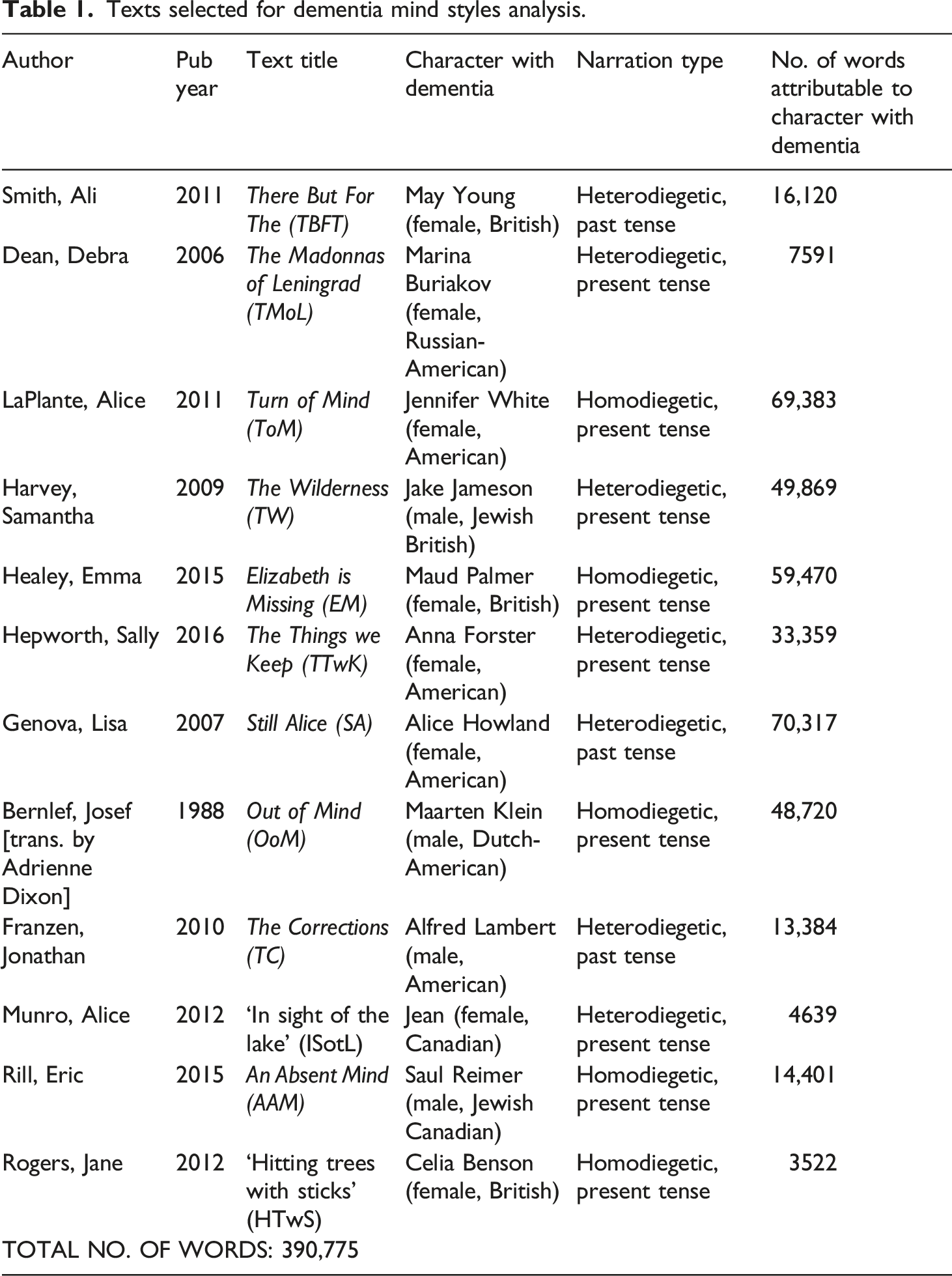
Texts selected for dementia mind styles analysis.
In terms of (b) the effect upon the reader, Enkvist holds experiential iconicity as a ‘receptor-oriented’ text strategy, in that it reflects the order the reader ‘is supposed to perceive things and act upon his perceptions’ (1981: 102). By incorporating iconicity into the definition of mind style, then, we are also recognising that the reader’s ‘mental simulation’ of the character’s way of thinking is inherent to mind style (see also Nuttall 2018: 178–9). Mental simulation refers to ‘the reenactment of perceptual, motor, and introspective states acquired during interaction with the word, body, and mind’ (Barsalou 2008: 618) and is particularly pertinent to imaginative discourse (Zwaan 2009).
The definition proposed here reconciles a problem identified by Semino (2007: 15), whereby ‘the term ‘mind style’ is ambiguous as to whether it refers to linguistic patterns in texts (‘style’) or to the characteristics that we attribute to particular (fictional) minds by interpreting linguistic patterns in texts’. Reconceiving mind style as both a) characters’ experience encoded in an iconic form and b) readers’ opportunity to simulate that experience, resolves this ambiguity and distinguishes mind style from similar processes.
3. Methods
The majority of mind style research has been qualitative; despite the fact that mind style results from an accumulation of features across a text, which corpus software can determine more readily than the analyst’s eye. Addressing this anomaly in the research, some scholars have applied corpus stylistic methods to investigate mind styles (e.g. McIntyre and Archer, 2010; Semino, 2007, 2011; Demjén and Semino 2021). This section outlines the rationale underpinning the procedure for selecting texts relevant for the study (Section 3.1), and for extracting data from those texts for analysis (Section 3.2), as well as the analytical methods employed (Section 3.3).
3.1 Selection of Relevant Texts
For the purposes of this study, texts were sought that matched all of the six criteria, listed and explained below: 1. contemporary, that is, published within the last 35 years (Padley, 2006) 2. fictional 3. prose 4. in the English language 5. featuring a character with any type of dementia 6. presenting the cognitive experience of a character with dementia, that is, a. homodiegetically b. heterodiegetically, with access to the character’s cognition provided through Free Indirect Style (FIS) or psychonarration.
This study is limited to contemporary fictional prose in English (criterion 1–4). Limiting the texts to those published in English, regardless of regional variant limits the generalizability of the findings to Anglophone cultural representations of dementia. One text translated into English from Dutch (Out of Mind, Table 1) was included because it satisfies all the criteria and, being set in the US, conforms to the other variables. Characters with any type of dementia are included (criteria 5). When a dementia diagnosis is not mentioned explicitly in the text or paratext, authorial claims and/or textual cues are deemed sufficient evidence for the texts’ inclusion in the study.
In order to investigate a character’s mind style, it is necessary that the narrative grant an internal perspective on the cognitive experience of dementia (criteria 6). The viewpoint strategies necessary to depict to mind style have not been made explicit in previous research, although Rundquist (2020: 44) observes that, outside of 1st person narratives, 3rd person narratives which adopt FIS are ‘amenable’ to the presentation of mind style. This study adopts Genette’s (1980) narratological framework to implement the criteria. First, the data includes narratives where the narrator is a character in the text with dementia (6a, homodiegetic narrator). Second, it includes narratives where the narrator is external to the story world and refers to a character with dementia in the third-person, but crucially, adopts the internal perspective of that character (6b, heterodiegetic narrator). Heterodiegetic narrators can reflect (or ‘focalise’ in Genette’s [1980] terms) the perspective of a character through the use of FIS or ‘psychonarration’ (Cohn, 1978) attributable to the character with dementia (see Section 3.2.1).
The texts chosen for this survey of how contemporary fiction represents dementia mind styles are listed in Table 1; amongst the novels, two short stories are included.
3.2 Selection of Data for Analysis
The chosen texts vary in terms of how they incorporate dementia, yet they all grant access to the internal perspective of a character with dementia. Because there are two distinct analytical methods employed in this study, the process for data selection is slightly different for each. First, I outline how the data was selected from the texts in Table 1 for quantitative corpus analysis (Section 3.2.1) and, second, for qualitative analysis (Section 3.2.2).
3.2.1 Data Selection for Corpus Analysis
According to Biber (1993), for a corpus to be representative, the data collected must represent the language being examined. A corpus allows the researcher to discover lexico-grammatical patterns across texts, so the data for this corpus could only be constituted of the lexico-grammatical patterns of characters with dementia. Therefore, the corpus was compiled by extracting from the texts in Table 1 only those sections or chapters which present viewpoints a or b (see criteria 6 in Section 2.1), excluding sections of narrative outside of that description.
This process of elimination was straightforward when only certain chapters or sections were narrated homodiegetically by a character with dementia. It was trickier to select passages where a heterodiegetic narrator adopts the perspective of a character with dementia, but Short’s checklist of viewpoint indicators provided a heuristic (1996; see also Lugea and Walker, forthcoming). Many of the chosen texts make frequent use of flashbacks, ‘analepses’ in Genette’s (1980) terms. Where the memory is a fleeting part of the current narrative of the character of dementia, it was included. However, where an extensive section of narrative is filtered through the younger self, pre-cognitive decline, it was not. It was decided that any Direct Speech interspersed in the selected passages should remain in our corpus data, even when it represents the speech of characters without dementia. This may skew the results towards cognitive normativity. Nonetheless, the rationale was that the speech of other characters is part of the cognitive-perceptual experience of the character with dementia; we ‘hear’ the other characters’ speech because the narrating or focalizing character with dementia does; indeed, characters’ processing of other discourses becomes salient to the analysis (Section 4).
Relevant data from the selected texts were digitised by converting e-books to machine-readable .txt files. Where this was not possible, physical copies of the books were scanned using Microsoft Lens, an application which converts photographic images of the pages to digitised text. The result of this procedure is a corpus of 390,000 words of fictional discourse from the viewpoint of a homodiegetic narrator with dementia or focalized through a character with dementia.
3.2.2 Data Selection for Qualitative Analysis
Counterintuitively, the data selected for qualitative analysis is more inclusive than that for quantitative analysis. This is because passages deleted from the corpus (for reasons outlined in 3.2.1) may have interpretative significance in the qualitative analysis of the texts as discourse (i.e. as whole texts which readers process). For instance, Harrison (2017) found that flashbacks can function as memories which influence the present cognition and behaviour of Maud in Elizabeth is Missing. The present research observes the same phenomenon in many of the texts and so – although analepses were excluded from the data for corpus analysis (Section 3.2.1) – these sections were preserved for cross-referencing in the qualitative analysis. Sections of narrative from perspectives of other characters are included in the data for qualitative analysis, so that their influence could be considered.
3.3 Analytical Methods
3.3.1 Analytical Methods: Qualitative
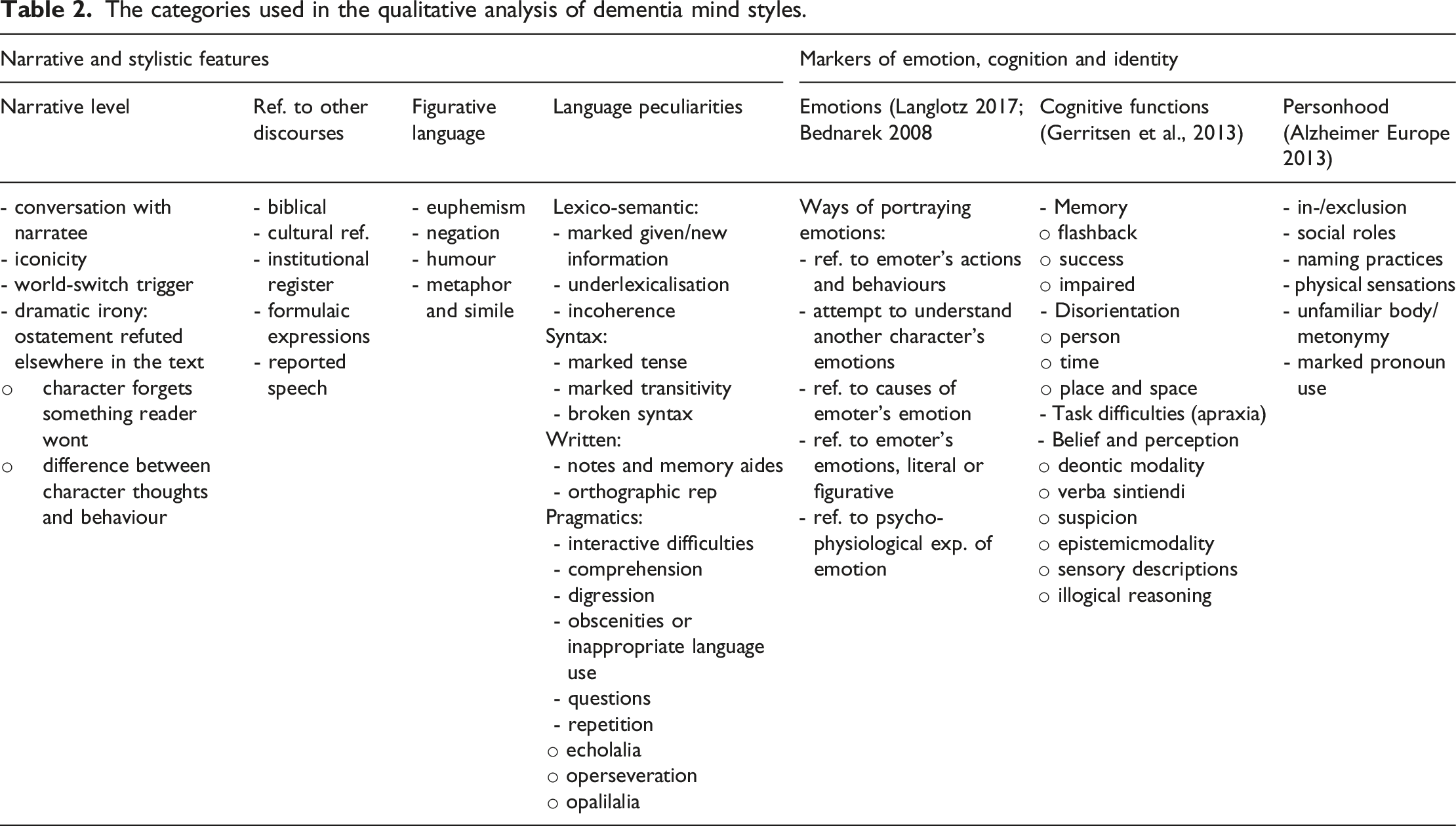
The data was loaded into Nvivo qualitative analysis software, which allows the analyst to create and assign categories (called ‘nodes’ in Nvivo) to sections of the text. The qualitative analysis began with the linguistic features associated with mind style in previous research (Section 2) and, in response to the data, added categories during the coding process. These drew on scholarly accounts of the dementia’s effect on language use (Cummings, 2020; Davis and Guendouzi, 2013) and its fictional representation (Gerritsen et al., 2013). Future research will investigate readers’ responses to these mind styles, so it was deemed important to catalogue references to ‘emotion’ (based on Bednarek, 2008; Langlotz, 2017). The qualitative analysis categories are not mutually exclusive and, in fact, were most illuminating when trends of co-occurrence emerged in the data.
3.3.2 Analytical Methods: Quantitative
The quantitative analysis aims to uncover what makes dementia mind styles distinctive from fictional prose in general. To achieve this, it is necessary to compare the dementia fiction (target) corpus to a reference corpus, which should be both larger in size and comparable. This research used the prose fiction section of the British National Corpus (BNC XML Edition, 2007; Burnard, 2007), which comprises of over 14 million words of prose fiction published between 1960 and 1991. In terms of comparability, there are limitations: the reference corpus represents English prose fiction from an earlier time period than the target corpus (1989–2016). Moreover, the BNC represents British English, while the target corpus also contains North American varieties of English. It was reasoned that any diachronic linguistic changes would have minimal impact on the data and that varietal differences could be accounted for at the analysis stage. The great advantage of the chosen reference corpus is its size.
The prose fiction section (tagged W_fict_prose) was extracted from the freely downloadable full version of the BNC and the data ‘cleaned’ (e.g. making punctuation markers consistent, losing accented characters to make the words readable). The files were converted to .txt, a format compatible with the chosen corpus analysis software, AntConc (Anthony, 2019).
Keywords are words that are statistically over- or under-used in the target corpus, when compared with a reference corpus. Thus, keywords are words that are characteristic in the dataset of interest. A list of keywords was generated in AntConc by comparing the word frequency lists of the target and reference corpora. I set the keyword statistics threshold to p < .0001 (15.13), which limits the keyword results to those which have a log-likelihood score of 15.13 or more, providing 99.99% confidence that the results are statistically significant. Once the software generated a list of keywords, I then sorted them using Log Ratio (effect size), from highest to lowest illustrating which keywords have the biggest difference between the target corpus and the reference corpus. I also applied another cut-off point, only taking keywords with a Log Ratio greater than 1, dismissing the other results on the grounds that the difference is very small, and keeping the rest as potential candidates for further analysis. In doing so, two cut-offs are applied: LL ≥ 15.13, and LR ≥ 1, meaning that all the remaining keywords are possible candidates for further analysis because they are (i) significant and (ii) have a fairly large effect size (Jeffries and Walker, 2018; McIntyre and Walker, 2019).
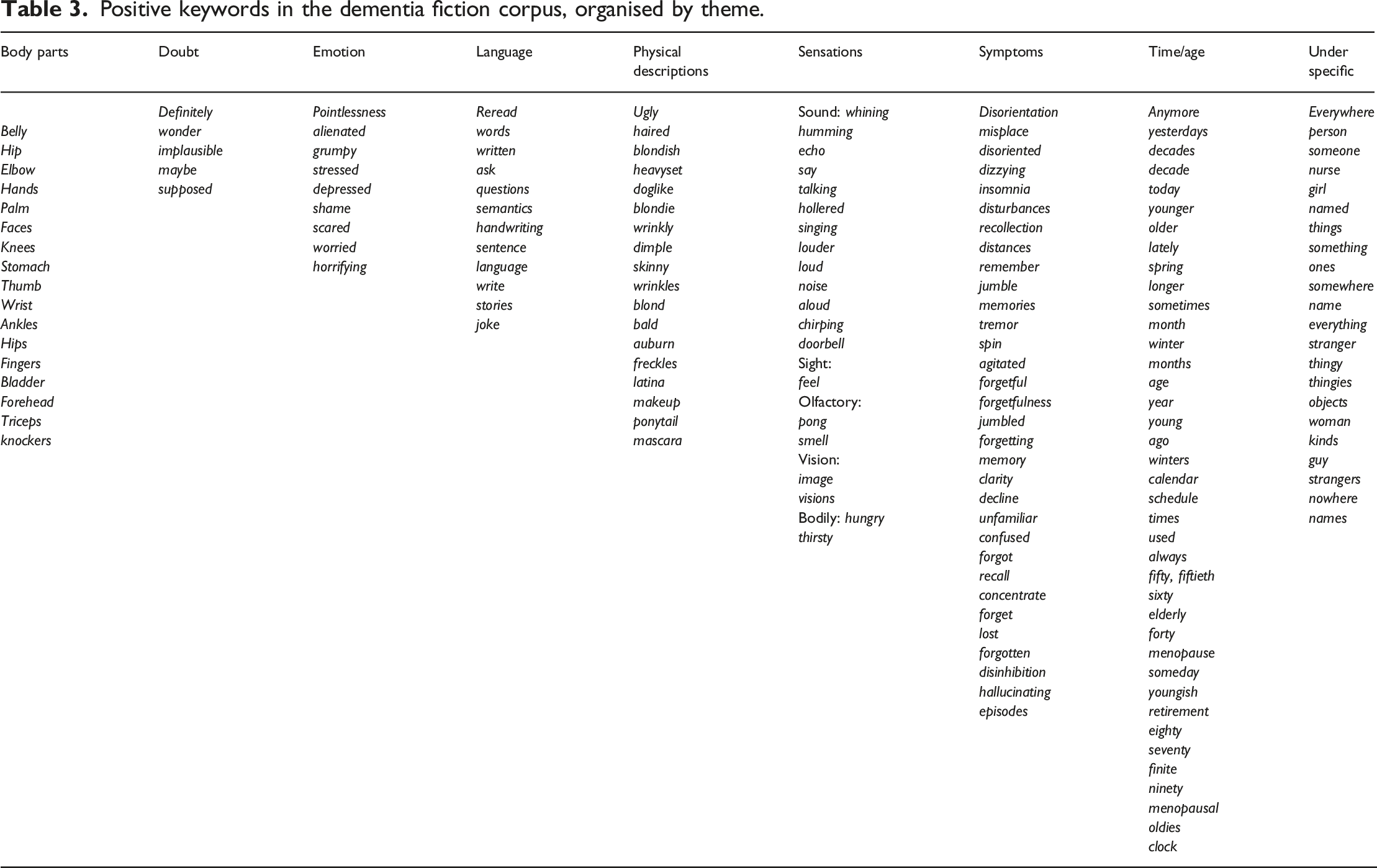
Once the keywords are reduced to a number wherein they are both significant and they have large enough effect size, where the keyword ranks on the list is largely irrelevant. These candidates were exported to an Excel file, where irrelevant results can be filtered out; for the present study, these were American spellings and Proper Nouns (McIntyre and Walker, 2019: 169). The resultant positive keywords were categorised and the most salient categories represented in Table 3. Although Table 3 includes references to dementia symptoms, the many keywords relating to dementia care and treatment were left out.
4. Analysis
The categories used in the qualitative analysis of dementia mind styles.
Positive keywords in the dementia fiction corpus, organised by theme.
4.1 Memory and Cognition in Language and Narrative
This section summarises how memory and cognition are represented iconically in dementia mind styles. According to Davis and Guendouzi, ‘individuals with dementia present with complex disorders of language including challenges with retaining knowledge of words and concepts but also using language structure and rules to create linkages among words and ideas in order to communicate meaning’ (2013: x). Narrativizing this experience presents a paradox for authors, a challenge addressed in different ways in the selected texts.
4.1.1 Language Breakdown
Perhaps due to the need for legible, coherent prose, instances of verbal incoherence and broken syntax are generally infrequent in the data. One technique observed is to use broken syntax in Direct Speech, while the thoughts attributed to the character with dementia remain fluent, allowing his experience to be reflected; this ‘psychonarration’ (Cohn, 1978) is characteristic of Alfred in The Corrections. Two of the texts represent the progression of dementia symptoms by experimenting with form. Out of Mind is particularly notable for this, as increasing deviations on many linguistic levels foreground Maarten’s cognitive changes. At the level of punctuation, there is increasing use of parentheses (see example ii) and ellipses to represent his disjointed thoughts. Typographically, the paragraphs become shorter and Direct Speech capitalised. Grammatically, the homodiegetic narrator evolves from using ‘I’, to ‘you’, to ‘he’ and eventually, by the end of the novel, Maarten disappears as a subject in his own narrative.
In An Absent Mind, comprised of chapters from different homodiegetic narrators, Saul begins fluently, but by the end of the novel his contributions are barely coherent and highly deviant in terms of orthography and typography. However, the surrounding chapters narrated by other characters serve to contextualise and supplement his contributions, making them meaningful and poignant. In a chapter narrated homodiegetically by his wife, she rejoices at the possibility Saul has recognised her for a second in the midst of an unresponsive phase; the next chapter – from his homodiegetic perspective – says only: i. JuSt . . . hEr as Pretti . . . CHoo fLeuR (Saul, AAM)
Saul uses chou-fleur (‘cauliflower’), his pet name for his Francophone wife. In the context of the novel, this is powerful confirmation of Saul’s momentary lucidity and the ongoing emotional connection with his wife. This example also challenges the assumption that mind style can only arise from consistent lexico-grammatical patterns and lends some weight to Palmer’s contention that the cues to fictional minds may be in a much broader range of features (Section 2.3): in this case, the intratextual interaction of another character’s observations and Saul’s minimal contributions. Moreover, the examples cited in this section illustrate how narratives can use ‘imagic iconicity’ (Section 2.3) to represent the cognitive difficulties in dementia mind styles, through typographical and orthographical deviations.
One more subtle way of formally representing cognitive changes in characters with dementia is by changing the syntactic style over the course of a novel. Still Alice begins by emphasising the protagonist’s cognitive abilities as a professor, with the use of complex syntactic structures in the narrative. However, towards the end of the novel when Alice’s symptoms have progressed, the protagonist observes her husband as follows: ii. The man in the chair continued reading his book and drinking his drink. The book was thick and the drink was yellowish brown, like the color of her eyes, with ice in it. He was enjoying and absorbed in both, the book and the drink. (Alice, SA)
The sentences are simplified to single or coordinated clauses, without subordination. Furthermore, lacking the specific name for her husband ‘John’ and the ‘ice tea’ he is drinking, she gives visual descriptions as ‘circumlocutions’ (Pashek and Tompkins, 2002). The repetition of the coordinated structure ‘book […] and […] drink’ in different grammatical positions across the three sentences is a rhetorical figure conduplicatio. As well as having important cohesive and poetic functions (Aitchison, 1994), repetition is a clinical feature of dementia (Stark, 2011) found throughout the dataset. Together, these features – the syntactic simplicity, repetition, semantic underspecificity and visual descriptions – represent the cognitive experience of dementia through ‘experiential iconicity’ and provide poetic quality to the narrative (see Rundquist, 2020, for a CG account of underspecificity in mind style).
4.1.2 Lexico-Semantic Characteristics
Example ii demonstrates the anomic aphasia symptomatic of dementia (Banovic et al., 2018; Cummings, 2020). Perhaps because the ‘lexicon in people with dementia is more sensitive than syntax’ (Banovic et al., 2018: 222), stylistic deviations are much more commonplace at the lexical level in the data. As such, a classic hallmark of mind style, underlexicalisation (Section 2) has renewed significance in this study where it is evident in every character. As well as circumlocution, characters use more under-specific terms, as evidenced by the keyword analysis (Table 3) which shows that the following terms are overused in the dementia fiction corpus: generic nouns instead of specific ones (things, thingy, thingies, something), and pronouns or generic terms to replace names (someone, girl, woman, guy, stranger, strangers) and places (somewhere). Another underlexicalisation strategy in the data is the use of substitute words (Pashek and Tompkins, 2002), visible through qualitative analysis. In the following extract, Maud describes her doctor’s departure after a home visit and the underlexicalisation reflects her unfamiliarity with technology: iii. He is already inserting the little plugs, the wire shells, back into his ears, while he talks on to Helen, and I wonder briefly what it is he listens to. I cup my hands over my own ears, straining to hear the sea-like music of my circulation, the singing of my blood. But hands don’t work as well as shells; they don’t create the right echo, or whatever it is. Helen comes back after letting the doctor out and sits on the arm of my chair. ‘You didn’t have to cover your ears, Mum,’ she says. ‘He wasn’t shouting.’ (Maud, EiM)
In example iii, Maud has difficulty naming the doctor’s ‘earbuds’ and draws on her existing schematic knowledge (Semino, 2002) of ‘shells’, which approximate the earbud’s shape and their use as a ‘listening’ device in childhood games. Through analepses, the reader later learns Maud collected shells as a child and the word reappears throughout the novel in her repetitive behaviours. In extract iii, considering one concept (earbuds) in terms of another (shells) is a metaphorical process, developed into an extended metaphor where bodily sounds are ‘music’ and ‘singing’. This extract typifies a trend found throughout the data, whereby long-term memories provide the characters with dementia with ‘source domains’ (Lakoff and Johnson 1980) to conceptualise and process stimuli in the present, engaging in ‘metaphorical iconicity’ (Section 2.3). Because narrative prose can supply those memories through flashbacks, and give access to characters’ use of long-term memory to process the present, readers are often afforded a better understanding of the characters’ behaviour than their interlocutors, as in example iii.
Memory loss in characters with dementia is also represented on the lexico-semantic level through the use of ‘marked given/new information’ (Short, 1996). In referring to nouns, speakers have the option of using definite reference (e.g. the) which indicates the referent is already known (i.e. given), or indefinite reference (e.g. a) which suggests the referent is unknown (i.e. new). A common feature in the data is the characters’ marked use of indefinite referring expressions where the referent was already well-established in the discourse, suggesting that the character has forgotten. For instance, Maarten describes his wife Vera, another main character in the novel with the physical description: iv. An older woman, her brown hair pinned up, wearing a black high-necked dress. (She is as complete as you could wish the image of a person to be.) (Maarten, OoM).
Maarten’s use of indefinite reference (‘an’) and the generic noun ‘woman’ to describe his wife jars with the intimate relationship that has been established between the two main characters. It suggests he has forgotten his past relationship with the person closest to him, as he processes only the immediate visual cues. Nonetheless, this extract is also notable for the emotion her appearance evokes in him, ‘complete’, suggesting his memory loss does not detract from his feelings for her. It illustrates the power fictional prose has for representing memory loss in the organisation of discourse and transcending it with insight to characters’ enduring emotions (Section 4.2.3).
4.1.3 Other Discourses
In considering how characters’ memory and cognition is represented in the corpus, the analysis now turns from linguistic features to more figurative and discourse-level features. During the coding process, it became apparent that characters with dementia often reference other discourses in their narration and speech, indicative of the endurance of long-term memories and their influence on present thought processing. Based on the data, several sub-categories were identified and their use varies according to the particular character and their knowledge resources. Lines from the bible, poetry and song pepper some of the characters’ narrations as verbal relics from long-term memory stores, reflecting the fact that memorised verse can be preserved. As Harris notes, ‘the cognitive resilience of rhetorical figures, their redundancy against the noise of distraction, attentional ebbs, and the decline of memory, are all relevant to how we converse with, and listen to, cognitively impaired people’ (2020: 23). Moreover, the professional expertise of some of the characters (Alice, a linguistics professor; Alfred, an engineer; Jennifer, a surgeon) is evident in the way they weave jargon into their narrative. As well as lending intertextuality to the prose, such references enrich our understanding of the character as more than their illness, as a whole person, with rich life experiences from which they can draw (Section 4.3).
The difficulty with representing the later stages of dementia is addressed in some of the narratives by using Direct Speech from other characters to ‘fill in’ what is happening in the immediate context. When Jennifer (ToM) has seemingly lost the capacity to interact with others, we only have access to her thoughts in the focalized narrative: v. She is angry; who wouldn’t be? But after her anger burns itself out, there will be something left. Nurse, she’s doing it again. (Jennifer, ToM)
Her cognitive disconnect from her surroundings is indicated by a lack of narrative report, where the other character’s Direct Speech (in italics) gives clues about her outward behaviour (‘it’ is something inappropriate) at a time when she is incognizant. Further consideration is given to how characters with dementia process auditory stimulus in Section 4.2.
Another kind of discourse which pervades the narratives is the use of fixed expressions. Clinical research has demonstrated that formulaic language is more easily retained by people living with dementia and is ‘comprised of conversational speech formulas, idioms, pause-fillers, and other fixed expressions’ (Bridges and Van Lancker Sidtis, 2013: 2). One character, Maarten, provides some meta-discourse on why fixed expressions are useful: vi. ‘Tomorrow is another day!' (This kind of sentence presents the least difficulty; proverbs, set phrases pop out all by themselves, with them my speech comes closest to normal talking.) (Maarten, OoM)
In thought, Maarten describes how fixed expressions lend a fluency to his speech, which otherwise he would find difficult to achieve. Fixed expressions such as these are used by many characters in the data, reflecting real interactive strategies in dementia (Davis et al., 2013) and an enduring kind of social knowledge and ability to relate to one’s culture and context.
Another kind of figurative language frequently found in the data is euphemism, although it tends to be employed by some characters (e.g. May) more than others (e.g. Saul). Euphemism adds to the under-specificity of language, discussed above, and also emphasises the cultural taboos constraining the character with dementia and their verbalisation of their experience, for example, bodily functions, sex and death. May, for instance, refers frequently to death and looks for signs of it. For example, reading her hospital bracelet, she observes: vii. 13.12.25. No date for (May, TBFT)
In vii, ‘the other’ is euphemistic reduction referring to her Date of Death. Of course it is illogical to expect to be able to observe one’s status as dead. May holds the superstition that a man wearing a suit will come when it is her time to die and considers the dress of every man she meets. In extract viii, she expresses her superstition in conversation: viii. He’s in there, she said. The man in the suit? He's not in a suit, not as far as know, the girl said. Well, I'm not dead yet, then. You said it, the girl said. (May, TBFT) ix. There’s a reminder from the optician, and a letter from the council. Of course the optician’s is right opposite the council offices, so you’d expect that really. (Celia, HTwS)
In this example, the premises (that the optician’s is opposite the council offices) do not provide reasonable grounds for the conclusion (that their letters would be delivered at the same time), giving rise to flawed inductive reasoning (McIntyre 2005). Moreover, Celia’s appeal to the narratee to share in her flawed assumption creates dramatic irony, whereby the reader has an awareness not available to the character. This example leads us to a consideration of narrative-level features in dementia mind styles.
4.1.4 Narrative Level
The majority of mind style research has focused on its creation at the local level, despite the fact it arises discursively. This fact is particularly pertinent to characters with dementia, as memory loss is indicated across stretches of text, by switching between present and past memories, or in the development of an unreliable narrator. Harrison (2017) observed that aspects of Maud’s environment trigger associations and initiate flashbacks to long-term memories in the narrative of Elizabeth is Missing. This larger-scale study found the trait was not limited to Maud, but evident throughout the data. The stimuli that initiate the flashbacks are categorised as ‘world-switch triggers’, drawing on terminology from Text World Theory (Werth, 1999; Gavins, 2007). During coding, it was observed that these triggers are often also tagged as ‘sensory descriptions’, highlighting the significance of sensory input (e.g. visual, auditory and olfactory) as stimuli for characters’ long-term memories. The significance of sensory descriptions in dementia mind styles is elaborated in Section 4.2.
Concomitant with Harrison’s (2017) findings, the flashbacks often influenced the characters’ ongoing cognition and behaviour when their thoughts returned to their present, allowing the reader a privileged understanding, as observed with example ii above. Because narrative grants readers access to different perspectives and ontological levels it facilitates dramatic irony, that is, the effect achieved when discourse participants know more than the fictional character(s) depicted (Booth, 1974). Three types of dramatic irony were coded in the data. First, when the character with dementia forgets something the reader won’t and, second, produces a statement refuted elsewhere (Table 2). Both of these kinds of dramatic irony foreground the cognitive difficulties in characters with dementia and contribute towards the establishment of an unreliable narrator/focaliser. Third, when dramatic irony arises due to a difference between character’s thoughts and behaviour, the way people with dementia might deceive or perform in social interactions is foregrounded, giving insight into the private strategies used to cope in social settings (see Section 4.3).
4.2 Sensory and Emotive Experience
This section turns to the iconic narrativization of heightened or altered sensory, physical and emotive experience. The majority of the texts in the corpus are present tense narratives (Table 1). Although it is not clear if this is representative of fiction depicting dementia, it is a strategy which supplements the foregrounding of sensory, physical and emotive experience. In the absence of short-term memories to comprehend the world around them, characters with dementia very much ‘live in the present’.
4.2.1 Sensory Experience
During the qualitative coding process, it became clear that sensory descriptions play a significant role in the narrativization of dementia. As well as lending a literary quality, sensory descriptions play a role in reflecting the cognitive difficulties faced by the character because they rely on sensual cues – visual, auditory and olfactory – to help process and interpret the world around them.
The visual sense of people with dementia can be impaired and this is reflected by narratives that depict characters’ hallucinations (keyword: hallucinating, Table 3). However, the salience of visual sensory input is highlighted as significant by the keyword analysis, which identifies the following as statistically overused in the dementia fiction corpus: blonde, blondie, blondish, auburn, bald, skinny, freckles and dimples (Table 3). When lacking the name to identify people around them, characters with dementia often use physical descriptions, as in the following example: x. Most of the residents, I notice, have nodded off. But Baldy’s still awake. Southern Lady. Really Old Lady. Young Guy and me. (Anna, TTwK)
Forgetting the names of her fellow care home residents, Anna instead identifies them using their physical (baldy, old, young) or social (southern) attributes; because this strategy is used throughout her narration, these descriptions become more salient than their character names. Jake (TW) uses a similar technique to refer to his doctor, the ‘fox-haired woman’, albeit with a more unconventional, metaphorical physical description. The effect of this particular kind of underlexicalisation is to foreground the characters’ anomic aphasia and reliance on visual sensory input.
Sometimes this ‘reliance’ is cast as heightened sensitivity, lending the characters a unique insight. In the following extract, Marina is lost and disoriented but enraptured by the vision of a leaf: xi. Green. The word doesn't begin to describe this. For the moment, she forgets that she is lost, that she is weak and chilled and the soles of her feet are tender with sores. She pinches a leaf between her thumb and forefinger and holds it up. It is breathtakingly beautiful, the first new green of the world, the light of creation still shining inside it. She studies it. Time recedes, and she floats beyond it, absorbed totally and completely in this vision. Who knows how much time has passed? She is beyond the tyranny of time. […] This slow erosion of self has its compensations. Having forgotten whatever associations might dull her vision, she can look at a leaf and see it as if for the first time. Though reason suggests otherwise, she has never seen this green before. It is wondrous. Each day, the world is made fresh again, holy, and she takes it in, in all its raw intensity, like a young child. She feels something bloom in her chest—joy or grief, eventually they are inseparable. The world is so acutely beautiful, for all its horrors, that she will be sorry to leave it. (Marina, TMoL)
Marina’s perception of some aspects of her immediate surroundings is dulled: physical sensations (weak, sore) and time. Time is treated metaphorically as a physical entity and a ‘tyrant’ from which she can move beyond. However, her visual sensory experience is foregrounded through various means. The word ‘green’ does not sufficiently describe her experience of it, which is instead connotes creation and light. Moreover, the word presupposes that all greens are alike, whereas this visual experience is unique for Marina, expressed through the similes ‘as if for the first time’ and ‘like a young child’. The source domain of life and creation is replicated in describing the emotions which ‘bloom’ in Marina, evoked by this vision. Again, labels are insufficient; the signifiers ‘joy or grief’ are inconsequential to her, for both are a part of life. As Leech and Short observed in their mind style analysis of Benjy, ‘[w]ith its childlike vision, such language borders on poetry in recapturing a pristine awareness of things’ (1981:207). Although their study investigated the lexico-grammatical features used to reflected the character’s experience iconically in the language form, this extract achieves a similar mind style effect through figurative language – metaphor, simile and connotative meaning. There is no doubt that people affected by the harsh realities of dementia may question the ‘compensations’ depicted by this literary example. However, literary representations such as this could also serve to illustrate the endurance of sensual and emotional feeling in later stages of dementia and the importance of sustaining those faculties in care.
The auditory channel is also significant in the data (see the positive keywords including noise, aloud, loud, in Table 3). In Section 4.1.3, it was proposed that the Direct Speech of other characters is interwoven with the narrative attributed to characters with dementia in meaningful ways. The qualitative analysis demonstrated that the ways in which the speech of other characters is represented can reveal something about the auditory processing of the character with dementia. Because characters with dementia are often older, their interlocutors can assume deafness which is not always the case: How are you doing today, May? The nurse shouted (May, TBFT). Here, the reporting verb ‘shouted’ is attributed to the focaliser May, indicating that she can hear better than the nurse presumes and adding to the dramatic irony, whereby the reader understands May better than other characters (Section 4.1.4). In many cases, the characters may hear perfectly well, but have difficulties identifying the source of sounds. In the following example, Maud’s disorientation means she relies on the auditory and visual cues available to process her surroundings: xii. But I can’t see anything to tell me why I’m here. “Hello, Mrs Horsham” a voice says. I look up. There’s a desk on the other side of the room with a sign saying POLICE RECEPTION. I read it aloud. (Maud, EiM)
In example xii, although Maud forgets why she is visiting the local police station, the reader will know it is a repeat behaviour, adding to a kind of dramatic irony where the reader remembers more than the character with dementia. The fact she visits the station often also explains why the unidentified police officer behind the ‘voice’ can greet her by name. Maud notes the lack of visual cues to help her orient herself. In an instance of diagrammatic and experiential iconicity, the greeting, ‘Hello, Mrs Horsham’ is represented according to her experience of it: unattributed Direct Speech, interrupting her thought process. Reflecting Maud’s confusion about its source, it is attributed to a disembodied ‘voice’, and it is left to the reader to infer the speaker, based on cues in the cotext. This exemplifies a trend found in the data, whereby characters report events and actions around them, leaving interpretation as to their significance or connection up to the reader. In a way, the effect is similar to the diminished sense of cause and effect realised by the transitivity patterns in other mind style studies (Section 2.1 and dealt with comprehensively in Nuttall [2019]). Searching for visual cues to orient herself, Maud finds them in the signage (capitalised in an instance of ‘imagic iconicity’), which she reads aloud. Reading aloud is something Maud does frequently throughout the novel, often in inappropriate contexts and to the annoyance of her daughter. In this way, she demonstrates limited awareness of her own speech production and its relevance or appropriateness (a trait found in some other characters and explored further in Section 4.3). While the other characters may not understand her behaviour, readers’ access to Maud’s sensory experience may well facilitate a deeper level of understanding in the reader towards the experience of dementia and behaviours that arise as a result of symptoms.
4.2.2 Emotive Experience
The qualitative analysis made a distinction between instances where characters with dementia express emotions, on the one hand, and attempt to understand others’ emotions, on the other (Bednarek, 2008; Langlotz, 2017). When coding the dementia narratives, it became clear that sensory descriptions often co-occur with both kinds of emotion description. In example xiii, Alice describes her own emotions evoked by a hug from her daughter: xiii. The pretty woman moved over and hugged Alice. She smelled fresh and clean, like soap. Her hug penetrated Alice much like her peanut butter eyes had. Alice felt happy and close to her. (Alice, SA)
As with Anna in x), a physical description has to stand in place of her daughter’s name, forgotten. Regardless, the richness of this positive sensory experience – the physical and visual eye contact and the smell of her daughter – evokes ‘happy’ feelings (like Marina in xi). The physical and visual stimuli are said to ‘penetrate’ Alice, using the BODY is CONTAINER metaphor to represent the piercing effect of external sensory stimuli on internal feeling. Although characters with dementia are also represented as moved emotionally by long-term memories depicted in flashbacks, immediate sensory experience often co-occurs with emotion descriptions.
When characters narrate other characters’ emotions they rely on immediate contextual cues. In some cases, characters with dementia are depicted as having a heightened understanding of others’ emotions, due to an increased awareness of the present. In others, the characters may simply report the cues pertaining to other characters’ emotions, but not make any interpretation as to their meaning. Saul for example, frequently notices his wife’s mascara is running: xiv. I glanced over at Monique. Her mascara was running. (Saul, AAM)
His description focuses on the visual dimension and makes no interpretation as to the emotional cause (she’s crying), or his part in it. On the one hand, this could be interpreted as part of the pattern in misunderstanding cause and effect in event description (see Section 4.2.1). On the other, his insensitivity to her emotional distress fits with other aspects of his brutish character, emphasising the intersection of dementia and its fictional representation with characterisation at large. Characters with dementia are not defined by dementia, in the same way that people are not.
4.3 The Self and Social Relationships
Although selfhood and the representation of ‘self’ has not been explored as indicative of mind style before, it was deemed significant in this study for several reasons. The agency of people with dementia is a key issue in dementia care and advocacy (Kitwood 1997; Alzheimer Europe 2013), and reflected in the fiction through various stylistic means (Section 4.3.1). Because dementia affects parts of the brain that influence cognition, memory and behaviour, it results in changes that relate to the self and one’s identity. Cartesian dualism, so influential in Western thinking, proposes cogito ergo sum (‘I think, therefore I am’), which problematically entails that loss of cognitive ability is a loss of self. Moreover, as symptoms progress and care needs increase, there is an increasing reliance on caregivers, raising issues of personal agency, as defined by the relationship between the person with dementia and others. Expanding on Semino’s research on the pragmatics of mind style, Section 4.3.2 explores the interactions between characters with dementia and other characters.
4.3.1 Selfhood
Societal representations of dementia often depict people with dementia as ‘zombies’ or ‘the walking dead’ (Bailey et al., 2019), negating agency and humanity in people with the condition. Fictional representations are not above such stereotypes, as exemplified in extract xi which describes Marina’s ‘slow erosion of self’, albeit in a context which emphasises her continued humanity. In ways discussed earlier, fiction can powerfully represent how personal identity endures in dementia by weaving in discourses and memories from characters’ past life experience (Section 4.1) and emphasising their ongoing sensual and emotional engagement with their immediate context (Section 4.2). This section explores how selfhood is represented through the use of pronouns, metonymy and transitivity processes.
As mentioned in Section 4.1.1, the most formally experimental text in the dataset, Out of Mind represents the worsening cognitive symptoms through internal deviation in the narrator’s pronoun use, from 1st person, to 2nd then 3rd and eventually no subject pronouns at all. A similar technique is adopted to a lesser extent by Jennifer (ToM). Less marked but just as significant for agency in dementia mind styles is the use of reflexive pronouns, as in the following example: xv. He finds (Jake, TW, my emphasis)
Through the self-reflexivity Jake is cast as both the object and the subject of his experience, foregrounding his mental processing as distinct from his physical location, as if one were not responsible for the other (see Rundquist [2020] for a CG account of this effect). As with features identified in Section 4.2, this kind of marked reflexivity contributes to the disorientation in dementia mind styles, as well as the lack of agency over oneself.
This separation from self is also evidenced in the widespread use of metonymy in the dementia fiction corpus. Metonymy is a type of metaphorical process whereby the target item is described by referring to an attribute or something closely related, for example, a whole person described in terms of a part of their body. Bodily metonymy has been identified as significant for mind style (Nuttall, 2019), forms a qualitative category in this study, and many body terms are identified as positive keywords in the corpus: for example, fingers, wrist, thumb (Table 3). In example xiv, May’s account of events shows limited agency over her limbs, which also seem to have a life of their own: xvi) May stretched out her arms. Two old arms stretched out in front of her. The girl put the shoes in the old hands. The old hands held them in May's lap, ready. (May, TBFT)
Example xvi uses parallelism, whereby a human agent (May, the girl) carries out a process in which a body part is the (in)direct object (arms, hands), and then the body part becomes the agent in the subsequent sentence. This pattern is twice repeated, strengthening the effect of the parallelism, which is to foreground May’s limbs as distinct from herself. While she has control over ‘her arms’ as Direct Objects, when they move away from her body to the extent she perceives them as ‘old’, they become estranged and take Subject position, alien to her. Henceforth, the possessive (‘her’) switches to the definite determiner ‘the old hands’, further indicating estrangement from her own body. It is difficult to ascertain if a changing conceptualisation of self is attributable to the natural ageing process, or to dementia. Nonetheless, the significance of body parts in the corpus is undeniable (Table 3).
4.3.2 Social Relationships
During qualitative coding, it became clear that naming practices, both for characters with dementia and those around them, are indicative of how dementia is experienced or perceived in relation to others. An outline of such practices is beyond the scope of this article and, arguably, is of limited relevance to mind style. Suffice to note that, in Section 4.2.1, it was shown that pronouns can convey a marked conceptualisation of self, but they can also do the same for the ‘other’. Many characters in the dataset use generic ‘they’ to refer broadly to caregivers, family or healthcare professionals, without a clear referent (related to underspecificity, Section 4.1). For instance, there is no clear antecedent for Saul’s pronoun use in example xvii: xvii. It’s been almost two years since (Saul, AAM, my emphasis)
While ‘they’ could represent a group whose names are forgotten, the generic 3rd person plural may also indicate that the character with dementia conceives of a distinct, homogeneous group of which he is not a part. Saul’s contribution in xvii embeds the Indirect Speech of this group, and although it is unlikely that his healthcare team or caregivers used the terms ‘sick and useless’, Saul’s attribution of these terms to them indicates that is how he feels he is perceived by the wider community.
While the precise pragmatic difficulties faced by people vary according to their specific dementia diagnosis, the condition can cause those affected to repeat or omit information, to use underspecific reference, to misunderstand figurative language and implied meaning, or to violate turn-taking norms and Gricean maxims (Cummings 2020). Although all of these language features were observed in the fictional data, there is only space here to expand on the violation of Gricean maxims, which has past been associated with mind style (Semino, 2014a, 2014b; Lugea, 2016). According to Grice’s (1975) Cooperative Principle (CP), conversation operates using implicit ‘norms’ which interactants tend to follow: make your contributions relevant, brief, true and orderly. Of course, speakers break these norms frequently, and often with intention. Cognitive impairments like dementia can cause speakers to ‘violate’ these norms unintentionally, as in example viii, when May asks the girl, ‘Is he in a suit?’, a non-sequitur violating the Gricean maxim of Relation (i.e. relevance). The same example also illustrates how interactants can facilitate successful conversations with people with dementia, if we examine the girl’s responses. Despite May’s seemingly irrelevant question, the girl completes the adjacency pair by answering and – in the face of another violation of Relation (‘Well, I’m not dead yet then’) – she again accommodates the contribution with grace and humour (‘You said it’). Banovic et al. (2018: 22) emphasise, ‘[i]t is important to understand that dementia affects the communication of the person with dementia, but it is also necessary to adapt the communication of other persons, persons from the environment that are involved in care’. Example viii illustrates how pragmatic norms can be relaxed in interactions with people with dementia to facilitate conversational coherence and harmony. The data also presents many instances of pragmatic failures between characters with dementia and their interactants but these are also often learning experiences for the reader who – with access to the consciousness of the character with dementia – can better understand the reasons behind apparent pragmatic anomalies (e.g. example iii).
5. Concluding Remarks
The analysis demonstrates that the features which contribute to dementia mind styles include and expand on those previously associated with the phenomenon (Table 2). A novel finding is that the characters’ use of discourse presentation reveals something about their memory and perceptual processing of other discourses (including speech, song, jargon, fixed expressions, etc.). It is argued that underpinning all the features that contribute to mind style, now greater in range, is the concept of iconicity; in other words, mind style can be redefined as an iconic representation of cognition, such that readers are invited to simulate the particular ‘way of thinking’ endowed in the text. The proposed clarification to the definition emphasises the role of textual features in simulating the cognitive experience of the narrator/character, and implicitly recognises the effect upon the reader which is to share in that experience.
As ‘dementia’ is an umbrella-term for a great number of conditions, this research has unified a range literary representations for the purposes of the analysis. Although the analysis draws out commonalities in the data, there were also differences, reflecting the many different ways dementia can be experienced and represented, and the heterogeneity of the illness and people affected. Exploring different kinds of dementia in different characters has allowed for the consideration of mind style as, yes, shaped by the range of symptoms that pertain to the condition, but also as variable according to the individual and their particular experience. With regards the tendency for mind style studies to focus on identifiable conditions (Section 2.1), I believe this is not imperative, but can reveal something useful about how those conditions are culturally represented, especially if a range of texts are considered; in some ways, stereotypes might be perpetuated by the fiction (e.g. loss of self), but in others, giving voice and attributing mind styles to characters with a given condition can enrich our understanding of how people live with – and are more than – the symptoms. As Burke (2018: 93–4) notes, ‘the very endeavour to imagine the subjective experience of a person whose dementia precludes self-narration is an ethical act wagered on the assumption that personhood persists regardless of the level of impairment in memory, language and cognition’. Therefore, reading fictional mind styles is – in itself – an ethical act of recognising and recreating others’ consciousness.
The mind style analysis reported here is the first stage of a broader research project which investigates whether such fiction fosters a shared cognitive experience between characters and readers, facilitating awareness of and/or empathy towards the condition. ‘Trying on’ (Zunshine 2006) the minds of characters living with a particular condition may be schema-refreshing, allowing us to see things anew and providing the defamiliarizing experience fundamental to literary reading. It may even facilitate empathetic engagement with the lived experience of that condition in a way that would otherwise never be possible (Bitenc, 2020). Rundquist observes the power of narrative fiction, in particular, to ‘access thoughts and other facets of consciousness that do not take linguistic form at all, and it can represent these phenomena with language’ (2014: 172). As such, fiction has the power to provide readers with simulations of psychological experiences which otherwise remain inaccessible – and often – unverbalized. In other words, ‘trying on minds’ is not simply an aesthetic exercise but a significant way in which literature conveys meaning, probes humanity and stretches the limits of readers’ experience. Just how readers enact that simulative experience remains to be explored further.
Footnotes
Acknowledgements
This research was carried out thanks to funding from the Arts and Humanities Research Council. The data processing was carried out with the generous help of data scientist, Alastair McKinley (Analytics Engines, Belfast). Thank you to my project team Dr Gemma Carney, Dr Paula Devine, Dr Carolina Fernández-Quintanilla and Jan Carson for their invaluable input, to Dr Brian Walker for advice on the corpus methods, and to the anonymous reviewers for their constructive feedback. Any errors are entirely my own.
Declaration of conflicting interests
The author(s) declared no potential conflicts of interest with respect to the research, authorship, and/or publication of this article.
Funding
The author(s) disclosed receipt of the following financial support for the research, authorship, and/or publication of this article: This work was supported by the Arts and Humanities Research Council (Grant no: AH/S001476/1).
