



Abstract
Catchphrases have long been a hallmark of US-American sit-coms and dramas, as well as reality, game and variety show programming. Because the phenomenon of the television catchphrase developed throughout the era of network, commercial broadcasting under Federal Communications Commission guidelines regulating profanity in network television, catchphrases traditionally have not included swear words. Nevertheless, certain past television catchphrases can be regarded as euphemistic alternatives of swearing expressions (e.g. ‘Kiss my grits!’), while contemporary catchphrases from cable or streaming series do include explicit swearing (e.g. ‘Don’t fuck it up!’). We examine a database of 168 popular catchphrases from a 70-year period of US-American television programming according to categories for bad language and impoliteness formulae. We identify three categories of catchphrases based on structural-functional similarities to swearing expressions, and we trace the distribution of these categories over time and across networks. The data reveal a trend towards explicit swearing in catchphrases over time, not only in series on cable and streaming services, but across networks. We conclude that the expressive nature of catchphrases and their structural-functional properties render the inclusion of swear words both more palatable to a television audience and more compatible with television norms, thus propagating catchphrase swearing on cable and streaming television services, and mitigating the use of swear words on network television. Due to appropriation phenomena, swearing catchphrases may serve to blur the lines between actually swearing and simply invoking a swearing catchphrase, thereby potentially increasing tolerance for swearing both on television and off.
1. Introduction
Since the dawn of television, catchphrases have been a hallmark of US-American sit-coms and dramas, as well as reality, game and variety show programming. A television catchphrase is a ‘psychologically salient’ (Bednarek 2010: 137) expression, which is typically associated with a particular television character or personality by virtue of repeated use. Catchphrases are so called because they are ‘catchy’, that is, they ‘catch on’ and are appropriated widely. As such, they are both well-known and frequently used (Alexander 1983: 73) and create a sense of community among television viewers (Richardson 2010: 104). Some well-known American television catchphrases include Homer Simpson’s ‘D’oh!’ (The Simpsons, Fox, 1989–), Sergeant Phil Esterhaus’s ‘Let’s be careful out there.’ (Hill Street Blues, NBC, 1981–1987) or Regis Philbin’s ‘Is that your final answer?’ (Who Wants to Be a Millionaire?, ABC, 2000–2002).
Because the phenomenon of the television catchphrase developed throughout the era of network, commercial broadcasting under the guidelines of the Federal Communications Commission (FCC), which regulates the use of ‘profane’, ‘indecent’ or ‘obscene’ speech in network television, catchphrases traditionally have not included swear words. Nevertheless, certain television catchphrases have similarities with or can be regarded as euphemistic alternatives of swearing expressions, for example, ‘Kiss my grits!’ (from Alice, CBS, 1976–1985). Further, explicit swearing expressions occur in series broadcast on cable or streaming services (not covered by the FCC regulations), such as ‘Don’t fuck it up!’ (from RuPaul’s Drag Race, Logo TV, 2009–). Such explicit swearing invokes taboos which are culturally and socially recognised as likely to cause offence or otherwise elicit an emotional reaction (Hughes 1991; Jay 1999; Ljung 2007; McEnery 2006). In this paper, we examine popular catchphrases from a 70-year period of US-American television programming, arguing that the expressive nature of catchphrases and their structural-functional properties render the inclusion of swear words both more palatable to a television audience and more compatible with changing television norms, thus propagating catchphrase swearing on cable and streaming television services, and mitigating the use of swear words on network television.
The study is structured as follows: we begin by outlining characteristics of catchphrases, distinguishing them from taglines, memorable quotes and signature interjections (section 2). We then provide the theoretical background on the use of swear words in TV series (section 3) before presenting the catchphrase database (section 4) and explaining our analytical approach (section 5). Next, we present our results (section 6), discussing how past catchphrases have performed the functions of swearing without the explicit use of swear words, in effect paving the way for the gradual implementation of swearing in television catchphrases. We also consider the development of the catchphrase dataset over the 70-year time span. Ultimately, we propose (in section 7) that swearing catchphrases serve to make the use of swear words more palatable to the viewing audience and, due to appropriation phenomena, may also serve to blur the lines between actually swearing and simply invoking a swearing catchphrase, thereby potentially increasing tolerance for swearing both on television and off.
2. Catchphrases
In the context of screenwriting advice, a catchphrase is defined as follows: A catchphrase will be a short phrase or expression used by a specific character, that recurs in a similar form throughout the course of the script. This will be the phrase that audiences leave the theatre reciting, imitating your character. But it is also important to your character as it makes clear to the audience what the character actually values. (https://industrialscripts.com/character-development/ (accessed 9/7/2021)
Screenwriter, producer and screenwriting educator Martie Cook also notes that ‘catch phrases […] are always character-specific, meaning when we hear the word or phrase, we immediately associate it with that character’ (Cook 2014: 242). According to screenwriter/producer Robert Berens, a catchphrase is a character’s ‘calling card expression’ and catchphrases […] play with the audience’s familiarity with these characters and their expectations of these characters [...] [a] lot of what people watch TV for is the familiar, the familiar told in a way new enough that it doesn’t feel like a waste of time and that it’s stimulating, it’s satisfying. So it’s that balance between the old and the new, and catchphrases are a distillation of that familiarity (interview, 31/3/2017).
While a catchphrase normally originates with one single character, it can also be invoked by other characters throughout a series (such as ‘Black Jesus!’ in Black-ish). As such, recurrence may be the more essential characteristic of catchphrases. Television series tend to run over a lengthy period of time, providing opportunity for recurrence of a catchphrase, which must be sufficient to become noticeable, but not so excessive that its use would impact on its effect (Richardson 2010: 100). The recurrence of catchphrases serves a foregrounding purpose similar to repetition (Bamford 2000; Bazzanella 2011), and this repeated nature of catchphrases renders them formulaic. As such, episodic narratives can be built around catchphrases, which can serve to ‘draw together the threads of the narrative to that point’ (Norrick 2000: 54). The phenomenon of repetition and recurrence in media texts such as ‘telecinematic discourse’ (Piazza et al., 2011) is known as ‘intratextual repetition’ and ‘intertextual repetition’ (Gordon 2009: 9), where the former refers to repetition within texts and the latter to repetition across texts, which in the current context would be episodes of a television series. Intratextual and intertextual repetition in television episodes in particular tend to result in ‘intertextual quotation’ (Beers Fägersten 2012a), referring to telecinematic dialogue (such as catchphrases) that is appropriated by viewers and used in subsequent, independent interactions (see also Richardson 2010: 102). Repetition and the potential for appropriation thus constitute two important features of catchphrases, in addition to their connection with specific characters or personalities.
From a stylistic point of view, catchphrases are multifunctional, and play a role in characterization, the creation of humour and the establishment of consistency (Bednarek 2018: 76). Catchphrases reward loyalty among viewers, and promote appropriation (Richardson 2010). Indeed, according to Partridge (1992) a catchphrase is precisely ‘a saying that has caught on, and pleases the public.’ Richardson (2010: 100–103) shows that audiences have an important role to play in creating and sustaining television catchphrases, including playing with their structure.
A catchphrase must be distinguished from a tagline or memorable quote, the former of which can be understood as a series’ slogan, while the latter is a noteworthy extract of dialogue. A series tagline, for example, the Gilmore Girls’ (The WB, 2000–2007) tagline, ‘Life’s short. Talk fast’, serves a marketing or descriptive purpose, but is not sourced from any actual dialogue. Memorable quotes, on the other hand, are extracts of telecinematic dialogue that are often attended to, retained and when socially motivated, produced in subsequent spontaneous interaction (Harris et al. 2008: 36). Memorable quotes, such as ‘I am the one who knocks’ (Walter White, Breaking Bad, AMC, 2008–2013), share these features with catchphrases, but unlike catchphrases they are not repeated within or across episodes.
Many catchphrases such as ‘D’oh!’ (Homer Simpson, The Simpsons, Fox, 1989–) or ‘Bazinga!’ (Sheldon, The Big Bang Theory, 2007–2019, CBS) take the form of interjections, and as such need to be distinguished from what Bednarek (2010: 131) calls ‘signature interjections’. A signature interjection is first identified as an interjection that is ‘produced by one speaker most frequently compared to other characters’ and then, among one such character’s interjections, is also ‘the one that is most frequent for that character’ (Bednarek 2010: 131). Bednarek’s examples of signature interjections from Gilmore Girls, such as Lorelai’s ‘ugh’ or Rory’s ‘wow’, indicate that one way interjections can differ from catchphrases is in their ordinariness. In other words, one would not necessarily recognise ‘ugh’ or ‘wow’ as a specific reference to Gilmore Girls as readily as one would be able to identify ‘D’oh!’ as invoking Homer from The Simpsons. In Bednarek’s (2010: 137) terms, catchphrases are ‘very clearly psychologically salient’, such that catchphrases may also be signature interjections, but a signature interjection does not necessarily constitute a catchphrase.
Some linguistic research on television series has commented on the linguistic form or meaning of catchphrases. Richardson (2010: 101) argues that it is ‘not untypical’ for catchphrases to be ‘unremarkable, linguistically’, but that they are sometimes ‘witty or linguistically playful’. In addition, some catchphrases have a template, a partially fixed structure that allows viewers to insert new elements into a particular slot (Richardson 2010: 102). Bednarek (2010: 137) hypothesized that expressive (particularly emotional) resources are often used as catchphrases, but did not explore this hypothesis any further. More recently, Bednarek (2019a: 14) proposed that ‘swear/taboo words often act as character catchphrases’, providing examples such as ‘son of a bitch’ (Sawyer, Lost, ABC, 2004–2010), ‘shiiiiiit’ (Clay Davis, The Wire, HBO, 2002–2008) and ‘absofuckinglutely’ (Big, Sex and the City, HBO, 1998–2004). To our knowledge, however, no systematic analysis has been undertaken to test these claims. In this article, we aim to fill this gap by undertaking systematic analysis of the formal and functional properties of catchphrases, especially in comparison to those of swearing expressions. This in turn will provide evidence for our hypothesis that catchphrases play an important role in propagating swearing and making it more palatable to audiences.
3. Swearing
The presence of swear words in television series is influenced by censorship (affecting broadcast/network television), by time (changes in social attitudes, laws, regulations) and by culture (cultural differences). The presence of swear words also impacts on the voluntary ratings that are assigned to TV series (e.g. TV-MA). These aspects interact with narrative-stylistic factors, including the characters, storylines and target audience of particular series and episodes (Bednarek 2019a, 2020). Swear words are frequent in US television series because they fulfil multiple functions for the televisual narrative, as shown through both interviews with screenwriters and through linguistic analysis. They can function to create characterisation, realism, humour and consistency; to convey ideologies and control viewer emotion; and to contribute to establishing settings and developing plotlines (Bednarek 2019a).
For some viewers, the use of swear words is noticeable as well as entertaining (Bednarek 2019b), but there are also pressure groups who monitor and complain about their use (Kaye & Sapolsky 2009). While swearing occurs most frequently in situation comedies, it is most often delivered in non-humorous ways and directed at another character (Kaye & Sapolsky 2001: 922). For this reason, it may not just be the abundance of swearing but the kind of swearing in US-American television programming that, predictably, generates complaints. Editorials and opinion polls testify to the recurring concern and widely-held belief that ‘verbal vulgarities on television lead to more cursing in everyday conversation and to a general breakdown in civility and personal values’ (Sapolsky et al., 2010: 45). This stance is particularly interesting in the catchphrase context: On the one hand, the catchphrase as a ‘joke format that foregrounds repetition and recognition’ (Darlington 2014: 134) represents the culmination of an episodic narrative, functioning as a punchline and encouraging a humorous interpretation – in contrast to previous observations of non-humorous swearing (Kaye & Sapolsky 2001). On the other hand, catchphrases are intended to catch on and be appropriated in subsequent, everyday conversation, thus potentially facilitating swearing in real life.
More generally, swear words have important stylistic functions but are also strongly affected by social attitudes and legislation, resulting in a range of different practices and uses, including euphemisms, innovations, metalinguistic commentary and using milder swear words (Bednarek 2019b). As mentioned above, federal law restricts swearing and governs network television but not subscription-based television such as cable or streaming services. The frequency and distribution of particular swear words (e.g. hell, god, damn, ass, fuck) therefore depend on the nature of the dataset that is analysed, for example, whether it includes older primetime programs versus more recent programs from broadcast and cable, or focuses on particular series/episodes which can be outliers (Bednarek 2020: 57–59).
In relation to change over time, various studies by Kaye and Sapolsky have traced swear word usage in American prime time television since the 1990s, revealing clear tendencies towards an increased usage. This overall increase represents a steady decrease in percentage for milder swear words and an increase in stronger swear words, in particular sexual and excretory words, during the period 1990–1994, while values decreased from 1994–1997 (Kaye & Sapolsky 2001: 316). In 2001, values for all types of swear words had increased since 1997, in particular excretory words (Kaye & Sapolsky 2004: 561), and by 2009, ‘the proportion of profanity represented by mild-other words [had] steadily decreased [...] indicating a gradual coarsening of language spoken in prime-time’ (Kaye & Sapolsky 2009: 32). The fact that instances of swearing on prime time television have increased is unsurprising, but it is interesting to note that there has been a steady shift in the kinds of swear words used, such that Quaglio’s observation that avoidance of some words is reflected in a preference for others (Quaglio 2008: 205–206) can be applied to stronger and milder swear words, respectively.
Werner’s (2021) study of selected swear words in TV and movie subtitles clearly illustrates the change in swear words in relation to external factors such as production codes, changes in the TV industry and shifting cultural attitudes. In relation to television, milder swear words (hell, damn) were largely avoided until the 1970s, but have become more and more acceptable. Werner also confirms a general increase in swear word use. These results reflect changes in cultural attitudes and a decrease in perceived taboo-ness, as well as the rise of uncensored cable/streaming services which are not subject to federal regulation. This in turn prompts network television programming to assert their right to include more adult content and language (Sapolsky et al., 2010: 45). As restrictions ease and prime time television adopts the linguistic practices of cable and pay television, it appears that milder swear words give way to stronger ones. Instances of swearing, in particular catchphrase swearing, highlight these changing norms of television and media language (Beers Fägersten 2014; 2017).
In addition to results about swear words in television differing depending on the analysed dataset, they also depend on the researchers’ definition of swear word. In fact, defining swear words is both a necessity and a real challenge: Definitions are often subjective and either too inclusive or too exclusive (Beers Fägersten & Stapleton 2017: 3) and there is no consensus around how terms such as swearing, expletive or swear words are used (Beers Fägersten 2012b; Bednarek 2019a, b). Without getting involved in this debate, we treat a word as swear word if the word or its use is considered taboo, and the word has literal and non-literal meaning, and the word can be used to express emotion or attitude. Identity-based slurs (e.g. kraut for someone German) are not included, while words such as god or jesus are considered ‘marginal’ members of the swear word category as only some would consider their non-literal use taboo (for further detail, see Bednarek 2019b). Swearing is used to refer to the use of such words, while expletive (following Ljung 2011) refers to a grammaticalized swearing expression used specifically for an interjective, mainly reactive function. The use of expletives is thus a specific, interjective form of swearing.
Since this article focuses on catchphrases, we will also define the categories with which we work here: • Non-swearing catchphrases: Catchphrases that do not contain any swear word • Pseudo-swearing catchphrases: Catchphrases that have structural and functional similarities with or can be regarded as euphemistic alternatives of swearing expressions • Swearing catchphrases: Catchphrases that contain at least one swear word
4. The catchphrase dataset
The catchphrase dataset used for this study consists of 168 catchphrases from US-American television programming and culled from online, curated lists. The main data source is Wikipedia’s ‘List of catchphrases’, which includes 106 American television catchphrases. This list was supplemented by additional entries in TV Land’s ‘The 100 Greatest TV Quotes & Catch Phrases’; TV Guide’s ‘TV’s 60 Greatest Catchphrases’; Click Americana’s ‘10 top TV catchphrases of the ’60s’, ‘10 top TV catchphrases of the ’70s’ and ‘10 top TV catchphrases of the ’80s’; E! News’ ‘The 26 Best ’90s TV Catchphrases’: The Wichita Eagle’s ‘Great TV catchphrases of the past decade’ (2000s); and Uproxx’s ‘Let’s Crown A Definitive TV Catchphrase Of The 2010s’ (see Appendix 1). Finally, additional examples of catchphrases from more contemporary television series were solicited from Reddit.com (11 June 2021). While Richardson (2010: 101) notes that catchphrases are associated with sitcom and sketch comedy rather than drama, we neither target nor exclude catchphrases according to genre or format. Instead, the use of externally curated lists allows us to focus on catchphrases that have emerged as well-known, memorable or popular, and thus amenable to subsequent appropriation.
The initial compilation was edited to delete any catchphrases that did not originate from US-American television series, serving to exclude catchphrases from television commercials (e.g. ‘Where’s the beef?’) or political speeches or debates (e.g. ‘Read my lips: No new taxes.).
Additionally, we note that the Wikipedia entry defines a catchphrase as a ‘short phrase or expression that has gained usage beyond its initial scope’ and emphasises that entries in the ‘List of catchphrases’ are not necessarily ‘catchy’ but, rather, ‘are notable for their widespread use within the culture’. Catchphrases were only included in the dataset, however, if they satisfied the criterion of repeated usage (either within one episode or across episodes) in line with our definition of catchphrases (see section 2). Thus, any single-occurrence catchphrase was excluded. Repetition of catchphrases that can potentially lead to intratextual quotation or appropriation by the audience (see section 2) is relevant to our inquiry of swearing catchphrases with regards in particular to their potential to mitigate swearing, rendering the instance less of an original production with a potential social risk, and more of a practice of quotation that carries cultural clout.
The final list that comprises the dataset (see Appendix 2) is by no means exhaustive; indeed, there are certainly notable exclusions. However, it does represent a compilation based on catchphrase familiarity and popularity among the general public. The dataset of 168 catchphrases represents a total of 129 different television series spanning a period of more than 70 years, from 1948 to 2021. Figure 1
1
shows the distribution of catchphrases over time, based on the decade in which the respective television series debuted; the list includes no catchphrases from series that debuted later than 2018. Catchphrases by decade.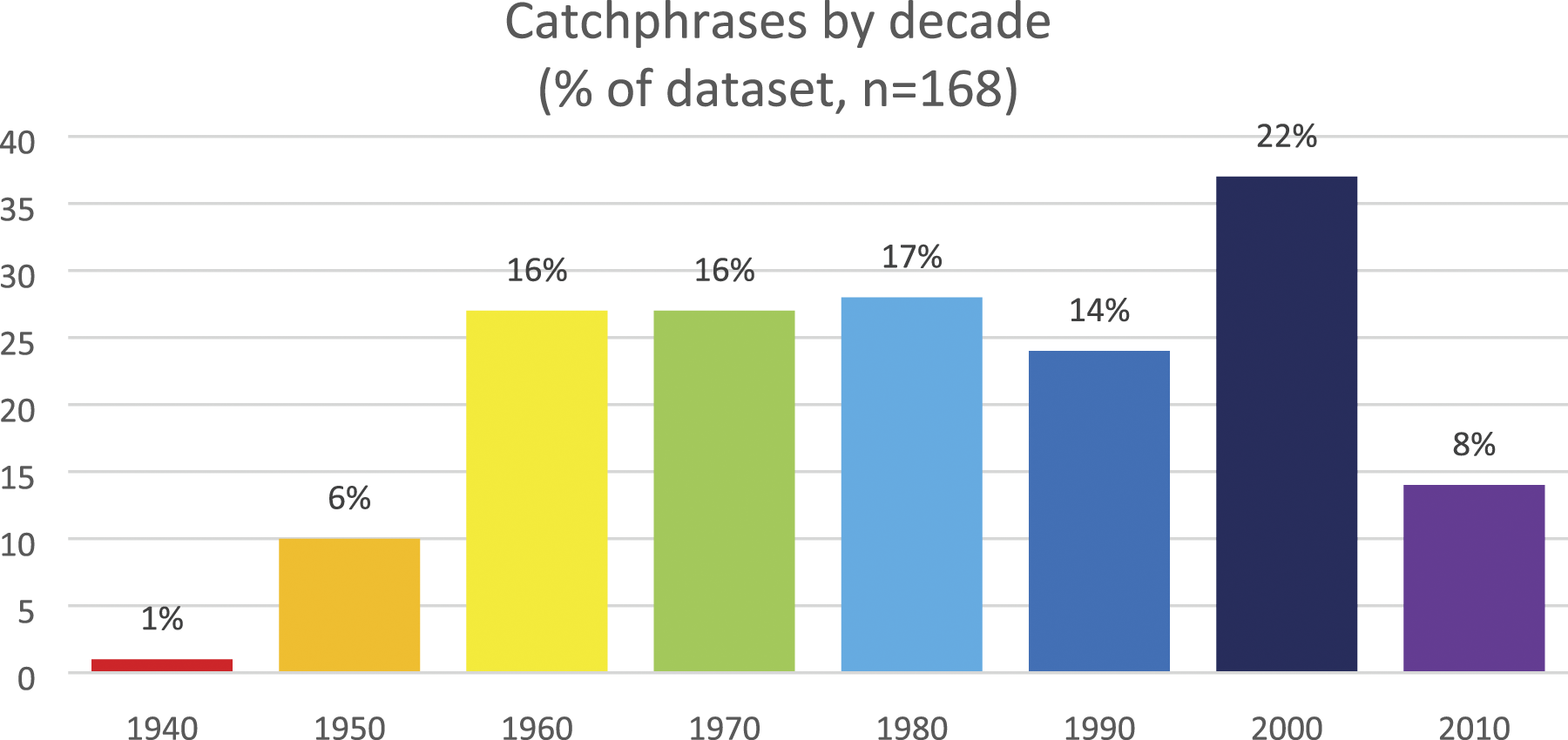
Figure 2 shows the distribution of catchphrases by original network. Not depicted in this table are the networks Bravo, Cartoon Network, Food Network, Logo TV and PBS, with one catchphrase each; Nickelodeon with two catchphrases; and Comedy Central, Netflix and MTV, with three catchphrases each. A total of seven catchphrases are from series that were distributed in syndication. Representing a collection of catchphrases that have emerged as popular, the database also reflects a shift in viewing patterns, such that more cable and streaming series are included as time goes by. In this aspect, we neither target nor exclude catchphrases according to network; while series on cable and streaming networks dominate the category of swearing catchphrases, traditional network television series are also represented. Across all networks, situation comedies are the most common type of programming represented in the database; a total of 116 catchphrases come from situation comedies, versus 29 from drama series and 23 from reality series or news programming. This distribution may reflect a greater acceptability of (pseudo-)swearing on television in humorous as opposed to serious contexts. Catchphrases by original network.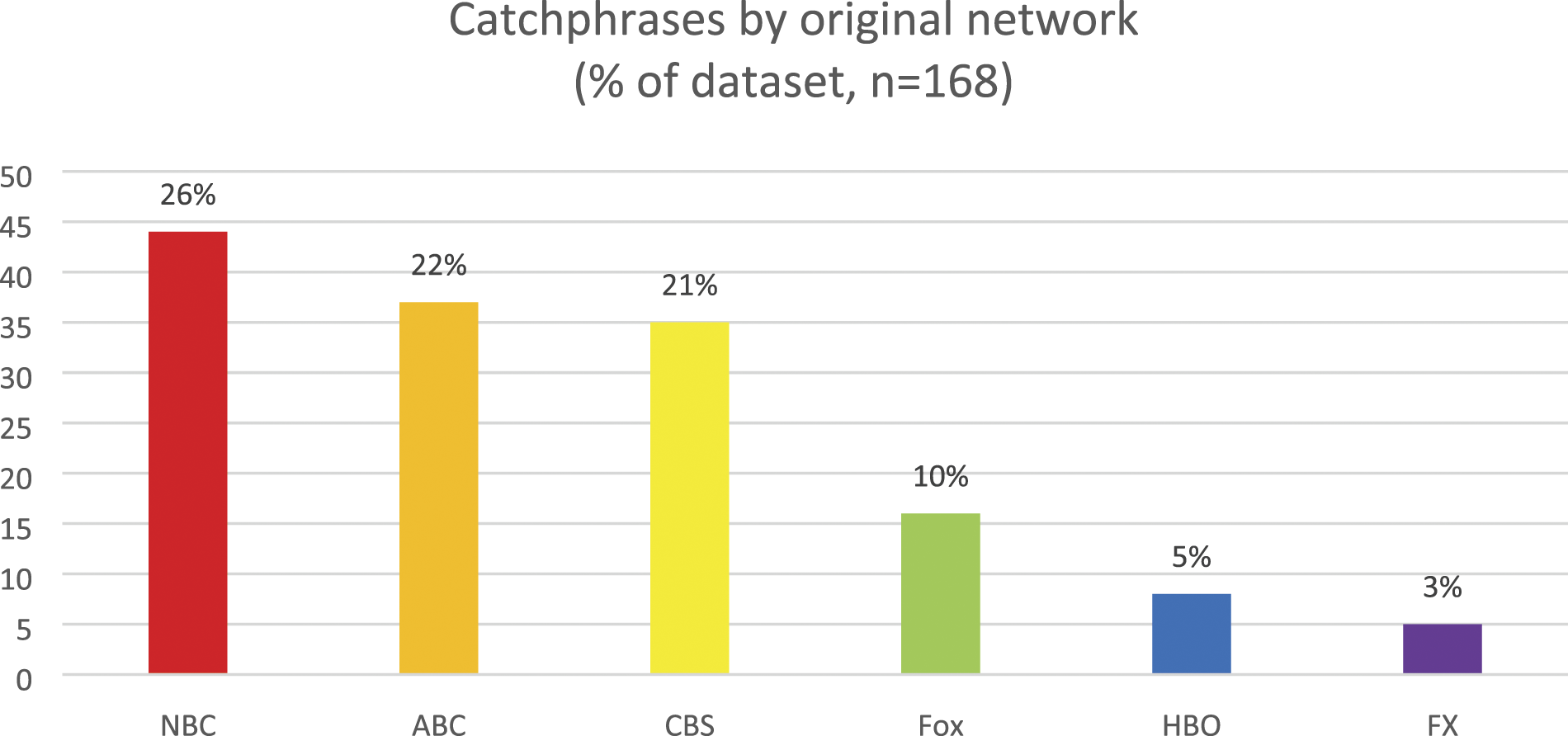
5. Catchphrase analysis
To substantiate our hypotheses about the potential of catchphrases for making swearing more palpable, we investigate (i) the association of catchphrases with expressivity/emotionality and (ii) the extent to which past catchphrases have performed the functions of swearing without the explicit use of swear words, in effect paving the way for the gradual implementation of swearing in television catchphrases.
To do so, we first categorised each catchphrase in our dataset according to sentence type, that is, declarative, imperative, interrogative and exclamative. Declarative and exclamative sentences differ in that the former relay information in a neutral manner, while the latter show strong emotion. This difference is usually conveyed via intonation and further encoded in punctuation, with declaratives conventionally ending in a period and exclamatives ending in an exclamation point. This analysis will provide first insights into whether catchphrases are associated with expressivity/emotionality, as claimed by Bednarek (2010). However, the main focus of our analysis is to apply frameworks developed for the functions of swearing and impoliteness to our catchphrase dataset. These frameworks focus on structural-functional properties rather than broad functional categories of swearing which have been described in the relevant literature on swearing.
McEnery’s “Categorisation of bad language” 2006: 32; original emphasis.
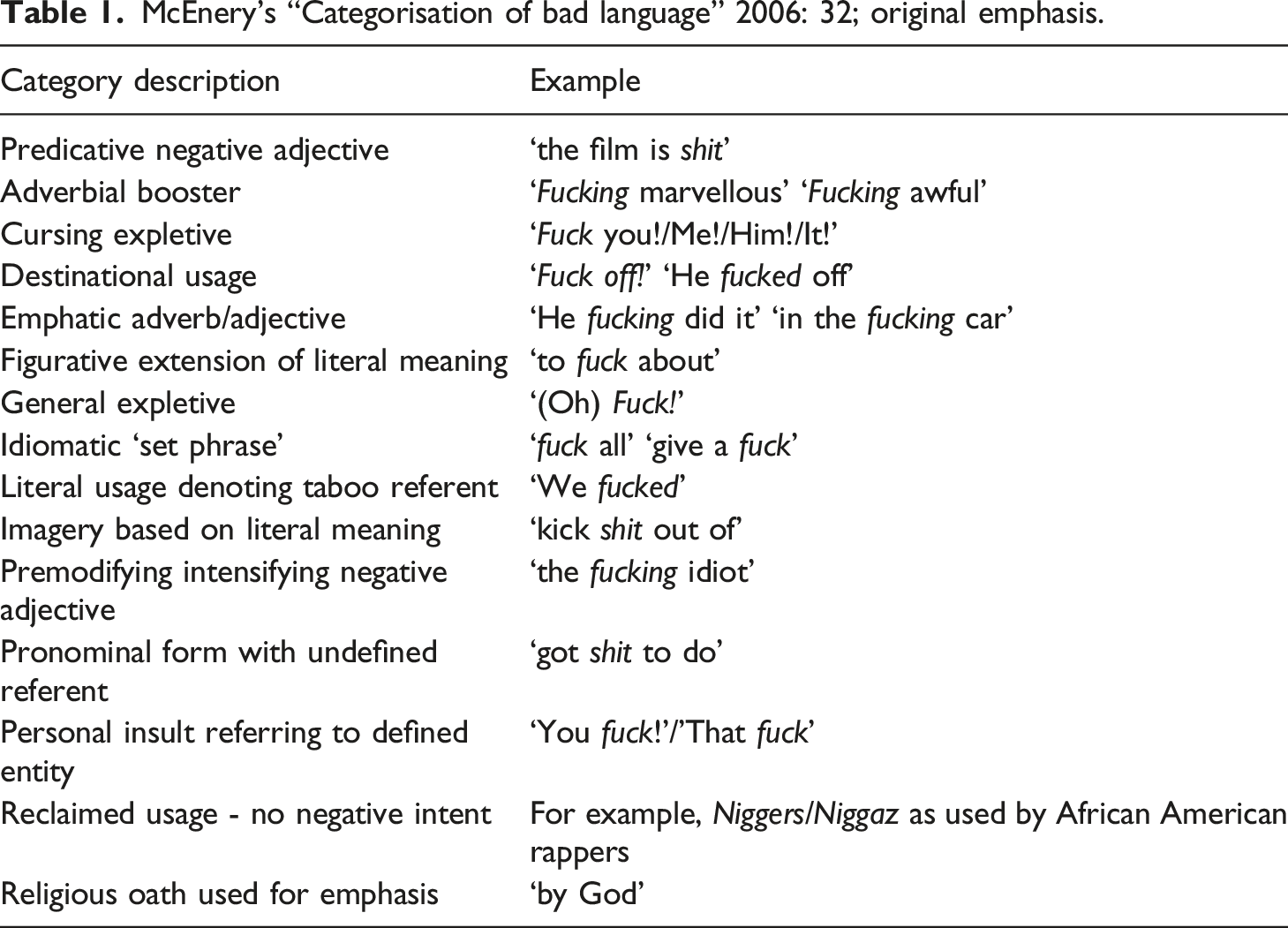
While McEnery provides prototypical examples, Culpeper (2011: 135–136) makes use of a template to itemise conventionalized and evidence-based impoliteness formulae. The impetus for using this impoliteness framework is the fact that Culpeper identified these formulae as reflecting expressions which showed a tendency to be experienced or challenged as impolite. The inclusion of swear words as in the formulae warrant their application to the catchphrase dataset. In the list below, bracketed words indicate structural characteristics and slashes separate example alternatives; the alternatives have been edited for brevity:
Insults
1. Personalised negative vocatives • [you] [fucking/etc.] [moron/ etc.] [you] 2. Personalised negative assertions • [you] [are] [so/such a] [shit/ugly/etc.] • [you] [can’t do] [anything right/etc.] • [you] [disgust me] / [make me] [sick/etc.] 3. Personalised negative references • [your] [stinking/little] [mouth/etc.] 4. Personalised third-person negative references (in the hearing of the target) • [the] [daft] [bimbo] • [she[ [’s] [nutzo]
Pointed criticisms/complaints
• [that/this/it] [is/was] [absolutely/etc.] [bad/crap/etc.]
Unpalatable questions and/or presuppositions
• why do you make my life impossible? • which lie are you telling me? • what’s gone wrong now? • you want to argue with me or you want to go to jail?
Condescensions (see also the use of ‘little’ in Insults)
• [that] [’s/is being] [babyish/childish/etc.]
Message enforcers
• – listen here (preface) • – you got [it/that]? (tag) • – do you understand [me]? (tag)
Dismissals
• [go] [away] • [get] [lost/out] • [fuck/piss/shove] [off]
Silencers
• [shut] [it] / [your] [stinking/fucking/etc.] [mouth/face/trap/etc.] • shut [the fuck] up
Threats
• [I’ll/I’m/we’re] [gonna] [beat the shit out of you/etc.] [if you don’t] [X] • [you’d better be ready ... to meet with me/do it] [or] [else] [I’ll] [X] • [X] [before I] [hit you/strangle you]
Negative expressives (e.g. curses, ill-wishes)
• [go] [to hell/fuck yourself] • [damn/fuck] [you]
(Culpeper 2011: 135–6).
While many television catchphrases are explicitly positive, for example, ‘You look mahvelous!’ (Fernando, Saturday Night Live, 1984–1985 2 ), others are neutral or ambiguous, for example, ‘The truth is out there.’ (Agent Mulder, The X Files, 1993–2002, Fox). Such catchphrases are not first and foremost those that function in ways similar to swearing expressions, even if some swearing expressions can be considered inoffensive or positive. Instead, we are interested in television catchphrases that align with the more prototypical expletive/exclamative structure and impoliteness function of swearing, as exemplified in McEnery’s categorisation and Culpeper’s formulae.
In our analysis, we first categorize the catchphrase dataset according to McEnery (2006). This initial categorisation allows us to identify to what extent the catchphrases have the structural-functional properties of swearing expressions, thereby excluding any irrelevant catchphrases from further analysis. We then consider which catchphrases among the resulting subset correspond to Culpeper’s impoliteness formulae. Crucially, we then trace this development over time, to test the claim of a gradual implementation of swearing in television catchphrases by examining lexis, that is, the explicit use of swear words, and gradability, that is, the comparative offensiveness/impoliteness of a word or expression.
6. Findings
6.1. Catchphrases by sentence type
Figure 3 shows the sentence type (i.e. declarative, imperative, interrogative and exclamative) of each catchphrase in the catchphrase dataset. Catchphrase by sentence type.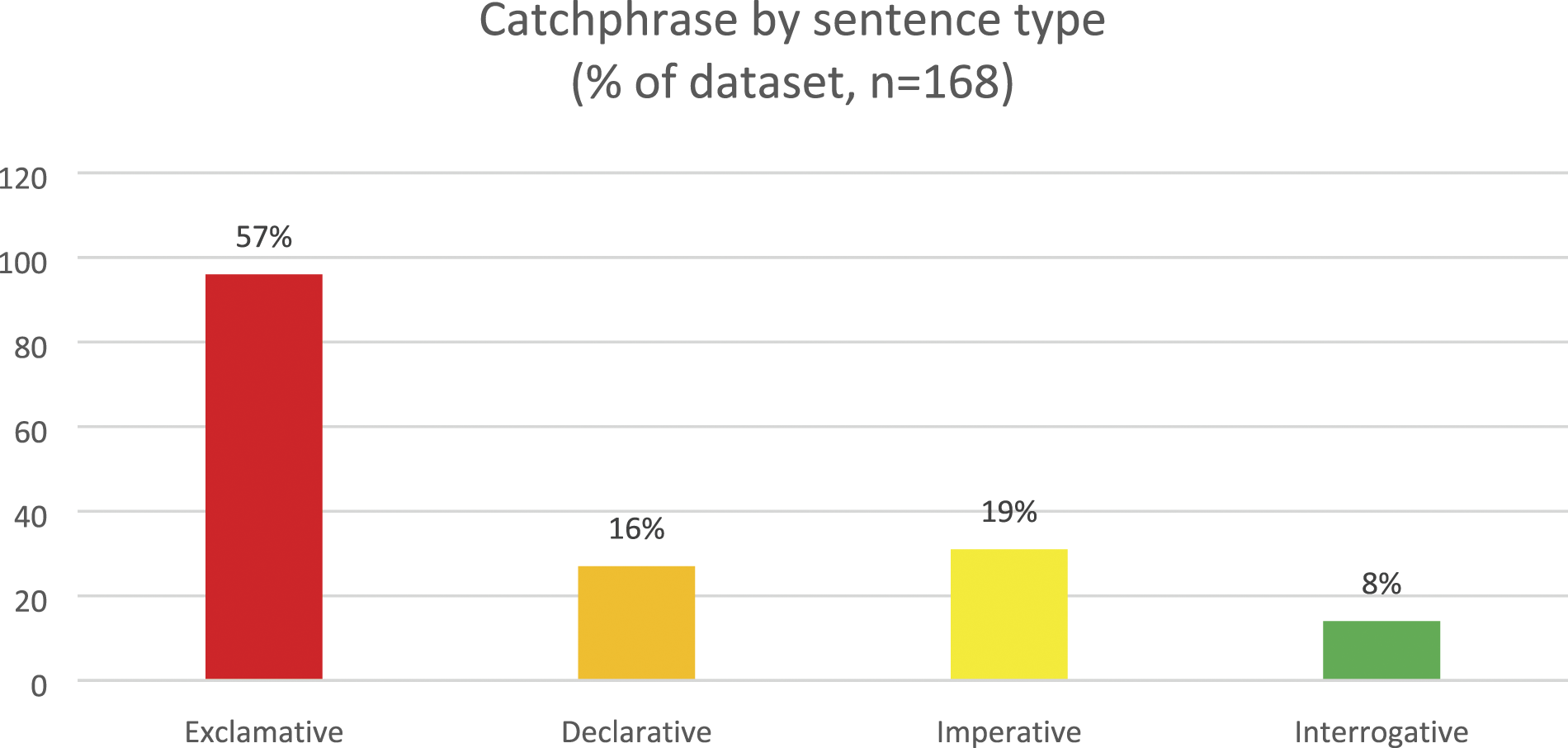
Declarative sentences account for 16% (n = 27) of the 168 catchphrases, for example, ‘I’m listening.’ (Frasier, Frasier, 1993–2004, NBC). Over half (57%, n = 96) of the catchphrases in the dataset are exclamatives, such as, ‘Dy-no-mite!’ (J.J., Good Times, 1974–1979, CBS). Exclamatives are predictable sentence types for catchphrases, as emotion renders them psychologically salient. However, in the dataset, there are even catchphrases of imperative (19%, n = 31) and interrogative (8%, n = 14) type which show emotion. Examples include, ‘Don’t have a cow, man!’ (Bart, The Simpsons, 1989–, Fox) and ‘Did I do that?’ (Urkel, Family Matters, 1989–1998, ABC). In total, emotive expressions comprise over 80% of the catchphrase dataset across three sentence types, which aligns with the suggestion that emotionality is a key defining feature of television dialogue (Bednarek 2012; 2018). These results also confirm Bednarek’s (2010: 137) hypothesis that emotional resources are often used in catchphrases. Since emotion is also a criterion of swearing expressions, it is, at this point, fruitful to move on from the basic formal properties of catchphrases to consider how their functional properties align with those of swearing expressions.
6.2. Results of the structural-functional analysis
As a first step, we excluded catchphrases that do not share the structural-functional properties of swearing expressions (see section 5). This resulted in an exclusion of 79 catchphrases (47% of 168), examples of which include, ‘Just one more thing...’ (Det. Columbo, Columbo, 1971–1978, NBC), ‘Baby, you’re the greatest! (Ralph Kramden, The Honeymooners, 1955–1956, CBS) and ‘How you doin’?’ (Joey, Friends, 1994–2004, NBC). Note that these catchphrases may nevertheless incorporate expressive/emotional resources, as evident from the analysis in section 6.1.
Of the remaining 89 (53% of 168) television catchphrases, a total of nineteen (11% of 168) were categorised as structurally and functionally similar to ‘general expletives’ (cf. McEnery’s (Oh) Fuck!), corresponding to emotive responses. Each of these catchphrases, however, represents a positive emotive response, such as ‘Dy-no-mite!’ (J.J., Good Times, 1974–1979, CBS), ‘Cowabunga!’ (Bart, The Simpsons, 1989–, Fox) or ‘Pop pop!’ (Magnitude, Community, 2009–2015, NBC). One additional catchphrase, ‘Sock it to me!’ (Goldie Hawn/Various, Rowan & Martin’s Laugh-In, 1967–1973, NBC), was also identified as representing a positive emotive response, but in the form of McEnery’s ‘idiomatic “set phrase”’. While none of these twenty catchphrases include explicit swear words, their expressivity and structural and functional similarity to expletives and idiomatic swearing can nevertheless be considered to prime the viewing audience for more explicit forms.
Number of pseudo-swearing catchphrases by bad language category.
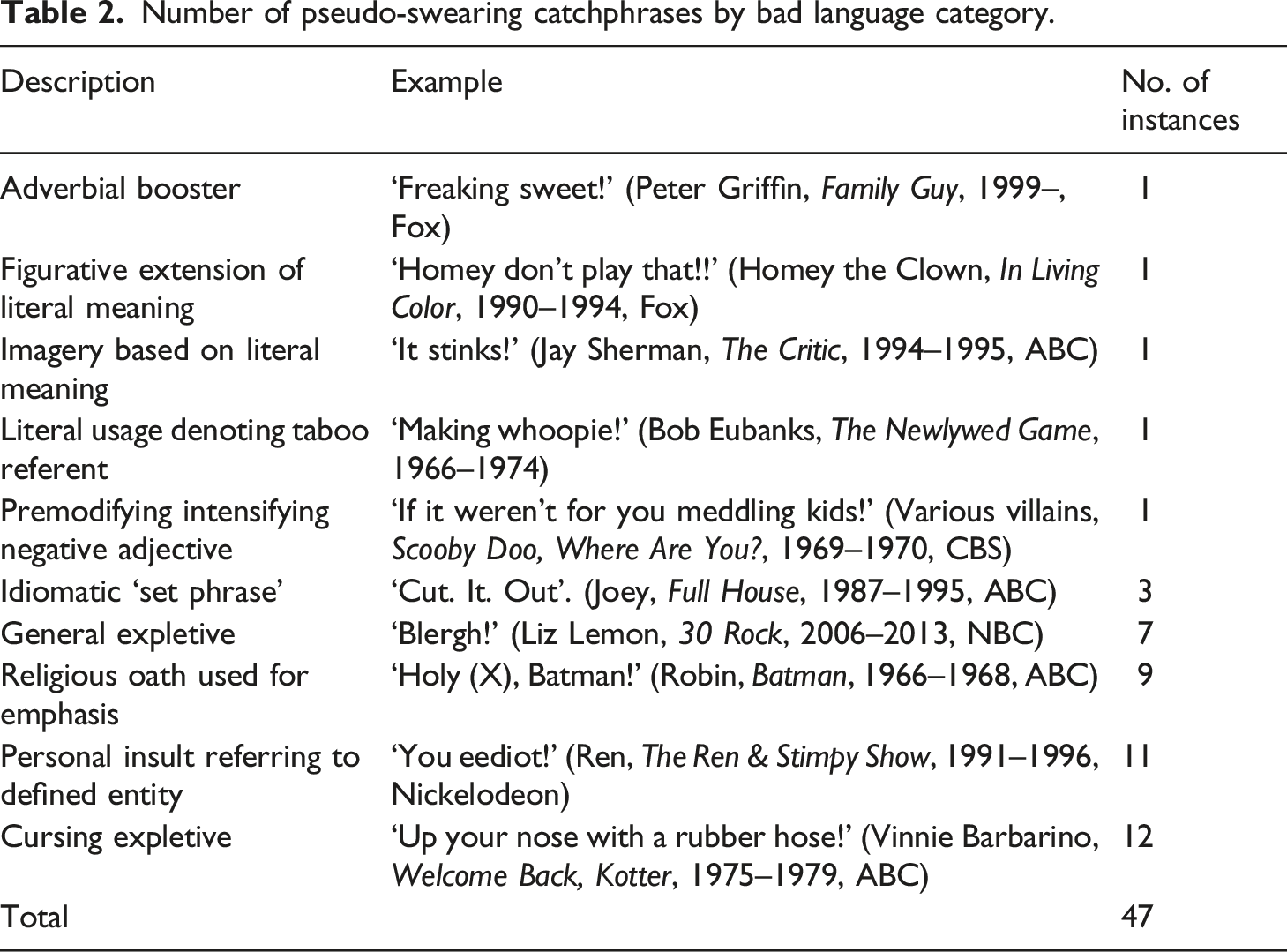
As they are not explicit swearing expressions, these 47 pseudo-swearing catchphrases do not correspond exactly to McEnery’s category examples. The structural and functional similarities, however, suggest that swearing is being evoked in the non-swearing locutions. Due to restrictions on swearing on television, the use of alternatives can be expected. In turn, viewers can also be expected to have a basic familiarity with the restrictions imposed upon television dialogue and thereby recognise the illocutionary force of pseudo-swearing, in particular such expletive- and cursing-like catchphrases as ‘Blergh!’ and ‘Kiss my grits!’
Number of swearing catchphrases by bad language category.
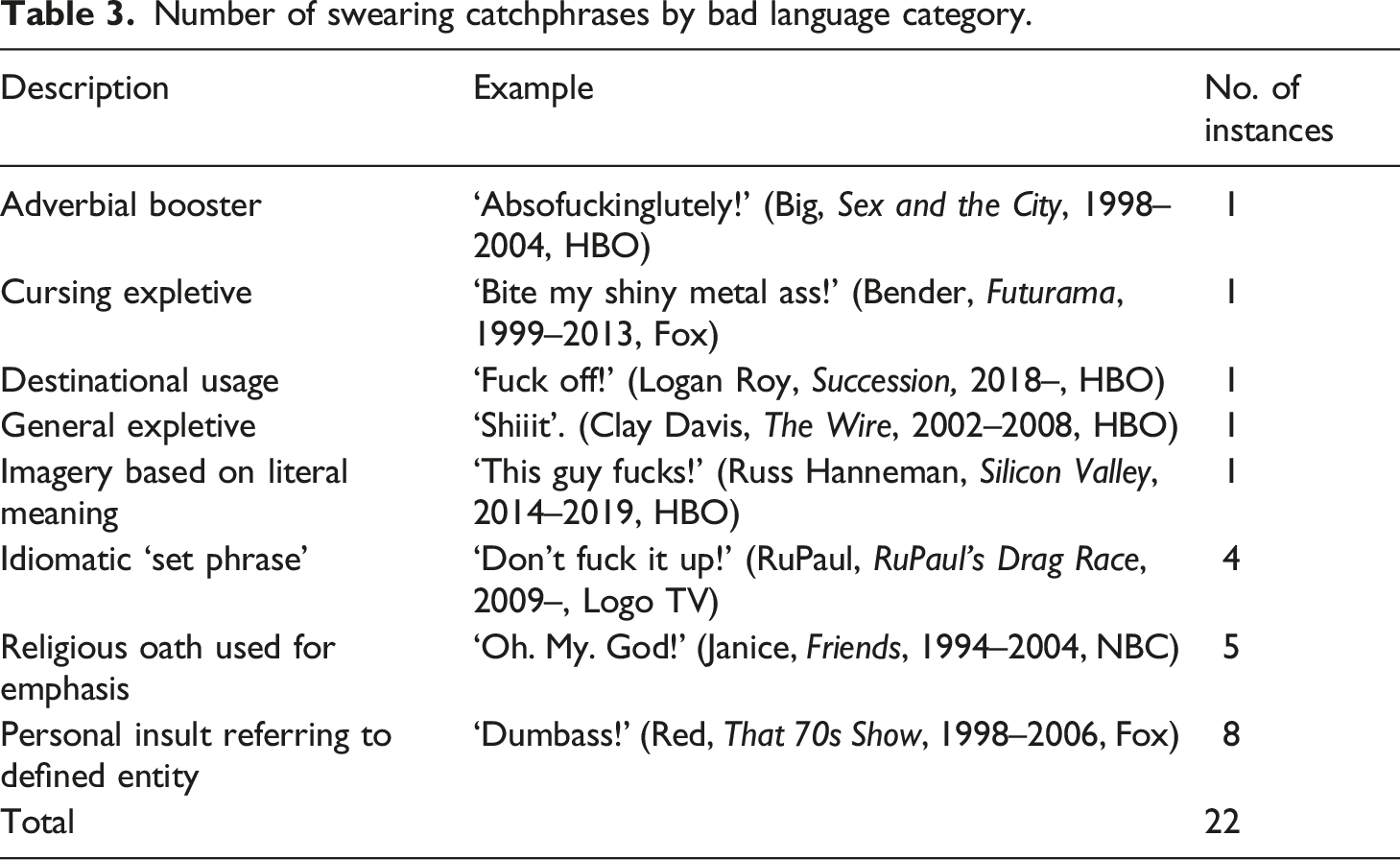
The structural-functional analysis thus reveals that over half (53%) of the catchphrases in the 168-item database show similarities to or direct correspondence with swearing expressions according to McEnery’s (2006) bad language categories. A small percentage of these 89 catchphrases (22%, n = 20) were identified as positive emotive responses, the majority of which (19) were exclamatives similar in structure and function to general expletives. These catchphrases can, thus, evoke the act of swearing. The status of this subset of catchphrases as positive emotive responses, however, excludes them from an analysis according to Culpeper’s impoliteness formulae, which instead can, in the next section, be applied to the pseudo-swearing and swearing catchphrase subsets.
6.3. Results of the impoliteness analysis
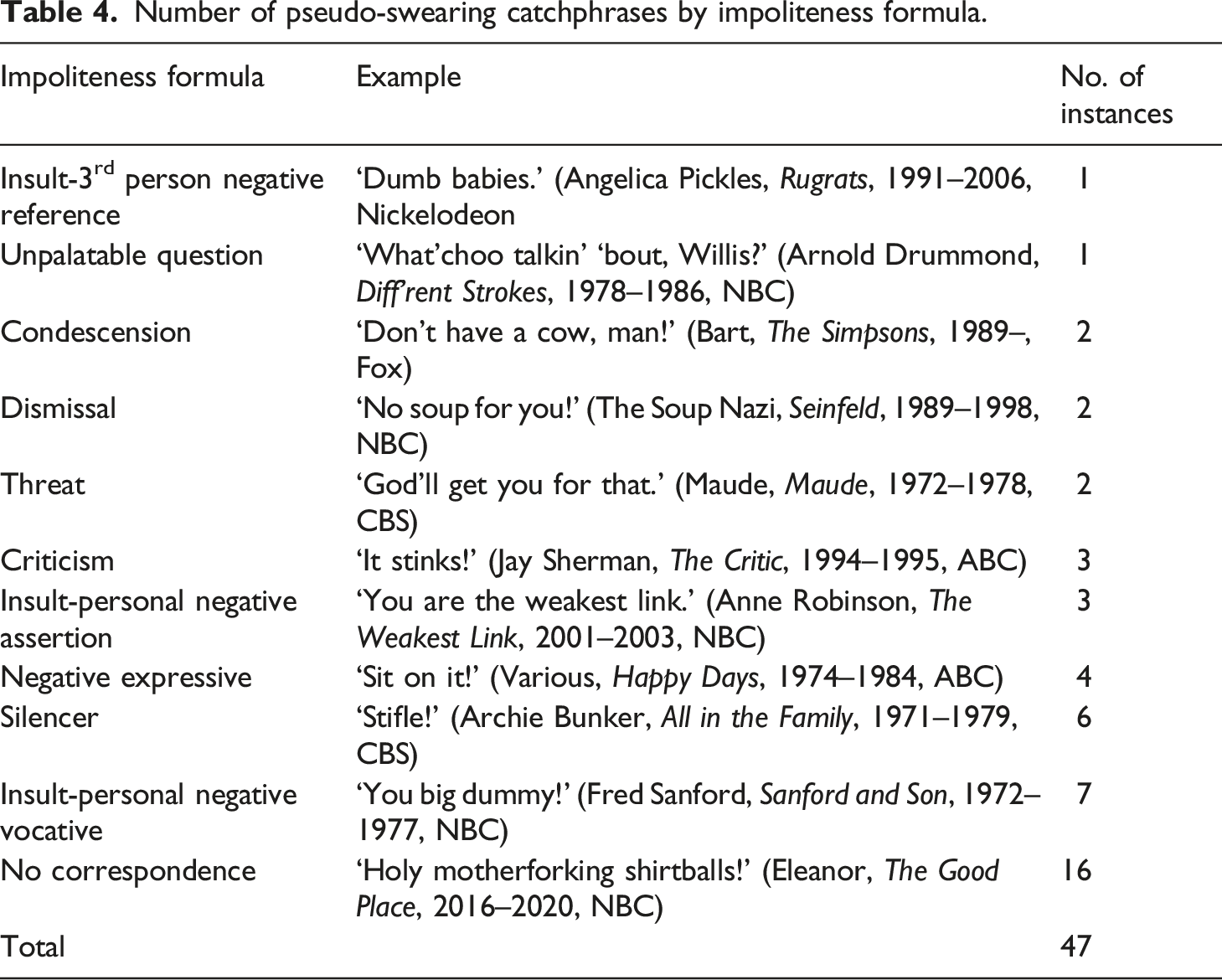
Number of pseudo-swearing catchphrases by impoliteness formula.
Number of swearing catchphrases by impoliteness formula.
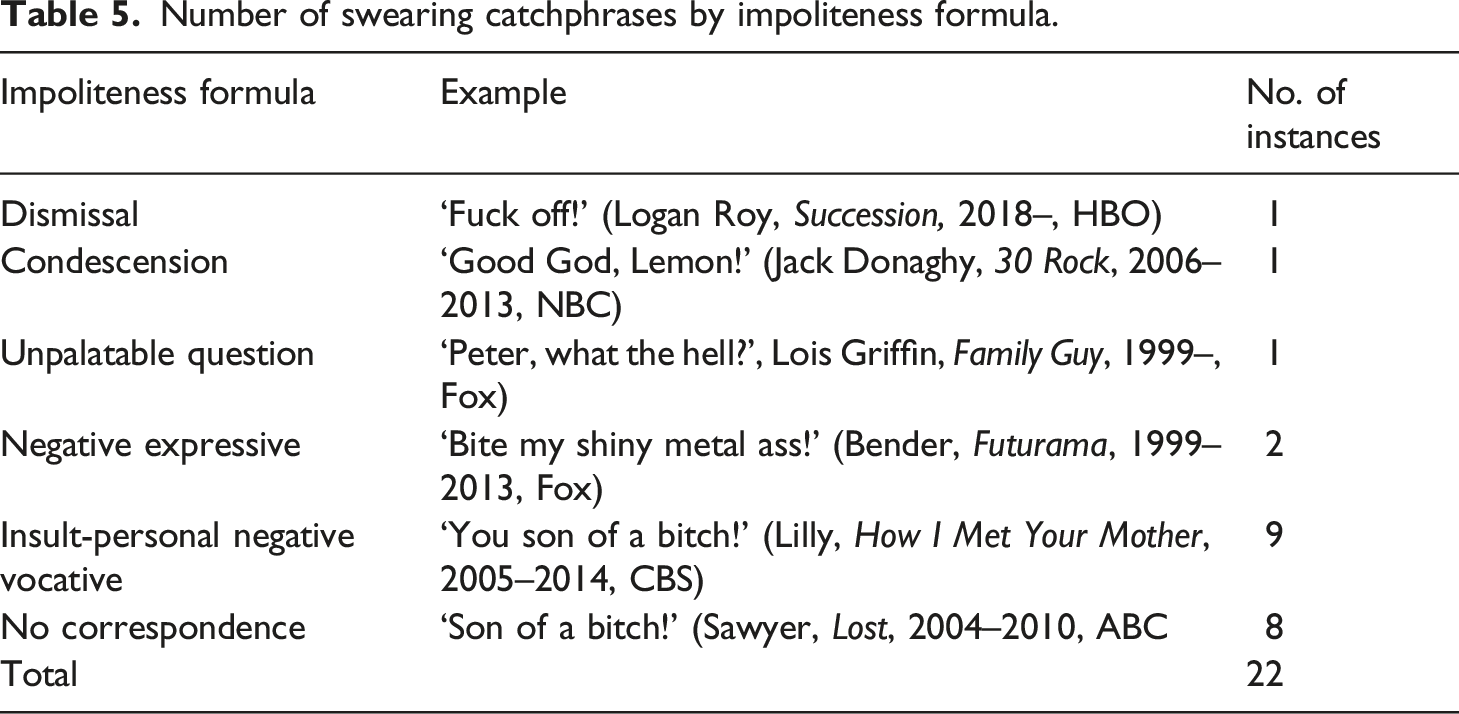
Excluding those that cannot be accounted for by the impoliteness formulae, the most common type of catchphrase is insult. An interesting difference to note between the two subsets, however, is that all eleven insults in the pseudo-swearing subset are genuinely negative emotive expressions, while three of the nine insults in the swearing catchphrase subset invoke the word ‘bitch(es)’ for the interpersonal function of displaying group identity and solidarity. Examples of such usage include ‘Hug it out, bitch!’ (Ari Gold, Entourage, 2004–2011, HBO) and ‘Wild card, bitches!’/‘What’s up, bitches?’ (Charlie and Mac, respectively, It’s Always Sunny in Philadelphia, 2005–, FX). In general, a greater percentage of the 47 pseudo-swearing catchphrases represent negative emotive responses (85%, n = 40) compared to 64% (n = 14) of the 22 swearing catchphrases. The pseudo-swearing catchphrases thus more consistently perform the prototypical functions of swearing expressions as negative emotive responses than the catchphrases that include explicit swearing. Among the catchphrases not corresponding to impoliteness formulae are a further eight pseudo-swearing (17%) and five swearing (23%) catchphrases that count as positive emotive responses, such as ‘Freaking sweet!’ (Peter Griffin, Family Guy, 1999–, Fox) or ‘Don’t fuck it up!’ (RuPaul, RuPaul’s Drag Race, 2009–, Logo TV), which serve the interpersonal functions of displaying identity and building solidarity, respectively. The catchphrase dataset suggests that pseudo-swearing catchphrases generally align with annoyance swearing (‘D’oh!’, ‘You eediot!’, ‘Good grief!’, ‘Holy crap!’, etc.), while swearing catchphrases comprise both annoyance and social swearing (‘Fuck off!’ and ‘Dumbass!’ vs ‘Absofuckinglutely!’ and ‘This guy fucks!’). The overall impression is that non-swearing catchphrases as generally positive emotive responses characterised by an exclamative structure have paved the way for pseudo-swearing catchphrases as negative emotive responses approximating general expletives and impoliteness formulae. These, in turn, have paved the way for swearing catchphrases. However, as swearing catchphrases comprise both negative and positive emotive responses, the explicitness of the swearing expression is mitigated. As this summary implies a linear development of catchphrases, the next section focuses on the 70-year period of the catchphrase dataset.
6.4. Catchphrases over time
As noted in section 3 above, swear word usage in television has changed significantly over time, which necessitates integrating a temporal dimension. In order to establish any development or progression among the four subsets of the television catchphrase dataset,
3
each subset was hence tracked over time. Figure 4 shows the number of catchphrases per subset for each of the eight decades represented. Catchphrase subset by decade.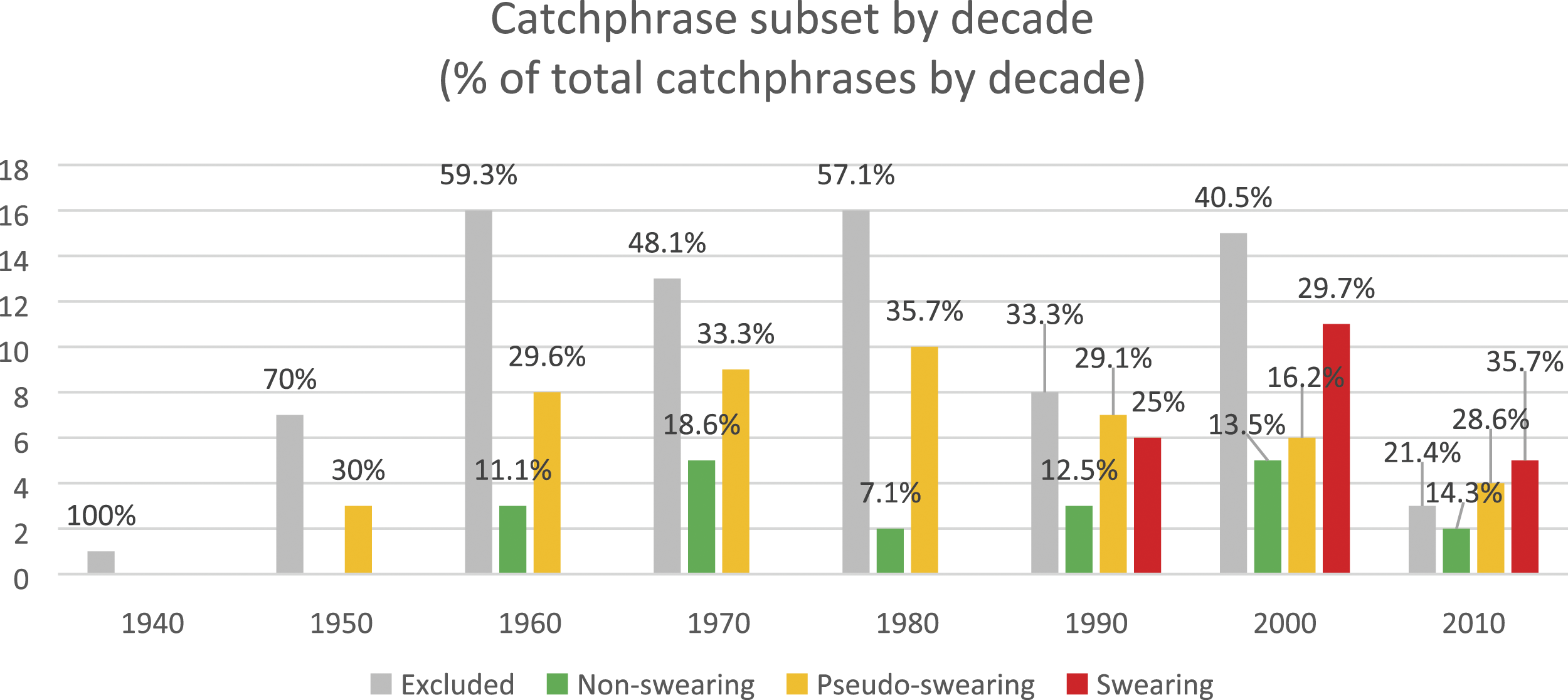
Figure 4 makes clear that the largest subset of catchphrases (n = 79), those that do not correspond to any of McEnery’s (2006) categories of bad language (e.g. ‘I’m listening.’), is the only catchphrase type to appear in all decades, with fairly consistent distribution, peaking every other decade. Of the remaining catchphrase subsets, the non-swearing catchphrases (n = 20; e.g. ‘Bazinga!’) appear in television series from the 1960s to the present, the pseudo-swearing catchphrases (n = 47; e.g. ‘Kiss my grits!’) appear from the 1950s to the present, while the swearing catchphrases (n = 22; e.g. ‘Bite my shiny metal ass!’) do not appear until the 1990s, also continuing to the present. Figure 4 reveals furthermore a steady increase in pseudo-swearing catchphrases until the 1980s, coinciding with the appearance of swearing catchphrases, which increase over two decades, while pseudo-swearing catchphrases gradually decrease from 1990 until the present time, aligning with Kaye and Sapolsky’s (2009) observed shift (see section 3). These trends also align with the above-mentioned industry shift in viewing patterns reflected in the increased presence of cable/streaming series in the database (see section 4).
The general decrease in the 2010s for all subsets should be considered a reflection of the lack of available catchphrase data as opposed to pointing to an overall trend. However, the advent of streaming services and an abundance of television programming may contribute to a dispersion of viewing patterns, such that it is difficult for specific catchphrases to attract widespread attention. Our findings thus appear to be in line with Richardson’s (2010) hypothesis that ‘the catchphrases of the future are less likely to achieve the distribution that those of the past were able to do, as the proliferation of TV channels and, arguably, the drift away from television as the domestic entertainment medium of first choice continues to fracture national audiences’ (2010: 101). It may also be the case that catchphrases need more time to enter the collective consciousness and populate curated lists, such as those used for this study’s data collection. In any case, our findings provide an empirical baseline that can now potentially be tested in future studies of other catchphrase datasets.
7. Discussion
In this paper, we have investigated the evolution of catchphrase swearing on US-American television programming by considering 168 popular television catchphrases over a 70-year period. We have found that over half of these catchphrases show a range of structural and functional similarities to swearing expressions and impoliteness formulae, such that exclamative, non-swearing catchphrases reflecting positive emotive responses have stably co-existed with and effectually provided contrast to pseudo-swearing catchphrases, dominated by negative emotive response-type. Pseudo-swearing catchphrases appeared in the 1950s and steadily increased to the 1980s, when explicit swearing catchphrases appeared and have increased, while pseudo-swearing catchphrases have decreased. In contrast to pseudo-swearing catchphrases, a greater percentage of swearing catchphrases comprise positive emotive responses. A lack of data for the 2010s prevents clear observation of continued trends.
In the introduction to their listing of the top ten television catchphrases of the 1970s, the Click Americana website states, ‘Whether we’re doing it for a laugh, to share a bond, or to cement our status as being in-the-know, Americans love a good catchphrase’. The implication of this statement is that American viewers not only recognise television catchphrases, they show their appreciation by subsequent appropriation, which in turn is appreciated as shared background knowledge. To understand and use catchphrases means to ‘belong to the cultural community’ (Richardson 2010: 1010). The fact that catchphrases can be invoked ‘for a laugh, to share a bond, or to cement our status as being in-the-know’ not only speaks to their multifunctionality in interpersonal interaction, but also suggests a transformative process. Catchphrases are not first and foremost invoked for their propositional content, but rather for their status as catchphrases and the cultural clout that they award those who invoke them and those who recognise them. In other words, the catchphrase is greater than the sum of its parts, ‘providing a mutually recognisable cultural shorthand for larger ideas, concepts, characters, and stereotypes’ (Darlington 2014: 123).
While we have not investigated the phenomenon of catchphrase appropriation and propagation in this paper, we can reasonably assume that television catchphrases are indeed appropriated as the Click Americana quote suggests, and by virtue of their being recognised as ‘popular’ or ‘best’ in curated lists. Additional support for this assumption comes from Harris et al. (2008), who found reported appropriation among 100% of their participants in a study of movie quoting, and from Bednarek (2017), who includes examples of the use of catchphrases on fan T-shirts and as hashtags on Twitter. While some may suspect that, due to social taboo, swearing catchphrases would resist appropriation, we propose instead that the catchphrase format makes swearing all the more palatable and mitigating: when appropriating a swearing catchphrase, the act of invoking a popular cultural reference eclipses the act of swearing. The use of swear words in television catchphrases and the subsequent appropriation of these thus increases tolerance and acceptability which, in turn, could lead to more swearing both on and off television.
The language of television series can both influence and be influenced by linguistic trends. It is important to point out that we are not claiming to have shown that swearing catchphrases have resulted in increased swearing in the ‘real’ world, nor do we have evidence that ‘real’ world swearing has led to more swearing catchphrases. What we have demonstrated, however, is the way in which catchphrases have evolved over time with respect to both pseudo-swearing and (explicit) swearing. In addition, our argument is that catchphrases have several properties which, together, may facilitate the spread of swearing: (i) catchphrases are highly salient due to their repetition, (ii) catchphrases tend to be appropriated by audiences and to become widespread, (iii) pseudo-swearing catchphrases have similarities with swearing catchphrases, (iv) the use of catchphrases has a community-creating function which may counter qualms about swearing and (v) the use of catchphrases can be considered as ‘mentioning’ rather than using swearing, thus blurring the use-mention distinction. All of these features make it likely that the evolving use of swearing and pseudo-swearing catchphrases may not only reflect changing industry norms, but also facilitate swearing as a pop-cultural phenomenon.
A recent development in television that supports our proposal is the growing number of television series titles with swear words. Articles such as, ‘What’s behind naughty TV titles?’ (Thompson, 2012), ‘Why are there so many swears in titles now?’, and ‘A definitive guide to the worst tv show titles in recent history’ (Cosman 2014) deride the use of swear words in titles as a marketing ploy, even criticizing such shows such as Don’t Trust the B---- in Apartment 23 (2012–2013, ABC), Good Christian Bitches (2012, ABC) and $#*! My Dad Says (2010–2011, CB) not for including swear words in principle, but for including a swear word that will need to be censored or abbreviated, which then makes it either difficult to pronounce the title or encourages the explicit use of the swear word, prompting calls for boycotts (Heussner 2010). A similar example is the Canadian series Schitt’s Creek (2015–2020, CBC). Reviewing the series for NPR’s Fresh Air, David Bianculli said the following: The name of the town also is the name of this TV series, and there’s a reason the deed to the town was bought as a joke. It’s a joke I can’t say on the radio, but the second word is creek. The first is spelled S-C-H-I-T-T-apostrophe-S and rhymes with spits. From now on, I’ll just call it ‘Creek’. (Bianculli 2015: n.p.)
Swearing catchphrases package swear words in such a way that mitigates acts of swearing, a strategy evident in the titles of such series as those listed above as well as the recent releases The End of the F***ing World (2017–, UK Channel 4) and Kevin Can F**k Himself (2021–, AMC). Additional series currently in development include, Fuck! I’m In My Twenties (NBC); How The Fuck Am I Normal (ABC), Dumb Fuck (ABC) and Grow The Fuck Up (NBC). 4 These latter titles are conspicuously catchphrase-like in structure and evidently function as emotive responses, suggesting that swearing catchphrases are indeed catching on. Further research would ideally investigate this development and attitudes towards swearing whether used in catchphrases, in the titles of television series, or more generally invoked for popular cultural references.
Footnotes
Declaration of conflicting interests
The author(s) declared no potential conflicts of interest with respect to the research, authorship, and/or publication of this article.
Funding
The author(s) received no financial support for the research, authorship, and/or publication of this article.
Notes
Author biographies
 ) and tweets @corpusling.
Appendix 1. List of catchphrase websites
https://en.wikipedia.org/wiki/List_of_catchphrases#In_American_television
https://www.seattletimes.com/entertainment/tv-land-lists-the-100-greatest-television-catchphrases/
https://www.tvguide.com/news/tvs-60-greatest-catchphrases-1070102/
https://clickamericana.com/media/television-shows/10-top-tv-catchphrases-of-the-60s
https://clickamericana.com/media/television-shows/10-top-tv-catchphrases-of-the-70s
https://clickamericana.com/media/television-shows/10-top-tv-catchphrases-of-the-80s
https://www.eonline.com/news/801701/the-26-best-90s-tv-catchphrases-ranked
Appendix 2. The television catchphrase dataset
Non-swearing catchphrases
Bad language category
Impoliteness formula
1. Yabba dabba do!
Fred Flintstone, The Flintstones
1960–1966
ABC
General expletive
N/A
2. Surprise, surprise, surprise!
Gomer Pyle, The Andy Griffith Show
1960–1968
CBS
General expletive
N/A
3. Sock it to me!
Various, Rowan & Martin’s Laugh-In
1967–1973
NBC
Idiomatic set phrase
N/A
4. Hey hey hey!
Fat Albert, Fat Albert
1972–1985
CBS
General expletive
N/A
5. Aaay!
Fonzie, Happy Days
1974–1984
ABC
General expletive
N/A
6. Dyn-o-mite!
J.J., Good Times
1974–1979
CBS
General expletive
N/A
7. Schwing!
Wayne and Garth, Saturday Night Live
1975–
NBC
General expletive
N/A
8. Hey hey hey!
Dwayne Nelson, What’s Happening!!
1976–1979
ABC
General expletive
N/A
9. Cowabunga!
Bart, The Simpsons
1989–
Fox
General expletive
N/A
10. Excellent!
Mr. Burns, The Simpsons
1989–
Fox
General expletive
N/A
11. Whoa!
Joey, Blossom
1990–1995
NBC
General expletive
N/A
12. Hey now!
Hank Kingsley, The Larry Sanders Show
1992–1998
HBO
General expletive
N/A
13. Bam!
Emeril Lagasse, Emeril Live
1997–1007
Food Network
General expletive
N/A
14. Dude!
Hurley, Lost
2004–2010
ABC
General expletive
N/A
15. Legendary!
Barney, How I Met Your Mother
2005–2014
CBS
General expletive
N/A
16. Bazinga!
Sheldon, The Big Bang Theory
2007–2019
CBS
General expletive
N/A
17. Cool, cool, cool!
Abed, Community
2009–2015
NBC
General expletive
N/A
18. Pop, pop!
Magnitude, Community
2009–2015
NBC
General expletive
N/A
19. A-mah-zing!
Penny, Happy Endings
2011–2013
ABC
General expletive
N/A
20. Wubba lubba dub dub!
Rick, Rick & Morty
2013–
Cartoon Network
General expletive
N/A
Pseudo-swearing catchphrases
Bad language category
Impoliteness formula
21. Now cut that out!
Jack Benny, The Jack Benny Program
1950–1965
NBC
Cursing expletive
Silencer
22. Bang, zoom, straight to the moon!
Ralph Kramden, The Honeymooners
1955–1956
CBS
Cursing expletive
Threat
23. Gee, Mrs. Cleaver...
Eddie Haskell, Leave it to Beaver
1957–1963
ABC
Religious oath
Condescension
24. Nip it!
Barney Fife, The Andy Griffith Show
1960–1968
CBS
Cursing expletive
Silencer
25. Ruh-roh!
Astro, The Jetsons
1962–1963
ABC
General expletive
N/A
26. Good grief!
Charlie Brown, Peanuts specials
1965–2011
CBS
Religious oath
N/A
27. Makin’ whoopie
Bob Eubanks, The Newlywed Game
1966–1974
ABC
Literal usage
N/A
28. Holy (X), Batman!
Robin, Batman
1966–1968
ABC
Religious oath
N/A
29. If it weren’t for you meddling kids!
Various, Scooby Doo, Where Are You?
1969–1970
CBS
Premodifying negative adj
Insult (PNV)
30. Oh my nose!
Marcia Brady, The Brady Bunch
1969–1974
ABC
General expletive
N/A
31. Ruh-roh!
Scooby-Doo, Scooby Doo, Where Are You?
1969–1970
CBS
General expletive
N/A
32. Stifle!
Archie Bunker, All in the Family
1971–1979
CBS
Cursing expletive
Silencer
33. You big dummy!
Fred Sanford, Sanford and Son
1972–1977
NBC
Personal insult
Insult (PNV)
34. God’ll get you for that.
Maude Findlay, Maude
1972–1978
CBS
Religious oath
Threat
35. Sit on it!
Various, Happy Days
1974–1984
ABC
Cursing expletive
Negative expressive
36. Up your nose with a rubber hose!
Vinnie Barbarino, Welcome Back, Kotter
1975–1979
ABC
Cursing expletive
Negative expressive
37. Jane, you ignorant slut.
Dan Aykroyd, Saturday Night Live
1975–
NBC
Personal insult
Insult (PNV)
38. Kiss my grits!
Flo, Alice
1976–1985
CBS
Cursing expletive
Negative expressive
39. Oh nooooo!
Mr. Bill, Saturday Night Live
1976–1982
NBC
General expletive
N/A
40. What’choo talkin’ ’bout, Willis?
Arnold Drummond, Diff’rent Strokes
1978–1986
NBC
Idiomatic set phrase
Unpalatable questions
41. How rude!
Stephanie, Full House
1987–1995
ABC
General expletive
Criticism
42. Cut. It. Out.
Joey, Full House
1987–1995
ABC
Idiom
Silencer
43. Have mercy!
Jesse, Full House
1987–1995
ABC
Religious oath
N/A
44. Oh mylanta!
Various, Full House
1987–1995
ABC
Religious oath
N/A
45. Don’t have a cow, man!
Bart, The Simpsons
1989–
Fox
Cursing expletive
Condescension
46. Eat my shorts!
Bart, The Simpsons
1989–
Fox
Cursing expletive
Negative expressive
47. Why you little…!
Homer, The Simpsons
1989–
Fox
Personal insult
Insult (PNV)
48. D’oh!
Homer, The Simpsons
1989–
Fox
General expletive
N/A
49. No soup for you!
The Soup Nazi, Seinfeld
1989–1998
NBC
Cursing expletive
Dismissal
50. Hello, Newman!
Jerry, Seinfeld
1989–1998
NBC
Personal insult
Insult (PNV)
51. Homey don’t play that!
Homey the Clown, In Living Color
1990–1994
Fox
Figurative extension
Criticism
52. Dumb babies!
Angelica Pickels, Rugrats
1991–2006
Nickelodeon
Personal insult
Insult (P3P)
53. You eediot!
Ren, Ren & Stimpy
1991–1996
Nickelodeon
Personal insult
Insult (PNV)
54. It stinks!
Jay Sherman, The Critic
1994–1995
ABC
Imagery
Criticism
55. Holy crap!
Frank Barone, Everybody Loves Raymond
1996–2005
CBS
Religious oath
N/A
56. Freaking sweet!
Peter Griffin, Family Guy
1999–
Fox
Adverbial booster
N/A
57. What the deuce?
Stewie, Family Guy
1999–
Fox
Idiomatic set phrase
N/A
58. You are the weakest link.
Anne Robinson, The Weakest Link
2001–2003
NBC
Personal insult
Insult (PNA)
59. You’re fired!
Donald Trump, The Apprentice
2004–2017
ABC
Personal insult
Dismissal
60. Later boners.
Dee, It’s Always Sunny in Philadelphia
2005–
FX
Personal insult
Insult (PNV)
61. Shut it down!
Liz Lemon, 30 Rock
2006–2013
NBC
Cursing expletive
Silencer
62. Blergh!
Liz Lemon, 30 Rock
2006–2013
NBC
General expletive
N/A
63. Shut up, Leonard!
Various, Community
2009–2015
NBC
Cursing expletive
Silencer
64. You know nothing, Jon Snow.
Yvette, Game of Thrones
2011–2019
HBO
Personal insult
Insult (PNA)
65. Ya basic!
Eleanor, The Good Place
2016–2020
NBC
Personal insult
Insult (PNA)
66. Holy motherforking shirtballs!
Eleanor, The Good Place
2016–2020
NBC
Religious oath
N/A
67. Holy chalupas!
Max, Fuller House
2016–2020
Netflix
Religious oath
N/A
Swearing catchphrases
Bad language category
Impoliteness formula
68. Oh. My. God!
Janice, Friends
1994–2004
NBC
Religious oath
N/A
69. Oh, my God! They killed Kenny! You bastards!
Stan and Kyle, South Park
1997–
Comedy Central
Religious oath/Personal insult
Insult (PNV)
70. Dumbass!
Red, That 70s Show
1998–2006
Fox
Personal insult
Insult (PNV)
71. Absofuckinglutely!
Big, Sex and the City
1998–2004
HBO
Adverbial booster
N/A
72. Bite my shiny metal ass!
Bender, Futurama
1999–2013
Fox
Cursing expletive
Negative expressive
73. Peter, what the hell?
Lois, Family Guy
1999–
Fox
Idiomatic set phrase
Unpalatable questions
74. Shiiit.
Clay Davis, The Wire
2002–2008
HBO
General expletive
N/A
75. I’m Rick James, bitch!
Dave Chappelle as Rick James, Chappelle’s Show
2003–2006
Comedy Central
Personal insult
Insult (PNV)
76. Hug it out, bitch!
Ari Gold, Entourage
2004–2011
HBO
Personal insult
Insult (PNV)
77. Son of a bitch!
Sawyer, Lost
2004–2010
ABC
Idiomatic set phrase
N/A
78. You son of a bitch!
Lilly, How I Met Your Mother
2005–2014
CBS
Personal insult
Insult (PNV)
79. Wild card, bitches!
Charlie, It’s Always Sunny in Philadelphia
2005–
FX
Personal insult
Insult (PNV)
80. What’s up, bitches?
Mac, It’s Always Sunny in Philadelphia
2005–
FX
Personal insult
Insult (PNV)
81. Goddamnit!
Various, It’s Always Sunny in Philadelphia
2005–
FX
Religious oath
N/A
82. Good God, Lemon!
Jack, 30 Rock
2006–2013
NBC
Religious oath
Condescension
83. Yo, bitch!
Jesse, Breaking Bad
2008–2013
AMC
Personal insult
Insult (PNV)
84. Don’t fuck it up!
RuPaul, RuPaul’s Drag Race
2009–
Logo
Idiomatic set phrase
Negative expressive
85. Suck a dick, dumbshit!
Various, Bo Jack Horseman
2014–2020
Netflix
Personal insult
Insult (PNV)
86. This guy fucks!
Russ Hanneman, Silicon Valley
2014–2019
HBO
Imagery
N/A
87. Black Jesus!
Ruby, Black-ish
2014–2021
ABC
Religious oath
N/A
88. Females are strong as hell!
Bystander, Kimmie Schmidt
2015–2019
Netflix
Idiomatic set phrase
N/A
89. Fuck off!
Logan Roy/Various, Succession
2018–
HBO
Destinational
Dismissal
Excluded catchphrases (not corresponding to McEnery’s categories for bad language)
90. We’ve got a really big show!
Ed Sullivan, The Ed Sullivan Show
1948–1971
CBS
N/A
N/A
91. Say good night, Gracie!
George Burns, The Burns & Allen Show
1950–1958
CBS
N/A
N/A
92. This is the city ..!
Sgt. Joe Friday, Dragnet
1951–1959
NBC
N/A
N/A
93. Lucy, you got some splaining to do!
Ricky, I Love Lucy
1951–1957
CBS
N/A
N/A
94. Good night, and good luck!
Edward R. Murrow, See It Now
1951–1958
CBS
N/A
N/A
95. Look! Up in the sky! It’s a bird! It’s a plane! It’s Superman!
Various, Adventures of Superman
1952–1958
Syndication
N/A
N/A
96. How sweet it is!
Jackie Gleason, The Jackie Gleason Show
1952–1957
CBS
N/A
N/A
97. Baby, you’re the greatest!
Ralph Kramden, The Honeymooners
1955–1956
CBS
N/A
N/A
98. Smile, you’re on Candid Camera!
Various, Candid Camera
1960–1975
ABC
N/A
N/A
99. What’s up, doc!
Bugs Bunny, The Bugs Bunny Show
1960–1975
ABC
N/A
N/A
100. The thrill of victory, and the agony of defeat!
Jim McKay, Wide World of Sports
1961–1998
ABC
N/A
N/A
101. And thatss the way it is!
Walter Cronkite, CBS Evening News
1962–1981
CBS
N/A
N/A
102. Here’s Johnny!
Ed McMahon, The Tonight Show
1962–1992
NBC
N/A
N/A
103. You rang!
Lurch, The Addams Family
1964–1966
ABC
N/A
N/A
104. Danger, Will Robinson!
Robot, Lost in Space
1965–1968
CBS
N/A
N/A
105. I know nothing!
Sgt. Schultz, Hogan’s Heroes
1965–1971
CBS
N/A
N/A
106. Would you believe!
Maxwell Smart, Get Smart
1965–1970
NBC
N/A
N/A
107. This tape will self-destruct in five seconds!
Male voice; Mission: Impossible
1966–1973
CBS
N/A
N/A
108. Space, the final frontier…
Captain Kirk, Star Trek
1966–1969
Syndication
N/A
N/A
109. Live long and prosper!
Spock, Star Trek
1966–1969
NBC
N/A
N/A
110. To the Batmobile!
Batman, Batman
1966–1968
ABC
N/A
N/A
111. Mom always liked you best!
Tommy Smothers, The Smothers Brothers Comedy Hour
1967–1969
CBS
N/A
N/A
112. Book ‘em, Danno!
Steve McGarrett, Hawaii Five-O
1968–1980
CBS
N/A
N/A
113. Won’t you be my neighbor?
Mr. Rogers, Mr. Rogers’ Neighborhood
1968–2001
PBS
N/A
N/A
114. What you see is what you get!
Geraldine, The Flip Wilson Show
1970–1974
NBC
N/A
N/A
115. Never assume ..!
Felix Unger, The Odd Couple
1970–1975
ABC
N/A
N/A
116. Just one more thing ...
Columbo, Columbo
1971–1978
NBC
N/A
N/A
117. Good night, John Boy!
Various, The Waltons
1972–1981
CBS
N/A
N/A
118. Elizabeth, I’m coming!
Fred Sanford, Sanford and Son
1972–1977
NBC
N/A
N/A
119. Come on down!
Johnny Olson, The Price is Right
1972–
CBS
N/A
N/A
120. Who loves ya, baby?
Kojak, Kojak
1973–1978
CBS
N/A
N/A
121. Never mind!
Gilda Radner, Saturday Night Live
1975–
NBC
N/A
N/A
122. We are two wild and crazy guys!
Steve Martin and Dan Aykroyd, Saturday Night Live
1977–1978
NBC
N/A
N/A
123. De plane! De plane!
Tattoo, Fantasy Island
1977–1984
ABC
N/A
N/A
124. Don’t make me angry...
David Banner, The Incredible Hulk
1977–1982
CBS
N/A
N/A
125. Thank you veddy much!
Latka, Taxi
1978–1983
ABC
N/A
N/A
126. Nanu, nanu!
Mork, Mork and Mindy
1978–1982
ABC
N/A
N/A
127. Let’s be careful out there!
Sgt. Esterhaus, Hill Street Blues
1981–1987
NBC
N/A
N/A
128. I’m Larry, this is my brother Darryl...
Larry, Newhart
1982–1990
CBS
N/A
N/A
129. Norm!
Various, Cheers
1982–1993
NBC
N/A
N/A
130. I love it when a plan comes together.
Hannibal, The A-Team
1983–1987
NBC
N/A
N/A
131. You look mahvelous!
Billy Crystal, Saturday Night Live
1984–1985
NBC
N/A
N/A
132. Yeah, that’s the ticket!
Jon Lovitz, Saturday Night Live
1985–1990
NBC
N/A
N/A
133. The balcony is closed.
Gene Siskel and Roger Ebert, Siskel & Ebert
1986–2010
Syndication
N/A
N/A
134. Two thumbs up.
Gene Siskel and Roger Ebert, Siskel & Ebert
1986–2010
Syndication
N/A
N/A
135. No problem!
Alf, Alf
1986–1990
NBC
N/A
N/A
136. Well, isn’t that special.
Dana Carvey, Saturday Night Live
1986–1990
NBC
N/A
N/A
137. Resistance is futile.
Captain Picard as Borg, Star Trek: The Next Generation
1987–1994
Syndication
N/A
N/A
138. You got it, dude!
Michelle, Full House
1987–1995
ABC
N/A
N/A
139. Make it so.
Captain Picard, Star Trek: The Next Generation
1987–1994
Syndication
N/A
N/A
140. Yada, yada, yada...
Various, Seinfeld
1989–1998
NBC
N/A
N/A
141. We’re not worthy!
Michael Myers and Dana Carvey, Saturday Night Live
1989–1994
NBC
N/A
N/A
142. Did I do that?
Urkel, Family Matters
1989–1998
ABC
N/A
N/A
143. I’m the baby, gotta love me!
Baby Sinclair, Dinosaurs
1991–1994
ABC
N/A
N/A
144. The truth is out there.
Fox Mulder, The X-Files
1993–2002
Fox
N/A
N/A
145. I’m listening.
Frasier, Frasier
1993–2004
NBC
N/A
N/A
146. It’s a good thing.
Martha Stewart, Martha Stewart Living
1993–2004
Syndication
N/A
N/A
147. I am Cornholio!
Beavis, Beavis and Butthead
1993–1997
MTV
N/A
N/A
148. Heh heh...
Beavis and Butthead, Beavis and Butthead
1993–2011
MTV
N/A
N/A
149. How you doin’?
Joey Tribbiani, Friends
1994–2004
NBC
N/A
N/A
150. Here it is, your moment of Zen.
Jon Stewart, The Daily Show
1999–2015
Comedy Central
N/A
N/A
151. The tribe has spoken.
Jeff Probst, Survivor
2000–
CBS
N/A
N/A
152. Is that your final answer?
Regis Philbin, Who Wants to Be a Millionaire?
2000–2002
ABC
N/A
N/A
153. Will you accept this rose?
Various, The Bachelor
2002–
ABC
N/A
N/A
154. That’s hot.
Paris Hilton, The Simple Life
2003–2007
Fox
N/A
N/A
155. Tell me what you don’t like about yourself.
Dr. McNamara and Dr. Troy, Nip/Tuck
2003–2010
FX
N/A
N/A
156. Denny Crane.
Denny Crane, Boston Legal
2004–2008
ABC
N/A
N/A
157. Everybody lies.
Dr. House, House
2004–2012
Fox
N/A
N/A
158. Make it work.
Tim Gunn, Project Runway
2004–2017
Bravo
N/A
N/A
159. That’s what she said.
Michael Scott, The Office
2005–2013
NBC
N/A
N/A
160. Suit up!
Barney, How I Met Your Mother
2005–2014
CBS
N/A
N/A
161. Wait for it...
Barney, How I Met Your Mother
2005–2014
CBS
N/A
N/A
162. I want to go to there.
Liz Lemon, 30 Rock
2006–2013
NBC
N/A
N/A
163. Clear eyes, full hearts, can’t lose!
Coach Taylor, Friday Night Lights
2006–2011
NBC
N/A
N/A
164. We’ve got a situation...
Mike Sorrentino, Jersey Shore
2009–2012
MTV
N/A
N/A
165. Treat yo’self!
Donna and Tom, Parks & Rec
2009–2015
NBC
N/A
N/A
166. Winter is coming.
Various, Game of Thrones
2011–2019
HBO
N/A
N/A
167. Title of your sex tape!
Jake, Brooklyn 99
2012–2022
Fox
N/A
N/A
168. I’m a doctor. I save lives.
Bow, Black-ish
2014–2021
ABC
N/A
N/A