



Abstract
Genre definitions by Swales (1990) and Miller (1984) include the communicative purpose of a text as an indicative feature of its genre. Genre studies have also identified how expert members of discourse communities possess professional expertise in genre styles. This article shows that beyond discourse community expert members, ordinary audiences also have conceptions of genre and use those conceptions to evaluate texts. Through a corpus-assisted discourse analysis of listener reviews of the true crime-comedy podcast My Favorite Murder, the analysis shows that negative reviews view the true crime-comedy categorisation as two separate genres, evaluating the podcast based on expectations of true crime and expectations of comedy. Positive reviewers accept the true crime-comedy genre as a new, mixed genre and evaluate the podcast from an in-group perspective, identifying themselves as members of the My Favorite Murder discourse community. Through this analysis, I show that audiences implement some form of genre analysis in text evaluations and that membership of the discourse community influences how they apply genre expectations to evaluations of texts.
Keywords
1. Introduction
The focus of genre theory has been on what genre is (see, for example, Biber and Conrad, 2019; Chandler, 1997; Miller, 1984; Swales, 1990), how genres and literary genres are used by producers, consumers and texts (see, for example, Crystal and Davy, 1969), and how texts display different genres (see, for example, Burger, 2016; De Jong and Burgers, 2013). Stylistics has investigated the style of literary genres (see, for example, Gregoriou (2007) for an exploration of crime fiction), as well as genres such as conversation, religion, and newspaper reporting (Crystal and Davy, 1969: 95, 147, 173). Recently, stylistics research in general has extended into reader response (see Whiteley and Canning, 2017 for an overview). However, little attention has been given to reader response in regard to genre, though research suggests that genre imposes ‘restrictions’ on readers and their interpretations of texts (Badran, 2012: 127). While there seems to be a gap in empirical research into audiences and genre, there are instances in popular culture of audiences doing a form of genre analysis. The 2015 Ridley Scott film The Martian won the 2016 Oscar in the category of ‘Musical/Comedy’. At the time, articles showed that audiences disagreed with this classification (Child, 2016; Lawson, 2016). This suggests that audiences of texts, and I use this term broadly to include different media, have not only certain expectations of genre but may also display some investment in the classification of a text.
This leads to two research questions: 1. Do readers have a common set of genre expectations? 2. Do these expectations affect evaluations of texts?
To investigate these questions, this paper analyses reviews of a true crime-comedy podcast: My Favorite Murder. Podcasting is an audio-only medium broadcast via the internet and apps like Apple Podcasts. Podcasting developed as a means of sharing content independently of established institutional media (Berry, 2018). For instance, Apple (2019) allows anyone to upload podcasts to their online store. When a podcast is uploaded to Apple, the producer is prompted to select up to three genres describing their podcast. Apple (2019) states that the more genres you choose, the more likely consumers will come across, and potentially listen to, your podcast. This raises three points of interest for this study. Firstly, the process of selecting genres places the power to categorise a podcast in the hands of the producer. Secondly, it expects producers and listeners to have some knowledge of what genres are. Finally, it means that producers may combine genres in unexpected ways. A prime example of this is the podcast My Favorite Murder (MFM), which is classified as a ‘true crime-comedy’ podcast. MFM started in early 2016; since then, 368 episodes have been produced. It averages 19 million listeners per week (Hughes, 2019) and has inspired similar podcasts such as S’Laughter. During most live shows (which are sometimes published in place of the standard, studio-recorded episode) Karen Kilgariff, one of the hosts, explains the genre: Georgia and I have both been obsessed with true crime since we were little kids (…) so we do love and follow and are obsessed with true crime and the stories about them but then we also, personality-wise, we’re just both two funny people who like to express ourselves through comedy and as a coping mechanism to get through this total piece of shit called life (Kilgariff, 2019: 22.00–24.02)
This explanation presents true crime as the primary content of the podcast, and comedy as secondary. Kilgariff (2019) suggests that humour in the podcast is part of the hosts’ personalities: ‘we’re just both two funny people’ as opposed to the comedy being part of the crime stories told.
The description of this podcast as a combination of true crime and comedy has been criticised (Denhoed, 2019). The genre of true crime centres on recounting crimes, often murders, and creates stories for the entertainment of readers (Gregoriou, 2011: 45). It is generally characterised by its realism, serious tone and the tendency to focus on murder as opposed to any other crime (Cobley, 2012: 286–7). However, Gregoriou (2007: 58–9; 2011: 94–6) also shows that humour, particularly irony, is a feature of true crime writing. This humour is generally used as a relief from the disturbing nature of the narrative. The criticism of MFM therefore may stem from the use of the true crime-comedy label, not necessarily the use of humour within a true crime podcast. The genre of comedy is much broader than true crime, with features often dependent on the type of comedy. Bevis (2013: 19) and Stott (2014: 2) suggest that the only common feature to comedy texts is the ability to induce laughter. This purpose can be applied to the use of humour in true crime, which is to provide ‘respite’ from the difficult subject matter (Gregoriou, 2011: 96).
The current paper investigates how listener reviews discuss and debate the categorisation of the podcast and focuses on the ways positive and negative reviews explicitly and implicitly describe and discuss genre expectations. My analysis shows that audiences have expectations of both true crime and comedy, which I suggest can be linked to the ratings of the podcast. While negative reviews seem to stem from unmet expectations relating to the true crime genre, positive reviews arise because reviewers identify with the communicative purpose of the podcast and align themselves with MFM discourse community. My findings therefore suggest that while genre does place constraints on audiences and their interpretations, audiences are willing to overlook prototypical genre characteristics if they identify as members of the discourse community in question.
Section two provides an overview of research on true crime, genre, and reader response. I explain my methods for data collection and analysis in sections three and four. Section five analyses the keywords identified in the negative and positive reviews; it shows how these keywords highlight genre expectations and how they are used to mitigate unmet expectations. Finally, section six summarises my findings and shows the importance of these findings for future investigations of genre in all text types.
2. Genre, true crime and reader response
2.1. Genre studies
Genre as a concept has origins across two academic fields: linguistic, which views genre as a set of conventions (Chandler, 1997: 2–3), and literary, which traditionally views genre as a classification system and more recently as ‘clarification’ that aids in the interpretation of texts (Bawarshi, 2000: 345). Linguistic definitions of genre are applied to a variety of texts such as academic essays (Swales, 1990). Literary genre is generally applied to literary texts, and includes classifications such as fiction, romance, and true crime, though Bawarshi (2000: 345) emphasises its applicability to literary and non-literary texts. In this paper, I use a linguistic definition of genre in order to account for the influence of discourse community membership in the podcast reviews, following Biber and Conrad (2019: 19), who state that linguistic analyses of genre can also be applicable to literary genres ‘because of the emphasis on textual conventions’ in both approaches. Chandler’s (1997: 2–3) definition of genre considers three approaches which focus on textual conventions: genre as ‘particular conventions of content and/or form’, genre as ‘family resemblance among texts’, and genre as a form of prototypicality. While genre can affect audience response to texts because audiences inevitably bring to bear their own expertise as readers/listeners when they engage with texts (Chandler, 1997: 3; Swales, 1990: 52), neither Swales (1990) nor Chandler (1997) consider this strongly in their definitions.
The communicative purpose of a text, however, is included in several commonly used definitions of genre (Miller, 1984: 151; Swales, 1990: 58). The communicative purpose of a text is defined as ‘the action it is used to accomplish’ (Miller, 1984: 151), as in, for instance, receiving a diagnosis at the end of a doctor’s visit. (Swales 1990: 52-3) argues that while a text’s purpose may not be easy to identify, members of the ‘parent discourse community’ will recognise it ‘at some level of consciousness’. I provide evidence for (Swales’ 1990: 52-3) claim by showing that reviewers of MFM referred to the podcast’s purpose in positive reviews, for example, that the hosts make discussions of mental health easier.
2.2. True crime and podcasts
True crime can be defined as having ‘typically sought to understand the monster and purpose behind real criminal acts, or, in a modern trend, focus on cases with questionable endings’ (Boorsma, 2017: 210). The modern true crime genre is characterised by a focus on the killers, treated almost like celebrities (Gregoriou, 2007: 48), and a sensationalised approach to the story, fictionalising real events in order to entertain the audience (Gregoriou, 2011: 45). While the stories blend fact and fiction, there is an expectation of some sources in order to support the provided information (Gregoriou, 2011: 63–4). Podcasts specifically have been a popular vehicle for true crime stories. The podcast Serial, which investigated a murder case, has been shown to have instigated the expansion of podcasting as a whole, a process termed ‘the Serial effect’ (Vogt, 2016).
2.3. Online reviews and stance
As stated in the introduction, a podcast’s audience can grow through online reviews. While it should be noted that these reviews are by no means representative of the entire audience, online reviews have been used to examine evaluations of texts such as reviewers’ positioning towards book content (Nuttall, 2017). Reviews are a naturalistic form of audience response, similar to book groups, because the response has been written without the interference of the researcher (Swann and Allington, 2009: 248). Therefore, this data can provide insight into audience responses to texts without researcher bias.
Online reviews tend to take a subjective stance, with consumer reviews expressing more personal perspectives than professional reviews (De Jong and Burgers, 2013: 80). Stance has been defined in a variety of ways (see DuBois, 2007 for an overview), with most definitions focused on the active aspect of stance-taking from its basis in speech act theory (Austin, 1975). DuBois (2007: 163) defines stance as ‘a public act by a social actor, achieved dialogically through overt communicative means (language, gesture, and other symbolic forms), through which social actors simultaneously evaluate objects, position subjects (themselves and others), and align with other subjects, with respect to any salient dimension of the sociocultural field’. Research on stance-taking tends to be rooted in conversation analysis as stance-taking is considered to be an action (Goźdź-Roszkowski and Hunston, 2016: 133) and a way for the speaker to (dis)align themselves with their conversation partner(s) and the evaluated object. In the case of online reviews, writers evaluate the product, for instance the podcast, interact with their imagined audience of other podcast listeners and, at times, the podcasts’ hosts. The alignment with the hosts in the positive reviews from this paper signals membership of the MFM discourse community. As discourse community membership is a key aspect of genre definitions, the alignment in reviews can therefore be used to analyse the reviewers’ knowledge of the true crime-comedy genre.
3. Data
My Favorite Murder has two episodes per week: one standard episode and one short ‘minisode’. The standard episodes last between 90 and 120 minutes and start with an introduction where the hosts talk about a range of subjects, often related to their personal lives. This introduction lasts around 30 minutes. After the introduction, the hosts take turns telling each other a true crime story. While one tells her story, the other comments and asks questions. The stories tend to be researched through Wikipedia and a few other articles, podcasts, or TV shows. The short episodes last between 10 and 30 minutes. They consist of the hosts reading letters from listeners about their ‘hometown murders’: crime stories that happened to or near listeners. The podcast has a large following, which has led to a book, a ‘fan cult’ forum where members pay to join, merchandise, regular live shows, and a podcasting network.
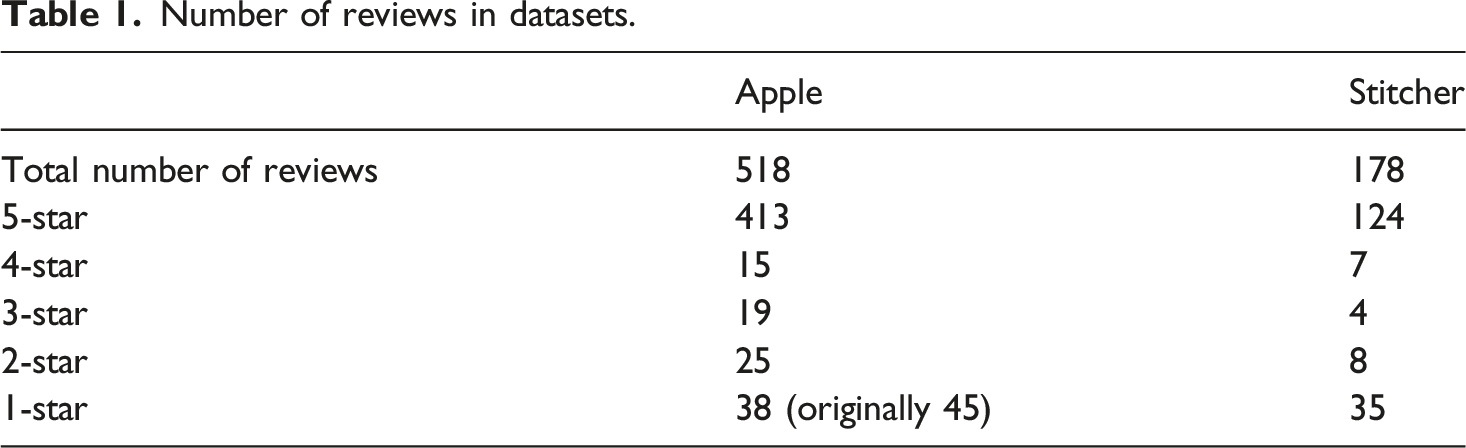
As discussed in the introduction, this podcast is particularly interesting for genre studies as the podcast is categorised by the hosts as a ‘true crime-comedy’ podcast. In order to identify how listeners evaluated the podcast and its categorisation, I analysed reviews from two podcasting apps: Apple Podcasts, used on Apple devices, and Stitcher, used on non-Apple devices. While it should be noted that it is impossible to know if all reviewers listened to the podcast, the reviews provide an effective way to analyse podcast evaluations. The reviews consist of a rating from one to five stars, one being the worst, five being the best, and a written response. This combination allowed me to identify patterns in high- and low-rated reviews and analyse connections between ratings and written responses.
Number of reviews in datasets.
4. Method
In order to examine whether positive and negative reviews contained different expectations of the MFM podcast and its genre, the reviews were grouped by star rating. The negative review corpus (NR) contained all 1- and 2-star reviews and consisted of 7639 words, the positive review corpus (PR) contained all 4- and 5-star reviews and consisted of 26,391 words. The difference in word count can be explained by the fact that the hosts often ask listeners to ‘rate and review’ the podcast, which supposedly increases its chart position. Listeners who like the podcast may be more willing to leave a review to help the hosts, thereby skewing the reviews towards the higher ratings. The 3-star reviews were omitted, as the 3-star rating is exactly in the middle and can therefore not explicitly be linked to negative or positive evaluations.
I used a keyword analysis as an ‘exploratory’ approach to identify words for further investigation (Gabrielatos, 2018: 227). The two corpora were compared against each other using AntConc (Anthony, 2019). I conducted two keyword searches, one for keywords in the PR corpus (using NR as the reference corpus) and one for keywords in the NR corpus (using PR as the reference corpus). I used a log-likelihood test (p < .01) to limit keywords to ones with statistical significance, and odds-ratio as the effect size measure to account for the small size of the corpora (Gabrielatos, 2018: 235–6). The odds-ratio measurement incorporates raw frequencies and the sizes of the compared corpora (Gabrielatos, 2018: 236). The keywords were sorted by effect size to focus the analysis on keywords with large differences between the two corpora (Pojanapunya and Watson Todd, 2018: 145). Keywords with an effect below 2 were discarded to investigate only keywords which appeared at least twice as often in the study corpus compared to the reference corpus. This approach identified 48 keywords in the PR corpus (with NR as the reference corpus) and 86 keywords in the NR corpus (with PR as the reference corpus).
Categorised keywords.
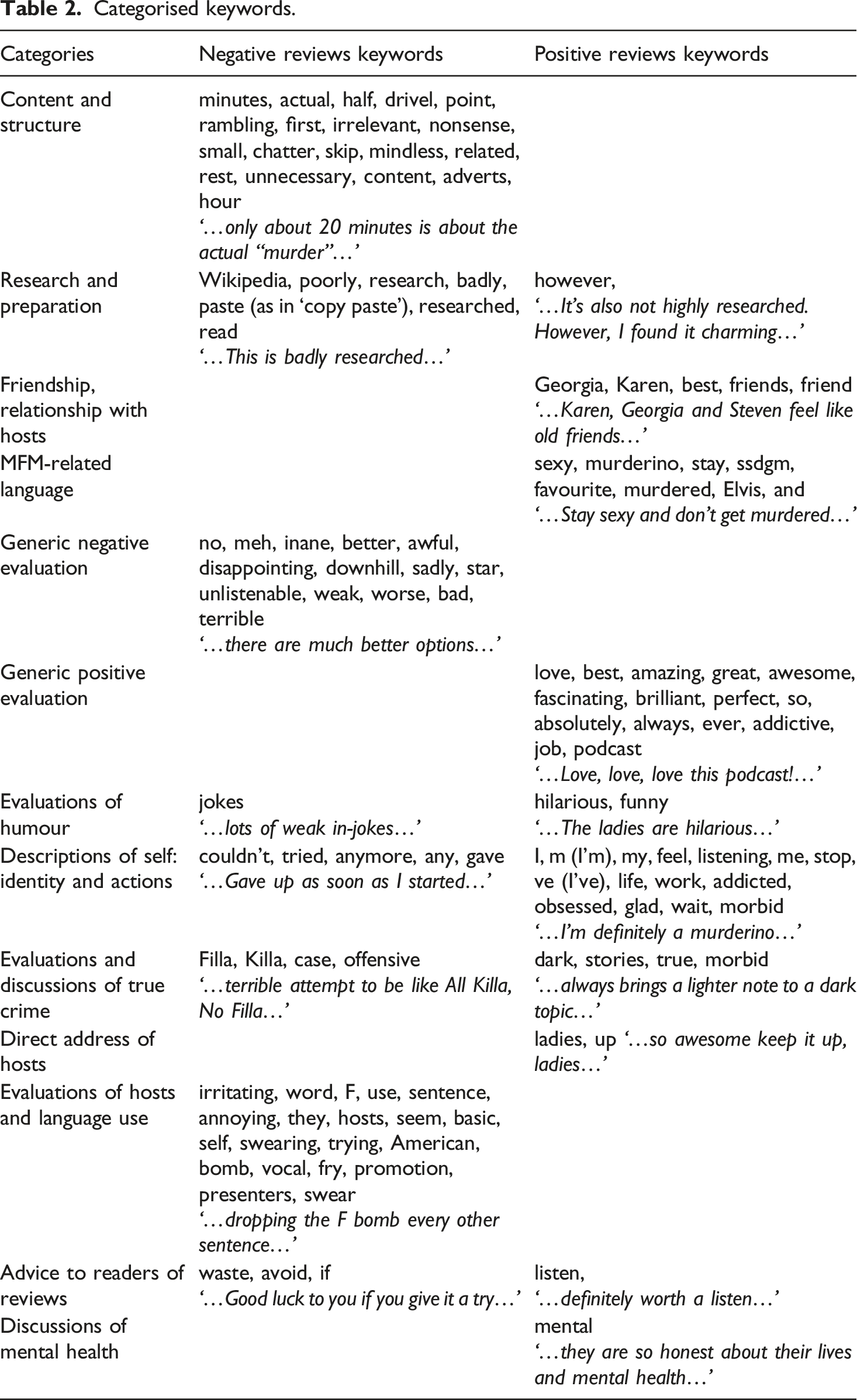
Negation can be used to create implicatures that rely on the triggering of the negated proposition (Jordan, 1998: 717), which can also indicate expectations of the evaluated object (Don, 2017: 7; Pagano, 1994: 261–3). By analysing negation in the reviews, I show what expectations the reviewers held about the podcast and how those expectations affected their ratings. In addition, I noted any other expectations that were alluded to in both PR and NR concordance lines to include expectations of the podcast that were not accounted for in literature on true crime and comedy genres.
In addition to genre characteristics, the keyword analysis of PR showed a variety of stance markers which aligned the reviewer with the podcast hosts, including first-person pronouns (Haddington, 2007: 289), ‘recycled linguistic elements’ (Haddington, 2007: 289), and names and relationship titles for the hosts. The stance markers allude to a sense of community and relationship between the hosts and the listeners. The implications of these keywords are discussed in 6.2, where I show how they signal membership of the MFM discourse community, and how this membership influences the expectations of the podcast and its true crime-comedy genre.
5. Results
5.1. Negative reviews
The NR keywords demonstrate a focus on research and preparation, content and structure, and the hosts and their language use. The following sections will discuss these categories, focusing on how negations can be used to identify the underlying expectations of the reviewers (Don, 2017: 7; Pagano, 1994: 261–3). Concordance lines are presented as numbered examples throughout the analysis. Keywords are in bold in all included examples.
5.1.1. Content and structure
Negative reviews commented on the content of the podcast, most notably the lack of true crime discussion in the introduction, indicated by the keyword ‘minutes’. The use of negation implies the pre-existing expectations that listeners had from the podcast: 1. I must have listened to 5 different episodes each for at least 10–15 2. It took them 31
Examples 1 and 2 show instances of denials (Martin and White, 2005: 119–120) as a form of negative evaluations of the introductions of the podcast episodes. The reviews use the negators, ‘without’ and ‘couldn’t’, to create an alternative situation, where there would have been mention of murder in the first 10–15 minutes (example 1). These are examples of what Pagano (1994: 253) refers to as ‘implicit denials’, where the writer does not provide any further explanation. As Jordan (1998: 717) argues ‘writers indicate what is not there only when there is a reasonable expectation that it is there’ (italics in original). Therefore, the negation in example 1 suggests that the writer expected to hear about ‘murder’ in the first ‘10–15 minutes’. Example 2 specifically mentions the amount of time, though in both cases this appears to be an estimate, it takes the hosts to get to the ‘actual content’. The use of ‘actual’ suggests that the introductions are not as important as the true crime content because the reviewer creates a juxtaposition between the crime discussion, ‘actual content’, and the introductions, implied to be not ‘actual content’. These reviews and the keyness of ‘minutes’ in negative evaluations suggest that if a show is categorised as true crime, negative reviewers may expect the sole focus to be crime. The reviewers do not accept the, often comedic, focus on the hosts’ personal lives in the introduction of the podcast, resisting the combination of true crime and comedy.
Beyond the introduction of the podcast, negative reviews also commented on the discussion of the true crime. Negation signals expected ‘substance’ which is not delivered in the podcast (example 3), and ‘actual’ creates a juxtaposition between expected content (‘the actual murder’) and what is delivered in the podcast (example 4). 3. There is 4. When it finally got to the
Example 3 shows explicit denial of substance, ‘no substance’, and explicitly labels the podcast as not true crime, warning people to not listen to this podcast if they are interested in true crime. The use of negation in the second clause of the sentence juxtaposes MFM with true crime, which shows the focus on the true crime aspect of the true crime-comedy genre. The reviews also suggest expectations of explicit details in true crime retellings. Example 4 shows an expectation of detailed discussion of the crime, as the reviewer uses denial to invoke an expectation of ‘talking about’ the ‘actual murder’. The potential exploitation of victims within the true crime genre that example 4 alludes to is discussed in other reviews as well as in discussion of the true crime genre more broadly (Burger, 2016). While example 4 considers the lack of discussion ‘admirable’ (though negative in terms of their expectation of true crime), other negative reviews note that the combination of true crime and comedy is specifically offensive: 5. What bothered me the most is that they show 6. The two hosts [sic] cackling banter is borderline moronic and very much disrespectful given the subject matter. How can you laugh and crack
Several reviews like examples 5 and 6 show a resistance to the combination of true crime and comedy. As genres ‘constrain’ the audience response to a text (Chandler, 1997: 7), a combination of two genres with such divergent purposes and topics creates competing constraints. This is apparent in examples 5 and 6, where the reviewers do not complain about specific sections of the content like examples 1 and 2, or the substance in the retelling of the true crime, like examples 3 and 4, but object solely to the combination of genres. The producers have labelled their podcast as true crime-comedy (and consistently label it as such during their live episodes) and while they may be considered ‘expert members’ of this discourse community (Swales, 1990: 58), the reviews show that a part of the audience resists the combination. The negative reviewers seem to judge the podcast by separate true crime and comedy expectations, either labelling those as inconsistent with each other (examples 5 and 6) or as unmet expectations (examples 1–4).
5.1.2. Research expectations
Besides content, negative reviews also commented on the research done by the hosts of the podcast. The negative evaluations suggest an expectation of thoroughly researched stories, presented with detail and exactness. The reviews indicate a connection between the perceived quality of research and true crime, as some reviewers suggested other podcasts as better-quality versions of true crime. This is particularly interesting as Gregoriou (2007: 48; 2011: 66) and Boorsma (2017: 210) reported that modern true crime stories tend to blur fact and fiction in order to create entertainment or ‘prove a point’ as opposed to reporting the crime as faithfully as possible. It seems that the negative reviews maintain a high expectation of realism in true crime, as Cobley (2012: 286–7) identified. The reviewers commented on the use of Wikipedia as a source (examples 7, 8, 9), as well as the perceived quality of the research (examples 9 and 10). 7. They do not do proper research. One of the hosts even admitted to using a 8. Most, if not all subjects of an episode are
Example 7 uses negation, ‘never’, when discussing the use of Wikipedia. The reviewer does not relate this to true crime directly, rather suggesting that no research should be done on Wikipedia. There are suggestions from producers of true crime content that while the genre may at times be sensationalised, the producers’ intention is to focus on the truth (Buozis, 2017: 256). These negative reviewers may suggest that listeners also have that expectation, which is combined with a distrust of Wikipedia. Both examples 7 and 8 contain the verb ‘admit’, positioning Wikipedia as a shameful source. There is no mention of potential sources that would be deemed worthy, though some reviewers do refer to other podcasts like ‘the Last Podcast on the Left’ (6 times) and ‘All Killa No Filla’ (4 times) as better examples of true crime podcasts. Example 8 also reveals an expectation of how much effort should be put into researching a true crime episode. The reviewer minimises the action of ‘recounting an episode’ and going ‘to Wikipedia’ through the use of ‘just’ and the use of ‘basically’. This suggestion of low effort research can also be seen in examples 9 and 10. 9. Worse still is that as soon as they cover a topic you actually have knowledge of yourself, you realise how 10. Add to that the
Example 9 shows that the reviewer combines the perceived research quality with the perceived accurateness of the podcast, commenting on the lack of met expectations for both topics. Example 10 combines the research quality with the delivery and juxtaposes this with ‘interesting, informative, and entertaining’, explicitly warning audiences that those qualities will not be found in this podcast. This suggests that better research and better delivery would include more (new) information or (unknown) details.
5.2. Positive reviews
The negative reviews showed a focus on the true crime aspect of the true crime-comedy combination and evaluated the podcast primarily based on its ability to meet separate expectations of true crime, though some reviews (examples 5 and 6) showed consideration of the combination of the two genres. Positive reviews on the other hand show different evaluations, with most comments focusing on a perceived relationship between hosts and listeners (e.g. Karen, Georgia, friends), the MFM community (e.g. murderino (a fan of the show), ssdgm (standing for the show’s tagline Stay Sexy and Don’t Get Murdered)), and descriptions of the reviewers’ themselves and their listening habits (e.g. I, me, my). The reviewers, when discussing true crime and research, also comment on the hosts’ own negotiation of the genre. The following section firstly analyses implied genre expectations in the concordances of these keywords, and secondly shows how alignment with the MFM discourse community is used as mitigation for unmet expectations.
5.2.1. True crime-comedy as a mixed genre
The positive reviews showed consideration of the combination of the true crime and comedy genres. Whereas negative reviews generally commented on unmet expectations of both individual genres, the positive reviews highlighted an awareness of the combination of the two, at times warning future listeners to be mindful that this is not just a true crime podcast, but also a comedy podcast. 11.
Example 11 shows that the writer is particularly aware of the combination of the two genres. While they seemingly consider true crime and comedy as two separate genres, indicated through the use of ‘also’ in the third sentence, they also acknowledge that the combination is creating new expectations. The evaluation of the podcast as a ‘fabulous true crime podcast’ is mitigated through the use of ‘but’ and it also being a comedy podcast. The use of ‘but’ suggests that the inclusion of comedy has an impact on the podcast’s ability to be a true crime podcast. The writer goes on to minimise the comedy, specifying that the hosts only use ‘light humo [u]r’ to ‘diffus [e difficult] situations’, in line with Gregoriou’s (2007: 58–9; 2011: 94–6) explanation of the use of humour in true crime narratives. Other reviewers draw on their self-perceived personal connection to the hosts to explain the genre: 12. … 13.
Both examples 12 and 13 show reviewers who were initially hesitant but who enjoyed the podcast after a few episodes. Both reviewers highlight their personal connection to the hosts as a means of justifying the true crime and comedy combination. Example 12 suggests that the reviewer ‘know [s] their ultimate intention’, highlighting a perceived close relationship between the reviewer and the hosts. The same can be seen in example 13, where the reviewer says that they now ‘get’ the hosts and are therefore able to understand and enjoy their humour. The negated propositions in these reviews focus on the purpose of the podcast (‘not to be disrespectful’) and imply that the podcast is for a specific audience (‘not for everyone’). Finally, the positive reviews contain discussions of unmet expectations of the genre. Yet different from negative reviews, the positive reviewers mitigate the unmet expectations by referring to intentions of the hosts and the perceived purpose of the podcast. 14. DON'T TAKE THIS PODCAST (very) SERIOUSLY
The review indicates the same expectations that were identified in the negative reviews: factual information and thoroughly researched episodes. Example 14 refers to the hosts’ own warnings about the lack of research in the podcast and the consequential mistakes. However, as opposed to the negative reviews, this reviewer seemingly identifies this as part of this podcast and does not suggest that this makes it less like a true crime podcast. Instead, they place the responsibility on the audience with the negation in the first sentence, ‘don’t take this podcast seriously’. The negated proposition suggests that this is something that audiences may do and subsequently misunderstand the podcast. The review highlights the hosts’ focus on mental health discussions, potentially indicating that this focus mitigates the lack of thorough research by juxtaposing it with the use of ‘but’. There also is a suggestion that the hosts are clear about the lack of research, which is foregrounded as the second sentence in the review. The hosts’ announcement of their style and content is also mentioned in other positive reviews. 15. They are very clear about the style and form of their 16. While they aren't always spot on with their research (but readily admit this), their recounting and conversations are always entertaining, and the personal stories of addiction and
These reviews not only indicate a focus on the hosts’ intentions, as was also seen in examples 11, 12, 13, and 14, they also suggest that the purpose of the podcast mitigates the lack of research that would be expected from true crime podcasts. Reviews 14 and 16 mention the focus on mental health as a mitigation of lack of research through the use of ‘but’ (example 14) and ‘while’ (example 16). This may be explained through consideration of the different approaches to genre. Negative reviews seemingly viewed genre as expectations of ‘content and form’ in line with Chandler (1997: 2–3) and resisted the mixing of the two genres, while positive reviews focus more on the communicative purpose of the genre in line with Miller’s (1984: 151) definition.
5.2.2. MFM community
Following on from the mitigation of genre expectations in reference to the hosts’ personalities and their intentions, the positive reviews contain a variety of keywords that suggest a personal involvement in the podcast including personal and possessive pronouns and first names of the hosts. Whereas negative reviews contained evaluations presented as declaratives (e.g. ‘There is no substance to this podcast’), the positive reviewers attribute evaluations explicitly to themselves: 17. 18.
Both examples 17 and 18 show the use of phrases like ‘I love’ to indicate explicit personal evaluations. Both reviews also show the connection listeners seem to have with the podcast hosts, demonstrating the intimacy of podcasts (Swiatek 2018: 173). Example 17 compares the hosts to ‘friends’ or ‘sisters’ and example 18 directly addresses the hosts with the informal phrase ‘you gals’. 19. This podcast definitely deserves #1 spot and has brought out the true # 20. K&G are honest from the get-go about not being perfectly researched/perfect in any manner, and their dedication to being earnest and forthcoming solidify this show as being one of the best. (…) Their unapologetic openness of mental illnesses/issues have brought a community together that isn't afraid to be themselves and ask for help and I truly think that’s beautiful. SSDG
Beyond the interpersonal relationship between hosts and reviewers, the positive reviews also signal membership of the discourse community through MFM-specific phrases and words. Example 19 shows the use of ‘murderino’ to self-describe the reviewer as a fan of true crime, as well as multiple lines from the podcast, which are used on merchandise: ‘Stay out of the Forest’, ‘You’re in a cult, call your dad’. Example 20 uses ‘SSDGM’, short for the tagline of the podcast ‘Stay Sexy and Don’t Get Murdered’, to sign off. The use of these terms and phrases signals the community membership of the reviewer, showing an address to the in-group as opposed to potential future listeners. Similarly, example 20 uses negation to imply there is an unmet expectation of ‘perfect research’ yet it mitigates this by referring to the community that the podcast has established.
These reviews suggest that the MFM community may be similar to a focal recreational discourse community (Swales, 1990: 58, 2016: 5). The MFM community can be classified as such because it has a ‘broadly agreed set of goals’ (Swales, 2016: 7), which the positive reviewers referred to: the podcast’s openness regarding mental health and the hosts’ honesty. There are means of intercommunication (Swales, 2016: 8): Facebook groups, the ‘fancult’ forum, Reddit threads, and Twitter through the hashtags #MFM and #SSDGM, which also function as its own ‘specific lexis’ (Swales, 2016: 8). Finally, it appears that the MFM discourse community ‘possesses’ a genre (Swales, 2016: 8): true crime-comedy. Members of the MFM discourse community place importance on the purpose of the podcast; creating a community, being open about mental health, and making difficult topics approachable. Non-members on the other hand, being those who do not align with the hosts or use MFM community-specific terms, focus on the content and expectations of true crime and comedy as two separate genres.
6. Conclusion
My analysis has shown that negative reviewers did not accept the combination of the two genres as a new, or ‘mixed’ genre (Chandler, 1997: 2) and instead evaluated the podcast by standards of comedy and true crime. They also indicated a focus on true crime expectations more so than comedy, shown through the key word analysis and subsequent categorisation of keywords. The focus on true crime as opposed to comedy in the negative reviews suggests that true crime expectations are less flexible than those of comedy or perhaps that this podcast was subverting expectations of true crime more than it was subverting expectations of comedy. The negative reviews highlighted poor research and lack of crime content as explanations for the low ratings through the use of negation and juxtapositioning. The positive reviews included similar implied expectations for true crime of thorough research but showed that alignment with the MFM discourse community affects the impact of these expectations on their evaluations. Members of the discourse community take the text’s purpose into consideration when evaluating that text, suggesting that communicative purpose may be particularly useful for analysing audience responses to genres.
I now return to my research questions: (1) Do readers have a common set of genre expectations? (2) Do these expectations affect evaluations of texts? My analysis shows that most reviewers, whether they left positive or negative reviews, share genre expectations. Notably, these expectations focused primarily on true crime, with references to other true crime podcasts against which MFM was measured. The true crime expectations centred around research, detail, and focus on the crime itself. While these genre expectations were present in positive and negative reviews, their impact differed between the two datasets. In response to research question two, my findings show that the impact of genre expectations depends on the reviewers’ relationship to the discourse community. Members of the MFM community referred to the communicative purpose of the podcast more than non-members and they used the purpose of the podcast as mitigation for unmet expectations. Members of the discourse community aligned themselves with the hosts and other listeners through phrases and terms from the podcast which signal their membership (e.g. SSDGM) and through intimate forms of address (e.g. ‘you gals’). The discourse community members accept true crime-comedy as a distinct genre, separate from true crime and comedy.
This article has shown that audiences conduct a form of genre analysis and that identification with a discourse community influences the impact of genre expectations on evaluations of a text. It also shows the importance placed on communicative purpose. Therefore, genre theory needs to consider communicative purpose as a more important feature than previously suggested, and as a feature that is not just relevant to analysts but one that is also employed by general audiences. With the growth of reader response studies in stylistics, future genre analyses of any text will need to focus on communicative purposes as well as discourse community membership in order to fully explore the genre of a text and its effects on audiences. Finally, this study has demonstrated that a corpus-assisted discourse analytical approach is particularly useful for investigating the genre expectations and evaluations of discourse communities with a large number of members.
Footnotes
Declaration of conflicting interests
The author(s) declared no potential conflicts of interest with respect to the research, authorship, and/or publication of this article.
Funding
The author(s) received no financial support for the research, authorship, and/or publication of this article.
