



Abstract
This article reports on some of the results of a project undertaken by researchers at the University of Sheffield with The National Trust in the UK, which seeks to examine the discourse found in guestbooks located in the Trust’s holiday rental cottages. Our key interests lie in the ways in which holidaymakers perform particular identities through the stylistic choices they make when writing entries in guestbooks, the role linguistic creativity plays in these performances, and the extent to which cognitive-linguistic analysis can help us understand guestbooks as socially and conceptually complex sites of linguistic interaction. Between 2014 and 2018, we collected over 800,000 words of data from 13 holiday cottages in two popular holiday regions in the UK: the Roseland Peninsula in South East Cornwall and the Port Quin area of Northern Cornwall. Our dataset was analysed and tagged using NVivo qualitative coding software, which enables the identification of both linguistic and non-linguistic features of the discourse and makes these items searchable. In the present discussion, we use Text World Theory to explore both the situational context of this discourse, or the ‘discourse-world’, and the conceptual structures, or ‘text-worlds’, which result from linguistic interaction in the minds of participants. We suggest that the unified examination of these two interacting levels of discourse enables a holistic investigation of the pragmatic and conceptual environment which surrounds the production and reception of the guestbook discourse; the linguistic and stylistic features of the texts themselves; and the mental representations that arise from them. In particular, we present a case-study analysis of the guestbooks of Caragloose, a three-bedroomed former farmhouse in South East Cornwall, which our study found to contain levels of linguistic creativity which were exceptional in our dataset. We outline the key stylistic features of this discourse and show how one collective linguistic endeavour in particular in Caragloose fosters an exceptionally experimental style across multiple entries. We reveal how the resulting discourse, although taking place between strangers separated in both time and space, exhibits a density of creativity more commonly associated with collaborative discourse produced between intimates in a face-to-face situation.
Keywords
1. Introduction
This article arises from a research project run between the University of Sheffield and The National Trust in the UK. The project focuses on a widespread mode of vernacular communication which has been largely ignored by analysts until now: the discourse used by holidaymakers in the guestbooks of holiday rental cottages. Our research seeks to understand the linguistic means through which holiday cottage guestbooks give permanence to otherwise transient cultural and physical experiences of tourism. Our key interests lie in the ways in which holidaymakers perform particular identities through the stylistic choices they make when writing entries in guestbooks, the role linguistic creativity plays in these performances, and the extent to which cognitive-linguistic analysis can help us understand guestbooks as socially and conceptually complex sites of linguistic interaction (see also Gavins and Whiteley, 2019).
Guestbooks more broadly, such as those situated at visitor attractions, have received previous academic attention in a number of fields. Within tourism studies, such books are most often approached as a means of evaluating the management practices at tourist sites, with the inscriptions in visitors’ books taken at face value and as an indicator of public opinion (see, for example, Brown et al., 2003; Sullivan, 1984). Noy (2008), however, takes a more critical approach, drawing on the theories of Goffman (1981) and Butler (1988) to view guestbooks as ‘stages’ for the performance of touristic identities. Noy argues: While, as a product, visitor books can be studied as collections of expression and articulation (containers of written discourse), in terms of their function in situ they constitute spaces in which these expressions and articulations materialise and take shape. In precisely this capacity – of supplying public spaces for expression – they can constitute unique sites that elicit tourists’ linguistic performance. (Noy, 2008: 509)
He goes on to point out that these ‘public spaces for expression’ have the potential to generate complex and multi-faceted discourses as a result of the involvement of multiple participants in the communicative situation: ‘by constructing certain voices and partaking in certain dialogues [inscribers] delineate their voice[s] on the multi-voiced surface of the visitor book, and [...] position themselves rhetorically on the stage’ (Noy, 2008: 524).
Noy’s work is reflective of wider research into tourist behaviour as a form of performance (Adler, 1989; Baerenholdt et al., 2004; Edensor, 2000, 2001, 2008), and his study of visitor books at an Israeli commemoration site highlights the way identity construction is inherent in guestbook contributions. Similarly, Stamou and Paraskevopoulos (2003, 2004, 2008) conduct one of the few linguistic investigations of guestbooks, applying methods from Critical Discourse Analysis to the language of visitors’ books in a Greek national park. They offer insights into the way visitors negotiate what they call ‘the duality of ecotourism’ in the guestbooks (2004: 105), as they shift between the two, often conflicting social practices of tourism and environmentalism. They find that guestbooks in different locations in the park contain evidence of these different social practices and reflect the dual nature of tourists’ experiences: books situated in a nature reserve contain entries which are more concerned with touristic spectacle, and books situated in an information centre contain entries more concerned with environmentalism. The work of Stamou and Paraskevopoulos demonstrates that visitors’ inscriptions in guestbooks are situated linguistic performances, reflective of the physical and cultural spaces in which the books themselves are located.
Historical research has also demonstrated the cultural importance of guestbooks, with visitors’ books forming a key primary source in a number of studies of British touristic behaviour in Europe in the 19th Century (see, for example, Barton, 2008; Colley, 2010; Heafford, 2006; James, 2012). James (2012, 2013) draws on the dramaturgical theory used by Noy (2008) to examine the guestbooks in Victorian British and Irish hotels and notes how guestbooks reveal the complex social practices involved in visitors’ interactions with place. James also notes a shift in the style of guestbook entries between the 1840s and early 1900s, from the ‘florid language’ of romantic tourism to sparser entries in the early 1900s. Furthermore, James (2013) presents evidence to suggest that Victorian guestbooks were widely recognised as sites of stylistic creativity in the period, describing a ‘meta-literature’ on the genre which appeared in periodicals and newspapers from the 1840s, reproducing excerpts from guestbooks for the purposes of entertainment.
Our own research seeks to address the comparative lack of scholarly attention which has to date been paid specifically to the discourse of holiday cottage guestbooks, and indeed to holiday accommodation guestbooks more generally. One of our primary aims has been to establish for the first time the typical linguistic features of the discourse of holiday cottage guestbooks within a defined regional and temporal dataset, so that our findings might be comparable with other forms of tourist discourse, such as postcards and visitor attraction guestbooks (e.g. Heller et al., 2014; Jaworski, 2010; Jaworski and Thurlow, 2011; Thurlow and Jaworski, 2010, 2011a, 2011b, 2014, 2015). We have worked in partnership with The National Trust in order to examine the discourse contained in some of the hundreds of guestbooks kept in holiday rental cottages owned and managed by the Trust throughout the UK.
The National Trust was founded in 1895 with the aim of protecting the country’s cultural heritage and open spaces. It is custodian of over 500 historic houses located across the British Isles, plus thousands of acres of parkland, coastline, and countryside. In 2019–20, the Trust had 5.95 million members and it receives over 65 million visits to its properties each year. It is the largest voluntary organisation of its kind in the UK and, with a total income of £681 million in 2019–20 (see The National Trust, 2020a), the Trust is a powerful lobbying and campaign body, which occupies an iconic position in the cultural and historical identity of the nation (see Bagehot, 2011; Burek, 2008; Jenkins and James, 1994; Newby, 1999; Waterson, 2006, 2011; Wright, 2009). This establishes a particular relationship between the Trust and the visitors to its properties which directly shapes the discourse at the heart of our research project in distinct and interesting ways.
Alongside its custodian activities, The National Trust runs a large holiday business, the income from which helps to support its conservation projects. The Trust currently owns three historical hotels, dozens of campsites and over 400 holiday rental cottages. Many of these cottages are restored historic houses in their own right, and many are situated in protected countryside owned by the Trust. National Trust holidays are aimed at an affluent, middle-class market, with the weekly rental prices of their cottages ranging from around £350 for the smallest properties in low season to over £4500 for the largest in the peak summer season. All National Trust rental cottages contain guestbooks, which are deliberately left by the manager of each property in a highly visible position, and they are well used by visitors. Many of the Trust’s cottages also contain small archives of older, filled guestbooks, and some of the cottages studied in our project contain books dating back as far as the 1960s. As such, The National Trust’s guestbooks are important records of tourists’ experiences from the late 20th century through to the early 21st century and contain invaluable examples of language use in a distinctive communicative context: participants interact in a shared physical location of national cultural significance, but at distinct temporal moments.
We undertook the initial stage of our research project in 2014 in Cornwall, one of the most popular holiday destinations in the UK. We photographed the guestbooks of five of the Trust’s rental cottages in the Roseland Peninsula in South Eastern Cornwall and the resulting digital images yielded over 300,000 words of data. In 2018, funding from The British Academy and The Leverhulme Trust enabled us to extend our dataset to include the guestbooks of a further eight National Trust cottages in the Port Quin area of North Cornwall, more than doubling the total number of words collected over the course of the project to over 800,000. The discourse collected at both stages of our collaboration with the Trust was analysed and tagged using NVivo qualitative coding software. NVivo enables the identification of both linguistic and non-linguistic features of the discourse and makes these items searchable. It also allows a broad overview of the dataset to be maintained and for emergent coding to be undertaken. This is a qualitative analytical process, by which key linguistic patterns across guestbook entries are identified, before a more detailed analysis of individual entries and stylistic choices is carried out.
2. Conceptualising guestbook discourse
In our first discussion of our dataset in Gavins and Whiteley (2019), we argued that holiday cottage guestbooks can be thought of as a conceptual as well as textual space, co-created by multiple inscribers. In terms of our own project, the people involved in this co-creation are: The National Trust, including all their local employees, who are largely silent in our data; the holidaymakers who write in the guestbooks; the holidaymakers, cottage maintenance staff, and other visitors (including us, as researchers) who read the guestbooks.
We argued that, in order for such a multi-faceted discourse situation to be fully understood, a cognitive-linguistic approach to its analysis is essential. We employed Text World Theory (see Gavins, 2007; Werth, 1999) for this purpose, since the text-world framework considers both the situational context of the discourse, or the ‘discourse-world’ (see Gavins, 2007: 18–33), and the conceptual structures, or ‘text-worlds’ (see Gavins, 2007: 35–72), which result from linguistic interaction in the minds of participants. We suggested that the unified examination of these two interacting levels of discourse enables a holistic investigation of the pragmatic and conceptual environment which surrounds the production and reception of the discourse; the linguistic and stylistic features of the texts themselves; and the mental representations that arise from them.
All of the participants in the discourse-world of a holiday cottage guestbook are united by their passage through or ownership of the cottage in which it is situated, although they are unlikely to meet face-to-face. In National Trust cottages, holidaymakers’ stays do not overlap. Guests vacate the property before the next visitors arrive, and keys for the cottages are collected from a safe deposit box, rather than requiring direct contact with National Trust staff. The guestbook therefore provides a unique space for interaction between the participants involved in the discourse situation, and furthermore makes previous interactions visible to new participants in the discourse-world. The discourse-world thus evolves through time, as new readers and writers come and go, contributing to a dynamic and evolving ‘rhetorical stage’. The guestbook inscriptions reflect how the participants conceptualise their environment and in turn prompt text-world conceptualisations in the minds of the guestbooks’ readers. Part of what is communicated in the discourse of the guestbook is the participants’ conceptualisations of the nature of the discourse-world itself: the inscribers’ ideas about the people who will be reading their entries, and their relationships to past and future holidaymakers or National Trust staff. These ideas will be partly based on their own past experiences and cultural assumptions, and partly on their encounters with preceding entries in the book.
We chose to focus our analysis in Gavins and Whiteley (2019) on a cottage called Gwendra Wartha in South East Cornwall (see The National Trust, 2020b), as it is in many ways a typical example of a National Trust rental property and its guestbooks provide representative examples of the kind of discourse at the heart of our project. The present article begins by building on the evidence of key aspects of holiday cottage guestbook style that we found in Gwendra Wartha and, in the next section, we give further examples of these linguistic features. This time, however, our examples are drawn from a cottage called Caragloose (see The National Trust, 2020c), also situated in the Roseland Peninsula, about two miles east of Gwendra Wartha. Our reasons for selecting Caragloose as a second case study are that, while its guestbooks also contain numerous illustrations of prototypical holiday cottage guestbook discourse, they include other features which depart considerably from the stylistic norms we identified elsewhere in our dataset. In particular, the levels of linguistic creativity to be found in Caragloose’s guestbooks are of special interest in that they far exceed those found in any of the other cottages we have examined over the course of our project. In Section 3 and Section 4, we show how this creativity manifests itself linguistically and, in Section 5, we discuss why we think this may be the case.
3. Key features of the discourse of holiday cottage guestbooks
Caragloose is a secluded, three-bedroomed, stone-built farmhouse, located on a cliffside with views over The English Channel. The National Trust uses a 1–5 ‘acorn’ system to grade the comfort and quality of all of its rental cottages and Caragloose is a 5-acorn cottage (with five acorns signifying the highest quality and comfort). Its current rental prices range from £669 per week in low season, up to £2,249 in high season. The cottage contains a current guestbook, as well as a number of older, completed books, the earliest of which dates back to March 1985. In keeping with the majority of cottages we have examined over the course of our project, Caragloose’s guestbooks are in the main large (B5 landscape), hard-backed books, the pages of which are lined and ruled into columns. In the earliest books in this cottage, these columns are headed ‘Date’, ‘Name’, and ‘Address’ in turn. For the first year of the earliest guestbook, the ‘Address’ column is used by inscribers to record either a full postal address or a more general place of origin (e.g. ‘Bristol’, or ‘Amersham, Bucks’), with occasional guests adding one or two sentences beneath these details, evaluating their stay. As time goes on, however, inscribers stop writing their full addresses completely and include only a general location, if any, underneath their names in the ‘Name’ column. Using the ‘Address’ column for a more extended commentary becomes the norm by April 1986.
This diachronic shift fits a pattern we observed across all 5 of the 13 cottages in our dataset which contained historic guestbooks. As we noted in Gavins and Whiteley (2019), in the late 1970s and early 1980s, inscriptions in these books begin to differ in length and detail. Guests give less information about where they are from and more general forms of self-reference start to be included in place of full names. Inscribers often refer to themselves by family surname only (e.g. ‘The Hobbs Family’), or by just first names (such as ‘Phillip, Charlotte, Patricia, Tony and Matthew’). This increasing generalisation may indicate the discourse participants’ increasing awareness of the public nature of the discourse. We also found, however, that more recent inscribers often provide other information through which they express their identities. For example, families often specify the ages of their children, children sometimes inscribe their own names and family members are sometimes identified by their family title or role, rather than their actual name (for example, ‘Granny’, or ‘the kids’). Holidaymakers sometimes indicate the relationships between the people in their particular group (such as, ‘4 friends and relations’), and pets and local animals are named as part of the group on occasion. We also found throughout our data that it is common for inscribers to note previous visits they have made to the cottage, to the general area, or to any other National Trust property (e.g. ‘Third enjoyable visit to Caragloose’, ‘2nd N.T. holiday. Thoroughly enjoyed my stay’). Visitors often specify their nationality or that of other members of their party, particularly if they are not British (e.g. ‘Memorable week with […] our close relations from California’), and some go further in elaborating their family identities, for instance entering information about family milestones (such as, ‘Honeymoon. Very peaceful and cosy’, or ‘Our first family holiday with Sam [aged 3 weeks]’).
In Gavins and Whiteley (2019), we suggested that this gradual shift in the style of guestbook entries in our dataset shows that inscribers form conceptualisations of other participants in the communicative situation and that their linguistic expression of these conceptualisations becomes increasingly complex over time. The ways in which they refer to past and future visitors, as well as to The National Trust, reveals not only their awareness of the existence of these co-participants in the discourse-world, but also the imaginative and detailed mental representations they construct of these people, their likely behaviours and interests. Inscribers refer to other participants, who they perceive as involved in the discourse-world with them, in a variety of ways. In so doing, they nominate these people as present in the text-worlds they create through their entries to the guestbooks. These mental representations of the discourse are constructed in the minds of participants from ‘world-building elements’ (see Gavins, 2007: 36), deictic items in the text which specify the temporal and spatial parameters of the text-world. The text-worlds of guestbook entries are thus structured around descriptions of space (for example, through the use of nouns, pronouns, articles, spatial locatives, spatial adverbs, demonstratives, and verbs of motion) and time (through the use of tense, aspect, temporal adverbs, and temporal locatives). References to the self and to others contribute to the building of a text-world in important ways, since this not only creates text-world versions of real or imagined people, but these versions are fleshed out by the discourse participants who read the entries using their background knowledge, cultural assumptions, and other discourse-world experiences. In Text World Theory terms, the resulting, often richly detailed entities which populate participants’ text-worlds are known as ‘enactors’ (see Gavins, 2007: 41).
The creation of text-world enactors of people outside the inscriber’s own visiting group is most often done in National Trust guestbooks through the process of thanking or praising the Trust itself. Figure 1 shows a typical example of this in an entry to the guestbook at Caragloose from 1997. (N.B. All examples used in publications arising from our research are anonymised in line with National Trust data protection requirements and identifying details are redacted.) Here, ‘Thank you N.T’ nominates the Trust as present in the text-world, albeit as a somewhat nebulous entity. This sort of generalised reference can be seen as an example of what Fauconnier and Turner (2002) term ‘conceptual compression’ (see also Turner, 2016), whereby a large organisation, consisting of hundreds of employees whose names are unknown to the inscriber, is represented through a single nominal item. Since both conceptualising and referring to all the real-world individuals who work for The National Trust is impossible for the author of this entry, the compression of these multiple entities into ‘N.T’ reduces the concept of this organisation to a more manageable, human scale. References to specific people in The National Trust are comparatively rare, with only a few exceptions in the Caragloose guestbooks. These mostly thank the property manager (whose name was Gail, at the time of the entries made in Figure 1) for such things as replacement water during a shortage, the provision of hot water bottles in winter, the basic groceries which are left as standard for National Trust holidaymakers on arrival, and for the general upkeep and presentation of the property (e.g. ‘Thank you Gail for a well presented a very clean house, also thank you for the milk’). It is not clear, even in instances of specific definite reference, whether the inscribers have actually met the property manager or whether they remain an imagined entity for them, since it is common practice for National Trust property managers to leave a welcome postcard or greeting card for new arrivals, signed with their name. Typical shorter guestbook entry from Caragloose.
There are further features of the discourse in Figure 1 which are typical of shorter entries to National Trust holiday cottage guestbooks. Firstly, the inscriber uses mainly indefinite articles, as in ‘A lovely farmhouse’ and ‘A very memorable week’. Figure 2 shows the same tendency in three other short entries from Caragloose’s books, also in 1997 (‘A fantastic week’s holiday’, ‘a lovely relaxing week’, ‘a truly wonderful house’, ‘a memorable family Christmas’), and we have found this preference for indefinite reference to be characteristic of entries of less than 30 words across our dataset. On the whole, entries of this length, while often containing lots of evaluative adjectives that can make the discourse appear more personal (e.g. ‘lovely’, ‘stunning’, ‘memorable’, ‘fantastic’, and so on), nevertheless tend towards the non-specific, indefinite, and generalised. Note that the lack of personal pronouns in each of the entries in Figure 2 adds to the universalised feel to this discourse. There is an example of pronoun deletion in ‘Had a lovely, relaxing week’, where the inscriber has chosen not to include ‘I’ or ‘we’ in subject position. Note, too, the generalising effect of the plural used in ‘views’, the non-specific ‘weather’, plus the similarly non-specific reference in ‘Everything’s been said’ and ‘Another winner’. Indefinite and non-specific reference in Caragloose.
The avoidance of specific definite reference in shorter guestbook entries often leads to agency and responsibility being masked and the third entry in Figure 2 shows how this can sometimes have a politeness function in the discourse (see Brown and Levinson, 1987). In the final comment, ‘The oven thermostat needs attention!!’, the face-threatening nature of a complaint is minimised through the personification of the oven thermostat and a direct request to the Trust to take action with a faulty appliance is side-stepped. Interestingly, we found during our coding of Caragloose’s guestbooks in NVivo that complaints feature particularly heavily in this cottage’s discourse when compared to the other cottages across time. Figure 3 shows the percentage coverage of complaints by year in the guestbooks of the Caragloose. The highest spike in complaints is in 2003, when almost 10% of the guestbooks are filled with this type of discourse in a total of 12 separate instances. Looking in detail at this year’s entries reveals that the two main topics around which the complaints centre are the lack of a telephone at the cottage and the lack of a double bed in any of the bedrooms. These remain the main complaint topics across the other Caragloose guestbooks as a set too. Just as in the example with the oven thermostat, however, it is rare for The National Trust or any of their individual employees to be named or addressed directly in any individual complaint. For instance, in a 2003 complaint about the lack of a telephone, one inscriber writes: ‘Big problem – no landline telephone!! Had a problem with my car + spent so many wasted hours trying to find a signal for the mobile phone! Please, please put in a telephone – even if it’s a pay phone – just in case!’ In the first sentence here, no subject is included, so no one is assigned responsibility for the lack of a telephone. The inscriber does not include a pronoun for themselves in the second sentence either, making the entire entry impersonal, nor do they name the Trust or anyone else in the final sentence. The imperative verb ‘put’ is used, and it can be easily inferred that this is directed at the Trust, but it is not made explicit who specifically is being asked to complete this action. Crucially, the property manager at the time is not nominated as an individual anywhere in this entry, in spite of the fact that their name is likely to have been known to these visitors (as to all visitors), either through a welcome card or through other entries which name them in the guestbook. Percentage coverage of complaints in Caragloose.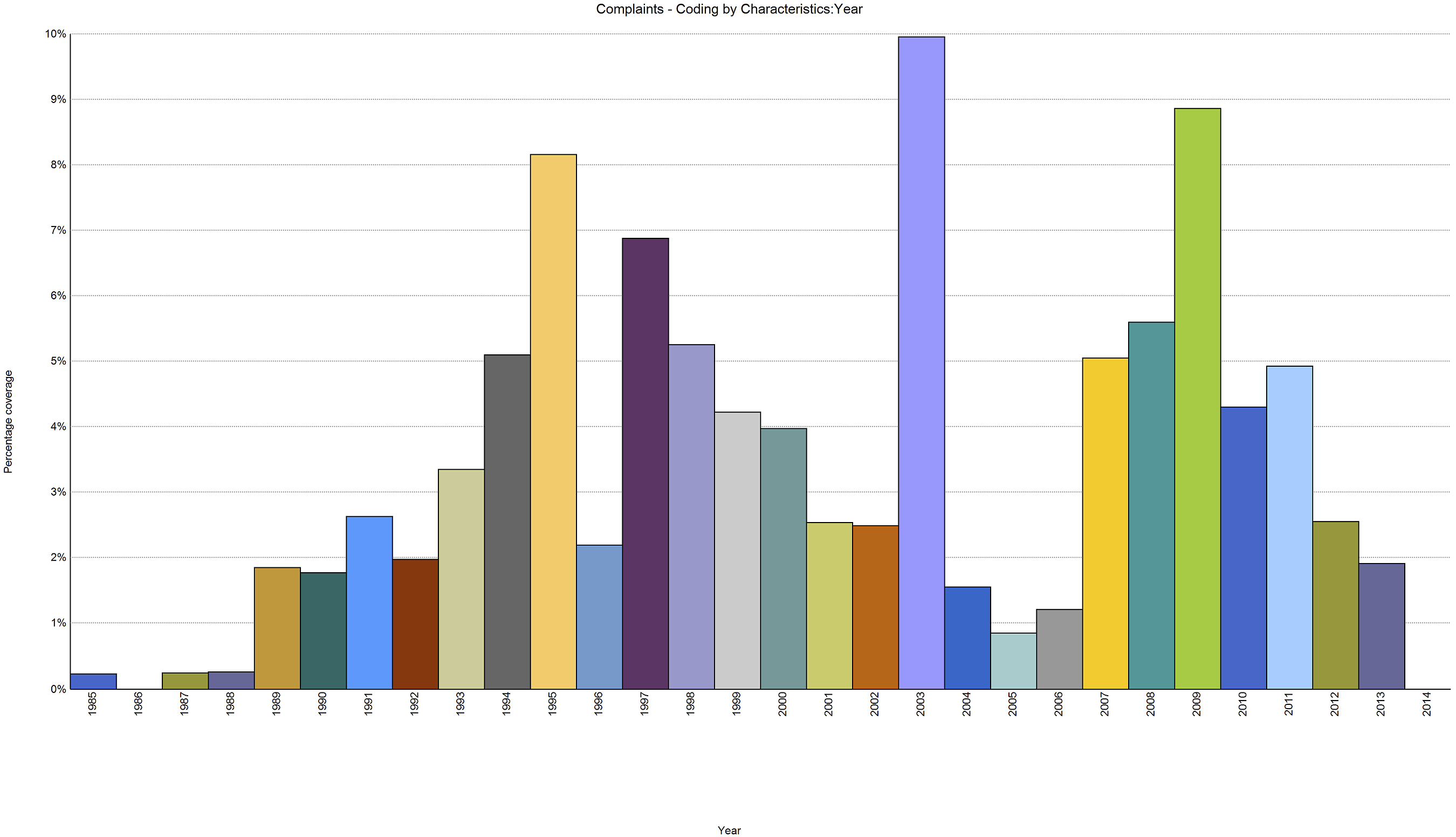
These sorts of politeness strategies around complaints are typical of the discourse of holiday cottage guestbooks in our experience and were found in all of the cottages in both phases of our project. Whether through the absence of direct address, the deletion of personal pronouns, passivisation, or the personification of inanimate objects, inscribers go to considerable lengths to minimise the face-threatening impact of complaints whenever they feel it is necessary to make them. This not only tells us that contributors to the guestbooks view the discourse situation as requiring the same levels of politeness as face-to-face interaction, but it also reveals how they conceptualise the Trust, its employees, and their relationships with both. Even though visitors to National Trust cottages are paying customers, we found them to be overwhelmingly polite towards the Trust in their guestbook entries, even when expressing dissatisfaction with the cottage in which they were staying.
Overall, shorter entries in National Trust guestbooks build comparatively minimalistic text-worlds, with little detail given about the spatial and temporal parameters of these worlds or about the enactors who populate them. Longer entries, however, provide an interesting comparison and one such entry from March 1991 reads: We had an excellent week and particularly enjoyed: Carne/Pendower beach St Mawes castle Mevagissey harbour Portloe The view from the Dodman and Nare Head Trelissick (gardens, gallery, restaurant, walks down to the sea) The funny little snack bar on the quay at St Mawes For those who feel the need, as we did, to do a mega food shop on arrival, we recommend the Tesco superstore at Truro harbour. Also, good bread and other essentials from the shop in Portscatho.
The text-world constructed here is much more detailed than those resulting from the discourse in Figure 2 for a number of reasons. First of all, there is more frequent use of personal pronouns, personalising the commentary and giving clear agency to the contributing family. There is also an increased use of the definite article, for example, in ‘The view from the Dodman’, ‘the sea’, ‘The funny little snack bar’, ‘the Tesco superstore’ and ‘the shop in Portscatho’, alongside all the proper nouns the entry also contains.
Although such specific definite reference may build a more detailed text-world, it is nevertheless reliant on a considerable amount of assumed discourse-world knowledge. For instance, not only is St Mawes mentioned as a popular seaside town close by to Caragloose, but ‘the funny little snack bar on the quay at St Mawes’ suggests a shared knowledge of this place and a shared experience of the snack bar as ‘funny’. It is furthermore worth noting that, because these kinds of text-worlds are essentially a narrated version of the discourse-world, the spatial components they include can be highly vivified for a reader reading the entries within the cottage or immediately preceding or following a visit to the other places mentioned. The text-worlds of the guestbook and the discourse-world in which they are created are thus closely connected and place becomes of primary importance in the discourse, as Noy (2008) and Stamou and Paraskevopoulos (2003, 2004, 2008) have also found.
The 1991 entry above also contains some typical examples of one of the most prevalent linguistic features of the discourse of holiday cottage guestbooks, which we again identified across all the cottages in our dataset: recommendations. Towards the end of the entry, the inscriber writes: ‘For those who feel the need, as we did, to do a mega food shop on arrival, we recommend the Tesco superstore at Truro harbour. Also, good bread and other essentials from the shop in Portscatho’. Recommendations such as these often create quite complex conceptual structures. The first sentence in this particular instance describes the imagined needs of future guests in what Text World Theory terms a ‘modal-world’ (see Gavins, 2007: 91–125). Modal-worlds are a particular type of text-world which are created whenever modalised language occurs in a discourse event. They allow attitudes, beliefs, and opinions to be conceptualised in a separate mental space, which normally exists at some degree of remoteness from its originating world. In this case, the modal-world is boulomaic in nature since it represents the imagined desires of a specific set of text-world enactors. It is important to note, however, that these enactors only exist in the discourse-world of the inscriber as mental representations of potential readers and that the inscriber is unlikely ever to meet actual future visitors to the cottage. Nevertheless, the author of the entry aligns the imagined needs of the future enactors with their own needs in the past. This, too, is represented in a separate text-world, which in this case is a ‘world-switch’ (see Gavins, 2007: 45–51). The shift in tense from the present tense ‘those who feel’ to the past tense ‘as we did’ switches the focus of the discourse from the moment of writing to an earlier point in time, when the inscriber’s family arrived at the cottage. The recommendation itself, which is explicitly marked with ‘we recommend’, sets up another text-world in which the solution to the need that the inscriber has imagined for future visitors can be conceptualised – a trip to the Tesco supermarket in the nearest city, Truro. Once again, this text-world is aligned with the author’s own activities at an earlier point in time, but is nevertheless a trip which has not yet taken place, involving enactors who are only imagined entities in the mind of the inscriber at the time of writing.
We found recommendations like these to be very common in longer entries in the National Trust holiday cottage guestbooks in our project. The suggestions they include are often precise and highly detailed and always assume some kind of ideal reader carrying out a particular action. Furthermore, they construct an identity role for their inscriber very clearly as an experienced and authoritative giver of knowledge. At the same time, they outline an identity for the imagined future visitor too – a not-yet-existent co-participant in the discourse-world, who nonetheless becomes an enactor in one or more unrealised embedded modal-worlds. Bruner (2005a), again from within tourism studies, provides an excellent explanation of this type of guestbook behaviour: There is a wide range of how tourists and performers individualize narratives about the site, depending on their motivations, perspectives, and understandings. To be a tourist is a social role, and like all roles, is not merely occupied but is constructed as it is enacted. The telling of travel stories serves to construct the teller as tourist, and also functions to construct a community of fellow travelers. It is the same with other roles in tourism, including those of the performers, guides, agents, and the locals – all are constructed roles best studied as a system in interaction, as a co-production. (Bruner, 2005a: 9)
Bruner talks about tourist destinations having a ‘master narrative’, a narrative which is sold to tourists by tour operators, tourists boards, and other governmental organisations and one which is tacitly agreed upon on a sometimes global scale (see also Bruner, 2005b). So, the UK is generally viewed and described as quaint, historical, and rich in culture, but its master narrative also includes the notion that the UK has a contemporary and fashionable edge, particularly in its major cities. Spain, to pick another example, is similarly culturally and historically rich, but its master narrative includes the notion that Spain is also somewhere tourists can go to experience a slower pace of life. Crucially for our project, Bruner argues that individual tourist narratives – in guestbooks, holiday reviews, when showing photographs to friends and family post-visit – often seek to break through this master narrative, to transgress it and personalise it. However, he also stresses that this individualisation of the master narrative is not necessarily enacted alone. The same sort of complex physical, textual, and conceptual space underpins the discourse situation of holiday cottage guestbooks too: multiple participants, negotiating individual narratives of their personal experiences across temporal divides, but in a shared physical location. In the next section, we look at how this multi-faceted situation gives inscribers in the guestbooks licence to transgress certain norms of social and linguistic behaviour, in the way Bruner suggests, and how this manifests itself through linguistic creativity which is jointly, rather than individually constructed.
4. Co-creativity in holiday cottage guestbook discourse
In Gavins and Whiteley (2019), we presented a number of examples of linguistic creativity from the guestbooks of Gwendra Wartha, which we identified as typical across our dataset. These included instances of syntactic parallelism (e.g. ‘Wonderful situation, wonderful cottage, wonderful time!’), and phonological parallelism (e.g. ‘The Hale-Bopp comet was spectacular in a sea of stars’). We also found that inscribers in all our guestbooks made creative use of euphemism and metaphor, for example, in ‘Great place, shame about the weather which has been……….!!’, and ‘It was like a famous five adventure’. We noted that the use of multimodality was common too, ranging from simple emphasis, the use of capitals, emboldened and underlined fonts, through to drawings and cartoons. We also showed how the participants in the discourse of a guestbook frequently exhibit self-awareness in the kinds of creativity they engage in, for example, when shifting or mixing registers. One entry in Gwendra Wartha’s guestbooks, for example, starts with a conventional saying and shifts into a more literary register marked by inverted commas: ‘super time had by all, etc. etc. ……“and as we left, the sun broke through the clouds with a triumphant smile”’; whilst other entries play with a military or explorer register in their reference to ‘morale’ and ‘natives’ and their syntactic elision: ‘Superb holiday – location, beaches, weather, even the natives!’ and ‘Morale high, despite lashing rain…’.
We have found throughout our dataset that linguistic creativity appears to function as a way to make the inscriber and their inscription stand out on the rhetorical stage of the guestbook, offering distinctive and playful deviation from the more common inscription styles adopted by other writers. Focussing on the first phase of our project in the Roseland Peninsula specifically, Figure 4 shows five graphs which reveal how various features of linguistic creativity – metaphor, multimodality, entry-level repetition, page-level repetition, and register mixing – appear in the guestbooks of the five cottages we studied in this area across time. It should be noted at this point that some of the disparity in distribution shown in these graphs results from the differing span of time covered by the guestbooks contained in each of the cottages: while Penhaligons and Gwendra Wartha both have guestbooks dating back to 1968, Caragloose’s books began in 1985, Porth Barn in 2006, and Hayloft most recently in 2012. Nevertheless, it is clear from this comparison that the overall percentage of Caragloose’s books covered by examples of linguistic creativity is considerably greater than that in any of the other cottages. Although Penhaligons’ guestbooks are a close second for some features, such as repetition, the use of creative features in general in Caragloose, and the use of multimodality in particular, far outstrip its closest rival. For instance, in Caragloose’s guestbooks, which span 30 years in total, multimodality appears at least once in 21 different years. By contrast, in Penhaligon’s guestbooks, which span 47 years in total, multimodality occurs in only 14 of those years. More importantly, the average percentage coverage of multimodality is much higher in Caragloose’s books than those of Penhaligon’s and others across time, as can be seen in Figure 4. Percentage coverage of key features of creativity in South East Cornwall data.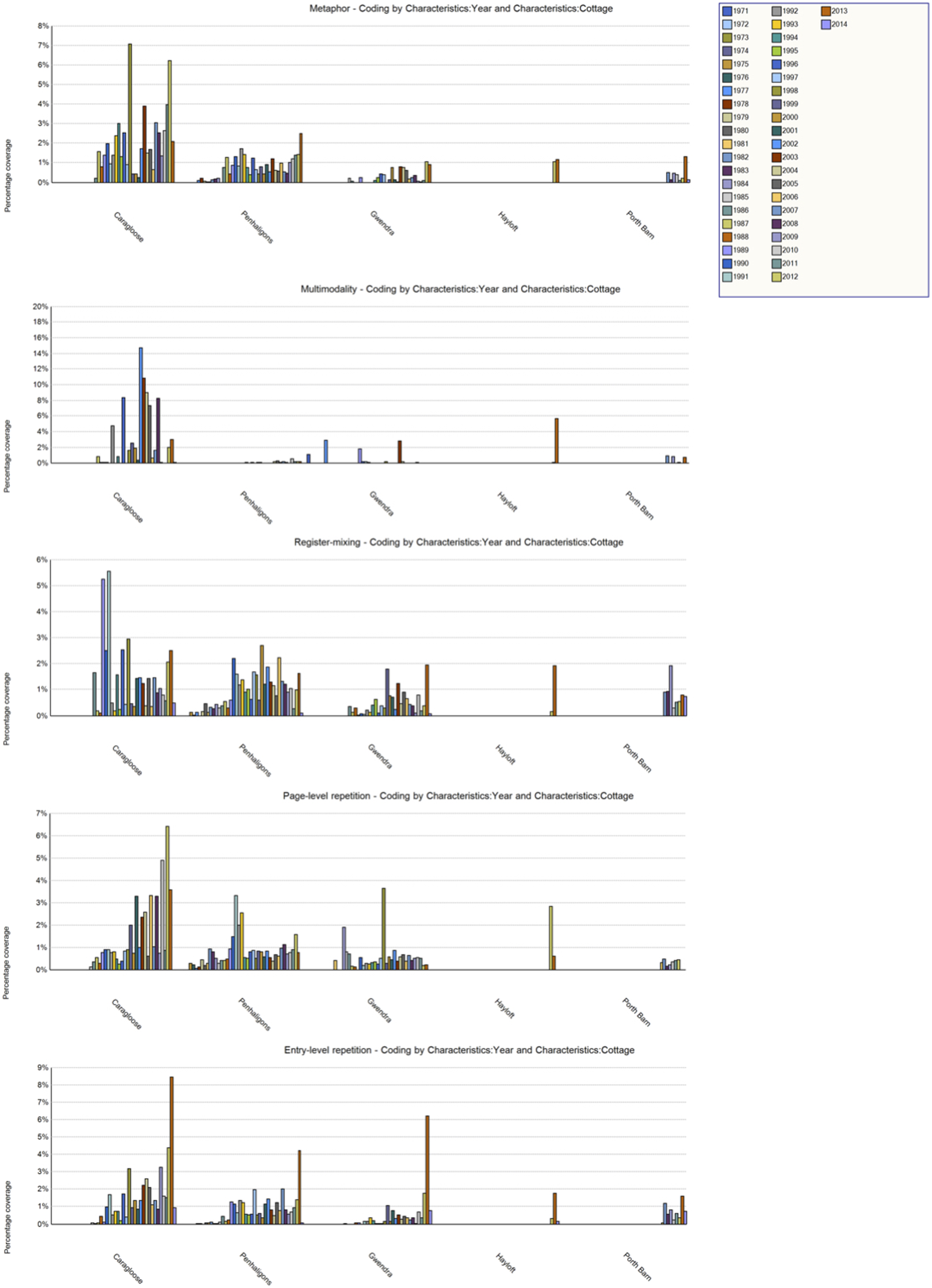
The other four cottages in this phase of our project barely contained any examples of multimodal creativity at all. Figure 5, however, shows a typical example from Caragloose, where one guest in 2004 filled an entire page of the book with a full colour sketch of the local landscape. Once again, the situated nature of the discourse is of paramount importance in the reception of this entry since anyone reading the guestbook within the cottage would recognise the picture to be a highly accurate representation of the view from the house across the garden to the sea. More important, however, is what the act of producing such a sketch communicates to the other participants in the discourse-world, not just about how the artist wishes to present themselves, but about what they assume about their co-participants. Full colour sketch in Caragloose guestbook.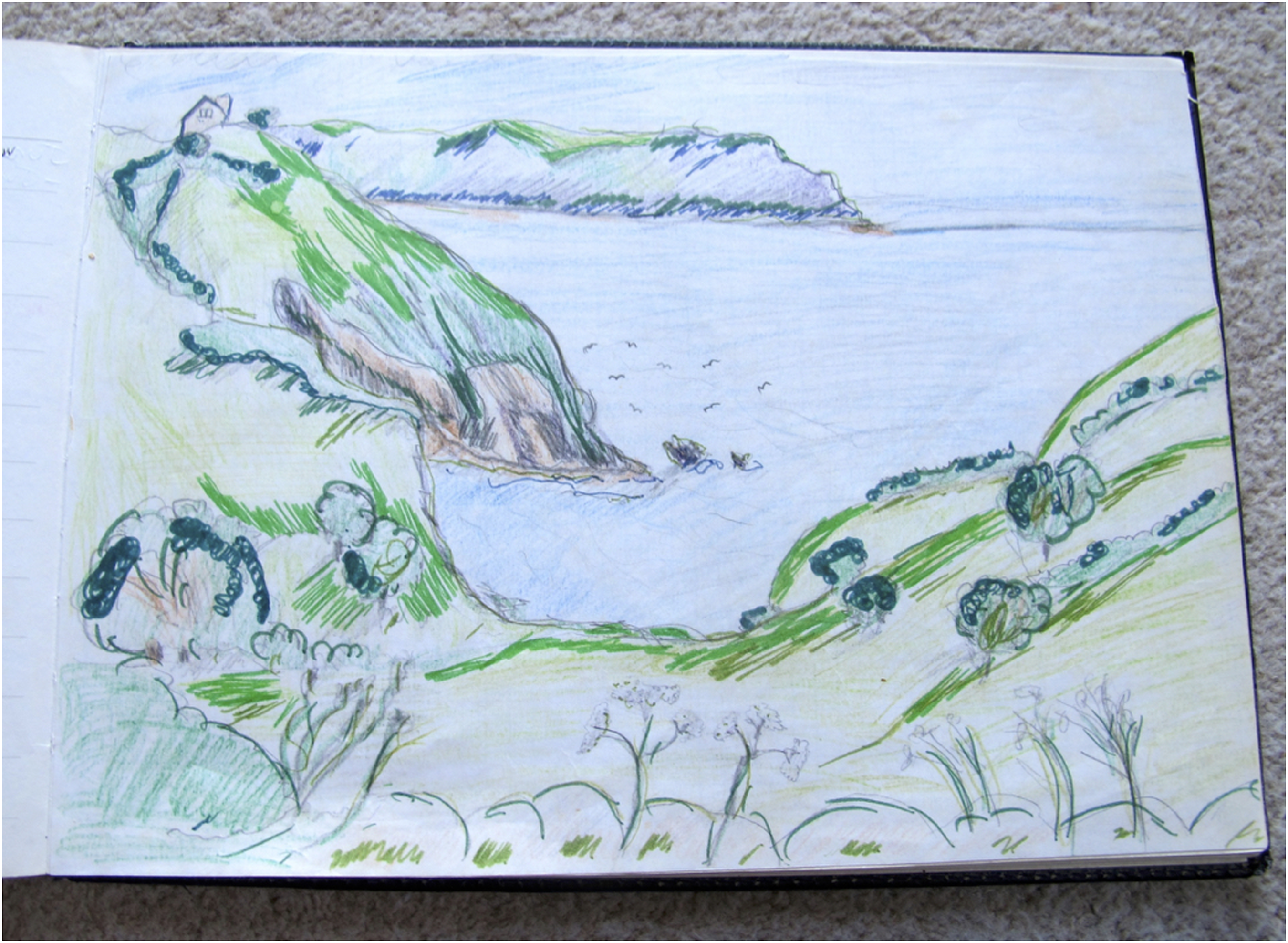
In Gavins and Whiteley (2019), we argued that all the communicative choices made by guestbook inscribers invite their readers to ascribe particular beliefs, opinions, values, and motivations to them, while at the same time revealing how the author conceptualises future visitors to the cottage. This two-way process of constructing the mental states of other people based on textual and other cues has been termed ‘mind modelling’ (see Stockwell, 2009) in cognitive stylistics. The inscriber responsible for the sketch in Figure 5 has invested what we can reasonably suppose was a considerable amount of time and effort in creating a piece of visual art in the guestbook – a guestbook, we should remember, which was originally designed simply to record people’s names, addresses, and the date of their visit. In so doing, they have made a presumption not only that such an artwork is an acceptable contribution to the overall discourse, but also that it will be appreciated by readers of the book. In this particular case, the inscriber does not include any text around the picture to make it clear who created it; although there are named and dated entries immediately preceding and following it, neither of them makes any reference to the picture. The artwork appears in the guestbook pages, therefore, as a discrete act of communication in its own right. We would furthermore argue that it presents its creator as a talented and cultured person, and that it shows their mind-modelling of future readers of the guestbook as similarly cultured and appreciative of visual art.
While there are no guarantees that the actual recipients of the entry will meet the expectations its author has of them, they have nevertheless chosen to design their contribution with an idealised conceptualisation of them in mind. This kind of careful recipient design (see Garfinkel, 1967) not only enables holidaymakers to perform certain identities through the language they use in the guestbooks, but also acts to form social and cultural connections across the temporal divide which separates each of the visitors to the cottage. Making assumptions about shared values, knowledge, and beliefs, and expressing these through the discourse of the guestbook is a highly socially cohesive communicative behaviour, which counteracts the otherwise insurmountably split nature of the discourse situation.
The effect that the recipient design of the guestbook entries has on minimising temporal as well as potentially social differences between the participants is nowhere made more apparent than in the creative discourse inscribers produce. In his study of everyday discourse, Carter (2004) observes that high levels of creativity in language are more likely to occur in certain communicative situations than in others. This is shown in Figure 6 (adapted from Carter) through a selection of typical types of interaction, separated according to their social contexts, where the more darkly shaded areas indicate an increase in the likelihood that linguistic creativity will be present. What is notable here is that, because the content of a guestbook’s entries is in great part based on the provision of information by participants who are unfamiliar with each other, it might be expected that the style of the language used in this situation would show only low levels of creativity. However, the essentially collaborative structure of the guestbooks themselves transforms the discourse from something which might otherwise be transactional and professional into a much more playful and creative style. Interaction types and linguistic creativity, adapted from Carter (2004).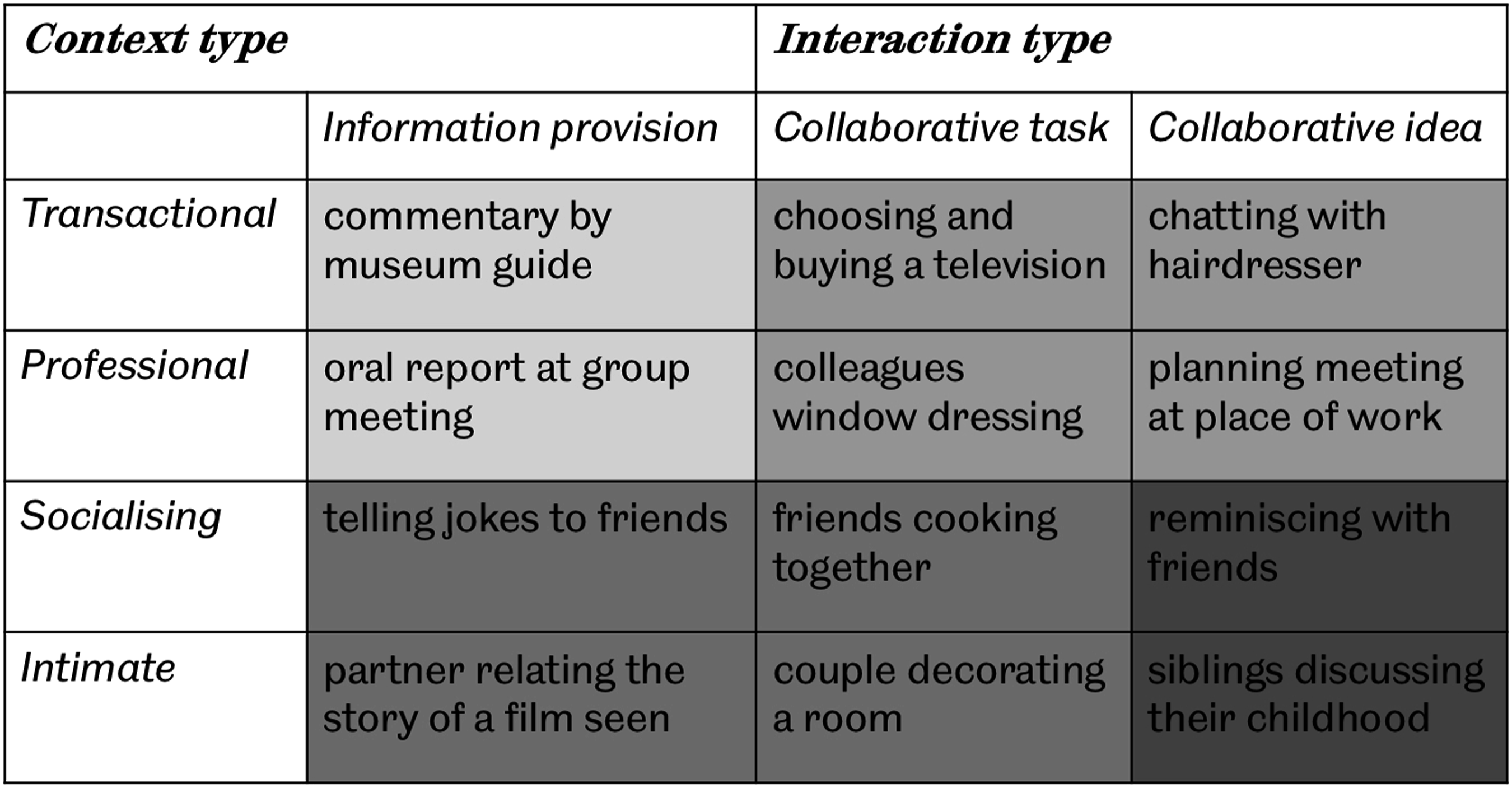
In Caragloose’s guestbooks, the density of creative linguistic features is high in comparison with all the guestbooks of all the other rental cottages in our study principally because of one collaborative endeavour in particular, which first becomes apparent in October 1985. Figure 7 shows two entries, the first of which states: ‘The best National Trust house we have stayed in. Very quiet and peaceful except for the spriggins’ late night knocking… The weather was good too.’ This is quickly followed by another guest the same month commenting: ‘An asset to the NT’s lettings. What are ‘spriggins’? We didn’t hear any’. The idea of ‘the spriggins’ is then swiftly taken up by other guests and gradually becomes involved in more and more of the house’s guestbook entries and in more and more creative discourse. In fact, from 1985 to 2014 the spriggins become the most frequent enactors to populate the text-worlds created by visitors to Caragloose, forming a cohesive connection across the majority of entries in the guestbooks and across the mental representations they produce. First appearance of the spriggins in Caragloose.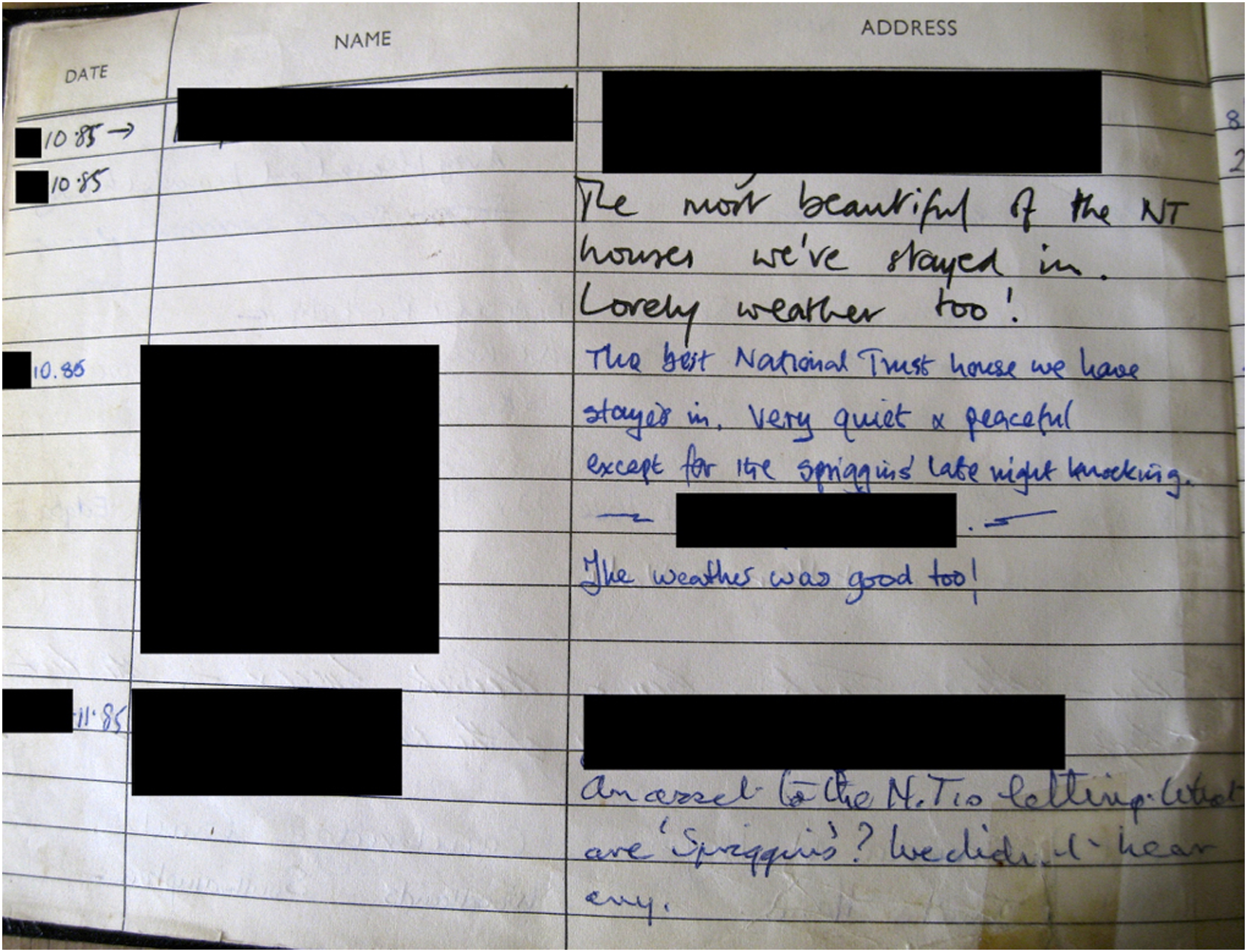
The collaborative creation of these creatures across multiple guestbook entries shows inscribers’ agreement on the following features of the spriggins: they are secretive and elusive creatures, who only come out at night; they are noisy and responsible for various creaks and bangs heard in Caragloose after dark; they are highly mischievous and can be destructive, responsible for breaking kettles, washing machines, and fridges, as well as moving visitors’ belongings so they cannot be found; according to some visitors, the spriggins like to party and have been known to steal alcohol and food
All of these traits emerge, not just from narratives which describe the visitors’ holidays in otherwise relatively plain terms, but also through much more experimental and creative discourse. One typical example of this from 1993 reads: After literally minutes of ceaseless toil and fastidious scientific research, spriggins located in front left ring of cooker. This would appear to be their main base and stronghold. If left undisturbed, no para-normal activity is observed. Have left a note for Mr and Mrs Pearson – hopefully spriggins will not send out a kamikaze squad on search and destroy mission. Oh, also spriggins do not like Redruth lager – but then neither do most humans. Totally overwhelmed by property and location, but underwhelmed by weather. 2nd NT holiday, by no means last.
Alongside the dramatic irony in ‘literally minutes of ceaseless toil’, this entry is full of highly creative register mixing. The inscriber here borrows military and scientific discourse (for example, in ‘main base and stronghold’, ‘fastidious scientific research’, ‘para-normal activity’, and ‘a kamikaze squad on a search and destroy mission’), while at the same time retaining other more typical discourse markers which keep the entry contained with the guestbook discourse genre. Such markers include the mention of the weather; the reference to the property managers (Mr and Mrs Pearson, at this point in time); the direct reference made to the National Trust; the deletion of personal pronouns and the evaluative coda used to close the narrative.
An even more creative entry centred around the spriggins can be seen in Figure 8, which provides pseudo-academic research on spriggins through the ages: I was greatly interested in the references to the ‘spriggins’ and have spent the week unearthing historical references to this strange phenomenon. In 1531 Nathaniel Bacon in his book ‘Goode Husbandrie’ wrote: ‘Knowest thou ye follie of persuing ye will o’ ye wispe Jack O’Lanthorne or ye spriggines’. In 1730 Daniel Defoe in his ‘Tour of Greate Britaine’ writes this on visiting Truro: ‘I have this daye heard mention of curious knockng without by the spriggins. I must confess I have not heard their like in other parts…’ William Cobbett also writes about spriggins in his book ‘Rural Rides’ published in 1836: ‘Tis a curious legend which local folk allude to with a glance over their shoulder. Spriggins pastiche.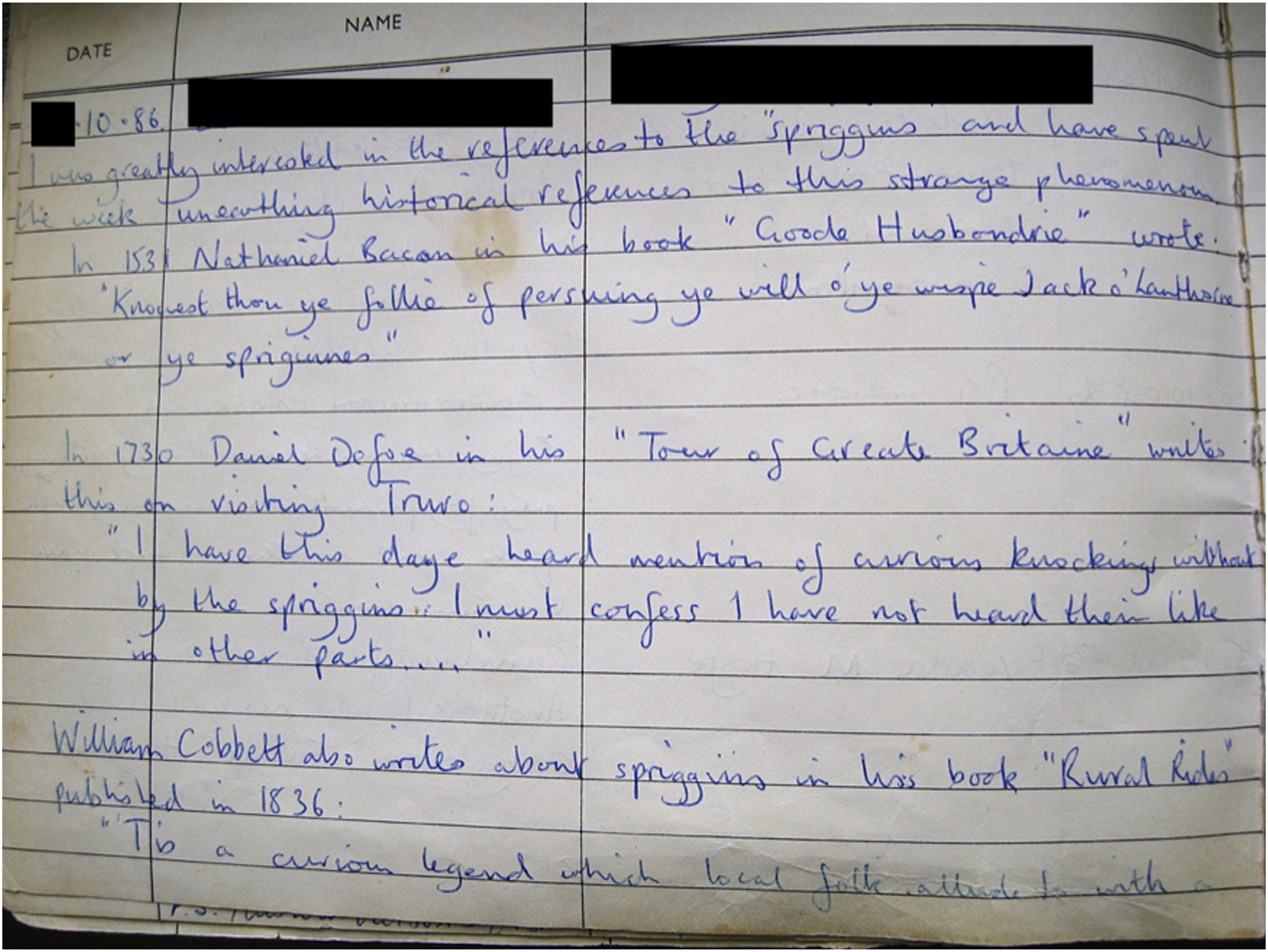
This carefully crafted pastiche not only makes use of archaic register (for example, in ‘ye’, ‘thou’, ‘knowest’ and so on), but even goes to the extent of enacting faux-language-change in the spelling of ‘spriggins’ between 1531 and 1836: the ‘es’ suffix is dropped in favour of ‘s’ alone between 1531 and 1730. The text-world structure of the discourse is also complex, since a text-world containing a first-person enactor of the inscriber is created first, in which this fictionalised version of himself embarks on historical research. This is followed by a series of embedded text-worlds, representing extracts from fabricated historical texts. Once again, the author of this entry is performing an identity – in this case as a well read, historically knowledgeable, but highly playful and clever traveller – as well as marking out an identity for his imagined ideal reader of the text. His stylistic choices reflect his mind-modelling of a future audience who will recognise the archaic register he replicates and respond positively to his skills of intertextual pastiche and playfulness.
A similar set of creative linguistic techniques can be seen at work in another entry from December 1989. This contribution to the guestbook at Caragloose extends over four full pages and begins as follows: HOWLING HAUNTINGS A report by our special on the spot correspondent. A National Trust spokesman tonight denied rumours regarding peculiar goings on at Caragloose Farmhouse, following allegations made by the [SURNAME] family of [PLACE OF ORIGIN]. [FIRST NAME], speaking on behalf of his family at a press conference at The Ship Inn, Portloe, told the landlord and I that the family had been the victims of paranormal phenomena during their Xmas vacation. The [FAMILY NAME] first became aware that all was not as it should be when large quantities of alcohol and a case and a half of phensic disappeared during the first night. They also complained that they suffered unexplained headaches and nausea the following morning. There was no escape even during the hours of daylight when hoards of spriggins assaulted the property from every angle. The spriggins were even accused of mounting an unsuccessful rescue attempt on the turkey – persistently trying to turn off the oven while [FIRST NAME] dozed in front of the fire.
There are numerous features of linguistic creativity here, most notably the alliterative headline ‘Howling Hauntings’, and the other register features borrowed from newspaper discourse, such as ‘on the spot correspondent’, ‘press conference’, ‘spokesman’, and ‘allegations’. The inscriber maps enactors of real-world people into the news-story text-world too, including members of their family and The National Trust as well. Once again, however, the author retains enough general markers of the guestbook genre to keep the discourse recognisable and to make the playfulness of the other features work. For example, proper names are used to refer to nearby real-world places, such as The Ship Inn at Portloe, a pub which features heavily in recommendations and commentary across all of Caragloose’s guestbooks. The entry also closes with an evaluative coda, which is separated from the main text by a spare line in the book and marked out with brackets: ‘(A superb holiday – we loved every minute of it. Beautiful scenery and walks. We would all like to come back here!)’.
The spriggins appear in Caragloose in otherwise conventional visitors’ reports of their holiday activities, in extended narratives, mock newspaper reports, visual art and collage, fake historical research, and numerous poems too: Candlelight wavered on each window sill Summoning spriggins from neighbouring hill A waxing moon hung from orchard’s bare bough The haunted eyes fixed on where you sit now. Then you wake in a sweat in the night’s quietest hour The sash windows shudder – resisting their power But somehow the evil has entered your head And into the darkness by hand you are led.
This entry, from 1998, is typical of several poems which appear in the guestbooks and which are often reminiscent of Christina Rossetti’s ‘Goblin Market’, with spriggins enticing visitors to the cottage to engage in mischief or follow them into the night. The direct address into the reader’s half of the split discourse-world is a particularly interesting touch here, with the second-person pronoun and proximal deixis in ‘where you sit now’ emphasising the poem’s situatedness and context-dependency. The phrase itself will clearly have a very different meaning for a visitor reading the poem in the guestbook in the cottage compared, for example, to a reader of Language and Literature encountering the text quoted in this journal article. The poem is playfully metatextual too. At this point in the evolving Caragloose collaborative discourse, the spriggins have been a prominent feature for 14 years and the reference to ‘resisting their power’ seems as much a reference to the urge to include them in an entry to the book as it is to the creatures themselves. Figure 9 is a graph showing the number of references to spriggins we coded per year of the guestbooks at Caragloose. As can be seen here, the peak of spriggins-based discourse came in 2000, with 16 separate entries making reference to these imaginary creatures in 12 months, while more recent entries show much lower levels of interest. References to spriggins in Caragloose guestbooks.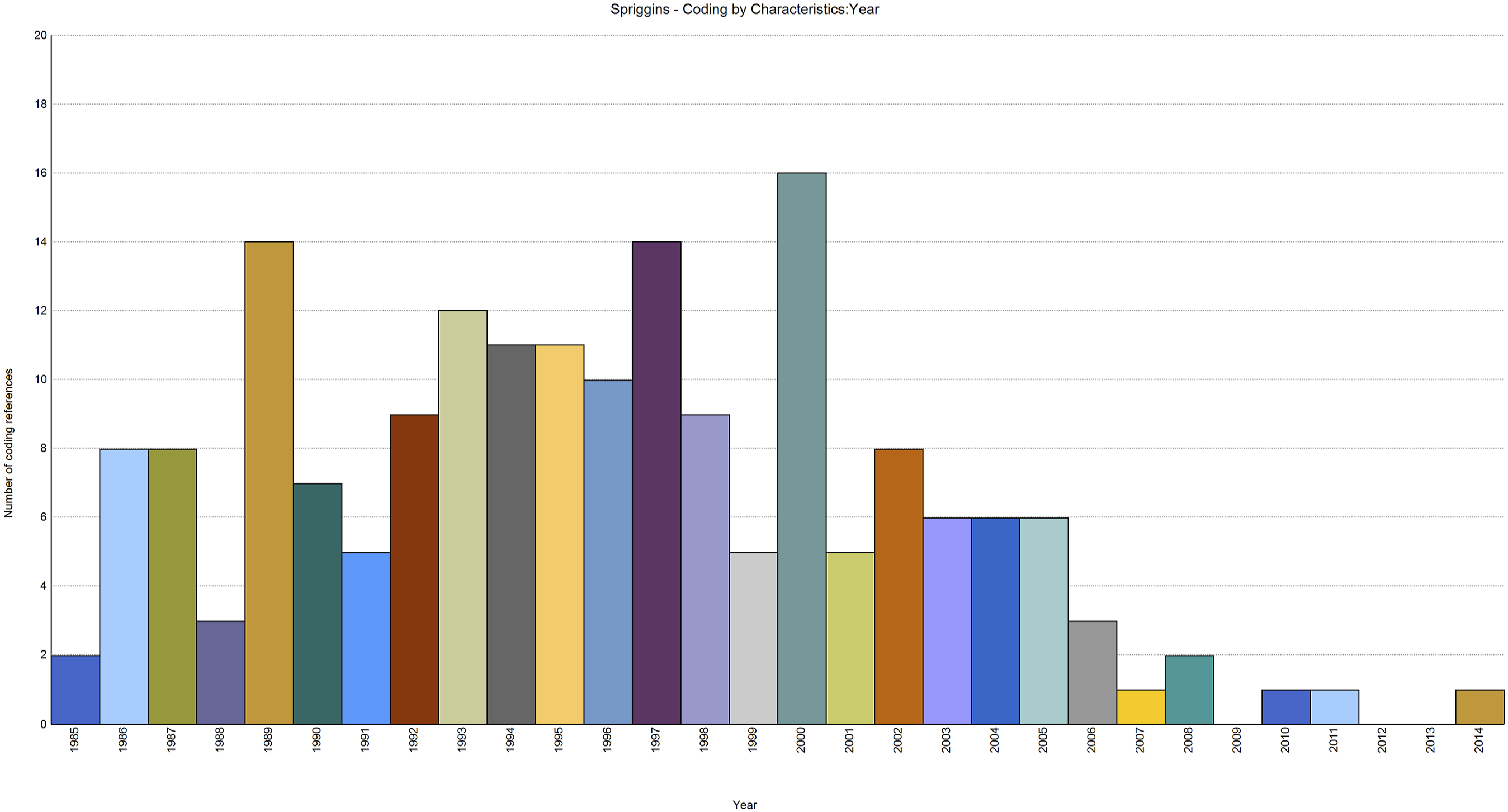
At various points during the waxing and waning of the spriggins’ appearances in Caragloose’s guestbooks, different contributors can be seen to encourage each other to continue their collaborative creative project. Figure 10 shows a key example of this. The poem here reads: I tried to see a spriggin here, I really thought I might, I even filled a Thermos flask And sat up all one night. On hearing eerie tappings once I crept to have a look I found a spriggin sitting Writing verses in this book. I crept up quiet behind him And, counting up to ten, I let him nearly finish Then I snatched away the pen- I could tell he wasn’t happy By his shouts in Sprigginese As he threatened to return and haunt The house, its barn and trees. So, reader, please be cautious My warning should be clear, Leave this book unattended And he’ll write ‘Spriggin woz ‘ere!’ Spriggins poem.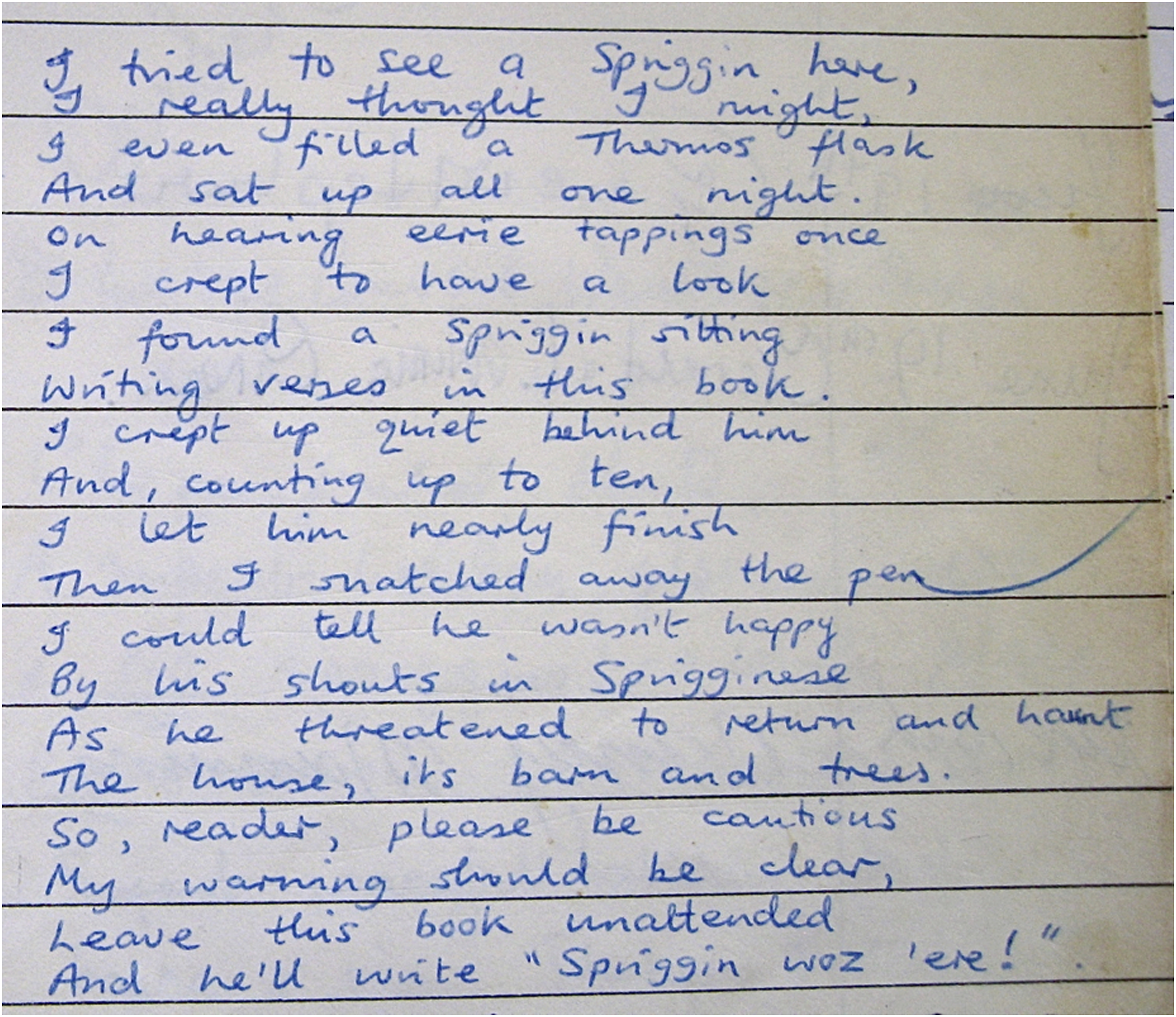
This entry is ontologically complex, having a circular narrative structure and enactors of the author, a spriggin, and the reader all included in the text-world. The separate entities of the author-enactor and the spriggin also become blended together in the twelfth line of the text, where the first-person narrator reports snatching away a pen, but the flourish at the end of ‘pen’ suggests this narrator may actually be the spriggin himself.
5. Understanding co-creativity in context
It is interesting to note that in most of the other rental cottages we have examined in our project, we have found that the most playful and experimental guestbook writing often appears to be done by children. Children are more likely to use multimodality in their entries, to play with fictionality, to create imaginary creatures, and so on. In Caragloose, by contrast, the collaborative construction of dozens of interconnecting text-worlds over a period of nearly 30 years is predominantly an adult pursuit. Not only is it clear from the handwriting, language, and complexity of the spriggin discourse in Caragloose that the majority of entries in which these creatures appear have been produced by adults, but the activities the spriggins are frequently described as engaging in – staying up late, drinking alcohol, partying, and so on – are also often adult in nature. The children in Caragloose tend to try to close the playfulness down, by comparison, pushing for narrative resolution through frequent demands to know precisely what or who the spriggins are (e.g. ‘What is a spriggin anyway??’, ‘Who are these spriggins? We didn’t see any’). It could even be argued that the drawings and collages depicting spriggins, such as those shown in Figure 11, which do seem to be created more by children than adults, are an attempt by these younger contributors to enforce greater stability on these mysterious figures. Their drawings are much more fixed, from this perspective, than the furtive and shifting textual representations being produced by adult inscribers in their poems, pastiches, and extended narratives. Spriggins children's drawings.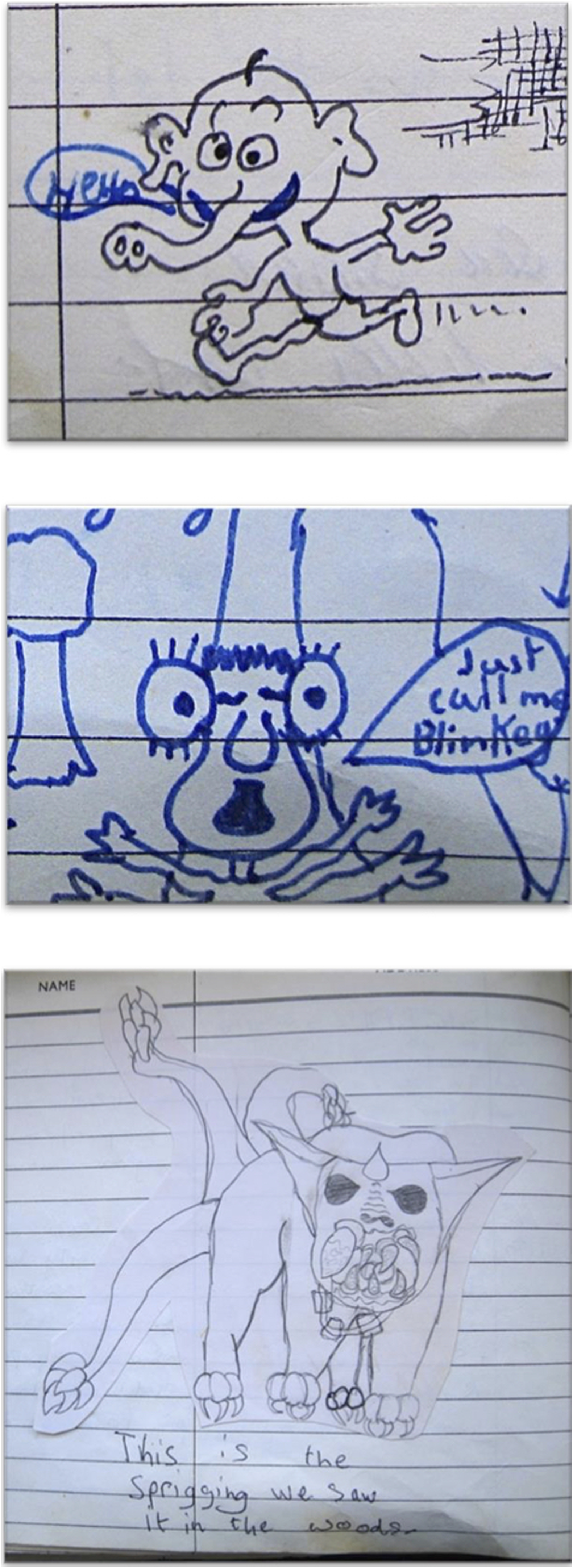
We saw in Section 3 that the discourse of holiday cottage guestbooks show levels of linguistic creativity that would more usually be associated with friends and family, interacting in a social or intimate situation, over a shared activity or idea (see Carter’s 2004 table, reproduced in Figure 6). We argued at this point that the similarly collaborative structure of a guestbook transforms its discourse from something which might otherwise be transactional into a much more experimental style. As soon as the guests in Caragloose start to take up the idea of the spriggins from its first creator and replicate it in their own entries, the discourse in this particular cottage’s guestbooks becomes an even more productive site for creativity. Every subsequent guest who adds to the collaboration further ensures its continuance and encourages yet more experimentation and playfulness from future inscribers. Essentially, the more creativity the shared discourse includes, the more likely that pattern will continue as the communicative situation develops.
There are additional factors to consider, however, in coming to a full understanding of how and why linguistic creativity occurs and often flourishes in holiday cottage guestbooks. Specifically, the discourse-world context surrounding the text of the guestbook is of paramount importance, as Edensor explains from the point of view of tourism studies: One of the effects of tourism is to mark out time, that of the extraordinary from the time of the mundane, a period of relaxation and play, which marks release from work and duty. These temporal conceptions of tourism involve notions about pleasurable activity and performance: the idea of letting go to reveal a more ‘authentic’ self… These notions incorporate ideas concerned with ‘letting your hair down’, ‘getting away from it all’, and ‘letting go’, a bundle of associations which assert the need to perform acts of excess and emotional and bodily release. (Edensor, 2000: 325)
In other words, the participants in the discourse-world of Caragloose’s guestbooks do not produce such unusually creative discourse simply because they are engaged in a collaborative textual endeavour. They do so because they are also engaged in the more broadly transgressive act of tourism. The pages of the holiday cottage guestbook not only provide inscribers with a rhetorical stage on which to perform their identities, but it is a stage which is removed from their everyday lives and crucially has the potential to be completely anonymous. In this situation of relaxation and play, inscribers in the guestbook are free, as Edensor puts it, to ‘let go’ of their usual existence and to be exuberant in a situation in which they remain disconnected from their co-participants, except through the discourse of the guestbook itself. It is clear from the data we have gathered and analysed in our project that, given this freedom, many participants embrace the opportunity to be excessive in their language use, as well as in their other tourist behaviour. Participants are at liberty to perform any identity they choose through the pages of the holiday cottage guestbook, and what they predominantly choose in Caragloose are identities which are at heart transgressive, inventive, and synergistic.
Footnotes
Declaration of conflicting interests
The author(s) declared no potential conflicts of interest with respect to the research, authorship, and/or publication of this article.
Funding
The author(s) disclosed receipt of the following financial support for the research, authorship, and/or publication of this article: This work was funded in part by The British Academy and The Leverhulme Trust [SG162480].
