



Abstract
This article contributes to empirical literary studies by offering a new reader response method for examining targeted textual features. With the aim of further establishing the new paradigm of reader response research in stylistics, we utilise a Likert scale – a tool that is usually used to generate data that is analysed quantitatively – to elicit qualitative data and, crucially, show how that data can be synthesised with an analysis of the primary text to provide empirically based conclusions relevant to particular textual features for cognitive narratology and stylistics. While we offer a new method that can be used to investigate textual features in all kinds of text, we exemplify our approach via the investigation of second-person narration in geniwate and Larsen’s digital fiction The Princess Murderer and provide a new understanding of the experiential nature of ambiguous forms of ‘you’ in fiction. Our stylistic analyses show how responses can be generated by linguistic features in the text. We then analyse reader responses to those examples and show that this can provide a more nuanced account of ‘you’ narratives than a stylistic analysis alone because it affords insight into how different readers do or do not psychologically project into and/or assume the role of ‘you’. Our results represent the first time that current typologies of the second person have been empirically tested and we are the first study to find an empirical basis for doubly deictic ‘you’. We therefore contribute a new empirically based understanding of how readers experience ambiguous forms of ‘you’ in fiction.
Keywords
1. Introduction: reader response research
Stylistics is defined by its commitment to the systematic analysis of literary texts, and this has always been inextricably linked to the role of the reader in the meaning-making process. Over the last few decades, against the backdrop of similar cognitive and empirical turns in the humanities more generally, we have seen the emergence of cognitive poetics, which synthesises stylistic analysis with insights from the cognitive sciences (e.g. Brône and Vandaele, 2009; Gavins and Steen, 2003; Stockwell, 2002) and, as we explore below, reader response data (e.g. Peplow et al., 2016; Whiteley, 2011).
Within the field of stylistics, critical engagements with empirical literary research more widely have tended to focus on the distinction between what Swann and Allington (2009) present as two opposing paradigms: ‘experimental’ versus ‘naturalistic’ approaches (see Peplow et al., 2016; Whiteley and Canning, 2017; cf. Peplow and Carter, 2014). According to this disciplinary conceptualisation, experimental studies, which are currently less common in stylistics, aim for maximum experimental controls, test hypotheses, often use quantitative methods, take place in a tightly controlled setting (usually in a laboratory with a researcher present), and may involve some manipulation of the text to isolate particular features and/or statistically analyse results (e.g. Kuiken et al., 2012; Miall, 2006; Van Peer et al., 2007). Naturalistic studies, on the other hand, are much more common in stylistics. Such studies seek maximum ecological validity by always presenting texts in their original form, using readers’ discussions about texts in their usual environment (typically a book group or online discussion), and use minimal researcher intervention. They generate verbal data that is almost always analysed via qualitative methods and sometimes includes ethnography (e.g. Benwell, 2009; Peplow et al., 2016; Swann and Allington, 2009; Whiteley, 2011). While ‘experimental’ and ‘naturalistic’ approaches are characterised as representing two opposing paradigms, we note that there are also examples of empirical research that combine the methods typical of each; questionnaires, for example, can be used to elicit data about a text that has been read in its original format (e.g. Kuijpers et al., 2014).
Clearly, both naturalistic and experimental approaches have advantages and disadvantages for researchers. While naturalistic studies can claim to offer the most authentic experience in so far as they target readers in their usual environment, as Peplow and Carter (2014: 449) note, ‘readers may not discuss the specific textual feature in which the researcher is interested’ so that, while the data may be plentiful, it may not actually be relevant for the original research aims. On the other hand, Hall (2008: 31) has criticised experimental studies for researching readers and reading under ‘atypical conditions’ that may not ‘tell us about the phenomenon it purports to’. From this perspective, the data may be relevant to the research question(s), but it may not reflect a naturally occurring reading experience and thus the validity of the results is questioned.
Despite the limitations of each approach, recent discussions about the value of empirical research for stylistics have been more open to a range of methodologies and methods. In the introduction to a special issue of Language and Literature on ‘Reading in the Digital Age’, Allington and Pihlaja (2016: 205) state that ‘this special issue is motivated by the conviction that diverse methodological approaches can and should be brought together to understand reading and interpretation’, thus recommending an inclusive approach to empirical literary study. In their special issue, ‘Stylistic Approaches to Reader Response Research’, Whiteley and Canning (2017: 72) similarly encourage the use of both experimental and naturalistic methods, but they also argue that the way empirical research is used in stylistics is distinctive. They define reader response research in stylistics as ‘a developing strand of stylistic research that gives equal attention to the text and data evidencing the text’s reception’. They further suggest that it is: …characterised by the application of … [reader response] datasets in the service of stylistic concerns in order to contribute to a stylistic textual analysis and/or wider discussion of stylistic theory and method … [and] enables the testing and development of stylistic methods and theories (2017: 73).
What distinguishes reader response research in stylistics from other forms of empirical literary research, therefore, is both the commitment to close textual analysis – be that the primary text and/or the reader data – and the use of reader response research in the development of stylistic theories, methods, and analyses.
While methodological flexibility may well be productive in so far as it opens up the potential for methodological, analytical, and theoretical insights, reader response research in stylistics – at least as defined by Whiteley and Canning (2017) – has largely been dominated by naturalistic approaches in which verbal data from reading groups (e.g. Bell et al., 2018; Canning, 2017; Peplow et al., 2016; Whiteley, 2011) or internet-based discussions (e.g. Gavins, 2013; Nuttall, 2017; Whiteley, 2016) is analysed qualitatively (but see, for example, Castiglione, 2017; and Kuzmičová et al., 2017 for exceptions). This is perhaps because naturalistic studies are better suited to generating data about larger, more complex literary concepts (e.g. metaphor, empathy, immersion) that are typically the focus of cognitive poetically driven studies. However, what is more difficult to generate in a naturalistic study is verbal data about a particular stylistic or linguistic feature. Naturalistic studies allow readers to determine the focus on the discussion and, while participants can be gently encouraged to discuss particular themes or elements in a text (cf. Whiteley, 2011), their discussions are unlikely to be consistently focussed on how a particular stylistic feature contributes to the text.
The methodological distinctions outlined so far might suggest that it is not possible to elicit data about a particular stylistic feature without exclusively utilising experimental methods – such as numerical scales and statistical analysis – in which the complexity of the response to that feature can be lost (cf. Hall, 2008: 22). In what follows, however, we offer a new mixed methodology that utilises a quantitative tool traditionally associated with experimental approaches – a Likert scale – to elicit rich verbal data about a pre-defined textual feature in a naturally occurring, authentically presented text. Thus, rather than perform a statistical analysis on quantitative results from that Likert scale, we instead use them to generate discussion about that feature. The resulting verbal data is analysed qualitatively to demonstrate the nuance of the reader’s response to a particular stylistic feature and thus the complexity of the stylistic feature itself. We therefore show that experimental settings can be useful generators of data that can be analysed qualitatively. While we acknowledge that the ecological validity of an experimental approach has its limits, the advantage of our method over naturalistic approaches is that multiple readers can be prompted to respond to the same specific textual features. Similarly, while we recognise that the qualitative analysis of verbal data means that we do not produce a statistical analysis, there is an advantage over strictly experimental approaches in that we are able to pay more attention to the nuance of individual response. In the study reported below, we focus on the use of ‘you’ in a digital fiction, but we suggest that our method could be used to investigate other types of textual features in any kind of text. In the spirit of the emerging field of reader response research in stylistics, we offer a new empirical method, provide analyses of a fictional text and reader response data, and show how our results provide an empirical basis for but also challenge current theories of narrative ‘you’.
2. Narrative ‘you’
‘You’ is a referentially ambiguous pronoun. In English, it homonymically references male and female as well as singular and plural addressees, but it can also be used as a generalised pronoun replacing ‘one’. It can therefore refer to numerous referents individually or simultaneously. The referential and deictic ambiguity of ‘you’ is reflected in numerous narratological typologies and/or terminological distinctions that have been developed to account for the second person in both print and digital fiction (e.g. Bell and Ensslin, 2011; Kacandes, 1993; Richardson, 2006; Walker, 2000). As we have shown in previous research (Ensslin and Bell, 2012), Herman’s (2002) five-fold typology is the most comprehensive in so far as it incorporates and/or extends other typologies of ‘you’ and thus captures the full deictic range of ‘you’ in a literary context.
Herman distinguishes between ‘address you’ and ‘referential you’. ‘Referential you’ can refer to a fictional entity (as opposed to a direct address) and can be either an ‘impersonal or generalized’ (2002: 340) collective audience. Alternatively, ‘referential you’ can take a form of a narrator referring to him/herself with ‘you’ or to a character in the storyworld (arguably the protagonist) as if to replace what would by default be a third person narrator. Herman uses the example of the narrator/protagonist of Edna O’Brien’s A Pagan Place, who refers to himself in the second person. Herman’s ‘address you’ category may be directed either at another character in the narrative as in ‘fictionalized address’ (341), or indeed the extradiegetic reader in the form of ‘actualized address or apostrophe’ (2002: 341). Finally, Herman shows how ‘you’ can be used to refer to both a fictional and a real addressee simultaneously, producing what he calls ‘double-deixis’, in which ‘you can induce hesitation between … reference to entities … internal to the storyworld and reference to entities … external to the storyworld’ (2002: 338). Clearly, this last category is the most referentially complex because of its hybrid nature.
Herman’s typology captures the complexity of ‘you’ in its ability to refer to or address characters and readers or both, but like other narratological typologies of ‘you’, it has not been empirically tested. Indeed, while there is general theoretical agreement that when used in fiction, ‘you’ likely prompts readers to feel directly addressed by the pronoun to various degrees (e.g. Fludernik, 1994; Herman, 2002) and that ‘you’ encourages stronger reader-identification with the textual construct designated by the ‘you’ than the use of ‘he’ or ‘she’ in third person narrative mode (e.g. Sanford and Emmott, 2012), relatively few studies have tested reader engagement with ‘you’ in fiction.
Brunyé et al. (2009) and Ditman et al. (2010) have compared reader responses to first, second, and third person short narratives, created for the experiment, by measuring comprehension in terms of response times and memory. Both studies reported higher levels of comprehension when the second-person form was used, with Brunyé et al. (2009: 30) concluding that ‘a second-person pronoun consistently … cued an embodied perspective’. Using longer already existing (rather than artificially created) texts, representative of ‘a more realistic reading environment’ (Brunyé et al., 2011: 661), Brunyé et al. (2011) tested reader responses to excerpts from second- and first-person literary narratives, shown either in their original or adapted form. The authors found that ‘when stories use a second-person narrative perspective, readers’ mental representations of space and emotion are relatively vivid and internalised’ (Brunyé et al., 2011: 663) and that ‘readers internalise described emotions and develop congruent emotional states, in terms of both affective valance and arousal, when they imagine themselves as a described protagonist’ (Brunyé et al., 2011: 663). In contrast, Macrae’s (2016) experimental findings of the relationship between ‘I’ or ‘you’ narration and readers’ perspective-taking within imaginative conceptualisations of a fictional narrative scene suggest that reader-identification with the textual constructs designated by these pronouns do not differ significantly, but that both ‘I’ and ‘you’ have ‘immersive, identification-inducing powers’ (Macrae, 2016: 65).
Overall, previous studies largely show that readers are likely to adopt a first-person, internal perspective when reading texts that use ‘you’ in both single-sentence texts and texts that use extended second-person narration. While these findings provide an important empirical basis for literary scholars, there are no empirical approaches that combine narratological and stylistic analyses of ‘you’ with reader response data for naturally existing print or digital literature.
3. Our reader response method for ‘you’
Building on the empirical studies outlined above, which demonstrate that readers do experience an embodied response to second-person narration, our research aims to explore whether reader responses to textual ‘you’ can be categorised according to existing narratological categories, and also what the reader responses reveal about second-person narrative that is not captured in these typologies. Our reader response methodology is grounded in Bortolussi and Dixon’s (2003: 37) psychonarratological distinction between ‘textual features’, which are ‘objective and identifiable characteristics of the text’, and ‘reader constructions’, which are ‘subjective and variable’ responses to the text. We maintain that the function of a textual feature – in this case ‘you’ – can be identified systematically via stylistic analysis of the text, but that readers’ responses can also be analysed stylistically to show how that feature is conceptualised. Our research questions were: to what extent do readers feel addressed by the ‘you’s in the fiction? If readers do feel addressed, to what extent do they identify the ‘you’ as themselves as a reader, as a character that is not them, or as a combination of both? To what extent do reader responses to ‘you’ in digital fiction support or contradict current theories of narrative ‘you’?
To answer our research questions, we investigated responses to The [Somewhat Disturbing but Highly Improbable] Princess Murderer by geniwate (sic) and Deena Larsen (2003) (henceforth TPM), a hypertext fiction produced in Flash software and published on the web. Since readers are inherently involved in the construction of digital narratives, ‘you’ is a particularly prevalent and deictically significant feature in numerous types of digital fiction (see Ensslin and Bell, 2012). As an example of a ‘born digital’ fiction (see Bell et al., 2014: 4), TPM is comprised of lexias – individual screens of text shown one-at-a-time – which are connected by hyperlinks. It thus follows a hypertextual structure, allowing readers multiple pathways through a multimodally designed text. Readers navigate by clicking hyperlinked buttons on the top-right of the interface and the text has no definitive ending.
TPM is a remediation of the Perrauldian ‘Bluebeard’ fairy tale (‘La Barbe bleue’, originally published in 1697) from a feminist angle. Thematically and stylistically, TPM mixes elements of the romantic fairytale, the crime mystery, and pornography, and it strongly alludes to and critiques the attitudes of hard-core gamers who blindly shoot and kill in-game characters and willingly accept the victimisation and marginalisation of female characters in mainstream videogame titles. Bluebeard is represented in TPM as a stereotypical Manichean villain, thus reiterating the binaries (e.g. good vs. evil) underlying many videogames. The original tale assumes a moral position in shifting the blame for the murders onto the princesses themselves, who all disobey Bluebeard’s order not to enter the ‘forbidden room’.
In previous research (Ensslin and Bell, 2012), we argue that TPM uses an intermittent second-person narratological point of view alongside a distinct form of interactivity to draw the reader into the storyworld, making them feel at least partly complicit in the murders. This is because in addition to the use of narrative ‘you’, every mouse-click triggers the sound of a woman’s sigh, a continually recurring auditory signal which suggests that readers are responsible for their deaths. A so-called ‘Princess Census’ also measures how many princesses are in the castle at any given time by responding to the reader’s mouse-clicks. The research in this article builds on that analysis by empirically testing those previous theoretical claims.
To investigate the extent to which readers feel addressed by ‘you’ in TPM, we designed a study around Herman’s typology and specifically the categories that contain some form of address: fictionalised address, actualised address, and double-deixis. The second person’s inherent referential ambiguity as a special case of person deixis (Herman, 2002: 332) should, in theory, cause readers to reposition the referent of at least some ‘you’s flexibly between the virtual and actual world, between intra- and extradiegesis, and between the protagonist, characters, narrator, narratee, implied reader, and actual reader. In line with existing narrative theory, which suggests that ‘the adoption by any actual reader of th[e] communicative “you” role will be easiest if … his or her specified properties do apply to the actual individual’ (Margolin, 1990: 439–440), readers should also feel addressed by ‘you’s that have attributes relevant to them and less so by those that do not. However, given the deictic complexity of the pronoun, we expected that the responses would be more complex and diverse than the theory suggests. Our hypothesis was therefore: readers will feel addressed by the ‘you’s in the text that they feel represent them, but they will resist the reference of those that do not.
4. The protocol
The reader response study involved 16 readers who were all English students at Sheffield Hallam University, UK. All participants had some level of familiarity with digital fiction and/or had read some digital fiction before 1 so as to minimise any potentially alienating effects experienced by novice readers. In terms of the stimulus, we showed the text to readers screen by screen. One of the fortuitous benefits of using hypertext fiction in a reader response study is that the texts naturally exist in fragmented form. Hence, the researcher does not have to artificially fragment the text into smaller chunks for the study, thus preserving a relatively authentic reading environment while also allowing small chunks of text to be isolated for analysis (cf. Miall and Dobson, 2001). The fragmented form of TPM does, however, offer some logistical challenges because it is also multi-linear. Isolating a consistent ‘textual feature’, that is, ‘an enduring property of the text [that] does not vary with the reader or the reading situation’ (Bortolussi and Dixon, 2003: 39), can be more difficult.
In his empirical study of multi-linear hypertext fiction reading, Gardner (2003) found that very few screens were shared across hypertext reading sessions by different readers. Given that TPM is also a multi-linear text that can be read in different orders by different readers, we could not rely on an authentic free reading section to produce a comparable data set. We therefore used a structured stimulus set to gather the reader response data. Screenshots of TPM were put into a hyperlinked PowerPoint presentation and shown to readers in a slideshow as though they were being shown in the original web version of the text; for example, areas of the screen were hyperlinked as in the original and mouse-clicks progressed the narrative. Crucially, while the sequence of lexia presented in the structured reading was constructed for the study, it was adapted from a reading that could have plausibly taken place, so, while it was artificially constructed, it did represent a typical sample of lexias that readers might experience in their own reading in a feasible order.
The textual stimulus comprised 30 screens in total and readers were told to read the text as normal, but that the researcher would stop them on particular screens to ask them about particular ‘you’s. During the study, readers were asked about 19 individual ‘you’s across seven lexias (so approximately 23% of the stimulus was tested) and these examples were chosen to test a comprehensive range of different types of ‘you’ as defined by Herman’s typology. The study design thus aimed at some ecological validity in terms of preserving a semblance of the fragmented reading experience of digital fiction, but we also recognise that the situation was artificial in terms of the researcher’s involvement.
When participants reached one of the 19 tested screenshots, they were asked to indicate their answer to the question ‘To whom does “you” refer in this screen?’ on a pen-and-paper-based multi-point response scale designed to measure their response to ‘you’ (example given in Figure 1). 2

Likert scale used in the ‘you’ study.
In advance of their reading, participants were given definitions of each point on the scale. The researcher stated that: ‘A’ means ‘you’ is a fictional character so the ‘you’ refers only to a character; ‘E’ means ‘you’ is me the reader, so is referring to you as the reader of the fiction; ‘C’ means that ‘you’ refers both to you as the reader and to a fictional character at the same time; it’s half you as reader and half a fictional character. B means it’s also a mix, but it is more a fictional character than you as reader. D is also a mix but is more you the reader than a fictional character.
In terms of Herman’s typology, ‘A’ represents fictionalised address, ‘E’ represents actualised address and ‘B’, ‘C’, and ‘D’ represent various compositions of double-deixis. Participants were also told that they could put their selection somewhere else on the scale if they wanted to, but very few participants did so and, if they did, we will refer to this in the analyses.
While we were working within an experimental paradigm in so far as we tested a pre-defined feature via a Likert scale in laboratory-like setting, we also recognise that quantitative research alone cannot capture the complexity associated with the processing of narrative ‘you’. Therefore, once participants placed a mark on the scale, they were then asked to explain their choices according to a consistent set of questions. If they chose ‘A’, they were asked: ‘Why do you think it is a fictional character?’ followed by ‘Who is the fictional character?’ followed by ‘How does that make you feel?’ If the answer was ‘B’, ‘C’, or ‘D’ they were asked: ‘Why do you think it is both character and reader?’ followed by ‘Who is the fictional character in this case?’ followed by ‘How does that make you feel?’ If the answer was ‘E’, they were asked: ‘Why do you think it is you as a reader?’ followed by ‘How does that make you feel?’ Occasionally, follow-up prompts were used to stimulate further explanation.
The combination of conceptually quantitative (i.e. marking on the ‘you’ Likert scale) and qualitative (i.e. follow-up questions) methods allowed us to interrogate the reader responses comprehensively. As Messenger Davies and Mosdell (2006: 33) suggest, ‘[qualitative] comments … act as a further reliability check on the numerical information in the questionnaire answers … and … provide extra, more nuanced and personalised details to augment or explain this information more clearly’. Thus, the quantitative marking on the ‘you’ scale allowed an understanding of where readers placed the ‘you’ on the cline, but this was done primarily to elicit qualitative interview data about the nature of that conceptualisation of ‘you’.
5. Analysis
In what follows, we focus on two lexias that generated particularly diverse responses from the participants and that suggest that the fictional narrative contains particularly ambiguous forms of ‘you’. We offer stylistic analyses to show how readers are positioned in the text via textual features according to narrative theory. We then compare our stylistic analyses with reader responses and consider how those responses might provide different or new insight into how readers process and respond to identities expressed via narrative ‘you’.
5.1 Example 1: ‘you’ as sadomasochistic torturer
Figure 2 shows the 12th lexia in our manipulated text stimulus, in which the two different occurrences of ‘you’ were tested. At this point in the structured reading, readers will know that Bluebeard kills princesses, that a detective is trying to solve the case, and also that ‘you’ could be one of three different characters: ‘Perhaps you are Bluebeard, or perhaps you are a princess. Perhaps you are a detective, come to solve the case’. Readers have been told that ‘with each click, a princess dies’ and also that ‘the conjunction between “you” and Bluebeard grows stronger’. Thus, the text consistently tries to position readers as ‘you-as-Bluebeard’ or at least as responsible for the princesses’ murders. When the reader gets to the text shown in Figure 2, they will have been clicking the mouse and hearing a princess sigh for some time.
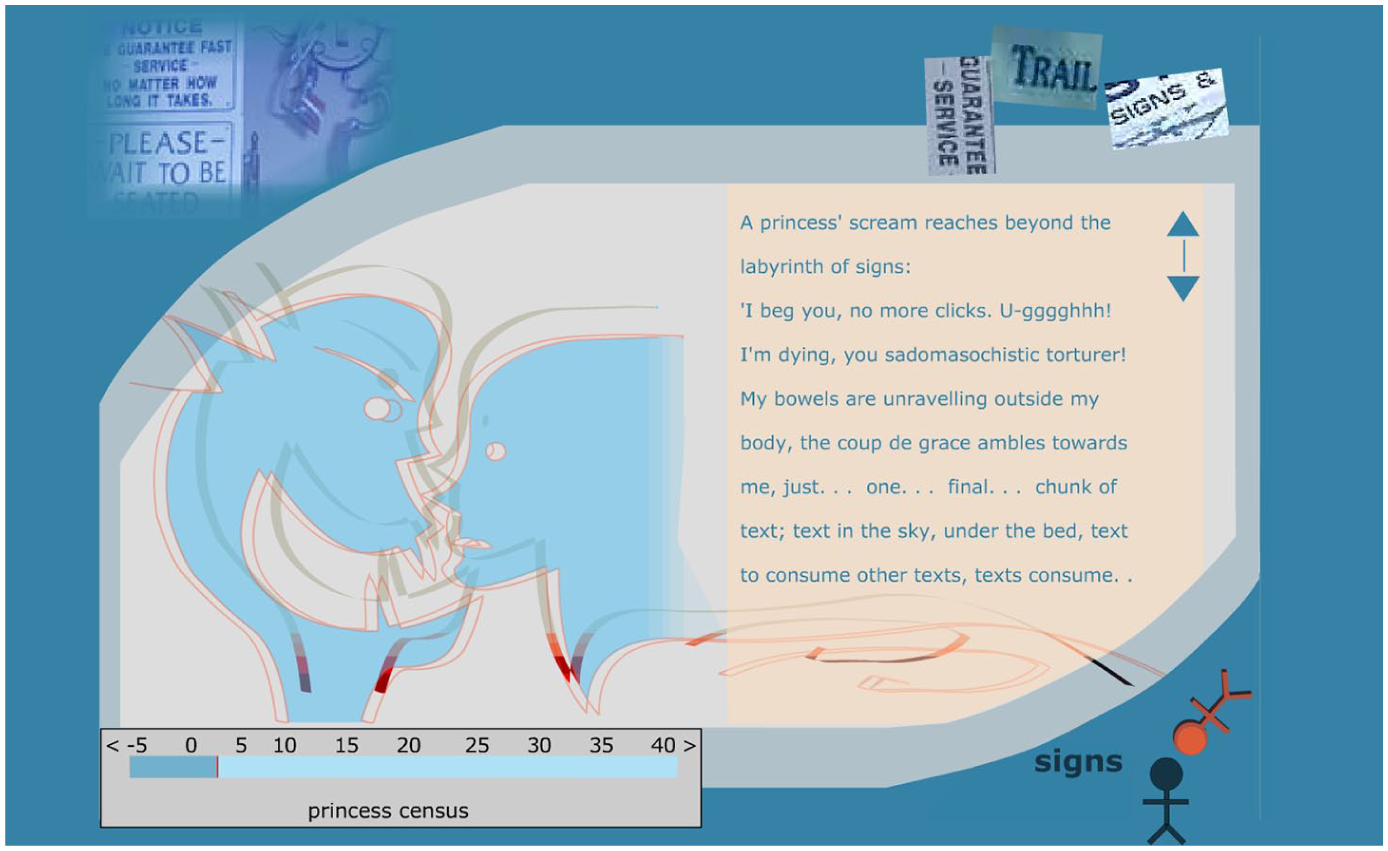
‘I beg you’ lexia.
The text shown in Figure 2 is largely comprised of direct speech which the extra-diegetic narrator reports as a ‘scream’ uttered by one of the princesses. The princess begs for ‘no more clicks’, which self-reflexively references the way in which the reader clicks the mouse, resulting in the death of a princess each time. That the screams reach beyond a ‘labyrinth of signs’, which alludes to the hypertextual structure of TPM, also implies that they can be heard outside of the text. The syntactic construction ‘I beg you’, which puts the ‘you’ in the object position, explicitly sets up a dialogue between the princess and an unnamed addressee. However, the fact that the reader is responsible for the clicks means that she or he might more easily identify with the ‘you’ here. The use of the ‘you’ as subject in ‘you sadomasochistic torturer’ should be more difficult for readers to identify with, because it involves them accepting the (sadomasochistic torturer) identity that the princess allots them, which we would assume is uncomfortable for them to adopt.
Readers negotiate their identification with the second-person pronoun in lexia 12 using the full range of the scale. Their Likert scale responses, which are presented in Table 1 for clarity, vary considerably.
Collated responses to the ‘you’s in Lexia 12.

As Table 1 shows, the equal spread of these responses over the two extremes of the scale seems not to indicate a strong trend and can instead be seen to illustrate the inherent ambiguity of the second-person address in The Princess Murderer specifically, if not, as indicated in theoretical analyses of the second-person pronoun, more generally.
Most participants that chose ‘E’ on the scale for this first ‘you’ in the lexia explain they have done so because they are the ones performing the action of clicking (4 out of 5). They feel that they are ‘you’ because they are performing a role that the text describes. Those that have chosen ‘A’ refer mainly (3 out of 5) to the direct speech of the princess by way of argumentation, but also list non-identification with the ‘you’ and their own involvement in the plot as a fictional character as reasons for opting for ‘you’ as a fictional character. Lauren,
3
for example, who opted for A, explains her choice as follows: 117 Lauren: Um, yeah it’s more like A 118 Researcher: Okay, so um why do you think it’s a fictional character? 119 Lauren: Because a fictional character is speaking 120 Researcher: Okay 121 Lauren: Like that’s speech from a fictional character, so– and they’re obviously not speaking to me
The intonation of Lauren’s use of ‘like’ (line 117) suggests she uses it as a discourse marker, rather than a comparator. Like most others who marked A, she justifies her choice on the basis that the ‘you’ refers to the direct speech of the princess, and consequently the ontological impossibility of a character speaking to a reader means she is not being referred to by the pronoun. Somewhat paradoxically, however, she also implicitly recognises that she is at least partially addressed: 122 Researcher: Okay, so to whom are they speaking? 123 Lauren: The character that I’m supposed to pretend to be
In the above exchange, Lauren states that ‘you’ refers to ‘the character that I’m supposed to pretend to be’, suggesting that the ‘you’ here is not purely a fictional character (as in their A mark on the Likert scale). Lauren’s use of the modal phrase ‘I’m supposed to pretend to be’ suggests an unrealised state of affairs in which obligation (‘supposed to’) plays a role. With the verb ‘pretend’, she further distances herself from the possibility that she could be a person killing princesses, emphasising the fantastical element of the narrative instead. While she recognises that she does not accept the actions associated with the ‘you’ and therefore argues that the ‘you’ does not refer to her, she simultaneously recognises that she feels as though she is meant to take on a fictitious role of this character ‘you’. Thus, while Lauren selects ‘A’ on the Likert scale, her verbal justification suggests that she thinks of the ‘you’ as having more than one addressee and what we define in our stylistic analysis as doubly deictic (Herman, 2002), referring both to someone in the actual world (Lauren) and in the fictional world (somebody accidentally killing princesses) at the same time. However, her discursive rejection of this identification with the character also problematises the idea that she is that character.
The participants’ Likert responses to the second ‘you’ of lexia 12 are also diversified, although the majority of participants tended to opt for ‘you’ as fictional character or ‘you’ as a mix, but more a fictional character than a reader (see Table 1). Participants provide various reasons for their quantitative positioning. Whereas a number of participants seem to feel that because they have accepted that they are performing the action of clicking, they are also the ones being referred to as ‘sadomasochistic torturer’ (e.g. Gargi, line 172), others argue that ‘you sadomasochistic torturer’ addresses ‘you’ as a reader and ‘you’ as a fictional character as separate entities (e.g. Thomas, lines 235–252). Others find that the ‘you’ has become an ‘amalgamation of [themselves] and Bluebeard’ (e.g James, lines 275–276) where they have been ‘cheated into being Bluebeard’ or now are ‘the character Bluebeard now, [killing] on purpose’.
The ways in which participants negotiate the possibility that they could be Bluebeard, and the responsibility this gives them over killing princesses, is illustrated below by Lewis: 228–229 Researcher: So for eight you put D, so why do you think that it’s both a fictional character and you as the reader? 230–231 Lewis: Yeah… it’s me who’s (2) con– consuming the text and that seems to be what’s torturing her 232 Researcher: Mm 233 Lewis: Is that the more the story goes on, the worse it– the worse it gets for her 234 Researcher: Mm-hm 235–238 Lewis: But at the same time it’s uh– I can’t sort of take the full (3) uh sort of responsibility for it when I know that there’s another character within there who’s um– who is tor– like who I can see is torturing her and like the image on the left as well there’s another– there’s two characters there
Here, Lewis argues that he cannot take ‘full responsibility’ (lines 235–238) for ‘torturing’ (lines 235–238) the princess, and relies on epistemic modality (‘I know’, lines 235–238) to highlight that another character is involved who is committing the act of torturing the princess (‘there’s two characters there’, lines 235–238). James, on the other hand, lessens his responsibility for Bluebeard’s actions by discursively diminishing his own agency and negatively evaluating the act of clicking and having become Bluebeard, thereby distancing himself from this character.
260–267 James: …the game and the world of clicking have become the same… world [now], which is not what I wanted to happen… So, yeah, it makes me feel really guilty, being called a sadomasochistic torturer, so… is that you as a reader, you as a character… bit of both, I suppose, I’m now C 268 Researcher: So eight is C, so who’s the fictional character 272–298 James: …You is me, but I am now implicitly being– it’s being suggested that I am a bit like Bluebeard I’ve become Bluebeard, uh so you is both, it’s a– it’s an amalgamation of me and Bluebeard, I think…. I didn’t want to be Bluebeard, so [I’m ] not [laughter starts] very happy [laughter ends] … I’ve been cheated into being Bluebeard… Uh, yeah I feel drawn into a web that I didn’t want to be drawn into… Things are not as… simple any more, there’s not just that and this, now it’s both together, [w]hich is slightly disconcerting. [It] shows how easily the mind can be drawn into a fiction, [how] easily [one] can be made to think in certain ways [a]bout oneself
Firstly, by highlighting his negative stance towards having become Bluebeard in ‘this is not what I wanted to happen’ (lines 260–267), James evokes a desired but unrealised alternative of not being Bluebeard through the use of negation and boulomaic modality. Similar discursive framing is used when he states that he did not want to be Bluebeard, and that he has been deceived. James also expresses negative emotions as result of the undesirable identity position he feels he is placed in (‘feeling guilty’, lines 260–267). Although this admission of guilt implies James has accepted the identity position of Bluebeard and takes responsibility for Bluebeard’s actions, it simultaneously highlights the participant’s evaluation of these actions as wrongful. James states explicitly how little agency he feels he has (‘Uh, yeah I feel drawn into a web that I didn’t want to be drawn into’, lines 272–298), but this lack of agency is also implicit in his negative evaluation of the actual situation of him being Bluebeard. In the final lines of the extract, James states that ‘you’ as both reader and character ‘is slightly disconcerting, [as it] shows how easily the mind can be drawn into a fiction’ (lines 272–298). In this utterance, he simultaneously seems to accept that he is Bluebeard and to distance himself from it by generalising, referring to ‘the mind’, instead of using a possessive personal pronoun, and by highlighting the seeming lack of control he has over this. What is particularly striking about James’ response is that it seems to show a conceptualisation of the ontological boundaries between the fictional and actual world as very fluid. For him, the ‘game’ (i.e. The Princess Murderer), in which Bluebeard is killing princesses, and the actual world in which he is clicking the mouse, have become the same (lines 260–267), and he therefore has ‘become Bluebeard’ (lines 272–298). James opts for ‘C’, ‘you’ refers both to you as the reader and to a fictional character at the same time, and emphasises the fictionality of The Princess Murderer in order to highlight how easily he gets drawn into the fiction, as though it were real life, and how he therefore necessarily has to adopt the identity of Bluebeard (lines 272–298). This contrasts directly to Lauren, who emphasises the fictional aspect of The Princess Murderer to reject an affiliation with the Bluebeard character. Both participants show resistance to character identification here, but whilst Lauren rejects the identity of ‘you’ as sadomasochistic torturer from the beginning, James accepts it whilst simultaneously stressing his negative stance towards it.
5.2 Example 2: don’t you believe in their pain?
Our second example is the 15th lexia in the sequence and contains four instances of ‘you’ or ‘your’ (see Figure 3). In the lexias leading up to this one, readers will have read that a princess is being tied up and killed by the ‘you’ and that the princess census shows the number of princesses is diminishing. Lexia 15 tells them that ‘ghostly outlines of any remaining princesses flutter in vain’, which suggests all princesses will be dead soon.
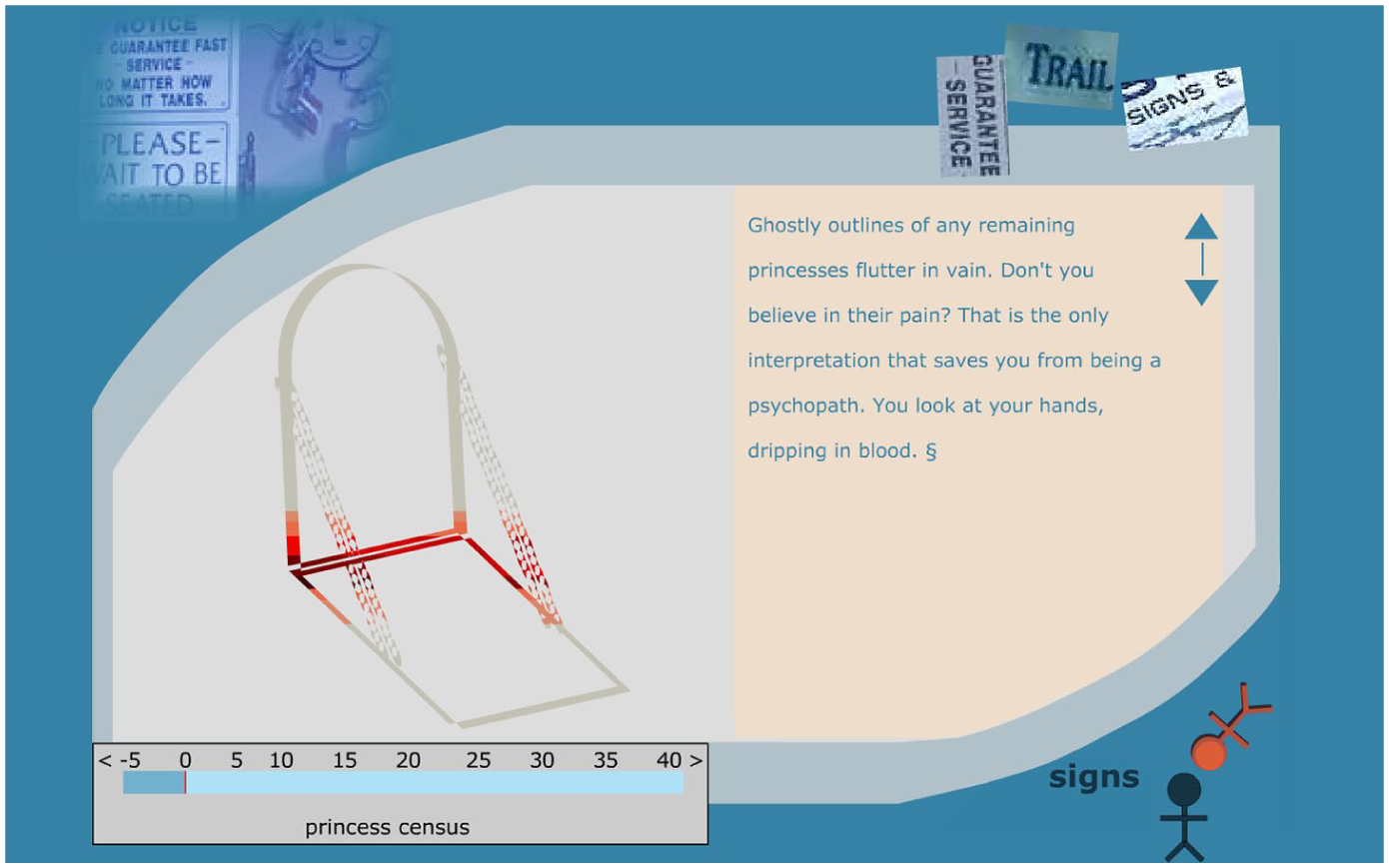
‘Don’t you believe’ lexia.
The passage ‘Don’t you believe in their pain? That is the only interpretation that saves you from being a psychopath’ seems to address the reader, who has previously been framed as at least partly complicit through their mouse-clicks and, as the reader response analysis above suggests, has accepted or resisted this identity so far. The abstract noun ‘interpretation’ reinforces this reading as it refers to the extradiegetic act of analysing the meaning of the narrative. The final sentence, ‘You look at your hands, dripping in blood’, however, creates an ontological switch between what the reader has been made to believe to be their own identity and the more likely reading that the address is here directed at a fictional character. While the first half of this sentence (‘you look at your hands’) could apply to the reader, the second half (‘dripping in blood’) presumably does not. The referent of ‘you’ and ‘your’ thus might change anaphorically as soon as readers reach the present participle. In theory, unlike the example above where readers are referred to as ‘reading’ or ‘clicking’, it should be harder for the readers to identify with the final two instances of the second person because the proposed identities do not always resonate with their real identities in the actual world.
Since the addressee of ‘you’ changes throughout the lexia, we might also expect to see those changes to be uniformly reflected in the reader response data too.
Table 2 displays the collated responses to the four ‘you’s in lexia 15. Although there is some correlation between our stylistic analysis and participant responses, there are also some important differences. In line with our stylistic analysis, most participants felt that the first two ‘you’s referred to them as readers, but it is worth noting that participants use the C, D, and E options on the Likert scale rather than opting for ‘E’ (‘you’ refers to the reader) exclusively. Justification provided for feeling addressed by the first two ‘you’s included participants feeling like they were: ‘in charge of what’s going on’ (Emily, line 364) and ‘physically taking part in the story’ (Emily, lines 361–362; also see Benjamin, lines 184–268; Gargi, lines 218–243; Hannah, lines 312–341 for a similar response); that the ‘you’s were ‘making you question the text’ (Thomas, lines 269–270); and that ‘the author or this text is challenging me about my experience of reading it’ (Georgia, lines 311–312; also see Thomas, lines 262–270 and Chloe, lines 342–380 for a similar response).
Collated responses to the ‘you’s in Lexia 15.
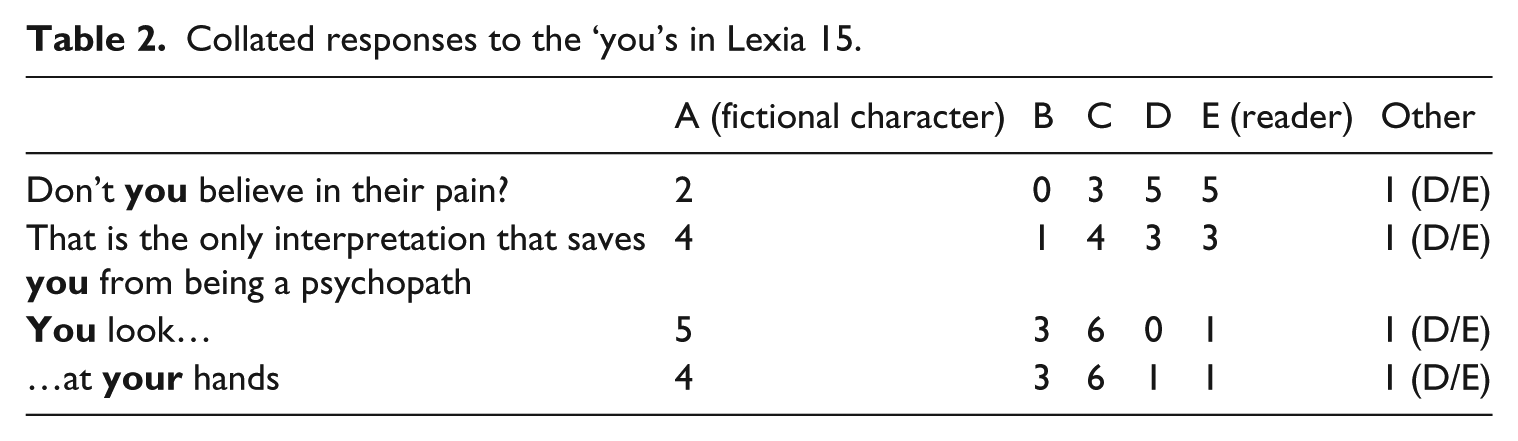
In contrast with our stylistic analysis, however, for the first two ‘you’s in lexia 15, a number of participants opted for ‘A’ where ‘you’ refers only to a character (2 for the first ‘you’ and 4 for the second ‘you’), ‘B’ which is more character than reader but a mix nevertheless (0 for the first ‘you’ and 1 for the second ‘you’), or ‘C’ (where ‘you’ refers equally to both reader and character) (3 for the first ‘you’ and 4 for the second ‘you’). When looking at participants’ reasons for ‘you’ referring to a character, participants give fewer reasons, but indicate, for example, that the sentences could relate to either character or reader (Jessica, lines 204–239), that Bluebeard is responsible for the killings of the princesses (Abigail, lines 360–411), or that it is addressing the reader as a fictional character (Sam, lines 226–247).
When looking at the second ‘you’ in lexia 15, it is clear that readers found it more difficult to align themselves with this ‘you’. Seven out of nine participants that opted for either ‘A’, ‘B’, or ‘C’ mentioned that they do not consider themselves to be a psychopath or simply do not feel addressed by this ‘you’ (e.g. James, lines 369–384; Thomas, lines 285–308; Lauren, lines 188–211), that they do not associate themselves with the murdering of princesses (e.g. Abigail, lines 387–411; Jessica, lines 242–278), or that they feel uncomfortable with being associated with the label psychopath and the actions of the character (e.g. William, lines 238–248; Georgia, lines 325–381). William’s response typifies participants’ discomfort with and resistance to projecting into the second ‘you’: 238 William: Midway for that one 239 Researcher: Okay 240–242 William: ’Cause it’s almost like she’s still addressing me the reader, but I don’t want her to be addressing me the reader, ’cause uh she’s like psychoanalysing me, that I might be a psychopath 243 Researcher: Okay, so who’s the fictional character? 244–245 William: The fictional character who she’s saying– I could be a psychopath, I hope she’s talking about Bluebeard
William states that he ‘hopes she is talking about Bluebeard’ (lines 244–245), rather than him, because he does not ‘want her to be addressing me the reader’ (lines 240–242). Although William’s interpretation of the first two lexias shows that he feels addressed as a reader, he also resists this identity, not wanting ‘her to address him’ (lines 240–242), and opting for ‘B’, ‘you’ refers equally to reader and character, in response to ‘That is the only interpretation that saves you from being a psychopath’. This diverges from our stylistic analysis of what the second ‘you’ of lexia 15 refers to. Here, as in the example from lexia 12, we have a reader response that suggests that there is a ‘you’ that the text wants the reader to be (a psychopath) and a ‘you’ that the reader chooses to be (not a psychopath). The referential ambiguity of the second-person pronoun and potentially doubly deictic nature of it creates a resonance between reader and participant, but also allows the participant to dispute the textual intent of ‘you’.
The undesirable identity position of the ‘you’ in ‘don’t you believe in their pain’ that the text allots readers is also negotiated discursively by other participants in different ways. Rather than give the narrator power over deciding whether the reader is a psychopath, Gargi, for example, claims that the ‘you’ is a character, maybe Bluebeard, that she is ‘still controlling’ (Gargi, lines 193–204), but that this idea of control is ‘like an illusion’ (Gargi, lines 193–204) and that ‘no matter what’ (Gargi, lines 206–215) she does, ‘people are dying’ (Gargi, lines 206–215): 193–204 Gargi: …it could be a character, but that I’m still controlling, sort of, but a character in the thing that I’m still controlling… at this point, I feel like, you know, like this whole control thing that I have is sort of like an illusion, like you enter this thing thinking that you have control 205 Researcher: Mm-hm 206–215 Gargi: But then as you click, you realise that… no matter what you do, these people are dying and this is what’s happening and [s]o you’ve tried clicking… the same thing’s happening, so you’re making me do this on purpose… that there’s no way out of this
This lack of control absolves her from having to take responsibility for her actions as a reader and helps her to distance herself from reader-identification with the ‘you’. This is again similar to the identity position taken by other participants. It shows how, in alignment with our expectations based on our stylistic analysis, readers struggled to align themselves with the second ‘you’ in lexia 15, as this would mean accepting the identity position of being a psychopath that the text allots them. In contrast with our stylistic analysis, however, some readers resisted this identity position by opting for ‘you’ as character or a mix of character and reader and discursively arguing that, because they were not a psychopath, the text had to refer to a character instead of them.
A similar reasoning is used by participants for the two instances of the second person in the final sentence of the paragraph, ‘you look at your hands, dripping in blood’. Here we can see that readers still tend to feel addressed by the statement if they felt addressed earlier, but that their position on the cline tends to shift more towards the middle, as is visible in Table 2. The explanations for ‘you’ 3 vary. Six out of 16 participants mention that the ‘you’ refers to a character at least partly because their own hands are not literally dripping in blood, and that therefore the ‘you’ refers, either completely or partially, to a character rather than to the reader. Readers mostly believe the fictional character involved to be Bluebeard or Bluebeard’s apprentice (seven out of 16). Three out of 16 participants interpret themselves as having become Bluebeard, whilst four other participants interpreted the final two ‘you’s as referring to a version of themselves, or an implied reader. One participant felt that the character addressed was a computer program or virus, whilst one other participant felt the ‘you’ addressed only the reader, and that no characters were addressed in ‘you’ 3. Hannah’s response below characterises how readers tended to still feel addressed by the third and fourth ‘you’, despite the general shift on the cline away from ‘you’ addressing the reader: 348–354 Hannah: …it’s like I know if I actually look at my hands, they’re not gonna be covered in blood, but… I still do feel kind of a little bit weirdly guilty, because it is like even though I’m not intending it, it’s like this kind of character idea of me is guilty of all this and… it does kinda feel like although it is talking to me, it’s not… like literally saying at the computer, look at your hands, like it’s– but i– it’s sort of related to my actions within the story.
Hannah indicates here that she knows that if she will look at her hands ‘they’re not gonna be covered in blood’, but that despite this, she still feels ‘kind of a little bit weirdly guilty’, because of her ‘actions within the story’, and that it is ‘this kind of character idea of me’ that is guilty of all of this. This again highlights the issue of control readers refer to as well as their perceived lack of agency in negotiating the negative identity positions relating to the ‘you’s in lexia 15.
6. Discussion
Overall, the results in our study reveal that readers attribute agency to the text in deciding who the ‘you’ refers to and how they relate to the text. They tend to feel propelled to adopt one of a variety of character roles in the text, even if they then resist them. In support of some of the conclusions made in previous empirical research into second-person narratives (e.g. Brunyé et al., 2009; Ditman et al., 2010; Brunyé et al., 2011), our results suggest that readers adopt a first-person, internal perspective in some instances of second-person narration. However, narrative ‘you’ does not always cause readers to identify with that pronominal reference. In fact, the range of ‘you’s analysed in our study shows that the nature of reader-identification with ‘you’ is more nuanced than previous research suggests. Perhaps unsurprisingly, our results confirm our hypothesis that readers will feel addressed by the ‘you’s in the text that they feel represent them authentically – e.g. when the text refers to a role associated with the digital reading experience – and that readers will resist the reference of those that do not. However, our participants did take up character roles as well and, in these cases, readers tend to discursively accept and take up textual/discursive positions they perceive as positive, for example ‘you’ as detective, but resist negative identity positions – e.g. ‘you’ as psychopath – by reframing their relation to the text. Arguably, the level of discursive resistance that some readers adopted to certain identity positions of ‘you’ shows not only the extent to which they felt it necessary to distance themselves from certain identity roles they perceived as negative, but arguably also the level to which they felt addressed – that is, in some cases they rejected the reference precisely because they felt implicated by a ‘you’ address that they wanted to distance themselves from.
It is important to recognise that the discursive negotiation present in our study was perhaps primed by the way the study was set up. Because a researcher was present whilst participants were going through the reading, and was continuously asking questions, readers may have felt more obliged to explain or negate any negative identity positions of ‘you’ that could be related to them. In the reader response data analysed above, however, there are several cases where the readers acknowledge the actualised address as being ‘you’-as-reader, but they do not accept the attributes associated with the ‘you’. This resistant response suggests that there is a ‘you’ that the text wants the reader to be and a ‘you’ that the reader chooses to be. We therefore observe empirical evidence of Phelan’s (1994: 134) ‘ideal narrative audience’, which he uses to characterise instances of ‘you’ that appeal to or signal the existence of a particular type of narratee defined as ‘the audience for which the narrator wishes he were writing’. This narratee is different to the ‘actual narrative audience’ or real readers receiving the communication, and readers, he suggests, can assume multiple positions at the same time. Whiteley (2011: 37) has shown empirically that readers project into multiple perspectives when they discuss a piece of first-person narrated fiction post hoc. She predicts that such projection is ‘also possible when reading the novel’ – that is, during online processing. Some of the participants in our study seem to recognise that there is more than one role that they can project into immediately after having read each extract, and thus at a time much closer to their reading of the text than Whiteley’s participants. Crucially, they also show how they can assume multiple perspectives at the same time. Our study therefore also provides the first empirical evidence of Herman’s (2002) double-deixis category. In particular, the readers’ resistant responses show how the ambiguous double-deictic category of ‘you’ may lead to readers feeling doubly situated – i.e. embodying two addressee positions and thus perspectives simultaneously.
7. Conclusion
In this article, we have shown that methods that have previously been used to generate data considered mainly from a quantitative perspective (such as Likert item questionnaires administered in an experimental setting) can also be used to generate data that can be analysed through qualitative methods and, in this case, to shed light on precisely targeted textual features. Our study is the first of its kind to empirically test a typology of narrative ‘you’ and also the first study that has developed a typology of narrative ‘you’ as an empirical tool. As a study utilising some experimental methods, reader responses may have been influenced by the researcher’s presence during the study. However, by qualitatively analysing the nuance of the reader’s response in the datasets, we maintain that we have generated genuine insight into how ‘you’ is processed in a fictional text. In the analysis of the data above, we focussed on ambiguous forms of pronominal reference that provided particularly varied responses in our dataset. We have shown that readers’ negotiation of the various identity positions offered by ambiguous forms of address displayed their tendency to adopt positive identity positions of ‘you’ but resist negative identity positions by reframing the ‘you’ as an optional identity that they were expected to psychologically project into. As a replicable method, our reader response protocol can be used to investigate other digital and print fictions that use second-person narration. We suggest that future research should further investigate the relation between readers’ stance towards textual ‘you’ and their projection into ‘you’ in other texts.
In offering an analysis of selections of The Princess Murderer in combination with indicative Likert scale responses and qualitative analysis of data from a structured interview, we have contributed to more empirically grounded textual understandings that are based on real readers’ responses and stylistically rigorous analysis. We maintain that it is the insight that this methodology provides – i.e. a stylistic analysis of both the fictional text and the reader data – that can make reader response research in stylistics so powerful, rather than an adherence to a particular paradigm, methodology, or tool. However, a stylistics toolkit, offering a range of methods, is necessary if reader response research in stylistics is to become a more firmly established and empirically grounded discipline.
Footnotes
Data

Declaration of conflicting interests
The author(s) declared no potential conflicts of interest with respect to the research, authorship, and/or publication of this article.