



Abstract
We suggest an innovative approach to literary discourse by using corpus linguistic methods to address research questions from cognitive poetics. In this article, we focus on the way that readers engage in mind-modelling in the process of characterisation. The article sets out our cognitive poetic model of characterisation that emphasises the continuity between literary characterisation and real-life human relationships. The model also aims to deal with the modelling of the author’s mind in line with the modelling of the minds of fictional characters. Crucially, our approach to mind-modelling is text-driven. Therefore we are able to employ corpus linguistic techniques systematically to identify textual patterns that function as cues triggering character information. In this article, we explore our understanding of mind-modelling through the characterisation of Mr. Dick from David Copperfield by Charles Dickens. Using the CLiC tool (Corpus Linguistics in Cheshire) developed for the exploration of 19th-century fiction, we investigate the textual traces in non-quotations around this character, in order to draw out the techniques of characterisation other than speech presentation. We show that Mr. Dick is a thematically and authorially significant character in the novel, and we move towards a rigorous account of the reader’s modelling of authorial intention.
Keywords
1 Introduction
One of the most significant shifts in narratology in recent years has been the recognition that literary narrative fiction can be defined not by event but by character. It used to be regarded as paradigmatic that any essential definition of narrative could be captured either by the notion of a sequence (A and then B and then C) or by a plot (B, after A, leading to C) or by an evaluative plot (B, because of A, but for the occurrence of C). Characters were elements that the plot happened to, in this perspective (Margolin, 1983, 1990, 1995). Of course, the relationship that readers develop with fictional characters is a main motivating factor in reading literature at all, and more recently, narratological scholars have reconnected with this general sense that character and consciousness are essential elements in narrative, and events are there simply to elucidate, stress, or vivify the people who are caught up in them (Hogan, 2011; Palmer, 2004; Vermeule, 2010).
Furthermore, much traditional narratology and stylistics across the 20th century was heavily influenced by Wimsatt and Beardsley’s (1954a, 1954b) arguments against ‘the intentionalist fallacy’ and ‘the affective fallacy’. These have widely been taken to have asserted a formalist, textual constraint on literary analysis, and prohibited consideration of authorial imagination and creativity on one hand, and readerly psychology or affect on the other. Though the position was later restated more subtly (Wimsatt, 1976), authorial design and intention have remained inimical to stylistics as a discipline until very recently (see Sotirova, 2014; Stockwell, 2015). Stylistics has been embracing psychological and affective matters for some time now, both implicitly in much modern stylistics of the last four decades, and explicitly in the form of a cognitive poetics. Though in their time the formalist and New Critical reaction to the impressionism and biographical speculation of the day was entirely justified, more recent innovations in the linguistic toolkit available to stylisticians mean that we are able to return to these key questions with greater systematicity and rigour. In short, we are better equipped to address issues of creative imagination and readerly effects in literary scholarship, and address some of Wimsatt and Beardsley’s concerns that textual analysis was not yet able to deal with creativity and aesthetics with sufficient subtlety. The present situation has come about because of twin advances in cognitive poetics and corpus stylistics. This article draws on a research programme that aims to integrate our best current knowledge of reading and mind with our most recent knowledge of corpus stylistic methods. Specifically, we use a corpus linguistic tool, CLiC (Corpus Linguistics in Cheshire, see http://clic.nottingham.ac.uk), developed at the University of Nottingham. CLiC is a free online tool built on top of Cheshire 3 – an open source retrieval engine for XML data (see http://cheshire3.org). We integrate the use of this tool with our cognitive poetic models.
2 Character and mind-modelling
Cognitive poetics takes character and the process of characterisation as a centrally important aspect of literary reading. Though of course character in a literary work is a textual trace (an ‘it’, rather than a ‘he’, ‘she’, or ‘they’), in the process of reading characters take on a life of their own in the reader’s mind to a greater or lesser extent. One of the earliest and most extensive cognitive stylistic works on characterisation is Culpeper (2001), which drew largely on the schema theories of Schank and Abelson (1977) and Rumelhart (1980). Though Culpeper suggests a comprehensive list of stylistic features and patterns which act as cues and instantiations for schematic rendering of character, like many cognitive poetic accounts the evidential base for the resulting readings rests on the validity of the source model and a stylistic appeal to readerly intersubjectivity and agreement. Of course, these sorts of validity have been insightful and persuasive, and we would not want to undermine the valuable and continuing role they have to play in literary linguistic analysis. However, Culpeper’s account shares some of the problems of schema theory itself, in the form of an idealisation of the reading process, a presumption of an ideal or model reader, a privileging of universal patterns over literary-textual singularity, and a relatively under-theorised or ad hoc specification of the constitutive nature of schema-types that schema theory has in common also with Fillmore’s (1982), Minsky’s (1975) and Talmy’s (2000) notions of framing, and Sanford and Garrod’s (1981) notion of scenarios, Fauconnier’s (1985) notion of mental spaces, and Lakoff’s (1987) notion of idealised cognitive models. In all of these accounts of knowledge-packaging and selection, the empirical evidence that is presented by way of demonstration tends to be purely methodological or purely stylistic. In this article, we attempt to present some corpus linguistic evidence that seems to us to align with the necessarily more idealised account from cognitive poetics.
In bringing together cognitive poetics and corpus linguistics, there are multiple advantageous avenues. Theoretical hypotheses which seem to be justifiable in cognitive poetic terms can be tested, verified, refined or rejected by corpus linguistic evidence. Specific features in a literary text or corpus of several texts can be identified by corpus linguistic methods and then integrated into a more holistic and experiential frame by drawing on cognitive poetic work. The combination aims to tackle what we discern as a false perception that corpus linguistics is concerned with general language use and cognitive poetics is concerned with individual readerly effects. In fact, cognitive poetics has been accused of universalism and reductivism (Sternberg, 2009) and corpus linguistic techniques have been used for the analysis of individual usage and close readerly effects. We assert that both approaches can independently encompass both social and individual aspects of literary linguistic analysis, but the purpose of the present article is to indicate how the two approaches can also work together.
Because of our focus in the present article, we do not have the space to replicate the range of arguments that have been put forward to discuss the relevance of corpus linguistic methods and theoretical foundations for the analysis of literary works. There is a growing body of literature dealing with what can be seen as ‘corpus stylistics’, see for instance Mahlberg (2013, 2014, forthcoming a, forthcoming b), McIntyre (2010, 2012), Biber (2011), McIntyre and Walker (2010), Fischer-Starcke (2010), Semino and Short (2004). A key aspect of corpus linguistics for this article is that corpus methods and descriptive tools can help to identify textual features that contribute to the creation of a reader’s sense of character. In line with the diversity of the stylistician’s toolkit outlined by Leech and Short (2007), corpus linguistics provides further tools to find textual evidence for stylistic interpretation. That corpus methods are becoming increasingly relevant is also reflected by their inclusion in the second edition of Simpson’s (2014) influential textbook. For the study of characterisation, Culpeper (2001) includes key words in his list of textual cues that work specifically well for the comparison of character speech in drama. With a focus on narrative fiction, Mahlberg (2013) introduces lexically driven categories of body language presentation. In this article we will not discuss fundamental corpus linguistics nor suggest a full methodological approach to study David Copperfield. Instead we will employ corpus methods to gather evidence for our approach to characterisation. Our focus is on the cumulative picture of character information that corpus methods can help to identify.
Cognitive poetics maintains the cognitive scientific principle that there are continuities in cognition and perception across all life experiences, and so literary characterisation and real-life human relationships are seen as continuous rather than distinct (Gibbs, 2006). The emphasis on continuities provides an important theoretical bridge to corpus linguistics. The evidence from corpora shows that linguistic phenomena often operate on a cline (Mahlberg, 2005, 2013). This is also crucial for Carter’s (2004) approach to literariness. He describes a ‘cline of literariness’ where some language uses are more literary than others with no clear dividing line between ordinary versus literary language (Carter, 2004: 69). For characterisation, the crucial point is that the language we use to talk about fictional and real people cannot be sharply distinguished. Some of it is a reflection of the form of a text, e.g. a narrator in a novel tends to describe more body language than we might do in other types of text, but the narrator’s language, and the language that characters use is still similar to the language used to talk about real people, or to talk about the experiences that we have with real people. In cognitive poetic terms (and as explained later), the ways we relate to and engage with other people in real life are fundamentally the same as the ways in which we engage with fictional characters. Cognitive poetics thus breaks the commonly assumed prohibition against psychology in the ‘affective fallacy’. However, it goes further and also breaks the ‘intentional fallacy’, because authors, editors, narrators, readers and other readers are also engaged in the same fundamental way. Just as we model the minds of people we meet in real life, so we model the minds of fictional characters, and we also model the minds of authors and other people reading the same literary works as us. Irvin (2006) calls this sort of readerly located framing of authorial intention hypothetical intentionalism.
In phenomenology (Poulet, 1969), the notion that authorial intention could be located as a model within the reader was adopted as a theoretical position, without much further psychological or empirical evidence other than introspection. More recently, the notion has been reframed within cognitive poetics as mind-modelling. The term here refers to the capacity that humans evidently have for imagining and maintaining a working model of the characteristics, outlook, beliefs, motivations and consequent behaviour of others. It is this fundamental cognitive capacity that allows us to understand that other people are people, and that they are in some ways similar to us and in some ways different. It is a fundamental feature of consciousness that we are able to understand that other people are similarly conscious. Our model and default presumption here is that you are conscious yourself. In this sense, you are the best example of person-ness, and other people that you encounter are modelled on your sense of person-ness as relatively good and less good examples of persons. So your family and close friends are also very good examples of persons, but acquaintances, passing strangers, faceless crowds, people in the news, people in history, and so on, are less and less good examples of persons. (Note here that the strength-of-goodness scaling draws on the cognitive linguistic notion of prototypicality [Lakoff, 1987; Rosch and Lloyd, 1978]; it is not a moral nor evaluative scale!). Usually, animals, objects and abstractions are very weak examples of persons, prototypically, although linguistic manifestations such as personification and animation can make them better examples. Even here there is scaling: your own cat or pet dog is likely to be a better example of a person than someone else’s pet, and that steak or fish you are about to eat has undergone depersonification at some level in your mind (see Stockwell, 2009 for a full account).
There is clearly an existential and ontological discussion to be had about consciousness, subjectivity and society, but we will not be having that discussion here. Instead, we can propose a theory of mind-modelling in which we assume that a mental representation of another person is created as a heuristic template. That template begins with the presumption that the other person is a person, and since the most viable and vivid model of a person is yourself, all interaction begins by modelling the other person as having your own experiential qualities: that person has consciousness, has beliefs and intuitions, has imagination, creativity, aspirations, goals and an outlook that is familiarly human in a very basic sense. Further presumptions that can be made include the ascription of memory, emotional capacities, an ethical sense, and physical sensations and needs to the other person – though here the modelling starts to move from central traits to features that begin to be cultural or experientially-informed. After that, less central and weaker presumptions would include estimations of physical ability, intelligence, manner, mood, and so on, often on the basis simply of visual appearance.
Of course, we do not go through life thinking that everyone we meet is a clone or simulation of ourselves. Otherness is intuitively defined as difference. The principal innovation in our theory of mind-modelling is that we do not assume a ‘blank slate’ when a person is imagining others (this has been a widespread common or implicit assumption, and can be found in early theories of character from Forster (1927) to Sartre (1936)). Instead we assume a template of self-hood that is already quite richly filled out. Incoming information and inferencing is not primarily regarded as an accumulation of facts, but rather as a set of cues that encourage an individual to alter their self-template in order to differentiate it away from that self and towards the other person. In this way, we reject the traditional notion that an evaluation of another person is based on an accumulation of features built-up from scratch. Instead, we regard incoming information and inferences as being cues towards an alteration of an existing template, remoulding it – sometimes additively and sometimes by removing existing presumptions – until a sufficiently working model of the other person is rendered in mind. The active and reiterated creative aspect of this process is why we prefer the term mind-modelling to the more passive senses of ‘mind-reading’ or ‘mind-attribution’ (see Apperly, 2011; Turner, 1992; Zunshine, 2006).
We should say that the notion of mind-modelling draws on but is not identical to the psychological and neuroscientific notion of Theory of Mind (ToM). In those disciplines, the notion was first used to understand how an individual can have a sense that other individuals have similar forms of consciousness, perspective, memory and emotion (Premack and Woodruff, 1978). There has been a great deal of debate in those fields as to whether the mental processes involved are characterised by an individual having a projected theory or guess as to the conscious state of the other person (the theory-theory argument), or whether the individual imagines themself in the other person’s consciousness (the simulation-theory position) (see Apperly, 2011). The former amounts to an individual’s ‘folk psychology’ of others, and the latter amounts to an imaginative projection. The term has broadened its usage to encompass ‘social cognition’ (Carpendale and Lewis, 2006), and has been developed even further as an application to literary reading (Leverage et al., 2011; Zunshine, 2006), at which point many psychologists express irritation at a perceived misuse of their original term (see Belmonte, 2008). We are not too concerned at the appropriation of the concept in cognitive literary studies, for two reasons. Firstly, the literary experience can involve either imaginative projection, empathy and engagement on the one hand, or resistance, critical distancing and distaste on the other, and it may be that the various arguments around ToM reflect different experiential aspects of the phenomenon that the peculiarity of literary fiction lays bare. Secondly, we have an empirical attachment to matters of textuality as a final form of validation within stylistics, and it may be that the delicate gradations required in cognitive psychology are not as primary in importance as our main concern to map reading experience and texture together.
Our approach to mind-modelling remains essentially text-driven. An assumed principle of optimal efficiency applies that might be regarded as similar to the notion of minimal departure (Ryan, 1992; Searle, 1975): unless the text in some way drives you to think otherwise, the character in your attention is a person like you. Stimuli derived from the text during reading serve to alter the basic assumed model of a person. Though this conception of mind-modelling originates in psychology and philosophy in general, and applies to all real-life and everyday situations, our main interest is in the process of fictional and literary characterisation. Our formulation is aimed at resolving the apparent paradox evident in the well-known fact that literary readers’ reported senses of character are often richer than the denoted information provided by the text (see Crittenden, 1982). It is, nevertheless, in the stylistic patterns in the text that the formulations of character can be empirically located. Any reader of a literary fiction creates characters from the following textual realisations:
Direct descriptions of physical appearance and manner, gestures and body language;
The presentation of speech for an apparently autonomous sense of characters’ personality, mood and perspective, and narrative suspensions within direct speech, and the framing discourse;
The representation of thought, beliefs and intentions (almost as if the reader has a telepathic ability);
The reactions of other characters (including the narrator) who can serve as counterparts for a reader’s own directed, preferred reading response;
Social relationships defined by deictic markers, defining and sustaining all the divergences of characters’ viewpoints from the reader’s own.
In the case study that follows, several (though not all) of these threads prove to be relevant (they are largely a summation of elements identified in Mahlberg, 2013. Other studies present roughly the same list to a greater or lesser degree of delicacy: Culpeper, 2001; Frow, 2014; Rimmon-Kenan, 2001; Vermeule, 2010). We employ corpus stylistic methods to find patterns that contribute to the cumulative picture created by the textual realisations. Hence, corpus methods are used as supportive techniques in this study.
3 Modelling a simple mind
The character of Mr. Dick in Charles Dickens’s David Copperfield (1850) is highly pertinent to our arguments so far. The novel has been taken as highly autobiographically flavoured, with the author’s initials (CD) reversed for the eponymous character (DC), the similarity of Copperfield’s and Dickens’s careers as reporter and then novelist, and numerous other parallels in the lives of the two (see Sehrawat, 2013; Storey, 1991). Mr. Dick is clearly a shortened form of Mr. Dickens, and indeed the pointedness and prominence of this character can be interpreted as a deliberate authorial focus. In other authorial hands, the manipulation of history and textual manifestation that pushed the parallels between Dick and Dickens extremely obviously might appear clumsy. For example, there is a whole backstory in which Mr. Richard Babley experiences a trauma and insists on his shortened name, ‘Mr. Dick’, foreclosing any discussion of the specifics of this trauma. ‘Babley’ itself appears to be phonetically echoic of ‘babble’, with the word suggesting perhaps childishness or the verbosity of a novelist.
Tick (1969: 143) notes the presentation of Mr. Dick as ‘an image of the author himself’, engaged in writing an autobiography (a ‘Memorial’) in spite of his poor memory, and constantly distracted by the pathological image of the head of King Charles I – the primary authorial Charles. In a passage towards the end of the novel, the narrating Copperfield recounts a long conversation with Mr. Dick. In the middle of this, (1) I nodded at him, and he nodded back again. ‘In short, boy,’ said Mr. Dick, dropping his voice to a whisper, ‘I am simple.’
This pattern, in which the narrator and Mr. Dick seem to mirror each other’s actions or perceptions, recurs several times in the novel: (2) I answered the solicitude which his face expressed, by conveying the same expression into my own, and shaking my head.
(3) I then shook hands with Mr. Dick, who shook hands with me a great many times.
In example (4), the concept of copying itself is thematised, before a mirrored shaking of the head: (4) ‘Don’t you think, ‘ said Traddles, ‘you could copy writings, sir, if I got them for you?’ Mr. Dick looked doubtfully at me. ‘Eh, Trotwood?’ I shook my head. Mr. Dick shook his, and sighed. ‘Tell him about the Memorial,’ said Mr. Dick. I explained to Traddles that there was a difficulty in keeping King Charles the First out of Mr. Dick’s manuscripts; Mr. Dick in the meanwhile looking very deferentially and seriously at Traddles, and sucking his thumb. ‘But these writings, you know, that I speak of, are already drawn up and finished,’ said Traddles after a little consideration. ‘Mr. Dick has nothing to do with them. Wouldn’t that make a difference, Copperfield? At all events, wouldn’t it be well to try?’ This gave us new hope. Traddles and I laying our heads together apart, while Mr. Dick anxiously watched us from his chair, we concocted a scheme in virtue of which we got him to work next day, with triumphant success.
In this last extended passage, there is a prominence of lexical choices from the domains of perception, thought and belief: think, looked, doubtfully, a little consideration (by Traddles), hope, anxiously, concocted and even perhaps deferentially, seriously and triumphant. The mirroring between Dick and David (Copperfield, also known as ‘Trotwood’ here) draws attention not only to their parallels but also significantly and forcefully to the nature of their minds and consciousness.
That Mr. Dick is, in his own words, ‘simple Dick – mad Dick’ (ch. 45; and example (1)) also marks him out from the society within the storyworld of the novel. Mr. Dick is narratologically set apart, gesturing towards the authorial mind outside the text-world within which Copperfield narrates in the first person. His own history and memory is vague and inarticulately defined. Several literary critics have argued that the character of Mr. Dick is a thematically central figure in the novel and in 19th-century fiction (Holmes, 2004; Keyte and Robinson, 1980; McDonagh, 2001; Marchbanks, 2006; Storey, 1991; Tick, 1969; Tambling, 2002; Wade, 2012). He is regarded not only as a mirror of the author, but also as a foil for the emotional life of the narrator, and as an early example of liberal treatment of mental illness.
The sense that Mr. Dick’s (faulty) mind and mental processes are highly prominent and thematised in the novel can be explored with greater systematicity. Typically, speech and thought presentation is used as an indication of the mental and perceptual states of fictional characters, drawing on Leech and Short’s (2007) model. However, Dickens’s characters tend to be largely ‘externalised’: they are depicted through their direct speech, actions and gestures rather than through explicit insights into their minds (John, 2001; Palmer, 2002). Therefore we will investigate the narrative contexts in which Mr. Dick occurs more widely. CLiC allows concordance searches restricted to ‘quotes’ and ‘non-quotes’. We focus on all occurrences of Mr. Dick in ‘non-quotes’, i.e. in text outside of quotation marks, as we are mainly interested in the relationship between Mr. Dick and the narrator – rather than Mr. Dick and any of the other characters.
3.1 Mr. Dick in different contexts of speech
One of the most basic methods in corpus linguistics is the study of concordance lines. With the help of a concordance, patterns and meanings of words can be described (e.g. Sinclair, 2004). This method is also useful to gather character information. As for the study of word meanings, the patterns that the narrator uses to describe characters make individual characters distinguishable from others. While there can be very exaggerated patterns, as is often shown for Dickens, there will also be more subtle patterns that are more difficult to identify systematically by reading alone, as their neglect in Dickens criticism shows (see Mahlberg, 2013). The cumulative evidence provided by concordance lines is an illustration of the text-driven nature of our approach to characterisation.
The (5) He always sat in a particular corner, on a particular stool, which was called ‘Dick’, after him; here he would sit, with his grey head bent forward, attentively listening to whatever might be going on, with a profound veneration for the learning he had never been able to acquire.
Notice here again the close proximity of references to mentality (head, attentively, listening, veneration, learning) and the reflexivity inherent in the stool being named after the character. Every other occurrence of the name Dick, where it refers to the character, appears in the full form Mr. Dick. This overwhelmingly heavy emphasis is of course a massively blunt irony: the most formal, distancing title pattern is collocated with the most diminutive short-form of a first-name. The modern sense of ‘dick’, meaning an idiot, was not current in the mid-19th century. And the colloquial meaning of ‘dick’ for a penis (from which the modern ‘idiot’ sense perhaps derives metonymically via ‘dickhead’ in the 1960s) similarly seems to be a late-19th century or turn-of-the-century coinage. The OED points to its first appearance in this sense in Farmer’s (1891) slang dictionary, but it does not seem to have been widespread before then. ‘Dick’ in Dickens is thus neither insulting nor psychosexual in any way (contrary to claims made by McDonagh, 2001), at least contemporaneously.
Based on concordance lines with a span of +/−10, the 164 occurrences of Mr. Dick that appear in non-quotes fall into three broad groups. There are 94 lines that contain quotation marks. For these by far the most common collocate of Mr. Dick is said, i.e. the reporting phrase for his own speech said Mr. Dick (almost a third of all, with 51 occurrences). This goes up to 62 if we include synonyms of reporting-speech phrases, such as returned (3 examples), suggested, simpered, rejoined, retorted, repeated, asked and cried, as well as a phrase that indicates the close of his speech: Not another word did Mr. Dick utter (see example (6)).
(6) ‘Not a word, boy!’ he pursued in a whisper; ‘leave all the blame with Dick – simple Dick – mad Dick. I have been thinking, sir, for some time, that I was getting it, and now I have got it. After what you have said to me, I am sure I have got it. All right!’ Not another word did Mr. Dick utter on the subject; but he made a very telegraph of himself for the next half-hour (to the great disturbance of my aunt’s mind), to enjoin inviolable secrecy on me.
32 of the concordance lines with quotation marks do not have speech phrases for Mr. Dick. Additionally, there are 70 lines without any quotation within the +/− 10-word span. Table 1 summarises these groups.
164 occurrences of Mr. Dick in non-quotes.
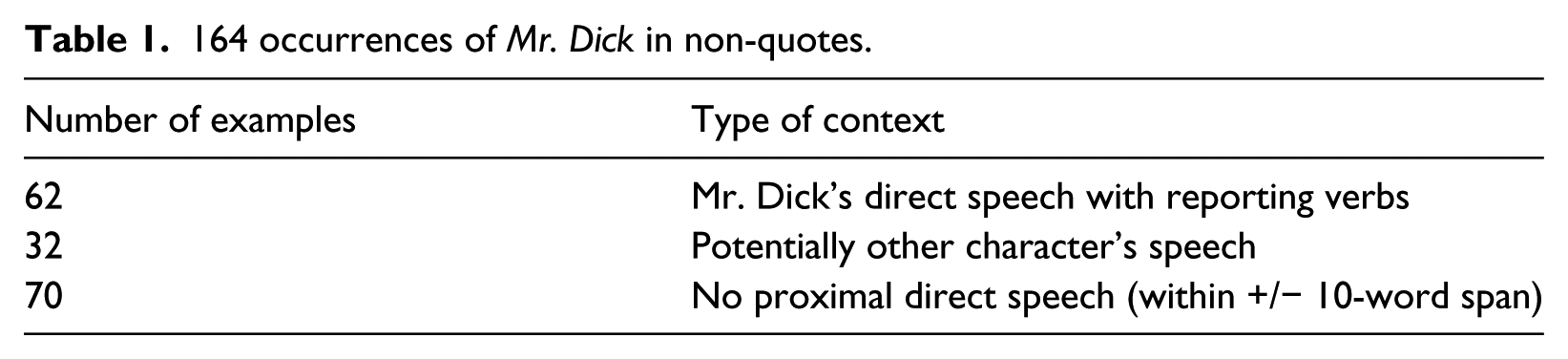
The overview in Table 1 is based on purely formal criteria. So we define ‘proximal direct speech’ merely in terms of the span of +/− 10 words. Within this range, example (7) is counted among the 70 examples of non-proximal direct speech, although the sentence ends with speech eventually (14 words later): (7) We found him [Traddles] hard at work with his inkstand and papers, refreshed by the sight of the flower-pot stand and the little round table in a corner of the small apartment. He received us cordially, and made friends with Mr. Dick in a moment. Mr. Dick professed an absolute certainty of having seen him before, and we both said, ‘Very likely.’
As outlined earlier, our aim in employing corpus methods is not a detailed analysis of every occurrence of Mr. Dick. We are interested in the main tendencies and especially the cumulative picture that is provided by the data. This is in line with the way in which concordances are used for the study of word meanings, where the main patterns are seen as most relevant (Sinclair, 2003). The formal criteria assist us in making systematic selections for more detailed analyses. The following three sections will narrow down our observations on each of the groups listed in Table 1.
3.2 Mr. Dick’s speech and the narrator’s comments in suspensions
According to Leech and Short (2007: 255–281), there is a cline of apparent narratorial–character control in which direct speech seems to convey the sense that characters are speaking directly and autonomously; by contrast, the greater the degree of apparent narratorial intervention in the form of indirect speech or narrative report of speech and thought, the less autonomous a character might appear. Mr. Dick – a character with apparently limited mental capacities – is given quite a bit of apparent autonomy. Not only is his speech directly presented for most of his ‘on-stage’ time, but it is also mainly presented in the most autonomous sequence: that is, with the speech freely appearing first, followed by the reporting clause. Although this does seem to be the most common pattern both in the Dickens corpus and in 19th-century literary fiction generally, the specific effects created for Mr. Dick become even more clearly visible if we look at patterns of Mr. Dick’s speech including his body language. To identify such patterns we focus on suspensions.
Suspensions are interruptions of the characters’ speech, as illustrated in example (1) given earlier, where said Mr. Dick, dropping his voice to a whisper, is a suspension, or ‘suspended quotation’ (we use this concept following Lambert, 1981). Suspensions are a useful place to begin a search for character information (see e.g. Mahlberg, 2012, 2013; Mahlberg et al, 2013). They give the narrator the opportunity to present descriptive information in an unobtrusive way: dropping his voice in a whisper in example (1) is presented as circumstantial information accompanying Mr. Dick’s speech. Part of example (1) is reproduced below for ease of reference. The suspension is italicised.
(1) ‘In short, boy,’ said Mr. Dick, dropping his voice to a whisper, ‘I am simple.’
Using CLiC to search for Dick in ‘long’ suspensions (i.e. interruptions of at least 5 words) generates the results in Table 2.
CLiC screenshot of all 12 occurrences of Dick in long suspensions (5 or more words).
It is noticeable here that Dick’s speech is repeatedly associated with reference to markers of his emotional state of mind or to his cognitive processes. Specifically, example (1), where Mr. Dick refers to himself as ‘simple’ corresponds to line 10 in Table 2. Furthermore, the content of several of Dick’s utterances is about beliefs, wishes and other mental states (line 4 believe, line 6 recollect, line 9 intend). David’s aunt’s forgot in line 7 illustrates how also characters speaking with Mr. Dick contribute to the focus on his state of mind. Complementing the direct speech, the narratorial suspensions include indices of mentality either as direct descriptions (line 2 after thinking a little), descriptions of gestures and demeanours that are strongly indicative of thought (line 5 with a despondent look upon his papers, line 10 dropping his voice to a whisper) or combinations of the two (line 1 considering, and looking vacantly at me). The cumulative effect is that the narrator’s observations and evaluations are being mirrored back at him in the distorting figure of Mr. Dick. The readerly effect is a sense of a high level of gestural mirroring and foregrounding of mentality.
3.3 Mr. Dick’s reactions to other people’s speech
The suspensions that can be searched with CLiC are again defined in purely formal terms. The tool does not distinguish whose speech is interrupted so simply returns all examples. Of the suspensions in Table 2 there are three lines that do not refer to Mr. Dick’s speech. In lines 11 and 12 he is in conversation with Mr. Micawber and responds to him by shaking hands. In line 3 it is the speech of David’s aunt that is interrupted, as shown in example (8).
(8) ‘Mr. Dick. An old and intimate friend. On whose judgement,’ said my aunt, with emphasis, as an admonition to Mr. Dick, who was biting his forefinger and looking rather foolish, ‘I rely.’
These examples highlight how Mr. Dick responds to and interacts with others. To these examples we can add another 5 similar ones by focusing on the concordance lines listed in Table 1 as ‘potentially other character’s speech’. All 8 examples (included in Table 3), show Mr. Dick’s reaction to someone else’s words. In lines 1 and 2 Mr. Dick responds to Mr. Micawber by shaking his hand. In line 4, Mr. Dick is listening to David’s aunt, in lines 5, 6 and 7 Mr. Dick is communicating with David (line 6 is from the extended example (4), where both respond to Traddles), and in line 8 he is responding to David’s aunt.
Eight examples of Mr. Dick between direct speech of other characters.
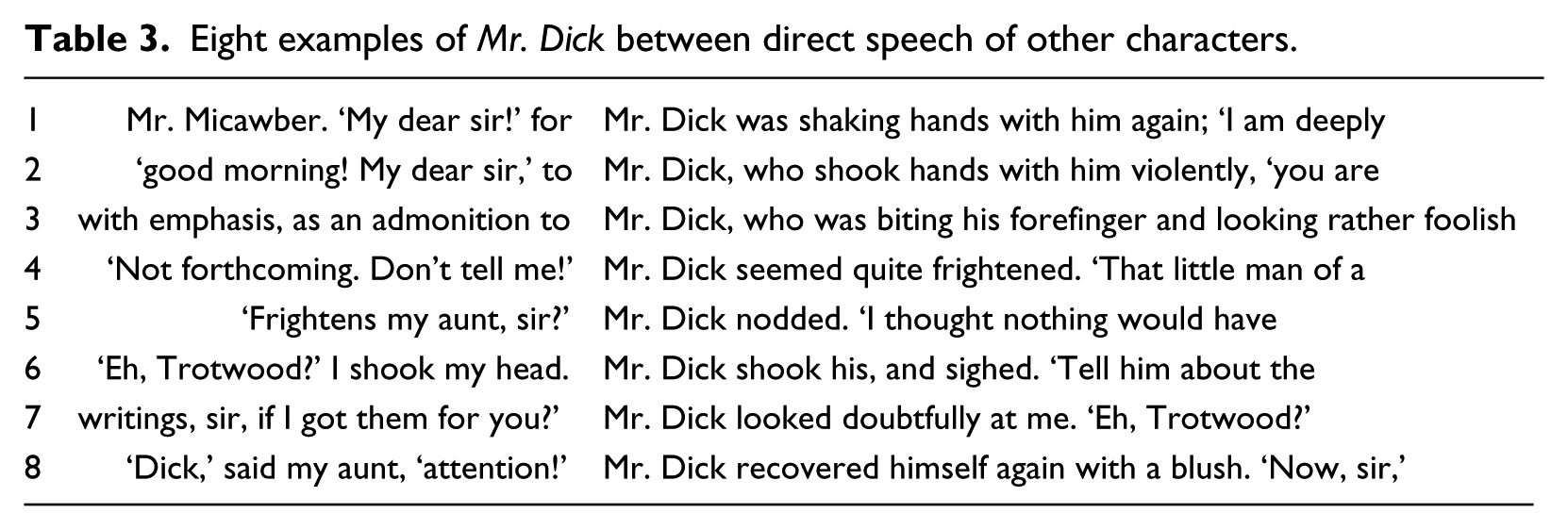
The examples in Table 3 also indicate another pattern in the presentation of Mr. Dick: a great deal of narratorial content around him is concerned with body language and gestures that index mental or perceptual states. These are either direct mental evaluations on the part of the co-present narrator (Mr. Dick seemed quite frightened), or are observations of body language offered to the reader with an inference of mental evaluation (Mr. Dick looked doubtfully at me), or they are plain physical descriptions that have an association of mentality (Mr. Dick nodded, … with a blush). Put another way, these are either direct observations in which the narrator mind-models Mr. Dick, or are invitations to the reader to share a mind-modelling with the narrator, or they are descriptions made available for readers to mind-model Mr. Dick for themselves. In each case, of course, it is not simply the character of Mr. Dick who is being mind-modelled, but also the character of the narrator David Copperfield. It is David’s perceptions, evaluations and mind-modelling processes through which we have any access to the mind of Mr. Dick. Readers of the novel have to mind-model Mr. Dick, while at the same time keeping track and creatively augmenting their developing model of the mind of David Copperfield.
3.4 Mr. Dick in examples without proximal direct speech
Taking the remaining 70 lines once the direct-speech occurrences in the +/−10-word range are removed, we are left with all the last examples of Mr. Dick in non-direct speech environments. There is a striking sense of readerly attention being drawn to Mr. Dick’s mind, and this intuition finds some evidence in particularly salient words in the co-text. Where direct speech is not involved, body-language, gesture and demeanour are given space to be elaborated. So when Mr. Dick appears, it is often in the vicinity of phrases like grey-headed and florid (ch. 13), bareheaded (ch. 17), with a grave motion of his head (ch. 17), laying our heads together (ch. 36); or Mr. Dick put his head into the parlour (ch. 45). If not his head, then other features of his head are mentioned, either directly (eyes on Mr. Dick ch. 13, with a face shining with pride and pleasure ch. 17) or by close proximity (who was biting his forefinger ch. 14, Mr. Dick would pull off his hat ch. 17).
The emphasis on markers of Mr. Dick’s emotional state of mind or cognitive processes, with lexis relating to beliefs, wishes and other mental states, as discussed in the previous two sections, is also confirmed by examples not limited to the direct contexts of speech. Amongst the 70 non-direct-speech environments of Mr. Dick, we find looked as wise, I thought would have gone to sleep, her determination, some selfish hope, looking rather foolish, his Memorial, was so low-spirited, most affectionate manner, had not the least belief, a delusion of, he thought, pride and pleasure, listening, enchained with interest, wild with joy, with a meditative, leaning thoughtfully, so very complacent, anxiously watched us, acutely sensitive, cordially, looked very deferentially and seriously, got taxed with such things, his thoughts were on the subject, gravely, pale and trembling, earnestness, with greater gravity than usual, unconscious, a delusion of Mr. Dick’s, a mental wrestle with himself, exceedingly compassionate, determined, disturbed, a good deal surprised, the discomfiture of Mr. Dick. These 35 occurrences are densely packed into 70 concordance lines. Not all of these markers of mentality, cognition or emotion attach directly to Mr. Dick, but they all occur in his vicinity. The overall readerly effect, we would suggest, is, again, an atmospheric foregrounding of mentality and perception around Mr. Dick.
An examination of the verb-forms attached to Mr. Dick across these non-direct-speech environments reinforces the intuitive sense that his is a passive, reactive mind in the novel. At a crude level we can assign the verbs either to full agency or to various shades of non-agentive predication, including the positioning of Mr. Dick as patient, recipient or beneficiary of another’s agency, or in passive or relativised position, and also including examples in which Mr. Dick is an instrument or part of the circumstantial element of the clause: so proto-agency or proto-patientive roles. In this scaling of agency by prototypicality, we are following Dowty (1991), as adapted by Stockwell (2009). On this measure, Mr. Dick has relatively little agency in just over half the cases (39 out of 70). Examples here include the following: (9) Wednesdays were the happiest days of Mr. Dick’s life (ch. 17) (10) as I was already much attached to Mr. Dick (ch. 17) (11) Peggotty was out showing Mr. Dick the soldiers (ch. 35) (12) He received us cordially and made friends with Mr. Dick in a moment (ch. 36) (13) and by finding Mr. Dick’s hand again with his own (ch. 49) (14) she kept her eyes on Mr. Dick (ch. 13)
However, even in those other cases we assigned as being more proto-agentive, the degree of agency is not prototypically very strong. Most of the predications are existential or relational, rather than physical. Table 4 gives all 31 of the non-speech predications in which Mr. Dick is the proto-agent in the novel. You can see that in order to have a list even of this extent, we have had to interpret the degree of agency fairly broadly.
All 31 non-speech predications with Mr. Dick as proto-agent.
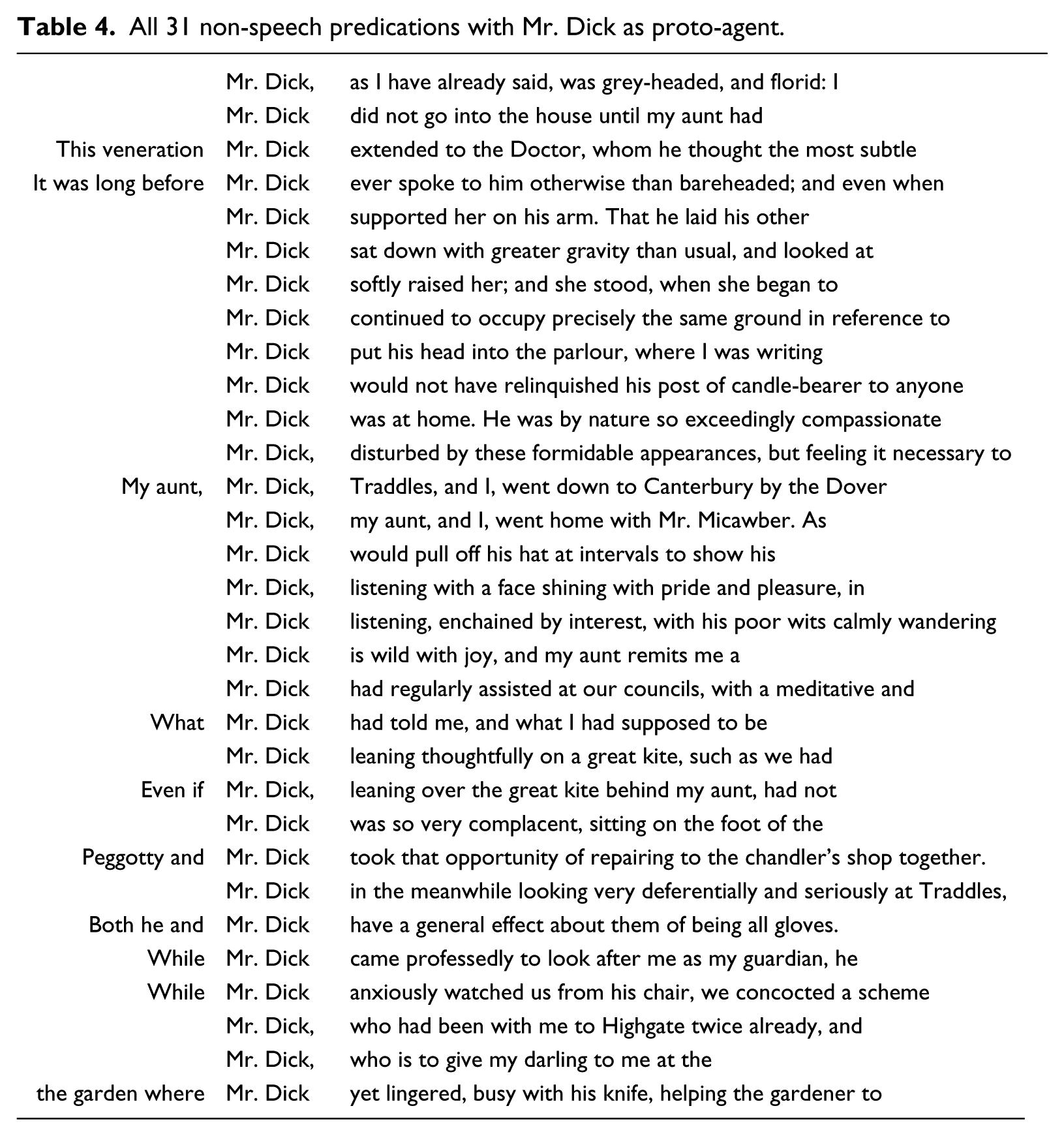
As can be seen here, even those predications that are most material are relatively static or inactive in some way, or are lexicalised in a progressive or non-declarative form: leaning, came to look after, yet lingered, and so on. Dick only actively goes somewhere in a group with others. His most active and agentive predications are perceptual or cognitive: he thought, listening, anxiously watched. Elsewhere, anything more agentive or wilful is subordinated or made part of a relative clause, or is modalised or negated, or is passivised: said my aunt as an admonition to Mr. Dick, who was biting his forefinger, Our instructions to Mr. Dick were that he should copy exactly what he had before him, But Mr. Dick got taxed with such things. The effect overall is that Mr. Dick hardly ever does anything materially, actively, definitely or with full agency; instead he receives actions, shares perceptions, or has actions that are unrealised in various ways.
4 Corpus stylistics and authorial mind-modelling
The foregoing analysis focuses on a single significant character and traces several of the stylistic patterns on which a reader can create a fictional mind. Of course, every single word mentioned in these quotations is in literal terms an utterance of Charles Dickens. And we have already noticed how the characters of Mr. Dick and of David Copperfield have been taken as a mirror and shadow of the author himself. This connection cannot entirely be dismissed as the usual biographical critical speculation, in this case. The fame of Dickens the novelist, the original instalment structure of the published novel, and the material reality of the text in hand all serve as reminders of the authorial mind. Within the novel itself, we can also find plenty of evidence of what a reader might regard as authorial tampering at the compositional deictic level (Stockwell, 2009, 2013). This includes not only the modelled mind who created the chapter headings and whose name is on the front of the book, but also other evidence within the texture of the novel that seems to indicate an intention that a reader can impute to the author.
For example, amongst the extracts of text that CLiC discovered as part of this study, we find the odd phrase (underlined here) in: Traddles and
Mind-modelling Mr. Dick and David Copperfield also involves meta-modelling of such mirroring and textual patterns, and assigning them to the mind of Dickens – we are building authorial intention in exactly the same way as we mind-model both fictional characters and real-life people. The productive integration of cognitive poetic theory underpinned by corpus stylistic evidence might finally allow us to move towards a rigorous account of authorial intention. Certainly this is the direction of travel in the recent narratological philosophy of, for example, Currie (2010) and Goldie (2012).
Interest not just in characterisation as a narrative technique but in character as a correlate of person-ness has been developing in cognitive narratology for a while. Several researchers have realised that a cognitive poetic approach is necessary: schemas for Culpeper (2001) as mentioned earlier, deictic space for Dancygier (2012), cognitive embodiment for Frow (2014). Our approach aims to develop this work by specifying the capacity for mind-modelling in stylistically empirical ways. Consequently, we have used the CLiC tool in this article for two purposes. Firstly, and most simply, we have used it as a powerful search engine to discover textual examples that can be explored using established stylistic description. Secondly, and more in keeping with the disciplinary standards of corpus stylistics, we have used it to uncover patterns across a text that can make claims for the generation of subtle textural effects in a reader’s mind. We have tried to use the method to demonstrate the theory, without treating corpus linguistics as an atheoretical method nor cognitive poetics as a non-empirical theory. The method here is integrative, in the hope of moving towards a cognitive corpus stylistics of characterisation.
Footnotes
Funding
The CLiC Dickens project is supported by the UK Arts and Humanities Research Council Grant Reference AH/K005146/1. The CLiC tool is currently a work-in-progress.