



Abstract
This article reviews recent research that examines how emotional processes change in response to exposure to new cultures and how successful changes in emotional processes play crucial roles in immigration outcomes. Social-psychology research has shown that emotional fit (i.e., having the “right” emotions in a given social context) is a pathway to social integration. Combining these findings with research on the crucial role of culture in shaping emotional experiences, this article aims to advance understanding of psychological adaptation processes among immigrants, cultural minorities, and cultural majorities, focusing on how they develop new emotional patterns to become calibrated to their cultural surroundings, a process termed “emotional acculturation.” We also discuss the antecedents and consequences of adaptive emotional acculturation. We hope to generate interest in future research on acculturation that fully incorporates the cultural foundations of psychological processes.
International migration has often been referred to as one of the major challenges of the 21st century. Significant and increasing proportions of the population in migrant-receiving countries consist of multiple generations of immigrant minorities (e.g., an estimated 281 million international migrants globally, approximately 3.6% of the global population; International Organization for Migration, 2022). Given the sheer number of lives connected to immigration experiences, either as immigrants themselves or as people in host cultures who interact with immigrants, it is paramount to understand what factors facilitate the successful integration of immigrants into their new cultures.
Indeed, there has been much psychological research on immigration and acculturation, the process of cultural and psychological change resulting from intercultural contact (Berry, 2005). Acculturation research has found how immigrants’ attitudes, cultural knowledge, skills, and identity develop and also serve as predictors of psychological and social well-being (e.g., Nguyen & Benet-Martinez, 2013; Sam & Berry, 2010; Ward et al., 2001). Prominently, scholars formulated theoretical frameworks, such as acculturation strategies (Sam & Berry, 2010) and bicultural identity integration (Nguyen & Benet-Martinez, 2013), that provide a systematic understanding of how immigrants accept their new cultures and maintain their heritage cultures as well as a framework for assessing immigration outcomes. Although some existing literature also shows the impacts of acculturation on more basic psychological processes, such as personality (e.g., Güngör et al., 2013) and self-esteem (e.g., Heine et al., 1999), understanding of such processes is still limited.
Cultural-psychology research has suggested the crucial role of culture in shaping psychological processes. A large body of empirical evidence shows that cultures differ in their shared assumptions and experiences, and such differences influence how people think, feel, and act. That is, people explicitly and implicitly understand and share goals prioritized in their cultural contexts, and this understanding shapes how they process information, engage with others, and experience emotions (Kim & Lawrie, 2019). We propose that emotions, in particular, deserve a deeper consideration in understanding psychological acculturation because of the key roles they play in social relationships. In this article, we review the literature that provides insights regarding how emotional acculturation occurs and how it may impact immigration adjustment outcomes, focusing on social and relational outcomes.
Acculturation is not a simple unidimensional process through which immigrants undergo changes toward the culture of the majority group in the host country. Research supports the view of acculturation as a bidimensional process (in regard to both the host and heritage cultures; e.g., Sam & Berry, 2010). Moreover, acculturation is a process that implicates not only immigrants’ psychology but also the majority group in host cultures (e.g., Kunst et al., 2021). Building on these perspectives, we advance a model of how intercultural contact through immigration shapes emotional processes, integrating ideas born out of findings on emotional fit and cultural shaping of emotional experiences.
Emotional Fit and Social Well-Being
Having high emotional fit is key for social inclusion and well-being (e.g., Anderson et al., 2003; Townsend et al., 2014). Emotional fit refers to the degree to which individuals’ patterns of emotional experience in a given situation are concordant with another person or people in the same or a similar situation. Emotional fit is more than similarity in the intensity of any particular emotions (e.g., feeling angry to a similar degree to others in a given situation; Kitayama et al., 2006). Rather, it refers to whether or not one’s profile of emotional experience across a wide range of emotions resembles a profile of others in a given situation. For example, a person who feels anger along with guilt and fear has a higher emotional fit with others who also feel anger along with guilt but has a lower emotional fit with others who feel anger along with excitement and pride in a similar anger-provoking situation (for a visual representation of high and low emotional fit, see Fig. 1). This conceptualization of emotional fit has been commonly used in relevant studies (e.g., Anderson et al., 2003; De Leersnyder et al., 2011; Townsend et al., 2014) as an implicit measure of emotional fit that is less susceptible to self-presentational concerns than explicit measures of attitudes or focal emotion intensity (De Leersnyder et al., 2011). Research shows that interpersonal interactions and relationships tend to work better if the involved individuals experience high emotional fit (e.g., Anderson et al., 2003). In addition, people in a threatening situation tend to experience less stress, both psychologically and physiologically, when they are with a stranger with a high (vs. low) emotional fit (e.g., Townsend et al., 2014).
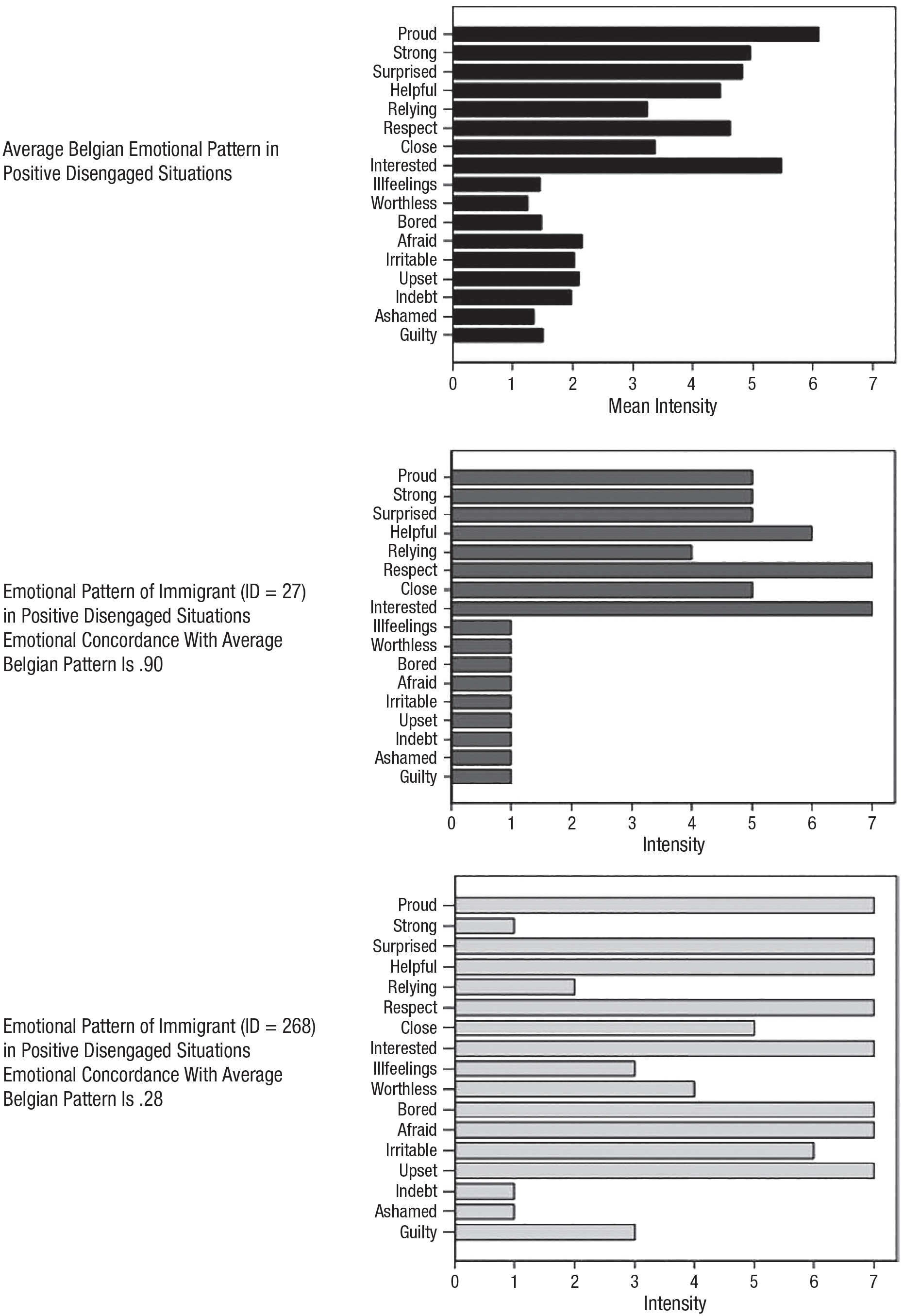
Graphical representation of the concordance between the emotional patterns of two individual immigrants and the average Belgian emotional pattern (from De Leersnyder et al., 2011).
Emotional fit is malleable and situation-dependent. Emotions are experienced and constructed in social interactions that derive their shape and meaning from culturally dominant ideas of how to be and how to relate to others (Mesquita, 2003); although constrained by previous experiences, the construction of emotions unfolds, each time again and anew, in response to the current demands of the situation. Thus, emotions are constructed in meaningful social interactions. Interaction partners shape each other’s emotions, for instance, by modeling, reinforcing, or constraining emotional interpretation and behavior (e.g., Hatfield et al., 1993). Because these social interactions take place in larger cultural contexts, the construction of emotions is also informed by cultural meanings and practices. Therefore, social interactions calibrate our emotions to cultural values and goals (Mesquita et al., 2016).
In each culture, the prevalent emotions can be understood from the characteristics of relationships that are valued in that culture (e.g., Kitayama et al., 2006; Mesquita et al., 2016). For instance, emotions highlighting a person’s individuality and independence from others, such as anger and pride, are more frequently experienced in cultures that endorse “independence” as a core value in relationships (such as the United States and Belgium). Conversely, emotions that help meet others’ expectations and repair relationships, such as shame and indebtedness, occur more often in cultures that value “interdependent” relationships (such as Japan and Turkey). Stated differently, the emotions that help to establish relationships in culturally valued ways are culturally encouraged or condoned, and emotions that violate these relationships are condemned (Mesquita, 2003).
Research has consistently found that individuals who fit with the typical pattern of emotions in their own cultures tend to have greater well-being compared with others who do not. People who experience emotions in ways that are typical in their cultural contexts have greater relational well-being (e.g., satisfaction with relationships and social support; De Leersnyder et al., 2014) and greater psychological well-being (e.g., higher self-esteem and positive emotion) than individuals who do not (De Leersnyder et al., 2015). This research extends the findings on fit in intercultural relationships.
Emotional Acculturation
In the context of immigration, as immigrants and cultural minorities engage in social interactions with majority members of the host culture, their emotions are shaped and constrained by a different set of social expectations. Over time, just like immigrants and cultural minorities learn the language of the majority culture (Clément et al., 2001) and acquire a bicultural identity (Chen et al., 2008), they develop a new repertoire of emotional patterns that fit the host culture better. That is, emotional acculturation occurs. Emotional acculturation can be broadly construed as any changes in the pattern of emotional experiences as a consequence of contact with a different culture (Fig. 2). Emotional acculturation is a dynamic process that continues through intercultural contacts and is relevant to the lives of immigrants and cultural-minority members. Similar processes could occur in cultural-majority members, provided that the latter form meaningful contacts with minority members.
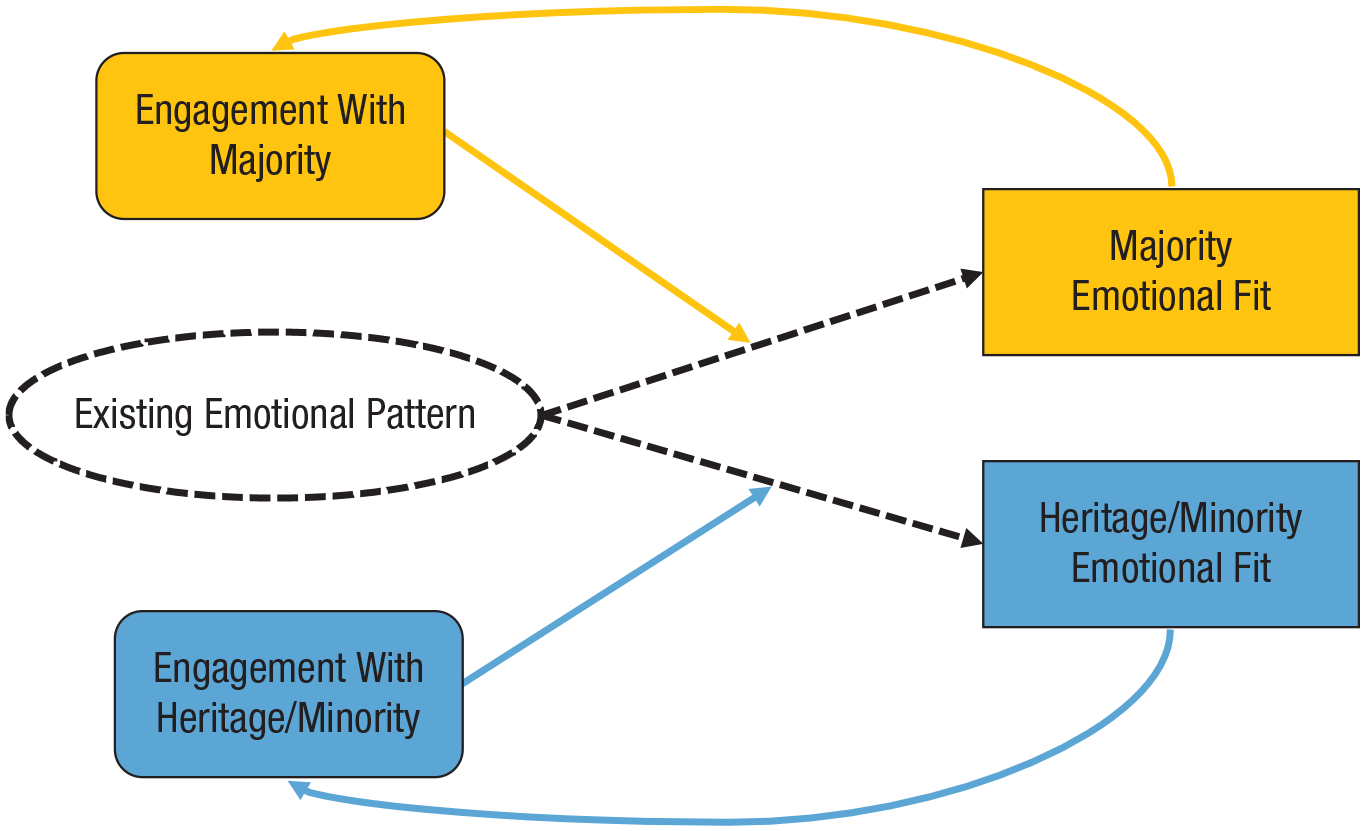
Abridged model of emotional acculturation.
Our research strongly suggests that immigrants’ emotions change. First, immigrants, and to a lesser extent minority individuals of immigrant descent, have a consistently lower emotional fit with their respective majority culture’s normative patterns than their majority peers, and we found this across different immigrant groups and host countries, such as Korean immigrants in the United States and Turkish immigrants in Belgium (De Leersnyder et al., 2011; 2020). Second, the age of migration and the proportion of life spent in the majority culture predict emotional fit with the majority such that immigrant-minority individuals who have been exposed more to the majority culture show emotional patterns that are more similar to those of their majority counterparts compared with those who have been exposed less to the majority culture (De Leersnyder et al., 2011). Furthermore, on average, first-generation immigrants consistently have the lowest emotional fit with the majority group, and every subsequent generation further shifts toward the majority norm (i.e., acculturates). Data suggest that it takes the mean minority individual of immigrant descent two to three generations to fully develop emotional patterns that are indistinguishable from the majority; and again, this is true for different immigrant groups in different majority contexts (De Leersnyder et al., 2011; Jasini et al., 2019).
Yet this change is not a simple replacement of an old set of emotional patterns with a new set. Research on acculturation and cultural identity has found that immigrants’ adjustments are bidimensional because they adjust to and identify with the host culture as well as maintain their connection with the heritage culture (e.g., Nguyen & Benet-Martinez, 2013; Sam & Berry, 2010). Studies have found that the fit with the majority emotions does not necessarily come at the expense of the fit with the minority emotions either. For instance, the number of majority friends positively predicted Turkish Belgian middle school students’ fit with majority emotional patterns without decreasing their fit with minority emotional patterns (Lee et al., 2024). That is, they developed a new set of emotional patterns that fit the majority patterns better, in addition to their heritage emotional patterns. Once they develop their second set, they are emotionally “bicultural.” There is some evidence that emotionally bicultural immigrants can flexibly respond to moment-to-moment changes in cultural expectations by switching between the two sets of emotional patterns, not unlike bilinguals switching between languages, once they develop linguistic proficiency, to fit in the situation. Individuals from the Turkish Belgian community samples fit the majority emotional norm better in work and the heritage-culture emotional norm in home situations (De Leersnyder et al., 2020). Furthermore, in a daily diary study among Belgian secondary school students, Turkish Belgian minority students fit the majority emotions better when (a) the emotional interaction was in the majority (vs. minority) language (i.e., Dutch vs. Turkish) and when (b) interacting with a majority (as opposed to immigrant-origin) partner (Lee et al., 2025).
Moreover, it is not just immigrants who undergo changes in emotional experiences. Given that shaping of emotional experiences is inherently interpersonal (e.g., Hatfield et al., 1993), it is likely that the emotional patterns of the majority members who engage with immigrants or minority friends also undergo change. Studies on globalization-based acculturation (Kunst et al., 2021) show that the majority members of a host culture could adopt the values, identities, and behaviors of immigrants through repeated interactions, depending on sociostructural (e.g., policies) and individual (e.g., personality and attitudes) factors. Recent work by Jasini, Tekin, et al. (2024) mirrors these findings with changes in emotional patterns. Reanalyzing data from the first wave of the large national school study in Belgium, the authors suggested that emotional acculturation may be a bidirectional process. Majority individuals, especially those who reported having minority friends, fit the emotion norm of the minority students in their class to the extent that the emotional patterns of minority students in the class converged with each other.
Emotional Acculturation and Social Integration
Active participation in the majority culture, especially through contact with majority others, is a key ingredient for emotional acculturation. Immigrants and immigrant-descent minority individuals who report having majority contact have a higher fit with the average majority emotional patterns in similar situations (De Leersnyder et al., 2011; Jasini et al., 2019). Moreover, a 3-year-long longitudinal study among more than 5,000 students from a representative national sample of middle schools in Belgium showed that minority students’ self-reported intercultural contact predicted greater emotional fit with the majority emotional pattern 1 and 2 years later (Jasini et al., 2023). High-quality intercultural contacts, such as friendships, predict emotional acculturation better than more shallow and transient intercultural contact. The number of friendship ties with majority students, measured through social network analysis (Jasini, De Leersnyder, et al., 2024), predicted minority students’ emotional acculturation, even after controlling for minority students’ self-reported overall majority contact. This effect was strongest for friendships reciprocated by the majority student in which the interactions are presumably more frequent and meaningful. These findings support the idea that emotional acculturation is the development of new emotional patterns more calibrated to their cultural surroundings, especially in high-quality interactions in meaningful relationships.
At the same time, emotional fit is also an important predictor of social engagement (e.g., Anderson et al., 2003). Extended to intercultural contact, emotional fit fosters more frequent and meaningful social contact between immigrants and majority members. The longitudinal study described above (Jasini, De Leersnyder, et al., 2024) also found a bidirectional relationship between emotional fit and intercultural contact. That is, emotional fit with the majority culture at the beginning of the study predicts self-reported contact with majority members over time, which in turn predicts emotional fit in the subsequent year. Thus, on the basis of this evidence of mutual influence between emotional fit and social contact, we reason that emotional acculturation may be a key condition for individuals’ social integration in culturally diverse societies.
Future Directions
The bidimensionality of emotional acculturation complicates the investigation and interpretation of its adjustment outcomes. Although previous research has shown that individuals with greater emotional fit with their culturally typical emotional patterns (i.e., majority members in their own culture) tend to report greater well-being (e.g., De Leersnyder et al., 2014), direct empirical evidence for adjustment outcomes of emotional acculturation is limited. Emotional fit with immigrants’ heritage culture and host culture may influence well-being independently or interactively. The outcome may also depend on more specific aspects of emotional fit. For example, although the existing literature on psychological and social benefits strongly affirms the benefit of emotional similarity (De Leersnyder et al., 2014), recent studies have found that minority individuals’ fit with the majority’s emotions can be harmful in situations in which the emotional norm is negative (Jasini et al., 2019; Lawrie & Kim, 2024) given that the typical majority pattern in those situations involves lower levels of beneficial emotions (e.g., lower levels of positive or relationship-supporting emotions). More research is needed to address the question of when and why emotional acculturation brings psychological and social benefits.
Beyond its direct implications for social and relational outcomes, emotional fit may facilitate other forms of psychological outcomes. Although existing literature points to a myriad of positive psychological consequences of encountering similar others, encountering different others may have its own positive outcomes. For example, being exposed to diverse perspectives has been shown to bring desirable psychological outcomes, such as cognitive flexibility and creativity (e.g., Crisp & Turner, 2011; Maddux & Galinsky, 2009). These studies also show that the key psychological component to bring out these positive outcomes is psychological adaptation to diversity. The current article articulates that developing emotional fit is not a process in which immigrants or minority members of a society become simply more similar to the majority members. Emotional acculturation is a process that reflects deeper engagement with a new culture and the development of a new perspective, in addition to the existing one (Mesquita et al., 2016). Thus, developing an emotional fit with a host culture, in addition to the preexisting fit with immigrants’ heritage culture, may be an important aspect of psychological adaptation because it may allow multicultural perspective taking and flexibility.
Existing research focuses primarily on the process of emotional acculturation that is assumed to be applicable to the majority of people who experience intercultural contacts and interactions. However, our data clearly show there is a great deal of variance in emotional fit with both the heritage culture and majority culture, even with comparable objective experiences (e.g., heritage country, location of residence, or generation status). Existing research suggests that some of the variance probably comes from each individual’s social experiences, such as social network composition and friendship, but it is also likely that there are individual difference factors that influence the rate of emotional acculturation. Studies have shown that factors such as the need for closure (Kosic et al., 2004) and implicit aptitude (Savani et al., 2022) moderate acculturation processes. There may be factors that are specifically relevant to emotional acculturation. For example, emotional intelligence (Salovey & Mayer, 1990) or empathic accuracy (Ickes, 1993) may influence emotional acculturation.
Moreover, the existing studies have focused on social integration and belonging as the key outcomes. Given the importance of social connection in shaping people’s general well-being (e.g., Cacioppo et al., 2002), and the association between cultural fit and various indices of health (Yoo & Miyamoto, 2018), we anticipate that psychological flexibility afforded by the successful development of bicultural emotional patterns would benefit psychological and physical health as well. Last, given the fundamental role of emotions that permeate through all aspects of psychological experiences, future research should begin to look at how emotional acculturation shapes and is shaped by other indicators of acculturation. Although cross-sectional research has found no association between emotional acculturation and cultural attitudes and identities (De Leersnyder et al., 2011; Jasini et al., 2019), it is possible that these different domains of acculturation longitudinally reinforce each other, for instance, because they all facilitate intercultural contact.
Conclusion
Uncovering the processes and consequences of emotional acculturation introduces a novel way to understand the microprocesses of acculturation—how everyday intercultural interactions over time shape and reshape individuals’ emotions, which, in turn, influences their sense of cultural belonging. The current article underscores the idea that emotions may function as invisible social and interpersonal barriers and that emotion is expected to be pivotal to understanding the social integration of people with diverse cultural experiences and perspectives. We hope to generate interest in future research on acculturation that fully incorporates the cultural foundations of psychological processes.
Recommended Reading
De Leersnyder, J., Kim, H. S., & Mesquita, B. (2020). (See References). Presents empirical evidence for the bicultural flexibility of emotional patterns.
De Leersnyder, J., Mesquita, B., & Kim, H. S. (2011). (See References). Examines emotional acculturation and develops the method for measuring emotional fit.
Jasini, A., De Leersnyder, J., Ceulemans, E., Gagliolo, M., & Mesquita, B. (2023). (See References). Examines the role of social contact as an antecedent and consequence of emotional acculturation.
Mesquita, B., De Leersnyder, J., & Jasini, A. (2019). The cultural psychology of acculturation. In D. Cohen & S. Kitayama (Eds.), Handbook of cultural psychology (2nd ed., pp. 502–535). Guilford Press. Reviews key findings on culture, emotion, and acculturation.
