




Abstract
Dancing to music is prevalent across human cultures. It is also developmentally precocious—most children display dance-like behaviors before their first birthday. This early emergence precedes a long maturational trajectory with broad individual differences. Here, we survey recent research on dance in infancy and childhood. We propose that investigating early musical movements is useful for understanding the development of dance itself and that dance can serve as a behavioral measure to better understand development in adjacent domains, such as auditory perception and musical memory. Finally, we discuss potential developmental mechanisms underlying early dance and highlight major remaining questions. Studying early dance provides an opportunity to highlight how fundamental processes in psychology, such as nature-nurture interactions, individual differences, and the interplay between abilities and environments, can impact the emergence and expression of this social and multimodal human behavior.
Across cultures and throughout human history, dance has been a pervasive component of ritual, leisure, and family life. Dancing figures depicted in cave paintings date back more than 10,000 years. It is a particularly human behavior—rhythmic movements by other species that are sometimes dubbed “dance” differ from human dance in both form and function. Human dance is unique in that it often includes synchronization to music, which is absent in most species (but for exceptions such as Snowball, the dancing cockatoo, see Keehn et al., 2019), and humans dance for aesthetic, hedonic, and social reasons, whereas other species’ “dancing” is usually restricted to communication. Dancing is often central to human activities that prioritize social-emotional cohesion, such as weddings and festivals (e.g., Brown, 2000). The universality of human dance is arguably driven by its propensity for transmitting cultural knowledge, strengthening social bonds, and coordinating emotions (Fink et al., 2021).
Dance emerges early in development. Most parents report that their infants dance at an age that usually precedes first steps and almost certainly precedes first words (Kim & Schachner, 2023). Dance also has important social and emotional consequences. Synchronizing with others, a common feature of group dance, encourages prosociality among even very young co-movers. Although toddlers can first experience synchrony only by being rocked or carried, prosocial effects are already apparent (Cirelli, 2018). As children’s control over their movements improves, they gain a tool for shaping and participating in their social environments. This universality and precociousness, as well as close links to socioemotional and auditory-motor development, have motivated a recent surge in developmental studies of dance.
Here, we describe what is known about early dance and how it has been examined by developmental scientists. Our focus is not on the cultural product of dance as defined by any particular discipline—we do not, for instance, examine impacts of ballet or bachata lessons—but rather on dancing that occurs in informal, everyday settings. We propose that dance is a useful dependent measure in the developmental toolbox to reveal knowledge, preferences, and abilities in nonverbal populations such as prelinguistic children. Finally, we discuss major questions remaining in the early-dance literature.
Conceptualization and Operationalization of Early Dance
A central challenge is to determine what counts as “dance.” Although dance is common across human societies (Fink et al., 2021), definitions and expressions are shaped by culture. At a minimum, dance involves movement that is not attributable to another motor goal. Dance movements are often rhythmic and often aligned with an external stimulus such as music, drum beats, or the movements of other dancers. However, although rhythmicity and synchronization are common features of dance, neither are required—guests grooving on the dance floor at a wedding vary in synchronization accuracy, but all are dancing. Likewise, behaviors such as rowing—which includes rhythmic, synchronized movements—would not be considered dance because the movements are in service of a nondance goal (propelling a boat). Indeed, when the goals of a perceived movement are unclear, adult observers infer movement itself to be the goal (Schachner & Carey, 2013). Movement, therefore, is necessary for dance but is not sufficient. Previous work has defined dance as intentional movements for aesthetic or expressive purposes, but whether intentionality is necessary is arguable. In the context of a baby moving to music, for example, we can only infer intentionality—for example, by observing that a baby moves more when their favorite song is played compared with a novel song. Likewise, movements such as head bobbing or toe tapping may occur without conscious intention. Intentionality is, however, sufficient—if someone intends to dance then they are dancing.
Alongside dance as a holistic concept, many perceptual and motor capacities contribute to dance, including but not limited to beat perception, rhythmic movements, sensorimotor synchronization, fine and gross motor skills, sequence learning, and expressivity. Literature that informs our understanding of the development of dance can home in on one of these skills (e.g., by exploring beat perception) or capture a broader conceptualization of dance (e.g., by asking children to freely dance to music). The literature uses various labels and measurement techniques to capture and describe these narrow and broad capacities (see Supplementary Table 1 in the Supplemental Material available online). These techniques include motion capture (Zentner & Eerola, 2010), electromyographic recordings (Rocha & Mareschal, 2017), MIDI drum-pad recordings (Yu & Myowa, 2021), human coding (Cirelli & Trehub, 2019; Kragness, Johnson, & Cirelli, 2022, Kragness, Ullah, et al., 2022; Kragness et al., 2023; Nguyen et al., 2023), and automated movement extraction (e.g., OpenPose; Rocha & Addyman, 2022). Each measurement solution comes with costs (equipment, processing, human hours) and benefits. Human coding, which is time-consuming and expensive, may be the best method for reducing false positives in identifying dance because coders can be trained to exclude movements that have a clear cause other than dance. For example, a child running around a room could be considered dancing, but a child running around the room to chase the family cat would not be considered dancing. Interobserver agreement on the amount of time children dance in a trial or video tends to be relatively strong although imperfect. On the other hand, motion-capture technology holds promise for capturing children’s movement kinematics (e.g., limb velocity) but may fail to distinguish movements that would or would not be considered dance by an observer (for a comparison of measurement techniques, see Fig. 1).
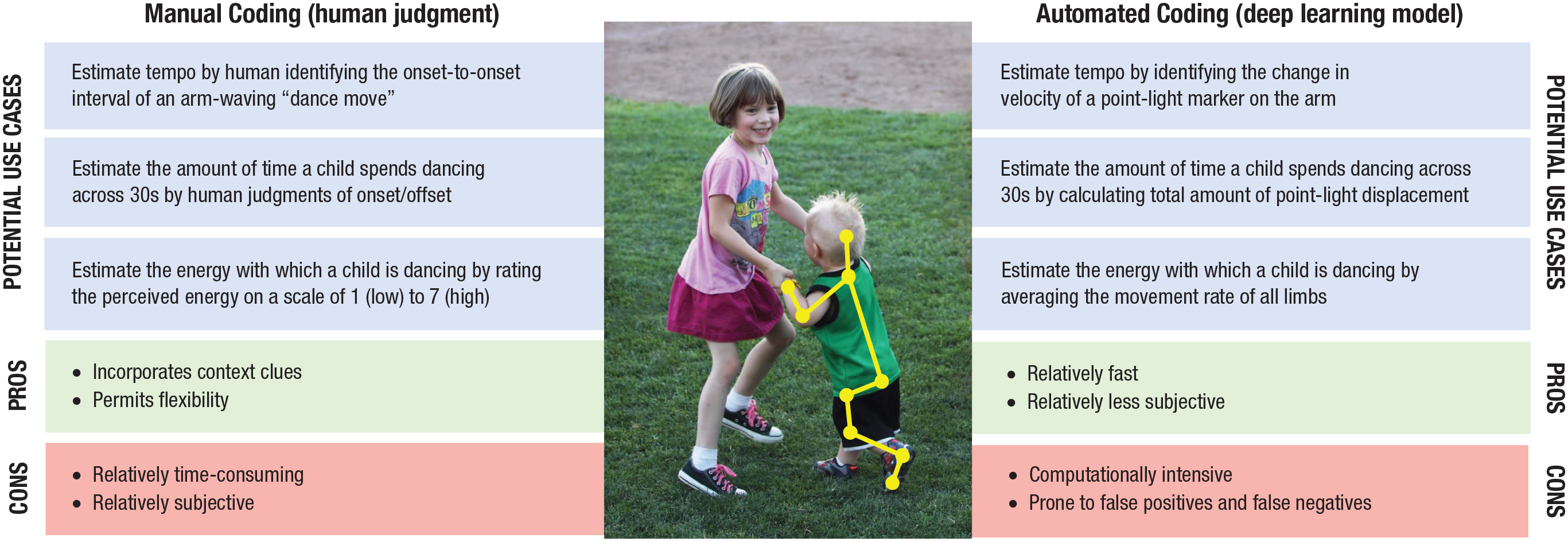
Comparison of manual versus automated evaluation of childhood dancing. Photo by Paul L. Dineen (CC by 2.0).
Developmental Timeline for Dance
Various neurocognitive capacities and motor skills contribute to childhood dance. Here, we summarize research examining the emergence and timing of these capabilities across childhood (see Fig. 2). Although perceiving and tracking auditory rhythms can be measured neurally even in premature neonates (Edalati et al., 2024), laboratory studies (Fujii et al., 2014; Zentner & Eerola, 2010) and parent reports (Kim & Schachner, 2023) suggest that infants begin to move more rhythmically to music than nonmusic as early as 2 months, often by 6 months, and almost always before their first birthday. Home-recording studies demonstrate that dance to music often involves flapping arms and swaying torsos in infancy, hops and spins in toddlerhood, and complex movements combining multiple body parts in later childhood (Kragness, Ullah, et al., 2022; Kragness et al., 2023). Early musical movements are often not synchronized with the beat (the regular pulse to which an adult might tap their toe). However, lab and home-recording studies show that infants demonstrate tempo flexibility, moving faster to faster music, perhaps by 5 months and certainly by early toddlerhood (Kragness, Ullah, et al., 2022; Rocha & Mareschal, 2017; Schmuckler & Paolozza, 2023; Yu & Myowa, 2021; Zentner & Eerola, 2010). A preliminary ability to move in anticipation of beats first emerges in toddlerhood but usually only for tempos close to children’s spontaneous tempo (i.e., rattle-shaking rate without accompanying music; Rocha et al., 2021). The ability to synchronize movements to various tempos broadens into early childhood, with consistent synchronization in simple tapping paradigms apparent by age 6 with refinement into adolescence (sine-wave metronomes: McAuley et al., 2006; instrumental music: Yu et al., 2022). This protracted timeline may reflect perceptual-motor integration flexibly attuning to a growing body. Less is known about how synchronization develops in full-body dance, but new methodologies using human coding and machine learning are beginning to address this question (Kragness et al., 2023; Rocha & Addyman, 2022).
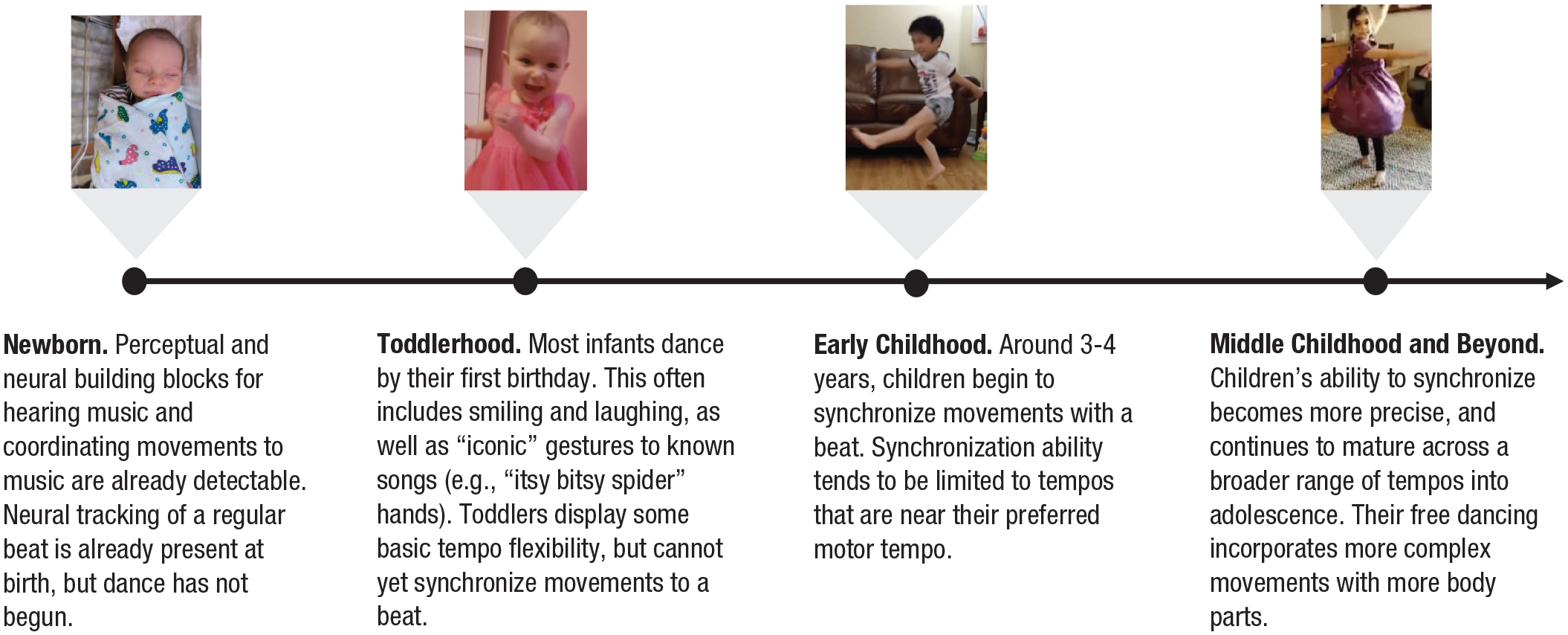
Summary of dance and dance-related capabilities across early childhood.
What Can Dance Reveal About Development?
Research with infants and children relies largely on using observable behavior to infer mental processes. Studies of infant cognition have long used infant looking as a proxy for processes such as attention and a far proxy for complex mental processes such as knowledge, memory, and discrimination. Sucking rate, facial displays of affect, and approach behaviors can also reveal developmental processes. Developmental scientists often rely on such observable behaviors in young participants who cannot respond verbally or follow instructions. However, even for older participants, such as children and adults, behavior offers insights about implicit knowledge or knowledge that is difficult to articulate. We propose dance as one such useful behavior.
Perhaps unsurprisingly, dance can reveal information about auditory and rhythm perception. For instance, rhythmic stimuli (such as music), which have a regular underlying pulse, often elicit more rhythmic movements from infants than less rhythmic stimuli (such as speech; Zentner & Eerola, 2010), suggesting early sensitivity to temporal regularity. As mentioned above, infants and children demonstrate sensitivity to tempo by adjusting dance movements toward the tempo of musical stimuli (Kragness et al., 2023; Kragness, Ullah, et al., 2022; Rocha & Mareschal, 2017; Zentner & Eerola, 2010). Children dance more and with more precisely timed movements in response to “high-groove” music, which adults consider to be “good for dancing” (Kragness et al., 2023). It has been proposed that high-groove music (such as LaBelle’s “Lady Marmalade” or the Glenn Miller Orchestra’s “In the Mood”) engages the motor system to resolve predictive uncertainty in response to moderately complex stimuli such as rhythmic syncopation (Stupacher et al., 2022). In accordance with this idea, children—like adults—dance more when listening to syncopated rhythms than simple rhythms (Cameron et al., 2023). Dance provides an avenue to investigate children’s sensitivity to tempo, groove, rhythmicity, and syncopation and holds potential for examinations of other musical and acoustic features, such as children’s perception of metrical structure (strong vs. weak beats).
Examinations of dance and movement can also supplement classic paradigms. In infants, for instance, recognition is typically inferred via measures of looking time. Differential interest in one type of stimulus over another is interpreted to reflect knowledge (although infants’ preference for novel vs. familiar stimuli is subject to many different factors, such as age and testing context). Although infant visual attention is the primary dependent measure, infants’ dance and movements are usually also available for examination. We examined 9- to 12-month-old infants’ responses to familiar or unfamiliar songs, sung either by their mother or a female stranger, in an infant-controlled preferential listening procedure (Kragness, Johnson, & Cirelli, 2022). Infants listened longer to familiar than unfamiliar songs, regardless of the singer’s identity. Alongside increased attention, infants produced more rhythmic movements during familiar song trials. Thus, infants’ recognition of familiar songs was indexed both by looking time and dance-like movements. Dou et al. (2024) also used a preferential listening paradigm to investigate infants’ relative attention to a known song, “Wheels on the Bus,” compared with the same melody with different lyrics and the same lyrics with a different melody. By 20 months, infants’ attention was enhanced by novel lyrics and novel melodies compared with the familiar rendition. A shift from a familiarity preference to a novelty preference by later infancy is broadly consistent with infant research in other domains, including language, vision, and cognition. Surprisingly, 11-month-olds in this study did not attend differently across conditions, but they appeared to danced most to the familiar version. Notably, infants’ rhythmic movements potentially revealed song knowledge earlier than did their visual attention. These findings also suggest that the suite of behavioral responses a young infant may have to certain music (e.g., visual attention, movement, or even expressions of positive affect) may reflect qualitative differences in musical engagement, which could be related to song function, song familiarity, stimulus properties, and infant arousal. Dance can be informative both as a dependent variable and to supplement interpretations of traditional measures, such as looking time.
An important theoretical and methodological consideration is that movement may be suppressed in response to novelty. The sudden presentation of a stimulus to an infant often elicits an “orienting response” in which the infant turns their attention to the new stimulus and suppresses movement to facilitate visual exploration. For example, in visual fixation studies, infants suppress movement at the moment of fixation to a target and begin to move again just before they look away (Robertson et al., 2001). This may explain why, for instance, Fujii et al. (2014) found that most 2-month-olds in their sample moved less and more slowly in response to music compared with silence. An analogous process could explain why toddlers unexpectedly produce more rhythmic movements to music when ringing a bell alone than when an experimenter demonstrates the target movement (Rocha & Mareschal, 2017). It is important to consider potential effects of orienting when designing and interpreting studies of movement, particularly with infants. It may be prudent, for example, to present stimuli multiple times or to lengthen trials to reduce the influence of orienting.
Stepping Into the Future of Dance Research
What are the origins of early dance?
A number of studies have reported that dance is observable early in life. However, little is known about why and how dance develops. Dance could arguably emerge, for instance, as a byproduct of biological and neurological maturation from behavioral reinforcement or from social imitation. Below, we briefly discuss several possible explanations for early dance. We note these explanations are neither exhaustive nor mutually exclusive—each accepts an interplay between nature and nurture.
An important consideration in the emergence of early dance is auditory-motor integration. When a dancer synchronizes to music, timing information is extracted from an auditory stream and transmitted to the motor cortex, and predictive processing mechanisms for planning and executing upcoming movements are engaged (Repp & Su, 2013). Research shows that motor areas in the adult brain, including the basal ganglia and supplementary motor area, facilitate music listening and beat perception, even in the absence of movement (Grahn & Brett, 2007). This auditory-motor connection may explain why it is sometimes difficult to suppress the urge to move to certain auditory rhythmic patterns. These auditory-motor pathways appear to be present around the time dance typically emerges—by at least 7 months of age, rocking infants to a rhythm shapes rhythm perception (Phillips-Silver & Trainor, 2005).
Maturationist explanations would predict that dance emerges as a result of experience-expectant connections between auditory and motor areas of the brain. That is, there may be an evolutionary predisposition for strong, early connections between auditory and motor areas, perhaps as a result of speech development. In this view, our earliest dances might be driven by this precocious auditory-motor connectivity. Once these connections are sufficiently established, simply listening to music could encourage a motor response from infants, albeit in a less refined way than adults because of physical and neural immaturity. These motor responses may be flexible, context-dependent, and under conscious control for individuals with mature executive function. From this perspective, early dance may be considered a partial byproduct of early perceptual-motor development rather than a purely learned behavior and should be strongly influenced by stimulus properties, such as pulse clarity and tempo. Experience, social reward, and cultural norms would then play a supporting role in shaping initially unlearned responses. Evidence of tempo flexibility in infants (e.g., Kragness, Ullah, et al., 2022) and preliminary evidence connecting adults’ beat-synchronization abilities to genetic variability (Niarchou et al., 2022) align with this perspective.
On the other hand, behaviorist explanations would highlight the role of learning mechanisms in the emergence of early dance. Social reward, for example, could shape the contexts in which infants execute dance-like movements. Even when music is not present, repeated rhythmic movements (i.e., sucking, arm flapping) are common in a young child’s behavioral repertoire. Indeed, the idea that repetitive actions underlie infants’ earliest interactions with the world dates back to Piaget. If these repetitive actions happen to coincide with music, observers’ resulting delight could offer a mechanism through which early dance is behaviorally reinforced. From this perspective, the auditory-motor connections that appear to drive musical movement in adulthood would be the result of experience-dependent changes in the brain.
Social-cognitive mechanisms could also play an important role. It does not take long before infants’ actions are influenced by social models—babies start to imitate basic motor patterns, such as clapping and table tapping, as early as 6 months (Jones, 2009). Indeed, North American parents frequently report dancing with and for their infants, and by toddlerhood children begin to integrate specific choreographed movements into their dance (Kim & Schachner, 2023). Whether social-cognitive mechanisms play a causal role in early dance is unknown.
In sum, although auditory-motor connections evidently emerge early, the relative roles that experience-expectant and experience-dependent mechanisms play in establishing those connections, and their contributions to early dance, are unknown. Is early dance a cause or consequence of auditory-motor integration? An important challenge for future research is to design studies that rigorously test such questions.
Family, culture, and individual differences
Regardless of its early origins, individual trajectories of dance behavior (such as latency and frequency) are undoubtedly shaped by motivational, social-emotional, and cultural factors. One study comparing Brazilian and German children provides compelling evidence that children from cultures that encourage dance in everyday life reach dance “milestones” before other children (sensorimotor synchronization; Kirschner & Ilari, 2013). Such observations suggest that cultural practices refine the neural and physical architecture necessary for dancing. The studies reported here used samples of children primarily living in Brazil, Canada, Germany, Japan, the United States, and the United Kingdom, limiting generalizability. Recent advancements in video motion-capture technology (e.g., Rocha & Addyman, 2022), data sharing (Databrary), and global family recruitment (e.g., Children Helping Science) offer substantial promise for understanding the effects of cultural context on dance.
Within a given cultural context, large variability is observed. According to North American parents, some infants dance as early as 2 months and some as late as 20 months (Kim & Schachner, 2023). It is probable that babies who dance precociously continue to seek environments and opportunities that further refine their dance ability and that this interplay between ability and experience continues through the lifespan. This developmental pattern (known as “niche picking”) has been observed in analogous domains—children’s early melody- and rhythm-perception abilities predict the amount of music lessons they subsequently take (Kragness et al., 2021). Examining how micro and macro environments shape the emergence and trajectory of dance will help shed light on important questions about experience-expectant and experience-dependent contributions to early dance.
Conclusion
Over the last decade, research on the development of dance in early childhood has accelerated. Aside from the importance of dance as a global cultural phenomenon, understanding early dance also has broader applications. For example, correlational research has highlighted developmental links between rhythmic movement and language in typically developing infants (e.g., Nguyen et al., 2023) and in children with language delays (e.g., Corriveau & Goswami, 2009), perhaps because both rely on auditory-motor integration and predictive processing. The causal link between synchronization and social bonding makes engaging musical experiences, such as dance, a promising avenue for supporting social outcomes for at-risk children and adults alike (Lense et al., 2020). Perhaps most importantly, human dance is joyful—childhood dance is frequently accompanied by smiles and laughter (Cirelli & Trehub, 2019; Kragness, Johnson, & Cirelli, 2022; Zentner & Eerola, 2010). Further elucidating the development of dance can reveal how early musical movements provide a foundation for a lifetime of musical engagement.
Recommended Reading
Fink, B., Bläsing, B., Ravignani, A., & Shackelford, T. K. (2021). (See References). Reviews dance research from an evolutionary perspective.
Kim, M., & Schachner, A. (2023). (See References). Explores when infants start to dance, how it changes over infancy, and whether its emergence relates to motor development.
Kragness, H. E., Anderson, L., Chow, E., Schmuckler, M., & Cirelli, L. K. (2023). (See References). Uses human coding of home recordings (many available for data sharing on Databrary) to demonstrate that children’s early free dance is influenced by stimulus properties.
Rocha, S., & Addyman, C. (2022). (See References). Reveals tempo flexibility in toddlers’ rhythmic movements using data collected virtually and analyzed with OpenPose (a deep learning model).
Supplemental Material
sj-docx-1-cdp-10.1177_09637214251323490 – Supplemental material for The Development of Dance in Early Childhood
Supplemental material, sj-docx-1-cdp-10.1177_09637214251323490 for The Development of Dance in Early Childhood by Laura K. Cirelli and Haley E. Kragness in Current Directions in Psychological Science
Footnotes
Acknowledgements
We thank Hayley Leopold for comments on a draft and three anonymous reviewers for their insightful suggestions.
Transparency
Action Editor: Robert L. Goldstone
Editor: Robert L. Goldstone

References
Supplementary Material
Please find the following supplemental material available below.
For Open Access articles published under a Creative Commons License, all supplemental material carries the same license as the article it is associated with.
For non-Open Access articles published, all supplemental material carries a non-exclusive license, and permission requests for re-use of supplemental material or any part of supplemental material shall be sent directly to the copyright owner as specified in the copyright notice associated with the article.
