




Abstract
Beliefs about the changeable or stable nature of human attributes, that is, growth or fixed mindsets, act as fundamental frameworks guiding social perception. These mindsets are closely allied with other important beliefs that can be used to sustain and justify, or to mitigate, prejudicial attitudes. In this article, we review our program of research linking growth mindsets to prejudice. First, we present the double-edged-sword model, which outlines why growth mindsets can have the paradoxical effect of both increasing prejudice through blame and decreasing it by undermining social essentialism, defined as the categorization of individuals based on presumed inherent essences. Second, we present the stigma-reduction model, which outlines when growth mindsets serve to directly decrease prejudice. Third, we highlight the implications of this work for prejudice-reduction efforts, emphasizing the need for interventions that not only challenge personal-level beliefs but also seek to transform broader environments.
Prejudice is a burden that confuses the past, threatens the future and renders the present inaccessible.
This quote reminds us that our personal biases can be profound. Viewing the world through the lens of prejudice can distort history, perpetuate negative attitudes, and stunt our vision for the future. Considering these costs, psychologists seek to understand what predicts prejudice with an eye toward reducing negative attitudes and instead encouraging connection, empathy, and greater acceptance. Prejudice—or people’s negative attitudes toward others because they belong to a particular social group—is a key attitudinal component of broader stigmatization processes (Phelan et al., 2008). Stigma occurs when individuals possess, or are perceived to possess, attributes that convey a devalued social identity such as obesity, addiction, or mental illness (Crocker et al., 1998). In this article, we examine how beliefs about stigmatized attributes can either sustain or mitigate negative prejudicial attitudes, with the goal of informing programs designed to reduce stigma.
Beliefs are powerful forces that help us make sense of the world around us. They can be just as important as logical thinking and objective facts in shaping our perceptions and behaviors (Piaget, 1971). Kelly (1955) highlighted the power of belief systems by explaining that we view the world through our own set of transparent templates—patterns that we create and place over the world’s realities. In this article, we draw on mindset theory, which outlines how beliefs about the changeable (growth mindsets) or stable (fixed mindsets) nature of human attributes, traits, and people create powerful templates for understanding our social world. Early mindset research highlighted the implications of mindsets for the self, with an emphasis on motivation, self-regulation, and goal achievement (e.g., Burnette et al., 2013; Dweck & Yeager, 2019). This work primarily focused on mindsets about the nature of intelligence. For example, a person with a growth mindset believes that intelligence is something that can be developed with hard work and the right strategies, which, compared with a fixed mindset, can lead to better learning and performance (Dweck & Yeager, 2020). Researchers extended work on mindsets of intelligence to understanding mindsets of people as foundational meaning-making systems for social perception (e.g., Levy et al., 1998; Molden & Dweck, 2006). This work highlights how mindsets inform expectations and judgments of others.
We sought to extend this research by examining how growth mindsets of stigmatized attributes, such as beliefs about the nature of obesity and addiction, are linked to prejudice. Specifically, our aims are threefold. First, we discuss why growth mindsets of stigmatized attributes, those attributes that are associated with devalued social identities (Crocker et al., 1998), are often not directly linked to prejudice. Specifically, we review work on the double-edged-sword model, which outlines opposing mechanisms (blame and essentialism) linking growth mindsets of stigmatized attributes to prejudice. Second, we review when growth mindsets may actually decrease prejudice, what we call the “stigma-reduction model.” Third, because these belief systems are constructed and reconstructed by people, we discuss how targeting mindsets may offer a promising lever for prejudice-reduction efforts.
Double-Edged-Sword Model
Beliefs regarding the extent to which other people or their attributes can change have implications for a network of allied beliefs, including blaming others and deeming others to have an inherent unchanging nature. This network of beliefs has nuanced implications for prejudiced attitudes and efforts to lessen stigma. For instance, it is often thought that perceiving stigmatizing attributes, such as obesity, as coming from fixed origins should reduce blame and thereby prejudice. This idea was central to deliberations by the American Medical Association in 2013 when deciding to declare obesity a disease; if obesity is understood to be a disease and not under personal control, then those with obesity cannot be blamed and prejudice should decrease. Similarly, the dominant approach to reducing sexual prejudice is to promote a narrative that sexual orientation comes from fixed origins. If sexual minorities are born that way, then they too cannot be blamed. Indeed, antagonism toward those with overweight or toward sexual minorities loses moral force when they are deemed unblameworthy (e.g., Hoyt et al., 2019). Additionally, health campaigns focused on addiction designed to improve public attitudes often seek to shift beliefs about addiction from attributions of individual responsibility to more biogenetic explanations (e.g., Stoltman et al., 2022).
However, reducing prejudice is not as simple as championing the belief that stigmatizing attributes are unchangeable. Unfortunately, such messages can also inadvertently reinforce the belief that those with these attributes have an inherent, unchanging nature, which can exacerbate prejudice. These contradictory effects are documented across a range of research domains outside of the mindset literature. For example, the mixed-blessings model shows how explaining mental disorders with fixed biological explanations can both increase and decrease stigma toward those with mental illness (Haslam & Kvaale, 2015). Or, in the domain of criminality, biological underpinnings are associated with both reduced blame but also increased concerns regarding future criminal behavior (Aspinwall et al., 2012). Building on these models, we investigate how growth mindsets can have a double-edged effect on prejudice characterized by a positive association via increased blame but also a negative association via reduced social essentialism. Below, we explore each of these connections in detail.
Mindsets, blame, and prejudice
Believing that attributes associated with devalued social identities, such as obesity, can be changed leads to the idea that individuals should be held accountable for not changing them. Weiner’s (1985) attribution theory provides a framework for understanding how individuals assign blame to others with implications for the development and maintenance of prejudice. According to attribution theory, the more people perceive others to be responsible for their stigma, the more prejudice they exhibit toward them (Crandall & Reser, 2005; Weiner, 1985). Blame predicts anger, rather than pity, which results in a desire to punish rather than help. The robust and replicable link between blame and prejudice has been demonstrated widely across stigmatized domains ranging from weight to sexual orientation (Crandall & Reser, 2005; Haider-Markel & Joslyn, 2008). Overall, growth mindsets of stigmatized attributes have been found to predict greater blame and in turn more prejudice (Hoyt & Burnette, 2020).
Mindsets, social essentialism,and prejudice
At the same time, these growth mindsets have been negatively linked to social essentialism, which is defined as the belief that certain groups of people have an underlying essence that defines them. Those with growth mindsets, versus fixed mindsets, are less likely to support social-essentialist thinking, in part because of their tendency to consider situational factors when explaining behavior rather than relying entirely on individual trait-based explanations. For example, they are more likely to see a child’s poor behavior as a result of challenges at home or adjusting to being at a new school, whereas individuals with fixed mindsets are more likely to explain the same behavior as the child being a “bad kid.” Knowing one thing about a person does not lead growth theorists to endorse stereotypes or make assumptions about underlying essences. Thus, it is perhaps not surprising that individuals with growth mindsets of stigmatized attributes have been found to be less likely to think of these attributes as representative of a shared, unchangeable human nature (e.g., Haslam et al., 2006). The reduced levels of social-essentialist thinking linked to growth mindsets have important implications for reducing prejudice. Social essentialism can fuel prejudicial attitudes, particularly when people view stigmatizing attributes such as obesity, addiction, or mental illness as a stable, intrinsic aspect of the person (Bastian & Haslam, 2006; Haslam & Kvaale, 2015; Ryazanov & Christenfeld, 2018). Thus, holding growth mindsets—such as viewing weight as changeable—can reduce the tendency to see those with stigmatizing attributes like obesity as having an unchangeable, devalued essence, leading to lower levels of prejudice (Hoyt & Burnette, 2020).
Although this effect of reduced social essentialism shows how growth mindsets can mitigate prejudice, when accompanied with heightened blame, growth mindsets can have a double-edged-sword effect on prejudice (see Fig. 1). We initially demonstrated these double-edged effects for the attribute of weight (Hoyt et al., 2017). Using an experimental design, we randomly assigned participants to read messages that either framed obesity as a disease or as a changeable condition. Relative to the changeable messages, messages about obesity as a fixed disease decreased blame and, in turn, reduced prejudice toward those with obesity, but they also strengthened beliefs that those with obesity have a negative and unchanging essence, which increased prejudice. We have currently replicated these links for other stigmatizing attributes, including addiction (Burnette et al., 2024), poverty (Hoyt et al., 2023), criminality (Hoyt, d’Almeida, et al., 2024), and anorexia nervosa (Hoyt, Burnette, et al., 2024).
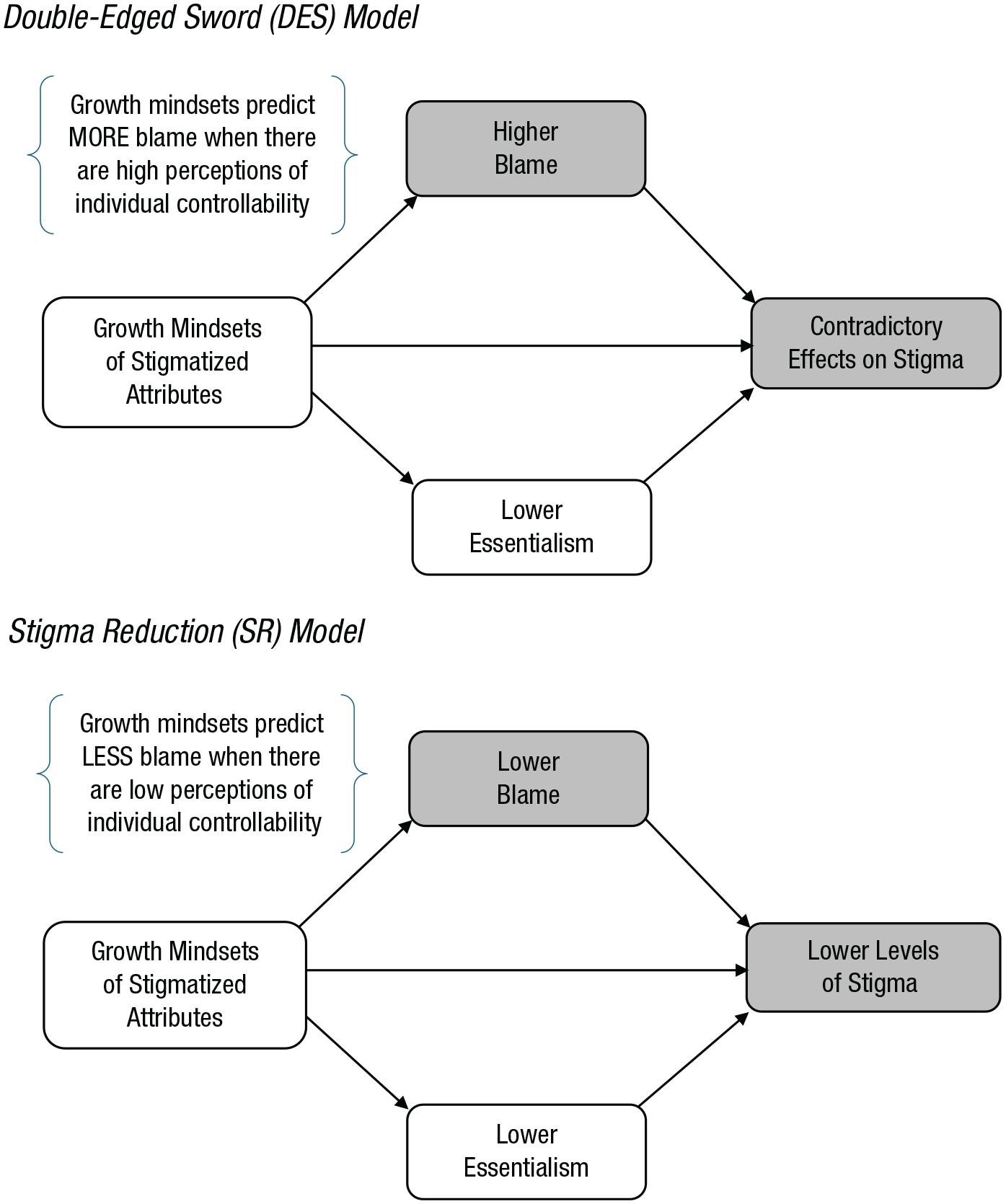
Double-edged-sword and stigma-reduction models.
Stigma-Reduction Model
Despite replications of the double-edged-sword effect across a range of attributes, it is important to note that growth mindsets do not always predict more blame. Rather, we find that growth mindsets, under certain conditions, actually predict lower levels of blame, which results in an overall stigma-reduction model (see Fig. 1). So, what predicts when growth mindsets are positively linked to blame versus negatively linked? This question is fundamental to understanding the difference between the double-edge-sword model and the stigma-reduction model. Central to understanding the answer to this question are perceptions of individual controllability. For example, we find the societal narrative around the stigmatized attribute to be critical. If the narrative is more focused on weak-will character-based explanations such as weight and addiction, with people often thinking the etiology of these is individual choice and therefore controllable, then growth mindsets are positively linked to blame. However, when the narrative is more focused on external causes for the onset, such as in mental health, which is more often attributed to trauma or genetics (Babij et al., 2023), we find that growth mindsets are negatively linked to blame. Beyond societal narratives, perceptions of controllability are also related to the type of mindset being investigated. Here, we consider whether mindsets focus on individual attributes or broader contexts like people in general, organizations, or society. Mindsets centered on individual attributes are often associated with stronger perceived individual controllability. However, mindsets focused broadly on people or society shift the focus away from individual blame to situational factors and environmental contexts (Hoyt et al., 2023). Overall, the link between growth mindsets and blame depends on controllability, which is influenced by the nature of the attribute and the type of mindset. When perceived individual controllability is high, the link to blame is positive, and when it is low, the link to blame tends to be negative or absent (see Fig. 1).
Prejudice-Reduction Implications
Our theoretical explorations into the double-edge-sword and stigma-reduction model were undertaken with the ultimate goal of better equipping us to understand how public-health messaging impacts prejudice and to develop interventions that harness the prejudice-minimizing effects without the costs (Hoyt & Burnette, 2020). For example, our work shines light on why efforts to reduce negative attitudes by promoting biological fixed explanations can fail; this can reinforce the notion of an inherent “differentness,” embedding the undesirable characteristics into people’s very nature. Our findings also highlight why messaging focused on treatment may also fail to reduce stigma, because this type of growth-mindset messaging, especially in stigmatized contexts in which individual behaviors are considered a key contributor, may increase blame.
Gaining a better understanding of how mindsets and their interconnected beliefs predict prejudice steered us to explore ways to mitigate prejudice by fostering growth mindsets in a way that minimizes drawbacks but maximizes benefits. One such approach is termed “compensatory growth-mindset messaging” (Burnette et al., 2017). This type of messaging is designed to weaken both blame and social-essentialist thinking while maintaining a sense of agency in future goal pursuits, which maintains the benefits of growth mindsets but eliminates the prejudice increasing potential costs. For example, we tested this messaging in the domain of addiction (Burnette et al., 2019). Participants who screened positive for probable substance use read one of two messages: a fixed message describing the brain mechanisms behind addiction or a compensatory growth message discussing the potential to change and offset addiction while acknowledging the many factors that contribute to becoming addicted. In addition to focusing on explanations outside of individual choice, we also noted the importance of seeking help and support rather than expecting individuals to recover alone. The compensatory growth-mindset message led to stronger growth mindsets, increased self-efficacy to overcome addiction, and stronger intentions to engage in effective therapies—all without increasing blame.
However, our work suggests that these messages alone may not be effective in reducing prejudice. This is perhaps unsurprising given the modest success of prejudice-reduction initiatives aimed solely on reducing it within individuals (Okonofua et al., 2022; Paluck et al., 2021). In pursuit of a more effective approach to prejudice reduction that moves beyond individual-focused interventions, Okonofua et al. (2022) have developed an innovative tactic they call “sidelining bias.” This method creates situations that effectively sideline people’s biases (i.e., their stereotypes, prejudice, or discrimination), rendering them nonfunctional. It leverages a key insight from social psychology that emphasizes the interplay between individuals and their environments. Rather than attempting to change people, sidelining bias aims to modify situations in ways that elevate individuals’ nonbiased goals. We suggest that this situational approach to prejudice reduction is well suited for integration with mindset theory because environments play a crucial role in activating beliefs. Although mindsets are often discussed in a simplified manner as a dichotomy between having either a growth or a fixed mindset, they actually exist on a continuum in which an individual’s position can shift on the basis of the situation (Murphy, 2024). Features of the situation can bring either more of a growth or a fixed mindset to the forefront. For example, environments that embrace failure, signal the importance placed on learning, and avoid focusing on talent can encourage growth mindsets (Murphy, 2024).
Overall, we encourage more research on a mindset-focused sidelining-bias approach to prejudice reduction—one that not only incorporates beliefs about the attribute but also understands the mechanisms of blame and social essentialism. This work might seek to alter situations to elevate growth mindsets that help to diminish the influence of bias. For example, in situations in which prejudice is fueled by beliefs in the controllability of stigmatized attributes—such as in treatment centers for substance use disorders—leaders and policymakers could cultivate cultures that emphasize the potential for recovery while not assigning blame. Such approaches would prioritize offering patients support, fostering collaboration toward recovery, and reinforcing that setbacks are a natural part of the growth process, not a reflection of personal inadequacy. Compensatory growth-mindset messaging would serve as a valuable tool within this broader strategy, helping to promote growth beliefs and self-efficacy while sidestepping blame. Efforts like these, which intentionally create broader situations that promote growth mindsets while avoiding blame, lay the foundation for progress without prejudice.
Conclusions
We have outlined two different models that illustrate why and when beliefs about the changeable or stable nature of stigmatized attributes can form, reinforce, or mitigate prejudice. The allied set of beliefs we reviewed—mindsets, blame attributions, and social essentialism—are woven together to form a complex fabric of viewpoints that can be used to sustain and justify prejudicial attitudes. Although our ability to draw definitive causal relationships from the work reviewed here is constrained, prejudice-reduction efforts are primarily concerned with impact. Looking ahead, it is important to consider interventions that both challenge personal-level biases but also transform the broader environments. This type of work can help to lift the burden of prejudice described by Maya Angelou, offering a clear perspective on the past, embracing the present, and moving toward a future unconstrained by the shadows of bias.
Recommended Reading
Dweck, C. S., & Yeager, D. S. (2019). (See References). Overview of the history of mindset research.
Hoyt, C. L., & Burnette, J. L. (2020). (See References). Discusses the double-edged-sword model focused on harnessing benefits without the costs.
Molden, D. C., & Dweck, C. S. (2006). (See References). Overview of how lay theories can influence self-regulation and social perception.
Murphy, M. C. (2024). (See References). Reviews the benefits of a growth mindset for individuals and organizations and situational strategies to encourage mindset shifts.
Okonofua, J. A., Harris, L. T., & Walton, G. M. (2022). (See References). Introduces the sidelining-bias approach to combating bias.
