



Abstract
During the past 20 years a number of articles have appeared within a field that has become known as the “science of magic.” This subdiscipline of psychology posits that the ancient art of conjuring can be used to develop psychological theories and knowledge, and more than 150 peer-reviewed articles have now been published. In the current article, we critically evaluate what can be considered as the three central tenets of the discipline: that the methods used in magic can be incorporated within experimental research, that magicians have particular insight into human cognition and behavior, and that the deconstruction of magic tricks can uncover novel psychological principles and mechanisms. We also discuss the problem that secrecy in conjuring creates for experimentalists and posit several recommendations that future scientists of magic might want to consider.
In the summer of 2008 two articles appeared within 6 days of each other that effectively ushered in a new discipline within cognitive science. Macknik et al. (2008) argued that the study of magic and its techniques can aid the understanding of attention, awareness, and consciousness. Within a week, Kuhn et al. (2008) went further and argued that there should be a formal “science of magic” (SoM). As noted by Lamont et al. (2010), bridging psychology with the ancient art of conjuring had been attempted before. Indeed, although most famous for his pioneering work on intelligence testing, the 19th-century psychologist Alfred Binet collaborated with two of the most prominent magicians of the day to uncover some of the psychological mechanisms involved in conjuring (Binet, 1894). Because magic concerns the manipulation of what observers experience, perceive, and believe, the central argument of the SoM is that magic can assist in the attempt to understand human behavior and cognition.
Although scientists of magic have not conceived the discipline in this way, we suggest that the SoM is based on three central assumptions. The first is that conjuring methods can be used to enhance psychology paradigms. For instance, many experimental procedures use some form of deception (e.g., violation of expectation paradigms), and deception is of course at the core of magic. The second central tenet of the SoM is the insight hypothesis. Years of performing magic tricks in front of live audiences has provided magicians with valuable knowledge about the nature of their effects—and thus insights into human cognition. The third tenet is what might be called the deconstruction principle. It is said that psychologists will gain information about psychological phenomena by examining magic effects and the procedures that induce them. In the 15 or so years since its modern inception, approximately 150 SoM articles have been published, and magic and psychology are now linked in a way that did not occur 2 decades ago.
Although we authored two of the early empirical articles, we have diverged in our views on the merits of the SoM. In addition to our published disagreements (Cole, 2020, 2021; Pailhès & Kuhn, 2021), we have had countless discussions about the true value of the SoM. Although we still diverge on several issues, we have come to converge on others and, in the spirit of constructive debate, have coauthored this article to critically reexamine some of the early, and current, SoM ideas. As well as evaluating the three central tenets of the SoM, we discuss some pitfalls and suggest recommendations that scientists of magic may want to consider in future work.
Can Magic Methods Enhance Experimental Psychology?
A major principle of the SoM is the notion that the methods of magic can be incorporated within experimental work on psychology. Conjuring methods are the techniques used by magicians, and the effects are the illusions, or “tricks,” experienced by a spectator. For instance, a subtle sleight of hand (i.e., a method) can be used to induce the illusion (i.e., the effect) that a coin has vanished. Similarly, a magician may “predict” a spectator’s future choice of playing card (i.e., the effect) by placing the desired card in a spatial location most likely to be chosen (i.e., the method).
One particular fruitful use of magic methods is in the area of problem-solving. Danek et al. (2014) argued, and empirically showed, that magic tricks are particularly useful in assessing problems solved using insight. Insight is the phenomenon in which a solution suddenly occurs, often accompanied with the so-called aha! experience. Danek et al. noted that insight research has traditionally been based on a small number of problems designed to induce the phenomenon. They then made the point that magic tricks, in contrast, can be solved either with or without insight, which, importantly, allows for a comparison of different problem-solving processes (i.e., insight and noninsight problem-solving), without changing the type of problem used. Indeed, we add that virtually every conjuring trick has the potential to induce (or not) insight and the resulting aha! experience.
Researchers have also used conjuring methods as a way of inducing effects that would otherwise be difficult to achieve naturalistically. For example, Johansson et al. (2005) examined the post hoc explanations people give for preferring one item over others. The experimenter showed participants two faces, each on two cards, and asked them to decide which they found most attractive by pointing to the chosen card/face. Importantly, each card had the alternative face secretly concealed behind the shown face. On some trials the experimenter used a sleight of hand to switch from the chosen to the nonchosen face before this was handed to the participants, who then verbalized the reasons for their choice. In other words, participants had pointed to Face A but were handed Face B (or vice versa). Remarkably, detection of the switch was noticed on only approximately 25% of the trials. This is striking because participants failed to notice that they were describing why they preferred a face they had not chosen. Johansson et al. referred to this effect as “choice blindness.” Other approaches have used magic procedures to elicit anomalous experiences or emulated spiritualist-induced paranormal effects to examine belief formation and misinformation (e.g., Kuhn et al., 2023).
It is clear that conjuring methods can supplement more established experimental procedures. However, on occasion, researchers (ourselves included) have seemingly been too eager to use magic techniques when there were already better methods available. Consider the rationale for developing a standard experimental paradigm designed to test a psychological principle. The experimenter begins with a behavior and carefully considers how it can be examined. In effect, the experimenter asks, “What is the best way to assess whether Phenomenon X is due to Y or Z?” or “What is the best way to show that Behavior X operates in this way?” The design then naturally follows. When a procedure is motivated by the SoM, however, there is a danger of what we call “shoehorning,” effectively forcing a magic-trick method into one’s research at the expense of the psychological phenomenon being investigated. The result can be that a procedure, designed for entertainment, is not optimal for showing what the experimenter wants to show. To put this another way, if a researcher were to develop an experiment to examine a psychological mechanism, such as attention shifts, the resultant paradigm would not end up looking anything like a magic trick. Indeed, in effect, experimental methods often go through a Darwinian selection-type process in which experimenters collectively hone a method over time to optimally assess the issue in question. Because a magic trick, in contrast, has not been designed to examine a psychological mechanism, there will inevitably be unnecessary confounds present. For instance, a trick invariably involves a magician being present. Although the presence of a human agent as part of an experimental procedure is a constant, it can add unnecessary noise.
One example of shoehorning is work that used magic methods to examine misdirection, attention, and awareness. This includes research from one of our own early SoM experiments in which we used a misdirection paradigm to investigate how social cues (i.e., where a magician is looking) can misdirect a person’s attention (Kuhn et al., 2009). Although this approach demonstrated effectively how people follow another person’s gaze, there is a more direct, and better controlled, way of studying social attentional processes: the well-established gaze-cuing paradigm (Friesen & Kingstone, 1998). Because it is specifically designed to assess a variety of questions associated with gaze and social attention, it is perhaps inevitable that the procedure is the best method for achieving this.
A further example of shoehorning was the use of the “cups-and-balls” routine (to again examine social attention). This is the effect, one of the oldest in conjuring, in which small balls seem to magically move between three cups. Hergovich and Oberfichtner (2016) pointed out that a previous use of the illusion to assess social attention (i.e., Tachibana & Kawabata, 2014) had failed to control for several nonsocial attentional factors that could have contributed to the allocation of attention. For example, the balls used in the routine are often salient red (as in Tachibana & Kawabata, 2014), a stimulus that may attract attention independent of the magician’s gaze. A central rationale of Hergovich and Oberfichtner was therefore to control some of the factors that Tachibana and Kawabata had failed to consider, such as the saliency of the balls. These were confounds that arose as a direct result of shoehorning a magic paradigm into experimental psychology. Interestingly, the improved design was still not optimal because it was itself based on a magic routine. If one were to improve the design of the procedure to control for all possible confounds, one would end up with a standard visual cognition paradigm. As above, it would be nothing like a magic trick.
Although experimental paradigms that use conjuring methods may not be the most controlled or “clean” way of assessing and developing psychological principles and theories, one has to acknowledge that any limitations are offset by an increase in naturalism. An effective way to develop an understanding of any psychological phenomenon is to examine it under well-controlled laboratory conditions as well as within more real-world contexts. Thus, although the presence of a human agent in a conjuring-based experimental paradigm (i.e., the magician) may introduce additional noise, humans are of course present in many everyday situations.
In sum, conjuring methods and the experiences they induce can offer valuable ways of supplementing existing research methodologies. However, we urge researchers to resist the temptation to shoehorn magic into their research.
Do Magicians Have Particular Insights Into Psychology?
One of the interesting aspects of conjuring and its relationship to experimental psychology is that there have been occasions on which a magician uses a psychological principle decades before it was “discovered” by experimental psychologists. For example, the so-called princess card effect principally relies on change blindness (Simons & Levin, 1997), the effect in which changes to a scene often go unnoticed when the scene briefly disappears before reappearing. This conjuring effect was described in the literature on magic (Stanyon, 1905) at least 92 years before it appeared in the literature on visual cognition. One of the central arguments of the SoM is therefore that magicians have particular insights into many psychological principles. As Thomas et al. (2015) stated, magicians possess “intuitive knowledge about the rules governing human cognition” (p. 117). Other authors have gone further, suggesting that a magician’s knowledge can be “superior to that of the neuroscientist” (Macknik et al., 2008, p. 871), “neuroscientists are just beginning to catch up” (Martinez-Conde & Macknik, 2008, p. 72), and “the magician’s intuitive understanding of the spectator’s mindset can surpass that of the cognitive scientist” (Otero-Millan et al., 2011, p. 1). Martinez-Conde and Macknik (2008) also stated that magicians can have a “deep intuitive understanding of the neural processes taking place in the spectators’ brains” (p. 72). Furthermore, in a Nature article, Martinez-Conde and Macknik (2007) stated that cognitive scientists can “take a lesson from magicians” (p. 414). Although such a suggestion overplays the knowledge possessed by conjurers, a small number of empirical articles support a more conservative insight hypothesis. For example, Pailhès and Kuhn (2020a) empirically supported a principle suggested by the eminent British magician Derren Brown, who argued that hand gestures and vocal primes can influence the choice of a playing card.
Pailhès and Kuhn (2023), however, have recently questioned the insight notion and advocated for a more data-driven approach to the issue. Pailhès and Kuhn used the forcing method of conjuring, in which a spectator is asked to choose an item, often a playing card. During a typical force, the magician controls the outcome of the “choice” such that the item is forced on them without their knowledge. Alternatively, the magician influences the probability of a desired outcome. In Pailhès and Kuhn’s study, magicians were asked to predict the likely success rate of a placement force, in which the magician places a card in a location that has a greater likelihood of being chosen. Magicians were remarkably good at predicting the outcome of such a force (within a few percentage points). Pailhès and Kuhn thus argued that magicians are adept at understanding what tricks work and that they have insights into aspects of the tricks that are directly observable. However, in other instances, in which data can be obtained only by direct questioning or experimental manipulations, magicians’ insights were poor. For example, Pailhès and Kuhn (2020b) asked conjurers to predict the factors that contribute to the success of the crisscross force, in which a spectator picks a playing card by cutting a deck in half but still receives the top card rather than the card located at their cut (see Fig. 1). Magicians rated the time delay between executing the deceptive movement and participants choosing the card to be the most important. However, the data revealed this to have no impact on the effect. In this instance, magicians’ insights into the nature of the force were clearly wrong. The Pailhès and Kuhn experiment is part of a growing number of studies that have questioned the idea that magicians truly understand how and why their tricks work (Cole & Millett, 2023).
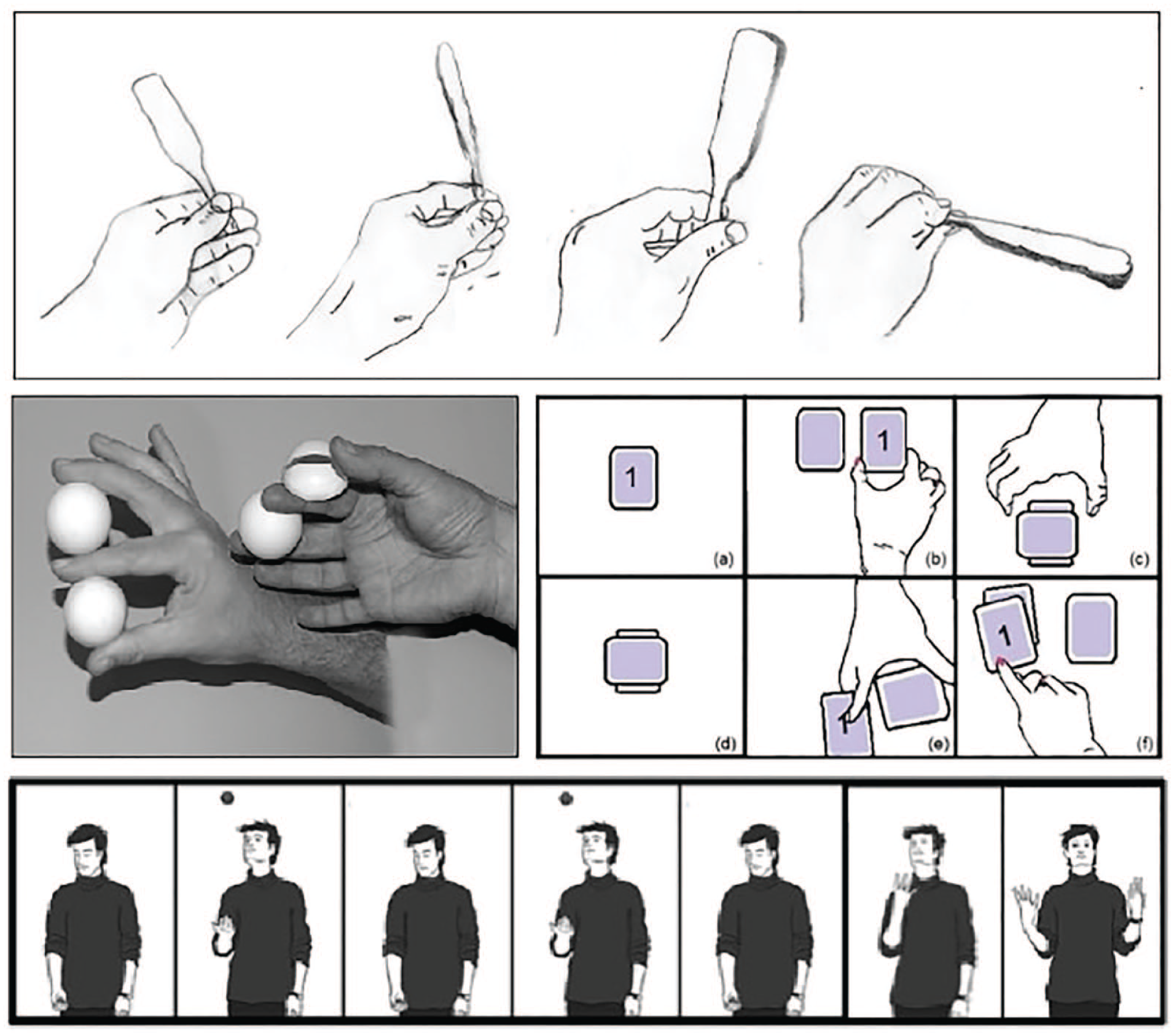
Four magic methods. The figure describes the secret method employed in four magic tricks. The middle right panel shows the sequence of the crisscross move. A deck of cards is presented (a). The spectator then cuts the deck (b). The magician then places the bottom half on the top half (c and d). This gives the impression that the card now at the top of the bottom half was at the cut location (e and f); it is in fact the top card of the original deck. The complete sphere illusion is shown in the middle left panel. The two balls held in the left half of the panel are actually semispherical shells, as seen on the right. The top panel shows the paddle move illusion. The bottom panel shows the vanishing ball illusion. On the third “throw” the magician retains the ball in the palm as the hand imitates the throwing action.
Although magicians will have some insight into human behavior, simply using or exploiting a psychological principle does not mean that magicians have greater insight or knowledge compared with a neuroscientist. As Ekroll (2019) pointed out, “Since knowing how to do something is not necessarily the same as understanding it, it is therefore likely that the art of magic includes tricks that are not very well understood, even by magicians” (p. 2). We therefore urge caution when basing experiments on the presumed intuitive knowledge about the psychological process that underpin magic effects.
The Deconstruction Principle
Perhaps the most promising avenue within the SoM has been the effort to uncover psychological principles by analyzing magic effects and the methods that induce them. Here, researchers essentially break down (i.e., deconstruct) magic tricks to examine why the effect/illusion works. In doing so, the hope is to uncover novel psychological principles. The work of Ekroll et al. (2013) on amodal completion is an example. Amodal completion is the phenomenon in which the brain completes, or “fills in,” parts of an object that are occluded. For example, if a tennis ball is positioned behind a book such that only half of it is visible, we do not perceptually experience half a ball. We know that it continues behind the book. Using a magic trick, Ekroll et al. (2013) provided support for the idea that this process is not due to an observer possessing the mere belief that an object has an unseen rear half; it is a perceptual phenomenon. Ekroll et al. described a variant of a magic trick in which a semispherical shell can appear as a complete ball when viewed from a certain angle (see Fig. 1). Despite the knowledge that the object is not a sphere, and the subjective experience of it not being a sphere when placed flat on a table, it suddenly appears to be complete when slightly lifted from the table. Ekroll et al. (2016) followed up this work by showing that the effect can make an observer’s finger feel shorter if placed inside the rear nonseen potion of the semispherical shell. It is as if the brain has to shorten the finger to make space to generate the complete sphere.
A further example is the assessment of the so-called paddle move (see Fig. 1; Hergovich et al., 2011). In this illusion, an object, typically a few inches long and relatively flat, is tilted to (seemingly) show both sides from two different angles. While making this move, the magician secretly rotates the object so that only one side is seen by the spectator. Hergovich et al. (2011) manipulated object speed, size/form, and tilt angle to determine what factors modulate the effect. Although there is already an abundance of research on motion perception, the assessment of such processes in which objects undergo different tilting and rotating has not been examined in any systematic way. Another good example of the deconstruction principle is the empirical work on the vanishing ball illusion (see Fig. 1; Kuhn & Land, 2006). In this effect, the magician throws a ball up and catches it two or three times. On the final throw, the ball seems to disappear immediately after leaving the hand. To achieve this method the conjurer simply conceals the ball within the hand while also making the throwing movement. Thomas and Didierjean (2016) showed that this effect is not simply due to an expectation mechanism. Indeed, a “ghost ball” seems to leave the hand.
We suggest that the above experiments are good examples of what the SoM can offer. They are not simply based on the principle of using magic procedures as an alternative to standard paradigms to examine well-researched phenomena (e.g., spatial attention), as set out earlier. They deconstruct a magic effect and ask what the effect can tell us about a psychological mechanism—a mechanism that would not have been uncovered without the SoM.
The Problem of Secrecy
Despite the successes of the SoM, bridging psychology with conjuring can lead to problems for the experimental psychologist. Cole (2021) pointed out that a recent development within conjuring is the tendency for magicians to falsely claim that a subtle psychological principle is used to perform an effect. This gives the impression that psychological mechanisms can be used in ways they cannot. For example, Brown stated that he can exploit top-down processes to such a degree that he can make shopkeepers accept blank pieces of paper to pay for a range of items (e.g., fast food, expensive jewelry) and even provide him with change (Brown, 2012). He has also repeatedly stated that many magicians are adept at using the psychological technique of cold reading. This is the phenomenon in which people, most often subconsciously, give away details about themselves nonverbally. The magician then claims to read these subtle behaviors as part of a routine. In a striking video, Brown (2011) supposedly provided an example in which he is filmed approaching strangers in a town center and able to determine various pieces of information about their lives. During one interaction, Brown appeared to know that a stranger works in a police station and would like to become a golf professional. There was no “fishing around,” ignoring “misses,” and pursuing “hits.” To the television viewer, Brown gleaned this information from the stranger with them saying virtually nothing, and all within 2 min of them meeting. As real as cold reading is, this supposed use of it is impossible.
Magic is an art form that relies on deception. This means that nothing said during a magic performance should be taken at face value. Difficulties arise when magicians appear on educational platforms, such as TED talks, and misinform rather than illuminate the public about the true nature of magic. We refrain from making judgment about the ethics of this type of misinformation within the realm of conjuring. Magicians are after all entertainers who are not subject to the need for openness in describing any method. We simply highlight the problem for researchers and urge caution if taking such claims at face value.
General Conclusions
We encourage researchers to reflect on the following questions when conducting SoM work. When considering the use of a magic procedure to examine a well-researched issue, does the method improve on the standard paradigms already in use? Does the magic effect and method being considered unambiguously add value to the psychological question being addressed? Do the findings have theoretical implications that go beyond the magic performance? Can one really trust a magician’s claims about how their conjuring tricks work? We hope that the challenges discussed in this article will help future researchers utilize the opportunities that the SoM has to offer.
Recommended Reading
Cole, G. G. (2020). (See References). Argues that some scientists of magic have subtly exagerrated the degree to which classic “forcing” relies on psychology.
Kuhn, G. (2019). Experiencing the impossible: The science of magic. MIT Press. Introduces magic research, provides a broad overview of the science of magic, and explains both the psychological mechanisms that underpin magic and how magic can be applied to real-world issues.
Kuhn, G., Amlani, A. A., & Rensink, R. A. (2008). (See References). Sets out the central rationale of the modern science of magic (i.e., that the ancient art of conjuring can aid experimental psychology).
Pailhès, A., & Kuhn, G. (2021). Mind control tricks: Magicians’ forcing and free will. Trends in Cognitive Sciences, 25(5), 338–341. Reviews research on forcing and decision-making and demonstrates how magic tricks can be deconstucted to help identify the cognitive mechanisms that underpin magic.
Footnotes
Transparency
Action Editor: Robert L. Goldstone
Editor: Robert L. Goldstone