



Abstract
Humans need to experience meaning in their lives yet often find it difficult to do so. We argue that, for nonreligious individuals in many Western cultures, the materialist and reductionist ideology that surrounds scientific practice and data may be an impediment to attaining a robust sense of meaning in life. Furthermore, scientific materialism and reductionism may be especially problematic for existential mattering—the form of meaning entailing a belief that one’s life matters in the context of the universe as a whole. We review new research supporting this account, along with implications for those immersed in the materialist worldview. We conclude by suggesting possible means of finding meaning, including a sense of existential mattering, without abandoning science, and highlight research directions to further examine these possibilities.
The scientific enterprise has, according to many, been the greatest source of large-scale good in the history of human civilization. Science has brought unprecedented health, prosperity, and happiness to uncountable individuals (Pinker, 2018). Given its phenomenal success, Americans’ widespread disbelief in some of science’s core, empirically supported principles, such as evolutionary theory, 1 is often considered an embarrassment at best and pernicious for continued scientific progress at worst (e.g., Bender et al., 2016).
Why do so many people doubt sound scientific knowledge? Studies have documented a range of factors that predict antiscience belief, including high religiosity (because, for example, scientific data contradict Judeo-Christian scripture), conservative political orientation (because certain scientific topics, such as climate change and vaccines, have become politicized), and a general lack of understanding of scientific principles (Rutjens et al., 2018). However, antiscience beliefs are also driven by psychological motivations. For example, scientific findings are often communicated in ways that acknowledge or emphasize the uncertainty surrounding most conclusions, so individuals who are highly intolerant of epistemic uncertainty may dismiss scientific claims in favor of viewpoints expressed with greater certainty (e.g., religious ideologies; Philipp-Muller et al., 2022). In addition, studies have shown that antiscience attitudes are common among those who perceive scientific theories as unethical, unintuitive, or contrary to the beliefs held by close others (Gottlieb & Lombrozo, 2018; Rutjens et al., 2018).
There is, however, another possible psychological cause of antagonism toward science that has not previously been addressed: that the version of science taught and generally accepted by scientists and science consumers alike is a highly materialist, entirely deterministic understanding of the universe, in which all human behavior, thought, and feeling ultimately can be reduced to the interactions of physics and chemistry (e.g., Sapolsky, 2023). In this materialist worldview, human life can seem meaningless; anything we experience as profound, awe-inspiring, or existentially significant is merely an illusion: either epiphenomenal and purposeless or generated by neurons for the sake of reinforcing behaviors that increase humans’ likelihood of survival and reproduction. Yet humans need to feel that their lives are meaningful; substantial evidence indicates that human happiness, well-being, and mental health require a felt sense of meaning in life (e.g., King & Hicks, 2021). It is therefore likely that one cause of many people’s dissatisfaction with science is the strong negative message science sends about the possibility of meaning in the universe beyond that which humans artificially create (e.g., Sapolsky, 2023). In the same vein, the widespread lack of meaning experienced by adults in modern secular societies (Oishi & Diener, 2014) may be partly attributable to our culture’s acceptance of the staunchly materialist and reductionist worldview that our science has instilled in us.
The End of Meaning?
Although science may pose a threat to humans’ search for meaning, there remain viable routes to experiencing meaning within a secular worldview, including (a) developing strong social connections; (b) finding a sense of purpose in one’s career, family, or other effortful activities; (c) understanding one’s self and behaving authentically to one’s identity (for a review, see King & Hicks, 2021); (d) enduring suffering (Vohs et al., 2019); and (e) nostalgic reflections (Routledge et al., 2011).
However, these secular sources of meaning may not be enough for many people living within our scientific cultural worldview because they do not address the need for existential meaning. In fact, studies show that individuals use psychological defenses to cope with the potentially problematic existential implications of scientific materialism, such as the inevitable finality of death. When individuals are reminded of their physical, mortal nature, they respond in a variety of meaning-buffering ways, including self-enhancement and in-group identification (for a review, see Pyszczynski et al., 2015). People will even directly reject aspects of scientific materialism to cope with existential threat, reporting, for example, a reduced belief in evolutionary theory and increased support for “intelligent design,” a theory more consistent with the idea of a supernatural creator, in response to reminders of their mortality (Tracy et al., 2011; see also Rutjens et al., 2010).
The terror and anxiety people seem to experience from thoughts of death is arguably due to the devastating impact death has on one’s ability to view life as meaningful (Heine et al., 2006). Indeed, effects similar to those found from mortality reminders emerge from threats to coherent meaning that are unrelated to death, such as the schema violations that occur when viewing surrealist art or participating in a psychology study in which the experimenter “transmogrifies” into a different person (Proulx & Heine, 2008). These threats to meaning lead many to adopt alternative means of meaning-making, such as embracing religious or spiritual ideologies (Norenzayan et al., 2008), or—in recent years—engaging in conspiracy theorizing. Conspiracy beliefs allow individuals to blame bad actors or even science itself for events such as global pandemics or a child’s autism rather than accept the terrifying truth that bad things can happen to good people (Stojanov et al., 2023). Building on this account, as well as the finding that existential threat can promote the rejection of evolutionary theory, we suspect that a belief in materialist science may be problematic for humans’ sense of meaning.
Does Science Reduce Meaning?
Scholars have argued that there are three distinct forms of meaning in life, resulting in a tripartite model composed of coherence, or the perception that one’s life is predictable and makes sense and things are as they should be; purpose, or the sense that one’s life is directed by values, goals, and ambitions; and existential mattering, or the belief that one’s existence is significant, important, and valuable within the context of the broader universe (George & Park, 2016). Which kind of meaning is likely to be most affected by scientific materialism and reductionism?
Science asserts that human existence is finite, potentially challenging people’s ability to view their daily activities and life goals as coherent in the context of an ephemeral life span (e.g., why work hard to succeed in ways that likely will not matter after you die?). However, materialism is not necessarily incompatible with a need for coherence given that scientific advances have allowed humans to prevent and cure diseases and, more broadly, to understand a great deal about human life and behavior. Science also can enhance coherence by allowing for reliable and accurate predictions of real-world events and implying a sense of order in the universe (Rutjens et al., 2013). Science also might promote purpose by encouraging innovation, progress, and discoveries that have made human lives unquestionably healthier and easier (Pinker, 2018). In fact, studies show that a belief in human progress can counteract the threat posed by mortality salience (Rutjens et al., 2009, 2016).
However, scientific materialism’s answer to the question of whether human life is meaningful in the “big picture,” existential-mattering way, is a clear-cut “no.” By reducing human life to its most fundamental physical components that eventually will disintegrate into nothingness and suggesting that everything else (e.g., ideas, beliefs) are mere human creations, materialism rules out the possibility of human life mattering existentially. Regardless of the validity of this conclusion, it is likely to be problematic for psychological well-being, especially because research suggests that existential mattering is the facet of meaning that contributes most strongly to one’s overall sense of meaning in life (i.e., above and beyond the effects of coherence and purpose; Costin & Vignoles, 2020). 2
To test whether scientific materialism is problematic for each form of meaning, we developed a measure of belief in materialism that includes items such as “There is just one primary reality: the physical” and “Everything that happens in the universe is caused by the laws of physics.” Notably, this materialist form of scientific understanding is different from other kinds of science beliefs one might hold, such as (a) a belief in the value and importance of scientific progress, (b) a belief that science is the only route to truth, and (c) a belief that science can provide a sense of spirituality by highlighting the connectedness of all living organisms (Folk et al., 2024; Preston et al., 2023; see also Fig. 1). In our study, we found that individuals who scored high on our scientific materialism scale reported less overall meaning in life (r = −.26, p < .001), and specifically less existential mattering (r = −.31, p < .001); these relations held when controlling for belief in God and religiosity, and no significant relations emerged with coherence or purpose when controlling for these covariates (Tracy et al., 2024). Furthermore, Folk et al. (2024) found that a similar measure of materialism they developed also correlated negatively with existential mattering (r = −.31) but not significantly with purpose or coherence, consistent with these results (although they uncovered a small positive correlation with coherence when controlling for religiosity; see Fig. 1).
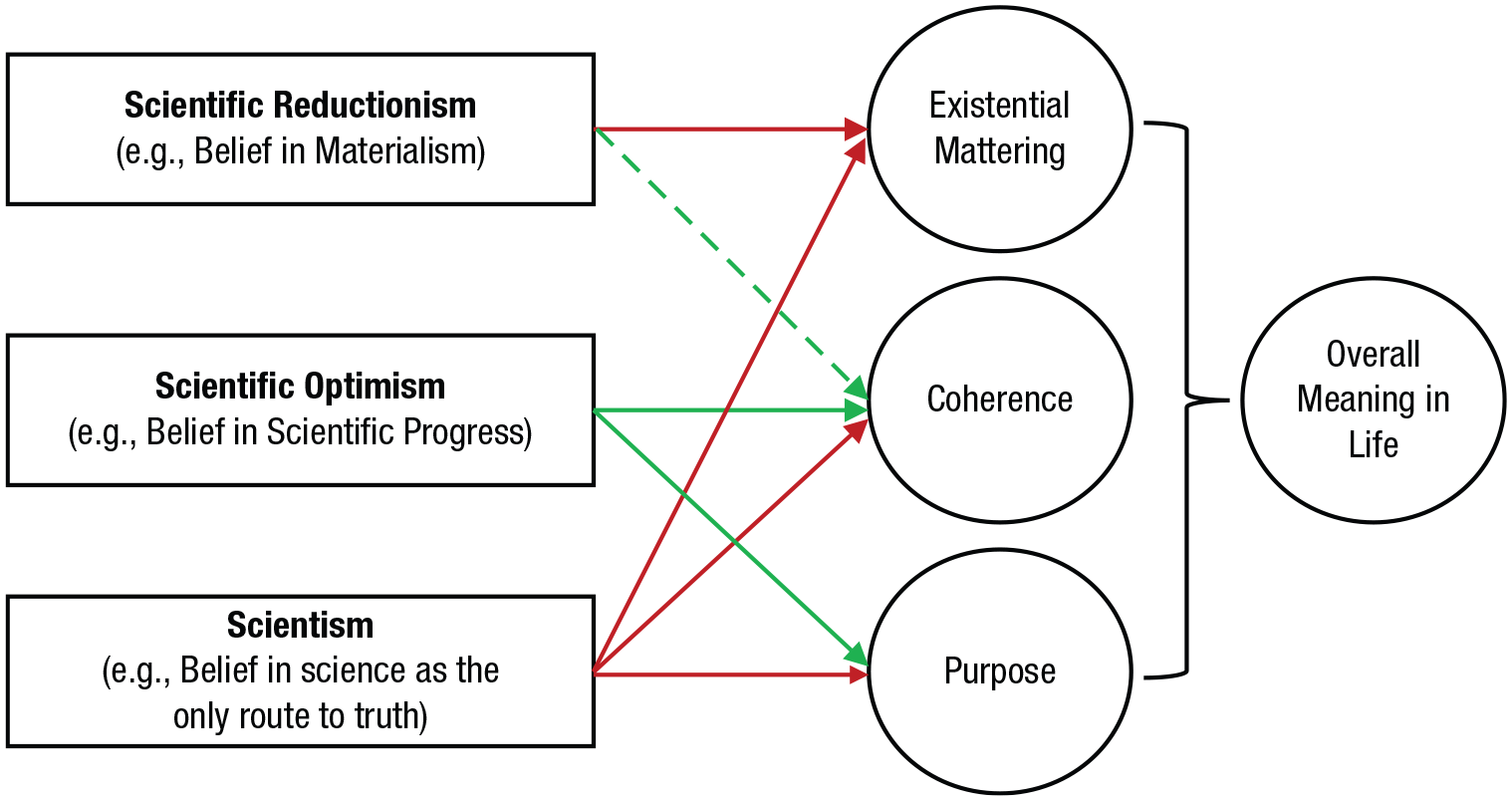
Associations between distinct science-related beliefs and each facet of meaning in life, controlling for religiosity or belief in God. In most cases, arrows are theoretical; extant causal evidence supports only the directional association between scientific reductionism and existential mattering (Tracy et al., 2024). Green lines indicate positive associations, red lines indicate negative associations, and the dashed green line indicates mixed results, with one study finding no relation and another finding a weak positive relationship (see Folk et al., 2024; Tracy et al., 2024).
In a second study, we experimentally manipulated exposure to the core principles of materialism (Tracy et al., 2024). Participants read a passage by famed scientist Nikola Tesla stating, in part, “The universe is simply a great machine which never came into being and never will end. . . . Humans, like the universe, are machines.” To compare the impact of materialist ideology with that of scientific progress, other participants read about the discovery of penicillin and its positive impact on human welfare. We also included a nonscience control condition in which participants read a historical passage.
We expected that religious individuals would be largely unaffected by this manipulation; for those who believe in God, existential meaning is typically found not in science but religion, so heightening these individuals’ awareness of materialism should be irrelevant to their sense of meaning. Indeed, religious individuals showed no effect of the manipulation (β = 0.03, p = .69), but, for nonbelievers, reading the materialism passage led to a reduction in meaning—specifically in the form of existential mattering (β = −0.22, p < .01; see Fig. 2), consistent with preregistered predictions. This effect did not emerge for participants who read about penicillin (or those who read the control history passage), suggesting that reminders of science per se do not inhibit meaning. Reminders of the materialist ideology that surrounds science do.
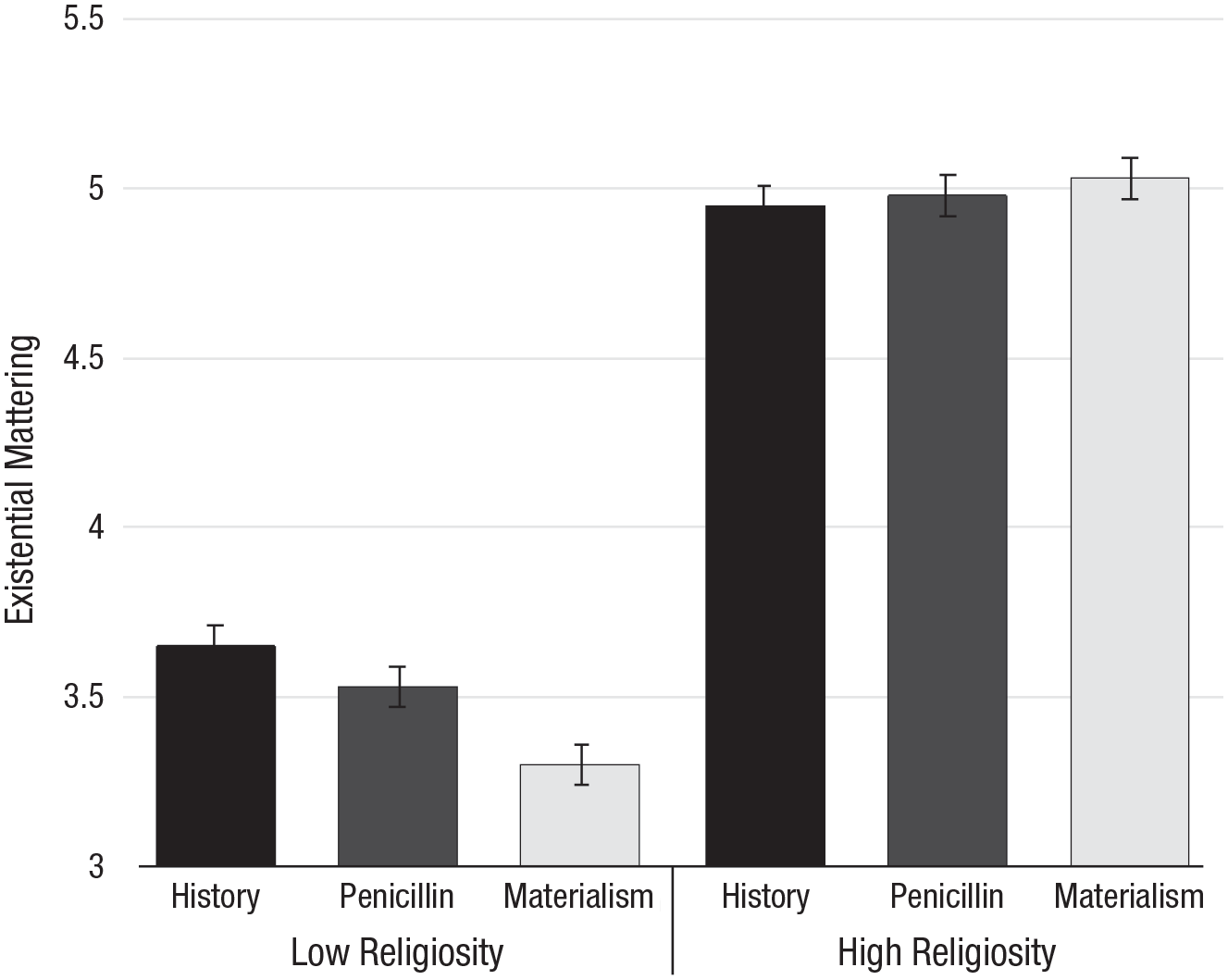
Effect of scientific materialism on existential mattering. Reading about scientific materialism compared with scientific progress and a nonscience control passage reduces nonreligious people’s belief that their lives matter existentially. Error bars denote standard errors of the mean. The interaction between religiosity and the experimental condition was statistically significant, F(2, 1724) = 4.01, p = .02. History = condition in which participants read a historical passage; penicillin = condition in which participants read a passage about the discovery of penicillin; materialism = condition in which participants read a passage laying out the core principles of materialist science.
Science Without Materialism and Reductionism?
More research is needed to replicate these findings, but their implication is that materialism is problematic for existential mattering. According to many scientists, this is a problem that cannot be solved; materialism and reductionism are science, so the only option is to seek sources of meaning within human lives that might provide purpose and coherence and give up on mattering to the universe (e.g., Sapolsky, 2023). But what if we were to draw a distinction between the bread and butter of science—its data and methods—and the materialist and reductionist ideology that surrounds those data and methods? Our findings suggest that what reduces existential mattering is not science’s commitment to empirical evidence or a belief in the value of scientific progress but the specific belief that all living beings are nothing more than entirely physical machines (see also Folk et al., 2024; Preston et al., 2023).
Of course, it is important to note that a good deal of (social) scientific research already involves the study of entities that are unquestionably not physical or material; economists study “supply” and “demand,” sociologists study “social structure” and “deviance,” and psychologists study “emotions,” “culture,” “intergroup relations,” and “personality.” Nonetheless, following the norms of science, all of these social scientists still tend to default to the stance that these constructs are not real; they are mere conceptual representations—tools we use to explain the behavior of physical entities such as human beings, hormones and neurotransmitters, or brain cells. Some neuroscientists go so far as to suggest that we should stop doing so because these nonmaterial concepts are illusions. Eliminative materialism calls for the abandonment of constructs such as “love” and asks that we instead think and speak in terms of the brain mechanisms that shape the specific behaviors we seek to understand (Churchland, 1984).
Yet the norms that require us, as serious scientists, to treat nonmaterial concepts as metaphorical rather than real are not proven facts about the nature of reality. Instead, they are beliefs that have emerged over the past several centuries, originating with Galileo and then Descartes, who both drew a distinction between mathematical and perceptual reality and argued that only the former could be a topic of scientific inquiry. According to this view, temperature, or the kinetic energy of atoms, is objective and real, but human perceptions of hot and cold are unquantifiable, and thus unscientific, subjective experiences (Frank et al., 2024). As a result, we psychologists have developed more and more elaborate ways to quantify and attempt to objectify humans’ unquantifiable experiences. These efforts have allowed us to build a large literature of research findings about the human mind. At the same time, we regularly buy into the materialist and reductionist assumption that these findings are ultimately meaningful only to the extent that they help us predict the behavior of physical entities such as neurotransmitters.
According to several physicists and philosophers, it does not need to be this way. We can let go of our fundamentalist grip on our materialist and reductionist beliefs while still maintaining our scientific standing because materialism and reductionism are “an optional metaphysics attached to, but separable from, the actual practice of science” (Frank et al., 2024, p. 5). These authors further suggest that our culture should excise these flawed beliefs to develop a “new kind of scientific worldview” (p. xvi). What would this new worldview look like? We might take a clue from Preston and colleagues’ (2023) finding that some people experience a form of spirituality from seeing science as a means of understanding nature and humans’ connection to it. Those who hold or believe in this “spirituality of science,” in turn, report greater meaning in life (Preston et al., 2023). Likewise, in our prior research showing that mortality reminders reduced participants’ belief in evolutionary theory (Tracy et al., 2011), we also found that those who first read a passage by cosmologist Carl Sagan alluding to a more expansive view of science (e.g., “If there’s nothing in here but atoms, does that make us less, or does that make matter more?”) responded to existential threat with a stronger belief in evolution.
As Sagan’s quotation implies, science is not only about reducing things to their smallest material components; it is also about exploring the larger systems these components form when they join together (Bateson, 1979). Many psychologists have long acknowledged this fact at least implicitly; those who study relationships, cultures, and group processes know that to understand these systems we cannot simply break them down into the individual parts that constitute them because the broader system influences each individual’s behavior within it. Although it is still a leap from accepting a systems-based approach to science to feeling that our lives existentially matter, a focus on how human existence is part of the broader system of the universe, instead of on how human bodies can be broken down to meaningless atoms, might be a viable way to begin.
Furthermore, several bodies of scientific data raise real challenges for materialism: most notably, quantum physics (e.g., Heisenberg, 1971), but also the cognitive science of consciousness, a topic that remains heavily debated despite decades of empirical research (e.g., Goff, 2019). Twenty-five years ago, David Chalmers and Christof Koch placed a bet on whether science would discover the neural basis of consciousness by 2023. A recent adversarial collaboration produced results that were decidedly mixed (Ferrante et al., 2023), and the bet was extended to 2048. One currently popular account that received support from the collaboration suggests that consciousness is not a distinctively human experience caused by particular brain activations but, instead, an irreducible, fundamental property of nature, like mass or energy (Tononi, 2004). Indeed, in 2020 just under half of all academic philosophers held the view that human consciousness cannot be fully explained by material brain processes (Goff, 2019).
Scholars in our own field of psychology also have noted limitations of certain aspects of science’s materialist ideology, such as the “view from nowhere” principle that scientific observations can be neutral and objective (Dubova & Goldstone, 2023; Frank et al., 2024). Heisenberg (1971) showed that this theoretical paradigm does not hold up in actual scientific practice, and in psychology it is belied by confirmation bias, wherein researchers are more likely to accept results that confirm what they already believe (Nickerson, 1998), and “concept dependence of evidence,” wherein scholars’ conceptual understandings shape the evidence they collect and the analyses they conduct (Dubova & Goldstone, 2023). Likewise, recent research demonstrates the impact of scholar and participant race and gender on which studies get conducted and published, further undermining the possibility of independence between observer and observed (e.g., Roberts et al., 2020).
Rather than ignore these limitations, psychologists might consider the benefits of the alternative: If we teach tolerance for theories that accept the potentially nonmaterial nature of consciousness, the impact that observers have on what they observe, or the need to study wholes to understand their parts, we might begin to unburden the psychological-science community, our readership, our students, and, ultimately, the public at large from our materialist fundamentalism. We might continue to lean on materialism when asking questions about the neural bases of attention, memory, or affect but accept that for “harder” questions about the meaning of our existence, or the cause of subjective awareness, materialism might not provide all the answers. This approach could allow for new ways of finding existential meaning within a scientific framework. Furthermore, disseminating science in this manner might reduce the existential angst that often accompanies materialism and consequently increase public belief in scientific findings.
In closing, secular Western society is one of the first in history to build a widespread worldview that asserts that humanity is insignificant to the cosmos (Taylor, 2007). The need to feel that one’s life matters existentially might, therefore, be a human universal. If a need for this kind of meaning is part of our species’ heritage, telling people to stop searching for it, or suggesting that such a search is naive, is unlikely to be effective. Current research suggests that the ideology of scientific materialism—but not scientific methods, practice, or extant data—may be one cause of many Westerners’ inability to feel that their lives existentially matter. Acknowledging this possibility, and questioning whether this ideology is a necessary part of the scientific worldview, might facilitate the development of a more existentially nourishing yet still scientifically accurate perspective.
Recommended Reading
Frank, A., Gleiser, M., & Thompson, E. (2024). (See References). Novel account of what the authors refer to as the “blind spot” in physics, cosmology, philosophy, and cognitive science: essentially, the ways in which these fields make flawed assumptions based on scientific materialism and reductionism that impede scientific progress and humans’ relationship with the planet.
Goff, P. (2019). (See References). Highly readable book for nonphilosophers about the philosophy of consciousness and the inadequacy of materialist or physicalist accounts.
Rutjens, B. T., Heine, S. J., Sutton, R. M., & van Harreveld, F. (2018). Attitudes towards science. In J. M. Olson (Ed.), Advances in experimental social psychology (Vol. 57, pp. 125–165). Academic Press. Broad and comprehensive review of research on psychological attitudes toward and responses to science.
Rutjens, B. T., & Preston, J. L. (2020). Science and religion: A rocky relationship shaped by shared psychological functions. In K. E. Vail & C. Routledge (Eds.), The science of religion, spirituality, and existentialism (pp. 373–385). Academic Press. In-depth analysis of the relation between religion and science in terms of how each addresses humans’ need for meaning.
Tracy, J. L. (2023, September 25). You can be a materialist and find meaning in the universe. Psyche. Brief overview, written for a general audience, of the author’s theory of why scientific materialism is likely to erode meaning and how systems theory might provide a solution.
