



Abstract
Emotions shape how people understand and interact with others. Here, we review evidence on the relationship between anxiety—a future-oriented emotion characterized by negative valence, high arousal, and uncertainty—and mentalizing—the ascription of mental content to other agents. We examine three aspects of this relationship: how people with anxiety disorders perform on mentalizing tasks relative to controls; how situational anxiety alters mentalizing performance; and how autistic people, who experience the impacts of mentalizing differences, are at high risk of anxiety. We propose a bidirectional model for understanding how short-term and longer term anxiety are related to mentalizing. Key to this relationship is the aversive experience of uncertainty and the motivations that result from it.
Daily life requires inferring others’ thoughts and feelings, and successful social interaction requires doing so flexibly and efficiently (Apperly, 2010). Mentalizing, or theory of mind, is the ability to ascribe such mental contents to other agents. In the 45 years since Premack and Woodruff (1978) asked whether chimpanzees “have a theory of mind,” substantial evidence has accrued regarding mentalizing abilities in human children and adults, across neurodiverse populations, and in nonhuman animals. Mentalizing is not a single construct; thus, it can be assessed in multiple ways, from reporting one’s own abilities to responding to scenarios in which another’s mental state is relevant. Here, we focus on performance-based mentalizing tasks rather than people’s self-reported abilities, which often assess mentalizing propensity rather than success in doing so. Given its multifaceted nature, performance on different mentalizing tasks does not always correlate (Warnell & Redcay, 2019).
Most mentalizing research has aimed to limit external influences (e.g., respondents’ emotions) on task performance by testing in controlled lab settings. Mentalizing does not unfold in an emotional vacuum, however. Rather, emotions alter the availability of cognitive resources, the prioritizing of information, and the strategies used for understanding others’ minds. Recent theory offers insights into how specific emotions relate to specific decision-making and action tendencies (Lerner et al., 2015). Elucidating how such tendencies shape mentalizing is important because social interactions evoke a range of emotions.
We focus on anxiety, a future-oriented emotion characterized by high arousal, negative valence, and uncertainty (Smith & Ellsworth, 1985). Anxiety can be measured as a trait on the basis of the frequency and severity of state anxiety. Although experienced by everyone, anxiety forms a core component of numerous clinical conditions. Anxiety disorders reflect frequent and severe experiences of state anxiety that affect functioning, often resulting in behavioral avoidance. Anxiety offers an apt case study for understanding how emotions shape mentalizing for several reasons. First, anxiety disorders are associated with poorer mentalizing performance in children and adults. Second, situational anxiety motivates efforts to reduce uncertainty, which typifies most social interactions and prompts egocentric mentalizing. Third, people with conditions associated with mentalizing differences are at higher risk of anxiety disorders.
Anxiety Disorders and Mentalizing
Anxiety disorders are characterized by significant social impairment (American Psychiatric Association [APA], 2013). Social interactions shape the maintenance of and recovery from mental-health conditions (Bolis et al., 2023); thus, understanding the relationship between anxiety disorders and mentalizing is vital. Recent evidence suggests that adults with anxiety-related disorders perform poorly in mentalizing tasks relative to controls (Sloover et al., 2022). Anxiety disorders are classified into separable conditions (APA, 2013), and different mentalizing endeavors introduce different demands. Some evidence suggests that different anxiety conditions predict differing mentalizing performance and that conditions may be associated with bias rather than difficulty per se.
Social anxiety disorder (SAD) provides a pertinent portal for considering mentalizing in anxiety disorders. Models of SAD suggest mentalizing differences as key to the disorder (Clark & Wells, 1995). Although SAD is associated with sensitivity to others’ impressions of oneself, this sensitivity does not confer more accuracy. Adults with SAD perform worse than controls on various mentalizing tasks (Sloover et al., 2022). At a nonclinical level, however, SAD-type symptoms do not always predict the same pattern (Pittelkow et al., 2021). There is more consistency in data from children and young people: Both SAD (Öztürk et al., 2022) and SAD-type symptoms (Pile et al., 2017) predict worse mentalizing performance. Research unpacking whether SAD causes or results from poorer mentalizing is lacking.
Mentalizing in people with other anxiety disorders has received less attention. When anxiety is elicited by worries about a spectrum of issues, as in generalized anxiety disorder (GAD), results are unclear. In one study, adults with GAD mentalized better than controls when worried but worse than controls when relaxed (Zainal & Newman, 2018). Alongside categorizable anxiety disorders, mentalizing may operate differently in people with conditions associated with high anxiety. Adults with obsessive-compulsive disorder and posttraumatic stress disorder also display poorer mentalizing than controls (Sloover et al., 2022). A nuanced understanding of the anxiety-mentalizing relationship requires clearer mechanistic evidence, including studies of mentalizing across anxiety disorders.
Understanding others’ minds requires solving different challenges. Cognitive mentalizing involves understanding others’ thoughts, perspectives, or beliefs, whereas affective mentalizing involves understanding others’ feelings. Social anxiety in children is more strongly associated with poor performance in affective mentalizing (Öztürk et al., 2022) than in cognitive mentalizing (Ronchi et al., 2020). Adults with SAD display the converse pattern: more difficulties with cognitive mentalizing (Pittelkow et al., 2021). The different relationships between anxiety and affective versus cognitive mentalizing pose a challenge to mapping the underlying mechanism(s). Understanding the processing demands of different mentalizing tasks is crucial for understanding how anxiety shapes mentalizing and how this influence might change across development. Systematic testing of mentalizing performance in different tasks with different processing demands in clinical populations is needed, but studies of induced anxiety offer clues for what to expect.
Situational Anxiety and Mentalizing
Studies of situational anxiety, often induced incidentally via an unrelated task, have revealed causal effects on mentalizing and have explored underlying mechanisms. For example, writing about an anxiety-inducing (vs. a neutral) life event increases interference from one’s own perspective when inferring what an agent with a differing perspective sees and knows (Todd et al., 2015; Todd & Simpson, 2016). This interference takes on different forms in different tasks: Feeling anxious increases the likelihood of describing an object’s location from one’s own spatial perspective when viewing a photograph, using one’s own privileged knowledge when inferring the intentions of an email sender’s ambiguous message, and struggling to ignore how many dots one sees when reporting an avatar’s perspective. Anxiety also increases egocentrism relative to other high-arousal negative emotions (e.g., anger, disgust), and these effects hold when controlling for self-reported arousal (Todd et al., 2015), suggesting that high-arousal negativity alone cannot fully explain anxiety’s effects.
Furthermore, Todd et al. (2015) found that, although anxiety increased self-focused attention, the relation between self-focus and mentalizing was negligible, suggesting that it too cannot fully explain anxiety’s effects. Nor can anxiety’s effects be fully explained by domain-general processing lapses, despite evidence that anxiety saps components of executive functioning (e.g., cognitive flexibility, inhibition; Shields et al., 2016) that are crucial for overcoming egocentrism. If domain-general executive dysfunction underlies anxiety’s effects on mentalizing, then feeling anxious should increase interference from any conflicting perspective. Yet anxiety reduces interference from another agent’s differing perspective when reporting one’s own perspective (Todd & Simpson, 2016). Further disputing a domain-general account, anxiety’s egocentric effects on spatial perspective taking, which involves mentally rotating oneself into another’s position (Surtees et al., 2013), held when controlling for its effects on nonsocial mental rotation (Todd et al., 2015).
If differences in arousal, self-focus, or executive functioning cannot adequately explain anxiety’s effects on mentalizing, what might? One point of view is that different emotions activate different cognitive and motivational processes, or appraisal tendencies, that are the purported proximal causes of emotions’ effects on judgment (Lerner et al., 2015). Anxiety is characterized by appraisals of uncertainty about one’s environment (Smith & Ellsworth, 1985). Because uncertainty is aversive, people are motivated to reduce it (FeldmanHall & Shenhav, 2019). One way to do so when inferring the (uncertain) content of another mind entails recruiting the (more certain) content of one’s own mind. Indeed, Todd et al. (2015) found that uncertainty appraisal tendencies mediated anxiety’s egocentrism-amplifying effects. Further supporting uncertainty’s role, surprise, a more positive emotion characterized by uncertainty (Smith & Ellsworth, 1985), also increased egocentrism (Todd et al., 2015).
Thus, situational anxiety can amplify egocentric mentalizing, but egocentrism is not an inevitable outcome of feeling anxious. Gender may play a moderating role. According to the “tend-and-befriend” hypothesis (Taylor et al., 2000), women manage anxiety and stress by seeking social connections, transcending their own perspective to do so. In one study, experiencing a stressful, anxiety-eliciting event—the Trier social stress test (TSST), which involves delivering an impromptu public speech—increased egocentrism in men, but this pattern reversed in women (Tomova et al., 2014). When under stress, women had less difficulty ignoring how a texture felt to themselves when judging how it felt to someone for whom it felt different. Caution may be warranted, however, because another TSST study found that anxiety and acute stress predicted greater empathic accuracy in men but not in women (Nitschke et al., 2022). Specifically, men’s inferences about a storyteller’s emotions better matched the storyteller’s reported emotions.
More evidence is needed to clarify the gender differences, but these seemingly contradictory findings might illustrate a broader point. The mentalizing tasks in Tomova et al. (2014) require resisting interference from one’s own perspective, with resultant egocentrism interpreted as poor mentalizing performance. This same requirement of ignoring a salient self-perspective may not apply to Nitschke et al.’s (2022) empathic accuracy task. Thus, anxiety may have differing effects on mentalizing endeavors that do versus do not require resisting egocentric interference. Disambiguating the impact of cognitive uncertainty, emotional anxiety, and physiological stress awaits future research.
Anxiety in People With Mentalizing Difficulties/Differences
We have highlighted theoretical and empirical evidence that state, trait, and disorder-level anxiety are associated with mentalizing difficulties. Just as mentalizing does not occur in an emotional vacuum, emotions are not experienced in a social vacuum. Common formulations of SAD propose that the misevaluation of oneself by others—so-called social-evaluative cognitions (Wong & Rapee, 2016)—contributes to its etiology and maintenance. Uncertainty during mentalizing may also be implicated here, such as when socially anxious people interpret ambiguous messages more negatively (Kingsbury & Coplan, 2016). Likewise, social factors can precipitate and maintain transdiagnostic anxiety experiences. There is a robust relationship between anxiety disorders and social functioning (Saris et al., 2017). Mentalizing abilities also affect the trajectory of social anxiety specifically (Poole et al., 2022) and predict future social withdrawal more generally (Selcuk et al., 2018). To our knowledge, however, cross-lagged models testing the development of anxiety and mentalizing are missing, so establishing whether anxiety precedes egocentric mentalizing or vice versa (longitudinal primacy) remains difficult.
An apt model is one in which mentalizing differences and anxiety are mutually reinforcing. We focus on mentalizing “differences” here rather than difficulties because these longer term tendencies toward different patterns of mentalizing reflect normative expectations rather than performance against a ground truth. Although manipulating mentalizing difficulties and testing resultant anxiety is challenging, mentalizing differences do occur naturally across people. In depression and schizophrenia, mentalizing differences are common across the life span (Frith, 2019; Nestor et al., 2022). Likewise, both conditions are associated with a high incidence of comorbid anxiety disorders (Achim et al., 2011; Newby et al., 2015). What remains unclear is the exclusivity of anxiety’s role in the link to mentalizing differences in these conditions. Some evidence suggests this might not be the case—for instance, there are similar but also subtly differing impacts of different psychopathologies on mentalizing performance (Luyten et al., 2020). More cautiously, different conditions are characterized by a constellation of symptoms, which may independently influence mentalizing differences. A possible area for future optimism may be in using network approaches (e.g., Beard et al., 2016) to map how different, transdiagnostically occurring mental-health symptoms, such as anxiety, relate to mentalizing differences. Establishing causal links between anxiety and mentalizing in other mental-health conditions is just as challenging as establishing causal links between mentalizing difficulties and anxiety disorders themselves: For both depression and schizophrenia, onset is commonly in adolescence or young adulthood, the same time as most anxiety disorders’ onset and a time of significant development in mentalizing (Blakemore, 2008). Given the interlocking nature of symptomatology and the typical antecedence of subclinical transdiagnostic features, establishing primacy is difficult.
Longitudinal primacy is evident by default in neurotypes associated with mentalizing differences. Autism is diagnosed, in part, on the basis of differences in communication and social interaction. Among the differences evident in autism are mentalizing differences (Chung et al., 2014). Importantly, not only do autistic people experience difficulties in inferring neurotypical peers’ mental states; they also experience neurotypical others’ incorrectly inferring their mental states (the “double-empathy problem”; Milton, 2012). The developmental primacy of mentalizing differences in autism makes the experiences of autistic people important in understanding the impact of mentalizing differences on later anxiety. Although autism is multifaceted and heterogeneous, our model, which posits a bidirectional link between anxiety and mentalizing, predicts greater anxiety in autistic people. Substantial evidence supports this prediction. Autistic children (Van Steensel et al., 2011) and adults (Lai et al., 2017) report high rates of anxiety disorders and score above their neurotypical counterparts on anxiety measures (Van Steensel & Heeman, 2017).
Uncertainty is a key driver of anxiety experiences, and models of anxiety in autistic people also give primacy to uncertainty (e.g., South & Rodgers, 2017). These models propose that uncertainty in autistic people results, in part, from social confusion caused by difficulties in labeling and understanding emotions (alexithymia), but little work has considered the inherent uncertainty of being a neurominority in a majority neurotypical world. There is a crucial distinction between describing autistic people as “intolerant” of uncertainty and appreciating that neurodivergence may entail fundamentally different experiences with uncertainty (Bervoets et al., 2021). Autistic people regularly inhabit environments that are less predictable, independent of their ability to tolerate that uncertainty.
The literature on anxiety and autism supports two key principles for developing a broader conceptualization of the relationship between anxiety and mentalizing. First, uncertainty can arise from being misunderstood by other people. Second, awareness of difficulties with inferring others’ mental states can also increase uncertainty. In our view, neurodivergence associated with mentalizing differences is linked to greater frequency and severity of uncertainty, independent of one’s ability to tolerate it. Sensory differences and alexithymia (South & Rodgers, 2017), alongside difficulties in recognizing and responding to physical sensations and generating mental models, all may contribute to anxiety’s prevalence in autism. Granted, even if social differences are a key driver of anxiety, there is not yet evidence for a specific role of mentalizing, as opposed to broader aspects of social cognition and social functioning. Experiments and individual-differences studies provide a falsifiable means for testing the impact of mentalizing differences on anxiety; such future studies are vital.
Theoretical Coherence and Implications
Central to our bidirectional model is a mediating role for uncertainty (Fig. 1). Anxiety is accompanied by an aversive sense of uncertainty that people are motivated to reduce. In mentalizing tasks requiring estimation or a quick response, a bias to reduce uncertainty may promote the prioritization of one’s own perspective (i.e., egocentrism). People with chronic anxiety experience more situational anxiety, leading to more egocentric mentalizing. This may be particularly heightened in SAD, in which social situations increase uncertainty and may bias learning about other minds. People who interact and mentalize differently than their peers may experience greater uncertainty in social situations. Models of anxiety frequently invoke intolerance of uncertainty. Independent of uncertainty tolerance, uncertainty resulting from mentalizing differences likely increases anxiety.
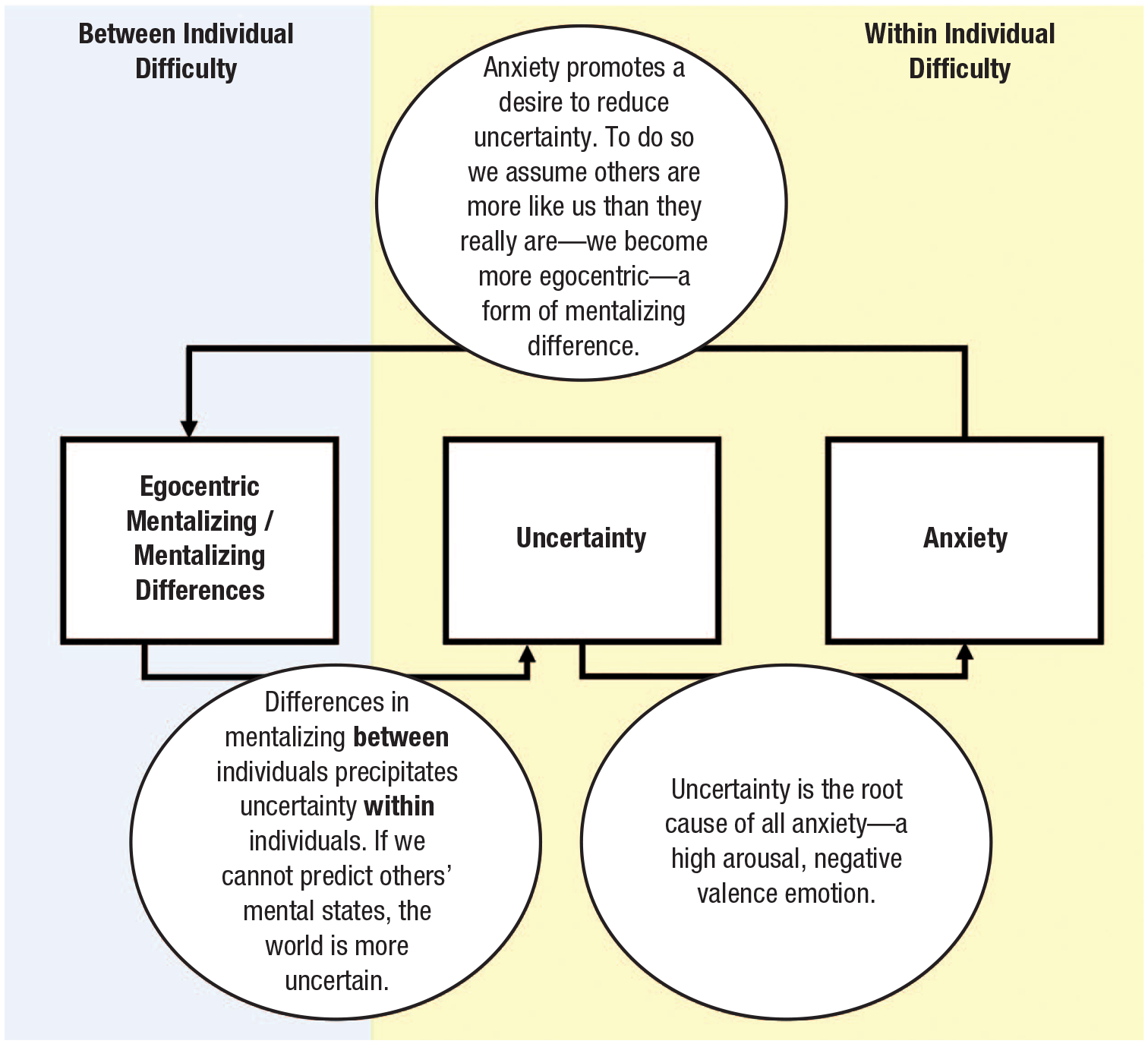
Bidirectional model linking anxiety and mentalizing differences via uncertainty. Uncertainty precipitates and/or perpetuates a “within-individual” experience of anxiety, although more than one individual in an interaction may feel anxious at a given time. Anxiety precipitates a “between-individual” experience of mentalizing difference, as participants become more egocentric in trying to reduce uncertainty. Here, “between individual” indicates that this difference is across a dyad. Mentalizing differences between people precipitate uncertainty separately within both individuals—uncertainty relates to difficulties in understanding others’ mental states and in having one’s own mental states understood.
Agenda Setting
Despite a recent groundswell of research on anxiety and mentalizing, much remains unknown. At a disorder level, most research has been on SAD at the expense of other conditions. This makes sense given SAD’s prevalence and link to the social domain; however, the broader impact of SAD on social functioning makes identifying its precise impact on mentalizing more challenging. Insofar as all mental-health conditions are arguably disorders of social interaction (Bolis et al., 2023), the limited evidence on experiences of GAD, specific phobias, and panic disorder is striking (but for evidence of the impact of these conditions on social cognition more generally, see Plana et al., 2014; and for evidence of the impact of GAD on mentalizing, see Zainal & Newman, 2018). Focusing on core processes, rather than solely on diagnostic criteria, will be crucial to understanding mentalizing differences across psychopathologies. Response to uncertainty is often neglected in frameworks such as the National Institute of Mental Health’s Research Domain Criteria. Our model predicts that uncertainty underpins important mentalizing differences; transdiagnostic-network, dimensional, and clustering approaches are likely needed to test this prediction because diagnostic categories conflate a range of experiences and symptom profiles.
Heightened egocentrism is consistent with uncertainty-reduction motivations in anxiety. Egocentrism is variously operationalized as difficulty in selecting between self-perspective and another agent’s perspective, not differentiating another’s mental state from reality, and/or the bias in judgments when anchoring on one’s own perspective to predict another’s perspective (Todd & Tamir, in press). Each manifestation could result from uncertainty, and thus ultimately from anxiety, but more work is needed to understand the impact of anxiety and uncertainty on the real-time processing of others’ mental states.
Anxiety, like egocentrism, is multifaceted. More work is needed to disambiguate the impacts of these facets. We propose that it is anxiety’s association with an action tendency to reduce uncertainty that produces egocentrism. There is no clear evidence that other associated aspects of anxiety enable egocentrism in the same way: For example, Todd et al.’s (2015) disgust condition did not induce egocentrism equivalent to anxiety, suggesting that neither negative arousal nor avoidance tendencies alone (both are high with disgust) consistently induce egocentrism. More conclusive evidence would come from further work on manipulations of uncertainty in the absence of anxiety, such as Todd et al.’s (2015) surprise and low-certainty inductions, or through reducing anxiety while maintaining uncertainty (perhaps through relaxation methods). Disambiguating uncertainty from anxiety also affords intriguing predictions about the sorts of environments in which egocentrism might proliferate, perhaps including those that offer highly consequential (but unpredictable) rewards, such as stock-market floors, as well as those that proffer high risks.
That many autistic people experience anxiety is clear. Longitudinal models tracking how anxiety in autistic people changes over time and relates to experiences of misunderstanding and being misunderstood are lacking. Over time, a broader range of profiles of differences in autistic people has emerged (Hobson & Petty, 2021), with effect sizes shrinking on traditional measures of difference from neurotypical populations. Although this presents challenges to autism research (Mottron & Bzdok, 2020), it also provides opportunities to measure the relation between autistic people’s experiences of anxiety and their experiences of misunderstanding and being misunderstood. We predict that anxiety is more likely in autistic people with frequent experiences of mentalizing errors than in those with fewer such experiences. Diverse autistic populations allow for testing this prediction directly. Likewise, for anxiety conditions in both autistic and neurotypical people, tracking social abilities such as mentalizing through effective treatment of anxiety should be a priority.
Conclusion
Recent advances are filling the “emotional vacuum” in our knowledge of how people mentalize. Longer term manifestations of anxiety are associated with mentalizing differences. Short-term anxiety induction provides a clue as to why: Situation-specific anxiety motivates uncertainty reduction and can make people more egocentric. The best explanation of the current evidence is a bidirectional model. As predicted by such a model, autistic people, who uniquely encounter the impacts of mentalizing differences, experience heightened anxiety. Future priorities include testing the validity of this model and considering how intervention might ameliorate its impact.
Recommended Reading
Lerner, J. S., Li, Y., Valdesolo, P., & Kassam, K. S. (2015). (See References). Accessible review and summary of “themes” of research on how emotion influences cognition.
Milton, D. E. (2012). (See References). Key text that challenges the notion of mentalizing differences in autism as unidirectional “deficits.”
Sloover, M., van Est, L. A., Janssen, P. G., Hilbink, M., & van Ee, E. (2022). (See References). Comprehensive review and meta-analysis on mentalizing in anxiety and related disorders in adults.
South, M., & Rodgers, J. (2017). (See References). Accessible article proposing a model for anxiety in autistic people with uncertainty as a key mediator.
Todd, A. R., Forstmann, M., Burgmer, P., Brooks, A. W., & Galinsky, A. D. (2015). (See References). Empirical article documenting causal effects of situational anxiety on egocentric mentalizing with uncertainty as a key mediator.
