



Abstract
Even before starting formal schooling, children show substantial variations in math skills suggesting that the home learning environment plays an important role in shaping young children’s math skills. Here, I review interventions aimed at providing young children with opportunities to learn math at home to identify what types of parent-guided activities may be effective at improving young children’s math. I also review interventions that may impact the frequencies and quality of the learning opportunities that parents provide to their children even if benefits for children’s math outcomes were not found or have not been tested yet. While some studies show that parent-guided math activities can impact children’s math skills, future work should carefully consider for whom interventions are most effective as both child and parent characteristics such as children’s general cognitive skills or foundational number skills as well as parents’ attitudes toward math may impact the effectiveness of the interventions.
The 2022 report of the National Assessment of Educational Progress (NAEP) in the United States contained alarming numbers: Only 36% of 4th graders and 26% of 8th graders were rated proficient or advanced in their math skills (NAEP, 2022). These results are particularly concerning as previous studies have shown that early math scores are predictive of later academic achievement (Duncan et al., 2007), educational choices in high school and college (Davis-Kean et al., 2022; Trusty et al., 2000), and income in adulthood (Currie & Thomas, 1999). Importantly, children already show substantial differences in math abilities at the start of kindergarten (Jordan et al., 2009). Hence, we need to identify ways in which children’s foundational math skills can be improved before they start formal math instruction. While extensive research has focused on preschools (Clements & Sarama, 2007; Greenes et al., 2004; Lewis Presser et al., 2015), recent work emphasizes the home as an important context to instill foundational math knowledge in children (Daucourt et al., 2021; Dunst et al., 2017). In this review, I will explore the role that parents can play in shaping young children’s math skills. Specifically, I will concentrate on parent-focused interventions to identify activities that may improve young children’s math. While there is an emerging body of work showing that parent-guided math activities can impact children’s math skills, I will also review the literature showing intermediary success, i.e., interventions that may impact the frequencies and quality of the learning opportunities that parents provide for example by measuring the frequency of parents’ talk about numbers and other math concepts even if benefits for children’s math could not be found or have not been tested yet.
The overarching frameworks for the research reviewed here are the Opportunity-Propensity model and sociocultural theory of development. The Opportunity-Propensity model suggests that academic achievement is a product of opportunities to acquire content knowledge and practice it as well as learners’ propensities to benefit from these opportunities (Byrnes & Miller, 2007). Sociocultural theory highlights the fact that children learn through participation in everyday activities embedded in their communities (Rogoff, 2003). In line with these frameworks, this review assumes that targeted interventions may increase the frequency or quality of math learning opportunities parents create for their children, in turn improving children’s math skills. However, recent studies suggest that partial success or complete failure of math interventions may be due to variations in children’s propensities to benefit from the training (e.g., having the requisite knowledge to take advantage of the input or the general cognitive skills to learn and retain it) or external factors that may affect the implementation of learning opportunities (e.g., parental math anxiety or beliefs about the importance of math for their children that may be shaped by larger cultural norms).
Following the Opportunity-Propensity framework, the majority of studies have tested the feasibility and efficacy of specific child-focused activities for increasing children’s opportunities to learn math while interacting with their parents. However, a few studies have emphasized the sociocultural framework by integrating math interventions into everyday activities of parents and children. I will review both approaches in the following sections.
Parent-Child Activities That Require Dedicated Materials and Time
Most intervention studies have tested the feasibility and efficacy of parent-child activities that require specific materials and dedicated times to engage in these activities. A few studies used various activities and interventionists to coach parents on how to use them (Akinci-Cosgun & Tezel-Sahin, 2022; Dulay et al., 2019; He et al., 2022; Kritzer & Pagliaro, 2013; Leyva et al., 2018; Niklas et al., 2016; Starkey & Klein, 2000). While some of these studies showed improvements in children’s math skills, the efforts needed to implement these interventions make their widespread use difficult. Thus, the remainder of the review will focus on interventions that test whether engaging with one activity and without extensive involvement of an interventionist increases children’s opportunities to learn math (see Fig. 1a–d for examples of materials used in previous studies). These studies have used board or card games, books or stories, or materials provided in museum exhibits.
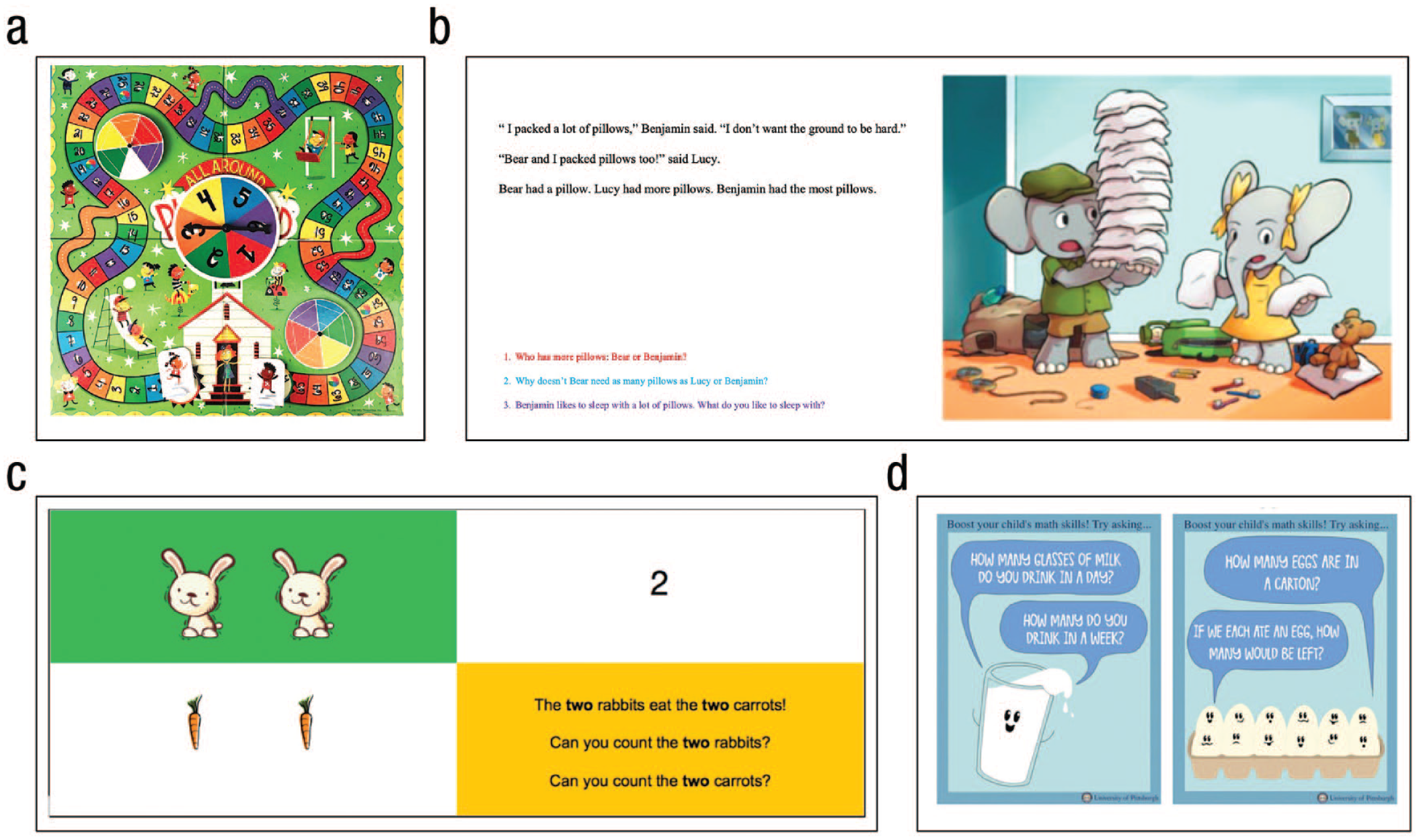
Sample intervention materials showing (a) a number board game (Ribner et al., 2022), (b) sample pages from a book focusing on increasing math language (Purpura et al., 2021), (c) sample pages from a book focusing on small numbers (Gibson et al., 2020), and (d) signs posted in grocery stores aimed at increasing parents’ conversations about math while shopping with their children (Hanner et al., 2019). Permissions for reproduction of these materials have been obtained.
Board and card games
When parents are prompted to talk about numbers while playing board games that require counting with their preschool-aged children, parents indeed use more number words (also referred to as number talk) than when given no instructions to do so (Vandermaas-Peeler, Ferretti, & Loving, 2012; Zippert et al., 2019; but see de Vries et al., 2021, for opposing findings). However, there is mixed evidence whether parent-child number board game play improves children’s math skills. For example, 4-year-old children from primarily high socioeconomic status (SES) families in the Mid-Atlantic region of the United States who were assigned to play a number board game with their parents twice a week for eight weeks performed significantly better on a standardized math assessment post-training compared to a business-as-usual control group (Ribner et al., 2022, see Fig. 1a). Similarly, 4- to 5-year-old Chinese children and their parents were assigned to play a number board game twice a week for four weeks (Cheung & McBride, 2017). Half of the parents were given training about the math concepts embedded in the game, and how and when to introduce them to their child during the game; the other half got the game but no additional training. Children whose parents had received instructions on how to incorporate math content into the game play showed significant improvements in counting, numeral identification, and addition from pre- to posttest and these effects tended to be larger than in the board game-only condition. Limited improvements in children’s math skills that were restricted to numberline estimations were also observed when 4-year-old students from exclusively low-SES backgrounds in the Mid-Atlantic region of the United States played a commercially available number board game with their parents compared to a business-as-usual control group (Sonnenschein et al., 2016).
However, other interventions yielded no improvements in children’s math skills. For example, playing two different versions of a commercially available number board game or a color board game did not yield any differences in children’s improvements in counting and numeral identification post-intervention (Sonnenschein et al., 2016). Similarly, two studies showed that playing a card game that required number comparisons did not yield any significant improvements in children’s numerical knowledge compared to a card game that required shape or color matching (Ramani & Scalise, 2020; Scalise et al., 2022).
One possible explanation for the lack of consistent intervention effects may be that only a subset of the children benefit from the learning opportunities provided to them. For example, Silver et al. (in press) randomly assigned parents and their preschool-aged children recruited in the Mid-Atlantic region of the United States to play with a number board game, a control board game focused on shapes, or a business-as-usual control group. Controlling for foundational number skills, inhibitory control, and vocabulary at pretest, no differences in math skills at post-test were observed between the intervention conditions. However, a significant interaction emerged between intervention condition assignment and number skills, such that only children with higher pretest number skills had higher post-test math scores when assigned to the number board game condition compared to the two control conditions and no differences among conditions were seen for children with lower number skills. These findings suggest that children may only benefit from this particular number board game intervention if they already possess some number knowledge. Thus, future work should pay close attention to ensure that interventions target an appropriate level of difficulty given a child’s current math knowledge.
Math interventions embedded in books and stories
Another frequently used approach to increasing children’s exposure to mathematical concepts is by embedding them into books and stories. This approach has yielded some success in increasing parents’ talk about a broad range of math concepts (i.e., math talk) beyond what is written on the page (Hendrix et al., 2019; Hojnoski et al., 2014). Importantly, there is evidence that reading math books can lead to improvements in children’s math skills. For example, 3- to 5-year-old children and their parents recruited in the Midwest of the United States were assigned to either read three picture books containing mathematical language or three control books without math language four times each over a span of four weeks (Purpura et al., 2021, see Fig. 1b). Children in the math book group showed significant improvements in comprehension of math language (i.e., words like “more”, “least”, and “enough”) immediately after the intervention compared to children in the control group. However, this effect was no longer present eight weeks later. Children in the math book group also showed significant improvements on a standardized math assessment compared to the control group immediately after the intervention and eight weeks later. Similarly, when parents and their 2- to 4-year-old children recruited in the Midwest of the United States were assigned to either reading books about small (1–3) numbers, large (4–6) numbers, or non-numerical concepts as controls, children who were read the books about small numbers showed significantly greater improvements in their understanding of number words than children in the two other intervention conditions (Gibson et al., 2020, see Fig. 1c). Importantly, children who already understood “one” and “two” before the intervention showed significantly greater improvements in their understanding of number words also when they were assigned to read the large number books compared to the control books, re-iterating the importance of considering children’s knowledge at the start of the intervention to target an appropriate level of difficulty.
Finally, other work highlights the importance of considering parent factors as important determinants for the effectiveness of a parent-guided math intervention. When first graders and one of their parents living in the Midwest of the United States were assigned to a math intervention or a reading intervention using an app, the more frequently dyads engaged with the math app, the higher children’s gains in math from the beginning to the end of the school year (Berkowitz et al., 2015). No such association was found for the reading app. Interestingly, children whose parents had high levels of math anxiety benefitted more from engaging with the math app than children whose parents had low levels of math anxiety. Moreover, following these children through 3rd grade revealed that children of highly math anxious parents showed similar growth in math when assigned to the math app as those of parents with low math anxiety (Schaeffer et al., 2018). In contrast, children of highly math anxious parents assigned to use the reading app showed significantly lesser gains in math achievement than children of parents with low math anxiety in the same intervention group. These findings highlight the importance of determining which interventions may be particularly effective for which subset of children by taking parent characteristics into consideration.
Museum-based interventions
Children’s museums offer a unique informal learning environment where parents and children may engage with particular exhibits and receive suggestions for activities that offer targeted learning opportunities. Providing parents with key engineering principles and instructions to ask guiding questions during play with construction materials in a museum indeed led parents and children to engage in more STEM-related conversations (Haden et al., 2014). Importantly, in another study parents and their preschool-aged children visiting a grocery store exhibit of a children’s museum in the Mid-Atlantic region of the United States were either instructed to shop for a meal on a $20-budget (i.e., the math intervention) or a healthy meal (i.e., the control condition) (Braham et al., 2018). Parents talked significantly more about numbers in the math intervention compared to the control condition. More importantly, children in the math intervention showed a significantly greater tendency to focus on number in a task where such a focus was not required after the intervention compared to children in the control condition. Thus, museums may provide parents with opportunities to engage their children in activities that improve children’s math skills, but it is possible that these improvements are only short-lived.
Parent-Child Activities That Can Be Integrated Into Everyday Activities
While all of the previous interventions required dedicated materials and time, interventions that can be integrated into families’ everyday activities may be less onerous for parents, more culturally sensitive, and easier to maintain over longer periods of time. As suggested by sociocultural theory, they provide children with important culturally embedded opportunities for learning. However, far fewer studies have tried this approach and their success has been mixed.
Cooking
Cooking together creates a prime opportunity to engage children in a broad range of math activities from pointing out Arabic numerals in recipes to counting and measuring. When primarily middle- to high-SES parents of 4-year-olds in the Southeast of the United States were prompted to include numeracy activities during a cooking activity with their children, parents provided more numeracy questions and dyads engaged in more numeracy conversations overall compared to dyads who simply followed the recipe (Vandermaas-Peeler, Boomgarden, et al., 2012). However, although children in the intervention group provided more correct answers during conversations with their parents than children in the comparison group, there were no significant differences in children’s performance on a standardized math assessment immediately post-intervention. Similarly, when primarily high-SES parents of 4- and 5-year-olds in the Southeast of the United States were instructed to support inquiry processes by encouraging questions, predictions, and comparisons during cooking, games, and nature activities, math conversations were more frequent during cooking and games, but children’s math skills after the intervention were not significantly different from those of children in a control group who received no instructions (Vandermaas-Peeler et al., 2018).
Shopping
Grocery shopping provides parents with another unique opportunity to integrate a broad range of conversations about math into everyday activities with their children. Placing signs prompting adults to talk more about math with children in a grocery store in the Mid-Atlantic region of the United States increased the number of adults who did so while shopping with their children compared to signs prompting other types of conversations (Hanner et al., 2019, see Fig. 1d). Similarly, when signs emphasizing conversations about number, color, and shape were placed around a food pantry in the Midwest of the United States, adults shopping with children engaged in significantly more talk about these academically relevant topics compared to when signs emphasized non-academic topics (Shivaram et al., 2021). However, to date studies have only shown that prompting parents to engage in such conversations indeed leads to increases in math conversations. While the impact on children’s math skills has not been tested yet, correlational studies suggest that math support in the context of grocery shopping may be associated with children’s math skills (Leyva, 2019).
Conclusions and Future Directions
In sum, the research reviewed here demonstrates that parents are indeed capable of providing children with more opportunities to learn math when given appropriate instructions and materials and that such interventions often lead to improvements in children’s math skills. However, failures to find such improvements in some studies are no reason to abandon these interventions. Instead, future research should carefully consider how children’s skills align with the intervention activities and which families in which contexts may benefit the most from the interventions. In addition, intervention durations and dosages as well as the time it takes to consolidate and integrate new skills need to be taken into account.
Recommended Reading
Daucourt, M. C., Napoli, A. R., Quinn, J. M., Wood, S. G., & Hart, S. A. (2021). (See References).
A recent meta-analysis examining the home math environment and children’s math skills showing that across 68 independent samples there is a small but significant positive association between children’s opportunities to learn math at home and their math skills.
Purpura, D. J., Schmitt, S. A., Napoli, A. R., Dobbs-Oates, J., King, Y. A., Hornburg, C. B., Westerberg, L., Borriello, G. A., Bryant, L. M., Anaya, L. Y., Kung, M., Litkowski, E., Lin, J., & Rolan, E. (2021). (See References).
An intervention using specifically designed books that incorporated mathematical language rarely emphasized in commercially available number books for young children.
Schaeffer, M. W., Rozek, C. S., Berkowitz, T., Levine, S. C., & Beilock, S. L. (2018). (See References).
An intervention using an app to provide parents and children with math stories and age-appropriate math questions related to the story.
Silver, A. M., Elliott, L., Ribner, A., & Libertus, M. E. (in press). (See References).
A study highlighting the importance of considering child propensities when examining the association between home learning opportunities and children’s math skills.
