



Abstract
Sexual desire for a partner is a unique feature that distinguishes romantic relationships from other close relationships. Yet desire is one of the most fragile relationship elements, often declining over time. Research has shown that the relationship processes that foster closeness (i.e., overlap between the self and partner; interconnection) are associated with higher desire and help couples maintain desire over time. However, this work does not explain how many couples who are quite close and connected can also report low levels of desire. One perspective, mostly from clinical observations and interviews with couples, is that too much closeness in a relationship stifles desire. Here, we review the empirical evidence for the association between closeness (and related constructs) and sexual desire. From this review, we propose that higher closeness is associated with higher desire, and rather than too much closeness stifling desire, high closeness might be optimally linked to desire when paired with a sense of otherness (i.e., distinctiveness between partners that allows for new insights and acknowledgment of unique contributions). Future research refining the concept of “otherness” and considering the balance of closeness and otherness in relationships has the potential to provide new insights into sexual-desire maintenance.
Sexual desire is a key feature that, for most people, distinguishes romantic love from other types of love (e.g., Fehr, 1993) and is often part of what draws people into a romantic relationship. Whereas desire tends to be high in new relationships, it typically declines with increasing relationship duration, particularly for women (McNulty et al., 2019; Murray & Milhausen, 2012; Sims & Meana, 2010). A growing body of research has investigated the relational factors that are associated with the maintenance of desire over time. Much of this work suggests that closeness between partners (or factors related to closeness) is a key route to desire maintenance (e.g., Birnbaum et al., 2016; Muise et al., 2013, 2019), but this work fails to explain how people in relationships with high closeness can also experience low desire for their partner (Sims & Meana, 2010). Research primarily involving interviews with couples and insights from couples’ therapists suggests that too much closeness might squash desire (e.g., Ferreira et al., 2015; Perel, 2006; Schnarch, 2000), but other research testing these ideas has not found that desire is lower at very high levels of closeness (Štulhofer et al., 2013). Here, we review the evidence for the association between closeness (and related constructs) and sexual desire in romantic relationships with the goals of considering whether too much closeness stifles desire and proposing that the balance of closeness and otherness (i.e., distinctiveness between partners) in a relationship is an important and novel way to understand the maintenance of sexual desire.
Is Too Much Closeness Bad for Sexual Desire?
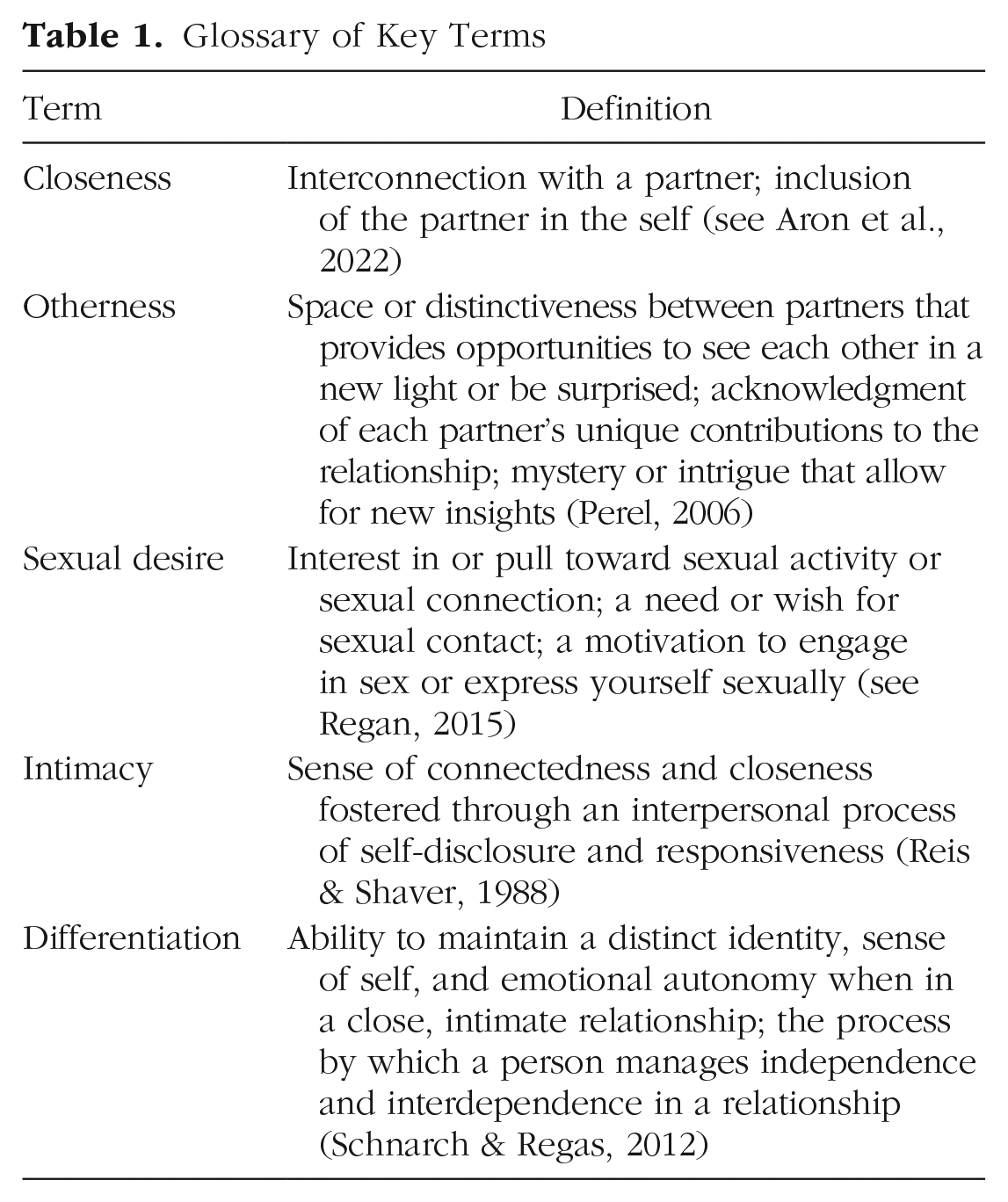
Since Basson’s (2000) seminal work demonstrating the role of relational intimacy in women’s sexual desire, a growing body of research has shown that closeness and associated factors in relationships facilitate sexual desire across genders. Given that closeness and intimacy are highly correlated (for a glossary of key terms, see Table 1) and intimacy has been conceptualized in a variety of ways (Reis & Shaver, 1988), we focused on how closeness and other relational factors that have been linked to closeness and intimacy are associated with sexual desire. Motivation to meet a partner’s sexual needs (e.g., Muise & Impett, 2016); perceptions of a partner as responsive (e.g., feeling understood, validated, and cared for; Birnbaum et al., 2016); emotional intimacy, including affectionate touch and sharing personal experiences (e.g., Brotto et al., 2009); and comfort in disclosing thoughts and feelings (e.g., Murray & Milhausen, 2012)—all of which are associated with closeness—have each been found to be associated with higher desire. In fact, in our own work, we found that on days when people felt closer to their partner, they also felt higher desire for their partner, and this accounted for how shared, novel experiences were associated with higher desire in relationships over time (Goss et al., 2022; Muise et al., 2019).
Glossary of Key Terms
Research also shows that people in relationships with high levels of closeness can still report low sexual desire for their partner (e.g., Sims & Meana, 2010), but the existing literature has not explained what accounts for this discrepancy. Clinicians and researchers have raised the possibility that too much closeness between partners might stifle sexual desire (for a review, see Ferreira et al., 2012). Indeed, people in relationships (7%–19% in one sample of dating undergraduate students) do, at times, report too much closeness (D. J. Mashek & Sherman, 2004), which was described as needing space and time alone, wanting separate interests, feeling suffocated, wanting more time with friends, and needing independence (D. Mashek et al., 2011). When people report more closeness than desired, they report lower relationship satisfaction and more thoughts of ending their relationship (Frost & Forrester, 2013). In one study, however, men who reported the highest levels of intimacy in their relationship also reported the highest levels of desire (Štulhofer et al., 2013). If, in fact, desire starts to wane at very high levels of closeness, we might expect a curvilinear association between closeness and sexual desire, in which desire levels off or declines at very high levels of closeness. In our own data (N = 269 couples) we tested whether there is a curvilinear association between closeness and desire and found evidence only for a significant linear, but not a curvilinear, association (Goss & Muise, 2023). That is, higher closeness was associated with higher levels of desire, and desire did not level off or decline at very high levels of closeness. Taken together, these data suggest that feelings of being too close to a partner may arise from a lack of independence or distinctiveness from a partner, and not just because partners experience high closeness.
“Otherness” and Sexual Desire
Given that, for most couples, desire tends to decline over time and even satisfied couples report these declines, sexual desire might require partners to also experience a sense of distinctiveness in their relationship, what we term “otherness,” in addition to closeness. Perel’s (2006) work on otherness and Schnarch’s (1991) work on differentiation captured this idea. Perel (2006) defined otherness as the space between partners needed to see each other in a new light, acknowledge each partner’s distinct contributions to the relationship, and provide the mystery and intrigue to create wanting. Schnarch (1991) argued that highly differentiated partners are able to have close, intimate relationships while still maintaining a sense of independence or distinction from their partner, allowing for greater connection and passion. These clinicians share a belief that whereas closeness may set the stage for desire, having distinctiveness between partners is what allows desire to grow and be maintained. Likewise, they suggest that the development of relationships in Western culture, in which very close, romantic relationships are prioritized, makes it difficult for partners to remain distinct from each other, which can cause desire to wane. According to both perspectives, when partners can maintain a high sense of otherness or differentiation, both partners and the relationship grow, as does their desire for each other.
Research supports clinical insights about otherness (and related constructs) and desire. When couples were asked about the factors that help them maintain sexual desire for their partner, autonomy was identified as a key theme in their responses and included “physical distance, having personal projects that do not include the partner or a more psychological sense of otherness—recognizing the partner as a separate person” (Ferreira et al., 2015, p. 313). In one of the only empirical tests of Perel’s ideas about the association between otherness and desire, people who reported higher “celebrated otherness” in their relationship, in which partner distinctiveness is valued and cultivated, reported higher sexual desire (Prekatsounaki et al., 2019). In another study, when women in long-term relationships were asked about what detracts from their desire, a key theme in their responses was overfamiliarity (or a lack of distinctiveness) with a partner (Sims & Meana, 2010). Although the existing work has not explicitly tested how the balance of closeness and otherness is associated with sexual desire, it provides initial evidence for the role of otherness in desire maintenance.
Differentiation in relationships is also associated with sexual desire. In a longitudinal couple’s study, women who were more differentiated and men who felt that they and their partner were more differentiated reported higher desire over one year (Allsop et al., 2021). In another study, lower differentiation in women accounted for their poorer sexual functioning (Burri et al., 2014). Because differentiation is conceptually related to otherness, this research can be seen as additional support for the role of otherness in desire maintenance. However, the aspects of differentiation highlighted in these studies focus on emotion regulation and uncertainty tolerance (or the characteristics that might allow a person to manage independence and interdependence in a relationship) and are distinct from otherness. Instead, they may represent the emotion-regulation skills and attachment security necessary for partners to differentiate (Schnarch, 1991), which in turn may allow for partners to develop and maintain otherness. Therefore, the existing research on differentiation indirectly suggests the role of both closeness and otherness in desire maintenance, but considering how these function together, and how emotion-regulation skills and attachment security might promote otherness, could provide novel insights into desire maintenance.
Balancing Closeness and Otherness in the Maintenance of Sexual Desire
Theories outside of the domain of sexuality endorse the idea that people seek to balance both closeness and otherness in their relationships, and we believe these ideas are ripe for extension to sexual-desire maintenance. For example, a key premise of self-determination theory is that the desire to affiliate and connect with others exists alongside the desire to be an autonomous person (Ryan & Deci, 2000), and when people can integrate these desires, they have the greatest potential for satisfaction and fulfillment. In one study, relatedness (akin to closeness) was associated with more positive relationship behaviors, especially when people were higher, rather than lower, in autonomy (the ability to express one’s true self; Kluwer et al., 2020). Likewise, one tenet of attachment theory is that having a secure base in a relationship is necessary to engage in exploration, personal growth, and autonomous goal pursuit (e.g., Feeney, 2004). Applied to sexual desire, it is possible that closeness provides the foundation for partners to find and acknowledge otherness, and it is this combination of closeness and otherness that sets the stage for desire maintenance. Figure 1 depicts our predictions of the key romantic relationship outcomes at different combinations of closeness and otherness.
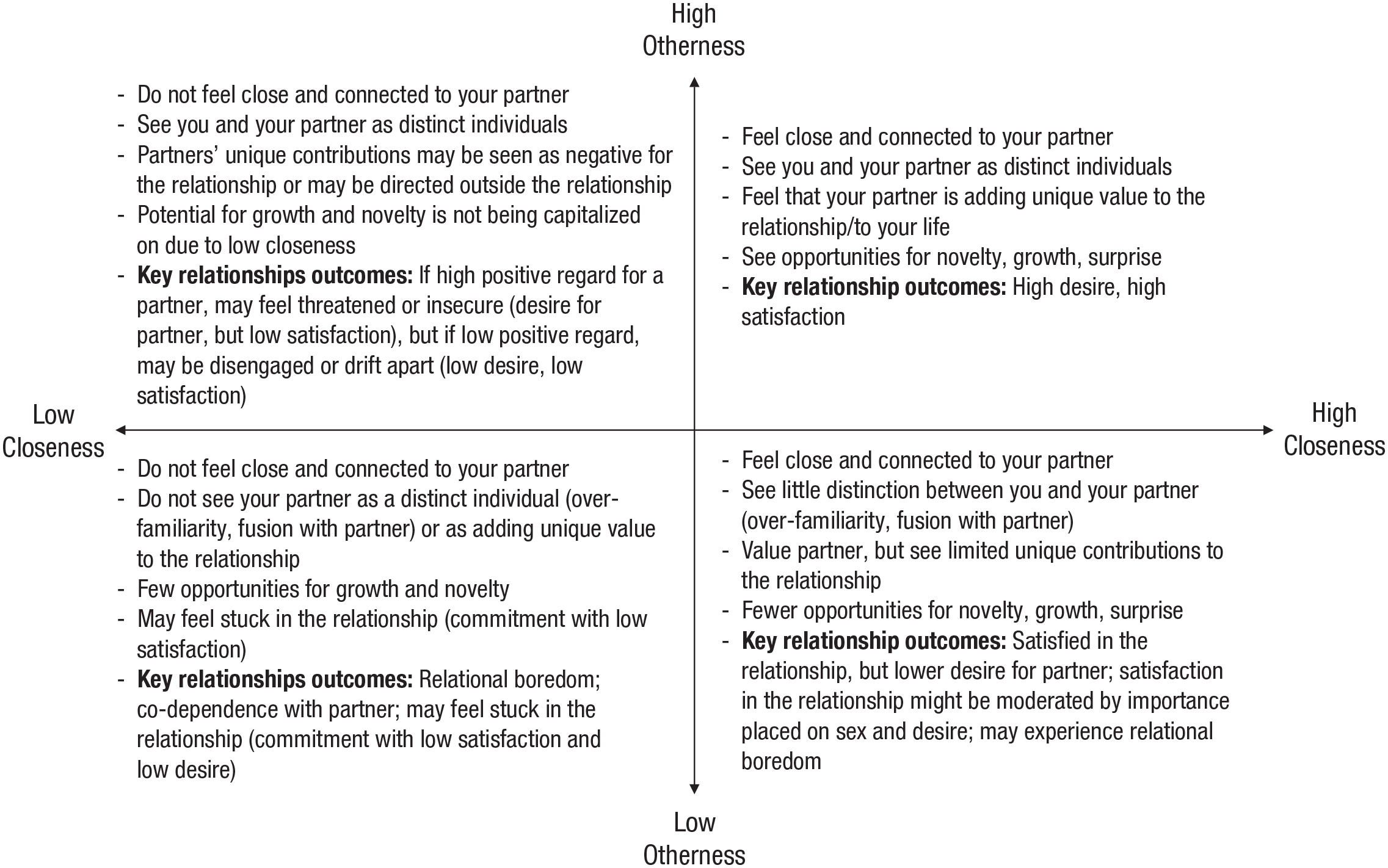
Overview of predicted outcomes and different levels of closeness and otherness in romantic relationships.
Closeness and otherness are not conceptualized as opposite ends of a continuum, but rather the need for closeness coexists with the need to be a distinct, independent person, and the fulfillment of both needs can combine to influence relationship processes (Ben-Ari, 2012). Optimal-distinctiveness theory, which is based on how people with multiple group memberships balance their need for group affiliation and their need to be distinct from other group members (Brewer, 2011), has been applied to romantic relationships. In a series of experimental studies, when people’s affiliative (closeness) needs were met, they were more likely to show interest in opportunities to be distinct from their partner (i.e., pursuing time without a partner), and when their distinctiveness needs were met, they were more likely to focus on closeness with their partner (i.e., seeing them and their partner as similar; Slotter et al., 2014). This work suggests that people might naturally try to balance these needs in relationships or choose to maintain relationships that have the potential to meet both needs.
Initial empirical evidence also alludes to the importance of both closeness and otherness for sexual desire. For example, shared novel experiences with a partner foster both closeness and otherness and through both pathways, are associated with higher desire (Goss et al., 2022). That is, new experiences with a partner promote desire because they make people feel close to their partner and remind them of the distinctiveness between them and their partner. In this study, closeness and otherness were positively correlated (r = .15), suggesting that although these variables are not highly overlapping, they are not negatively associated, and it is possible to have high levels of both closeness and otherness. People also pursue personal growth outside of their relationship, which might be another way to facilitate otherness between partners. On days when people reported heightened personal growth outside of their relationship, they reported more passion, pointing to the possibility that engaging in activities outside of the relationship may help people see themselves as distinct from their partner and foster desire (Carswell et al., 2021). However, people who consistently pursued personal growth outside of the relationship reported less closeness with their partner and lower passion (Carswell et al., 2021). Taken together, these findings suggest that high otherness paired with low closeness is associated with lower desire and that feelings of closeness might be necessary for otherness to foster desire in relationships (see Fig. 1).
Future Directions in Understanding the Maintenance of Desire in Relationships
To learn more about the role of closeness and otherness in desire maintenance, one key next step is to develop a more comprehensive understanding and measurement of otherness. At present, measures of closeness might be entangled with otherness. For example, the Inclusion of the Other in the Self measure (Aron et al., 1992), which is commonly used to assess closeness (Aron et al., 2022), asks people to rate their degree of overlap with their partner (with more overlap between partners indicating more closeness). It is unclear how people who simultaneously have high closeness and high otherness might respond. In addition, scales assessing differentiation of the self (e.g., Skowron & Friedlander, 2009) focus on the process of being able to manage both independence and interdependence in the same relationship and do not assess the degree to which otherness is experienced in the relationship for each partner. We suggest that assessing otherness itself is valuable in understanding how the balance of closeness and otherness is associated with desire maintenance.
Another key future direction is to identify individual differences that might underlie the optimal balance of closeness and otherness in a relationship. For example, people may differ in the degree to which they desire more or less closeness and otherness in their relationships. We know from past research that discrepancies between actual and ideal closeness have implications for relationship quality (Frost & Forrester, 2013); therefore, the optimal balance of closeness and otherness might depend, in part, on a person’s desired levels of closeness and otherness. Likewise, some people might be better able to tolerate high levels of closeness and otherness. Given that features of secure attachment, such as emotion regulation and comfort with independence and interdependence, are part of the process of differentiation in relationships (Schnarch, 1991; Skowron & Friedlander, 2009), people who are securely attached (low attachment anxiety and avoidance) might be more comfortable with high closeness and high otherness in a relationship.
The association between otherness and sexual desire might also differ on the basis of the valence of the new experiences or unique contributions partners are bringing to the relationship. In our previous studies on otherness (Goss et al., 2022), we found that one aspect of otherness—seeing a partner in a new light—was not always positive. Among couples living together at the onset of the COVID-19 pandemic, people mentioned learning new, negative behaviors about their partner (e.g., “My partner is showing a certain character that I did not know they had, with less tolerance and patience, and this has surprised me”) and these new, negative insights may have been desire-limiting rather than desire-enhancing. Indeed, in one study, self-concept change related to engagement in a romantic relationship was differentially linked to relationship quality depending on the valence of the content being added to the self-concept; adding positive aspects to one’s self-concept was associated with higher relationship quality, but adding negative content was associated with poorer outcomes and increased risk of infidelity (Mattingly et al., 2014). Applied to otherness, acknowledging the unique, positive contributions a partner makes to the relationship might be desire-enhancing, but learning that a partner has surprising views or behavior that you see as harmful might cause partners to drift apart.
It is also possible that future research on closeness and otherness could provide novel insights into gender differences in desire. In long-term relationships, gender differences in sexual desire have been well-established, with women’s desire on average declining more steeply than men’s, especially when a couple has children (e.g., McNulty et al., 2019). The heteronormativity theory of women’s low desire suggests that gender inequities that create distinct roles for men and women in mixed-gender relationships are an understudied explanation for women’s lower sexual desire (van Anders et al., 2022). In an empirical test of this theory, women in relationships with men who report doing more than their fair share of the household tasks reported lower sexual desire for their partner (Harris et al., 2022). It is possible that feelings of closeness and otherness in a relationship could account for associations between the gendered division of labor in relationships and sexual desire. Gender differences in which women have less involvement in the public sphere, less leisure time, and more childcare and household responsibilities than men (see van Anders et al., 2022) might limit their feelings of closeness to their partner, as well as their opportunities to feel distinct from their partner, which in turn could be novel mechanisms explaining gender differences in sexual desire.
Investigating the role of otherness in relationships in future work could also generate new insights into two additional areas of relationship science: infidelity and consensual nonmonogamy (CNM). In one study of people’s motivation for having sex with a secondary partner, in both CNM and nonconsensually nonmonogamous situations, people engaged in sex with their secondary partner more often to experience something they could not with their primary partner (e.g., fetish, different gender; Kelberga & Martinsone, 2022). Therefore, otherness may play a role in people’s motivation for nonmonogamy (Perel, 2017), whether with the consent of their primary partner or not. Other research comparing monogamous and CNM relationships has similarly shown that polyamorous relationships not only may help people fulfill their needs for intimacy and passion across relationships but also can lead to greater intimacy and passion in their primary relationship as a result (Balzarini et al., 2019). Examining how infidelity or polyamorous relationships might affect otherness in both primary and secondary relationships may provide new insight into people’s motivations for nonmonogamous relationships and lead to broader insights into how people balance closeness and otherness across relationships.
Conclusions
Despite sexual desire being a key factor in relationship development, at least in Western cultures, it is one of the more challenging aspects of a romantic relationship to maintain over time. In the current article, we considered the important, but insufficient, role of closeness in desire maintenance. We proposed that high closeness without sufficient otherness or distinctiveness between partners might be one reason why desire declines over time. Researchers have a lot to learn about the role of otherness in relationship maintenance, and it is possible that future work on the balance of closeness and otherness can provide new insights into how couples can keep their sexual spark alive.
Recommended Reading
Ferreira, L. C., Narciso, I., & Novo, R. F. (2012). (See References). Introduces the idea that differentiation (distinctiveness between partners) might play a role in the association between intimacy and sexual desire.
Goss, S. C., Raposo, S., Balzarini, R., Rosen, N. O., Benyamin, V., & Muise, A. (2022). (See References). Reports on an initial test of the simultaneous role of closeness and otherness in sexual desire.
Mark, K. P., & Lasslo, J. A. (2018). (See References). Compiles research on the factors (most of which are interpersonal, with other factors identified as individual or societal factors associated with sexual desire in relationships) and provides a comprehensive review of the research on desire maintenance.
