



Abstract
Values, abstract motivational goals—guides for the right and wrong, the desirable and undesirable—relate to many important attitudes and behaviors. Although meaningful understanding of values exists already at age 5, most developmental value research has focused on adolescence. Not enough is known about what happens to children’s values during middle childhood, the period between these two life stages. We propose five criteria for value maturation, reflecting key cognitive and social advances in this period: (a) that children’s value coherence increasingly reflects the motivational associations among values and that, with age, values become increasingly (b) abstract (c) consistent, (d) stable, and (e) related to behavior. Values undergo profound developmental changes during middle childhood indicating that, the importance of adolescence notwithstanding, middle childhood is crucial for value maturation.
Values form a system of abstract motivational goals, describing what one should or should not do, prescribing whom one should esteem, and providing justification for behavior (Rokeach, 1973; Schwartz, 1992). Because values relate to many important attitudes and behaviors, including aggression, altruism, risk-taking, and religiosity (Sagiv & Schwartz, 2021), it is important to understand their development (Döring et al., 2016).
Possibly reflecting the importance of identity formation (Erikson, 1963), most developmental research on values concern adolescents (Fig. 1). However, recent work demonstrates that children have a meaningful understanding of values already at age 5 (Twito-Weingarten & Knafo-Noam, 2022). This gap may reflect a theoretical notion of middle childhood as a latency period, with little significant development (see Knight, 2014, for discussion). This leaves an intriguing question: What happens to values in middle childhood?
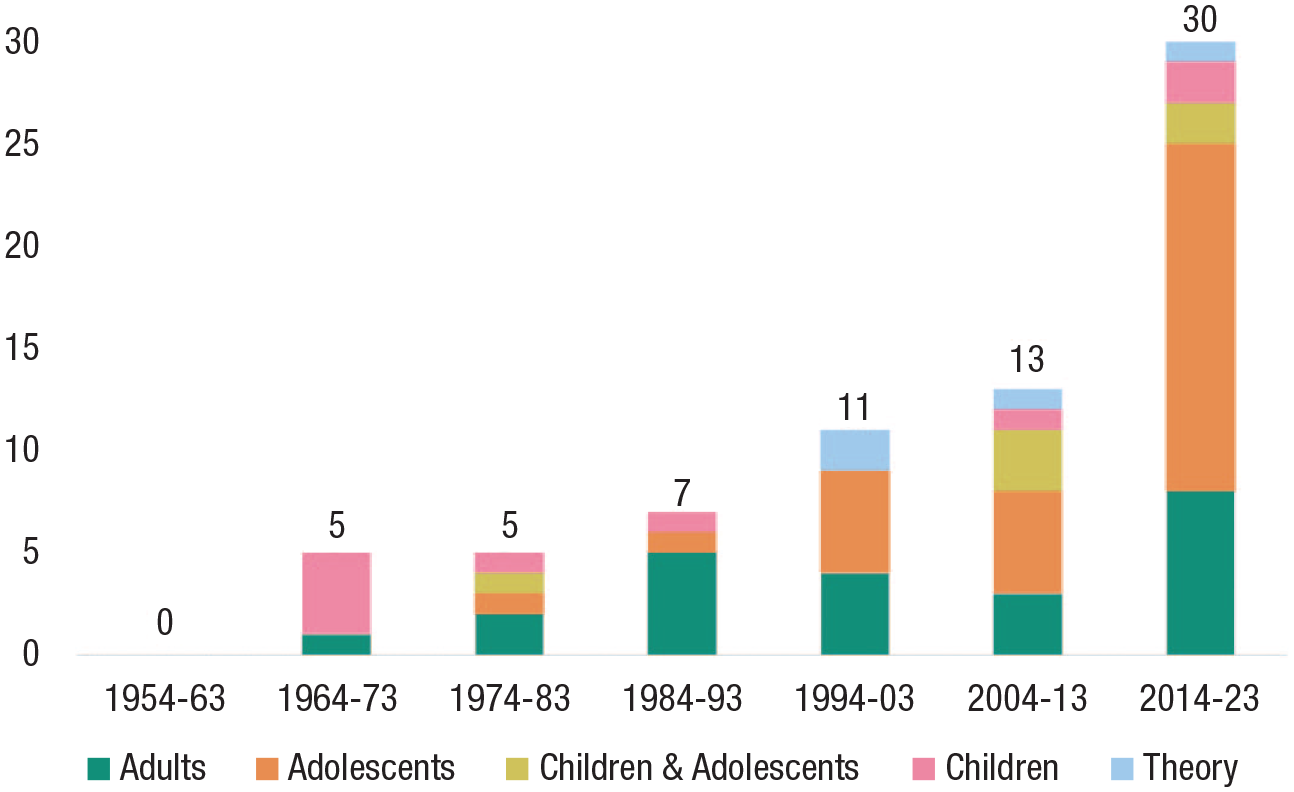
Articles on values in leading developmental journals by period and age group. Articles (N = 71) in top general developmental psychology journals. We chose the 10 highest-ranking journals based on ISI impact factor if they addressed general developmental psychology (e.g., not focusing on developmental psychopathology) and diverse age groups (e.g., not focusing on adolescence specifically). A third of the papers dealt with values in (typically young) adults; 66% of the remaining empirical papers dealt with adolescents specifically.
Values: Definition and Structure
Values are desirable, abstract goals, affecting how people think and feel about specific situations, actions, and people and, as such, motivate action and evaluation of others and the self (Schwartz, 1992). We focus on values as defined and conceptualized by Schwartz (1992) for several reasons. First, Schwartz’s theory was supported in over 500 samples from almost 100 countries (Sagiv & Schwartz, 2021). Second, it is highly influential (e.g., over 23,000 citations by 2023 for Schwartz, 1992). Finally, most childhood value research uses Schwartz’s theory (50% of Fig. 1 empirical papers).
Schwartz (1992) sought to identify which values were common and had similar meanings (though not necessarily similar importance) in diverse cultural contexts. Respondents from dozens of cultures rated the importance of values using items devised from both Western and non-Western sources. Value items consistently clustered into 10 values (Fig. 2).
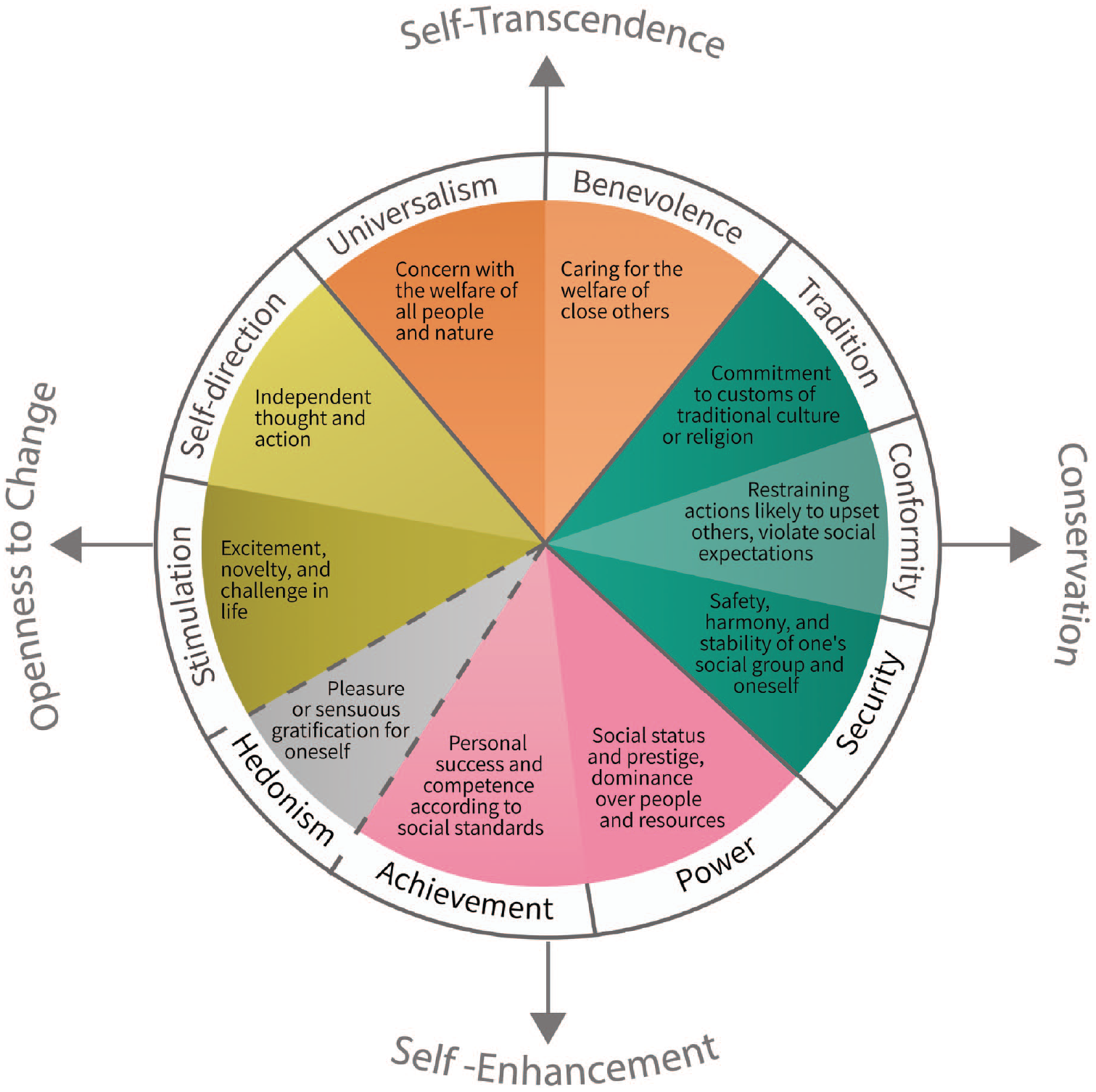
The theoretical and empirical structure of values. The figure shows the structure of values proposed theoretically by Schwartz (1992) and replicated in hundreds of studies (Sagiv & Schwartz, 2021). Each value is presented with its definition, which represents the underlying motivation common to several value items. For example, the value items of social order, health, and family security all promote security. The circular structure reflects the associations among values (adjacent values are compatible with each other, whereas values at opposite sides of the circle are less compatible with each other). Values are further organized into higher-order values (indicated by colors in the figure), as described in the text. Hedonism reflects both self-enhancement and openness values. We note that although more recent versions of the value theory further divide the value structure to a more refined structure of 19 values (Sagiv & Schwartz, 2021), there is little developmental work with this refined value structure, and this article deals with the original 10-value system.
Values were also shown, using diverse methodologies, to be organized in a circular structure with only slight variations across cultures (Sagiv & Schwartz, 2021). The circle represents a motivational continuum, with adjacent values correlating positively with each other and relating in a similar direction to other variables (attitudes, behaviors, demographics). Values reflect two main dimensions: (a) openness to change (novelty and variety), in contrast with conservation (status-quo preservation) and (b) self-enhancement (self-interests) versus self-transcendence (the needs of others and nature). Values at opposite sides of the circle usually correlate in opposite directions with other variables (e.g., aggression correlates positively with power and negatively with universalism; Benish-Weisman, 2019).
Importance of Middle Childhood
Although middle childhood, the period between early childhood and adolescence (approximately, ages 6 to 11), has traditionally been overlooked, it is key to physiological, social, and cognitive development (Del Giudice, 2018; Harter, 2015). During this period, neural changes promote the ability to evaluate and maintain abstract rules and information (Dumontheil, 2014). Middle childhood involves progress in abstraction and generalization skills, allowing better planning and an improved ability to understand multiple perspectives (Harter, 2015). In addition, hormonal changes activate changes in social behaviors, such as dominance seeking, risk-taking, aggression, altruism, and attachment to mates (Del Giudice, 2018). Last, cognitive and neural changes allow children to better understand others’ perspectives, acquire social skills, and increase in complexity of interactions with peers. Therefore, this period is crucial for social development. Moreover, although the ability for self-awareness and self-reflection appears already in early childhood, children’s thinking about the self further progresses in middle childhood (Harter, 2015). This cognitive progress and changes in the ability to self-regulate and to think about multiple perspectives are expected to drive development of values, involved in evaluating the self and others.
Five Value Maturation Criteria
As noted, research on adults and adolescents has shown repeatedly (Sagiv & Schwartz, 2021; Schwartz, 1992) systematic conflicts and compatibilities in the motivations underlying different values. Thus, values typically show coherence, with individuals’ values reflecting the motivational compatibilities and incompatibilities among values (Daniel, Döring, & Cieciuch, 2023). In addition, values are abstract, referring to ideas rather than specific objects, contexts, or behaviors. Thus, values are trans-situational, applying to multiple situations and occasions. Finally, as a key function of values is to evaluate and guide behaviors, values are systematically linked to behavior (although there are constraints on the value-behavior association; Sagiv & Roccas, 2021).
Building on these features of values, we present five criteria for a relatively mature value system, suggesting that reaching these criteria with age constitutes the process of value maturation. We propose that during middle childhood, values become increasingly (a) coherent, (b) abstract, (c) consistent, (d) stable, and (e) related to behavior.
Value coherence
The pursuit of some values has psychological, practical, and social consequences that may conflict or may be compatible with pursuing other values (Bardi & Schwartz, 2003; Sagiv & Schwartz, 2021). The compatibilities and conflicts among values constitute a motivational continuum of values (Fig. 2). Some values share a common motivation (e.g., power and achievement both emphasize promoting one’s interests), whereas other values (e.g., power and benevolence) reflect conflicting motivations (self- vs. other interests).
The finding that across cultures a similar structure of values is found suggests that the structure has psychological or social implications. Indeed, children’s value preferences align with the value theory, with opposing values rarely valued highly by the same child (Daniel et al., 2020). Giving high importance simultaneously to values that are incompatible with each other, such as security and stimulation, may be difficult because believing in incongruent ideas causes discomfort (Aronson, 2019). In addition, such combinations may prevent effective decision-making, as opposing values promote different choices in dilemmas (Bardi & Schwartz, 2003). For example, individuals faced with an opportunity to take an adventure will not have a clear path of action if they value both stimulation and security similarly.
Although most support for the value structure is from adult and adolescent samples, research shows that in children even as young as 5 years old, the value structure largely replicates that of adults. This was found using two different measures with Australian, Israeli, and Palestinian children (Abramson et al., 2017; Collins et al., 2017; Maslamani et al., 2023). Thus, children enter middle childhood already with a meaningful value structure.
Nevertheless, a meaningful value structure at the group level does not necessarily imply that every child comprehends the value interrelations and trade-offs to the same extent. Indeed, within middle childhood there is an integration with age of the value structure. Among 5-to-12-year-olds, most had value profiles that combined compatible values and not contrasting values, but some children—more likely to be younger—showed little differentiation among their values. Over 2 years, children increased in their likelihood of differentiating their values (Daniel et al., 2020). Among 6-to-12-year-olds, value coherence (operationalized as fit of individuals’ values with the overall structure, prevalent in the sample, that largely replicated the theoretical structure) increased with age. Coherence increased from the younger ages toward ages 9 and 10, followed by a drop in coherence, which may stem from processes of value-importance change rather than sociocognitive maturation, an effect replicated longitudinally (Daniel, Döring, & Cieciuch, 2023) and cross-culturally in Israeli and Palestinian children (Maslamani et al., 2023).
Value abstraction
Children readily rate or rank their values (Twito-Weingarten & Knafo-Noam, 2022). However, this does not necessarily imply that children think about values in an abstract manner. Abstraction is a central characteristic of values because it enables applying values not only to specific, concrete behaviors or ideas but to broad, overarching concepts. Abstraction enables applying the same value (e.g., benevolence) to different concrete behaviors (helping an offended friend and sharing lunch) and in different situations, which is important for the ability to be consistent in one’s behaviors across situations and for values’ central place as aspects of one’s personality.
In one study of 5-to-12-year-olds, older children were more inclined to describe their values as abstract ideas and to generalize them to other situations beyond the concrete example given in the value survey, whereas younger children were more likely to describe specific instances, behaviors, or contexts in which the value can be applied (Shachnai & Daniel, 2020). A longitudinal study of 6-to-8-year-olds also showed more value abstraction in older children. Importantly, it provided initial evidence that cognitive progress in this age relates to children’s value abstraction. Children’s working memory longitudinally predicted later value abstraction indirectly, via children’s ability to form general concepts (Misgav & Daniel, 2022).
As parts of the personality system, values are characterized by consistency and stability (Schwartz, 1992). Value consistency refers to the likelihood that an individual will value the same values similarly in different situations and contexts, whereas stability refers to the likelihood of valuing the same values across different points in time. The social and cognitive progress in middle childhood is expected to contribute to increasingly consistent and stable values.
Consistency
Initial findings (Collins et al., 2017) support our consistency criterion for value maturation. Using the best-worst method for assessing values, each value was compared by 5-to-12-year-old children five times to sets of other values. Consistency substantially increased with age and plateaued around age 9 (Fig. 3).
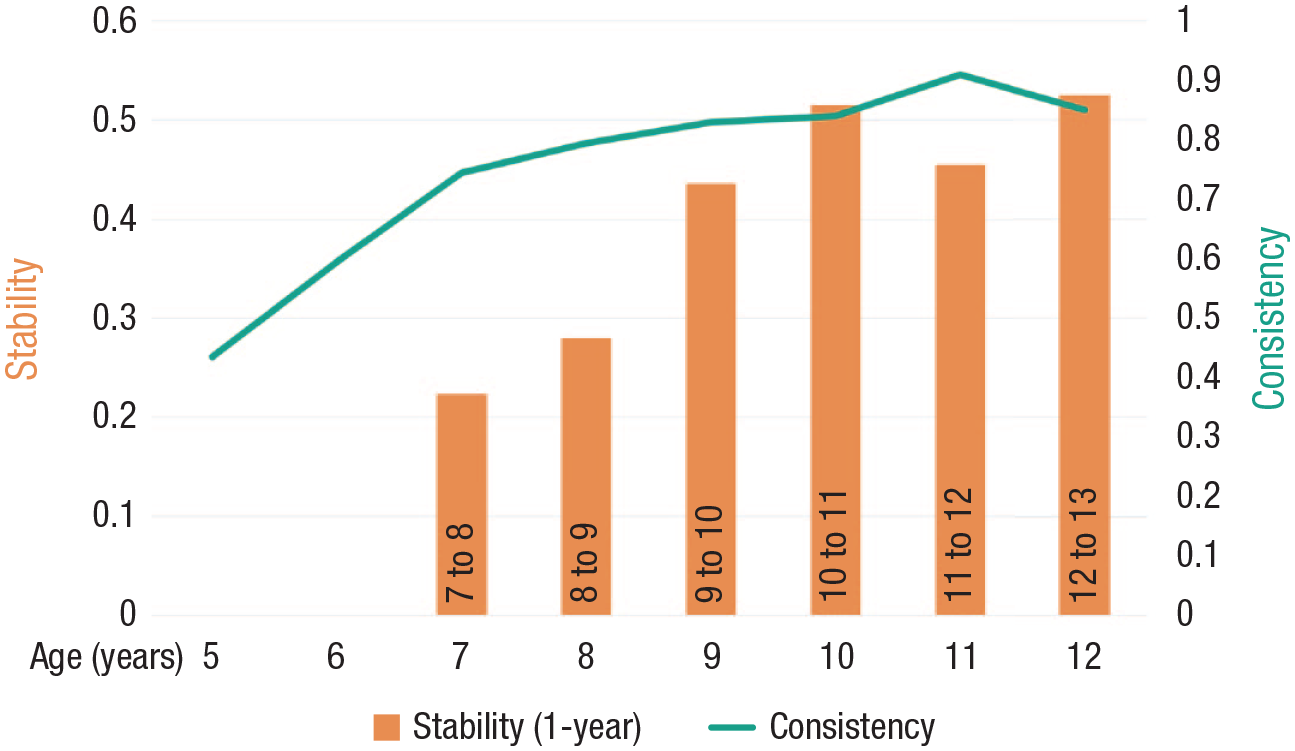
Increasing consistency and stability of values in middle childhood. One-year stability estimates are based on Cieciuch et al. (2016; averaged across two samples and across values). For current purposes, we consider selection of the same value as the most or the least important at least four times out of five times in a set of values as indicating consistency. Consistency indicates the proportion of children choosing the same value repeatedly (four or five out of five times) as most/least important (averaged; Collins et al., 2017).
Consistency is also indicated by ranking the same values similarly using different stimuli (e.g., two sets of 10 value items). Palestinian and Israeli children’s consistency was low at ages 5 and 6, higher at ages 7 and 8, and still higher at ages 9 and 10, although not higher, and for some children lower, at ages 11 and 12 (Maslamani et al., 2023).
Stability
Studies on adults have provided significant evidence for values’ rank-order stability, as the relative importance of a person’s values compared with other individuals remains consistent over time (Bardi & Goodwin, 2011). Although research on children is less common, stability in values has also been observed during the transition to adolescence in 10-year-olds (Vecchione et al., 2020). One key study followed children longitudinally (Cieciuch etal., 2016), showing that 1-year stability of values increases with age from age 7, though it appears to level off around the age of 9 or 10 years (Fig. 3). In a second longitudinal study between 6 and 11 years of age, 1-year stability varied across values and increased mainly in openness to change and conservation values (Daniel, Misgav, & Chomsky, 2023). Thus, in middle childhood, values become increasingly stable, supporting our stability criterion.
Value-behavior congruence
A coherent system of stable and consistent value priorities can be used to efficiently select behaviors and to evaluate the actions of others. Thus, a value-behavior relationship increasing with age is another criterion of maturation. Several processes suggest an expected increase in the association between values and behaviors. First, as children’s values become more stable and consistent as they develop, values will be able to guide behaviors in the same way repeatedly, serving to validate and establish the association. The increase in value coherence means that children become more likely to differentiate between their values and prioritize them clearly. With reduced likelihood of holding contrasting values as simultaneously highly important, they will be able to easily and consistently make decisions in dilemmas that contrast conflicting values. Thus, their behaviors will fulfill the values they mostly care about more clearly.
In addition, values serve to justify behaviors. People who observe their own behavior may attribute it to their values (Bardi & Goodwin, 2011). Research has shown reciprocal relations between values and behavior in adolescence, whereby values predict changes in behaviors and behaviors predict changes in values over time (Benish-Weisman, 2019). As children make behavioral choices, they can self-reflect and use their own behaviors to learn what they find important. This process might be further strengthened by social reinforcement. For example, parents’ appreciation of a child’s helping behavior might assist the child to perceive himself or herself as valuing kindness or care (Thompson et al., 2006), therefore strengthening the value-behavior relation. Finally, during childhood, children develop increased agency (Vecchione et al., 2016), which is derived from cognitive-social maturation as well as external factors like school demands and parental support. This sense of agency allows them to express abstract goals through actions.
Research on children’s values demonstrates that, overall, children’s values are associated with their behaviors in ways compatible with Schwartz’s (1992) theory (Twito-Weingarten & Knafo-Noam, 2022). Importantly, some of this work associated values with behaviors that are assessed with non-self-report measures. For example, self-enhancement versus self-transcendence values related to children’s observed sharing and helping behaviors (Abramson et al., 2017; Misgav, Shachnai, et al., 2023). Children’s values related to aggression and prosocial behavior as rated by peers (Benish-weisman, 2019). Finally, children’s security and self-enhancement values related to their delay of gratification in a computerized quest game (Twito-Weingarten & Knafo-Noam, 2022).
Less is known about the development of the value-behavior association. In a single longitudinal study on values and behaviors (albeit with 10-to-12-year-olds), researchers looked at the association between values and value-expressive behaviors (aggregated scores of self-reported behaviors that represent specific values, such as helping representing benevolence values). The average value-behavior association increased from .33 early in the school year to .42 later (Vecchione et al., 2016). Cross-sectional studies also confirm an age-increasing association between values and behaviors in the case of cheating and honesty (Henshel, 1971) and sharing behavior and self-transcendence values (Abramson et al., 2017). In sum, preliminary evidence suggests that, indeed, the value-behavior association increases with age in childhood.
Conclusions, Limitations, and Future Directions
Middle childhood is a period in which maturation of cognitive capacities and increased social skills and experience in social interactions may enhance development of more mature thinking about values. Our review of the nascent literature on children’s values shows evidence for maturation in value structure with age during middle childhood, although the starting point for this period already shows a relatively developed value system. In addition, results on increasing stability and consistency, as well as increasingly abstract thinking about values, provide further evidence that middle childhood is key for the development of children’s value system. This change in children’s values may be further manifest in values increasingly guiding the selection of behaviors.
In our review we relied mainly on research using Schwartz’s (1992) values conceptualization. We note that only the coherence criterion is intimately linked to the value structure as demonstrated by Schwartz in adults and replicated in children. Maturation in middle childhood is relevant to values in general, showing increasing abstraction, consistency, stability, and relevance to behavior.
While Schwartz’s (1992) value theory applies across cultures, we note that much of the work that is being done on children’s values still comes from relatively Western cultural contexts. The largest representation to date of cultures in children’s values research (Döring et al., 2015) included Bulgaria, Germany, Italy, Poland, the United States, and New Zealand, a relatively diverse set of countries but still missing much of the Majority World. The fact that the structure of values has been replicated in these countries as well as in Australia, Israel, Palestine, and Estonia (Twito-Weingarten & Knafo-Noam, 2022) suggests that the role of coherence will be similar across cultures. It would be important to study also the other maturation criteria across cultures. In some cultures, strong societal norms may attenuate the association between values and behaviors (Sagiv & Roccas, 2021). Similarly, some cultures may emphasize consistency or stability less than other cultures (English & Chen, 2007). Although this would perhaps indicate less consistency, stability, or value-behavior association in such cultures, children may still become more consistent or stable in their values with age. This is an open question for future research.
Although values emerge relatively early in life, they undergo prolonged development throughout childhood. Possibly reflecting the maturation processes described earlier, there is an increase in children’s reference to values as mental concepts. Researchers coded the reference of children to their own mental states, and the mental states of others, when talking about their values. Younger children were more likely to report values in the context of observable occurrences. With age (cross-sectionally and longitudinally), children were more likely to refer to motivations, but also to cognitions and emotions, in their description of values and the role of values in their lives (Misgav, Chomsky, & Daniel, 2023). Importantly, there were also bidirectional associations over time between the mental understanding of values and sociocognitive development in theory of mind. With the development of mental understanding of values, values may become more suited to be used as guides of behavior and road maps to navigate social relations.
While values’ rank-order stability increases with age, the mean importance children ascribe to values has been shown to change substantially during middle childhood. For example, 5-to-7-year-old children place greater importance on conservation than openness to change values, a difference that is reversed in older children. Age differences in importance are more complex for the other values dimension and may vary by culture (Twito-Weingarten & Knafo-Noam, 2022). For example, in Israeli Jewish 5-to-12-year-olds, the importance of self-transcendence versus self-enhancement increased with age (Abramson et al., 2017), whereas a Polish sample showed a decrease in the importance of self-transcendence values from age 7 to early adolescence, with some evidence for self-enhancement decreasing and then increasing in importance (Cieciuch et al., 2016). An Israeli longitudinal sample of 6-to-11-year-olds showed a curvilinear pattern of increase and decrease in self-transcendence and a linear decrease in self-enhancement (Daniel, Misgav, & Chomsky, 2023). Developmental variation in value importance may thus be culture specific, and past evidence on mean-level change comes from a limited range of cultural settings. The possibility that, with age, children increasingly acquire the values prevalent in their culture necessitates further cross-cultural research on how, and at what developmental period, cultural differences in values emerge with age.
An important task for future research on value development is to integrate current notions of values in middle childhood with developmental changes that occur in adolescence (Twito-Weingarten & Knafo-Noam, 2022). Early adolescence is characterized by low stability in personality (Klimstra et al., 2009), possibly reflecting the hormonal, neural, and social changes characteristic of early adolescence. Although the stability of values tends to increase with age among both adults and teenagers, typically reaching a plateau in older age groups (Milfont et al., 2016; Pöge, 2020), early adolescence may be a point in development in which this trend is reversed and stability is reduced. We similarly saw some evidence that progress in coherence and consistency across middle childhood does not continue toward preadolescence (Cieciuch et al., 2016; Collins et al., 2017; Daniel, Döring, & Cieciuch, 2023; Maslamani et al., 2023). Research covering middle childhood through late adolescence is crucially missing. One challenge in developing such research is to use values measures that are age appropriate yet comparable across age groups (Twito-Weingarten & Knafo-Noam, 2022). Importantly, other life milestones, such as giving birth, career changes, or immigration, may further change values in later development (Bardi & Goodwin, 2011).
Further development in adolescence, beyond an increasingly stable value system, may involve increasingly sophisticated thinking about values and using them for behavior. Older adolescents have higher value differentiation (i.e., tend to emphasize different values in different contexts such as home and school) than early adolescents (Daniel et al., 2012). It is possible that older adolescents are more capable of handling discrepancies in their interpretation of values in various situations. As such, value maturation in adolescence may be qualitatively different from that in childhood, characterized by more flexibility in the strategic use of values for behavior. This notion requires further research.
Importantly, some findings (e.g., drop in value coherence toward adolescence) suggest that although children’s values mature during middle childhood, this development does not follow a linear pattern. Additional changes through life, such as the transition to middle school, romantic relationships, coming of age, or retirement, make value development a life-span process.
Recommended Reading
Del Giudice, M. (2014). Middle childhood: An evolutionary-developmental synthesis. Child Development Perspectives, 8, 193–200. An accessible, brief, yet comprehensive review of middle childhood from evolutionary, social, and biological perspectives.
Sagiv, L., Roccas, S., Cieciuch, J., & Schwartz, S. H. (2017). Personal values in human life. Nature Human Behaviour, 1(9), 630–639. A comprehensive review of the theory of human values, including its application to attitudes and behaviors as well as the personal and social correlates of values.
Twito-Weingarten, L., & Knafo-Noam, A. (2022). (See References). Summarizes the literature on value development (including mean-level changes discussed here only briefly), discusses value measurement in childhood, and relates values to morality.
Footnotes
Acknowledgements
The authors contributed equally to this article. The authors wish to thank members of the Hebrew University Social Development Lab for their comments on an earlier version. Thanks go also to Louise Twito-Weingarten and Aviv Shafir for their analysis of publication patterns on values and to Sigal Knafo for her work on the figures.
Transparency
Action Editor: Robert L. Goldstone
Editor: Robert L. Goldstone
