



Abstract
Verbal irony is pervasive in social interaction, presumably because it can be used to achieve a number of communicative goals and effects. In general, verbal irony has a reputation for having negative effects, but in this article we present evidence for the cognitive, social, and emotional benefits of verbal irony and demonstrate the potential of this form of language to provide crucial psychological insights. The power of irony lies in its ability to create meaning that is in conflict with the literal meaning—thus altering our understanding of it and by doing so enhancing cognition, mediating emotions, or shaping social relationships.
On January 7, 2023, after 4 days of voting and 15 rounds of ballots, Kevin McCarthy finally received enough votes to become the speaker of the U.S. House of Representatives. After this contentious and drawn-out process, he began his acceptance speech with the words “That was easy, huh!”
Clearly, McCarthy’s election was not easy; it was, in fact, the longest speaker selection process since 1859. So why did McCarthy choose these factually inaccurate words? In using words whose literal or conventional meaning does not align with their intended meaning, McCarthy made use of a figure of speech called verbal irony. Verbal irony is deliberate insincerity, often used to express negative emotion (Roberts & Kreuz, 1994), but the relationship between negative emotion and irony is not yet well understood. According to some, verbal irony is associated with a condescending attitude, negative evaluation, criticism, or dark humor (Dynel, 2018; Grice, 1991; Wilson & Sperber, 1992). So perhaps McCarthy wanted to taunt his opponents, indicate his disapproval with the process, or criticize the lack of consensus within his own party. However, a growing body of research supports the idea that verbal irony might instead, or in addition, serve a number of positive functions, such as releasing tension, regulating negative emotion, or sparking camaraderie between the speaker and the audience. So maybe McCarthy wanted to unite the divided senators, reduce any lingering emotional tension from the long election process, or signal an overall positive attitude with his statement. Although his intent may have been one or several of these at once, this example illustrates that verbal irony is a naturally occurring, layered phenomenon whose underlying psychology deserves both highlighting and investigation.
What Is Verbal Irony?
Most people can recognize that someone intends irony, as the preceding example illustrated, but finding a common definition has been challenging. A number of subtypes of verbal irony have been proposed based on its linguistic form, including sarcasm (irony that is sharp or bitter), ironic criticism and compliments (using compliments to criticize and vice versa), hyperbole (exaggeration), and understatement (Colston, 1997; Kreuz & Link, 2002). To further complicate things, nonexperts sometimes conflate situational and verbal irony, using “irony” to describe broadly unfortunate circumstances and “sarcasm” to describe any form of verbal irony or humor, regardless of intent. Thus, borders between subtypes remain blurry.
Researchers have considered verbal irony in several domains of psychological inquiry. Most of these researchers agree that in irony, a speaker does not mean the literal or sincere meaning of their utterance, but there is typically no one-to-one mapping between ironic and nonironic meaning. For instance, the ironic description of someone as “elegant” cannot be mapped to a single literal interpretation, such as “clumsy,” but rather to a number of different literal meanings (e.g., “awkward,” “rough,” “shy,” “sloppy,” “shabby,” etc.; see Bromberek-Dyzman, 2012). To bring together different perspectives and to focus on the cognitive mechanisms associated with verbal irony, we adopt a broad definition of irony as deliberate insincerity that the speaker intends to be noticed by the listener, involving incongruity between a situation and accompanying words, gestures, or images. From this broad framing, we consider what is known about the interactions of irony with other social and cognitive abilities and identify future directions for verbal irony in the psychological sciences. Other forms of figurative language may have similar associations with cognitive abilities, so the benefits described here may not be unique to irony. Full consideration of those is beyond the scope of the present article, but understanding which benefits are more strongly associated with a particular type of figurative language would be a fruitful avenue for future research.
Cognitive and Emotional Underpinnings of Ironic Insincerity
Verbal irony is frequently used in daily conversations (Gibbs, 2000), for example, to comment on the fact that, as often happens in life, things have not gone as expected. Irony is common in informal communicative exchanges and in close peer relationships, such as friendships or between siblings. Ironic intent can be cued by a variety of signals, including incongruity with the preceding context or allusion to previous remarks or events. In face-to-face communication, irony is cued by facial expression, tone of voice, or gesture (Deliens et al., 2018), whereas quotation marks or emojis are typical cues in computer-mediated communication, such as chatting or texting (Regel & Gunter, 2017; Weissman & Tanner, 2018).
A dominant perception is that irony, in contrast to other forms of figurative language, has negative implications (Dynel, 2018), must contain a negative evaluation (Grice, 1991), or conveys a negative attitude (Wilson & Sperber, 1992). As such, irony is typically perceived as having negative socioemotional consequences, including its risk to be critical, condescending, ridiculing, exposing, or unprofessional. This assessment might stem from irony being more frequently used in the context of negative emotions (Roberts & Kreuz, 1994). Gottman (1994) called irony a toxic communication style that can contribute to destroying relationships, and as a result of this negative view of irony, folk wisdom advises against it, especially in professional settings, to avoid harm.
Alongside this negative perception of verbal irony, there is lesser-known but compelling evidence that irony can also have positive effects and is more nuanced than simply “good or bad.” For example, on the basis of readers’ eye movements, Filik et al. (2017) concluded that processing irony involves two consecutive stages, an initial negative assessment followed by a positive resolution. In the Filik et al. study, participants were faster to process a victim’s hurt response to irony than an amused response to irony. Later processing measures showed, however, that the amused response was ultimately more congruent with the expectations that readers built up when processing the context. Indeed, ratings of irony suggest it is perceived as both offensive and amusing (Boylan & Katz, 2013), and the tinge hypothesis (Dews et al., 1995) posits that irony can mute both positive and negative meanings. That is, the positive surface meaning of ironic criticisms (e.g., saying “that was easy” when something was actually difficult) gives a slightly positive tinge to the intended criticism, whereas the negative surface meaning of ironic compliments (e.g., saying “that was hard” when something was surprisingly easy) gives a slightly negative tinge to the intended compliment. Recently, verbal irony has further been characterized as eliciting mixed or ambiguous emotions, wherein several emotions are experienced at once. Pfeifer and Pexman (2023) proposed that affective sciences should make use of irony as a paradigm to study complex emotion.
Skills related to verbal irony
Verbal irony is linked to a number of cognitive and emotional skills, for example, mentalizing, which is the ability to take another person’s perspective and reason about their knowledge, beliefs, and emotions. This skill is proposed to be necessary for irony because a listener must understand that a speaker does not intend the literal meaning of their statement and further understand that the speaker believes that the listener will grasp this deliberate insincerity (Sullivan et al., 1995). Studies involving individuals with impaired irony abilities (e.g., Shamay-Tsoory et al., 2005) show that irony recognition and mentalizing skills are indeed linked, such that those who struggle with irony recognition also struggle with mentalizing and that these two abilities rely on shared neural resources.
A second skill related to verbal irony is emotional intelligence, as recently highlighted in a study by Jacob et al. (2016). In their study, Jacob et al. created irony with a mismatch between a speaker’s verbal and nonverbal emotion cues (e.g., saying “I feel great” with an angry tone of voice and a frown) and found that individuals with higher emotional intelligence were faster at recognizing such irony. In addition, Olkoniemi et al. (2019) found that participants who scored higher in emotion recognition needed less time to process ironic remarks compared with participants who had lower emotion recognition skills. Thus, both mentalizing and skills related to emotional processing (e.g., emotional intelligence, emotion recognition) are connected to, if not required for, understanding verbal irony.
Further, experiential factors, such as contact to other language and cultures, can impact irony use and irony appreciation. Tiv et al. (2019) found evidence that bilingualism might shape preferences for ironic communication. In their study, results showed bilingual and monolingual participants used irony for similar communicative functions but that greater second-language proficiency was linked to more frequent use of irony. Irony use might further vary depending on an individual’s cultural background, as Blasko et al. (2021) found when investigating irony use in American, Mexican, and Chinese speakers. Although irony use was reported in all three cultural groups, participants from the United States and Mexico tended to report that they used more irony than did participants from China, which Blasko et al. attributed to the United States and Mexico being more individualistic cultures.
Emerging irony: a social-cognitive achievement
Developmental studies have provided insights about the social cognition of verbal irony and the relationship of irony with other emergent cognitive and affective skills (Pexman, 2023). For instance, recent studies show a developmental dissociation between irony detection (recognizing irony, demonstrated around age 5 or 6) and appreciation (enjoying irony, demonstrated around age 8 or 9; Lee et al., 2021). By age 5, many children begin to offer their own ironic remarks and gestures (Pexman et al., 2009; Fig. 1) and start to detect that speakers who use irony do not mean what they say (Harris & Pexman, 2003). Research shows that children’s irony appreciation tends to develop alongside their language skills and their mentalizing and executive functioning skills. These associations suggest that irony comprehension is a form of advanced social-cognitive reasoning (Filippova & Astington, 2008).
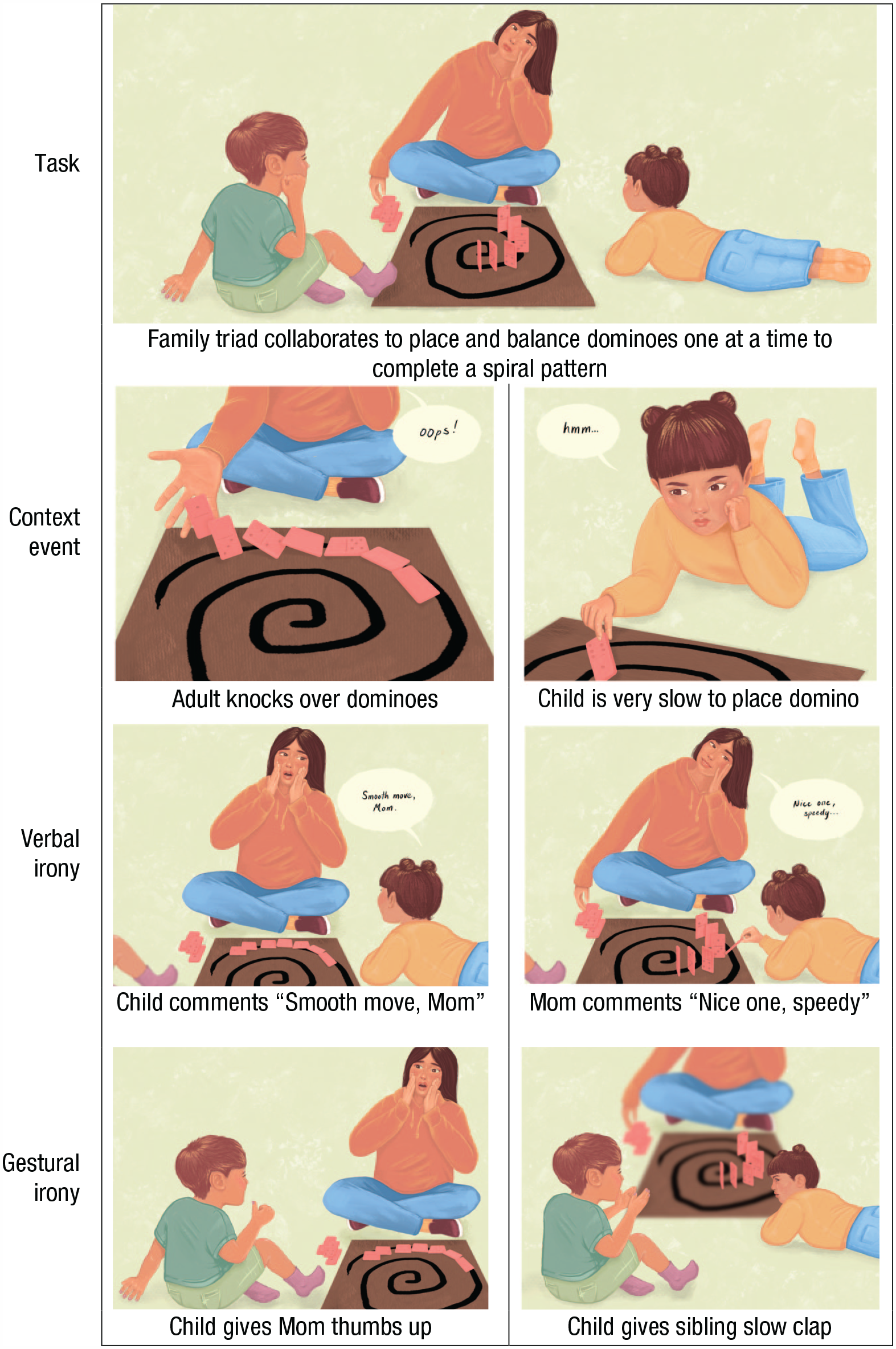
Examples of verbal (middle) and gestural (bottom) irony in a social context (cooperative task of placing dominoes on a spiral pattern in family triads involving one caregiver and two children, top panel). Examples adapted from observations in Pexman et al. (2009).
To summarize, verbal irony relies on cues and occurs in both face-to-face and computer-mediated interpersonal communication. It elicits a complex emotional response, and its understanding is related to both perspective taking and emotion processing. This becomes especially clear from a developmental perspective, where detection and appreciation of irony emerge in distinct steps and in close relation to other social-cognitive skills.
Cognitive Benefits of Irony
A growing body of work demonstrates what some might consider surprising benefits of interacting with verbal irony. Verbal irony offers cognitive benefits for reasoning and creativity, can act as a valve for emotions, and mediates social relationships. In what follows, we shed light on these lesser-known benefits of verbal irony.
Recently, Huang et al. (2015) showed that both generating and responding to an ironic remark catalyzes creativity. They used a simulated conversation task whereby participants read a conversation that included ironic or sincere remarks and were asked to continue the conversation either ironically or sincerely, followed by a task measuring creative thinking whereby participants needed to either solve a problem using innovative solutions (e.g., Duncker candle problem; Duncker, 1945; olive-in-a-glass problem; Appendix D in Huang et al., 2015) or produce words that connected three unrelated words (Remote Associates Test). The authors found that after encountering verbal irony, participants offered more creative solutions. Interestingly, this benefit persisted regardless of whether the conversations involved ironic compliments or ironic criticisms, suggesting that it may be the contradiction irony achieves, not the intention of the remark, that affords benefits to creativity.
Similarly, in Blouin and McKelvie (2012), participants completed an irony detection task together with several measures of creative and divergent thinking. They found a positive relationship between detecting irony and creativity, such that more accurate irony detection was associated with more creativity. There was also a positive relationship between irony detection and postformal thinking (the ability to accept and integrate a variety of truths that are context dependent and may be incompatible). These findings suggest that skills beyond logical thinking, namely, accepting nuance, contradiction, and ambiguity, might be related to irony comprehension skills.
In addition to benefits for creativity and reasoning, researchers have investigated the possibility that irony might act as a valve for emotions. Pfeifer and Lai (2021) investigated the emotional states of ironic speakers in the context of negative events. Participants rated the feelings of a speaker using either literal or ironic language, and ironic speakers were seen as feeling less negative and less aroused than literal speakers. The authors concluded that a speaker’s use of irony suggests more emotional composure and posited that irony might be a verbal form of emotion regulation.
Combining the ideas of irony enhancing creativity and reducing undesirable emotions, Miron-Spektor et al. (2011) tested whether verbal irony might provide a fruitful avenue to manage anger-evoking situations in the workplace. Participants listened to recordings of customer complaints that contained direct, ironic, or no displays of anger. Results showed that when participants listened to customers expressing anger via irony they showed increased creativity and enhanced complex thinking in later tasks and also attenuation of the negative implications of anger. This work suggests that even for the audience, irony can enhance problem-solving ability and illustrates benefits of irony in a professional environment.
Last, the use of irony can indicate interpersonal closeness between speaker and audience. Pexman and Zvaigzne (2004) embedded irony in scenarios where protagonists were either in a close social relationship (e.g., best friends) or not (e.g., salesperson and customer). Participants rated ironic statements within close relationships as funnier, more teasing, and less status changing than those made within distant relationships. The authors concluded that closer relationships encourage irony, and irony allows speakers to highlight relationship closeness. Taking this finding one step further, one could argue that irony has the potential to spark camaraderie and intimacy, a testable hypothesis for future work.
However, not all irony has equivalent effects. In Burgers et al. (2012), participants read mock commentaries on news reports that were either explicitly or implicitly evaluative (e.g., explicitly describing it as “great/a shame” that someone is working for someone vs. implicitly describing that it “apparently works/does not work” for someone) and either contained irony or not. They found that explicit cues made ironic texts easier to comprehend but not more enjoyed, suggesting that one’s appreciation for irony in part depends on its complexity. Specifically, Burgers and colleagues (2012) proposed a u-shaped relationship between complexity and appreciation, with a moderate amount of complexity being ideal for appreciation.
Taken together, this research suggests that in using irony, a speaker provides a cognitive puzzle for the audience to solve, which has the potential, upon successful decoding, to elicit reward and, ultimately, enjoyment. Simultaneously, the process of solving this puzzle can jump-start creativity and divergent thinking, and presenting it may also communicate trust and closeness while building rapport. These rich cognitive and communicative effects shed light on why we use irony despite the risk that it could be misunderstood.
Future Directions: Irony Is More Than a Figure of Speech
Our review highlights a small set of studies in which links of irony to cognition and emotion have been examined. The findings highlight that studying irony solely as a linguistic device might veil the cognitive mechanisms (see Fig. 2) that are engaged when we use it. Future work should more extensively consider effects and outcomes of irony to pin down irony’s unique social-cognitive signature. Specifically, such work should focus on how verbal irony might facilitate (a) related social-cognitive skills, especially in development; (b) creativity and problem-solving; and (c) managing emotions and relationship closeness during interpersonal interactions.
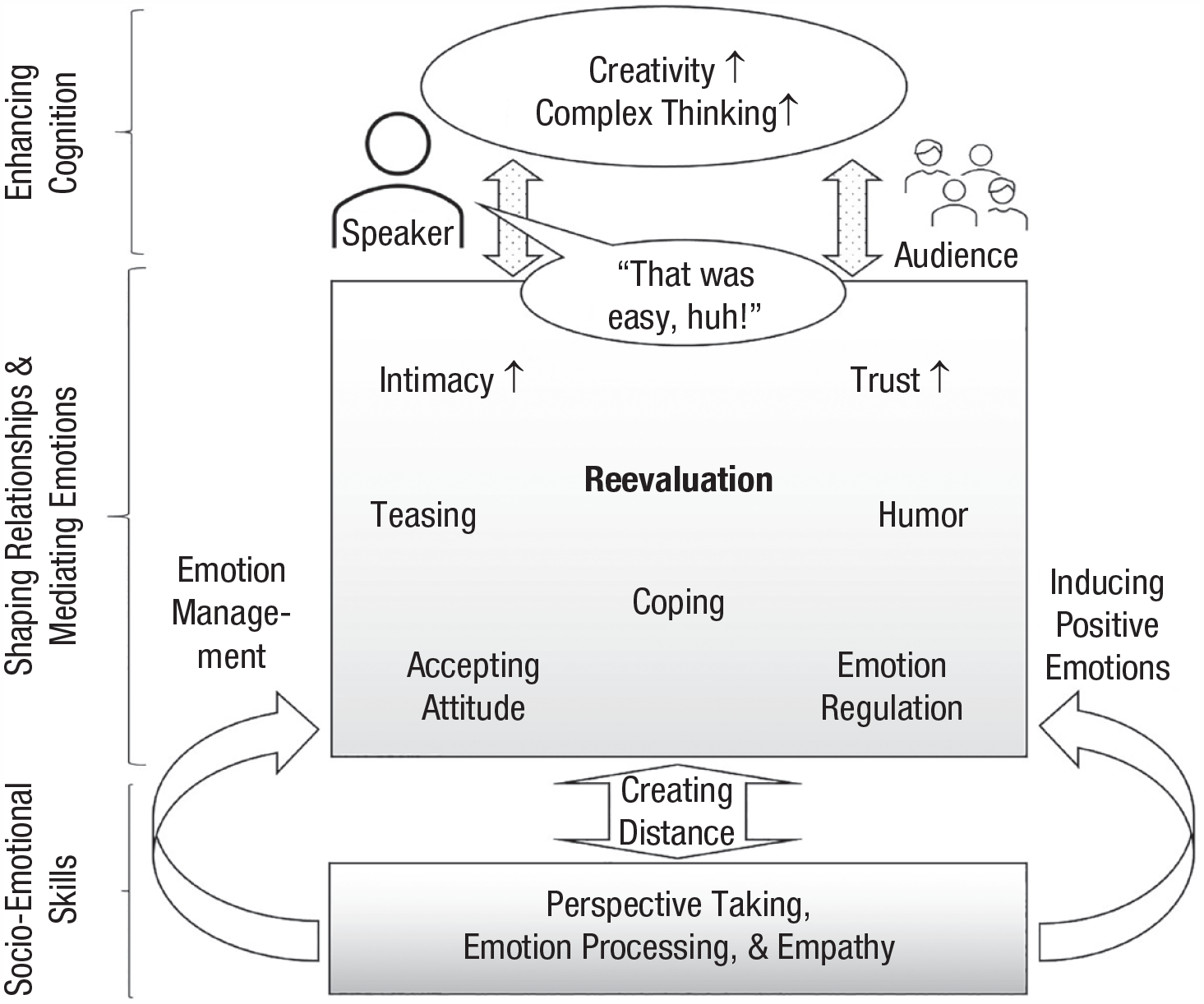
Schematic presentation of socioemotional skills (bottom) that enable irony, possible beneficial effects on relationships and emotions (center), and cognitive benefits of irony (top). Arrows indicate potential mechanisms through which such benefits could be accomplished.
Irony and social-cognitive skills
A promising avenue for future research lies in irony’s potential to facilitate social-cognitive skills. Existing research suggests that skills such as mentalizing or executive function help children to grasp the ironic speaker’s mental state, attitude, and intent. What has not yet been tested is the reverse effect, that in grasping the speaker’s ironic intent, children may, for instance, exercise and refine their mentalizing or executive function skills. Thus, future work could investigate the hypothesis that the relationships between irony and such skills are bidirectional. Additionally, although irony understanding temporally coincides in development with children’s ability to hold simultaneously conflicting beliefs about someone else in mind, a developmental link between appreciating, not just understanding, such beliefs and appreciating irony has not yet been directly tested. Because irony skills allow children to engage fully in everyday conversation and social play, irony training might provide crucial social-cognitive benefits, as initial research has suggested (Lee et al., 2021).
Irony in creative cognition
A second promising avenue is further testing mechanisms through which irony enhances creativity, to identify which aspect of irony (e.g., complexity, novelty) affords the benefits. For example, one could hypothesize that more-complex (or novel or contradicting) irony could afford more-creative benefits (or make them accessible to more individuals). Further, better understanding which type of irony elicits most appreciation could be vital for harnessing its creative benefits while minimizing negative perceptions.
Irony in managing interpersonal communication
A last avenue considers the effects of irony for emotion regulation and in building, maintaining, and indexing social relationships. Irony can allow a speaker to create distance between themselves and an emotional event. Through such distance, emotions of both speaker and audience might be dampened and, subsequently, the risk of escalation reduced (as seen in Kwon et al., 2020). Creating space to reframe and deflate boiling emotions could be an adaptive property of verbal irony to manage emotions in the self and others. By indexing intimacy, irony might also give rise to a more accepting attitude of the speaker. Considering the mechanisms by which irony affects emotions and relationships will provide further insights into how irony is used to mediate and negotiate them. As such, the role of emotion management in the context of social relationships, including the directionality between emotional responses to irony and relationship outcomes, is of key interest.
Conclusions
Verbal irony is pervasive in daily life, has been documented across languages and cultures, and is used during both face-to-face and online communication. We have highlighted promising avenues for future investigation of the psychology of verbal irony. These have the potential to clarify when verbal irony is beneficial and to advance understanding of emotion and cognition.
Recommended Reading
Kałowski, P., Zajączkowska, M., Branowska, K., Olechowska, A., Siemieniuk, A., Dryll, E., & Banasik-Jemielniak, N. (2023). Individual differences in verbal irony use: A systematic review of quantitative psycholinguistic studies. Metaphor and Symbol, 38(1), 81–111. A recent review of individual differences in irony processing, which carefully highlights different cognitive and social aspects in verbal irony research and synthesizes such work for a general audience.
Kreuz, R. (2020). Irony and sarcasm. MIT Press. An accessible, yet in depth exploration of the irony phenomenon in book format. Aptly appeared as part of the “Essential Knowledge” Series at MIT Press.
Pexman, P. (2023). Irony and thought: Developmental insights. In R. W. Gibbs & H. Colston (Eds.), The Cambridge handbook of irony and thought (pp. 181–196). Cambridge University Press. A recent review of developmental research on verbal irony, in a handbook that is further recommended reading.
