




Abstract
Over the past two decades, there has been a significant shift in how dehumanization is conceptualized and studied. This shift has broadened the construct from the blatant denial of humanness to groups to include more subtle dehumanization within people’s interpersonal relationships. In this article, we focus on conceptual and empirical advances in the study of dehumanization in interpersonal relationships, with a particular focus on dehumanizing behaviors. In the first section, we describe the concept of interpersonal dehumanization. In the second section, we review social cognitive and behavioral research into interpersonal dehumanization. Within this section, we place special emphasis on the conceptualization and measurement of dehumanizing behaviors. We then propose a conceptual model of interpersonal dehumanization to guide future research. While doing so, we provide a novel review and integration of cutting-edge research on interpersonal dehumanization.
Dehumanization takes place when people see others as less than fully human. Initially, it was conceptualized as an extreme phenomenon that occurs during major intergroup conflicts (e.g., mass shootings, the Syrian War, the Rwandan genocide). Over the past two decades, however, it has been expanded to encompass more subtle denials of humanness (e.g., Leyens et al., 2000). This broadening has led to the study of dehumanization within interpersonal relationships (Bastian & Haslam, 2011), whereby people may be dehumanized by acquaintances, work colleagues, and even close others, such as parents, romantic partners, and peers. In this article, we focus on the conceptual and empirical advances in the study of dehumanization in interpersonal relationships, which we term interpersonal dehumanization.
Interpersonal Dehumanization
Traditionally, the study of dehumanization has been situated within intergroup processes, and humanness was considered a unidimensional construct (e.g., Leyens et al., 2000). Haslam’s (2006) model of dehumanization, however, suggests that dehumanization can occur along two dimensions. According to this model, people can be denied human uniqueness (i.e., qualities that separate humans from other animals, such as the capacity for morality, intelligence, and culture). This form of dehumanization involves perceiving or treating others as unintelligent, uncivilized, or irrational. People can also be seen as lacking human nature (i.e., the qualities that separate humans from inanimate objects, such as possessing emotions, warmth, and flexibility). The denial of human nature involves perceiving or treating others as if they are unfeeling, cold, and rigid objects, with only instrumental value. Denying human nature to others, a tendency that appears to be widespread (e.g., Haslam et al., 2005), is distinct from, and contributes above and beyond to, feelings of dislike (e.g., Kteily & Landry, 2022), is especially problematic in interpersonal relationships because it disrupts social connection and belongingness (Haslam, 2022) as well as the fulfillment of attachment needs for love, comfort, and security (Karantzas et al., 2022).
Beyond denying another person either or both forms of humanness, the manner in which dehumanization is perpetrated in interpersonal contexts can vary (Haslam, 2006, 2022; Karantzas et al., 2022; Pizzirani et al., 2019). For example, dehumanization can be quite overt, with people explicitly likening others to animals. However, dehumanization can also be subtle, such as dehumanizing another by attributing less human traits to them relative to the self.
Social Cognitive Research Into Interpersonal Dehumanization
To date, the study of interpersonal dehumanization, much like research on intergroup dehumanization, has largely been social cognitive or perceptual in nature. This research has focused on the extent to which people judge others as lacking human traits and emotions, ascribe more human traits to themselves than to others, or attribute animalistic or mechanistic qualities to others (e.g., Rodrigues et al., 2021). Some of this work has also found that people who are maltreated tend to dehumanize themselves (Bastian & Haslam, 2011). Moreover, when perpetrators self-dehumanize, both targets and perpetrators can reclaim their humanness by attributing human traits to the other person (Vaes & Bastian, 2021).
Other work has focused on the nonconscious perception and processing of faces and eye gaze. Across these studies, dehumanization has involved the processing of a person’s face in a piecemeal way (similar to how objects are processed) rather than holistically (e.g., Fincher & Tetlock, 2016) along with the attribution of less human features to those whose faces are perceived as less attractive, intelligent (Alaei et al., 2022), or agentic (Formanowicz et al., 2018). When individuals perceive others as averting eye gaze, they judge them as lacking sophistication (Khalid et al., 2016). The study of dehumanization has also focused on how perceiving others as lacking human qualities shapes employers’ treatment of their subordinates (Väyrynen & Laari-Salmela, 2018) and dampens health care providers’ empathy for their patients (Capozza et al., 2016). There is also work examining the predictors of interpersonal dehumanization. For example, research has found that individuals in a position of high power attribute less human traits to those in positions of low power (Gwinn et al., 2013).
More recent research, however, has expanded the study of interpersonal dehumanization to investigate dehumanizing behaviors. This focus on behaviors, rather than social cognitions and perceptions, has primarily occurred within the context of close relationships—specifically, romantic relationships. Because other reviews have addressed social cognitive research on interpersonal dehumanization extensively (for example, see Kteily & Landry, 2022), we focus here on interpersonal dehumanization behaviors.
Beyond Social Cognition: Dehumanizing Behavior in Close Relationships
The study of dehumanizing behaviors focuses on how they should be conceptualized and measured, their individual difference and contextual predictors, and their links to personal and relational well-being.
Conceptualization and measurement of dehumanization behaviors
Work in this area has centered on the question, “What relational behaviors are dehumanizing?” Karantzas and colleagues have extended Haslam’s (2006) dual model by integrating theory and research from relationship science. Focusing on romantic relationships, they (Karantzas et al., 2022; Pizzirani et al., 2019) claim that many (but not all) negative relationship behaviors reflect the perpetration of dehumanization. For a behavior to be dehumanizing, it must reflect the denial of human nature and/or the denial of human uniqueness. For example, a couple may engage in disagreements regarding financial pressures that involve the raising of voices in anger or frustration. But if their disagreement does not involve denying each other human nature and/or human uniqueness, neither partner has dehumanized the other.
With regard to relationship behaviors that reflect interpersonal dehumanization, empirical work across multiple studies by Pizzirani et al. (2019) on the self-report assessment of interpersonal dehumanization within romantic relationship indicates that denials of human uniqueness and/or human nature entail specific facets that capture related but distinct forms of interpersonal dehumanization. Extending this empirical work, Karantzas and colleagues (2022) suggest that several major negative, destructive relationship behaviors map onto the two denials of human uniqueness (see Fig. 1): treating a partner as if they are (a) unrefined (i.e., lacking sophistication, social intelligence) and (b) immature (i.e., childish, irresponsible, helpless). More specifically, contempt (viewing oneself as superior to a partner; Gottman, 1999) and hostility (acts of ill will that are aggressive, attacking, and spiteful toward a partner; Baron et al., 2007) communicate that the partner lacks sophistication, rationality, and intelligence. Insensitive caregiving (the lack of providing care and support in relationships; Karantzas, 2017) includes behaviors that may appear supportive on the surface but treat the partner as immature or childish. Accordingly, the partner is denied a sense of competency and autonomy and/or is denied attachment needs for love, understanding, and security.
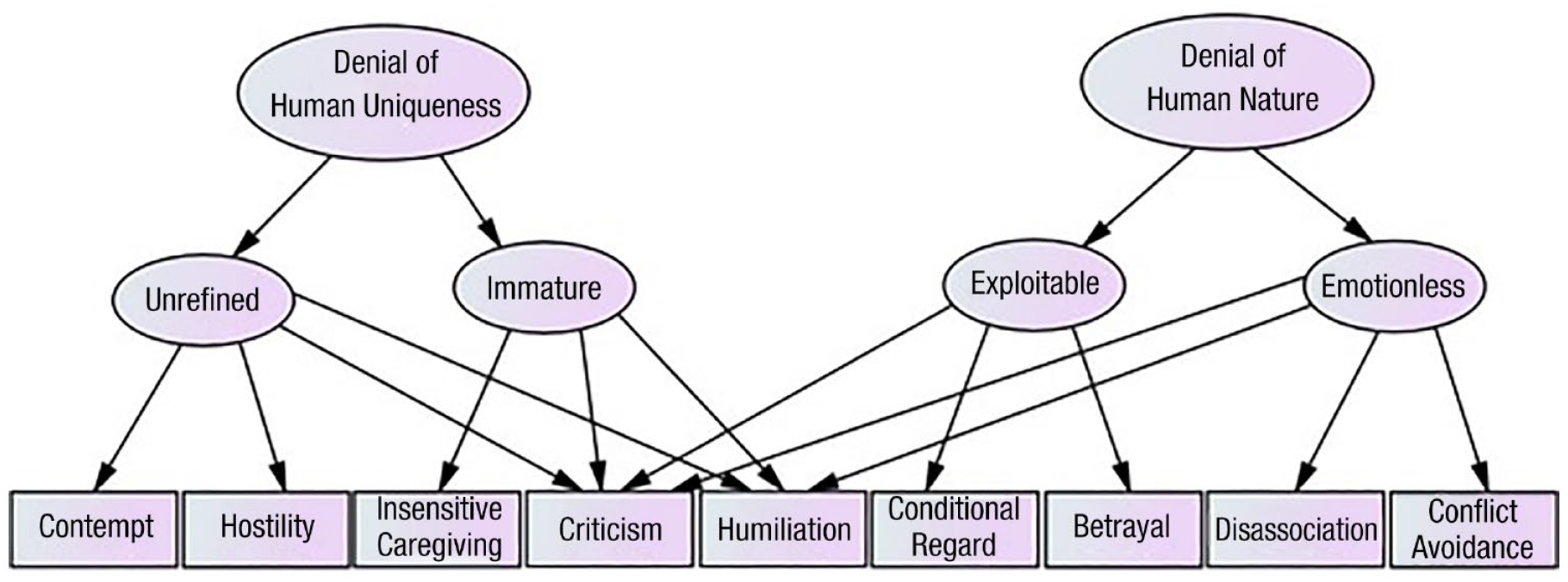
Interpersonal model of dehumanization (Karantzas et al., 2022).
Other relationship behaviors map onto the two facets of human nature denial (see Fig. 1). They include treating a partner as if they are (a) exploitable (i.e., simply a means to an end) and (b) emotionless (i.e., lacking the ability to experience or express emotions). Disassociation (disregarding the existence of a partner through rejection, abandonment, or withholding love; Feeney, 2004) and conflict avoidance (avoiding or withdrawing from discussing important relationship issues via stonewalling; Eldridge & Baucom, 2012) are behaviors that treat a partner as if they do not have emotions. Both types of behaviors also communicate that the perpetrator cannot or will not empathize with the partner or care about their feelings. Betrayal (the violation of relationship norms underlying loyalty and trust, such as infidelity and deception) involves treating a partner as if they are exploitable. It communicates that the partner no longer holds the same value they once did (Fitness, 2001). Conditional regard (Leary et al., 1998) is another form of denying human nature in which a partner is exploited (by taking the partner for granted or treating them as simply a means to an end; Haslam, 2006).
Some behaviors reflect either one of the broad dimensions of dehumanization or the simultaneous enactment of various facets of denying human uniqueness and/or human nature. Two major behaviors are criticism (negative, critical statements about a partner’s behavior, characteristics, or qualities) and humiliation (aggressive humor, mockery, or sarcasm; Gottman, 1999). Whether criticism or humiliation reflects denying human uniqueness (and, therefore, treating a partner as unrefined or immature) and/or human nature (treating a partner as exploitable and/or emotionless) often reflects a couple’s relationship history or specific problems (Karantzas et al., 2022). If, for example, a couple has difficulties managing household responsibilities, criticism or humiliation may focus on a partner’s inability to be responsible in managing household tasks. In this instance, dehumanization most likely reflects facets of denying human uniqueness. In contrast, if a couple is dealing with emotional intimacy problems, criticism or humiliation that targets a partner’s inability to experience or express emotions might reflect the denial of facets of human nature.
Although the behaviors just outlined, which may be common in relationships, can be conceptualized as acts of dehumanization for research purposes because they deny the full humanity of the partner, it is not always appropriate to describe them as such or to refer to someone who performs them as a dehumanizer. However, the more severe, blatant, and repeated the behavior is, the more those labels apply. Recent studies involving both self-report and observational assessments of dehumanization in romantic relationships have shown that both the frequency and severity of behavior are important aspects of determining the level of perpetration of interpersonal dehumanization (Knox et al., 2022; Pizzirani et al., 2019, 2021).
Predictors and outcomes of interpersonal dehumanization behaviors
Several recent empirical studies have examined the predictors and outcomes of interpersonal dehumanization behaviors. Regarding the association between the predictors of dehumanization and its enactment, this research has discovered various contemporaneous and developmental predictors of dehumanization. One contemporaneous predictor is attachment insecurity, which is associated with greater maltreatment of relationship partners involving the denial of human qualities (Knox et al., 2022; Morera et al., 2022,). Indeed, Knox et al. (2022) found that perpetration of maltreatment (which includes coercion, manipulation, and dehumanization) is associated with the attachment insecurity of both the perpetrator and their partner. Another factor is negative traits such as the dark triad (Bastian, 2019). Research has found that those who score higher on dark-triad traits engage in more dehumanization behaviors, such as contempt, criticism, and stonewalling (Horan et al., 2015). Trait self-regulation appears to be another important individual difference factor, with those who report lower self-regulation enacting more dehumanizing behaviors, such as hostility, toward their partners (Klein et al., 2016).
An important contemporaneous contextual factor is the extent to which partners engage in dehumanization with each other. Pizzirani and colleagues (2021), for example, found that dehumanization by one partner is one of the strongest predictors of dehumanization perpetrated by the other partner during an observed conflict discussion task. Research into interpersonal dehumanization more broadly has also discovered that people who view others as lacking human qualities have a greater tendency to enact dehumanizing behaviors. The likely reason for this is that perpetrators who perceive others as less than human are less likely to experience empathic distress or guilt and less likely to condemn themselves for engaging in dehumanizing acts (Haslam & Loughnan, 2014). Beyond these contemporaneous predictors of dehumanization, recent research has also investigated the developmental origins of dehumanization. In a recent prospective study, Pizzirani and colleagues (2021) found that observer ratings of maternal hostility in infancy and early childhood forecast perpetration of dehumanization observed in romantic-couple interactions 20 to 30 years later.
Research on the association between dehumanization and relational and personal well-being in relationships reveals a host of negative outcomes. For example, a dyadic study by Mahar and colleagues (2020) found that individuals who dehumanize their partners by objectifying them have lower relationship satisfaction and commitment. Other research has found that both perpetrators and targets of dehumanization report both lower relationship quality (Pizzirani et al., 2019) and the use of destructive communication tactics with their partners (e.g., Horan et al., 2015; Pizzirani et al., 2019). Those who perpetrate interpersonal dehumanization also act in a more insensitive manner when meeting their partner’s socioemotional needs (Pizzirani et al., 2019). Finally, those who perpetrate dehumanization are at greater risk of perpetrating both physical and emotional abuse (Pizzirani et al., 2019; Pizzirani & Karantzas, 2019) and dating or sexual violence (e.g., Morera et al., 2022).
People who are the target of dehumanization also experience a raft of negative personal outcomes. These include greater negative affect (e.g., shame, guilt, sadness, anger, hurt), depressive symptoms (Pizzirani et al., 2019), emotional numbing (Bastian & Haslam, 2011; Brock et al., 2021), negative self-appraisals (e.g., viewing the self as machine-like), and the inability to think clearly (Bastian & Haslam, 2011; Brock et al., 2021).
Interpersonal Dehumanization Behavior: Beyond Close Relationships?
Although the research into interpersonal dehumanization behavior has focused mainly on romantic relationships, these behaviors are also witnessed across other types of interpersonal relationships, including close relationships with family members and friends, and in other relational contexts, such as in the workplace, medical settings, or sporting contexts. In one of the few studies of interpersonal dehumanization outside the context of close relationships, thematic analysis of employee exit-interview transcripts found that managers’ disregard of staff worries and concerns as well as the treatment of them as a “means to an end” revealed the denial of both human nature and human uniqueness (Vayrynen & Laari-Salmela, 2018).
We contend, however, that the impact of dehumanization behaviors should be most significant in close relationships because of the attachment bonds that exist between romantic partners, parents and their children (both early and later in life), siblings, and close friends. Relationships with attachment figures serve specific purposes or functions, two of them being safe haven (love and comfort in times of distress) and secure base (a strong base from which to take on life’s challenges and explore the broader world; e.g., Gillath et al., 2016). In regard to linking the types of dehumanization to attachment functions, the denial of human nature can impede an attachment figure from serving as a safe haven, whereas the denial of human uniqueness can impede an attachment figure from functioning as a secure base. Thus, when individuals engage in acts of dehumanization, they fail to fulfill these key attachment functions, significantly thwarting a person’s felt security.
Another important factor to consider when considering dehumanization behaviors within close relationships is the degree of interdependence between partners. According to interdependence theory (e.g., Kelley et al., 1983), the outcomes of each dyad member depends on the characteristics that a person (P) brings to the relationship, the characteristics that the other (O) brings to the relationship, and the interaction between the characteristics of each individual (P × O). 1 Thus, how each dyad member’s characteristics affect their own as well as the other person’s propensity to perpetrate dehumanization—or be the target of it—offers deeper insights into the relational conditions that govern when dehumanization is and is not likely to occur.
Bringing It Together: A Conceptual Model of Interpersonal Dehumanization
To bring the existing theoretical and empirical literature together, we propose a new conceptual dyadic model of dehumanization in interpersonal relationships, one that is situated within an interdependence theory framework (Kelley et al., 1983). As illustrated in Figure 2, we suggest that a core set of personal characteristics that have received some empirical support to date—attachment insecurity (higher levels of attachment anxiety and/or avoidance), dark traits (e.g., narcissism, psychopathy, Machiavellianism, aggression), exposure to dehumanization earlier in life, and self-regulation difficulties in relationships—not only heightens a person’s tendency to perpetrate dehumanization but also increases their risk of becoming a target of dehumanization. Furthermore, individuals who harbor one or more of the negative personal characteristics outlined in Figure 2 should be more likely to trigger the perpetration of dehumanization by their partners. Two important areas for future research are to strengthen the current empirical evidence regarding the personal characteristics outlined earlier and to explore how differences in partner characteristics are associated with dehumanization experiences within relationships.
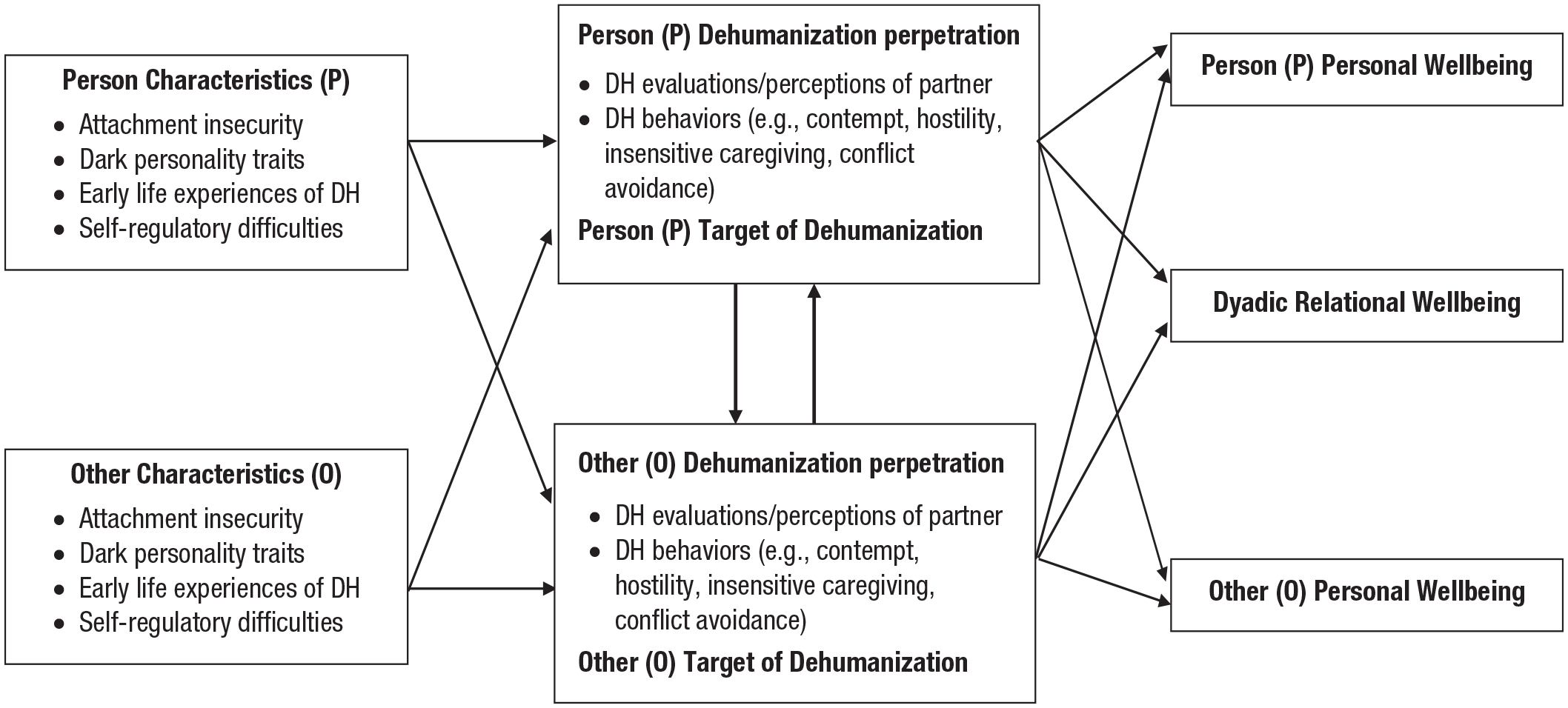
A dyadic model of dehumanization. DH = dehumanization.
Figure 2 also illustrates that being the perpetrator or target of dehumanization may reside in certain relationship dynamics, whereby a person’s response to being the target of dehumanization might be to perpetrate dehumanization against the other partner, sometimes in a preemptive fashion. This phenomenon mirrors the processes of meta-dehumanization and reciprocal dehumanization observed in research on intergroup dehumanization (Kteily et al., 2016). In such instances, both partners are the target and perpetrator of dehumanization. This dynamic shares much in common with a widely studied communication pattern termed “negative hostility” (Gottman, 1999). Future research into dehumanization behavior dynamics is especially important given that dyadic observational studies of the dehumanizing behaviors of couples is limited.
Finally, drawing on the evidence surrounding interpersonal dehumanization and outcomes, Figure 2 illustrates that a person’s experiences of being the perpetrator or target of dehumanization also has consequences for their personal well-being (e.g., negative self-perceptions, emotional well-being) as well as their partner’s (other) well-being and the couple’s relational well-being (e.g., relationship satisfaction and stability). Important areas for future research include the extent to which dehumanization forecasts the longitudinal course of personal and relationship well-being. For example, are the effects of dehumanization felt beyond the immediate moment when they occur, and if so, what do the trajectories look like for personal and relational well-being? Furthermore, future research should also investigate whether denials of human nature are associated with more negative relationship outcomes than denials of human uniqueness. It has been assumed that denials of human nature are more likely to thwart social connection and human bonding than denials of human uniqueness (Haslam, 2022; Karantzas et al., 2022), yet this remains a conjecture.
Future research could also attempt to determine the causal associations implied by our model in Figure 2. For instance, research could try to establish the causal associations between (a) individual difference factors as well as contextual factors and the perpetration of interpersonal dehumanization and (b) interpersonal dehumanization and personal and relational well-being. It would also be important to determine the extent to which our model can be applied to different types of relationships. Do, for example, the central tenets of our model apply also to workplace relations, athlete-coach relations, and patient-doctor relations, to name but a few examples? Although we have not provided an exhaustive list of future research directions, the areas we have outlined provide an initial road map for some of the major areas that, if studied, would significantly advance our understanding of interpersonal dehumanization.
Conclusion
This review shines a spotlight on interpersonal dehumanization, with a specific emphasis on dehumanizing behaviors. Our review highlights that interpersonal dehumanization is a rapidly expanding and innovative field of research. It provides a clearer understanding of the current and emerging directions of research investigating how even subtle forms of negative behavior may, at times, thwart social connection and human bonding. It also provides a theoretical platform for scholars to launch new streams of research on interpersonal dehumanization processes and outcomes.
Recommended Reading
Bastian, B., & Haslam, N. (2011). (See References). One of the first empirical papers on interpersonal dehumanization that elucidated its cognitive and emotional consequences.
Kteily, N. S., & Landry, A. P. (2022). (See References). An authoritative and comprehensive review of the conceptualization of, measurement of, and research into dehumanization.
Karantzas, G. C., Simpson, J. A., & Pizzirani, B. (2022). (See References). As part of a special issue on social isolation, separation, and loss, a review of the interpersonal dehumanization literature as it relates to experiencing loss and disconnection.
Pizzirani, B., Karantzas, G. C., Roisman, G. I., & Simpson, J. A. (2021). (See References). A landmark investigation into the developmental origins of dehumanization in close relationships using the prospective Minnesota Longitudinal Study of Risk and Adaptation data set.
