



Abstract
Social anxiety disorder (SAD) is a highly prevalent and disabling disorder characterized by intrapersonal (self-related) and interpersonal (interaction-related) difficulties. We use the biobehavioral systems of affiliation and status as linchpins connecting intrapersonal and interpersonal bodies of knowledge to frame such difficulties. We suggest that the mismatch in self- and other perceptions contributes to misalignments in interaction patterns, such as reduced alignment (similarity-based complementarity or reciprocity) in affiliative contexts and enhanced alignment (contrastive complementarity) in status-related contexts. Such misaligned interaction patterns affect, in turn, self- and other perceptions of the interacting partners. In SAD, biased intrapersonal constructs and processes contribute to misaligned interpersonal dynamics, which in turn impact intrapersonal constructs, creating a vicious cycle. Future research should seek to combine individual-level and interaction-level data in affiliative and status-based contexts to enhance the understanding and treatment of SAD.
Three people are asked to toast their friend at her wedding. The first feels slightly anxious but also excited at the opportunity. The second is somewhat concerned with the way she will come across and experiences some apprehension. The third, an individual with social anxiety disorder (SAD), is terrified by the prospect of appearing incompetent and pathetic. For him, even everyday interactions, like chatting over lunch with an acquaintance or asking a question in a work meeting, seem daunting and consequential. Indeed, SAD is conceptualized as a condition in which individuals feel negatively evaluated by others and fear acting in ways that will be humiliating or embarrassing or will lead to rejection (American Psychiatric Association, 2022).
Clinical levels of SAD are associated with adverse intrapersonal (distress, low positive affect, and low self-esteem) and interpersonal (reduced quantity and quality of interpersonal relationships, lower professional advancement) outcomes (Aderka et al., 2012). Social anxiety (SA) ranges in severity, and even below-diagnostic levels are associated with reduced well-being and lower intimacy across relationships (Weisman et al., 2011). The clinical profile of SAD is marked by early onset and high comorbidity with major depressive disorder (J. D. Huppert, 2009). Several interventions have been found to be effective in the treatment of SAD, yet many patients leave therapy before completion, fail to exhibit clinically significant symptom reduction, or relapse after the end of treatment (Mayo-Wilson et al., 2014). Given the prominence of self-related and relationship-related difficulties in SA, a theoretical integration of intrapersonal and interpersonal approaches appears especially promising in creating a more complete model of SAD and thus advancing treatment (Ginat-Frolich et al., 2023).
In the present review, we propose that the systems of affiliation (a.k.a. communion, warmth) and status (a.k.a. agency, dominance, rank) provide an organizing framework for the dynamic and reciprocal relationship between intrapersonal constructs and processes (self- and other views, emotions, motivations; Clark & Wells, 1995) and interpersonal dynamics (Alden & Taylor, 2010). These systems are thought to affect the functioning of intrapersonal processes and direct interpersonal patterns and strategies (Anderson et al., 2015; Baumeister & Leary, 1995; Mahadevan et al., 2016; Williams, 2007). In the following, we describe the two systems and present the basic postulates of intrapersonal and interpersonal approaches. Next, we review research on the ways SA affects intrapersonal and interpersonal functioning in status and affiliation domains. The dimensions of status and affiliation are thought to underlie both intrapersonal representations and interpersonal behaviors. Figure 1 graphically presents our model of the ways in which intrapersonal representations and interpersonal interactions combine to reciprocally contribute to the vicious cycle of SAD. We conclude with future research directions, highlighting our approach’s potential benefits.
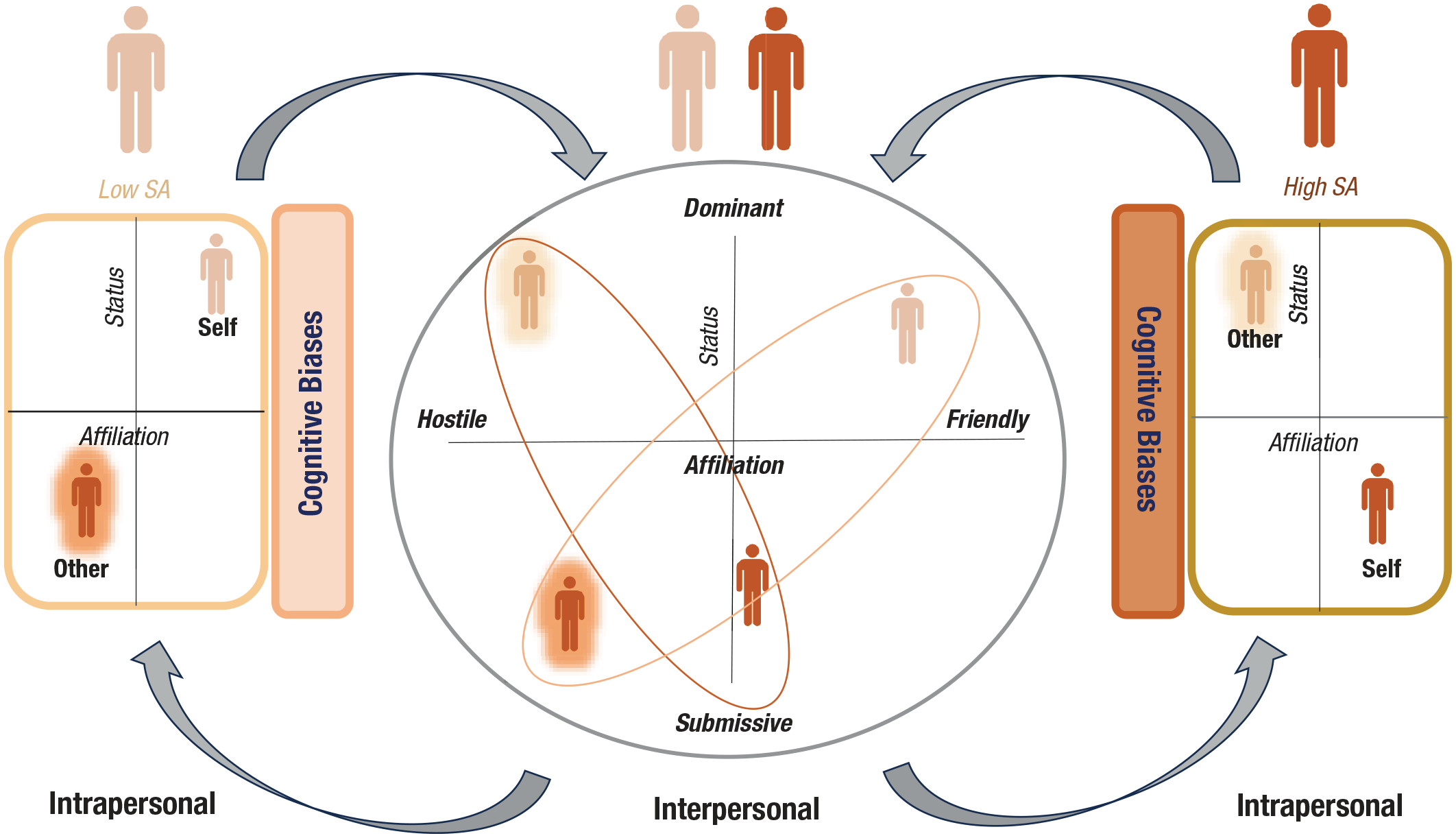
Ways intrapersonal representations and interpersonal interactions reciprocally contribute to the vicious cycle of social anxiety disorder.
Affiliation and Status: Biobehavioral Systems Integrating Intra- and Interpersonal Approaches
Humans are characterized by lifelong motivations to satisfy the basic social needs for affiliation and status (Anderson et al., 2015; Williams, 2007). Group living confers significant evolutionary advantages, compelling members to rely on social support. Such pressures are believed to lead to the formation of two central biobehavioral systems of affiliation and status (Anderson et al., 2015; Baumeister & Leary, 1995). A biobehavioral social system may be conceptualized as a set of mechanisms with a common functional theme acting as a coordinated set of neural, hormonal, cognitive, motivational, and behavioral processes (Feldman, 2017; Sapolsky, 2005). The affiliative system continuously monitors for inclusionary status and uses this information to guide behavior (Baumeister & Leary, 1995). The system is sensitive to changes in inclusion, as indicated by discrete cues (e.g., gaze aversion) and complex events (e.g., ostracism; Williams, 2007). An important consequence of group living is the need to compete with group members for vital resources (Anderson et al., 2015). The status system monitors the relative social standing of group members and uses this information to guide behavior (Mahadevan et al., 2016; Sapolsky, 2005). This system is sensitive to cues connoting changes in social position. Suffering a loss to one’s reputation through public criticism, failure in a competition, or failure to display expected knowledge or skills is experienced as a social defeat (Azoulay & Gilboa-Schechtman, 2022). These systems map onto two prominent challenges in people’s lives, colloquially known as “getting along”—maintaining and fostering affiliative social connections and intimate bonds—and “getting ahead”—gaining and maintaining social status, reputation, and prestige.
The functioning of these two systems is reflected in our intrapersonal representations and in the conceptualization of the gamut of interpersonal interactions and behaviors (see Fig. 1). In the intrapersonal sphere, descriptions of self and others abide by the dimensions of affiliation and status (Abele & Wojciszke, 2007). Individuals tend to describe themselves—and others—as “points” in the two-dimensional space spanned by the horizontal dimension of affiliation and the vertical dimension of status. The interpersonal circumplex is a prominent model for interpersonal interactions (Wiggins, 1979). The circumplex is also conceptualized as two orthogonal axes of affiliation and status. Moreover, an interaction—a “dance” between two or more individuals—is thought to occur in a space spanned by these dimensions. Interpersonal behavior can be conceptualized as “blends” of affiliative and status components. Individuals continuously influence each other, such that one’s behaviors are consistently adjusted by the intentional or unintentional actions of the other person (Pincus & Hopwood, 2012). One of the central assumptions of the interpersonal model is that behaviors elicit or invite aligned (complementary) behaviors. Importantly, the nature of alignment differs depending on the interpersonal dimensions: Affiliative behaviors typically elicit reactions that are reciprocal or similar (e.g., friendly behaviors tend to invite friendly responses, and hostile behaviors tend to invite hostile responses). Status behaviors tend to elicit reactions that are contrastive (e.g., dominant behaviors tend to invite submissive responses, and submissive behaviors tend to invite dominant responses).
Intrapersonal and Interpersonal Approaches to Social Anxiety
Intrapersonal models focus on the ways individuals think and feel about themselves and respond to the actions of others. Cognitive models of psychopathology are the primary examples of intrapersonal conceptualization of such conditions (Beck & Haigh, 2014). According to these models, individuals with SAD are seen as driven by a motivation to make a good impression while simultaneously doubting their ability to achieve this aim (Clark & Wells, 1995). This doubt is thought to be rooted in negative self-representations as well as the perceptions of others as overly critical. Representations of self and others are postulated to be used as a prism in processing incoming information (Beck & Haigh, 2014). According to both theory and empirical studies, biases in information processes contribute to the maintenance of SAD (Ginat-Frolich et al., 2023).
Interpersonal models emphasize individuals’ active role in forming and unfolding their dyadic and group interactions (Pincus & Hopwood, 2012). In contrast to intrapersonal theories, which focus on the ways individuals shape their internal world and are shaped by external events, interpersonal theories highlight the impact of an individual on selecting which interactions to have and how to have them (the form of the social dance). Problems in interpersonal relationships may occur when individuals fail to perceive themselves and/or others accurately (mismatch in others’ perceptions of the self or the self’s perception of others) and when aspects of their interpersonal strategies are misaligned, that is, when the social dance is disrupted (Pincus & Hopwood, 2012).
Interpersonal problems appear, however, to be specific to the type of social domain. For example, it is possible for a person to overestimate the status of others. Such perceptions may lead to overcomplementary behaviors (in this case, submissiveness). This overcomplementarity may, in turn, lead others to perceive this person as nonassertive, further inviting dominant advances. The same person may underestimate the friendliness of others. Again, such perceptions may lead to reduced complementarity, in this case, reduced reciprocity of friendly advances (Alden & Taylor, 2010). This lack of affiliative reciprocity may, in turn, lead others to perceive a person as less friendly, further disrupting affiliative interaction dynamics. Importantly, patterns of interactions feed not only into our perceptions of others but also into our self-representations and motivational states. Indeed, affiliative social interactions are associated with positive changes in self-representations, enhanced positive mood, reduced self-relevant processing, and motivation to strengthen the evolving relationship (Miles et al., 2010). Similarly, being in a position of power tends to activate dominant aspects of self-representation (Chen, 2020).
Status System in Social Anxiety
Intrapersonal approach
SA is associated with enhanced availability of and sensitivity to status-related information. First, self-representations in SA typically include traits and behaviors indicative of a lack of dominance, prestige, and deficiencies in social skills (Gilboa-Schechtman et al., 2017). Moreover, SA is also associated with diminished motivations to achieve high status and enhanced motivations to avoid low status (Blay et al., 2021). Second, research suggests that individuals with high SA tend to see their peers as dominant and critical more than these peers see themselves (Zabag et al., 2018; see mismatch on the dominance dimension in Fig. 1). Third, SA is associated with enhanced attention to and biased interpretation of status-related stimuli (e.g., dominant facial expressions; Ginat-Frolich et al., 2023). Fourth, SA is associated with an enhanced and more protracted experience of negative emotions related to diminished social status (shame, anger, humiliation; Azoulay & Gilboa-Schechtman, 2022; Rozen & Aderka, 2023) and reduced experience of positive emotions related to enhanced social status (pride; Cohen & Huppert, 2018).
Interpersonal approach
SA is associated with submissive responses to dominance cues and challenges in status-based interactions. First, men with high SA demonstrated more submissive behaviors when competing for female attention (Weeks et al., 2011). Second, individuals with high SA (especially men) exhibited an enhanced negative response to loss-of-status events (Azoulay & Gilboa-Schechtman, 2022). Indeed, in individuals with high SA (especially men), loss of status appears to be associated with reduced efforts to regain lost ground (Gilboa-Schechtman et al., 2014). Finally, although only a few studies examined contrastive complementarity in status-related contexts in SA, individuals with high SA appear to exhibit enhanced complementarity in competitive contexts (i.e., increased submissiveness; Weeks et al., 2011). Submissive behaviors may, in turn, affect one’s self-representation (Chen, 2020).
These data suggest that individuals with high SA are characterized by an overactive status system marked by enhanced sensitivity and reactivity to cues of high social status, which may contribute to the vicious cycle of SA maintenance (Gilbert & Trower, 2001). Specifically, the evaluation of the self as weak and powerless may lead to increased vigilance for, and biased interpretation of, signals of dominance; perceptions of others as dominant lead to enhanced status complementarity, which in such cases is manifested as submissive behavior; these behaviors may, in turn, deepen the perceptions of the self as deficient and others as dominant (see gray arrows in Fig. 1).
Affiliation System in Social Anxiety
Intrapersonal approach
Individuals with high SA describe themselves as friendly and warm, attesting to their positive self-representation in the affiliation domain (Gilboa-Schechtman et al., 2017). With respect to the representations of others, individuals with high SA compared with individuals with low SA tend to perceive unfamiliar and close others as less warm (Shin & Newman, 2019; Zabag et al., 2018). Interestingly, SA is associated with diminished motivations for affiliation and enhanced motivations to avoid affiliation loss (Blay et al., 2021) and with the enhanced experience of negative emotions related to lack of affiliation (loneliness; Rozen & Aderka, 2023). Moreover, individuals with high SA exhibit a more intense, less self-regulated, and protracted response to exclusion and rejection experiences than individuals with low SA (see Gilboa-Schechtman et al., 2014). Individuals with high SA also evidence an avoidant response pattern to exclusion, withdrawing from, rather than pursuing, affiliative opportunities. Last, SA is associated with reduced attention to and biased interpretation of affiliation-related stimuli (e.g., smiles; Ginat-Frolich et al., 2023).
Interpersonal approach
In affiliative interactions, SA is associated with fewer expressions of warmth and more negative reactions to expressions of affiliation (Fernandez et al., 2020). These behaviors may hinder the development of close relationships in SA and contribute to felt—and actual—exclusion. In addition, SA is found to be associated with reduced interpersonal similarity in affiliative contexts: Individuals with high SA exhibit less verbal as well as nonverbal joint actions, motion synchrony, physiological synchrony, and smiling reciprocity with their partners than do individuals with low SA (Asher et al., 2020). Indeed, interaction partners of individuals with high SA see these exchanges as less coordinated and less enjoyable than partners of individuals with low SA (Heerey & Kring, 2007). In intimate romantic relationships, individuals with high SA tend to view themselves as warm but may be perceived by their romantic partners as aloof (Tonge et al., 2020). Thus, individuals with high SA may see themselves as friendly yet timid while coming across as aloof and standoffish (see mismatch on the affiliation dimension in Fig. 1).
In sum, individuals with high SA appear to be characterized by an underactive affiliation system marked by reduced sensitivity to cues of warmth (but not of hostility) and disruptions in interpersonal dynamics (Gilbert & Trower, 2001). Again, the reciprocal relationships between internal representations of self and other’s affiliative qualities and interpersonal dynamics may contribute to the maintenance of SA. Specifically, the evaluation of others as unfriendly and critical may reduce sensitivity to signals of friendliness and acceptance; perceptions of others as cold or even hostile dynamically and reciprocally reduce affiliative behaviors; these behaviors further reduce the reciprocity and warmth of the interaction, which, in turn, may deepen the perceptions of others as unfriendly (see Fig. 1).
Vicious Circle of SA’s Maintenance: Reciprocal Influence of Intrapersonal and Interpersonal Factors
The reciprocal relationships between internal representations of the self and others and interpersonal dynamics may contribute to the vicious cycle of SA maintenance. Specifically, a mismatch in perceptions of self and others affects the way interpersonal cues are interpreted and guide the ensuing interaction, creating a misaligned dynamic pattern. In SA, the perception of the (unfamiliar) other as dominant, the oversensitivity to cues of dominance, and the undersensitivity to cues of warmth and friendliness may be taken as an “invitation” to status-related (rather than affiliation-related) interpersonal dance (Gilbert & Trower, 2001). Given an alignment inherent in the dynamic unfolding of status-related interactions, individuals with high SA may assume a submissive role, and individuals with low SA may assume the (complementary) dominant role. Inferiority perceptions combined with submissive dynamics may lead individuals with high SA to experience enhanced embarrassment or shame, decreased enjoyment and authenticity, and an impaired sense of “shared reality.” These emotions direct and moderate interpersonal exchange, negatively affecting affiliative reciprocity (Saporta et al., 2023). The alignment inherent in the dynamic and reciprocal unfolding of interpersonal interaction (Gallotti et al., 2017) may enhance the representations of the self as weak and deficient and of the other as dominant and cold. Thus, interpersonal dynamic patterns may create a context in which the initial beliefs of individuals with high SA about self and others are strengthened rather than modified, contributing to the persistence of SA-related distress.
An enhanced link between status and affiliation in SA may further intensify this vicious cycle. Individuals with high SA appear to be more inclined than those with low SA to interpret low affiliation (exclusion) signals as connoting loss of status (Gilboa-Schechtman et al., 2014). Thus, individuals with high SA engaged in interactions marked by low affiliation may feel not only disliked but also unappreciated. These biased interpretations may, in turn, lead to enhanced submissiveness, lowering self-esteem, engendering feelings of embarrassment and shame, and further deepening the negativity of status-related self-representation.
In addition, individuals with high SA have difficulty positively updating their perceptions of self and others (Zabag et al., 2022). In doing so, they may fail to transition from this social cautiousness, advantageous in unstable hierarchies, to social exploration, advantageous in benevolent and cohesive social groups. These rigid (mis)perceptions may prevent individuals from adaptively modifying their views and engaging in more flexible and reciprocal interactions. Individuals with high SA may thus continue to fear rejection and put-downs even within groups that accept and value them, negatively impacting the development and maintenance of in-group relationships.
Future Directions
Despite the advances in understanding SAD under the theoretical guidance of both the intrapersonal and interpersonal approaches, there are several important gaps in existing conceptualization and knowledge. First, examining intrapersonal and interpersonal variables within a single study may help tighten our understanding of the interplay between self- and other representations and interaction-related difficulties in SAD. Specifically, exploring the impact of an interaction in which an individual with high SA assumes a dominant role on self-representation may enhance our understanding of the ways in which self-representations are modified and SA is ameliorated. Indeed, although we are expanding our understanding of the ways in which affiliative complementarity impacts self- and other representations through the processes of synchrony, such data are mostly missing with respect to competitive and hierarchical contexts. Second, research suggests that SA is characterized by a considerable heterogeneity of interpersonal styles (Cooper & Anderson, 2019). Exploring the ways in which these distinct styles interact with intrapersonal representations is important for understanding the full gamut of SA-related patterns. Relatedly, alignment patterns of individuals with high SA are expected to differ on the basis of the relationship with the interaction partner (stranger, close other, authority figure) as well as on the actual actions of that partner. Understanding the way SA affects the range and flexibility of such patterns may direct intervention efforts. Third, enhancing the knowledge regarding the linkage between affiliation and the status systems across developmental phases (childhood, adolescence, adulthood) may contribute to a better understanding of the clinical trajectory of SAD. SAD is characterized by adolescence onset, and peer relationships are highly central at this developmental stage. The ability to disentangle loss of affiliation from loss of status during this stage may be significant for the alleviation or exacerbation of SA-related distress. Enhancing such ability may guide prevention efforts. Fourth, in many encounters with peers and colleagues, we switch back and forth between affiliative and status-related interactions (e.g., receiving instructions from our boss regarding work tasks and then discussing with her our weekend plans). This flexibility appears central to competent social functioning and may be particularly impaired in SA (Gilbert & Trower, 2001). Developing paradigms to assess and enhance this flexibility may improve social functioning in SA. Finally, the literature on psychopathology and intervention in SA remains mostly disjointed (J. Huppert et al., 2023). For example, understanding responses among individuals with SAD to various interpersonal styles in friendships and in romantic contexts (typically the realm of personality and psychopathology research) is rarely integrated with the understanding of the effects of therapists’ interpersonal style (the realm of intervention research) in the treatment of clients with SAD. However, such integration may enhance therapeutic attunement, speed up clients’ bonding, enhance authenticity and compliance, and reduce SA-related distress.
Coda
We function in the social world seeking to satisfy several—sometimes conflicting—fundamental interpersonal needs and motives, most centrally the need to belong (being loved, cared for—affiliation) and the need to matter (being noticed, feeling important—status). Satisfaction of affiliative needs bolsters social bonds, and satisfaction of our need to matter enhances our sense of agency and competence. Analogously, the frustration of these motivations leads, respectively, to loneliness and shame, impacting the ways we see ourselves and others. We have argued that intrapersonal constructs and processes (self- and other views, emotions, motivations) impact interpersonal dynamics, which in turn impact self- and other views. A greater understanding of these cycles of influence could turn the vicious cycle of avoidance and distress observed in SA into a virtuous cycle of social flourishing.
Recommended Reading
Anderson, C., Hildreth, J. A. D., & Howland, L. (2015). (See References). Discusses the fundamental role of the status system in interpersonal functioning.
Baumeister, R. F., & Leary, M. R. (1995). (See References). Presents a model of the functioning of the belongingness/affiliation system.
Clark, D. M., & Wells, A. (1995). (See References). Presents a cognitive model of social anxiety, emphasizing self-representation and the functioning of cognitive biases.
Gilbert, P., & Trower, P. (2001). (See References). Presents an evolutionary theory of social anxiety, highlighting the functioning of the affiliation and the status system in this disorder.
Shin, K. E., & Newman, M. G. (2019). (See References). Examines the mismatch in the perceptions of self and others in social anxiety.
