



Abstract
Why are some fields and occupations more diverse than others? In this review, we describe a conceptual framework—the field-specific ability beliefs (FAB) model—that provides a promising answer to this question. This model proposes that gender and racial/ethnic imbalances in a field or occupation result in part from the confluence of two beliefs: (a) the belief that success in that context requires high levels of intellectual ability (“brilliance”) and (b) the cultural stereotype that associates intellectual ability with (White) men more than other groups. We describe the FAB model and detail evidence for it, including evidence that the beliefs at its core are present even among children. We conclude by highlighting open questions.
Fields and occupations vary considerably in the extent to which they reflect the demographic diversity of the broader population. To date, most research investigating this variability has focused on understanding the obstacles to the participation of women and racial/ethnic minorities in a subset of fields—those in science, technology, engineering, and mathematics (STEM; e.g., Ceci et al., 2009). However, STEM fields vary with respect to their (lack of) diversity (Cheryan et al., 2017), and women and racial/ethnic minorities are underrepresented in some fields outside of STEM as well. Considering 2020 PhD recipients from the United States, for instance, we see that individuals who identified as women or Black received substantially more PhDs in biology (53.8% and 4.4%, respectively), a STEM field, than in philosophy (27.4% and 2.7%, respectively), a humanities field (National Center for Science and Engineering Statistics, 2021). How might we explain this more complex pattern of gender and racial/ethnic participation across fields?
Here, we summarize recent work that identified a particular belief—the belief that success depends on (high levels of) intellectual ability or “brilliance” 1 —as a powerful obstacle to gender and racial/ethnic diversity across fields. Fields in and outside of STEM where this belief is common—thereby assigning value to a quality that women and some racial/ethnic groups are stereotyped as lacking (e.g., Bian et al., 2017; Zhao et al., 2022)—have larger gender and racial/ethnic gaps in representation (Cimpian & Leslie, 2015; Leslie et al., 2015; Meyer et al., 2015). We first describe these field-specific ability beliefs (FABs), then discuss how they—in concert with stereotyped notions of brilliance—pose a barrier to gender and racial/ethnic diversity. We also discuss the acquisition of these beliefs during childhood and adolescence, laying the groundwork for interventions to combat their effects. Finally, we identify key open questions concerning the FAB model.
What Are Field-Specific Ability Beliefs?
FABs are beliefs about the path to success in a particular context (e.g., a field, an occupation). Specifically, they are beliefs about the extent to which success in that context depends on intellectual ability as opposed to just dedication and hard work. To take an example, most people would probably agree that being a successful chess player is more dependent on intellectual ability than being a successful video gamer. No doubt, succeeding in either activity requires hard work, but that does not seem enough in the case of chess, where some measure of brilliance is commonly believed to be involved as well. To clarify, FABs do not portray intellectual ability and hard work as mutually exclusive. Rather, FABs portray these factors as operating in tandem—in some fields more than others. Essentially, FABs supply answers to the following question: Is hard work sufficient for success here, or does it need to be supplemented by some amount of brilliance?
FABs are cultural beliefs (e.g., Markus & Kitayama, 2010)—beliefs that are shared not just by the members of the relevant field or occupation but also by the broader public. In fact, a helpful way to understand FABs is by analogy with cultural stereotypes about the intellectual abilities of various social groups: Just as cultural stereotypes associate certain social groups more than others with intellectual ability (e.g., Steele, 2013), FABs associate success in certain fields more than others with this quality. Just as cultural stereotypes about intellectual ability are largely consensual (i.e., agreed upon by members of a culture; e.g., Gardner, 1994; Hammond & Cimpian, 2017), so too are FABs (e.g., Heyder et al., 2020; Ito & McPherson, 2018; Meyer et al., 2015; Storage et al., 2016). Just as cultural stereotypes about intellectual ability are an obstacle to equity in many prestigious careers (e.g., Schmader, 2023), the research we review here suggests that so too are FABs, especially when they join forces with these stereotypes.
Finally, we should specify that the FAB model concerns how people conceive of success in a field, not the actual requirements for success. 2 Similarly, this model is couched in terms of people’s concepts of intellectual ability and hard work, not the metaphysical counterparts of these concepts (i.e., reality). As a result, FABs inherit the slipperiness and variability that characterize people’s concepts of—and intuitive theories about—these entities. This point is particularly salient with respect to intellectual ability: Intellectual ability is sometimes conceived as a fixed quantity and other times as something malleable (e.g., Dweck, 2006). Or, to consider another dimension of variability in intuitive theories on this topic, intellectual ability is sometimes conceived as an attribute that only a subset of the population could ever possess and other times as something that everyone could possess, at least in principle (e.g., Rattan et al., 2012). Thus, depending on the notion of intellectual ability that an individual is operating with or that is prevalent in a certain cultural context, FABs that portray intellectual ability as necessary for success may overlap with so-called fixed (vs. growth) mindsets and nonuniversal (vs. universal) mindsets, respectively. However, none of these specific perspectives on intellectual ability (as fixed, nonuniversal, etc.) are “built into” FABs, and the effects of FABs hold across a range of such perspectives (e.g., Bian, Leslie, Murphy, & Cimpian, 2018; Porter & Cimpian, 2023). 3
Field-Specific Ability Beliefs Relate to Gender and Racial/Ethnic Diversity
On its face, the belief that intellectual ability or brilliance is necessary for success seems innocuous. However, when combined with gender and racial/ethnic stereotypes that associate brilliance with some groups more than others, this belief poses an obstacle to diversity. In fact, the key claim of the FAB model is that a substantial portion of the variance in gender and racial/ethnic diversity across contexts can be explained by attending to the combination of these two factors: cultural beliefs about success in that context (i.e., FABs) and cultural stereotypes about brilliance (see Fig. 1).
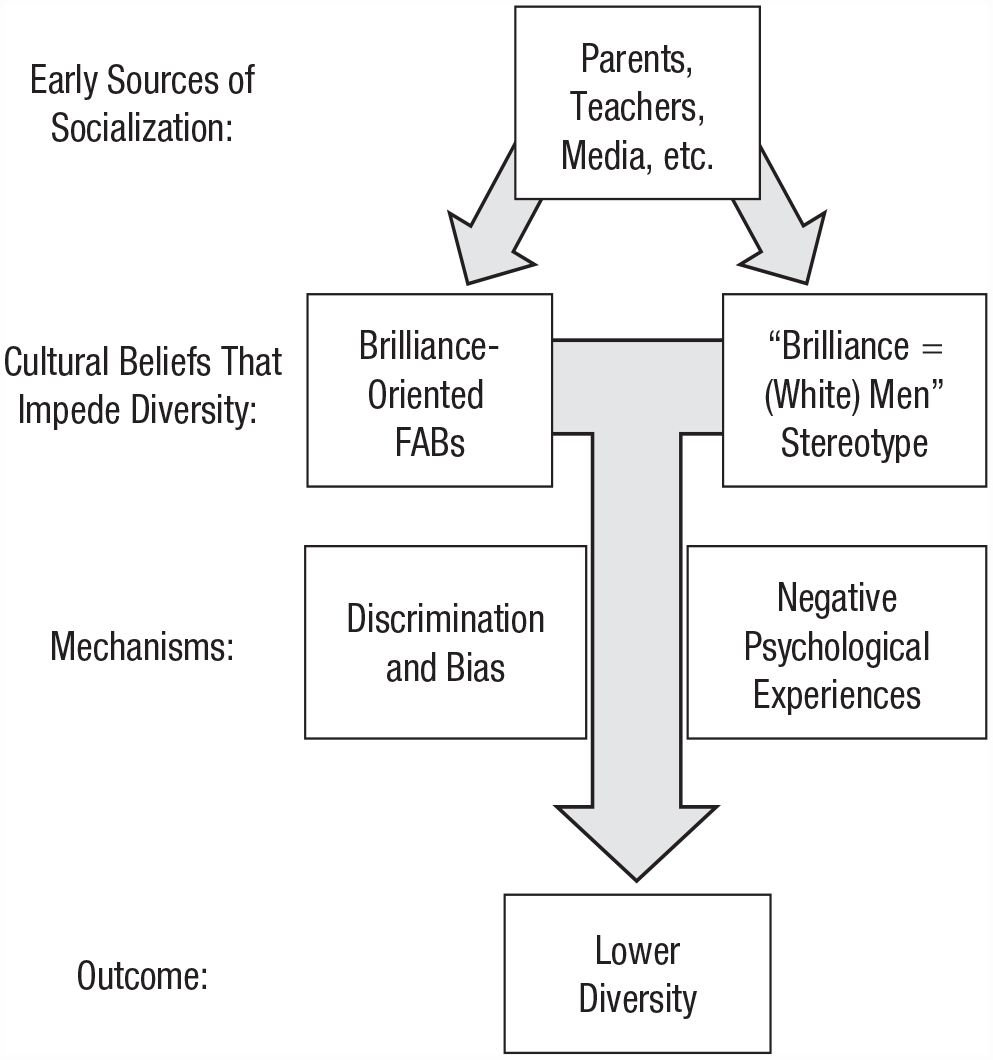
Diagram of the field-specific ability beliefs (FAB) theoretical model. The top row depicts the socialization sources of the two beliefs at the core of the model, which are depicted on the next row: the cultural belief that success in a context requires intellectual ability and the cultural stereotype that associates intellectual ability with (White) men more than other groups. The third row depicts the mechanisms by which these two cultural beliefs affect diversity: the biases of powerful individuals in brilliance-oriented contexts and the negative psychological experiences of women and racial-/ethnic-minority individuals in brilliance-oriented contexts. The bottom row depicts the outcome of these processes—namely, a context’s lower gender and racial/ethnic diversity.
As an initial test of this model, Leslie and colleagues (2015) asked faculty, postdoctoral researchers, and graduate students representing 30 disciplines and nine U.S. universities to report their FABs—that is, whether they thought that intellectual ability was necessary for success in their fields or that motivation and sustained effort were sufficient. Academics’ FABs predicted the percentage of women in their fields: The more strongly a field’s members emphasized the role of brilliance in achieving success, the lower was women’s representation at the doctoral level (Fig. 2A; see also Cimpian & Leslie, 2015; Hannak et al., 2023; Meyer et al., 2015; Storage et al., 2016). The degree to which a field emphasized brilliance was also inversely correlated with the percentage of doctoral degrees awarded to Black Americans, who—like women—are targeted by negative stereotypes about their intellectual abilities (Fig. 2B; see also Storage et al., 2016). Notably, the percentage of doctorates awarded to Asian Americans, who are not stereotyped in the same way, was unrelated to the field-level emphasis on brilliance, offering support for the idea that FABs pose an obstacle distinctly for individuals from groups whose intellectual abilities are stigmatized.
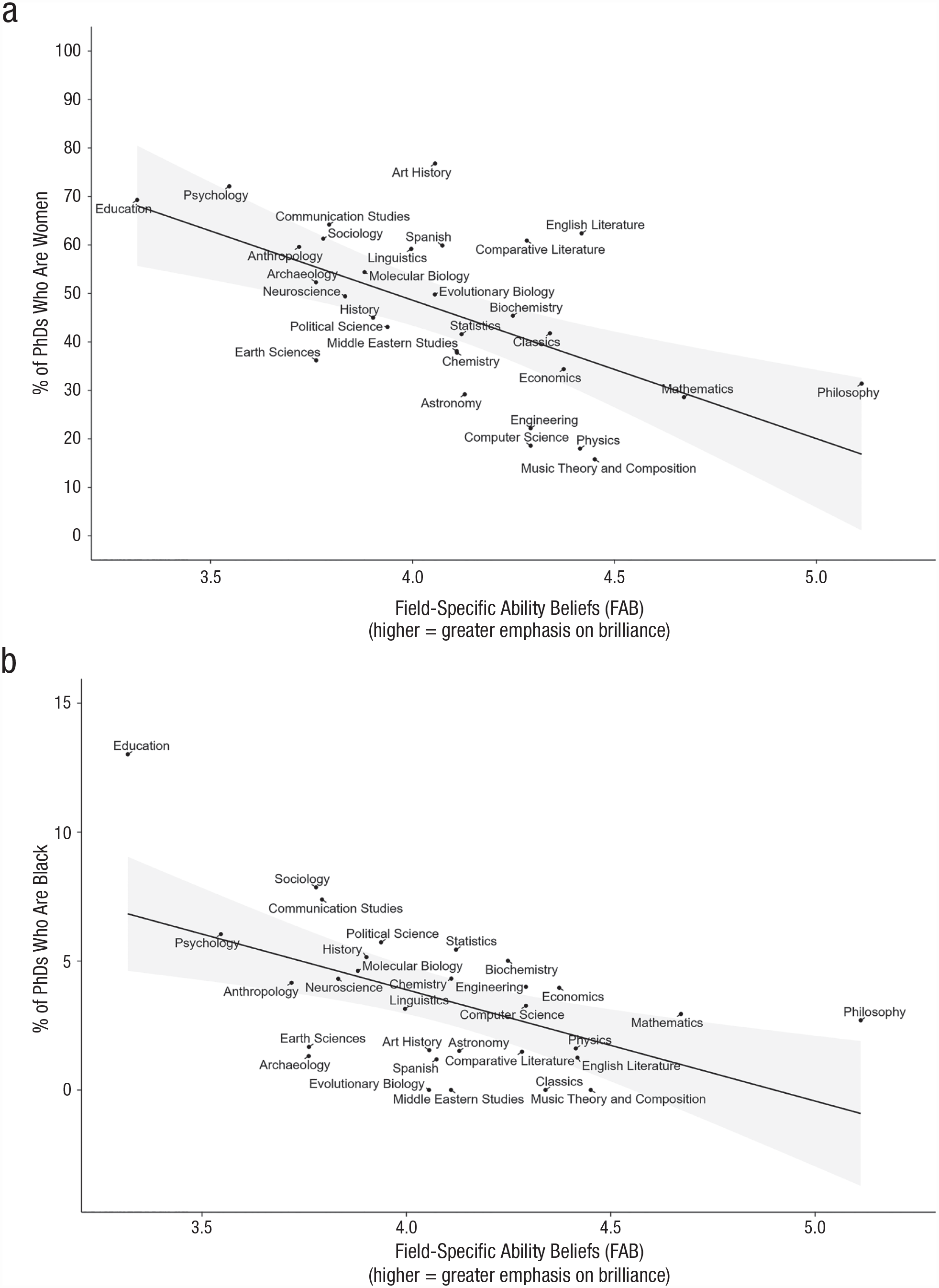
The more brilliance oriented field-specific ability beliefs are, the lower is the representation of women (A) and Black Americans (B) among U.S. PhD recipients (Leslie, Cimpian, et al., 2015). The PhD data are from the U.S. National Center for Science and Engineering Statistics (2012). The error bands indicate the 95% confidence interval around the linear regression line.
Mechanisms: How Do Field-Specific Ability Beliefs Act as an Obstacle to Diversity?
What mechanisms underlie these patterns of underrepresentation in brilliance-oriented fields and occupations? Work on this topic has focused on two categories of complementary processes: (a) the biases of powerful individuals in brilliance-oriented contexts and (b) the negative psychological experiences of women and racial-/ethnic-minority individuals in brilliance-oriented contexts.
First, because of the negative cultural stereotypes targeting their intellectual abilities, individuals who identify as women or racial/ethnic minorities are often perceived as less suitable for roles that supposedly require brilliance and are thus excluded from them. Bian, Leslie, and Cimpian (2018) found evidence for this claim with respect to gender. When asked to recommend individuals for a job, participants were less likely to recommend a woman if the solicitation mentioned a requirement for brilliance. This bias was substantial in magnitude—the odds of referring a woman were 38.3% lower for the brilliance job—and was also observed in a high-powered preregistered replication. Notably, even 5- to 7-year-old children were less likely to select a girl than a boy teammate when a game was described as being “for really, really smart” children, suggesting that informal gatekeeping processes start early in life (e.g., in children’s peer groups). Evidence that connects these gender biases with women’s underrepresentation in brilliance-oriented fields and occupations was reported by Leslie and colleagues (2015): The more a field valued brilliance, the more its members endorsed biased beliefs such as that men are “more suited” than women to do “high-level work” in their field, and endorsement of such gender-biased beliefs accounted for approximately 70% of the association between a field’s FABs and the gender composition of its PhDs (see also Hannak et al., 2023).
Second, women and racial-/ethnic-minority individuals in—or faced with the prospect of being in—brilliance-oriented contexts experience them as aversive, which makes it less likely that they join and remain in these contexts. For instance, when hypothetical job or educational opportunities are described as requiring brilliance, women express less interest in them and anticipate that they will feel anxiety and a lack of belonging if they were to pursue them (Bian, Leslie, Murphy, & Cimpian, 2018; cf. Deiglmayr et al., 2019). Further, the more that academics in a field perceive it as brilliance oriented, the more that women in that field experience impostor feelings—that is, they doubt their abilities and worry that others will discover their supposed incompetence (Muradoglu et al., 2022). This pattern is absent among men and is particularly pronounced among women from racial/ethnic groups traditionally underrepresented in higher education.
A proximal cause of these negative psychological experiences may be the local culture to which a context’s orientation to brilliance gives rise. When a field values brilliance and genius, it tends to foster a culture in which so-called masculinity-contest norms are common (Vial et al., 2022; see also Berdahl et al., 2018). These norms promote “dog-eat-dog,” zero-sum competitive behaviors intended to “separate the wheat from the chaff” and identify the (few) brilliant superstars. Such a workplace climate is often uncomfortable for individuals who identify as women and racial/ethnic minorities, leading them to doubt whether they fit the mold of the person who succeeds in these contexts. Indeed, women’s diminished sense of belonging and greater anxiety in brilliance-oriented contexts is partly explained by the perception that they are dissimilar to the “typical” individual in these contexts (Bian, Leslie, Murphy, & Cimpian, 2018). 4 Given their power to shape the experiences of individuals who identify as women and racial/ethnic minorities, masculinity-contest norms are a promising target of intervention: Portraying a hypothetical brilliance-oriented context as lacking masculinity-contest norms reduced women’s anticipated impostor feelings and increased their sense of belonging (Vial et al., 2022). Notably, men’s psychological well-being also benefited from the removal of these norms.
Taken together, this body of work offers two conclusions. First, the low levels of gender and racial/ethnic diversity in brilliance-oriented contexts are due in part to (a) direct forms of discrimination and (b) gender and racial/ethnic differences in key well-being indices in response to these contexts. Put differently, individuals who identify as women and racial/ethnic minorities are steered away from brilliance-oriented contexts by powerful others, but they themselves also forsake these contexts to protect their well-being. Second, brilliance-focused contexts are inhospitable in part because of the professional norms they foster, which center zero-sum competition and projecting infallibility.
Development: The Components of the FAB Model in Childhood
A prominent feature of the FAB model is its attention to childhood: Understanding the developmental trajectory and sources of the beliefs that are at the core of this model provides a useful tool to combat their effects (see Fig. 1).
To date, most developmental work on the FAB model has focused on the acquisition of stereotypes about brilliance, particularly as they concern gender. In broad outline, this research has suggested that stereotypes about brilliance (a) are acquired in early elementary school (e.g., Bian et al., 2017; Jaxon et al., 2019; Okanda et al., 2022), (b) increase in strength with age (Zhao et al., 2022), (c) are held implicitly and explicitly (e.g., Bian et al., 2017; Storage et al., 2020; Zhao et al., 2022), and (d) are acquired by children growing up in a range of cultural contexts, including China, Japan, Singapore, and the United States (Bian et al., 2017; Okanda et al., 2022; Shu et al., 2022; Zhao et al., 2022). For instance, in a sample from the Midwestern United States, 6- and 7-year-old (but not 5-year-old) girls were less likely to view their own gender as “really, really smart” (i.e., brilliant) compared with same-age boys (Bian et al., 2017; see also Bian, Leslie, & Cimpian, 2018). This finding was replicated with a sample of children from the Northeastern United States (Jaxon et al., 2019). In Japan, however, gender-brilliance associations favoring boys and men seem to emerge only at age 7 (Okanda et al., 2022). Once acquired, these notions seem to translate into behavior as well: Six- and 7-year-old girls express less interest than boys in a hypothetical game for “really, really smart kids” (Bian et al., 2017; Bian, Leslie, & Cimpian, 2018).
An active and fast-moving literature examines the intersection of gender and racial/ethnic stereotypes about brilliance among children. The tentative takeaway from this work is that the association of brilliance with men is present in children’s concepts of some, but not all, racial/ethnic groups; in some cases, this association is even reversed. For instance, children in the United States and China seem to associate brilliance with White men in particular (Bian et al., 2017; Jaxon et al., 2019; Shu et al., 2022). This stereotype actually favors women when U.S. children are evaluating Black individuals (Jaxon et al., 2019) and when U.S. and Chinese children are evaluating Asian individuals (Shu et al., 2022). However, when gender-brilliance stereotypes are assessed covertly, with an implicit association test (IAT; Greenwald & Banaji, 1995), a “brilliance = men” association emerges more reliably across racial/ethnic groups (Zhao et al., 2022), perhaps in part because the canonical version of the IAT highlights the stereotype targets’ gender identities. Further research will be needed to clarify this complex pattern of findings.
Less research to date has investigated children’s FABs—that is, when and why children, like adults, come to believe that success in some fields or occupations more than others requires intellectual ability. So far, the only evidence on this point comes from samples of adolescents. For instance, German 10th-grade students view brilliance as more central for success in math than in language arts (Heyder et al., 2021; see also Gunderson et al., 2017). And—mirroring findings with adults—the more strongly students endorse the necessity of brilliance for math success, the lower are girls’ (but not boys’) intrinsic motivation and ability self-concepts, even when adjusting for prior performance in math. Another set of studies examined U.S. high school students’ FABs about STEM fields. Here as well, the more that students viewed these fields as requiring brilliance, the lower were girls’ intentions to pursue them (Ito & McPherson, 2018).
Little is currently known about the sources of children’s brilliance stereotypes and FABs in their environments. Notably, both sets of beliefs have been documented among parents and teachers in several cultures (Copur-Gencturk et al., 2021; Heyder et al., 2020; Musto, 2019; Zhao et al., 2022), suggesting that socialization by close others may play a role in their acquisition (see Fig. 1). Consistent with this possibility, children’s gender-brilliance stereotypes are correlated with their parents’, especially early in childhood (Zhao et al., 2022; cf. Okanda et al., 2022). More research is needed to understand whether and how parents and teachers transmit these beliefs to children (see Musto, 2019) as well as to understand the role of children’s broader cultural contexts in this socialization process: Cultural artifacts, such as movies made for children, also reflect the beliefs at the core of the FAB model (Gálvez et al., 2019).
Looking to the Future
The findings we have summarized indicate that there is considerable knowledge about the development and consequences of the beliefs at the core of the FAB model, and yet many exciting research avenues remain to be pursued still. For instance, it would be worth investigating whether the effects of FABs on an individual are moderated by that individual’s intuitive theories about intellectual ability or by the theories that are prevalent in their context. As anticipated above, two such intuitive theories seem particularly relevant: fixed versus growth mindsets, which differ in whether intellectual ability is viewed as fixed versus malleable, respectively (e.g., Dweck, 2006; Murphy & Dweck, 2010), and nonuniversal versus universal mindsets, which differ in whether the potential for high intellectual ability is viewed as being rare versus common in the population, respectively (e.g., Rattan et al., 2018). For instance, might holding a growth or universal mindset mitigate some of the negative consequences of being in a brilliance-oriented context (e.g., Aronson et al., 2002)? More generally, it will be important to investigate whether the effects of FABs are independent of—or cut across—these various intuitive theories of intellectual ability or are instead bound up with particular subsets of such theories. The evidence so far (Bian, Leslie, Murphy, & Cimpian, 2018; Limeri et al., 2022; Porter & Cimpian, 2023) suggests independence but is limited.
In addition to the specific open questions articulated in this section and throughout, a major focus of future research should be to use the research on the FAB model to ensure that all fields and occupations reflect the diversity of the broader population. This model suggests two complementary pathways toward this goal: intervening to change how success is defined in (currently) brilliance-oriented fields and intervening to change brilliance stereotypes. 5 Although stereotypes do change over time (e.g., Charlesworth & Banaji, 2022; Eagly et al., 2020), they are often unresponsive to targeted interventions (e.g., Forscher et al., 2019). Thus, intervening to change beliefs and messages about the role of intellectual ability in success may be the more tractable path toward diversity. Before starting down this path, however, we need a clear understanding of how these beliefs are perpetuated—what macro- and microlevel features of a field signal its orientation to intellectual ability. These features can then be fruitfully targeted by intervention work aimed at mitigating the expression of a brilliance-valuing ethos. In addition to its practicality, this approach shifts the burden for change away from members of marginalized groups and toward individuals who—though not materially impacted by brilliance-oriented environments—may be aware of these beliefs and contribute to their expression and omnipresence.
Recommended Reading
Bian, L., Leslie, S. J., & Cimpian, A. (2017). (See References). An article suggesting that gender-brilliance stereotypes are held by children as young as 6 years of age.
Cimpian, A., & Leslie, S. J. (2017). The brilliance trap: How a misplaced emphasis on genius subtly discourages women and African-Americans from certain academic fields. Scientific American, 317, 60–65. An accessible introduction to the field-specific ability beliefs model.
Leslie, S. J., Cimpian, A., Meyer, M., & Freeland, E. (2015). (See References). An article presenting evidence that women and Black Americans are underrepresented in brilliance-oriented fields.
Muradoglu, M., Horne, Z., Hammond, M. D., Leslie, S. J., & Cimpian, A. (2022). (See References). An article presenting evidence that women (and particularly women from racial/ethnic groups that are traditionally underrepresented in higher education) experience stronger feelings of being an impostor in brilliance-oriented fields.
Vial, A. C., Muradoglu, M., Newman, G., & Cimpian, A. (2022). (See References). An article presenting evidence that brilliance-oriented fields are often characterized by masculinity-contest cultures, which undermine women’s (and, to some extent, men’s) well-being.
