




Abstract
We like people and objects more when they are described in positive than in negative terms. But even seemingly neutral words can elicit positive or negative responses. This is the case for words that predominantly occur alongside positive (or negative) words in natural language. Despite lacking positivity/negativity when evaluated in isolation, such semantically prosodic words activate the evaluative associations of their usual company, which can color judgment in unrelated domains. For example, people are more likely to infer that “endocrination” (a fictional medical outcome) is negative when it is “caused” (a word with negative semantic prosody) rather than “produced” (a synonymous word without semantic prosody). We review what is known about the influence of semantically prosodic words and highlight their importance for judgment and decision making.
It is no surprise that we are more likely to arrive at negative evaluations when something is described in negative rather than positive terms. We think negatively of a “horrible” person and positively of a “fantastic” outcome. But what if the descriptors did not differ in valence (i.e., their positivity/negativity)? Could judgments still be influenced?
Semantic Prosody in Language
In natural language use, words co-occur with other words. Whenever words frequently co-occur in close proximity, they are said to collocate. For example, the word “crystal” collocates with the word “clear,” and the words “peanut butter” tend to collocate with the word “jelly.” Words that are related tend to collocate, so collocations in natural language use have yielded insights about knowledge representation and the meaning of words (Landauer & Dumais, 1997; Lund & Burgess, 1996).
In special circumstances, words collocate with other words that share a certain feature. When a word tends to collocate with positive words in general, the word is said to have positive semantic prosody. Likewise, when a word tends to collocate with negative words in general, the word is said to have negative semantic prosody (Louw, 1993; Partington, 2004; Stubbs, 1995). The term “prosody” often refers to speech patterns of stress or intonation; the intonation of vowels can depend on neighboring letters. Semantic prosody, however, refers to how aspects of the semantic profile of words can depend on the words they typically have as neighbors in natural language use. For instance, the words “set in” have negative semantic prosody because most collocates that precede it (e.g., “rot,” “decay,” “malaise,” “despair”) are negative (Sinclair, 1987; Louw, 1993). On the other hand, the verb “lack” has positive semantic prosody because the words that follow it (e.g., “skills,” “power,” “resources,” “knowledge”) are often positive (Hauser & Schwarz, 2016). Thus, “he lacks skill” is a negative statement about another person, yet the word “lack” has positive semantic prosody because what is lacked is usually positive.
Despite their collocations, many words with positive or negative semantic prosody are themselves seen as neutral when participants rate how positive or negative the words are. For instance, most people do not see the word “cause” as being positive or negative. Linguistic Inquiry and Word Count (LIWC), a tool that researchers use to measure qualities of written text, identifies “cause” as a cognitive verb that lacks valence (Pennebaker et al., 2015). Warriner and colleagues (2013) asked participants to rate the valence of words on a scale of 1 (very unpleasant) to 9 (very pleasant) and found that participants assigned the word “cause” a valence rating of 5.13, functionally the midpoint of the scale. However, “cause” tends to be followed by negative concepts within everyday language (Stubbs, 1995); its most frequent collocates within four words to the right in the Corpus of Global Web-Based English (Davies, 2013) are “problems,” “death,” “damage,” “effect,” “harm,” “concern,” “pain,” “serious,” “cancer,” and “action.”
As these examples illustrate, many words with semantic prosody have an interesting psychological feature: They have valenced collocations within everyday language use but are not necessarily valenced themselves. When we use such semantically prosodic words in describing others, would peoples’ judgments reflect the (neutral) valence of the word itself or the (positive or negative) valence of the word’s usual collocates? Can one bias impressions by using an apparently neutral word that usually keeps the company of valenced words?
Semantic Prosody Guides Judgments
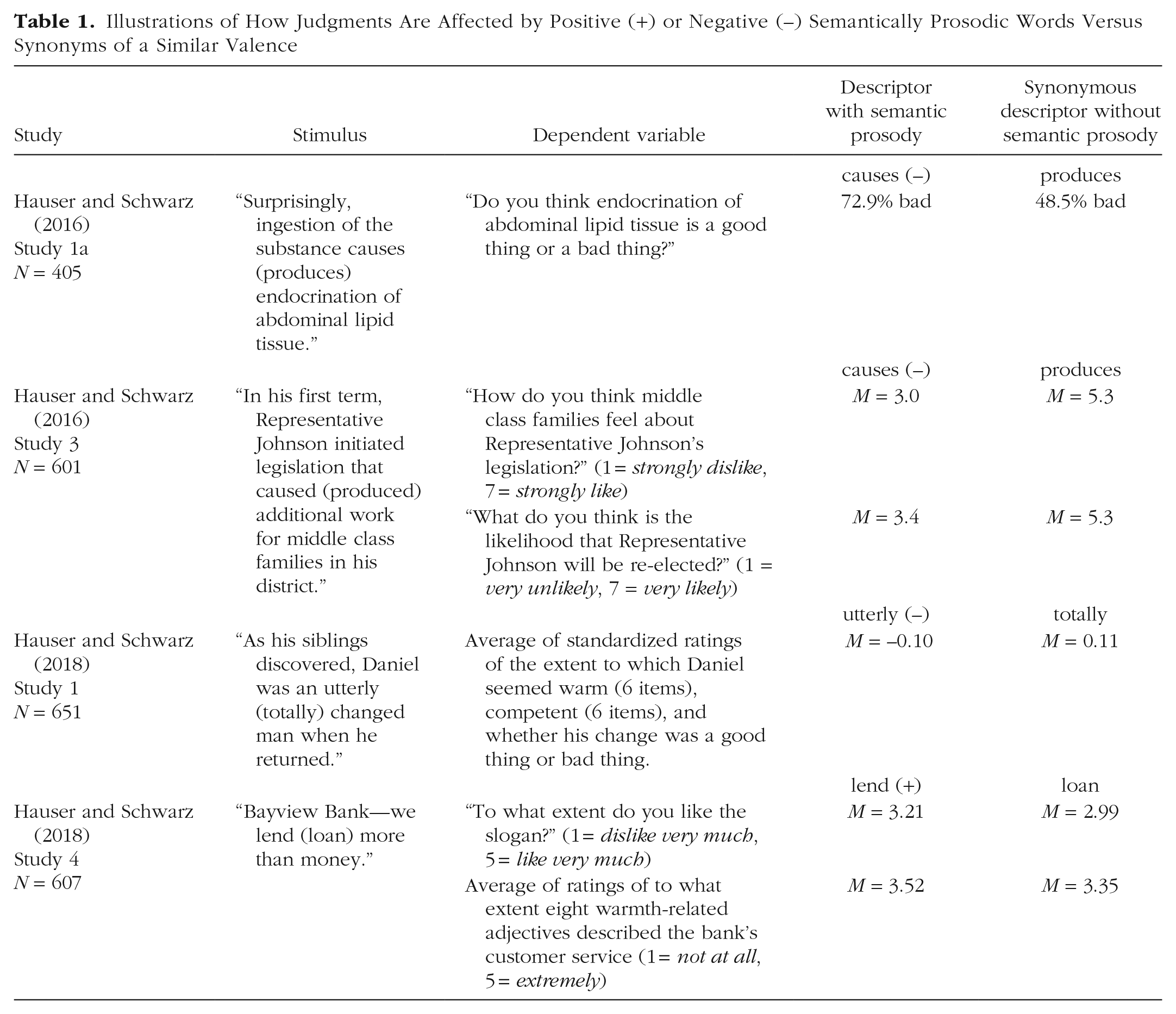
The answer to this question is a resounding “yes!” As shown in Table 1, when concepts are described using terms that are similar in semantic features but differ in semantic prosody, people draw upon the valence of the company that these words keep when forming a judgment. People infer that “endocrination of abdominal lipid tissue” (a fictitious outcome) is negative when it is “caused” (a verb with negative semantic prosody) versus when it is “produced” (a synonymous verb with no semantic prosody; Hauser & Schwarz, 2016, Study 1). People also have more negative impressions of a person who is described as having “utterly” changed (an adverb with negative semantic prosody) versus “totally” changed (a synonymous adverb with no semantic prosody; Hauser & Schwarz, 2018, Study 1). And they think more positively of a bank that, in its slogan, uses the term “lend” (a verb with positive semantic prosody) versus the term “loan” (a synonymous verb with no semantic prosody; Hauser & Schwarz, 2018, Study 4). In all these cases, words that thesauri and participants identify as synonyms (e.g., “cause” and “produce,” “utterly” and “totally,” “lend” and “loan”) generate markedly different impressions because of their different semantic prosodies.
Illustrations of How Judgments Are Affected by Positive (+) or Negative (−) Semantically Prosodic Words Versus Synonyms of a Similar Valence
Semantic prosody also affects how people produce language. When asked to complete sentence fragments that contain a semantically prosodic word, people do so with words that match the valence of the word’s usual collocates. For example, participants completed the fragment “The new supervisor caused . . .” with more negative words than the fragment “The new supervisor produced . . .” (Hauser & Schwarz, 2016, Studies 2 and 4).
Semantic prosody also factors into real-world decision-making. In one study, we recruited heterosexual single female participants for research on how people make decisions on the dating app Tinder. Participants were asked to view Tinder profiles of males and indicate whether the potential suitor seemed likeable, whether they would “swipe right” on him (i.e., chat him up), and whether they would go out on a date with him. The profiles contained either words with positive semantic prosody (vs. synonyms with no semantic prosody) or words with negative semantic prosody (vs. synonyms with no semantic prosody). Semantic prosody swayed impressions of the profiles such that participants had more romantic interest in suitors who had used positive semantically prosodic words (vs. non–semantically prosodic synonyms) in their profile descriptions, and participants had less romantic interest in suitors who had used negative semantically prosodic words (vs. non–semantically prosodic synonyms) in their profiles (Hauser & Schwarz, 2018, Study 5). The company that words keep in natural language affects the real-world judgments people make.
Semantic Prosody and Implicit Associations
The reviewed effects of semantic prosody may come from inferences about communicators’ likely intention in choosing a particular word (e.g., they would not have said “cause” if their intention was not negative). Alternatively, semantic prosody may trigger a mere gut response to the associations the word suggests. In the latter case, semantic prosody effects should also emerge on implicit attitude measures, which are used to capture valenced associations that people may not be consciously aware of. One such measure is the evaluative priming task, developed by Fazio and colleagues (1986). In this task, participants categorize target concepts (e.g., happiness, racism) as positive or negative. Preceding the target, participants briefly see a prime word that is clearly positive (e.g., “love”) or negative (e.g., “hate”). People are faster in categorizing a target as good or bad when the prime word matches their evaluation of the target. For example, people are faster in categorizing “happiness” when it is preceded by “love” rather than “hate,” whereas they are faster in categorizing “racism” when it is preceded by “hate” rather than “love.”
Can neutral words with positive or negative semantic prosody influence target categorization in ways that parallel the influence of words with clearly positive or negative valence? Empirically, this is the case (Hauser & Schwarz, 2022). Exposure to words with positive (or negative) semantic prosody facilitates the evaluation of positive (or negative) words (Study 1) and pictures (Study 2), paralleling the influence of clearly positive or negative words. Importantly, the words with positive and negative semantic prosody used in this study were previously rated as being similar in valence when participants were asked to report how pleasant or unpleasant the words themselves were. In short, implicit measures show that words with semantic prosody have positive/negative associations that people may lack conscious awareness of.
The valence of the company that neutral words keep in everyday language influences the accessibility of valenced concepts. This aligns with theories of human reasoning that emphasize prediction (Friston, 2010). If human minds are built to predict the world, these effects operate similarly to Bayesian priors. When a word is continuously experienced alongside negative company, then exposure to the word should activate these prior associations, preparing a person to expect negative concepts, which allows for a faster response. The observed evaluative priming effects also imply that an influence of semantic prosody does not require extensive inferences about what the speaker or writer wanted to convey by choosing the semantically prosodic word.
These findings also highlight the distinctions between associative learning and propositional knowledge (for a review, see Strack & Deutsch, 2004). These two systems are not always in agreement; as demonstrated in research on explicit versus implicit attitudes, a person could consciously harbor positive feelings toward members of stigmatized groups yet still have negative implicit associations with them (Gawronski & Bodenhausen, 2006). The dissociation of explicit and implicit measures of valence for semantically prosodic terms operates similarly. A person may consciously know that both good as well as bad things can be “caused” and thus consciously report that “cause” does not have an inherent positive or negative meaning. However, that person may still have negative associations with the word “cause” because of its frequent collocation with negative words in natural language. This could raise the accessibility of negative concepts and cast a negative hue on evaluations of ambiguous material, as observed in our experiments (Table 1).
Implications
Firth (1957) pointed out that “you shall know a word by the company that it keeps” (p. 11). The reviewed research demonstrates that the valence of the company words keep introduces subtleties to word meaning. Seemingly neutral words can acquire valenced associations when they collocate with valenced concepts in natural language use. People seldom consciously report these associations when asked about the meaning of a semantically prosodic word. Nevertheless, the associations influence their interpretation of utterances, their judgments and decisions, and their expectations about the valence of what is likely to come next. People make inferences based on the company words keep.
These effects have many real-world implications. For instance, because of the frequent co-occurrence of the racial label “Black” with discrimination and “African American” with equality, people concerned with equality donate more to organizations containing the word “African American,” whereas people concerned with discrimination donate more to organizations containing the word “Black” (Hall et al., 2021). Similarly, collocational profiles for words denoting rape are suggested to have different associations with guilt. Participants are less likely to find someone guilty of “rape” and “sexual assault” than of “nonconsensual sexual intercourse” (Berkland et al., 2022). Overall, semantic prosody and collocational profiles can be subtle yet powerful frames that can guide reasoning and real-world decision-making.
The observation that valenced collocations color words with subtle valenced meanings suggests that collocation may also endow words with other attributes of their collocates. As described previously, collocation of racial labels with abstract qualities of discrimination/equality (Hall et al., 2021) and collocation of criminal terms with guilt (Berkland et al., 2022) color the meanings of those terms. Researchers also discovered other patterns of word collocations. Some words tend to collocate with predominantly high-/low-arousal words in natural language, and some words tend to collocate with predominantly concrete/abstract words in natural language (Snefjella & Kuperman, 2016). If collocations color terms with meaning (as in the case of semantic prosody), it is possible that arousal-level collocations and concreteness-level collocations add corresponding nuanced meaning to words. Overall, there may be many different collocational patterns in natural language that can color words with nuanced meanings. Semantic prosody may be just one instance of a more general phenomenon of subtle collocation-based meaning shifts.
Semantic prosody also has important implications for text analysis tools that are popular in psychology and other behavioral sciences. LIWC (Pennebaker et al., 2015) and other sentiment analysis tools aim to identify the valence or affective tone of open text responses. Many of these tools are developed by having humans identify positive and negative words, which they verify with diagnostic texts. The resulting valence dictionary is then used to compute the average valence of the words in an open text response. Given that valence ratings often fail to capture the valenced associations of semantically prosodic words, these procedures miss their influence. For instance, LIWC (Pennebaker et al., 2015) identifies “cause” as a cognitive verb that indicates thinking about structural relations. This type of thinking is presumed to be a positive outcome in diary studies in which participants are writing about traumatic experiences. However, “cause” has negative semantic prosody within most corpora and reliably promotes negative inferences.
Lexical tools could be improved and informed by incorporating associations from corpora into the valence measurement of open text responses. Indeed, some tools, like word2vec (Mikolov et al., 2013) and GloVe (Pennington et al., 2014), classify meaning through collocations and context, which captures the valence of semantically prosodic words (Hauser & Schwarz, 2022). For instance, one Twitter sentiment lexicon determines word valence by calculating the number of times a word appears in tweets with positive or negative emoticons, and “cause” appears far more often alongside negative emoticons (Kiritchenko et al., 2014). Such tools have also uncovered other collocations in language that may foster the development of implicit associations (for examples, see Caliskan et al., 2017; Charlesworth et al., 2021; Lewis et al., 2020; Lewis & Lupyan, 2020). Combinations of rating and collocation approaches to lexica development could provide more accurate measures of word meaning.
Quite clearly, the company that words keep needs to be considered as an element of the meaning of those words themselves. Words that thesauri and participants identify as being synonyms are not truly synonymous when those words’ collocations influence judgments (e.g., “cause” and “produce”). Aside from semantic prosody, words have many properties that we draw upon to inform our judgments, reason about concepts, and form semantic knowledge. Instead of merely linking to stored meaning representations that are formed from nonlinguistic experiences, words may provide cues for meaning in the moment (for reviews of words as cues to meaning, see Casasanto & Lupyan, 2015; Elman, 2011).
Remaining Questions
Our studies provide an existence proof that semantic prosody can influence judgment. However, they are based on a limited number of words. This is due to two factors. First, there are few comprehensive lists of words with semantic prosody. Second, the available lists of words with valenced collocation patterns also include words that are valenced themselves (Ellis & Frey, 2009; Snefjella & Kuperman, 2016). For instance, the clearly negative word “kill” has negative semantic prosody because most of the things that are killed are negative (e.g., pests, enemies, etc.). However, such markedly valenced words are not suitable for investigating the influence of collocation patterns because, for them, positive (or negative) collocations are confounded with the positive (or negative) valence of the word itself.
Thus, one major question facing research on semantic prosody is “How many words have semantic prosody?” To calculate a rough estimate, we combined openly available data sets (Snefjella & Kuperman, 2016; Warriner et al., 2013) to assemble a list of 13,772 words, their valences, and their average collocate valence (i.e., the average valence of the company they keep in natural language). We identified words with an average collocate valence that was unpleasant (i.e., with collocate valence ratings that were 10% of the scale points below the “neutral” midpoint) and an average collocate valence that was pleasant (i.e., with collocate valence ratings that were 10% of the scale points above the “neutral” midpoint). We then flagged words with an average collocate valence that differed by 10% of the scale points from the valence of the word. These criteria identify words that keep valenced company in natural language that differs from the valence of the word itself.
These procedures flagged 307 words (from a relatively small sample of 13,772) with potential semantic prosody, indicating that the reviewed studies provide only a brief glimpse into the population of words with semantic prosody. Having established that the semantic prosody of neutral words can influence judgment and decision-making, we hope that the issue will receive broader attention in corpus linguistics. Understanding how many apparently neutral words in the lexicon have semantic prosody is important for understanding the likely scope of semantic prosody’s effects in communication, judgment, and decision-making.
We also need to understand the extent to which semantic prosody differs across people. People learn the collocation patterns of words through their exposure to language. However, not all persons have the same exposure history. For instance, people who learn English as a second language have a far different history of exposure to English words than do native English speakers (Omidian & Siyanova-Chanturia, 2020; Xiao & McEnery, 2006; Zhang, 2021). Similarly, scientists may frequently use the word “cause” in contexts that differ from the negative collocates that characterize “cause” in the corpus of everyday language. Hence, the same word may have different semantic prosodies for different populations. As discussed earlier, people consider “endocrination” a good thing when a pill “produces” it but a bad thing when a pill “causes” it (Hauser & Schwarz, 2016). If health care professionals and patients differ in their collocational associations, a promised outcome may seem less beneficial to the patient than the professional intended. We suspect that a comparison of language use in everyday and professional contexts will identify many differences in collocations, which may impair communication across these contexts in previously unidentified ways.
Conclusion
Words with semantic prosody color evaluative judgments even though people do not endorse semantically prosodic words as being positive or negative. This highlights how the contexts in which we use words in natural language guide the meanings of the words themselves.
Recommended Reading
Hauser, D. J., & Schwarz, N. (2016). (See References). Studies assessing the impact of semantic prosody on judgment.
Hauser, D. J., & Schwarz, N. (2018). (See References). Studies assessing the impact of semantic prosody on person impressions.
Hauser, D. J., & Schwarz, N. (2022). (See References). Studies assessing the impact of semantic prosody on evaluative priming.
Stubbs, M. (1995). (See References). A classic from corpus linguistics, including an in-depth analysis of the semantic prosody of the word “cause.”
Xiao, R., & McEnery, T. (2006). (See References). A thorough corpus linguistic review of semantic prosody and an assessment of it across languages.
