




Abstract
Whether life transitions are anticipated or unforeseen, they can be challenging to navigate because the change process involves a period of uncertainty and adjustment. Specifically, transitions often require social identity change, whereby individuals leave one or more social groups behind and join one or more groups in the new environment. Such changes can be especially hard when individuals belong to a disadvantaged group (e.g., a low-income or racial- or ethnic-minority group) because they also have to contend with the additional hurdle of systemic inequality. Yet members of disadvantaged groups also have resources to navigate social identity change during life transitions—resources that facilitate and support successful social identity change. We review our research with immigrants and university students to show how individuals’ social connectedness with groups can facilitate positive outcomes during life transitions, including social integration, psychological well-being, positive beliefs about the self, and successful academic performance. In particular, we consider individuals’ group memberships prior to the transition and the new identities they adopt in the new context as key determinants of successful identity change. We conclude with implications for policy and practice.
Everyone can expect to experience major life upheavals. Some of these changes are planned (e.g., enrolling at a university or moving to a new country), whereas others are unexpected (e.g., experiencing injury or winning the lottery). Even when life transitions are anticipated and/or positive, they can be challenging to navigate because the change process involves a period of uncertainty and adjustment that requires individuals to develop new skills and knowledge. Life transitions often also involve changes to group memberships, that is, leaving one or more group memberships behind (e.g., as no longer being a high-school student) and joining other groups in the new environment (e.g., as a university student). Such changes have a profound impact on individuals because their sense of self is defined by group memberships and the social identities that are derived from them (Tajfel & Turner, 1979). Thus, social identity change requires individuals to reconsider who they are and recalibrate their sense of self.
Transitions can be especially hard when individuals belong to a disadvantaged group (e.g., a low-income or racial- or ethnic-minority group). Members of low-status groups face hurdles including intolerance and discrimination from individuals (Verkuyten et al., 2020), institutional bias in policies and procedures, and systemic inequality (Onyeador et al., 2021). Thus, it is essential to consider the specific and additional factors that shape the extent to which members of disadvantaged groups successfully navigate social identity change triggered by life transitions.
Research investigating people’s experiences of life transitions spans several social science disciplines (see George, 1993; Hale & de Abreu, 2010; Merriam, 2005). These literatures largely focus on the limited concrete resources (e.g., money), qualifications (e.g., education level), and social support available to members of disadvantaged groups as they navigate these life changes. This work also considers how prejudice and discrimination from society at large limits disadvantaged-group members’ chances of success during a transition.
Our research takes a different approach by considering how membership in disadvantaged groups can serve as a resource to individuals who are navigating life transitions. Our analysis fits within a broader social identity approach that has considered the role of group memberships and social networks in shaping people’s experiences and behaviors in a range of domains, including health (C. Haslam et al., 2021; Jetten et al., 2014), organizational behavior and leadership (Ellemers et al., 2003; S. A. Haslam et al., 2017), and education (Mavor et al., 2017). Here, we review our work with immigrants and university students to showcase how social connectedness with groups can facilitate both negative and more positive experiences and outcomes during life transitions. Because such changes typically require individuals to leave one or more groups behind and take on new social memberships, we consider the impact of individuals’ social identities prior to the transition, as well as the new identities they adopt in the new (physical and/or social) context.
As shown in Figure 1, our work has examined four ways in which group memberships can improve people’s experiences and outcomes in the context of life transitions: by facilitating acceptance and support from fellow group members, instilling a positive sense of distinctiveness, highlighting enhanced group prospects, and maintaining a sense of identity continuity over time. In the sections below, we consider how these social identity processes can facilitate four types of positive outcomes during life transitions: social integration into a new cultural context, psychological well-being, positive beliefs about the self (including self-esteem and self-efficacy), and successful academic performance.
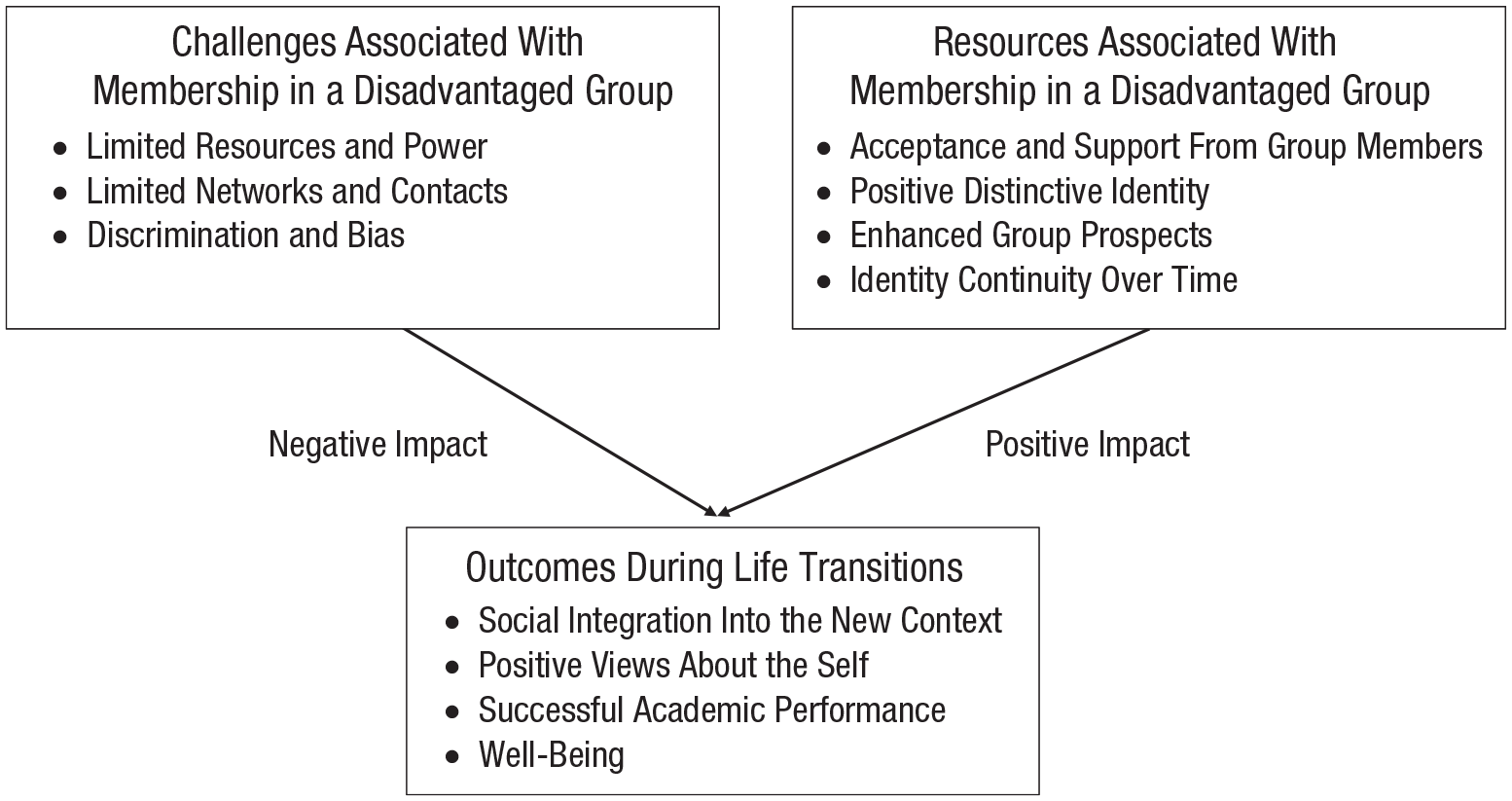
Challenges and resources associated with disadvantaged-group membership and their impact on outcomes during life transitions.
Immigrants’ Social Integration Into the Host Country’s Culture
When immigrants move to a new region or country, they undergo a process of cultural and psychological change known as acculturation as they encounter concrete markers (e.g., language, clothing, food) and symbolic practices (e.g., values, customs, beliefs) that make up the host society’s culture. Public debates regarding the most appropriate way for immigrants to engage with the host culture focus on two distinct acculturation strategies: assimilation, whereby immigrants immerse themselves entirely in the host culture while giving up their culture of origin, and integration, whereby immigrants adopt some aspects of the host culture while also retaining aspects of their culture of origin (Berry, 2001).
Although research indicates that people who adopt the integration strategy experience less stress and more positive adaptation than do those who adopt the assimilation strategy (Berry, 2005), immigrants often encounter pressure to assimilate into the host culture’s society (Badea et al., 2018). Indeed, research investigating the reasons underpinning immigrants’ acculturation choices has tended to focus on the social opportunities provided by members of the host society (Ramos et al., 2013; Van Oudenhoven et al., 2006). For example, members of the host society might perceive immigrants as a threat and thus discriminate against them (Badea et al., 2018). Immigrants’ perception of such rejection from the host society is negatively associated with their likelihood of developing positive relationships with that society (Verkuyten & Yildiz, 2007) and thus negatively associated with the likelihood of integration.
Unfortunately, however, immigrants face discrimination and bias from sources other than the host culture. They may also expect rejection by members of their country of origin. For example, friends and family “back at home” may believe that the immigrants have abandoned their original cultural values and practices (Pedraza, 2006). Our work has examined the role of perceived rejection by one’s country of origin as well as the host culture in shaping immigrants’ acculturation strategies.
We recruited Romanian and Moroccan immigrants in France to investigate these ideas (Badea et al., 2011). Results showed that greater perceived rejection from the country of origin was associated with lower levels of group identification, or social connectedness, with that country. In turn, lower group identification was associated with lower endorsement of the integration acculturation strategy and greater endorsement of the assimilation acculturation strategy. Immigrants’ perceived rejection by social networks in their country of origin thus reduced their social connectedness to this group and predicted their endorsement of the less adaptive strategy of assimilation, rather than the more adaptive strategy of integration. These results underscore the importance of group memberships in shaping immigrants’ ability to successfully navigate the life transition.
Immigrants’ choice of acculturation strategy is also influenced by another set of social identity processes: beliefs about the extent to which their group is culturally similar to the host society. There are two views regarding the impact of perceived group differences. One perspective holds that if immigrants perceive their group as being culturally different from the host society, they will view this difference as a barrier to integration and withdraw from mainstream society. Another view—based on social identity theory (Tajfel & Turner, 1979)—is that the perception of cultural difference helps group members establish who they are and where they stand in relation to other individuals. This positive sense of distinctiveness strengthens the minority identity and thus reduces the need to establish distinctiveness through other means. This outlook should promote a more positive orientation toward the host society and thus increase immigrants’ willingness to integrate into it.
We investigated these competing views in a series of studies with members of two disadvantaged groups who had immigrated to new host societies (Zhang et al., 2013a). The first group consisted of Chinese immigrant workers who had moved within China from their rural regions of origin to a large city in search of better job opportunities and who had experienced lower status in the city because of institutional policies (i.e., restricted access to social services such as health care because they had left their registered place of residence) and prejudice from city residents who disparaged their traditional cultural values. The second group consisted of Chinese immigrants who had moved to Australian metropolitan areas to pursue new opportunities in employment or education. In the Australian context, Chinese immigrants tend to experience racial prejudice in a range of domains, including employment, housing, and social interactions (Fitzgerald, 2007).
Our results across correlational and experimental studies support social identity theory’s hypothesis regarding the positive impact of perceived difference: When individuals had a clearer sense of their disadvantaged group’s identity as distinct from the majority group, they were more willing to actively participate in the host society; this was particularly true for those who had not been strongly identified or emotionally connected to the host society (Zhang et al., 2013a). These findings underscore the importance of distinct group membership as an influence on the way that immigrants from disadvantaged groups navigate the transition into a new context and the extent to which they are willing to directly engage with the host society.
Immigrant Children’s Self-Esteem, Self-Efficacy, and Academic Performance
Families and their children constitute a large proportion of immigrants. According to the Organization for Economic Cooperation and Development (2012), the extent to which immigrants are well integrated into a host society can be assessed by examining how well their children are doing. Immigrant children’s adjustment is influenced by various factors, including political and social contexts (e.g., national and state policies), microsystems (e.g., families and neighborhoods), and individual differences (e.g., developmental competencies), as well as the intersection of these factors (Motti-Stefanidi, 2019).
We add a distinct social identity analysis to this literature by considering how immigrant children’s awareness of their disadvantaged group’s future prospects shape their attitudes and behavior. We propose that children’s consideration of alternative possibilities for their group’s social and economic prospects shapes their beliefs about their individual abilities as well as their performance on academic tasks. Such perceived cognitive alternatives can promote the narrative that the group’s current lower-status position is not a foregone conclusion, but rather can and will be changed in the future.
We tested these hypotheses with Chinese children whose families experienced low status because they had moved to a city from rural regions in search of work (Iyer et al., 2017; Zhang et al., 2013b). We designed a brief intervention to draw children’s attention to the possibility of improved prospects for the group’s social and economic status in the future. Children were randomly assigned to read a brief passage stating either that, in the future, children of country immigrant workers would have the same opportunities as city children do (i.e., improved group prospects, which we referred to as high cognitive alternatives) or that, in the future, children of country immigrant workers would not have the same opportunities as city children do (i.e., no change in group prospects, which we referred to as low cognitive alternatives).
Compared with children in the low-cognitive-alternatives condition, children in the high-cognitive-alternatives condition reported higher levels of self-esteem (Zhang et al., 2013b) and academic self-efficacy (i.e., the belief that they were capable of achieving a desired academic goal; Iyer et al., 2017) and achieved higher performance on academic tasks assessing skills in mathematics and attention (Iyer et al., 2017). Taken together, these studies demonstrate that immigrant children’s awareness of their disadvantaged group’s improved future prospects has concrete benefits for their self-views and behavior in the new social context. The results thus underscore the influence of group memberships and social connectedness on disadvantaged-group members’ ability to navigate a new social context after a life transition.
Low-Socioeconomic-Status (Low-SES) University Students’ Well-Being, Ability to Cope With Adversity, and Plans for the Future
For individuals from low-SES backgrounds, a university education is supposed to provide an opportunity for social mobility, as they gain the knowledge, skills, and networks to start a career and improve their economic conditions. Universities have used Widening Participation schemes (in the United Kingdom) and affirmative-action programs (in the United States) to increase the percentage of low-SES students who enroll in their degree programs.
Yet enrollment alone does not guarantee success for students from low-SES backgrounds. As do members of any disadvantaged group, they need to cope with a social environment that may be quite different from the one they left behind (Reay et al., 2009). Indeed, research shows that low-SES university students tend to have lower retention rates, poorer academic performance, and lower psychological well-being compared with the university student population more generally (Jury et al., 2017). There are various reasons why low-SES students may struggle with the transition to higher education, including uncertainty about how to navigate the new context, insufficient knowledge and skills for the new context, insufficient interpersonal support, and individual differences, such as pessimism (Jury et al., 2017; Vernon et al., 2019).
Our work adds to this analysis by taking a social identity approach to consider another important aspect of this transition: change in group membership. When low-SES students take on the new identity of “university student,” they believe that they belong in the new university context and are able to take advantage of the material and psychological resources available to them as members of this group. Being willing to take on the new identity should thus result in higher levels of well-being, including greater self-esteem and satisfaction with life and lower levels of depression.
We examined the factors that influence willingness to take on the new university-student identity in two longitudinal studies in which we surveyed first-year students before their enrollment and then at two time points during their first year (Iyer et al., 2009; Jetten et al., 2008). We investigated the extent to which two aspects of low-SES students’ social connectedness predicted willingness to take on the new identity: whether they belonged to multiple groups prior to enrolling at the university and whether they perceived these prior group memberships as compatible with the new university identity.
Results showed that low-SES students struggled more with the transition to the university context than their higher-SES counterparts did, as low-SES students reported less willingness to adopt the new university-student identity. This effect was partly explained by low-SES students belonging to fewer social groups prior to enrollment and perceiving the university identity as being less compatible with the group memberships in their previous networks. However, results also showed that when lower-SES students did develop a strong sense of social connectedness (i.e., group identification) as a university student, they tended to fare better: Greater identification predicted higher levels of well-being (Iyer et al., 2009) and stronger beliefs that university education would help improve their social status (Jetten et al., 2008).
Individuals’ previous group memberships can also serve as a resource during times of change if they are maintained as central aspects of identity over time. Our longitudinal research and experimental studies show that such identity continuity affects the extent to which nostalgia for the past can empower individuals during times of change (Iyer & Jetten, 2011). In an experimental study involving first-year university students, we independently manipulated their sense of identity continuity and nostalgia for the past; results showed that when perceived identity continuity was high and students thus felt a connection to who they had been in the past, nostalgia for the past produced more positive outcomes than did a control condition in which nostalgia was not induced. These positive outcomes included greater well-being (including excitement about the transition and life satisfaction), perceived ability to cope with academic challenges, and interest in trying new opportunities. However, when perceived identity continuity was low and students thus felt disconnected from their past, the outcomes for these variables were more negative when nostalgia was induced than when it was not.
Conclusions
Life transitions—such as moving to a new country or city, or enrolling at a university—can be challenging. People from disadvantaged backgrounds face additional hurdles during times of change because they also have to contend with systemic inequality, such as prejudice and discrimination from individuals and institutional bias. Our research offers two insights for policymakers and practitioners seeking to facilitate individual’s success in navigating such transitions.
First, it is important to acknowledge that membership in a low-status group does not produce only hardship and strife for individuals. Deficit models of social policy emphasize the problems faced by people from disadvantaged backgrounds and thus focus on how these individuals need to change in order to improve their circumstances (e.g., Song & Pyon, 2008). In contrast, our research shows that individuals’ disadvantaged-group memberships and social networks can bolster their sense of identity and provide support during times of change, both when they draw on their minority identity and when they adopt new identities that are central to the new context. This strengths-based approach acknowledges that people from disadvantaged backgrounds have resources and agency that can help them cope with, and thrive during, transition. It offers a more nuanced view of disadvantaged groups’ experiences and confers respect and dignity to these individuals, rather than victimhood and paternalism.
Second, our findings indicate that policymakers and practitioners should look beyond the beginnings of life transitions when choosing points of intervention. In the British higher-education context, for instance, Widening Participation schemes tend to focus on recruiting students from disadvantaged backgrounds, and put less emphasis on creating conditions to foster these students’ success and well-being once they arrive on campus (Stevenson et al., 2019). In the same vein, immigration policies in countries such as Australia and the United States tend to focus on entry requirements and application procedures, and give less attention to immigrants’ experiences upon arrival (Akbari & MacDonald, 2014). In contrast, our findings—from a combination of correlational, longitudinal, and experimental research studies—indicate that policymakers should also facilitate disadvantaged-group members’ positive experiences of life transitions after they have arrived in the new context. One recommendation is to develop programs that strengthen links with (past and present) social networks, in order to create opportunities to leverage these sources of support. A second recommendation is to provide more economic opportunities to disadvantaged groups in the new context; this will enhance their perceptions of improved group prospects, which has benefits for self-views and task performance. In this way, members of disadvantaged groups can use their social connectedness with old and new groups as a foundation from which to successfully navigate life transitions.
Recommended Reading
Haslam, C., Haslam, S. A., Jetten, J., Cruwys, T., & Steffens, N. T. (2021). (See References). A recent review of the impact of social identity on health outcomes during life transitions.
Haslam, S. A. (2014). Making good theory practical: Five lessons for an Applied Social Identity Approach to challenges of organizational, health, and clinical psychology. British Journal of Social Psychology, 53(1), 1–20. https://doi.org/10.1111/bjso.12061. A review of a theoretical framework for developing robust applications of social identity theory to address global challenges.
Hornsey, M. J. (2008). Social identity theory and self-categorization theory: A historical review. Social and Personality Psychology Compass, 2(1), 204–222. https://doi.org/10.1111/j.1751-9004.2007.00066.x. A comprehensive and highly accessible introduction to the theoretical frameworks that are central to the analysis presented in this review.
