




Abstract
Past studies show that spending money on other people—prosocial spending—increases a person’s happiness. However, foundational research on this topic was conducted prior to psychology’s credibility revolution (or “replication crisis”), so it is essential to ask whether the evidence supporting this claim is robust and replicable. Here, we consider all 15 published preregistered experiments on prosocial spending to evaluate whether there is causal evidence for the idea that spending money on other people promotes happiness. Although the evidence appears somewhat mixed, we argue that the emotional benefits of prosocial spending are robust and replicable in large samples. These benefits are particularly likely when people have some choice about whether or how to give and when they understand how their generosity makes a difference. This review provides renewed support for the idea that prosocial spending promotes happiness and offers a template for revisiting phenomena that were established prior to the credibility revolution.
In 2021, during the second year of the pandemic, responses to a global survey revealed that more than one third (36.7%) of people had donated to charity in the past month, a figure nearly 6% higher than global estimates from before the pandemic (Helliwell et al., 2022). What accounts for such high levels of generosity, even during a global crisis? One possibility is that using financial resources to help other people—called prosocial spending—feels good. Indeed, in the first experiment on this topic, people randomly assigned to spend $5 or $20 on others were significantly happier than people randomly assigned to spend on themselves (Dunn et al., 2008). Since then, the emotional benefits of generosity have been observed in diverse areas of the world, from South Africa to Vanuatu (Aknin et al., 2013, 2015), as well as among toddlers (Aknin et al., 2012; see Dunn et al., 2014, for a review). These findings have been cited widely in the literature, discussed in popular culture (e.g., Grant, 2014), and used to inform government policy (e.g., the 2013 report on charitable giving by the United Kingdom Cabinet Office Behavioural Insight Team). But how robust and replicable is the evidence that spending money on other people improves happiness?
Here, we review all relevant experiments implementing the current best practice of preregistration to answer the question of whether spending money on other people causally increases well-being. We conclude that the causal impact of prosocial spending on well-being is robust and replicable in large samples (n ≥ 200 per condition). We also extract key lessons on when it appears that these emotional benefits are most likely to be detected: when paradigms involve actual behavior, when participants have a choice in deciding who or how to help, and when participants receive information on how their actions help other people. These lessons underscore the hedonic benefits of actual generous behaviors that provide a sense of choice and the feeling that one has created positive change.
Why Revisit Evidence for the Emotional Rewards of Prosocial Spending?
In recent years, many scientists have come to see research practices that were once commonplace as unacceptable (Nosek et al., 2018; Vazire, 2018). A landmark paper by Simmons et al. (2011) revealed that common strategies—such as using multiple dependent variables or adding a covariate to an analysis—substantially increase the risk of finding support for a hypothesis that is false. To prevent this form of p-hacking, the field has embraced new methods, such as preregistration, wherein authors commit to a specific method and analytic strategy before analyzing data (e.g., Nelson et al., 2018). Additionally, researchers now recruit larger samples to obtain more robust estimates and conduct direct replications to examine the reproducibility of a finding (Vazire, 2018). Applying these modern best practices, researchers have cast doubt on several central reported effects in social psychology, including stereotype threat (Flore et al., 2018), ego depletion (Vohs et al., 2021), and the effect of signing a veracity statement at the beginning rather than the end of a self-report form (Kristal et al., 2020). Nosek and colleagues (2022) argued that “replicability challenges are observed almost everywhere that has undergone systematic replication” (p. 726).
Because the foundational work on prosocial spending was conducted before many of these issues were recognized and better methods were introduced, it is essential to reevaluate whether prosocial spending increases happiness. None of the early experiments on prosocial spending described in our previous review (Dunn et al., 2014) were preregistered, and almost all used sample sizes that would be considered unacceptable by contemporary standards. Indeed, our original article on prosocial spending—which has been cited more than 2,000 times—reported just one experiment with 46 undergraduates (Dunn et al., 2008). A recent meta-analysis suggests that at least 200 participants per condition are needed to detect the effects of generosity on happiness (Curry et al., 2018). This implies that early studies on prosocial spending were severely underpowered. Moreover, early studies on prosocial spending had several characteristics that predict failure to replicate in other topic areas, such as multiple dependent variables and the inconsistent use of covariates.
The Present Review
Here, we evaluate the causal evidence for the happiness benefits of prosocial spending by reporting the results of a review of all 15 published experiments that used the contemporary best practice of preregistration. Looking across numerous reports, methods, and authors allowed us to probe the stability of this effect. We restricted our review to preregistered studies because “preregistration is the only way for authors to convincingly demonstrate that their key analyses were not p-hacked” (Nelson et al., 2018, p. 519). We included only experiments because we were interested in the causal impact of prosocial spending on happiness; correlational studies cannot tell whether generosity increases happiness or happiness increases generosity (Brethel-Haurwitz & Marsh, 2014), nor can they fully account for third variables that could be responsible for the association.
We searched PubMed, PsychInfo, and Google Scholar to identify all experiments that included a preregistered analysis comparing a condition in which participants were randomly assigned to spend (or earn) money to benefit other people against a relevant control condition. We adopted the most prominent definition of happiness: subjective well-being, which encompasses levels of positive emotions 1 and negative emotions, as well as life evaluations (Diener, 1984). Experiments that included preregistered analyses of any of these three components of subjective well-being were included in our review. When multiple preregistered measures were used in the same experiment, we report results for current positive emotion in the text and in Figure 1, which provides a graphic summary of the 15 experiments and their results. This strategy facilitated comparison across studies because current positive emotion is the most commonly measured component of subjective well-being in the prosocial-spending literature. Table 1 presents a more detailed summary of the experiments.
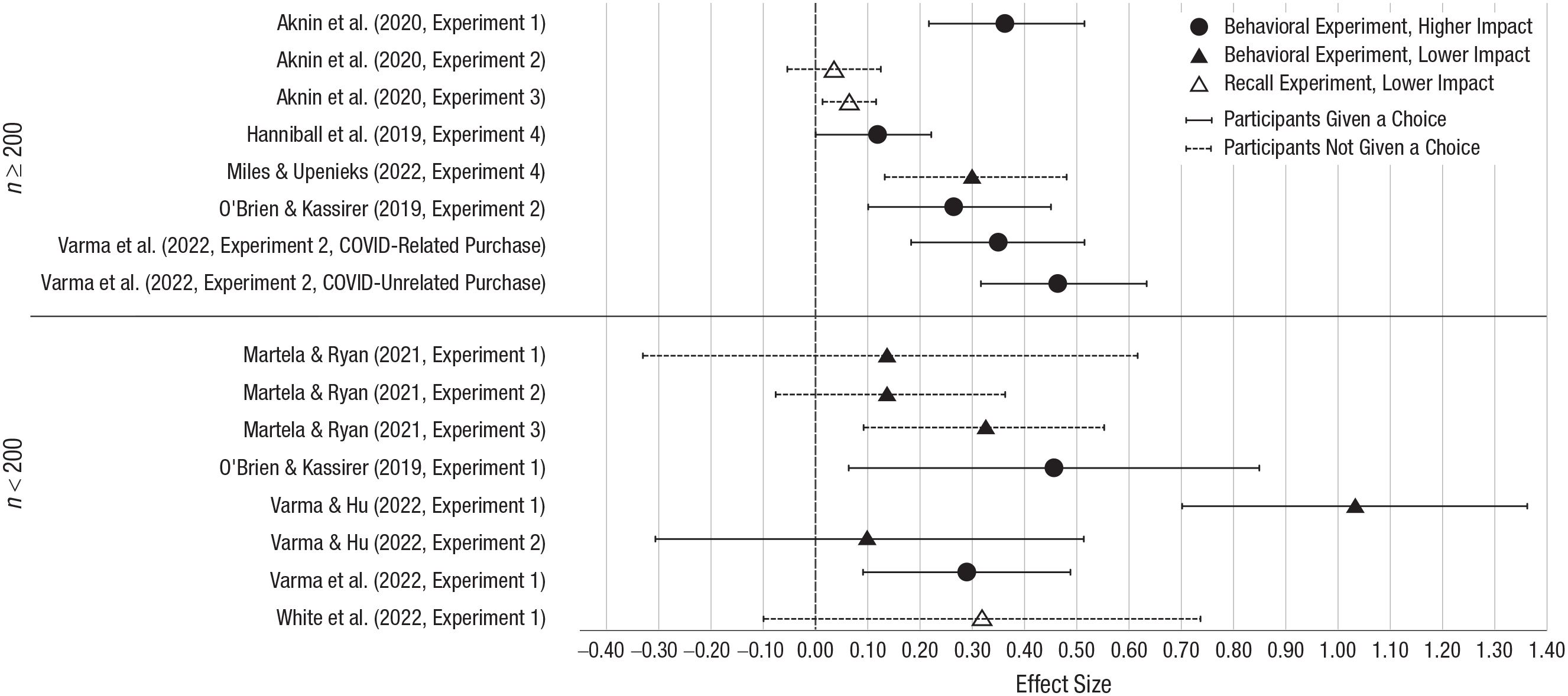
Effect-size estimates (Cohen’s d; Cohen, 1992) from all 15 published experiments that included a preregistered test of the emotional rewards of prosocial spending. Experiments listed above the horizontal dividing line meet the minimum recommended threshold of 200 participants per condition; those below the line had smaller sample sizes. Within each group, the experiments are listed alphabetically. Effect sizes of 0.2, 0.5, and 0.8 are considered small, medium, and large, respectively. Error bars represent 95% confidence intervals around the effect-size estimates. For each experiment, the graph indicates whether or not participants were given a choice regarding prosocial spending (or earning), whether a behavioral or recall paradigm was used, and whether participants had or were provided with information about the impact of their prosocial spending (higher impact = yes; lower impact = no). Effects for which the error bars do not cross zero are significant, p > .05. For Miles and Upenieks (2022, Experiment 4), results are shown for the comparison of the prosocial-earning condition with the control condition (no earning). For White et al. (2022, Experiment 1), results are shown for the comparison of the personal-spending condition with the prosocial-spending condition.
Summary of Key Information From All 15 Published Experiments That Included a Preregistered Test of the Emotional Rewards of Prosocial Spending
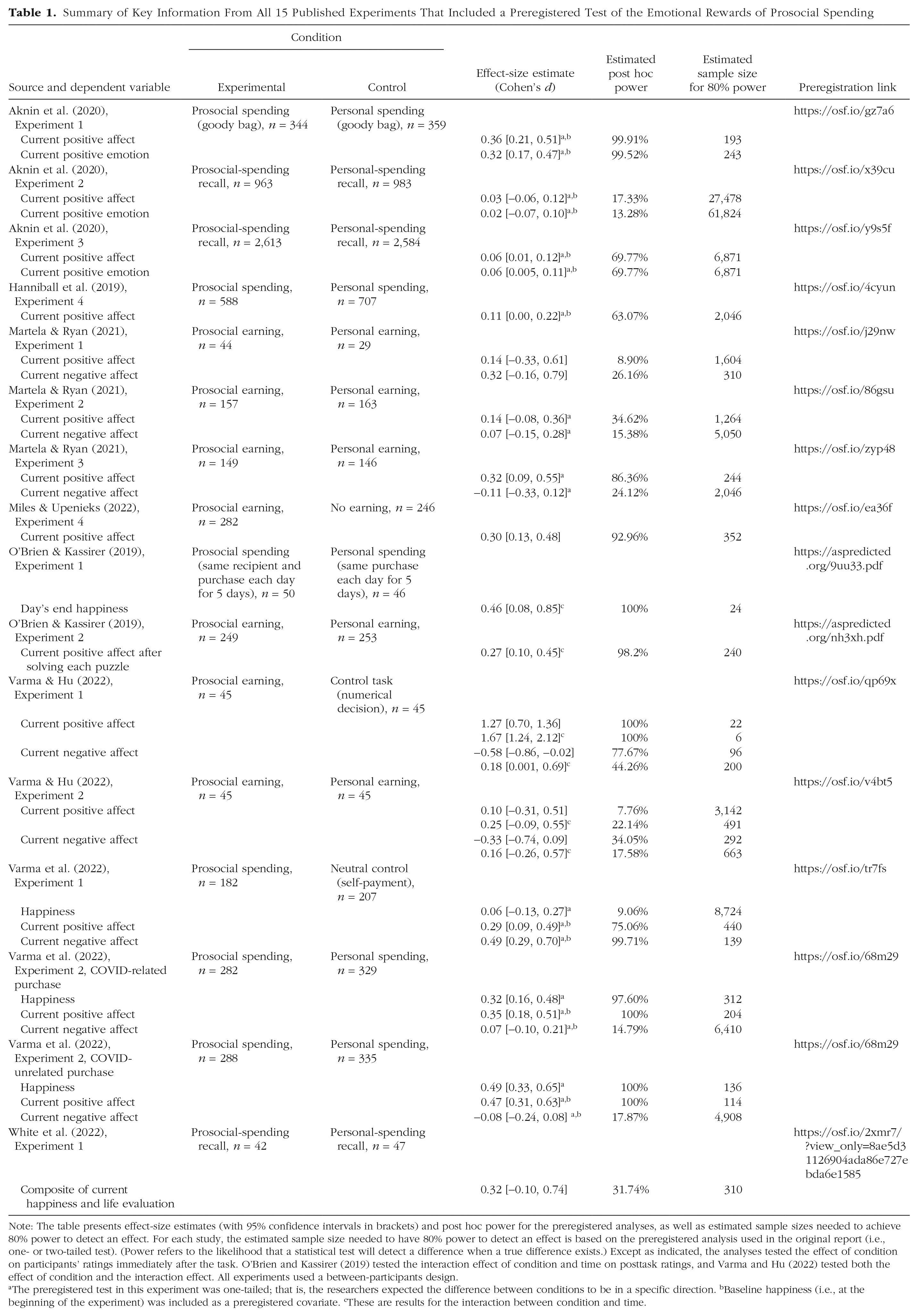
Note: The table presents effect-size estimates (with 95% confidence intervals in brackets) and post hoc power for the preregistered analyses, as well as estimated sample sizes needed to achieve 80% power to detect an effect. For each study, the estimated sample size needed to have 80% power to detect an effect is based on the preregistered analysis used in the original report (i.e., one- or two-tailed test). (Power refers to the likelihood that a statistical test will detect a difference when a true difference exists.) Except as indicated, the analyses tested the effect of condition on participants’ ratings immediately after the task. O’Brien and Kassirer (2019) tested the interaction effect of condition and time on posttask ratings, and Varma and Hu (2022) tested both the effect of condition and the interaction effect. All experiments used a between-participants design.
The preregistered test in this experiment was one-tailed; that is, the researchers expected the difference between conditions to be in a specific direction. bBaseline happiness (i.e., at the beginning of the experiment) was included as a preregistered covariate. cThese are results for the interaction between condition and time.
Given the importance of statistical power for obtaining reliable effects, we separate our findings into two parts: First, we review all experiments with sample sizes that meet Curry and colleagues’ (2018) minimum recommended threshold of 200 participants per condition (what we call “larger experiments”), and then we briefly review those that do not meet this threshold. As Figure 1 shows, the emotional rewards of prosocial spending are detectable in nearly all the larger experimental studies, but the results are no more predictable than a coin flip in smaller studies.
Experiments Examining the Emotional Benefits of Prosocial Spending
Larger experiments (n ≥ 200 per condition)
Seven larger preregistered experiments have examined the emotional rewards of prosocial spending. As part of a registered report, we (Aknin et al., 2020, Experiment 1) conducted a lab experiment to investigate the emotional benefits of prosocial spending using a tightly controlled, theoretically informed design called the goody-bag paradigm. In this paradigm, participants report their baseline happiness and learn that they have earned a small windfall that they can use to purchase a goody bag filled with treats (e.g., chocolate) at a steeply discounted price. In light of past research demonstrating that exercising choice is necessary to feel happiness from giving (Weinstein & Ryan, 2010), participants are presented with choices: They can decide whether they would like to buy a goody bag and also can select its contents. Critically, participants are randomly assigned to one of two conditions. In the personal-spending condition, participants see a goody bag being packaged for themselves. In the prosocial-spending condition, participants see a goody bag being packaged for a sympathetic and deserving beneficiary: an anonymous sick child at a local children’s hospital. After the purchase, participants report their current positive emotions. Using this goody-bag paradigm, we found that participants in the prosocial-spending condition reported feeling significantly happier than participants in the personal-spending condition, as predicted (Aknin et al., 2020). Participants in the prosocial-spending condition who chose not to make a prosocial purchase were excluded from analyses (as specified in the preregistration), but the emotional benefits of prosocial (vs. personal) spending remained when these participants were included in analyses. Thus, we obtained clear evidence for the immediate emotional rewards of prosocial spending in a large preregistered lab experiment.
The emotional benefits of prosocial spending emerge even under conditions in which people might be inclined to focus more on their own needs. Varma and colleagues (2022, Experiment 2) tested the emotional benefits of prosocial spending by using the goody-bag paradigm near the beginning of the COVID-19 pandemic, a time marked by stress and uncertainty—which previous research suggests can provoke relatively egocentric concerns (e.g., Todd et al., 2015; but see Vieira et al., 2020). The researchers varied whether participants had the opportunity to buy items relevant to dealing with the pandemic (e.g., hand sanitizer) or irrelevant items (e.g., snacks). Depending on condition, participants were offered the chance to buy these supplies for themselves (personal spending) or for a needy child (prosocial spending). Results were consistent with the preregistered hypotheses: Participants in the prosocial-spending conditions reported greater happiness and positive emotions than participants in the personal-spending conditions after the purchase (although negative emotions did not differ across conditions). The observed differences were smaller and less robust when people bought items that were directly related to COVID-19 than when they bought COVID-unrelated items. Still, it appears that the emotional rewards of giving are detectable even during times of uncertainty and concern, such as a pandemic.
In addition to examining whether the benefits of prosocial spending emerge even in contexts that might be expected to enhance self-interest, researchers have tested whether these benefits emerge among individuals who are prone to prioritizing their own self-interest. Because people who have committed serious crimes tend to exhibit heightened self-interest, Hanniball and colleagues (2019, Experiment 4) recruited a sample of former offenders online. On the basis of random assignment, participants received the opportunity to use a small payment to donate to one of two visible and real online charitable campaigns (prosocial spending) or to buy a similar personal item that would be mailed to them (personal spending). Results were consistent with the preregistered hypotheses: Participants who spent on other people reported greater positive emotions afterward than did participants who spent on themselves. Notably, the effect size was smaller than that detected in behavioral experiments conducted with nonoffender samples. However, observing any benefit in this population suggests that the emotional rewards of prosocial spending emerge even for individuals who tend to prioritize their own self-interest.
Although most research on prosocial spending, as the term suggests, has examined spending, recent studies that are considered to be part of this literature have examined how people feel after earning money for charity. Miles and Upenieks (2022, Experiment 4) asked participants to complete math problems online. In the prosocial-earning condition, the researchers donated 10¢ to the American Red Cross for each problem the participant solved correctly; in the personal-earning condition, participants themselves received 10¢ for each problem they solved correctly; and in the control condition, there was no reward for good performance. As predicted, prosocial earners reported higher positive emotions than did participants who received no reward at all. The authors did not preregister a comparison between the prosocial- and personal-earning conditions, but exploratory analyses revealed that participants felt happier after earning a reward for themselves than after earning money for charity. We speculate that earning a reward for charity was better than earning nothing—but worse than earning for oneself—because participants had no choice about whether or how to donate.
Indeed, O’Brien and Kassirer (2019, Experiment 2) used a very similar paradigm in which participants attempted to complete 10 puzzles. Participants in the prosocial-earning condition earned 5¢ for charity for every puzzle they solved; prior to completing the puzzles, they were presented with information about the importance of five charities and allowed to choose the charity that was most meaningful to them. Participants in the personal-earning condition earned 5¢ per puzzle for themselves. After solving each puzzle, participants reported their happiness, and all participants were sent a confirmation of the donation or personal payout within 1 week, to underscore the impact of their contribution. The emotional rewards of repeated personal earnings faded quickly, but the happiness of repeatedly earning money for charity was slower to dissipate, occurring at approximately half the speed across the 10 puzzles. These results suggest that people may continue to reap emotional rewards from repeated instances of earning money for the same charity—as long as they are able to choose a charity that is meaningful to them.
Finally, we conducted two large preregistered experiments to examine whether recalling a past instance of prosocial spending leads to happiness (Aknin et al., 2020, Experiments 2 and 3). In both studies, participants were randomly assigned to describe a time when they spent approximately $20 on themselves or someone else, and then they reported their current positive emotions. In the first study, participants who recalled spending on other people were no happier than participants who recalled spending on themselves. This result was not consistent with the preregistered predictions or with the results of past research. One reason for these null results may have been that many participants wrote brief and pallid descriptions of their spending experiences (e.g., one participant wrote “buy coffee”). Therefore, in a follow-up experiment, we made several preregistered changes to bolster participants’ engagement, such as requiring a minimum character count for descriptions of their spending. The results demonstrated the importance of increased engagement, as participants who described a prosocial-spending experience reported more positive emotion in the moment than did participants who described spending on themselves. It is important to note, however, that the effect sizes seen in the recollection paradigm were very small—one sixth of the effect size observed using the goody-bag paradigm (Aknin et al., 2020, Experiment 1). Thus, the benefits of prosocial spending may be larger when participants spend money on other people during the study than when they simply reflect on past experiences.
Prosocial spending led to higher happiness than a relevant control condition in six out of the seven large experiments with preregistered analyses testing this prediction. The studies used a variety of paradigms and populations—from undergraduates to ex-offenders—which suggests that this effect is robust and replicable in large samples. However, the benefits of prosocial spending appear to be relatively weak when people do not have a choice about how to give, lack information about how their donation will make a difference (see Fig. 1), or simply recall a past experience of giving.
Smaller experiments (n < 200 per condition)
The fairly consistent support for the emotional rewards of prosocial spending in larger samples may lead scholars to assume that this finding should be easy to detect even in smaller samples. It is not. Of the eight experiments that fail to meet the minimum sample-size threshold of 200 participants per condition, only four provide even partial support for the emotional rewards of prosocial spending. Still, although the “success rate” is weaker for the smaller experiments than for the larger ones, the same key methodological features can potentially account for the hits and misses.
Choice and impact
Small studies that give people a choice about how to help—and enable them to see how their actions make a difference—are more likely to yield evidence for the emotional benefits of generosity than are small studies that do not give participants a choice. In two experiments, Varma and Hu (2022) invited participants in the prosocial condition to choose one of four local charities, and these participants were given repeated opportunities to donate money to their chosen charity at no cost to themselves. Participants in this prosocial condition reported greater positive affect compared with participants who received no reward (Experiment 1), though not compared with participants who earned money for themselves (Experiment 2). Similarly, Varma et al. (2022, Experiment 1) gave participants the choice of donating to one of two charities; participants in this prosocial condition reported greater positive affect compared with participants who received money for themselves, although conflicting results emerged on other measures (e.g., negative affect). In contrast, Martela and Ryan (2021) conducted three experiments in which participants in the prosocial condition had no choice about where to give and no information about why their donation mattered—they were simply told that they would earn money for the Red Cross, as well as for themselves. In just one of these three experiments, participants who earned money for both the Red Cross and themselves reported significantly greater positive emotions than participants who earned money only for themselves.
Stronger evidence for the emotional benefits of prosocial spending comes from a higher-impact experiment in which participants chose how to spend $5 per day for 5 consecutive days (O’Brien & Kassirer, 2019, Experiment 1). Participants in the prosocial-spending condition could choose how to spend the money on someone else in their everyday lives, although they had to spend the money in the same way each day (e.g., by bringing their partner a favorite candy each night). Participants in the personal-spending condition could choose how they wanted to spend the money on themselves, also in the same way each day (e.g., buying themselves a latte from the same coffee shop at 3 p.m. daily). Whereas participants quickly adapted to purchasing the same item for themselves each day (i.e., they exhibited declining happiness over the 5 days), participants who purchased the same item for the same recipient each day continued to experience elevated happiness across the 5 days.
Behavior versus recall
Although all of the smaller experiments reviewed above examined actual financial behavior in the moment, one additional study used a recollection paradigm in which participants were asked to recall a time when they spent money on themselves, another person, or a pet (White et al., 2022, Experiment 1). Although participants felt happier after recalling spending money on a pet rather than on themselves, they did not feel significantly happier after recalling spending money on another person rather than on themselves. This null result dovetails with our observations from the larger experiments: The benefits of prosocial spending are difficult to detect using recollection paradigms.
Integration
Only four of the eight smaller experiments provide any support for the causal impact of prosocial spending on well-being, a result that underscores the importance of larger samples for detecting this effect. Those smaller studies in which the benefits of prosocial spending were detected have several notable features: In most cases, participants were given the opportunity to exercise choice and to comprehend the positive influence of their actions. In addition, the benefits of prosocial spending were found only when emotion was assessed at the time the prosocial behavior happened or soon thereafter, and not when it was recalled. Not surprisingly, these benefits were more likely to emerge when the prosocial-spending condition was compared with a neutral control condition, as opposed to the more relevant comparison condition in which people got something for themselves.
Future Directions
Although early experiments were underpowered and relied on nonpreregistered designs that are susceptible to false positives, this review demonstrates that the emotional benefits of prosocial spending are replicable and robust in large preregistered experiments. In contrast, the evidence from smaller studies is much more mixed. Therefore, we recommend that researchers conduct preregistered experiments with at least 200 participants per condition and enable participants to make vivid and meaningful choices in the moment. We recognize that the need for larger sample sizes may spur researchers to conduct experiments in which participants recall a past spending experience or decide about a trivial amount of money (e.g., 5¢). However, our review suggests that these strategies may backfire. As predicted by self-determination theory (Ryan & Deci, 2000), people are more likely to experience happiness when they have the opportunity to make choices about their generous spending and see how their actions have a positive affect on others. It is also important to think carefully about how to measure happiness. To detect the immediate benefits of prosocial spending, we recommend using well-validated, multi-item measures of state positive emotions.
Understanding the conditions that maximize the emotional benefits of prosocial spending is critical, not only for research, but also for laypeople and practitioners who are interested in promoting happiness and generosity. For instance, charities should offer opportunities for donors to choose how to give and enable donors to see the specific impact of their gifts.
Although our review has focused on situational features of prosocial spending that amplify the emotional rewards for most people, future research could examine whether some forms of prosocial spending may be especially rewarding for certain individuals (Lyubomirsky & Layous, 2013), a possibility akin to the idea behind personalized medicine. We hope that in the next decade, blanket advice to spend money on other people will be replaced by personalized giving suggestions tailored to individuals’ interests and personalities.
Recommended Reading
Aknin, L. B., Dunn, E. W., Proulx, J., Lok, I., & Norton, M. I. (2020). (See References). A report on three large preregistered experiments demonstrating the emotional rewards of prosocial, compared with personal, spending, but also variation in those rewards based on important features of study design.
Curry, O. S., Rowland, L. A., Van Lissa, C. J., Zlotowitz, S., McAlaney, J., & Whitehouse, H. (2018). (See References). A recent review and meta-analysis of the prosociality and well-being literature, offering a converging claim that large samples (n > 200 per condition for between-participants designs) are needed to reliably detect a causal effect.
Nelson, L. D., Simmons, J., & Simonsohn, U. (2018). (See References). A detailed and thoughtful discussion that covers how the field of psychology has adopted new methods to minimize bias and inaccuracy in research and that makes a strong case for the importance of transparency and preregistration in improving the field, and science more broadly.
