



Abstract
The vast majority of research on autism spectrum disorder (ASD) focuses on characterizing and addressing the social communication deficits and restricted, repetitive patterns of behavior that constitute the diagnostic criteria for the disorder. Yet a small but significant portion of individuals diagnosed with ASD exhibit exceptional cognitive abilities in one or more domains. These twice-exceptional individuals often have unique skills that potentially enable them to make significant contributions to the workforce, but at the same time face unique challenges during the transition to independent living because of a lack of services and broad public misperceptions regarding their condition. Here I review the current literature on cognitive divergence in ASD, focusing on cognitive theories, neural substrates, and clinical and societal implications.
According to the Autism and Developmental Disabilities Monitoring Network, autism spectrum disorder (ASD) is diagnosed in one in forty-four 8-year-old children in the United States (Maenner et al., 2021), and the prevalence is rising every time it is measured. The most recent version of the Diagnostic and Statistical Manual of Mental Disorders (DSM; American Psychiatric Association, 2013) outlines diagnostic criteria for ASD, which include deficits in social communication and interaction across multiple contexts and restricted, repetitive patterns of behavior (RRBs) that are present early during development and cause significant impairment in social and occupational functioning. 1 The vast majority of research and treatment efforts are, perhaps justifiably, devoted to ameliorating social communication deficits and addressing RRBs in individuals most severely affected by the disorder. The purpose of the current selective review is to highlight theories and empirical work focusing not on deficits, but rather on strengths or exceptional abilities in ASD, to identify gaps and provide a roadmap for future research on this understudied topic.
ASD is a diagnosis that encompasses a highly heterogeneous group in terms of genetic etiology, behavioral phenotype, cognitive and intellectual function, and life outcomes. Despite the well-documented difficulties that diagnosed individuals and their families encounter, a notable percentage exhibit enhanced cognitive abilities and have positive outcomes. For example, one study found that around 60% of autistic individuals have special isolated skills and enhanced perceptual abilities (Meilleur et al., 2015). In a longitudinal study examining the domains of socialization, communication, independent-living skills, and mental health in children diagnosed with ASD, around 80% of these children were doing well (i.e., showing proficiency or growth) during midchildhood in at least one of these domains, and a little over 20% were doing well in four or five of these domains (Szatmari et al., 2021). These findings highlight the notion that the “spectrum” in ASD refers to the heterogeneity in symptoms and intellectual function observed in individuals who receive this diagnosis.
Compared with the study of social and cognitive impairments in individuals with ASD, the study of enhanced abilities sometimes associated with the diagnosis has received much less attention. Many terms have been introduced to describe enhanced abilities in autism. In this review, I use the terms that the authors of the original studies used, noting that they are not in all cases clearly defined, and may not necessarily refer to the same phenomena despite superficial similarities.
Autistic individuals with enhanced abilities are sometimes referred to as twice-exceptional—exceptional both for having an ASD diagnosis and for having enhanced cognitive abilities in some domains. They are also sometimes said to exhibit cognitive divergence, that is, exceptional cognitive strengths in one domain coupled with profound deficits in another (see Table 1 for definitions of these and other terms used in this review). Difficulties with defining giftedness and the fact that educators are often not familiar with the diagnosis of twice-exceptionality, appropriate interventions, and how to advocate for these individuals have contributed to the relative dearth of empirical research on this topic, much of which has been descriptive (Assouline et al., 2012).
Glossary of Terminology Used in This Review
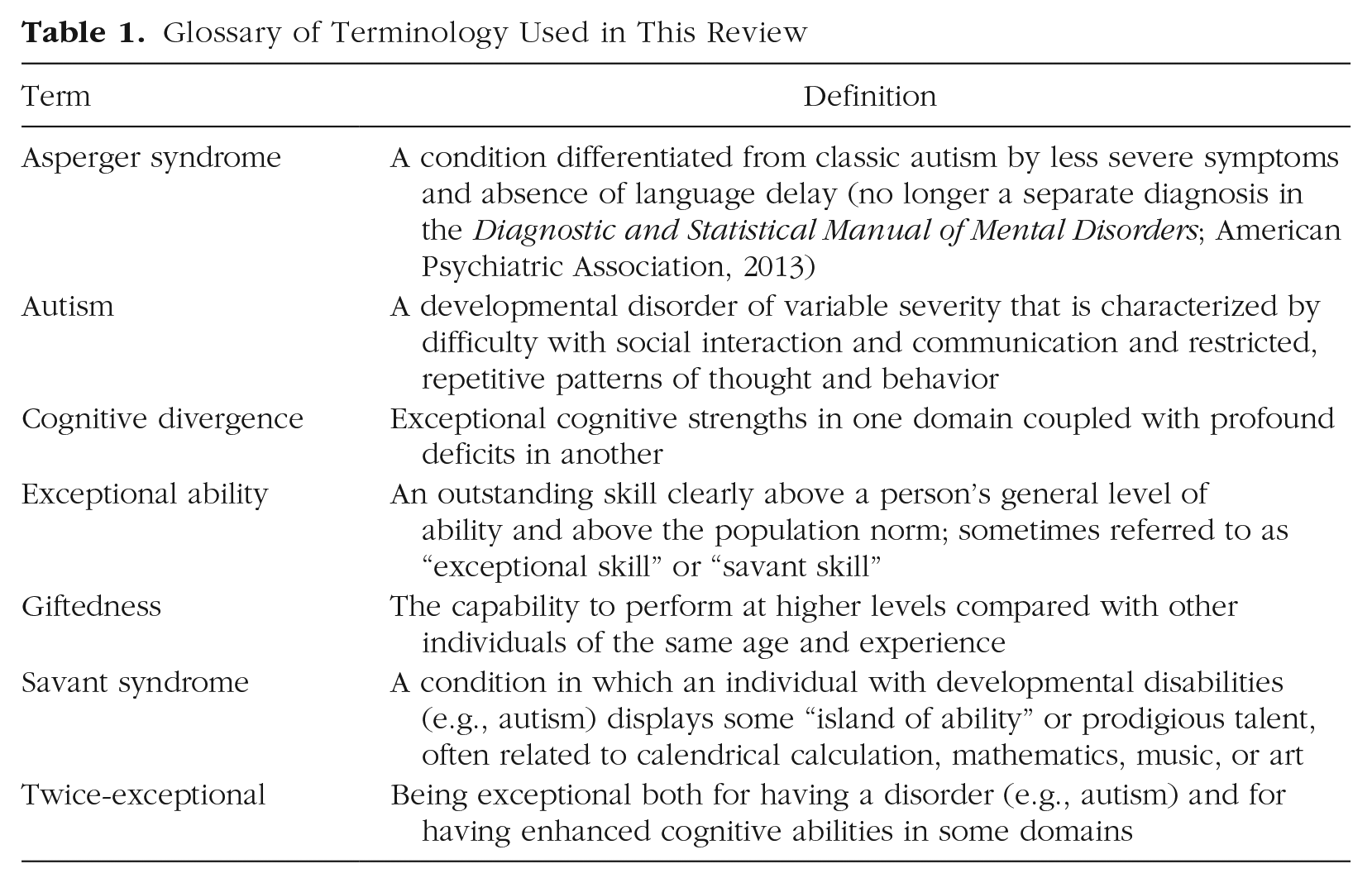
Many readers may be familiar with the term savant syndrome, which refers to a condition in which an individual with developmental disabilities (autism or another disorder) displays some “island of ability,” or prodigious talent, often related to calendrical calculation, mathematics, music, or art. In a savant syndrome registry including 319 individuals, 75% of the savants had a common underlying ASD diagnosis (Treffert & Rebedew, 2015). Savant skills exemplify the heterogeneity of the autism spectrum and are associated with many myths and misconceptions that have recently been debunked. For example, not all savants are autistic, and not all autistic persons are savants. Likewise, savant syndrome is not always associated with low IQ. In addition, despite initial reports that savants as a group are not very creative, more recent observations provide a different picture. One musical savant was able to play back a Tchaikovsky piano concerto flawlessly after having heard it for the first time on TV. But in concerts performed later in life, the same individual incorporated not only replication, but also improvisation into his performances by changing the pitch and tempo to produce variations on well-known pieces, and eventually began creating and composing entirely new musical pieces (Treffert, 2014).
Adding to the confusion surrounding twice-exceptionality and cognitive divergence in ASD is the fact that the diagnostic criteria for the disorder are still evolving. For example, the term Asperger syndrome was included in DSM’s fourth edition, in 1994, to delineate high-functioning autism, but it was dropped in the fifth edition, released in 2013, which subsumed Asperger syndrome under the ASD umbrella. This alternating terminology has made it particularly challenging to track the relevant literature on exceptional abilities in autism, which can be observed in both high-functioning autism and autism with intellectual disability. In the following sections, I begin by summarizing cognitive theories of exceptional abilities in ASD and then move on to review what is known regarding neural correlates of these abilities. I then discuss clinical and societal implications of this phenomenon and close by suggesting future directions for this emerging line of research.
Theories and Cognitive Profile of Exceptional Abilities in Autism
A number of theories have been put forth to account for exceptional abilities in autism. A sampling of these theories and relevant empirical work is provided here. The three that are most relevant for the current discussion (see Fig. 1) are the hyper-systemizing theory (Baron-Cohen & Lombardo, 2017), the weak central coherence theory (Happé & Frith, 2006), and the enhanced perceptual functioning theory (Mottron et al., 2006).
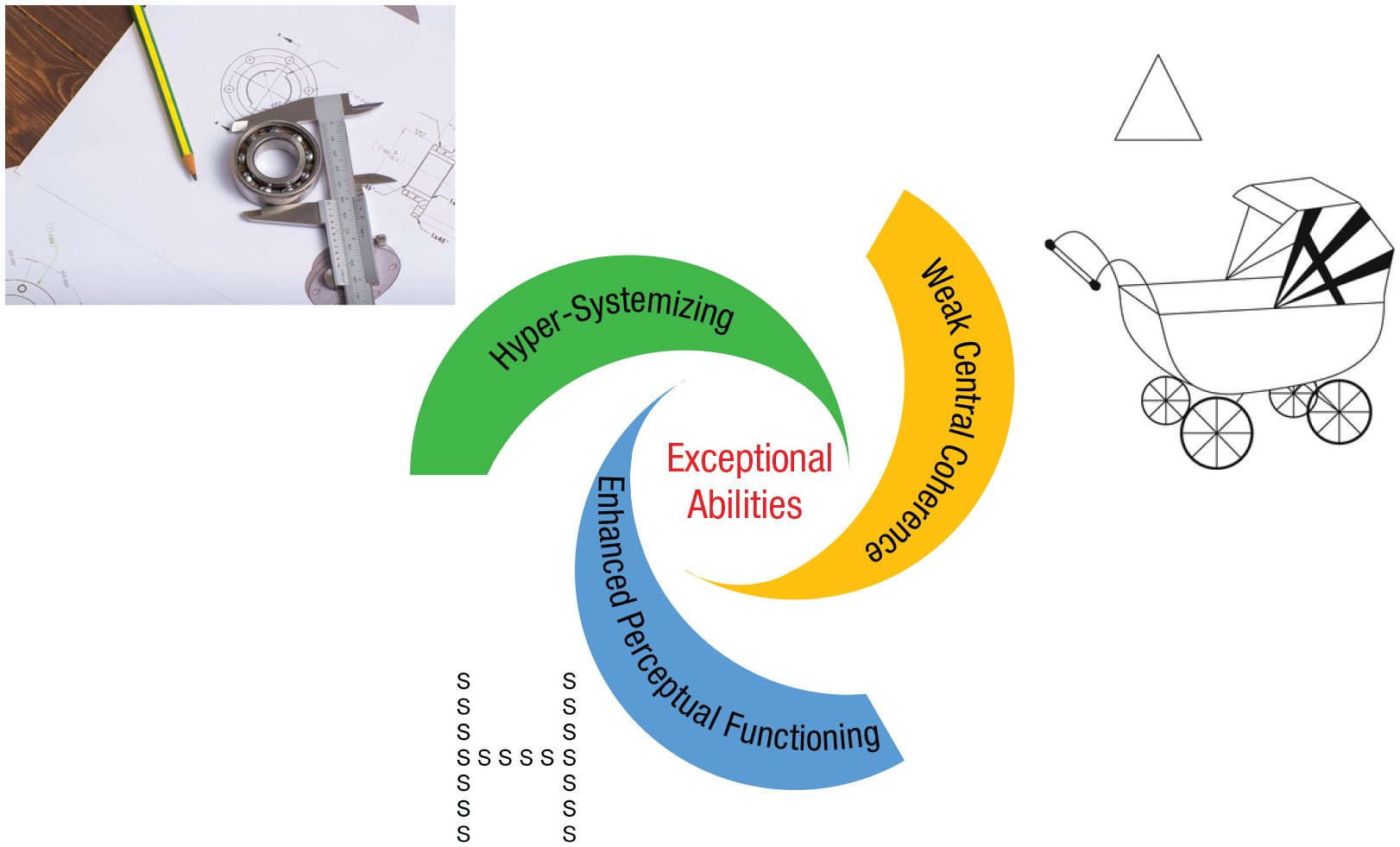
Three cognitive theories that have been proposed to account for exceptional abilities in autism: hyper-systemizing theory (Baron-Cohen & Lombardo, 2017), weak central coherence theory (Happé & Vital, 2009), and enhanced perceptual functioning theory (Mottron et al., 2006). Hyper-systemizing may contribute to special skills in mathematics. Weak central coherence and enhanced perceptual functioning could lead to focusing on the details of a specific object (e.g., finding the triangular shapes in a drawing of a baby carriage or concentrating on the smaller shapes that make up a larger letter) and “missing the forest for the trees.”
Hyper-systemizing theory
Systemizing is the drive to construct systems, and it has been hypothesized to provide an explanation for the link between autism and exceptional abilities (Baron-Cohen et al., 2009). The hyper-systemizing theory posits that people with autism are hyper-systemizers, individuals who are motivated to identify lawful regularities that govern the relations among a system’s input, operations, and output. According to this theory, obsessive systemizing in the domains of calendrical calculation, mathematics, and music contributes to savant skills in those domains (Baron-Cohen & Lombardo, 2017). The Systemizing Quotient is a self-report questionnaire designed to measure this tendency in an individual and includes questions such as “I am fascinated by how machines work” and “In maths, I am intrigued by the rules and patterns governing numbers” (Baron-Cohen et al., 2003). The hyper-systemizing theory posits that attention to detail in autism functions to achieve the goal of understanding any kind of system, and strong systemizing explains RRBs such as narrow interests and insistence on sameness (Baron-Cohen et al., 2009).
One study compared cognitive, perceptual, and behavioral profiles of autistic adults with savant skills (n = 44), autistic adults without savant skills (n = 36), and neurotypical individuals without autism or savant skills (n = 31). The authors found that that the group with savant skills had higher sensory sensitivity and exhibited more obsessive behaviors and more systemizing than the other two groups (Hughes et al., 2018).
Weak central coherence theory
Several theoretical accounts have focused on detail-focused cognitive styles (Happé & Vital, 2009)—such as those associated with RRBs—as predispositions for the emergence of special skills and talents in autism. According to the weak central coherence theory of autism, both deficits and strengths in diagnosed individuals’ perceptual processes arise from a bias for featural and local information that results in failure to extract the gist, or “big picture.” This detail-focused cognitive style leads to potential superiority in local or detail-focused processing (Happé & Frith, 2006). Early support for the weak central coherence theory as an explanation of islands of ability in autism came from the Embedded Figures Test, in which ability to attend to perceptual details is assessed by asking participants to place cut-out target shapes on top of matching hidden shapes in a larger picture (Shah & Frith, 1983; Fig. 1). More recent larger-sample studies using the Embedded Figures Test, however, have not found evidence for superior performance in children with ASD (White & Saldaña, 2011).
Enhanced perceptual functioning theory
Closely related to the central coherence theory is the enhanced perceptual functioning theory. Superior performance on visual search tasks has been noted in children and adults with high-functioning autism. In these types of attention tasks, participants are asked to locate a target item embedded within an array of distractors. For example, participants may be presented with letter shapes that are made up of smaller symbols (see Fig. 1) and instructed to attend to the smaller symbols (i.e., local elements), which may or may not match the global letters. A recent review of studies investigating visual search superiority in autism revealed a small to moderate advantage overall, depending on the nature of the experimental task, but not a consistent advantage (Constable et al., 2020). Cognitive mechanisms that have been proposed to underlie superior search performance of autistic individuals include enhanced perceptual discrimination (Kaldy et al., 2016)—specifically, enhanced simultaneous discrimination of multiple visual stimuli (Shirama et al., 2017)—and altered attentional processes (Keehn & Joseph, 2016).
Mottron and colleagues (2006) first formulated the enhanced perceptual functioning theory after observing an autistic individual with savant syndrome who favored local elements in perceptual tasks. They hypothesized that the development of savant abilities requires an encounter with a perceptually defined class of units, combined with learning and generalization to new material. Performance on Raven’s Progressive Matrices, used as a test of intelligence, and the Block Design subtests within the Wechsler intelligence scales often also reveals unique strengths in autism that are related to enhanced perceptual functioning and discrepant with measures of verbal ability (Dawson et al., 2007).
Conclusion
At this juncture, it would be premature to conclude that any of the major theories of autism outlined here will best account for exceptional abilities in ASD, given the mixed empirical support. For example, there is evidence for enhanced performance on perceptual tasks in individuals with autism who do not necessarily exhibit exceptional abilities (Samson et al., 2012).
Empirical Research on Exceptional Abilities in Autism
Although there are several theoretical accounts of exceptional abilities in autism, a review published in 2011 identified only five empirical studies on twice-exceptional children with ASD in the prior 20 years (Foley Nicpon et al., 2011). A study of academic experiences of 59 twice-exceptional children with ASD (ages 5–17) found that indices of their working memory and processing speed were significantly positively correlated with their reading, mathematics, and written-language achievement. The authors also noted that working memory and processing speed explained 61% of the variance in reading achievement and that fine motor skills predicted math achievement (Assouline et al., 2012).
Most of the studies to date were conducted on relatively small samples of twice-exceptional individuals with ASD. A larger study of 1,470 children with autism (4–18 years old) found that 46% had at least one parent-reported “extraordinary talent” in the areas of memory, reading, and computation. An additional 23% had at least one personal strength. These autistic children’s cognitive profiles were different from those of autistic children with no reported extraordinary talents or personal strengths (Bal et al., 2022). In an earlier study of 137 individuals with autism who had a range of intellectual abilities, 28.5% of the sample met criteria for either a savant skill or an exceptional visuospatial or mathematical skill. Contrary to the theory that savant skills are associated with ritualistic behaviors and circumscribed interests (O’Connor & Hermelin, 1991), this study did not find evidence of a relationship between severity of RRBs and savant abilities (Howlin et al., 2009).
As already noted, some individuals with ASD have exceptional math and reading skills. Although the majority of individuals with Asperger syndrome or high-functioning autism have average mathematical ability, some exhibit mathematical giftedness (Chiang & Lin, 2007). In a study of 114 children with ASD, Chen and colleagues (2019) found evidence for a subgroup whose math skills were poor compared with their reading skills and another subgroup whose math skills were high compared with their reading skills. These findings underscore the heterogeneity that is so often observed in this population.
Neural Basis of Exceptional Abilities in Autism
If there have been few empirical investigations of exceptional abilities in autism, there have been even fewer studies examining the neural basis of these abilities. Most of the few neuroimaging studies that exist are case reports of single individuals. Wallace et al. (2009) reported the case of an individual (GW) with Asperger syndrome who exhibited savant skills in the domains of art and calendar calculations. Examination of how his cortical thickness compared with that of an age-matched neurotypical group revealed that his cortex was thicker in bilateral superior parietal areas that have been implicated in mathematical cognition (Dehaene et al., 2004). Another case study used functional MRI (fMRI) to compare calendrical calculation strategies in a savant with Asperger syndrome and a self-taught mathematical prodigy. Results revealed that patterns of neural activation differed between these two individuals. Whereas the individual with Asperger syndrome showed widespread brain activation during calendar tasks, the math prodigy with no clinical diagnosis showed more focal parietal patterns of activation (Fehr et al., 2011).
To assess empirical evidence in support of the enhanced perceptual functioning model, Samson et al. (2012) conducted a meta-analysis of 26 fMRI studies focused on face, object, and word processing. Across studies, they observed greater neural activity in temporal, occipital, and parietal regions in individuals with ASD compared with neurotypical individuals (Fig. 2), alongside lower task-related activity in frontal cortices. Given this pattern of activation, the authors suggested that autism may be characterized by enhanced allocation of neural resources to those brain regions involved in visual processing. Although this study did not separate out individuals with enhanced abilities per se, it does point to potential neural mechanisms that might support such abilities.
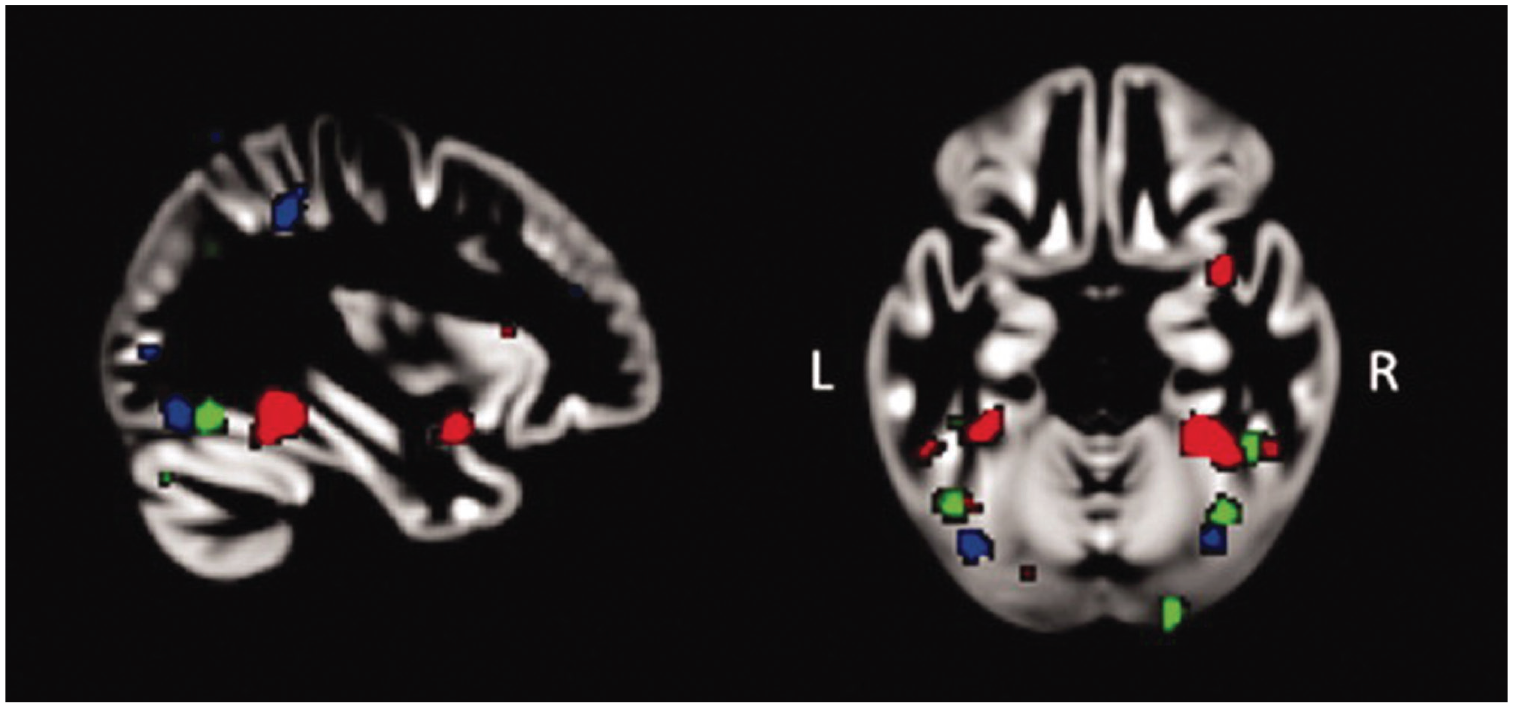
Brain images showing the results of Samson et al.’s (2012) meta-analysis of functional MRI studies investigating brain activation in autistic and neurotypical individuals. The colored regions show the mostly posterior areas where task-related activity was greater among the autistic individuals during face (red), object (green), and word (blue) processing. The image on the left is a side view of the brain, with the front of the brain depicted on the right side of the image and the back of the brain depicted on the left. The image on the right is a top-down view of the brain, with the front of the brain depicted on the top of the image and the back of the brain depicted on the bottom. L = left; R = right. From “Enhanced Visual Functioning in Autism: An ALE Meta-Analysis,” by F. Samson, L. Mottron, I. Soulières, and T. A. Zeffiro, 2012, Human Brain Mapping, 33(7), p. 1569 (https://doi.org/10.1002/hbm.21307). Copyright 2011 by John Wiley and Sons. Reprinted with permission.
Edmonson et al. (2020) used magnetic resonance spectroscopy to investigate superior search abilities in children with ASD and found that greater concentration of the neurotransmitter gamma-aminobutyric acid (GABA) in the visual cortex was related to more efficient search strategies. This finding is in line with the hypothesis that ASD may result from atypically increased cortical excitation due to an imbalance of excitatory glutamatergic signaling and inhibitory GABAergic signaling (the E/I imbalance theory; Rubenstein & Merzenich, 2003).
Superior math abilities in children with ASD have been investigated using fMRI. The conclusion that posterior brain areas are overrecruited in ASD is generally supported by this line of work. A study of 18 children with high-functioning ASD showed that they exhibited better numerical problem-solving abilities and more sophisticated strategies compared with typically developing (TD) children. Conventional analyses examining the brain one portion at a time did not reveal any significant group differences in brain activation during task performance. However, activation patterns across ventral temporal-occipital and posterior parietal cortices distinguished children with ASD from TD children. Further, activation patterns in ventral temporal brain areas that are typically activated during face processing were instead associated with numerical problem-solving abilities in children with ASD (Fig. 3), but not TD children. This suggests that unique neural utilization capabilities subserve mathematical abilities in ASD (Iuculano et al., 2014).
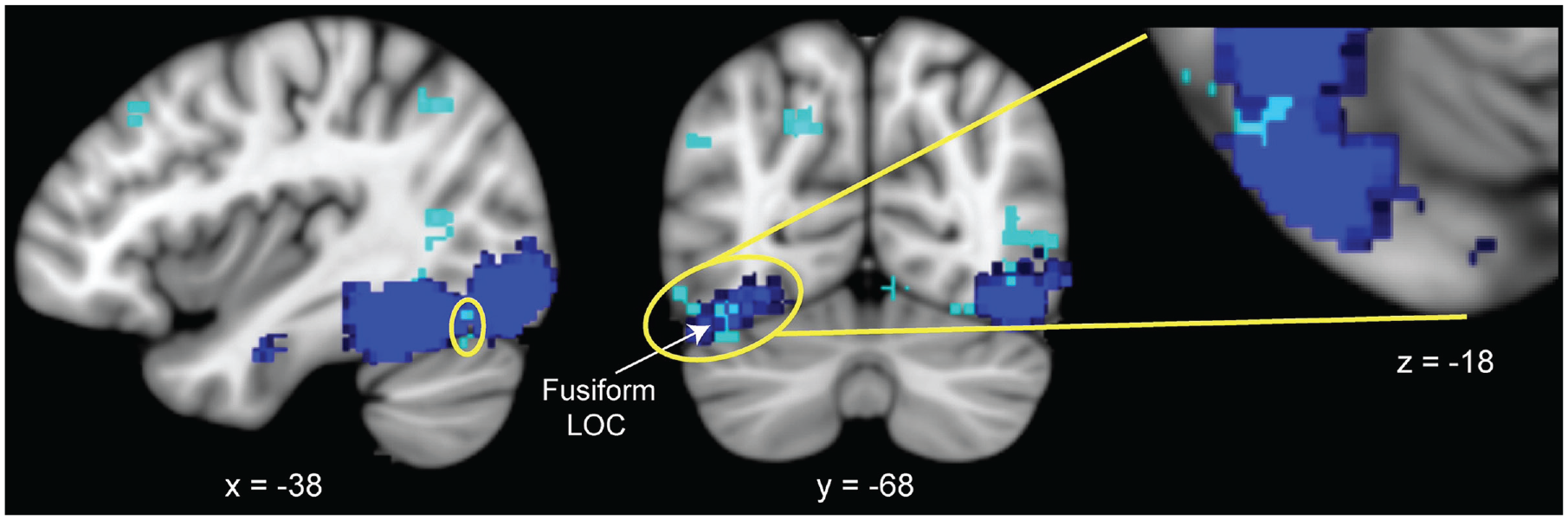
Brain areas within the lateral occipital cortex (LOC) and fusiform gyrus that predict mathematical ability in children with autism spectrum disorder (cyan) and brain areas that are used by neurotypical individuals for processing faces (blue). The image on the left is a side view of the brain, with the front of the brain depicted on the left side of the image and the back of the brain depicted on the right. The image in the middle is a back view of the brain. The yellow ovals highlight regions of overlap, shown in a more close-up, top-down view in the inset on the right. From “Brain Organization Underlying Superior Mathematical Abilities in Children With Autism,” by T. Iuculano, M. Rosenberg-Lee, K. Supekar, C. J. Lynch, A. Khouzam, J. Phillips, L. Q. Uddin, and V. Menon, 2014, Biological Psychiatry, 75(3), p. 228 (https://doi.org/10.1016/j.biopsych.2013.06.018). Copyright 2014 by the Society of Biological Psychiatry. Reprinted with permission.
Taken together, the scant literature on the neural basis of exceptional abilities in autism leaves much to be desired. Limited sample sizes and the lack of an explicit focus on cognitive strengths in autism have contributed to this problem. The findings from the neuroimaging studies reviewed in this section do not necessarily generalize to twice-exceptional individuals with ASD, but provide direction for future studies including this population.
Clinical and Societal Implications
Individuals with ASD who can be characterized as twice-exceptional exhibit exceptional giftedness, but still experience exceptional challenges. Cain and colleagues (2019) analyzed a large longitudinal data set collected over a 6-year period to identify academic trajectories of twice-exceptional children with autism. The children were 3 to 6 years of age at the beginning of the study and 8 to 11 years of age at the end. Those who scored at or above the 90th percentile on any subtest of the Woodcock-Johnson III Tests of Achievement and/or were qualified for the gifted-and-talented program at their school were categorized as “gifted.” Twenty-one percent of the children with ASD in this sample were gifted according to this definition. The academic outcomes of these gifted children improved over time relative to the outcomes of the nongifted children with ASD. The gifted children with ASD also benefited disproportionately from mental-health services (Cain et al., 2019).
As twice-exceptional children enter adolescence and navigate transitions to adulthood, they face additional unique challenges. Interviews with 40 academically talented individuals who were diagnosed with ASD and who were enrolled in competitive colleges revealed that they generally participated in challenging courses, interest-based extracurricular activities, and other advanced educational experiences. A quarter of the sample reported experiencing challenges with the dual identification of both having ASD and being academically talented. Still, many of the interviewees reported attaining a good understanding of their strengths and weaknesses during elementary-school years (Reis et al., 2021). This study highlights the positive contributions to society that twice-exceptional individuals with ASD can make when appropriately supported and encouraged.
Individuals diagnosed with ASD generally have poorer outcomes in transitioning to independent living compared with those who have learning disabilities, intellectual disabilities, or emotional disturbances. Young adults with ASD are the least likely of these disability groups to have ever lived independently since leaving high school (Anderson et al., 2014). Similarly grim statistics highlight the employment gap for autistic adults; only 58% of young adults on the autism spectrum work for pay outside the home between their high-school years and their early 20s (Roux et al., 2015). The statistics for those who are twice-exceptional are more difficult to ascertain. Twice-exceptional children with autism can be misunderstood and thus are often underserved in terms of their social and emotional needs.
Accommodations that parents, clinicians, and educators can engage in to aid twice-exceptional children with ASD academically include allowing them to choose specific reading materials in their areas of interest, avoiding timed tasks, and repeating directions for assignments. Guidelines for enhancing twice-exceptional children’s social skills and addressing their language and communication difficulties are also available (Assouline et al., 2008).
Future Directions
Autism is sometimes linked with savant skills or giftedness. Despite public fascination surrounding this phenomenon, exceptional abilities in autism do not necessarily translate to functional skills for the individuals who exhibit them. Very few of these individuals succeed in using their skills to find permanent employment or improve their social integration over time (Howlin et al., 2009). As I have discussed, twice-exceptional individuals with ASD often have unique skills that potentially enable them to make significant contributions to the workforce, but at the same time, they face unique challenges during the transition to independent living because of a lack of appropriately tailored services (Assouline et al., 2008). A priority for future research is identifying predictors of, and contributors to, successful social, academic, and occupational trajectories for these individuals.
There is much that is unknown regarding the neural basis of exceptional abilities in autism at present; there are many theories, but few reports of empirical investigations. With the exception of a handful of case studies that have been conducted to date, the neural correlates of cognitive divergence in autism are unspecified. Without dedicated research funding, the mystery of the neural architecture supporting this phenomenon will remain unsolved. Whereas autism research has historically focused on understanding social and cognitive difficulties that diagnosed individuals experience, a greater emphasis on strengths and islands of ability will ultimately be required to fully characterize the heterogeneity in this increasingly prevalent neurodevelopmental disorder.
Recommended Reading
Assouline, S. G., Foley Nicpon, M., Colangelo, N., & O’Brien, M. (2008). (See References). Provides a comprehensive summary for professionals, including guidelines for service providers, clinicians, and educators working with twice-exceptional children with autism spectrum disorder (ASD).
Foley Nicpon, M., Allmon, A., Sieck, B., & Stinson, R. D. (2011). (See References). Summarizes findings from the few empirical investigations of twice-exceptional individuals with ASD.
Iuculano, T., Rosenberg-Lee, M., Supekar, K., Lynch, C. J., Khouzam, A., Phillips, J., Uddin, L. Q., & Menon, V. (2014). (See References). Reports the only empirical investigation of brain activity supporting enhanced mathematical ability in children with ASD.
