




Abstract
It has become common practice to conceptualize bias as an automatic response, cultivated through exposure to bias in society. From this perspective, combating bias requires reducing a proclivity for bias within individuals, as in many implicit-bias training efforts common in schools and corporations. We introduce an alternative approach that begins with the presumption that people are inherently complex, with multiple, often contradictory, selves and goals. When the person is conceptualized this way, it is possible to ask when biased selves are likely to emerge and whether this bias can be sidelined—that is, whether situations can be altered in potent ways that elevate alternative selves and goals that people will endorse and for which bias would be nonfunctional. Using both classic and contemporary examples, we show how sidelining bias has led to meaningful improvements in real-world outcomes, including higher academic achievement and reduced school suspensions, less recidivism to jail, and less stereotyping in mass advertisements.
Do I contradict myself? Very well then I contradict myself, (I am large, I contain multitudes.)
People are complicated: They have enormous capacity for both good and evil. Seminary students preparing a lecture on the Good Samaritan may help a bystander in need but instead may walk right on by if they are running a few minutes late (Darley & Batson, 1973). This situationism—the power of seemingly “small” changes in situations to influence behavior—is a profound lesson of social psychology (Ross & Nisbett, 2011). Yet surprisingly, this insight has not been adequately integrated into an understanding of social bias, which we define as both an affective and cognitive response (i.e., prejudice and stereotype, respectively) that drives negative treatment (discrimination) because of a perception of another person’s social group membership. This review addresses a specific problem: When people are likely to behave in biased ways that harm others, how can one effectively intervene to encourage more positive, prosocial, and nonbiased behavior?
In modern society, it is common to take a direct approach. Many organizations (e.g., schools, corporations) attempt to rid staff of undesirable biases by way of implicit-bias training, which typically makes people aware of bias and offers cognitive strategies to mitigate it (but see Kawakami et al., 2008). There is no doubt that there is value in broad public education efforts concerning bias. There is, moreover, a particular need to recognize systematic forms of bias so people can begin to grapple with these as a society (Rucker & Richeson, 2021). Yet research shows that such bias-reduction strategies are often ineffective and may even backfire in real-world contexts (Forscher et al., 2019; Lai et al., 2016; Paluck et al., 2021). One challenge is that if bias is “in the air,” it may be so ubiquitous and multiply reinforced that it may be difficult to counter directly. Certainly, an older tradition also emphasizes the potential to reduce bias through broad and sustained situational factors, especially intergroup contact, particularly under certain conditions (e.g., equal status; Allport, 1954; Pettigrew & Tropp, 2006). Yet such approaches may often not be available to organizations. What, then, can organizations do (Onyeador et al., 2021)?
Common approaches are based on a strong assumption that the cause of a person’s biased behavior lies in that person’s deeply embedded internal qualities. But what if the focus is instead placed on the interplay between the person and the situation, especially as interpreted by the person (Ross & Nisbett, 2011)? This focus suggests that even if all people are exposed to bias and have the potential to behave in biased ways, this is not all they are, could be, or want to be. The critical questions become, “How do situations evoke biased or nonbiased potentials in individuals?” and “How can situations be altered so that people become the better selves they really want to be?”
We call this approach “sidelining bias.” Consider a metaphor from sports. Imagine the person as a team comprising many players (working selves). Each player can pull the team in a different direction. If one player has the potential to hinder the team’s potential to win the game in a given circumstance (e.g., a biased working self), then the strategy is to replace that player and bring in someone else better suited for the situation, that is, to sideline the problematic player. The potential for bias still exists on the team (in the person), but it is latent. It is no longer active. It has been benched.
Thus, we theorize that it is often helpful to conceptualize people as inherently complex, with multiple, often contradictory, selves, identities, and goals. In doing so, we integrate social bias with advances in basic theorizing about the development of personality and motivation, including McConnell’s (2011) multiple self-aspects framework, which describes the self as “a collection of multiple, context-dependent selves” (p. 3); Mischel and Morf’s (2003) theory of personality as a cognitive-affective processing system comprising many if-then contingences (“if X situation, then think, feel, and behave Y”); and Dweck’s (2017) theory of personality and motivation, which posits that “BEATs” (sets of
According to this broad theoretical approach, people develop and can have available multiple perspectives from which they interpret the world and from which their feelings and action may arise. We call these working selves. These working selves can remain latent and inactive until they become functional (i.e., until they would be helpful for working toward goals in a specific situation), at which time they may come on-line to guide behavior (see Moskowitz, 2002). It is entirely possible for a person to have some working selves that are biased (e.g., a political-ideology self) and others that are nonbiased or even antibiased (e.g., a professional self). When the person is conceptualized this way, it is possible to ask when negative or biased selves are likely to emerge (Spencer et al., 2016). Moreover, one can learn how to alter situations to elevate alternative positive working selves—namely, by foregrounding ideal goals that people will endorse; that they can organize their thoughts, feelings, and behavior around; and for which bias would be nonfunctional. (As we discuss later, these are often prosocial goals defined by professional roles.) The goal is to sideline bias, to reduce its accessibility in a real-world context or its relevance to the goals the person is seeking to achieve, and thus to reduce its hold on consequential behavior.
The sidelining approach is fundamentally different from common bias-reduction approaches (Fig. 1, Table 1). First, this approach treats bias (or nonbias, or antibias) as an expression of the working self and the kinds of goals that this self can pursue in a given context. This shifts responsibility and causality from bad individuals (e.g., “racists”) to bad contexts (those that elicit biased selves and behaviors). The sidelining approach thus challenges the architects of contexts to recognize these dynamics and, when necessary, to change contexts to elicit better selves and behaviors (Fiske et al., 2004; Murphy & Walton, 2013).
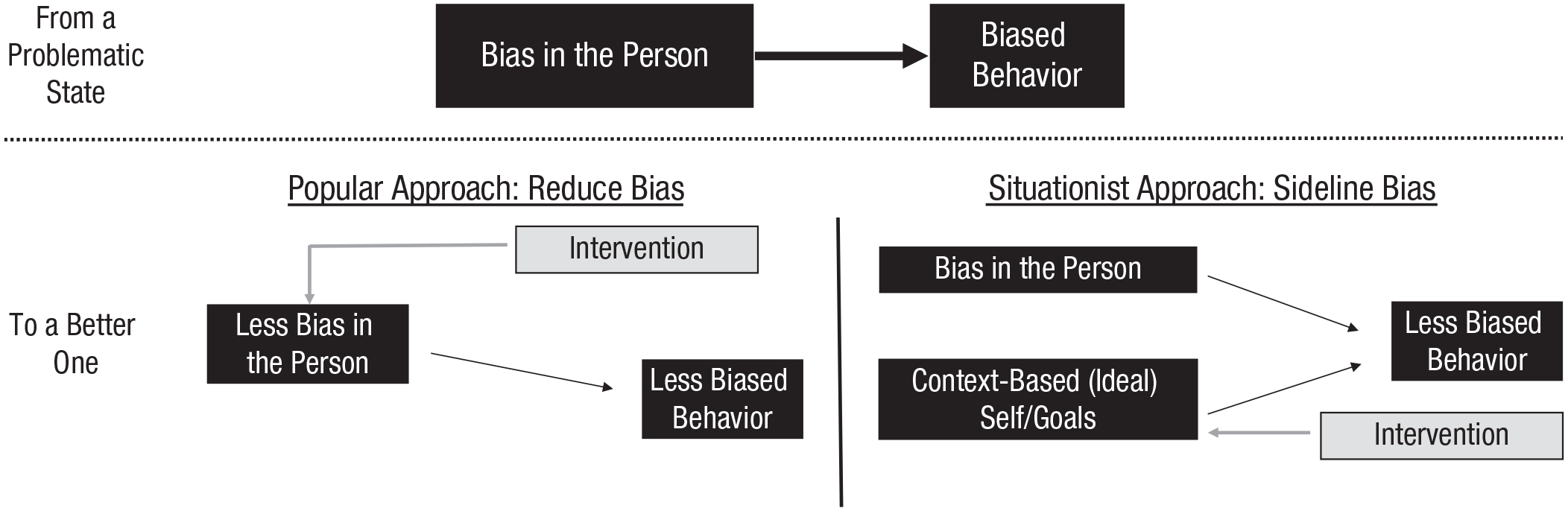
Two approaches to contending with bias. The bias-reduction approach emphasizes bias in the person; interventions based on this approach are designed to reduce bias and, in turn, discrimination. The sidelining-bias approach emphasizes the expression of bias; interventions based on this approach are designed to mitigate discrimination by elevating a nonbiased (or antibiased) alternative self and ideal goals for which biased behavior would not be functional.
Comparison of Two Approaches to Contending With Bias
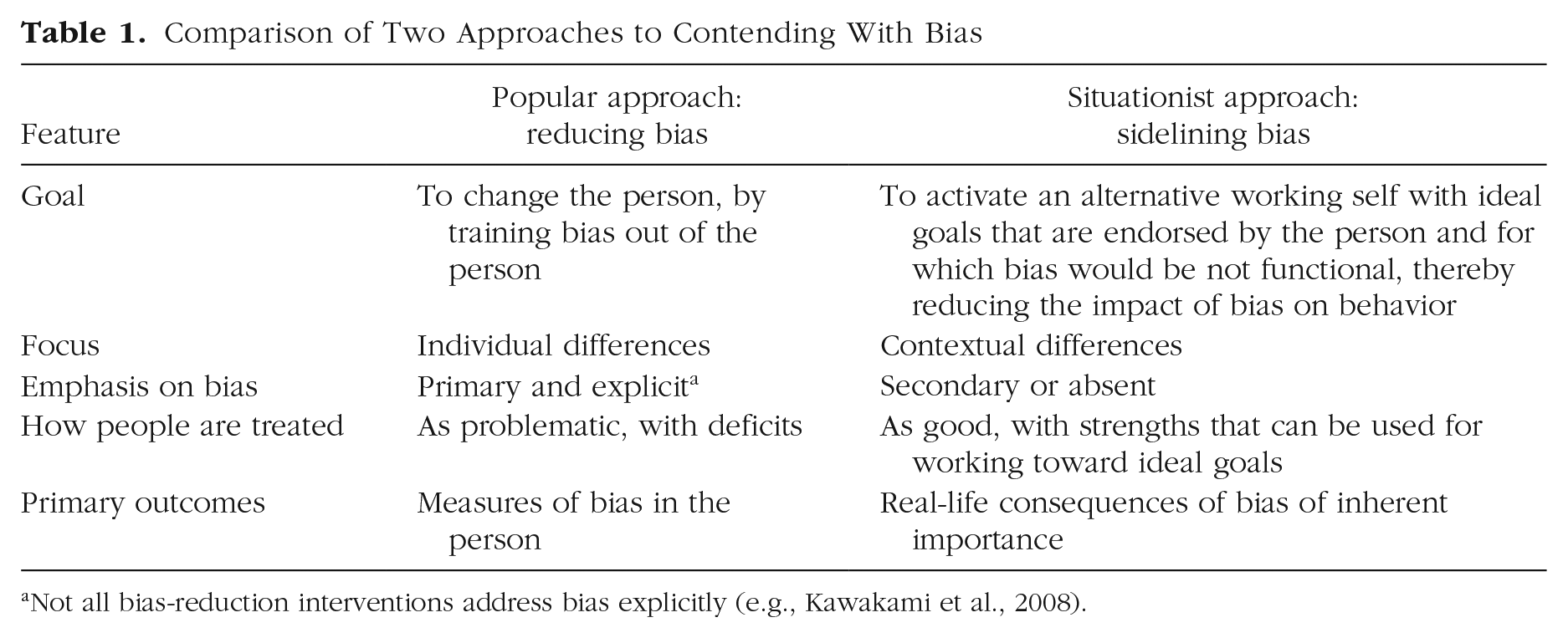
Not all bias-reduction interventions address bias explicitly (e.g., Kawakami et al., 2008).
Second, the sidelining-bias approach is aimed at expressions of bias and cycles of bias, not at reducing the person’s capacity for bias (the latent potential for bias). Thus, the intent is not to change a deeply rooted aspect of individuals, at least not immediately or directly. Instead, to achieve improvement in long-term, real-world consequences of inherent importance (e.g., lower rates of removing racially stigmatized children from school), the approach is aimed at redirecting how individuals interact in pivotal contexts, including especially how they make sense of and respond to treatment from others in recursive cycles that can produce lasting effects (Walton & Wilson, 2018).
Third, a significant challenge bias-reduction approaches face is that, in focusing on increasing awareness and recognition of bias, they can seem deficit based, as representing people in negative ways, and consequently provoke backlash, despite intentions to bring people together (Brannon et al., 2018). By contrast, the sidelining approach is asset based; it identifies people in pivotal roles in circumstances in which bias is available and can contribute to discrimination. These people may be asked to reflect on ideals they hold in their roles and how they are working or can work toward these ideals by behaving in positive, prosocial ways, sometimes in the face of the possibility of bias. Thus, people are never defined as biased; they are assumed to be morally good or, at least, to have the potential to become so. Moreover, by beginning from an asset-based perspective, this approach allows for discussions of bias to be strategically integrated, as needed. In the following review of examples of sidelining bias, we note ways in which bias has been directly raised in certain intervention procedures and cases in which it has not been raised directly.
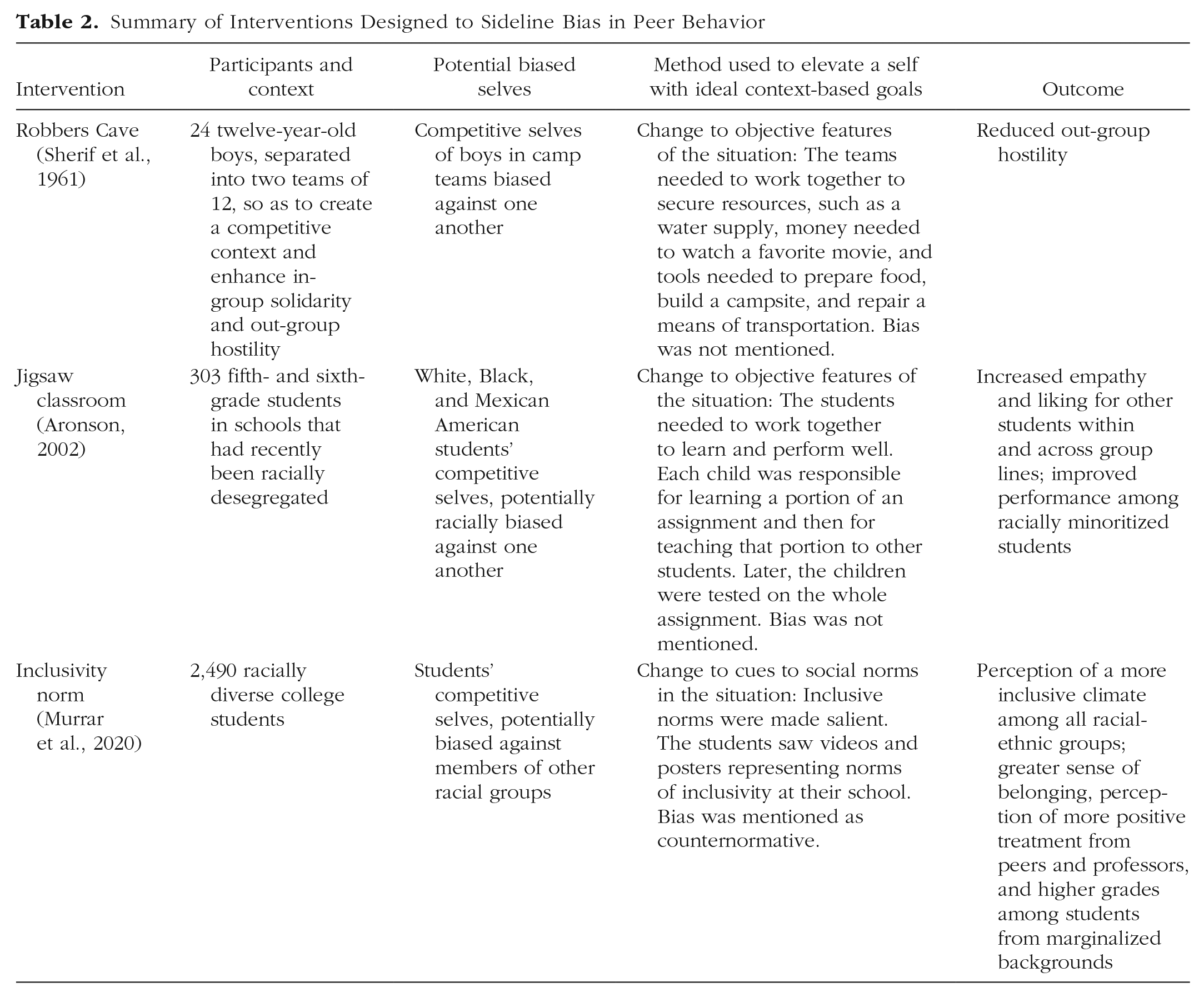
Next, we present classic and contemporary research to show how a focus on context-based goals can sideline bias. Rather than discussing research aimed at reducing bias itself or focused solely on controlled lab settings, we present research that follows theory that recommends focusing on tests of interventions with the following qualities: (a) random assignment to treatment or control conditions, so as to identify causal effects; (b) longitudinal assessment of outcomes; and (c) use of outcomes of inherent, real-world importance (Campbell & Brauer, 2020; Okonofua et al., 2020). The interventions we discuss illustrate the use of a variety of procedures (see Tables 2 and 3 for summaries).
Summary of Interventions Designed to Sideline Bias in Peer Behavior
Summary of Interventions Designed to Sideline Bias in Hierarchical Contexts
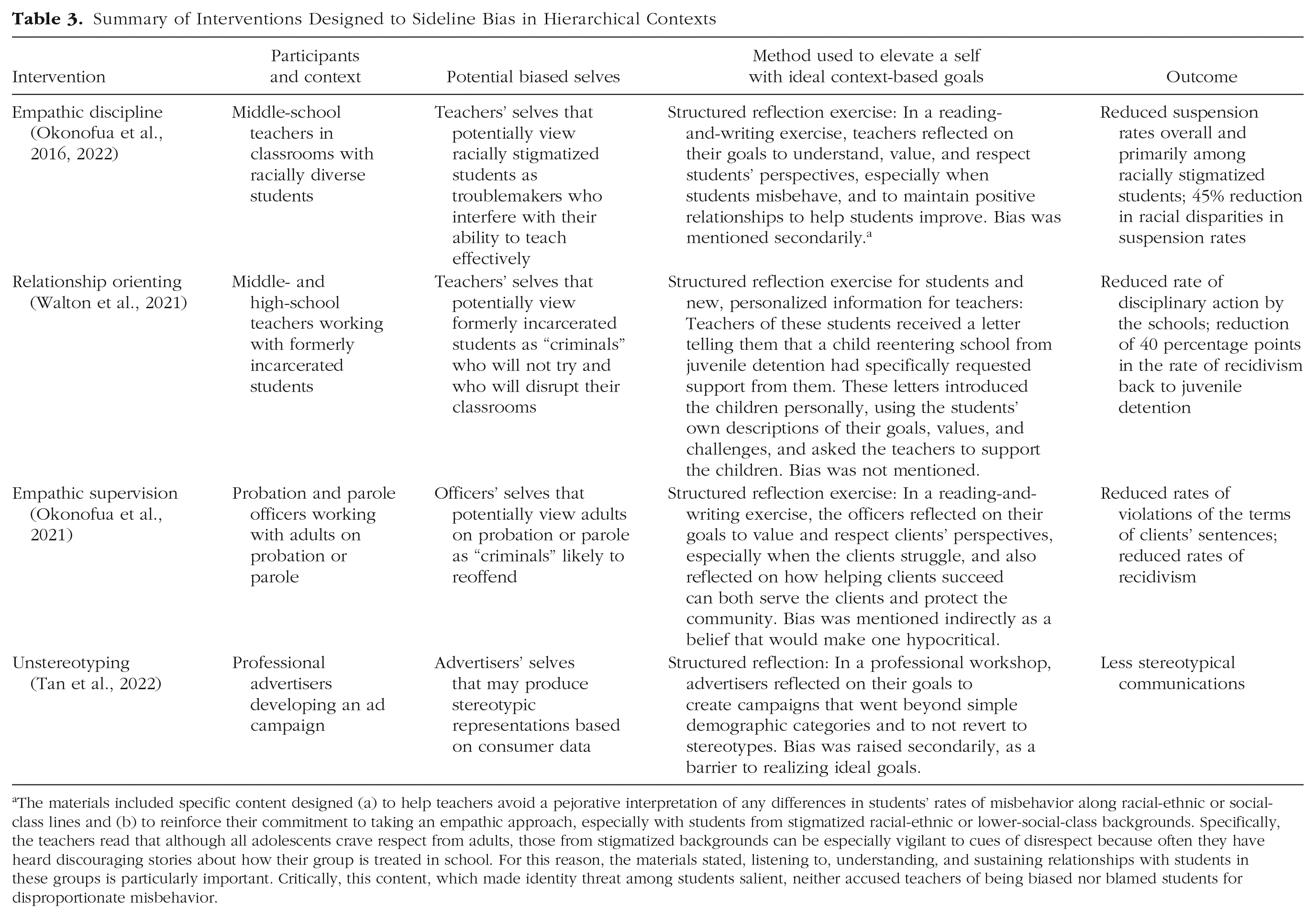
The materials included specific content designed (a) to help teachers avoid a pejorative interpretation of any differences in students’ rates of misbehavior along racial-ethnic or social-class lines and (b) to reinforce their commitment to taking an empathic approach, especially with students from stigmatized racial-ethnic or lower-social-class backgrounds. Specifically, the teachers read that although all adolescents crave respect from adults, those from stigmatized backgrounds can be especially vigilant to cues of disrespect because often they have heard discouraging stories about how their group is treated in school. For this reason, the materials stated, listening to, understanding, and sustaining relationships with students in these groups is particularly important. Critically, this content, which made identity threat among students salient, neither accused teachers of being biased nor blamed students for disproportionate misbehavior.
Implications for Intervention
Classic and contemporary research illustrates ways to elevate, within specific contexts, ideal goals that are incompatible with discrimination and that people will endorse, and shows that this can improve behavior and pivotal outcomes.
Sidelining bias in peer interactions
Classic and more contemporary research shows the potential to sideline bias to improve peer relations (Table 2). For instance, in Sherif et al.’s (1961) Robbers Cave study, elevating superordinate goals, such as the need to repair a shared water supply, successfully reduced animosity between two groups of boys, despite the absence of a direct effort to reduce bias. Likewise, Aronson’s (2002) “jigsaw classroom” intervention used cooperative-learning techniques to create common goals concerning learning and teaching in newly desegregated classrooms and to replace competitive norms. This both improved liking across racial-ethnic lines and reduced inequalities in achievement.
In more recent research, Murrar and colleagues (2020) used posters and videos to highlight inclusivity norms in college classrooms. This led students of all racial-ethnic groups to perceive a more inclusive climate in class and improved the class experience (e.g., sense of belonging) and grades, especially among students from marginalized backgrounds.
Sidelining bias in hierarchical interactions: elevating ideal professional selves
Some of the most egregious discrimination occurs among people in positions of authority or influence, such as teachers or law-enforcement officers. Yet people in positions of power also often have role-based goals that are incompatible with bias (e.g., helping all children to grow). Is it possible to elevate foundational professional goals, such as the goal of service, in education, criminal justice, and advertising (Grant & Hofmann, 2011)? Would this improve outcomes among the people who are served and mitigate disparities that result from bias? Table 3 reviews studies in which this opportunity was considered.
Teachers’ response to misbehavior in class: the empathic-discipline intervention
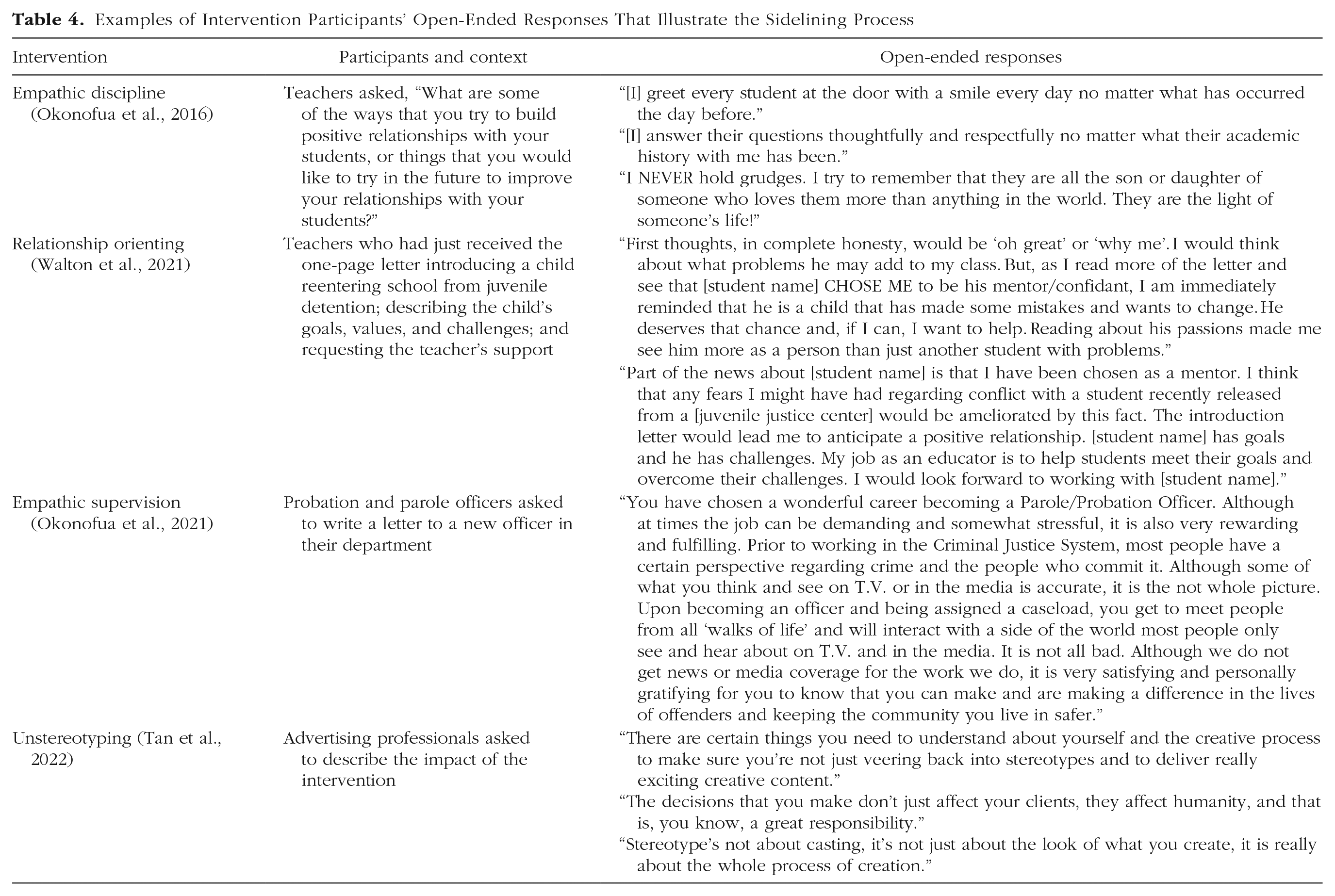
Evidence suggests that bias contributes to racial disparities in school discipline (Okonofua & Eberhardt, 2015). Rather than attempt to rid teachers of racial bias, we implemented an intervention focused on evoking teachers’ professional goals to help all children learn and grow (Okonofua et al., 2016). In this empathic-discipline intervention, teachers reviewed exemplary models of how other teachers respond to students when they misbehave (i.e., understanding and valuing students’ perspectives and maintaining caring, respectful relationships, rather than treating students punitively or leaving the relationships). These teachers were then asked to write a letter to new teachers to help them maintain positive relationships with students, even when those students misbehave. Thus, the intervention focused on teachers’ professional goals to help and support children. Table 4 illustrates this sidelining process. Moreover, there was a particular focus on helping those students who face systemic biases, whose identities are regularly threatened at school and who may thus be most sensitive to negative treatment (see the footnote in Table 3). From the perspective of teachers’ professional goals, stereotyping students and discriminating against them would not be functional (Okonofua et al., 2020). In two randomized placebo-controlled trials with teachers of thousands of students across more than 20 cities, the intervention meaningfully cut suspension rates overall. Moreover, it reduced racial disparities in suspension rates by 45% over the intervention year and the subsequent school year (Okonofua et al., 2016, 2022).
Examples of Intervention Participants’ Open-Ended Responses That Illustrate the Sidelining Process
Teachers’ support for court-involved youths: the relationship-orienting intervention
Some of the most disadvantaged children in school are those who have been convicted of a crime and spent time in juvenile detention. These students, disproportionately boys and racially minoritized students, are readily seen as potential sources of violence—not as children facing challenges and striving to meet them. These stereotypes can guide how teachers interact with students when they return to class from detention. In another study (Walton et al., 2021), we developed an intervention to elevate youths’ own voices in introducing themselves to an educator. A few days after reentering school from juvenile detention, participants reflected on their positive goals in school and challenges they faced, and how developing positive relationships with adults could help them succeed. They were also asked to identify an adult in school who could be important for them and what they would want that person to know about who they were as a person. Each student’s responses were then included in a one-page letter to the educator the student chose, asking for the educator’s support. Tested in an initial small, randomized controlled trial, this relationship-orienting intervention reduced recidivism to juvenile detention through the semester following release from 69% to 29%. In an additional study, teachers who received these letters expressed more positivity and greater commitment toward the students than did teachers who did not receive the letters. They saw the young people as students to help, not as criminals (Table 4).
As did the empathic-discipline intervention, the relationship-orienting intervention helped teachers become their best professional selves in their relationships with students. Biases based on race, gender, or criminal history are dysfunctional for this goal.
Probation and parole officers’ support for clients: the empathic-supervision intervention
A key factor in recidivism among formerly convicted and sentenced adults is their relationship with their probation or parole officer. A return to prison is often due to a violation of the terms of the sentence and is reported by the officer; yet when incidents are ambiguous, officers exert judgment. A positive relationship with an officer can also provide support that helps prevent violations. Yet biases may interfere with such relationships. Can these biases also be sidelined by evoking an officer’s professional goals?
The empathic-supervision intervention focuses on officers’ goals to serve their communities. Interviews with officers indicated that they shared a goal to help their clients in order to support their neighborhoods. This information informed the design of the intervention. In the intervention, a 30-min online module, officers considered how showing care and concern for the individuals they supervised could help those individuals come to trust and respect them in return, and thereby allow them to more effectively address those individuals’ needs and keep the officers’ communities safe, welcoming, and thriving. Thus, the treatment highlighted officers’ professional goals and the means to attain them in ways that made bias against formerly incarcerated people dysfunctional, sidelining it, as illustrated in Table 4. Over the course of 10 months, relative to a randomized control condition, the intervention reduced documented violations and reduced recidivism by 11% among the approximately 20,000 adults on probation or parole whom the officers served (Okonofua et al., 2021).
Sidelining bias in mass communications: the unstereotyping intervention
Stereotypical representations of social groups (e.g., racial and ethnic stereotypes, gender roles) dominate advertisements in mainstream media (Grau & Zotos, 2016; Mastro & Stern, 2003) to pernicious effect (Behm-Morawitz & Mastro 2009; Halliwell & Dittmar, 2004).
To ameliorate such effects, Tan et al. (2022) implemented an intervention that elevated the professional goal of being creative among advertisers developing brand communications in the United States, the United Kingdom, and The Netherlands. Again, there was no direct focus on reducing bias. Instead, a 1-day workshop emphasized how being an effective advertising professional means viewing the consumer as a unique human being, and how this is the antithesis of stereotyping. This unstereotyping intervention targeted a crucial step in the development of an advertisement campaign, the generation of a label on the basis of consumer data—aggregate demographic information about the brands’ consumers—that guide an entire campaign, including the content and placement of advertisements. Advertisers created a label before and after the workshop. Compared with a randomized control group of advertisers who did not attend the workshop and showed no change in the stereotypicality of their labels, those who attended the workshop produced labels 6 months after the workshop that were 35% less stereotypical, as rated by an independent sample from the general public in each country (i.e., focus groups). The results suggest that elevating creativity goals can reduce stereotyping in advertisements that reach and affect millions of consumers around the world. (See Table 4 for examples of how advertisers described this potential of elevating creativity goals.)
Where Else Can Bias Be Sidelined?
By appreciating the complexity of people, the sidelining approach helps people at risk of behaving in bad, biased, and harmful ways to behave in ways that are good, antibiased, and supportive of others. It is exciting to consider the array of real-world contexts in which it may be possible to sideline bias. For example, can physicians’ prosocial and professional motivations be elevated to improve equity in health? How could sidelining work in law enforcement? Are there ways to sideline bias more broadly than by focusing on specific professional roles, such as by elevating ideal moral selves? As different contexts are explored, can researchers learn more about the relative effectiveness and fit of different methods to activate nonbiased selves and goals, such as making specific changes to situations (Aronson, 2002), cuing social norms (e.g., Murrar et al., 2020), implementing active reflection methods (e.g., Okonofua et al., 2022), and providing people with novel, personalized information (Walton et al., 2021)?
Many of the examples we have given involve, at least in part, deliberative processes that take place over time. Could sidelining also help in heated moments, when behavior is shaped by automatic processes, such as when police officers make on-the-spot decisions in potentially threatening situations (Sassenberg et al., 2022)? It will also be exciting to explore individual differences, including differences in the availability of both biased and non- or antibiased working selves. Do such individual differences moderate the effectiveness of the sidelining approach?
Finally, can the sidelining approach be used to erode the very potential for bias over time? Although the consequences of biased and nonbiased behavior may often be interpersonal (e.g., improved vs. worsened trust), they can also be intrapersonal. As contexts elicit nonbiased goals and selves more frequently, and as people use these selves more, could people become less biased (Moskowitz et al., 1999)? Further, can the sidelining approach be integrated with general bias-education efforts? Once a sidelining approach has been implemented and people are working toward ideal goals, will they be more receptive to and less threatened by information about social bias (cf. Rucker & Richeson, 2021)?
Social psychology gained early prominence through dramatic demonstrations that even normal people could behave in terrible ways in specific situations. The sidelining approach is intended to accomplish the inverse: to help normal people behaving in biased ways behave more positively, and thereby help everyone—both themselves and those with whom they interact—flourish.
Recommended Reading
Burns, M. D., Monteith, M. J., & Parker, L. R. (2017). Training away bias: The differential effects of counterstereotype training and self-regulation on stereotype activation and application. Journal of Experimental Social Psychology, 73, 97–110. http://doi.org/10.1016/j.jesp.2017.06.003. A key article that shows how bias reduction does not necessarily translate to a reduction in biased behavior.
Fiske, S. T., Harris, L. T., & Cuddy, A. J. C. (2004). (See References). A discussion of a noteworthy example of how good people can do bad things depending on context.
Markus, H., & Wurf, E. (1987). The dynamic self-concept: A social psychological perspective. Annual Review of Psychology, 38, 299–337. https://doi.org/10.1146/annurev.ps.38.020187.001503. A discussion of the theoretical foundations of multiple working selves with multiple goals.
Morris, M. W., Chiu, C., & Liu, Z. (2015). Polycultural psychology. Annual Review of Psychology, 66, 631–659. https://doi.org/10.1146/annurev-psych-010814-015001. A presentation of a theoretical approach to understanding individuals’ relationships to culture as partial and plural.
Ross, L., & Nisbett, R. E. (2011). (See References). A presentation of the theoretical foundations of the situationist tradition in social psychology.
Footnotes
Acknowledgements
We thank Mahzarin Banaji, Ivuoma Onyeador, and the reviewers for helpful comments on an earlier version of this manuscript. Portions of this work were presented at the Social Cognition Preconference at the February 2022 annual meeting of the Society for Personality and Social Psychology in San Francisco, California.
Transparency
Action Editor: Robert L. Goldstone
Editor: Robert L. Goldstone
