




Abstract
Identity signals inform receivers of a signaler’s membership in a subset of individuals, and in doing so shape cooperation, conflict, and social learning. Understanding the use and consequences of identity signaling is therefore critical for a complete science of collective human behavior. As is true for all complex social systems, this understanding is aided by the use of formal mathematical and computational models. Here I review some formal models of identity signaling. I divide these models into two categories. First, I discuss models used to study how identity functions as a signal, with a focus on public-health-related behavior and disease transmission. Second, I discuss models used to understand how identity signals operate strategically in different social environments, with a focus on covert, or encrypted, communication.
Identities have behavioral and social consequences. In particular, a person’s identity involves information that can be signaled (Smaldino, 2019b). Identity signals are those components of communication transmissions, displays, or other behaviors that inform receivers of the signaler’s membership in some categorizable subset of individuals. Such signals likely play a large role in human communication. Indeed, humans are nearly unique among vertebrates in the ability to live in anonymous societies, because we can use identity signals rather than direct knowledge to identify other individuals as targets for cooperation, social learning, avoidance, or aggression (Moffett, 2019). Certainly, members of no other species live in societies of such complexity as we do, enabled in part by our ability to make rapid decisions about how to interact with previously unknown individuals. In human societies, identity signals can be coarse-grained and overt, such as clothing emblazoned with “Pride” rainbows or participation in a “Make America Great Again” rally, or they can take more covert forms, such as subtle fashion cues or political dog whistles (i.e., suggestive language intended to gain support without provoking opposition).
The intense sociality of human beings enables the benefits of large-scale cooperation, but also carries the risks of exploitation and conflict. Identity signals help to guide individual decisions regarding whom to associate with, learn from, avoid, or attack. As a result, identity is entangled with many of our most urgent social problems (Bak-Coleman et al., 2021), including organized violence and oppression, misinformation, and the politicization of public-health measures, sustainable practices, and climate change. Understanding how identity signals shape social behavior, and how the signals themselves are employed strategically, is therefore critical.
Knowing that identity signals are important is the first step, but actionable predictions and prescriptions require the development of more precise theories of identity signaling. Ideally, theories about complex social systems—including those involving identity signaling—should be articulated sufficiently clearly that they can be formalized mathematically or computationally (Smaldino, 2017, 2020). Formal models help us to see the assumptions underlying our theories, and by establishing the consequences of those assumptions, we can make broad predictions and identify important targets for future research. The program of producing formal models of identity signaling is still in a relatively early stage, but it is underway. In what follows, I present some formal models that explore the social consequences of identity signaling. I divide this presentation into two main sections. The first section concerns models that rely on strong assumptions about how identity is likely to function as a signal, so that the consequences of those assumptions for population-level dynamics can be tested and evaluated. The second section concerns models that focus on understanding how identity signals are themselves shaped by population processes, which allows researchers to investigate how identity signals are likely to operate in different social environments.
Population-Level Consequences of Identity Signaling: Out-Group Aversion and Disease Transmission
Models in this first class are based on the assumption that individuals have observable identities that can be used to guide the decision making of others. In other words, features of psychology and behavior are taken as given, in order to understand their consequences at the population level. This connection is critical, because it is often difficult to predict how individual-level behaviors scale up to macro-level patterns, especially across time scales longer than those that can be studied experimentally (Resnick, 1994). A classic example of this approach is Schelling’s (1971) work on models of segregation in which individuals use observable identities and weak preferences for similar neighbors to unconsciously assort into strongly segregated neighborhoods without ever intending to do so. Here I highlight work on identity signaling in a polarized population characterized by out-group aversion—the tendency to avoid or discard products or behaviors that become associated with an out-group—paying special attention to the spread of infectious disease.
Historically, many modeling frameworks for understanding social behavior, including models of infectious disease, have ignored identity. There is a great opportunity to improve our understanding of public health and epidemiology by incorporating traditional modeling approaches with our understanding of how individuals use identity to assort with one another and adopt health-relevant behaviors (Moya et al., 2020). For example, consider vaccination rates and the phenomenon of herd immunity. Using standard epidemiological models, researchers can calculate the proportion of the population that would likely need to be vaccinated in order for the overall infection rate to decline steadily and reach herd immunity. However, these models usually assume that vaccines are uniformly distributed in the population. Salathé and Bonhoeffer (2008) showed that if vaccinations tend to cluster in networks—that is, if people tend to assort into identity groups with others who share their views on vaccination—then the overall vaccination rate needed for herd immunity is likely to be substantially greater than what is predicted by the standard models. This indicates that incorporating identity into models of social behavior is not merely interesting, but also greatly important.
If a population is polarized into opposed identity groups, then products or behaviors associated with the out-group may become undesirable, even if they are intrinsically desirable in the absence of social comparisons (Berger & Heath, 2007, 2008). Adding out-group aversion between two groups to standard models of innovation diffusion can lead to interesting and complex patterns of adoption (Smaldino et al., 2017; Smaldino & Jones, 2021). Results from such a model are shown in Figure 1a, which plots the adoption rate at equilibrium among each of two groups as a function of out-group aversion. As the strength of out-group aversion increases, adoption rates decline among both groups, such that the group that adopts the behavior later experiences a larger decline. If out-group aversion is sufficiently strong, the behavior can become wholly associated with one of the groups and not the other, and thereby serve as a reliable social marker.
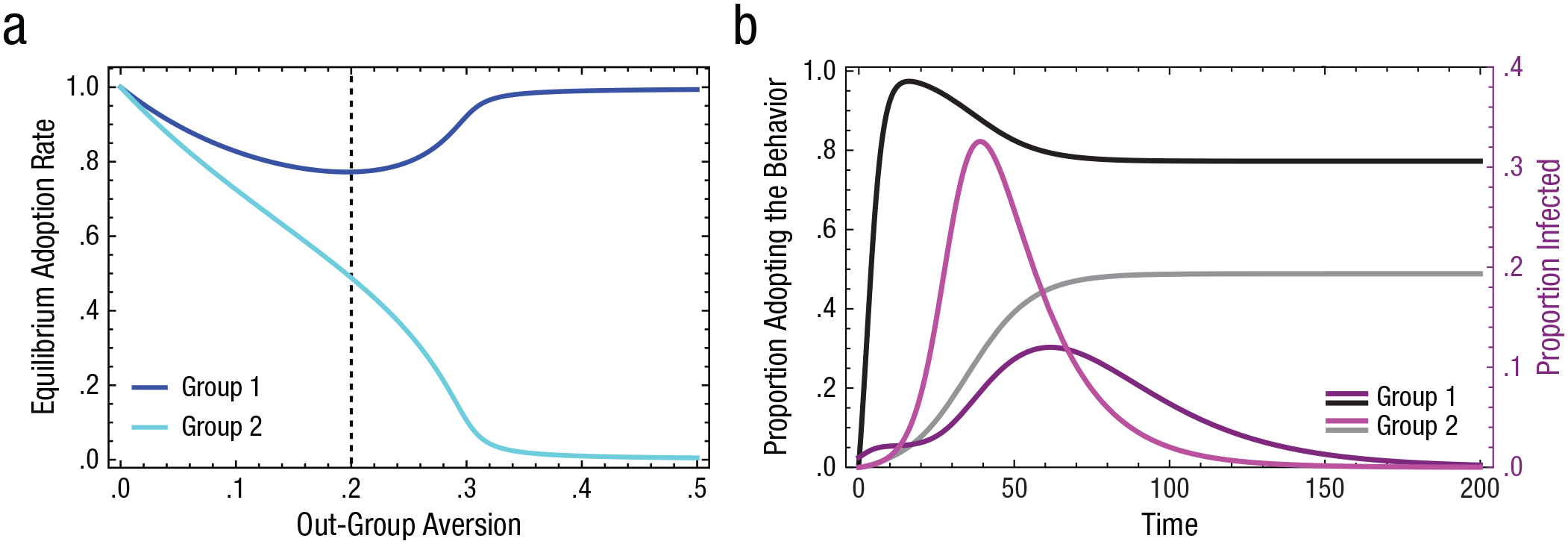
Predicted consequences of out-group aversion. The graph in (a) shows the equilibrium rate of adopting a given behavior for each of two interacting groups as a function of out-group aversion, given that Group 1 has a higher baseline proclivity to adopt the behavior. The graph in (b) shows the coupled temporal dynamics of infection with a contagious disease and adoption of a behavior reducing disease transmission among two interacting groups exhibiting both homophily (so that disease transmission occurs mostly within groups) and out-group aversion at a level indicated by the dashed vertical line in (a). Adapted from “Coupled Dynamics of Behaviour and Disease Contagion Among Antagonistic Groups,” by P. E. Smaldino and J. H. Jones, 2021, Evolutionary Human Sciences, 3, Article E28, pp. 5, 8 (https://doi.org/10.1017/ehs.2021.22). Copyright 2021 by the authors. The original article is available under the Creative Commons CC-BY license.
There has been increasing interest in coupled contagion models, in which behavior and disease are modeled as contagions that influence one another (Funk et al., 2010; Verelst et al., 2016). These models rarely incorporate variation in how particular individuals are likely to influence one another. To address this gap, Jones and I created a mathematical model in which the population was divided into two groups that interacted primarily with in-group members—they exhibited homophily (Smaldino & Jones, 2021). In this model, a disease breaks out in one group, and at the same time, a behavioral contagion that decreases transmission among those who have adopted it is introduced. The model thus captures phenomena such as social distancing and wearing face masks. Without out-group aversion, the behavior spreads rapidly, and the spread of the disease is suppressed. Things change when out-group aversion is included in the model, however. Indeed, research on the “behavioral immune system” suggests that already-existing out-group aversion may be strengthened when the threat of a harmful pathogen is salient (Schaller & Park, 2011). When out-group aversion is included in the model, the disease spreads much more widely. Although it first appears in Group 1, infection ends up being much more rampant in Group 2, whose members are more likely to avoid adopting the preventive behavior. Moreover, the increased disease prevalence in Group 2 leads to a larger “second wave” in Group 1 long after the initial outbreak (Fig. 1b). Although this model is fairly abstract, the results indicate that including behavioral nuances such as identity clustering and out-group aversion are important for making valid inferences about the dynamics of infectious-disease transmission and related social phenomena. Indeed, this model, first analyzed in the spring of 2020, anticipated some of the unfortunate dynamics related to COVID-19 transmission in polarized countries like the United States, in which interventions such as face masks and even vaccines became identity markers that were subsequently shunned by many people who identified with oppositional groups, with tragic consequences (Goodspeed, 2021; Johnson et al., 2020).
Understanding Identity Signaling: Covert and Overt Signaling
Incorporating theories of identity enriches models of social dynamics and allows us to make more nuanced predictions about how those dynamics unfold. Models like the ones just presented tend to use fairly coarse-grained characterizations of identity, in which individuals belong to one of a discrete number of groups and are easily identified as members of those groups. This simplification is useful for providing a baseline for the effect of identity and may be justified empirically in some cases. Nevertheless, identity signaling is often more nuanced. Individuals may conceal their identities entirely, or signal them covertly so that only receivers with insider knowledge are likely to perceive an identity signal for what it is. It is important to understand what this diversity in signaling behavior accomplishes, as well as the social forces that lead to reliable patterns in signaling behavior under varying constraints. This may subsequently allow us to better understand why we observe some of the variation in signaling behavior that we do. The goal of this second class of models is to understand how strategies for identity signaling are shaped by social forces, and therefore which strategies are likely to be common in particular social environments.
Identity signaling is for cooperative assortment
To understand the models of identity signaling presented next, I think it is useful to first take a brief detour to consider the joint problems of cooperation and coordination, which identity signals appear to be partially designed to solve (Smaldino, 2019b). Humans cooperate vastly, often with people to whom they are unrelated by blood, and with people they are likely to never see again. A great deal has been written on the free-rider problem, which concerns how cooperative individuals can avoid being exploited by others (for a review, see Raihani, 2021). Although solving the free-rider problem is likely the driving force behind many human social behaviors and cultural institutions, another problem remains even when it is solved. Generating the benefits of cooperation involves finding the right people to cooperate with (Calcott, 2008; Smaldino, 2014). What makes a partner ideal for cooperation depends on one’s own characteristics and the details of the cooperative task at hand. The problem then becomes one of assorting with sufficiently similar people so that cooperation is made efficient through coordination on norms, goals, and expectations. Even when diversity or complementarity is preferable to perfect alignment, a baseline degree of similarity is still needed to facilitate coordination. For example, team performance often suffers when members have misaligned goals (Chow & Chan, 2008).
Here is where identity signaling comes into play. Norms, goals, and expectations—which we can simply call social traits—are often opaque. How are we to find other individuals who share our social traits? If social traits correlate with group identities, the path to optimizing coordination is straightforward: assort with in-group members and avoid out-group individuals. In theory, if a society is small enough that all in-group members can be individually known, there is little need for signals to demarcate in-group from out-group individuals. In practice, the need to interact with out-group individuals for things such as trade and finding marriage partners nearly always requires a way to distinguish between strangers who are like oneself and strangers who are not. In contemporary societies, we often consider complete strangers to be members of our in-group if we perceive that they share the same nationality or religion, or if they support the same sports team, musical act, or political party.
In this “dividing line” scenario in which one assorts only with in-group members, overt markers—which can be linguistic, behavioral, or sartorial—can serve to distinguish potential cooperation partners from individuals to be avoided or even targeted for aggression (Smaldino, 2019b). Evolutionary models have shown how arbitrary markers can readily become associated with particular norms (McElreath et al., 2003). Of course, such a scenario is hardly limited to small-scale societies or ancient history; “us versus them” distinctions are commonplace in today’s world. However, the boundary between “us” and “them” is often more fuzzy than stark.
A theory of covert signaling
The large, diverse societies in which most of us live are accompanied by special problems for identity signaling. It is rarely feasible to simply avoid or attack everyone who is not solidly a member of one’s in-group, not to mention the fact that the definition of in-group is often context-specific (Roccas & Brewer, 2002; Smaldino, 2019b). We must work with dissimilar people, engage in commerce with them, and otherwise interact as functioning members of a diverse society. Nevertheless, some assortment is surely better than none, particularly if it allows cooperation toward goals that are not shared by everyone. Theories of identity signaling must therefore account for signaling strategies that are attuned to the complexity of contemporary multicultural societies. This requires a radical rethinking of how identity is used for cooperative assortment, avoidance, and aggression in large, diverse societies (Smaldino, 2019b). To tackle one aspect of this problem, my colleagues and I have proposed and formalized a theory of covert signaling (Smaldino et al., 2018; Smaldino & Turner, 2021) that deals with how identity signaling works when overt “us versus them” signaling is overly coarse-grained.
Covert identity signals are those aspects of communication that allow individuals who share social traits to recognize one another while simultaneously allowing signalers to avoid being recognized as dissimilar by those not “in the know” (Fig. 2a). Political dog whistling is a well-discussed example. For example, former U.S. President George W. Bush often publicly denounced the 1857 Dred Scott Supreme Court decision. Although opposition to an old, since-overturned judicial decision that upheld slavery may seem banal, many evangelical conservatives interpreted the Dred Scott case as morally analogous to the 1973 Roe v. Wade case that upheld the right to abortion, so the president’s denouncement of the Dred Scott decision communicated to these audiences his committed opposition to abortion rights (Kirkpatrick, 2004). More quotidian examples of covert signaling, including the ways in which people implement fashion, humor, and other semiotic tools to subtly indicate identity, are well documented (Smaldino & Turner, 2021). Covert signaling may be particularly important to members of persecuted minorities, such as LGBTQ+ (lesbian, gay, bisexual, transgender, and queer or questioning) individuals or political dissidents, who have strong incentives to assort with one another but also to avoid detection by nonmembers. However, covert signaling is favored whenever the benefit of avoiding detection by dissimilar individuals outweighs the cost of diminished signal strength.
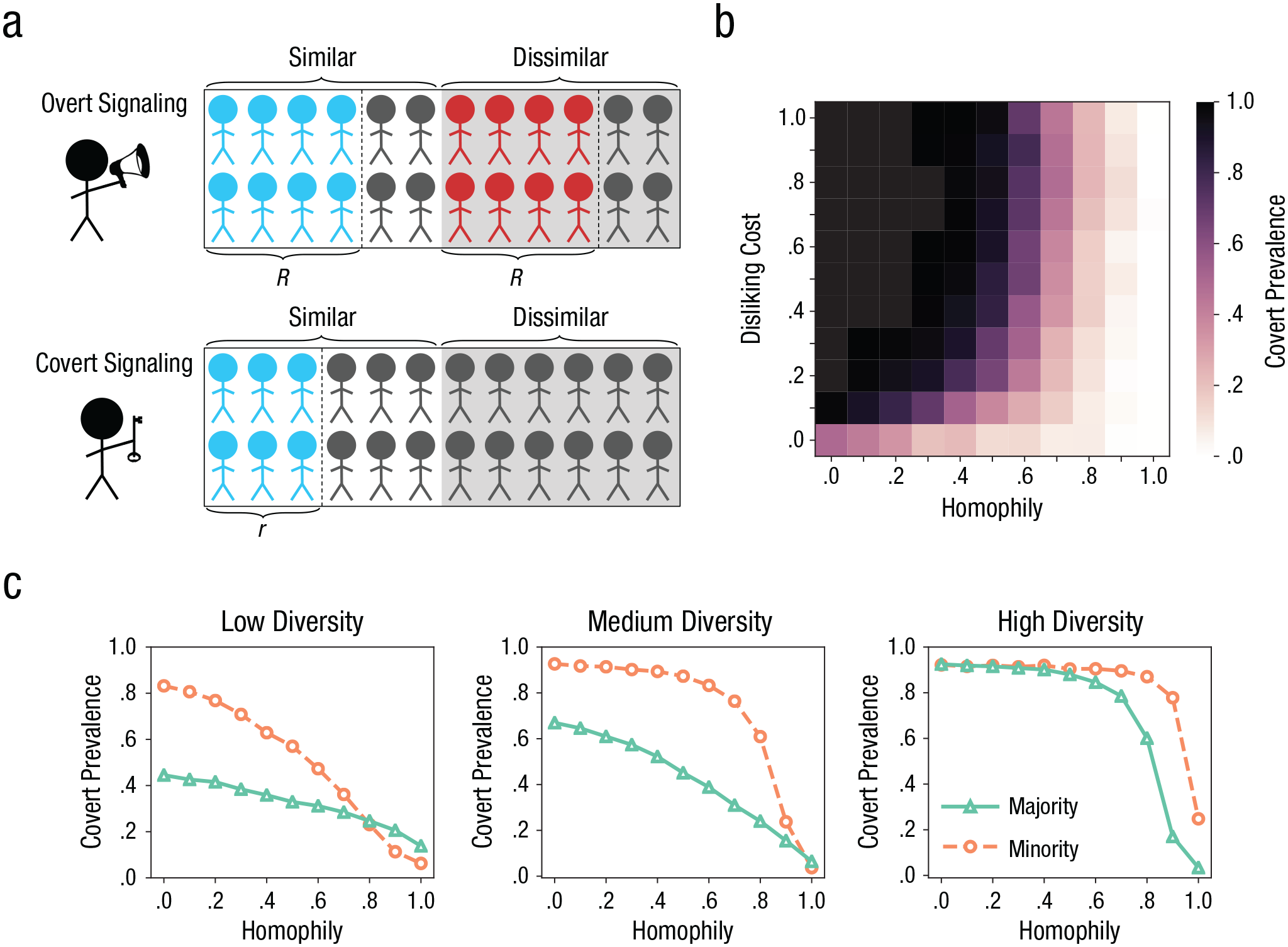
Covert signaling. The diagram in (a) shows how signals work in the model. Identity signaling leads to liking by similar receivers (blue) and disliking by dissimilar receivers (red). Overt signals are perceived by a proportion, R, of receivers. Covert signals are noisier (perceived by a smaller fraction, r, of similar receivers) but avoid detection by dissimilar receivers. The graphs in (b) and (c) reproduce the results of evolutionary agent-based simulations (from Smaldino & Turner, 2021). The graph in (b) shows the equilibrium frequency of covert signaling as a function of homophily and the cost of being disliked, and the graphs in (c) show the prevalence of covert signaling among majority- and minority-group members as a function of homophily, in societies with low, medium, and high diversity.
The idea of covert signaling is not new; for example, Loury (1994) described it quite explicitly in his discussion of political correctness. However, formal modeling allows a clearer articulation of the theory and facilitates asking more precise questions about the social conditions that might favor the use of covert signaling (Smaldino, 2017). Such models include not only identity-signaling strategies, but also strategies for processing identity signals, as well as a stage in which individuals use the information learned from identity signaling to form partnerships and receive associated payoffs (Smaldino et al., 2018; Smaldino & Turner, 2021). The models include a mechanism for varying the degree to which individuals are able to preferentially assort with partners they like and avoid partners they dislike (homophily). Similar pairs get higher payoffs than dissimilar pairs, because of an enhanced ability to coordinate. If partners are dissimilar, they incur additional costs if they are aware of their dissimilarity, because their negative attitudes impair their ability to coordinate. The models assume a (cultural) evolutionary dynamic in which signaling strategies of more successful individuals are more likely to be copied (Kendal et al., 2018; Mesoudi, 2011).
Analysis of the models reveals that covert signaling is favored when being disliked is costly and when individuals cannot count on being able to partner only with those they prefer (Fig. 2b). This indicates that more covert signaling should be evident when encounters are arbitrary and dissimilar individuals are therefore more likely to be paired. Analyses exploring this idea in greater depth showed that covert signaling is increasingly favored in more diverse societies and is favored more by individuals with minority-group status than by those with majority-group status (Fig. 2c).
Treating identity signaling as a behavior with social consequences means that the models generate testable predictions about how people will actually use communication that carries identity information. Identifying covert signals is inherently difficult, however, because by definition they carry information accessible only to members of the associated identity group. My colleagues and I recently used differential responses by partisans of the political left and right to tweets sent during a period of intense political discussion—the weeks before the 2020 U.S. presidential election—to identify likely overt and covert signals (van der Does et al., 2022). Analyses showed that Twitter users with more heterogeneous follower networks tweeted more covertly. We then performed a behavioral experiment in which participants could select tweets to show to an audience made up of a known proportion of in- and out-group members. They gained money when the tweets they selected were liked more often than disliked and lost money when their selected tweets were disliked more often than liked. We found that participants strategically selected tweets with more covert signals when their audience consisted of more out-group members. These findings suggest that the model captures something real about how people signal their identities in a diverse society.
Finding Out More About Who We Are
A complete science of human social behavior requires a strong appreciation for the organizations and coalitions into which people sort themselves and each other, how the resulting identity designations influence social dynamics, and how the social environment shapes how individuals signal their identities and process identity information from others. Many questions remain in need of theories clear enough to be modeled. How do identities come to be represented in the mind? How might the size or diversity of a culture influence the nature of those identities, including trade-offs between the depth and breadth of identity representations? How do subcultures emerge and evolve? To advance theory in these areas, additional modeling techniques, such as the use of multilayer networks to represent the many social contexts in which humans interact (Atkisson et al., 2020), may prove useful. The ultimate goal is tight integration between models and empirical data (Smaldino, 2019a). This is difficult when most current measures of social identity are coarse-grained and rarely account for context. In the meantime, translating theories into formal models can help researchers figure out what to look for.
Recommended Reading
Funk, S., Salathé, M., & Jansen, V. A. A. (2010). (See References). A thorough review of coupled contagion models of behavior and disease transmission.
Kauffman, S. A. (1971). Articulation of parts explanation in biology and the rational search for them. In R. C. Buck & R. S. Cohen (Eds.), PSA 1970 (pp. 257–272). Philosophy of Science Association. A philosophical discussion of hypothesis generation and the value of formal models in articulating and testing hypotheses.
McElreath, R., Boyd, R., & Richerson, P. J. (2003). (See References). A presentation of a simple model of social norms and ethnic markers, with an introduction to the relevant theory.
Moffett, M. W. (2020). Societies, identity, and belonging. Proceedings of the American Philosophical Association, 164(3), 1–9. A brief summary of the research on human identity and anonymous societies, introducing many of the ideas fleshed out in Moffett (2019).
Smaldino, P. E. (2019b). (See References). A review of the role of identity signaling in cooperative assortment throughout human cultural evolution.
