




Abstract
Who is most likely to join and engage in extreme political action? Although traditional theories have focused on situational factors or group identity, an emerging science illustrates that tendencies for extreme political action may also be rooted in individuals’ idiosyncratic cognitive and affective dispositions. This article synthesizes cutting-edge evidence demonstrating that individuals’ cognitive and affective architecture shapes their willingness to support ideological violence. In the cognitive domain, traits such as cognitive rigidity, slow perceptual strategies, and poor executive functions are linked to heightened endorsement for ideological violence. In the emotion domain, characteristics associated with emotional reactivity and impaired emotional regulation, such as sensation seeking and impulsivity, can facilitate readiness for extreme political action. The review homes in on the roles of cognitive rigidity and sensation seeking as traits heightening proclivities for extreme pro-group behavior and recommends that future research should assess cognition-emotion interactions to reveal different subprofiles of political actors. A theoretical framework focused on cognitive and affective information-processing traits—and their interactions—opens up tractable empirical questions and a future research agenda. Identifying subsets of ideologues is an endeavor with potential to inform the design of evidence-based interventions aimed at reducing ideological extremism and fostering social understanding.
Keywords
In his brilliant 1951 book The True Believer, the thinker Eric Hoffer pondered why some people are more likely than others to engage in extreme ideological action—action that promotes violence against other people in the name of a group or cause. Who is most likely to participate in the behaviors of extreme or fanatical ideologies? Hoffer theorized that the root of radicalization lies in low self-esteem and frustration, in the desire to discard and forget oneself by immersing oneself in a larger collective. Since then, over the past 70 years, research has moved away from this self-esteem hypothesis toward a more systematic study of how contexts and motivations shape individuals’ willingness to participate in extreme political action. Prominent psychological theories frequently concentrate on identity and situational factors, such as age, gender, socioeconomic circumstance, level of hardship, or the individual’s sense of efficacy, empowerment, or identification with the group (Drury & Reicher, 2005; van Zomeren et al., 2008). Other theoretical accounts center on high-level motivational factors, specifically, on how general human motivations to experience coherence, certainty, and connectedness can drive individuals to join ideological groups and movements (Douglas et al., 2017; Jost et al., 2008). These theoretical perspectives have generated important insights about how social, economic, and existential conditions can amplify an individual’s proneness to engage in extreme ideological action.
Nonetheless, these lines of research have sometimes overlooked the contribution of deeply rooted generalized individual differences that are internally embedded in the individual’s brain architecture, and not necessarily shared by all. These traits reflect the individual’s way of processing and evaluating information in general, in everyday interactions with the world, with any kind of stimuli across a variety of domains, rather than in the specific context of politics. These individual-level attributes are often unconscious and grounded in biological idiosyncrasies in how brains operate, which lead to slight—but significant—variations in how different individuals perceive stimuli and make decisions (Miyake & Friedman, 2012). Given the abundance of sociopolitical opinions and decisions humans form throughout their lifetime, it is thus fruitful to ask whether such implicit information-processing tendencies affect individuals’ propensities for political action.
Here we synthesize recent research suggesting that susceptibility to extreme political action is sculpted by an individual’s biologically rooted cognitive and affective architecture, not only by the individual’s situational and motivational characteristics. Cognition refers to information processing of neutral stimuli in the service of decision making (e.g., how individuals process visual shapes and judge them according to task instructions), whereas emotion is engaged in processing emotionally valenced or emotionally provocative stimuli (e.g., how individuals evaluate fearful or disgusted faces). Although most psychological processes (e.g., memory or learning from rewards and punishments) are infused with both cognitive and affective components, we make this stimulus-oriented distinction for the sake of simplicity and clarity, in accordance with conventions of cognitive psychology (Zajonc, 1984). We further argue that future research should address nuanced cognition-emotion interactions and that this can shed light on the origins of extreme ideological action and the multitude of heterogeneous actors that it attracts.
Cognitive Underpinnings of Extreme Political Action
Individual differences in proclivities for extreme political action have been shown to relate to implicit cognitive characteristics across multiple psychological domains. One information-processing style that has been demonstrated to be a core correlate of ideological thought is cognitive rigidity (Zmigrod, 2020b). Cognitive rigidity is marked by a difficulty to adapt behavior in response to changing environments, task demands, and reward contingencies. Individuals who are more cognitively inflexible perform more poorly on tasks such as the Wisconsin Card Sorting Test (WCST) or the Alternative Uses Test, which require participants to process and respond to visual or linguistic stimuli in an adaptable manner. For instance, in the WCST, participants are instructed to sort cards according to their shape, color, or other visual feature. The card-sorting rule then changes, and individuals who are cognitively flexible are able to change their behavior in accordance with the new rule, whereas rigid individuals struggle to adapt to the new task demands. Individuals who exhibit more cognitive inflexibility in these objective neuropsychological tasks also have more ideological and dogmatic worldviews (Zmigrod, 2020b) in the realms of nationalism (Zmigrod, Rentfrow, & Robbins, 2018), politics (Van Hiel et al., 2016; Zmigrod et al., 2020), religiosity (Zmigrod, Rentfrow, Zmigrod, & Robbins, 2019), and receptivity to evidence (Zmigrod, Zmigrod, et al., 2019). As predicted by horseshoe theories of political extremism, cognitive rigidity characterizes individuals on the extreme right and extreme left of the political spectrum (Zmigrod et al., 2020; Figure 1a), which shows that the extremity of the ideology may matter more than its content or mission.
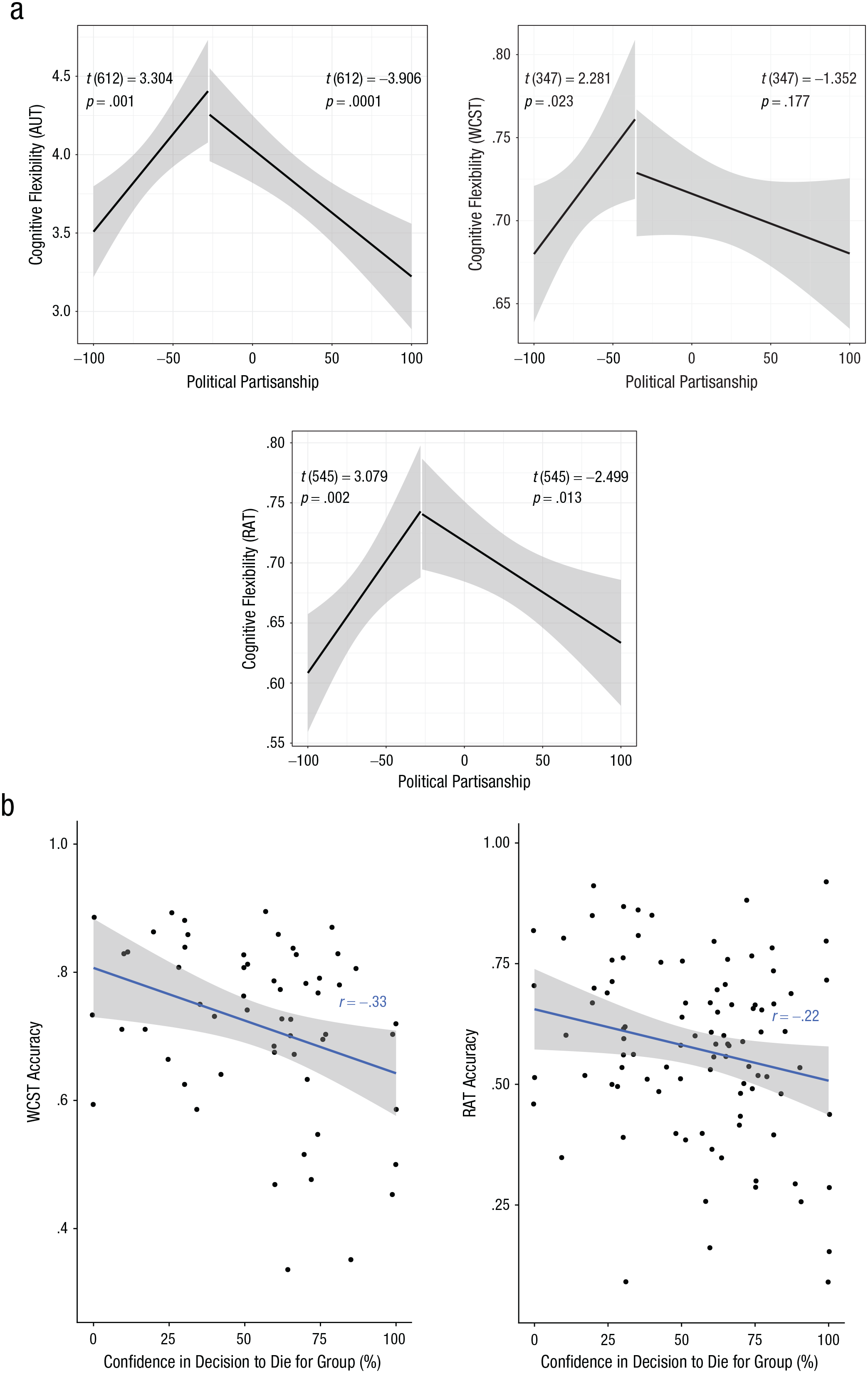
Associations between cognitive flexibility and (a) political partisanship and (b) willingness to die for one’s ideological in-group. The graphs in (a) show scores on the Alternative Uses Test (AUT), Wisconsin Card Sorting Test (WCST), and Remote Associates Test (RAT) as a function of participants’ political partisanship. Negative partisanship values indicate the strongest identity fusion with the Democratic party relative to the Republican party, and positive values indicate the reverse. The plotted lines and t values are from interrupted regression models designed to identify U shapes in data using the Robin Hood algorithm (Simonsohn, 2018). The shaded areas represent 95% confidence intervals. Reproduced from Zmigrod et al. (2020), p. 414. The graphs in (b) show scores on the WCST and RAT as a function of participants’ conviction that they would be willing to die in order to save members of their ideological in-group, along with Pearson’s correlations. The shaded areas represent 95% confidence intervals. Reproduced from Zmigrod, Rentfrow, and Robbins (2019), Figure 1.
In a study of extreme political action, greater cognitive rigidity predicted greater willingness to endorse violence to protect an ideological group or cause, as well as readiness to sacrifice one’s life to save fellow in-group members (Zmigrod, Rentfrow, & Robbins, 2019; Fig. 1b). Notably, individuals who had greater conviction or confidence in their decision to self-sacrifice for the sake of a broader ideological group tended to be more cognitively inflexible across multiple tasks. Thus, individuals’ implicit dispositions toward cognitive rigidity or flexibility can play a significant role in political judgments and behaviors, acting as individual-level factors that augment or reduce the likelihood of engaging in political action.
Rigidity may also manifest itself in the context of metacognition, that is, the awareness of one’s cognitive capacities and processes. Difficulties in metacognition may drive individuals to stick more rigidly and dogmatically to ideological scripts or extreme identities. In a metacognition study by Rollwage and colleagues (2018), participants were asked to make a perceptual decision about which of two squares had a greater density of dots and then to indicate their confidence in their decision. Individuals who performed well on this metacognitive task were able to discriminate between their accurate and inaccurate perceptual decisions, whereas metacognitively impaired individuals could not track their own performance well. Rollwage and colleagues found that ideologically extreme individuals tended to perform more poorly on this metacognitive task relative to ideologically moderate individuals. This suggests that extremism may be tied to a difficulty in regulating one’s knowledge and mental processes, a finding corroborated by several research groups (Kleitman et al., 2019; Rollwage et al., 2019; Sinclair et al., 2019).
In addition to cognitive rigidity and impaired metacognitive awareness, more general difficulties with complex cognitive processing involved in planning and working memory may underlie tendencies to adopt extreme pro-group attitudes. In a data-driven study, Zmigrod and colleagues (2021) administered more than three dozen classic neuropsychological tasks from the cognitive-psychology cannon to investigate the relationships between performance on these tasks and extreme pro-group attitudes. The psychological measures were administered 2 years prior to the ideological questionnaires, which lent a temporal dimension to the analysis: Assessment of psychological traits preceded the assessment of ideological worldviews. The authors conducted simultaneous regressions to predict individuals’ endorsement of extreme pro-group actions from scores on a range of psychological behavioral tasks (Fig. 2a) and personality surveys (Fig. 2b).
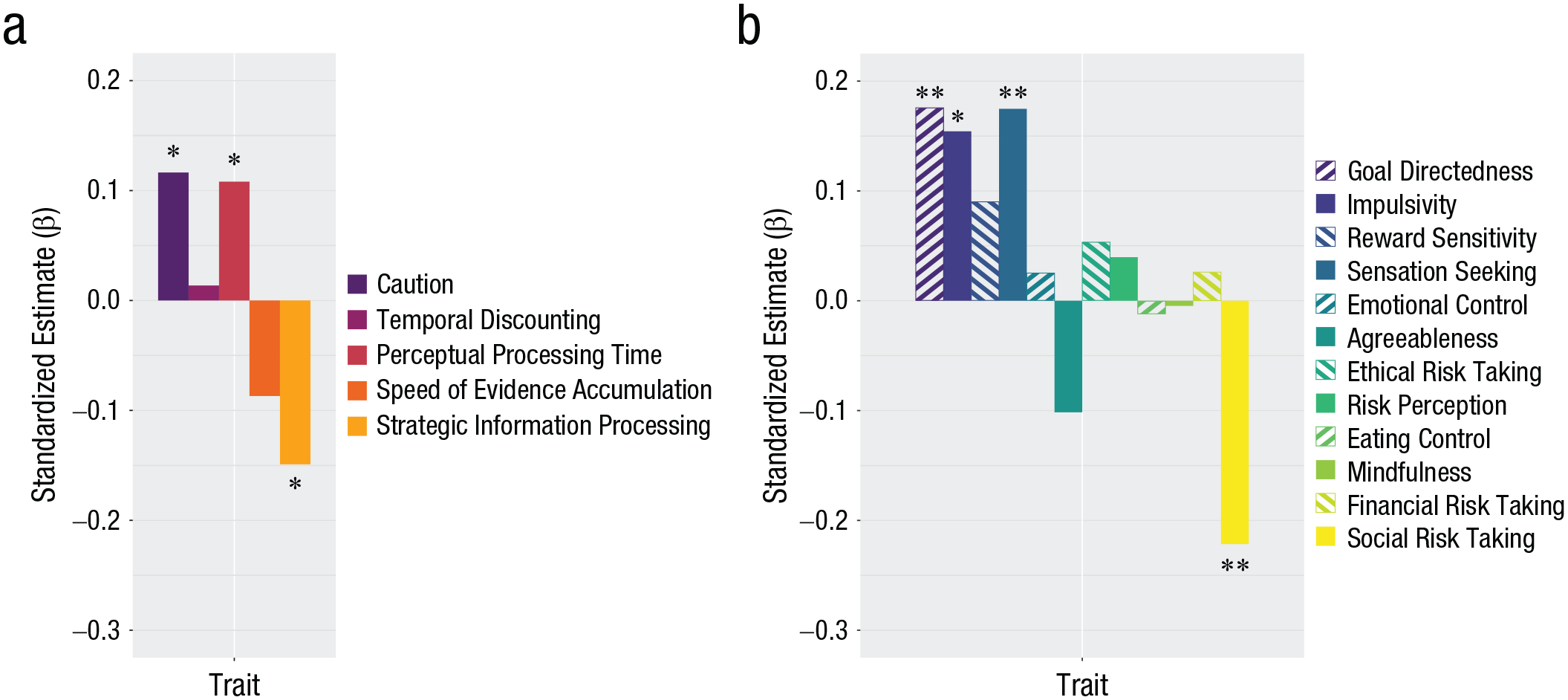
Results of regression analyses predicting individual differences in extreme pro-group attitudes, using scores for (a) cognitive and (b) personality traits as the predictors. Asterisks indicate variables that were significant predictors of extreme pro-group attitudes, including support for ideological violence against out-groups to protect the in-group (*p < .05, **p < .01). Adapted from Zmigrod and colleagues (2021), p. 9 in the main article (a) and p. 5 in the Supplemental Material (b).
Some of the tasks administered tapped into executive functioning, including planning and working memory. These were implicated in the factor labeled “strategic information processing.” One such task was the Tower of London task, in which participants must mentally plan how they would move a series of colored disks stacked on top of each other so that they are arranged as shown in an illustration. Another executive-functioning task was the keep-track task, which is used to quantify how many items an individual can hold in working memory at the same time. As shown in Figure 2a, greater proclivity for extreme pro-group action was significantly associated with poorer performance on these strategic-information-processing tasks. Difficulties in strategic information processing may thus subconsciously push individuals toward extreme doctrines that prescribe action and provide clear explanations of the world, and so make less stringent demands on working memory.
Additionally, participants performed perceptual decision-making tasks (called two-alternative forced-choice tasks), in which they were asked to make a series of fast and accurate choices between two visual stimuli. Classic tasks used included a local-global task, in which participants were presented with a global figure (e.g., an “H”) which was composed of smaller local figures (e.g., “O”s). On some trials, participants needed to indicate the global shape, and on other trials, they needed to indicate the local shape. They were asked to do this as quickly and precisely as possible. Computational modeling was applied to the data from the perceptual decision-making tasks in order to extract individuals’ tendencies toward slow and accurate or fast and imprecise strategies—a cognitive variable called caution. Additional performance measures quantified how much time it took participants to process the perceptual stimuli (perceptual processing time) and how quickly they accumulated relevant evidence before making a decision (speed of evidence accumulation). Methods for analyzing data from multiple tasks at once were applied to create robust individual-differences variables that represented these cognitive processes. The findings revealed that individuals who possessed extreme pro-group attitudes exhibited slower processing of perceptual (visual) stimuli and greater caution in perceptual decision-making tasks (Fig. 2a). Hence, individual differences in low-level perceptual tendencies are linked to endorsement of ideological violence: One’s willingness to engage in extreme political action may thus be linked to how one processes evidence from the decision environment in general—even in basic perceptual contexts.
Emotional Roots of Extreme Political Action
Perhaps one of the most obvious aspects of any political action is that it is highly emotional (Goodwin et al., 2000; Valentino et al., 2011). Yet despite recent advances in understanding of how emotions are transmitted and regulated in intergroup and political contexts (Goldenberg et al., 2016), remarkably little is known about how general individual-level affective dispositions may be associated with political action, especially in the context of support for extreme pro-group actions such as violence.
It can be productive to evaluate the emotional roots of extreme political action in terms of two focal components in the affective process: emotional reactivity and emotion regulation. Emotional reactivity refers to the duration of an individual’s experienced emotions in response to a stimulus before returning to the baseline level of arousal and to the intensity of that experience (Nock et al., 2008). Given the stability of emotional reactivity across situations (Silvers et al., 2012), it is likely that emotional reactivity, particularly in the case of negative emotions, predicts responses to political situations and therefore political action.
In the same data-driven study that examined links between cognitive traits and extreme political views (Zmigrod et al., 2021), several personality traits associated with emotional reactivity were implicated in extreme pro-group attitudes. Two traits that were particularly important were impulsivity and sensation seeking (see Fig. 2b). Impulsivity relates to emotional reactivity that leads to actions that are poorly conceived, prematurely expressed, and unduly risky, or inappropriate to the situation (Evenden, 1999). Heightened impulsivity was associated with support for ideological violence, which suggests that general impairments in inhibitory control in response to rewards and punishments may amplify an individual’s likelihood of engaging in extreme political action. Sensation seeking derives from a need to maintain reactivity and involves seeking intense and complex emotional sensations, coupled with the willingness to take risks in order to attain such experiences. The findings indicated that individuals with extreme pro-group attitudes tend to self-report high levels of sensation seeking. An affective disposition toward seeking high levels of stimulation in general thus appears to facilitate seeking extreme ideological experiences in particular. The emotional profile of the extreme political actor may therefore be characterized by a heightened craving for intense emotional experiences along with impulsivity in contexts that require a level of emotional control and regulation.
A positive association between emotional reactivity and tendencies toward extreme political behavior has been corroborated by studies using psychophysiological techniques to measure emotional reactivity. Through clever experimental design, Swann and colleagues (2010) found that elevating autonomic arousal led to heightened endorsement of extreme pro-group actions, especially in people whose identities were highly fused with the group beforehand. Furthermore, a meta-analysis by Lorber (2004) identified associations between psychophysiological reactivity and interpersonal aggression (d = 0.10) and antisocial conduct problems (d = 0.20), both of which could reasonably be positively associated with extreme ideological actions. The relationship between reactivity and extreme political action may also be nonlinear, especially because individuals characterized by very high reactivity also display avoidance from emotionally intense situations (Nock et al., 2008).
A second key affective process relevant to the political realm is emotion regulation, the activation of a goal so as to influence the trajectory of emotion (Gross et al., 2011). One useful strategy for emotion regulation is cognitive reappraisal, which involves modifying how one thinks about an emotion-eliciting situation in a way that leads to changes in one’s emotional trajectory (Uusberg et al., 2019). For example, in response to an anger-inducing speech by a controversial political leader, individuals may regulate their emotions by assuring themselves of the historical significance of this leader. Indeed, a study by Halperin and colleagues (2013) showed that teaching Jewish Israelis to use reappraisal to reduce negative emotions in the context of the Israeli-Palestinian conflict was associated with a reduction in their negative attitudes toward Palestinians, as well as an increase in their willingness to make concessions for peace.
Although there has been increasing interest in regulation of emotions driven by group-related political situations (for a review, see Goldenberg et al., 2016), the investigation of how individual-level tendencies for emotional regulation sculpt inclinations for political action is in its infancy. In research by Ford and colleagues (2018) concerning the 2016 U.S. presidential election, Clinton voters who used reappraisal to manage their emotions in response to Trump’s election were less likely to partake in political action than were Clinton voters who did not make use of reappraisal. Further longitudinal investigation of the association between reappraisal and political action has suggested that using reappraisal may be a double-edged sword (Feinberg et al., 2020; Ford & Feinberg, 2020): Although it helps the individual to cope with negative emotions related to politics, it can hinder the motivation to change the status quo through action. Investigating how emotion-regulation strategies impact predispositions toward normative and extreme political action is thus a worthwhile future research avenue.
Future Directions: Cognition-Emotion Interactions
Given that cognition and emotion are psychologically and neurally intertwined, and that ideological discourse is often composed of both rational (“cold”) argumentation and passionate (“hot”) persuasion, it is important to consider the functional interactions between cognitive and affective dispositions in order to elucidate the psychological underpinnings of political action (see Fig. 3a). Methodologically and analytically, it can be challenging to hypothesize and examine cognition-emotion interactions, and so we outline a theoretical exemplar of how this can be achieved.
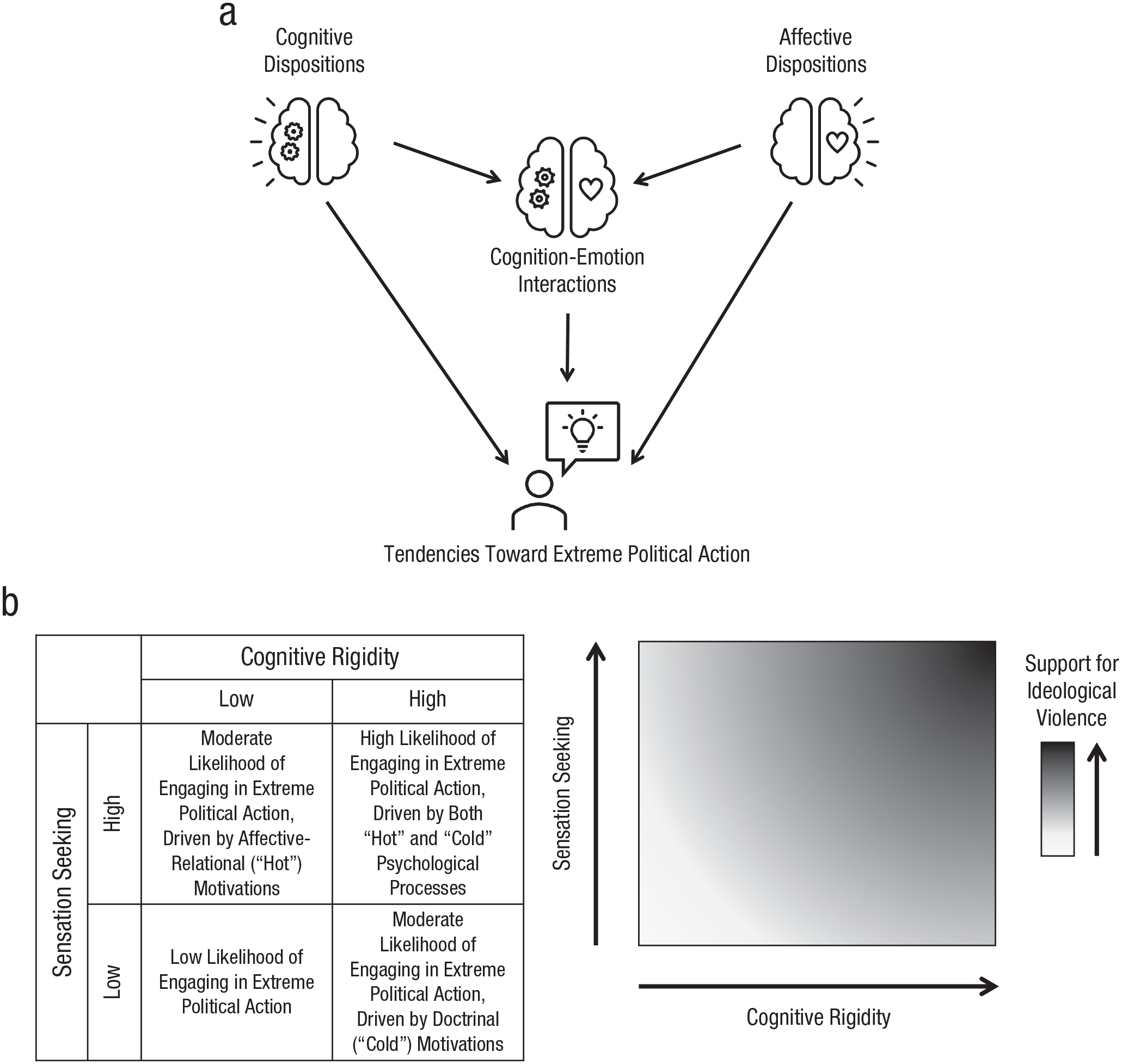
Cognition-emotion interactions: (a) a conceptual model showing consideration of cognitive traits, affective traits, and their interactions in shaping extreme ideological attitudes and actions and (b) a theoretical example of how cognitive rigidity and sensation seeking might interact in shaping likelihood of engaging in extreme ideological action. This model is based on the assumption that the interaction operates in a multiplicative fashion, such that high cognitive rigidity and high sensation seeking produce the most ideologically extreme psychological profile.
As we have discussed, support for ideologically motivated violence is amplified by cognitive rigidity as well as sensation seeking, to take two examples. It is plausible and likely that these traits interact to shape tendencies for political action (see Fig. 3b). According to this reasoning, individuals characterized by both high cognitive rigidity and high sensation seeking will be rigid in how they interpret their political environment and will be susceptible to emotional triggers when negative events befall their ideological group. They may therefore be highly likely to immerse themselves in collective ideologies and demonstrate a willingness to support violence for the sake of the cause or group. In contrast, individuals characterized by low cognitive rigidity and low sensation seeking will be able to flexibly evaluate events and arguments in their political environment and will be emotionally resilient to emotional contagion from other individuals in their surroundings and less susceptible to the allure of sensation-fulfilling extreme collective acts. Consequently, they will have a low likelihood of engaging in extreme political action or being swept up in emotionally charged or polarizing social movements, all other situational and group-level factors being equal.
Perhaps the most interesting cases in interaction models are those involving individuals who are low on one trait and high on the other. In the case of an individual who is cognitively rigid but low in sensation seeking, the model in Figure 3b posits a moderate likelihood of participation in extreme ideological action, perhaps motivated more clearly by dogmatic doctrinal issues than by a desire to seek emotionally intense experiences. In the case of an individual who is cognitively flexible but high in sensation seeking, the model also suggests a moderate likelihood of engaging in ideologically motivated behavior, but driven by a strong craving for emotionally intense social experiences.
Examining interaction models may therefore reveal different subprofiles of political actors, such as those who are characterized by affective-relational motivations versus those who have dogmatic tendencies (Zmigrod, 2020a). If researchers focus purely on one trait, they will miss the nuances distinguishing different subprofiles and predictive models. Interaction models can also reveal various types of trait-by-trait interactions, such as those that are multiplicative (i.e., traits compound each other’s effect) or compensatory (each trait’s effect substitutes for the other’s effect). This interactionist approach can allow more sophisticated risk assessments of vulnerable individuals by elucidating the gradients of risk along which an individual may be positioned, depending on the number and types of relevant traits the individual possesses. In addition to benefiting assessment, this approach better positions practitioners to tailor interventions that focus on the specific psychological domains in which individuals may be impaired. For example, interventions might be personalized to improve emotion-regulation strategies or enhance cognitive flexibility and other executive functions, or might target a customized cocktail of these psychological processes. Knowledge of trait-by-trait interactions can facilitate better estimation of the efficacy of such targeted interventions.
Conclusions
Not all individuals are equally likely to engage in extreme political action, and not all those who do have the same psychological profile. A burgeoning line of research suggests that certain cognitive and affective traits may increase an individual’s support for extreme ideological behavior. In the cognitive domain, traits such as cognitive rigidity, impaired metacognition, slow perceptual strategies, and poor executive functions have been correlated with heightened endorsement of extreme ideological action. In the emotion domain, characteristics associated with emotional reactivity and impaired emotional regulation, such as sensation seeking and impulsivity, can facilitate readiness for extreme political action. Consequently, situational and motivational characteristics may be only part of the story when one considers who is most likely to participate in extreme pro-group behavior; individual differences in biologically rooted mental processes may be key—but often elusive—predictors (Jost et al., 2014). A new line of research using neuropsychological brain damage to examine the causal links among biology, cognition, and ideology has shown that damage to the amygdala and prefrontal cortex is associated with ideological conservatism (Nam et al., 2021), indicating that neural processes directly bear on ideological tendencies. Causality is currently being further investigated with longitudinal designs, biologically sensitive paradigms, and computational modeling (Zmigrod & Tsakiris, 2021), as well as theoretical perspectives that consider the bidirectional links between individual differences in cognitive and ideological domains (Zmigrod, 2020a).
Psychological science has now matured to enable nuanced analyses of interaction effects between cognition and emotion, allowing researchers to unearth various psychological subprofiles of political actors. This approach can illuminate who is most vulnerable and who is most resilient to ideological extremism—and why. It also elucidates hidden similarities and differences in the minds of individuals willing to take extreme measures to support their ideological doctrines, regardless of the ideology’s mission. This work can buttress depolarization efforts by highlighting common vulnerability factors that can motivate extremist behavior in diverse ideological settings and by demonstrating that the implicated psychological domains—such as cognitive flexibility, metacognition, and emotion regulation—are malleable in themselves and amenable to training and education. This research therefore has the potential to allow societies and individuals to harness the power of human cognition and the malleability of human emotion to find common ground and civil compromise.
Recommended Reading
Goldenberg, A., Halperin, E., van Zomeren, M., & Gross, J. J. (2016). (See References). A discussion of emotion-regulation processes in the context of group-based emotion.
Swann, W. B., Jr., Gómez, Á., Huici, C., Morales, J. F., & Hixon, J. G. (2010). (See References). Reports a series of experimental studies showing that elevating arousal, especially in identity-fused individuals, translated into endorsement of pro-group actions.
Zmigrod, L. (2020b). (See References). A concise review of the link between cognitive rigidity and ideological rigidity.
Zmigrod, L., Eisenberg, I. W., Bissett, P. G., Robbins, T. W., & Poldrack, R. A. (2021). (See References). A data-driven analysis revealing the cognitive and personality signatures of individuals who endorse ideological violence, as well as other ideological worldviews such as political conservatism, nationalism, dogmatism, religiosity, and social dominance orientation.
Footnotes

References
Supplementary Material
Please find the following supplemental material available below.
For Open Access articles published under a Creative Commons License, all supplemental material carries the same license as the article it is associated with.
For non-Open Access articles published, all supplemental material carries a non-exclusive license, and permission requests for re-use of supplemental material or any part of supplemental material shall be sent directly to the copyright owner as specified in the copyright notice associated with the article.
