



Abstract
A highly relevant but provocative research question is whether and how one can intentionally change personality traits through psychological interventions, given that traits are relatively stable by definition. Recently, research has begun to investigate personality change through intervention in nonclinical populations. One attractive and innovative interventional avenue may lie in using digital applications to guide and support people in their desire to change their personality and trigger change processes. This article provides a rationale for nonclinical personality-change interventions and discusses motivations to change, the potential of using digital applications for intervention efforts, key studies that illustrate this emerging field of research, and future directions.
Keywords
Classical views see personality traits as rather immutable and not amenable to intervention efforts. Traits are usually defined as relatively enduring patterns of behaviors, thoughts, and feelings, as opposed to their expressions in behaviors, thoughts, and feelings at a given time (Baumert et al., 2017). Trait expressions are more transient and arise in response to specific situations and contexts. Conceptually, traits are considered predictors of outcomes or moderators or covariates; they are rarely seen as targets of interventions. Taking a different view, in this article we assume that personality traits are more dynamic and plastic than once believed and thus accessible to intervention efforts.
Why Promote Personality Change Through Interventions?
We first ask a fundamental question: Are there good reasons to intervene to promote personality change? We argue that there are. First, an extensive literature suggests that personality traits are powerful predictors of a wide range of outcomes in the domains of education, work, relationships, health, and well-being (Bleidorn et al., 2019; Soto, 2019). For example, high conscientiousness is positively associated with academic achievement, job performance, physical health, relationship quality, and longevity. In contrast, high negative emotionality is associated with enormous economic costs that exceed the costs of common mental-health disorders (Cuijpers et al., 2010). Second, despite the relatively enduring nature of personality traits, numerous longitudinal studies have shown that they are malleable and continue to evolve in adulthood and old age, albeit slowly (Graham et al., 2020; Roberts et al., 2006). Third, longitudinal studies reveal that naturally occurring personality change has important consequences, such as better health and longer life (Mroczek & Spiro, 2007). For example, in one study, increases in self-control, a facet of conscientiousness, across the adolescent years predicted greater success in love and work in adulthood (Allemand et al., 2019). Not only do personality traits predict important outcomes, but the extent and direction of their change can have consequences.
The Critical Role of the Motivation to Change
Another important question that deserves attention is whether people really want to change their personality traits, and if so, in what direction and why. Self-help books suggest that people have an intrinsic desire to change, grow, and self-actualize. This observation aligns with the prevailing view in life-span developmental psychology that people want to actively contribute to their own development. People are influenced by the physical and social contexts in which they live, but they also take a self-directed and active role in selecting and modifying those contexts by creating opportunities for change. Regarding personality, this means that in modern societies, individuals are expected to have some freedom to shape their own personality development.
Recent research supports this view. Indeed, many people want to change their personality; the desire to increase extraversion and conscientiousness and decrease negative emotionality are the most common change goals (Stieger, Eck, et al., 2020; Thielmann & de Vries, 2021). Personality-change goals (e.g., “I want to be much more talkative than I currently am”) predict subsequent trait growth in ways consistent with the stated desire to change, albeit with small effect sizes (Hudson et al., 2020), which indicates that the motivation to change can trigger change processes even without intervention efforts. Personality-change goals are common among younger adults, as well as middle-aged and older adults (Hudson & Fraley, 2016), and there is initial evidence that the desire for personality change is not just a phenomenon of the individualistic “Western” lifestyle, but occurs all over the world (Baranski et al., 2021). One caveat, however, is that not all change goals actually translate into action. Accordingly, motivation to change should be explicitly considered as a prerequisite for participation in personality-change interventions or for inclusion as part of intervention efforts.
Encouraging Personality Change Through Specific and Generic Models
There has been some theoretical discussion of personality change through intervention (Allemand & Flückiger, 2017; Martin et al., 2014). Some of these conceptual frameworks focus on specific traits, such as conscientiousness (Magidson et al., 2014; Roberts, Hill, & Davis, 2017) or negative emotionality (Sauer-Zavala et al., 2017), and others on self-regulation processes (Rebele et al., 2021). Overall, these frameworks promote a bottom-up approach in which psychological interventions target specific and narrowly defined behaviors, thoughts, and feelings at specific times and in specific situations, rather than acting directly on the traits. It is assumed that an accumulation of changes in the expression of traits will eventually lead to changes at the trait level. This idea is consistent with a recent theoretical framework on personality development that attributes long-term personality development to repeated short-term, situational processes (Wrzus & Roberts, 2017). According to this framework, repeated behaviors, thoughts, and feelings triggered by situations, as well as intentions and change goals, can lead to personality development through two broad types of processes. On one hand, reflective processes presumably change and maintain one’s personality by consciously gathering information from watching and thinking about one’s behaviors, thoughts, and feelings. On the other hand, personality development can occur without reflection through associative learning processes such as habit formation, in which a behavior becomes automatic or habitual through regular repetition. Similarly, it is possible that repeatedly experiencing pleasant or unpleasant reactions from oneself or others may strengthen or weaken certain expressions of traits.
Various paradigms from psychotherapy research can be adapted for the purpose of personality-change interventions. For instance, specific intervention models assume that intervention should primarily be based on specific treatment factors that are described in treatment manuals (e.g., cognitive restructuring in clinical treatments of depression, exposure in treatments of anxiety disorders). Thus, the goal is to apply specific treatments and adhere closely to carefully developed guidelines and manuals (Javaras et al., 2019). For example, a recent theoretically informed intervention framework for changing conscientiousness suggests changing behavioral expressions associated with conscientiousness in ways so that the change is enduring (Roberts, Hill, & Davis, 2017), and one way to do so is through behavioral activation. This is a specific therapeutic intervention intended to increase engagement, across numerous life domains, in goal-directed activities that are considered important, enjoyable, and in accordance with individual values.
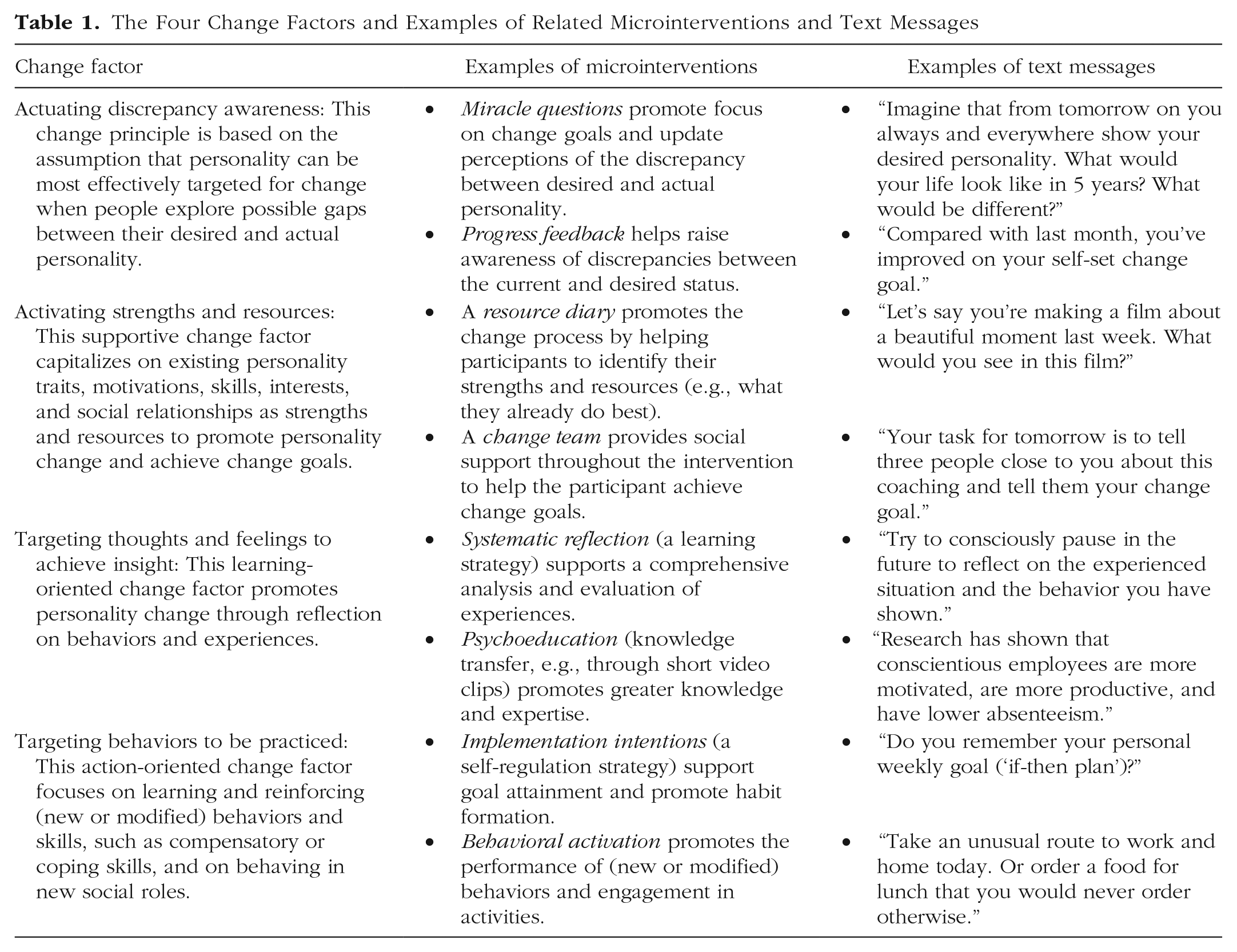
Alternatively, generic intervention models assume that intervention should be largely collaborative and based on general factors or principles (e.g., cooperative working relationships between clients and therapists; personal beliefs that engaging in a suggested behavior will have positive consequences; Norcross & Goldfried, 2019). One intervention framework for personality change suggests applying four change factors derived from research mapping the relationship between psychotherapy processes and outcomes (Allemand & Flückiger, 2017). First, intervention efforts should actuate awareness of discrepancies. Desired changes can be most effectively targeted when people are aware that they want to be different than they are, and one way to foster such awareness is to contrast the desired personality with the actual one. Second, interventions should activate people’s existing personality traits, motivations, skills, interests, and social relationships as strengths and resources for the change process and for achieving change goals. One way for intervention participants to activate resources is to seek social support from other people. Friends and family members can provide support during difficult phases of an intervention and help participants attain their change goals. Third, interventions should target reflective processes, with the goal of helping people achieve insight by better understanding their underlying assumptions, expectations, and motivations. One way to gain insight is through systematic reflection, a learning process in which one comprehensively analyzes and evaluates one’s own experiences, including actions, thoughts, and emotional reactions. Fourth, interventions should target practice in action, with the goal of helping people explore and practice new behaviors, and gradually increase their engagement in new activities and behaviors outside their “comfort zone.” One way to do this is to promote behavior change through behavioral activation.
The main goal of the change-factors model is to optimally realize and integrate all four change factors to maximize intervention effects. Table 1 provides examples of how these four change factors can be addressed through microinterventions, small techniques that help people change their thoughts, feelings, and behaviors in everyday life and trigger and sustain the change process.
The Four Change Factors and Examples of Related Microinterventions and Text Messages
Initial Evidence for Personality Change Through Intervention
There is an extensive literature on personality change as “side effects” of clinical interventions and psychotherapy in which personality traits are not the direct targets of the treatments. For instance, a recent study tested the effects of two 4-week clinical interventions on clinical states (e.g., stress, depression) and personality traits in a sample of substance use patients (Stieger, Allemand, et al., 2021). The results showed large changes in both clinical states and personality traits over the 28-week assessment period; these changes occurred particularly rapidly during the treatment period. A systematic review of 207 clinical intervention studies found decreases in negative emotionality and increases in extraversion due to interventions designed to target mental-health problems (Roberts, Luo, et al., 2017). Two main results are noteworthy. First, most changes in personality traits happened in the first couple of weeks of therapy, and change plateaued after 8 to 10 weeks; this trajectory contrasts with the slow developmental change processes typical in longitudinal observational studies (Roberts et al., 2006). Second, the type of therapy employed (e.g., cognitive behavioral, psychoanalytic) was not strongly associated with the extent of personality change. This suggests that trait changes are not uniquely the result of specific therapeutic techniques but rather can be explained by principles shared across different types of clinical therapies (Norcross & Goldfried, 2019).
Research on self-directed and intentional personality change through intervention in nonclinical populations has only recently attracted interest in personality psychology. Studies have examined the effectiveness of specific intervention components in producing personality change. For instance, a 16-week intensive longitudinal study demonstrated that generating implementation intentions as specific “if-then” plans (e.g., “If I feel stressed, then I will call my mom to talk about it”) for attaining personality-change goals and then following through on those plans was associated with trait changes (Hudson & Fraley, 2015). In addition, a 15-week intensive longitudinal study of engagement in behavioral challenges found that attaining behavioral change goals by regularly and successfully completing concrete and specific behavioral activities (e.g., “Introduce yourself to someone new”) predicted trait change over time (Hudson et al., 2019).
To date, few studies have combined multiple intervention components to produce personality change, and the existing studies have often had small sample sizes. In one such study, participation in a 10-week structured personality-change coaching program (Martin et al., 2014) designed to target traits through face-to-face coaching with psychologists resulted in significant increases in conscientiousness and extraversion and decreases in negative emotionality; some changes were maintained 3 months after the intervention (Allan et al., 2018). In addition, recent research explored the effects of a 5-week behavioral-activation training intervention, finding increases in facets of conscientiousness, and a 12-week coaching intervention (i.e., instructional feedback and monitoring) was associated with some personality change (Massey-Abernathy & Robinson, 2021). Although this research on intentional personality change is still in its infancy, the results, which are based primarily on self-reports, are promising and suggest that people can change their personality traits in desired directions.
Supporting Intervention Efforts Through Digital Applications
One attractive and innovative avenue for addressing people’s desire to change their personality is to provide them with guidance, support, and coaching by means of digital applications accessible via computers, tablets, and other devices. In particular, the use of smartphones with text-messaging services and applications for intervention purposes is becoming increasingly popular in psychology and other disciplines (Marsch et al., 2014). Smartphones are ubiquitous, have powerful technical abilities, and make sophisticated interventions attractive and widely applicable. Owners typically keep their smartphone near them, which allows daily connections and high treatment intensity. In addition, people often have an emotional attachment to their smartphones and daily routines, which lowers inhibitions to digital interventions while increasing engagement.
Digital applications support intervention efforts through automatic delivery of microinterventions. Table 1 includes examples of these techniques to promote personality change. Traditional intervention approaches typically use individual or group formats in controlled settings with face-to-face interaction. Digital interventions, on the other hand, provide a powerful avenue to offer momentary, guided, automated, and tailored information, education, and support remotely in everyday contexts (Schueller et al., 2013). One form of intervention is digital coaching, in which a digital coach such as a chatbot is used to facilitate the coaching dialogue and support the coaching process. Digital applications can provide the right type and amount of support at the right time by adapting to people’s changing internal states and contexts (e.g., social opportunities to show extraverted behavior; Nahum-Shani et al., 2018). All of these unique features of digital applications can help reinforce and sustain change efforts and support people in performing exercises, completing tasks, and training remotely. However, digital tools should leverage these features to encourage individual autonomy and internal accountability for change. They should support rather than hinder people’s self-directed change efforts.
Digital applications support assessment of intervention outcomes and processes. Assessments can be performed directly on smartphones or other devices, using self-report or observer-report measures. A key strength is the potential for continuous monitoring of ongoing behaviors, thoughts, feelings, and situations using a wide range of assessment methods to study people in their natural environment (Trull & Ebner-Priemer, 2014). Such monitoring provides early indications of the success or failure of intervention efforts. Moreover, the combination of smartphones’ powerful technical abilities and their proximity to their owners offers the opportunity to detect useful internal and contextual information (e.g., mobility and activity patterns) that can be used to personalize the delivery of microinterventions. Indeed, digital methods for assessing everyday life and expressions of personality, such as mobile sensor technology, have great potential for automatically collecting objective data on behavioral and contextual indicators and monitoring behaviors (Beierle et al., in press; Harari et al., 2020).
Digital applications support feedback on progress toward goals for change based on regular data collection. Feedback can take different forms, including tailored suggestions (e.g., “Do not let small setbacks get you down”) or praise for expected behaviors (e.g., “Congratulations for successfully completing the behavioral exercise”), or it can be visual (e.g., a traffic light on a digital device that signals progress, regression, and stability). Feedback motivates people and supports self-monitoring and learning processes. Finally, digital applications also support reminder functions. Various forms of tailored reminders are an important part of digital interventions as they help with task completion and support the self-directed change process. Overall, digital applications present a great opportunity to implement scalable, cost-effective, and low-threshold (i.e., minimal-demand) interventions that are applicable to a wide range of people and can easily be combined with classical intervention formats.
Achieving Personality Change Through Digital-Coaching Interventions
Recent work has started to study personality change through digital-coaching interventions. We illustrate these efforts with two examples from our work that, conceptually, used the generic change-factors model described above (Allemand & Flückiger, 2017). These two digital interventions were not designed to treat clinical or subclinical populations. Participants were screened, and those with indications of mental-health problems or psychological distress were informed about alternative treatment options. In a first effort, we examined the effectiveness of a 2-week digital-coaching intervention in which participants chose whether to target their self-discipline, a facet of conscientiousness, or openness to action, a facet of openness to experience (Stieger, Wepfer, et al., 2020). The intervention was delivered via text messaging. Each day, participants received two text messages that included reminders to complete implementation intentions, self-reflection tasks, psychoeducation, and individual feedback (e.g., “Good morning [name]. You have set yourself the following goals for today: [individualized implementation intentions]. We wish you a lot of success in achieving your goals and look forward to your progress!”). The results showed that of the two personality facets that people could opt to change, they chose the one on which they scored lower at the start of the intervention. Furthermore, people who chose to become more self-disciplined showed a greater increase in self-discipline than in openness; the reverse was true for those who wanted to increase their openness to action. These changes were maintained at the follow-ups 2 and 6 weeks after the intervention ended. This research provides the first evidence that personality facets can be changed using a short-term digital intervention with high treatment intensity. However, whether changes produced by such interventions are permanent or only temporary shifts in personality that revert to baseline after an extended period of time is an open question for future research.
In a second effort, we examined the effectiveness of a 3-month digital-coaching intervention targeting personality traits using a randomized controlled trial in a large sample of adults (Stieger, Flückiger, et al., 2021). The smartphone application PEACH, a digital coach that automatically guides and supports people in achieving their personality-change goals, was used to deliver the microinterventions. Participants interacted with a chatbot twice a day and received education, behavioral tasks, feedback, encouragement, and support. Table 1 includes examples of microinterventions and text messages from the chatbot. Results showed that participants who received the coaching reported greater changes than those in the control group (who waited 1 month before the coaching began). The changes aligned with the self-selected goals for change and were significant whether participants desired to increase or decrease their level of a personality trait. Observers, such as friends, family members, or intimate partners, also detected significant, albeit smaller, changes in participants desiring an increase but not in those desiring a decrease. The produced changes persisted at 3 months after the intervention, but again, it is an open question whether these changes will revert over time or are permanent. Follow-up assessments over longer time periods are needed. This work provides the strongest evidence to date that personality traits can be changed in desired directions through digital intervention, challenging traditional positions that highlight the immutability of personality.
Future Directions and Conclusions
Our work on digital-coaching interventions was informed by a generic, principle-based intervention model (Allemand & Flückiger, 2017). Future work is needed to develop specific theories that can be tested to better understand intervention mechanisms and specific processes of change. Theoretical and empirical work is also needed to determine the ideal intervention length for producing change and when people are most receptive to coaching (Nahum-Shani et al., 2018). Another future direction relates to the long-term effectiveness of personality-change intervention efforts: Do the changes achieved in the short term lead to lasting long-term changes, and what specific intervention strategies are most effective in achieving permanent change? Whether personality change can be sustained depends on various factors, including pleasant or unpleasant reactions from oneself or others. Although positive feedback can reinforce the outcomes achieved, unpleasant reactions can cause people to revert to their previous behavioral patterns. A stable, supportive, predictable social context is probably the best for achieving long-term personality change. Finally, future work is needed to examine the long-term consequences of personality change through intervention: How are life outcomes in various domains, such as health, education, work, and social relationships, affected? Although some research has shown that naturally occurring developmental changes can influence later life outcomes (Allemand et al., 2019), it is an open question whether intervention-related changes also affect life outcomes.
People want to play an active role in their personality development, and digital applications are a promising and innovative interventional avenue to achieve this. Because smartphones are typically with their owners, they can take on the role of a “digital coach in your pocket” that provides guidance and support in everyday contexts. The initial results of this emerging field of research are promising, supporting the idea that personality traits are more dynamic and plastic than previously thought, and highlighting the potential of intervention efforts. Understanding how personality traits and facets can be changed and the potential benefits and challenges of such change holds promise for promoting human welfare and healthy aging.
Recommended Reading
Allemand, M., & Flückiger, C. (2017). (See References). Describes how research linking psychotherapy processes and outcomes can inform the development and imple-mentation of personality interventions.
Chapman, B. P., Hampson, S., & Clarkin, J. (2014). Personality-informed interventions for healthy aging: Conclusions from a National Institute on Aging work group. Developmental Psychology, 50(5), 1426–1441. https://doi.org/10.1037/a0034135. Describes how personality-informed interven-tions can be used to promote healthy aging.
Jackson, J. J., Beck, E. D., & Mike, A. (2021). Personality interventions. In O. P. John & R. W. Robbins (Eds.), Handbook of personality: Theory and research (4th ed., 793–805). Guilford Press. Provides a comprehensive review of available work on personality interventions.
Mroczek, D. K. (2014). Personality plasticity, healthy aging, and interventions. Developmental Psychology, 50(5), 1470–1474. https://doi.org/10.1037/a0036028. Comments on the promise of personality interventions and describes parallels between intervention efforts targeting cognitive and personality variables.
Stieger, M., Flückiger, C., Rüegger, D., Kowatsch, T., Roberts, W., & Allemand, M. (2021). (See References). Describes an empirical study testing the effectiveness of the first digital-coaching intervention aimed at changing the Big Five personality traits.
Footnotes
Acknowledgements
We thank our many colleagues, especially Mirjam Stieger, Dominik Rüegger, and Tobias Kowatsch, for their collaboration on the digital interventions presented in this review. We thank Gabrielle Pfund for helpful comments on earlier drafts.
Transparency
Action Editor: Robert L. Goldstone
Editor: Robert L. Goldstone
