



Abstract
Do social networking sites (SNSs) influence well-being? According to the active-passive model of SNS use, the impact of SNSs on well-being depends on how they are used: Using SNSs actively to interact with other users positively affects well-being, whereas passive consumption of SNS content negatively affects well-being. However, emerging evidence suggests that the active-passive distinction is too coarse to fully capture the relationship between SNS use and well-being. Here we describe the extended active-passive model of SNS use, which refines the original model in three ways: It decomposes active use, decomposes passive use, and crosses usage types with user characteristics. We describe recent empirical evidence illustrating the benefits of these three extensions and highlight important future research directions. The extended active-passive model of SNS use provides a nuanced understanding of the relationship between SNS use and well-being by highlighting that active use of SNSs is not always beneficial and passive use is not always detrimental.
Do social networking sites (SNSs) influence well-being? One framework that has addressed this question is the active-passive model of SNS use (for a review, see Verduyn et al., 2017). According to this model, actively using SNSs to interact with other people enhances well-being by increasing social capital and associated feelings of connectedness. In contrast, passive consumption of SNS content undermines well-being by stimulating harmful social comparisons and associated feelings of envy or inferiority. Although this model has increased understanding of how SNS use affects well-being, here we suggest that the model should be refined.
In the first section of this article, we position the active-passive model in the broader research landscape, clarify the main tenets of the model, and highlight the model’s limitations. In the second section, we introduce the extended active-passive model of SNS use. This extended model refines the original model in three ways: It decomposes active use, decomposes passive use, and crosses usage types with user characteristics.
The Active-Passive Model of SNS Use
Positioning the model
SNSs have changed the way people interact. These online platforms share three defining features: Users can create a personal profile, build a list of connections, and traverse a stream of frequently updated information (Ellison & Boyd, 2013). Facebook, the most popular SNS, has 2.9 billion monthly active users, but other SNSs, such as Instagram and Twitter, have massive user bases as well. These users invest a significant amount of time on these platforms—on average, more than 2 hours each day (Kemp, 2020).
An overwhelming number of studies have examined the impact of SNS use on well-being. Initial studies, mainly using cross-sectional methods, provided mixed evidence, but these studies were not well positioned to make claims about the causal impact of SNS use on well-being. However, recent large-scale experiments, the gold-standard tool for drawing causal inferences, revealed that SNS use has a small negative effect on well-being (for a review, see Kross et al., 2021). This conclusion is consistent with meta-analyses, which have revealed a small negative correlation (r ≈ −.10) between SNS use and well-being (Appel et al., 2020).
The finding that SNS use has a small impact on well-being may lead one to conclude that worries (or enthusiasm) about SNS use are unjustified. However, this conclusion is premature for at least three reasons. First, small effects may have substantial consequences when the predictive behavior is prevalent and applies to a large number of people (Funder & Ozer, 2019). This certainly holds for SNS use, as a large number of people repeatedly spend a lot of time on these platforms. Second, most prior research in this domain examined a possible linear relationship between SNS use and well-being. However, this relationship might actually be nonlinear. Recent studies suggest that some use of SNSs is better than not using them at all or using them excessively (Twenge & Campbell, 2019). Third, and most important, SNSs allow for a wide range of activities (e.g., posting pictures, chatting, looking at profiles), and a growing consensus suggests that the impact of SNSs on well-being depends on how they are used (Kross et al., 2021). Moreover, these specific usage types may have stronger positive and negative consequences for well-being than the overall amount of time spent on SNSs. In this vein, a popular distinction that has been made between usage types is the distinction between active and passive use (e.g., Verduyn et al., 2017).
Clarifying the model
Active usage pertains to activities that facilitate interactions with other people. When engaging in active SNS use, people reach out to other users or provide feedback on other users’ posts. Typical examples of such behavior include posting a status update, picture, or video; posting a comment or reply; and chatting with other users. It is notable that when engaging with SNSs actively, users produce content but may also necessarily consume some content as well (e.g., read responses during a chat conversation). Passive usage pertains to viewing content on an SNS without engaging in interactions with other users. When using SNSs passively, people do not reach out to others but merely consume the content others have posted. Typical examples are lurking, reading status updates, watching pictures, and browsing news feeds. Most SNS behaviors can be easily categorized into one of these two categories even though there are borderline cases. For example, although we consider the act of liking a post to belong to the active-usage category (i.e., liking is a shortcut to express one’s positive evaluation of or attitude toward a certain post), it is unlikely to stimulate rich interactions.
The distinction between active and passive use has advanced understanding of the relationship between SNS use and well-being in three principal ways. First, it has revealed that SNSs are not often used the way they are intended. Most SNSs are intended to foster social interaction. This requires active SNS use, but the majority of time, most users engage in passive use (Verduyn et al., 2015).
Second, the active-passive distinction has stimulated researchers to go beyond overall measures of SNS use, such as the total amount of time people spend on SNSs or the frequency with which they log in to their account. Consensus is growing that SNSs are not inherently good or bad but that much depends on how they are being used (Kross et al., 2021).
Finally, the active-passive model has helped clarify the mechanisms underlying the relationship between SNS use and well-being. According to this model, active usage offers people the possibility of fulfilling their need to connect with others, allowing users to increase their social capital (i.e., informational, instrumental, or emotional support from others) and associated feelings of connectedness. Passive usage may fulfill people’s need to evaluate their opinions and abilities by providing a massive amount of social-comparison information. However, as information on SNSs is generally positively biased, the social-comparison information they provide generally negatively affects the well-being of people who are consuming this information passively; these people perceive other users as more successful or attractive than they themselves are (for a review, see Verduyn et al., 2020).
Limitations of the model
Despite these benefits, the active-passive distinction does not fully capture the complexity of the relationship between SNS use and well-being. First, it is not hard to think of counterexamples. A grandmother is unlikely to feel bad, envious, or inferior when looking at pictures of her grandchildren having fun (passive use), and a teenager is unlikely to become happy when involved in a nasty discussion with cyberbullies (active use). Second, although several studies have revealed negative effects of passive SNS use on well-being, a number of studies have found nonsignificant (e.g., Wenninger et al., 2019) or even positive (e.g., Yang, 2016) effects. The same holds for active use; multiple studies have found nonsignificant (e.g., Pang, 2021) or even negative (e.g., Zheng et al., 2019) effects. These conflicting findings suggest that an extension of the active-passive framework is needed. In the next section, we outline three current directions in research on SNS use that are promising for refining the active-passive framework and formulate the extended active-passive model of SNS use (see Fig. 1).
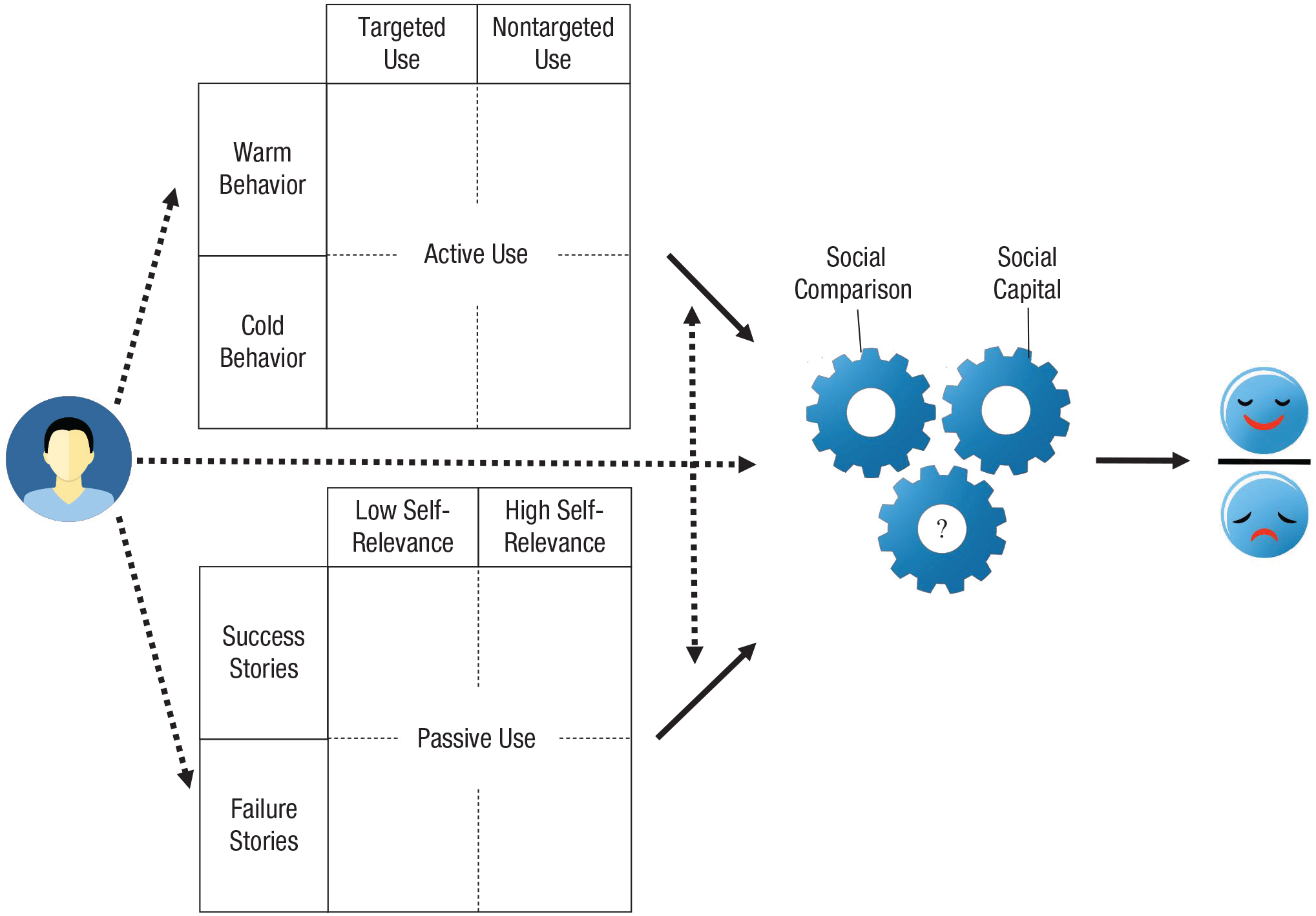
The extended active-passive model of social-networking-site (SNS) use. Active use of SNSs is expected to stimulate accrual of social capital and associated feelings of connectedness when users engage in warm active use that is targeted at a particular person or at a small group of people. This is less or not the case when users engage in nontargeted active use, and cold active use may even prevent accrual of social capital. Passive SNS use is expected to stimulate damaging upward social comparisons when users consume other users’ success stories that are relevant for their own self-concept. This is less or not the case when users consume self-irrelevant information or failure stories. The relationship between subtypes of SNS use and well-being varies across people, as indicated by the dotted arrows. Social comparison and accrual of social capital are only two out of many psychological mechanisms that explain the relationship between SNS use and well-being (question mark in the third gear). Future research is necessary to identify (a) additional explanatory mechanisms, (b) additional dimensions of active and passive SNS use and their impact on well-being, and (c) user characteristics that consistently moderate the impact of SNS use on well-being.
The Extended Active-Passive Model of SNS Use
Decomposing active use
The effect of active SNS use on well-being is unlikely to be identical for all types of active use. Accumulating evidence suggests that two features of active usage are essential to consider: reciprocity and communion (see the top left of Fig. 1).
Reciprocity: targeted versus nontargeted
Active usage of SNS is theorized to foster accrual of social capital and feelings of connectedness, but this does not hold for all types of active use. According to theories on social capital, the creation and accrual of social capital depends on the occurrence of reciprocity during social interactions (Wenninger et al., 2019). Research on social sharing of emotions indicates that feelings of connectedness depend on partners expressing concern for and interest in one another (Rimé, 2009), and research on self-disclosure reveals that people feel a stronger sense of connection when their partners reciprocate by sharing information themselves (Sprecher & Treger, 2015).
The degree to which active usage is reciprocated depends on the type of active use people engage in. Active usage encompasses nontargeted communication in a public context (e.g., broadcasting, such as posting a status update) as well as communication targeted at a particular person or small group of people, in either a public (e.g., commenting) or a private (e.g., direct messaging) context. Targeted active use elicits a stronger social obligation to respond because of the norm of reciprocity and has been positively linked with greater well-being compared with nontargeted active use (Wenninger et al., 2019). For example, when a user tags someone in a comment or directly messages someone, there is a high probability that the targeted person will respond. In contrast, when a user writes a status update, it is unlikely that the majority of the user’s network will reciprocate, and responses may be rather superficial. Supporting this idea, meta-analytic evidence (Liu et al., 2019) indicates that replying, commenting, and liking (i.e., targeted active use) are positively associated with well-being, whereas status updating and photo posting (nontargeted active use) are not. Nontargeted active use may result in feelings of connectedness and improved well-being only when people receive substantial feedback from their connections (Marengo et al., 2021).
Communion: warm versus cold
Targeted active use is likely to foster well-being, but only when aimed at establishing positive connections. According to the interpersonal circumplex model (Wiggins, 1991), the main dimension underlying behavior promoting interpersonal ties is communion, which ranges from warm (agreeable) to cold (quarrelsome) behavior. Although most behavior on most SNSs is warm (Wenninger et al., 2019), both targeted (e.g., cyberbullying) and nontargeted (e.g., broadcasting hate speech) active use can also be cold. These types of cold active SNS use prevent the development of social bonds and are negatively related to well-being (Kowalski et al., 2014).
Decomposing passive use
SNSs contain a wide variety of content. Emerging evidence suggests that the consequences of passive SNS use depend on the nature of the content consumed. Two content features are essential to consider: self-relevance and achievement (see the bottom left of Fig. 1).
Self-relevance: high versus low
Although passive usage of SNS may stimulate accrual of some types of social capital (e.g., access to information), theorizing suggests that it mainly fosters damaging social comparisons. However, the occurrence of social comparison depends on the nature of the SNS content consumed. According to the self-evaluation maintenance model (Tesser, 1988), social comparisons are more likely to occur when the comparison dimension is relevant, rather than irrelevant, for the evaluation of one’s self concept. For example, a graduate student may feel a sting of envy when reading about a fellow student who published an important article, but not when discovering that the other student won a major swimming contest. In the latter case, the graduate student may actually feel happy by basking in the reflected glory of the fellow student.
Research on the relationship between SNS use and body image further highlights the importance of self-relevance. Looking good is a major concern for young people (Levine & Smolak, 2002), and passively consuming appearance-related content on SNSs is negatively associated with people’s body-image perceptions (for a review, see Ryding & Kuss, 2020). In several experiments, the impact of passive consumption of SNS content depicting “ideal” appearance (e.g., models who look thin or toned) has been contrasted with passive consumption of content that is neutral regarding appearance (e.g., nature scenes or popular travel destinations). These studies show that content depicting ideal appearance, but not appearance-neutral content, negatively affects body image and well-being, and these effects are mediated by social comparison (e.g., Tiggemann & Zaccardo, 2015). In summary, damaging social comparisons are more likely to occur when people consume self-relevant content on SNSs than when they consume content that has no repercussions for the evaluation of their self-concept.
Achievement: success versus failure
Passive consumption of content that is relevant to one’s self-concept may foster damaging social comparisons, but this holds only when the content concerns other people’s accomplishments. This type of content is very prevalent on SNSs, as people tend to share their successes rather than their failures (Kross et al., 2013) and to upload beautiful rather than unflattering pictures of themselves (Chua & Chang, 2016). Consumption of this content results in the impression that other people are better off than oneself (i.e., upward social comparison: other > self), which generally affects well-being negatively (for a review, see Verduyn et al., 2020).
However, SNSs are occasionally used to share failures (Kross et al., 2013). Consuming this type of content may result in the impression that other people are worse off than oneself. Such downward social comparisons (self > other) do not tend to affect well-being negatively and may even foster it. For example, people reported feeling worse about their own body when they viewed pictures on SNSs of others looking great, but this was not the case when they viewed unflattering pictures of others (Fox & Vendemia, 2016). However, exposure to other people’s failures may also elicit negative feelings as a result of empathy or emotional contagion (Hancock et al., 2008). In fact, positive and negative responses may occur simultaneously. For example, graduate students may empathize and feel sad when reading that the manuscript of a fellow student was rejected by a prestigious journal while simultaneously feeling proud because they managed to publish in that journal themselves.
Crossing usage types with user characteristics
The active-passive framework can be improved not only by decomposing active and passive SNS use, but also by examining the interaction between usage and user characteristics (Kross et al., 2021). A growing body of research suggests that the consequences of active and passive usage differ across persons (e.g., Beyens et al., 2020). This may be because different people engage in different subtypes of active and passive usage. Alternatively, certain user characteristics may act as vulnerability or protective factors influencing the relationship between SNS use and well-being (see the person icon and dotted arrows in Fig. 1).
A first set of studies examined the possible moderating impact of the demographic variables gender and age. A popular claim is that women and young people are especially vulnerable to the negative consequences of SNS use. However, empirical evidence on the role of gender and age is mixed. Although some studies have suggested that certain types of SNS use are especially detrimental to women’s well-being, gender has not been found to be a robust moderator (for a review, see Meier & Reinecke, 2020). The results for age as a moderator are also mixed (Meier & Reinecke, 2020). It should be noted, however, that the age range studied has been rather limited (e.g., comparison of adolescents with young adults). Thus, future research is needed to examine the possible differential effect of SNS use on well-being for different age groups.
A second set of studies examined user characteristics that are more directly related to the psychological mechanisms that are assumed to explain the relationship between SNS use and well-being. According to the active-passive model of SNS use, SNSs can elicit damaging social comparisons. However, people differ in their tendency to engage in social comparisons; people scoring high on this trait are particularly vulnerable when confronted with the successes of others. Consistent with this trait-state approach, studies have found that passive SNS usage predicts increases in upward social comparisons (J.-L. Wang et al., 2017) and decreases in well-being (de Vries et al., 2018), but only among users scoring high on social-comparison orientation. This further demonstrates that social comparison is both an explanatory mechanism (mediator) and a vulnerability factor (moderator). Whereas social-comparison orientation is a key vulnerability factor, other personal characteristics can protect people from the consequences of social comparisons. For example, people with higher self-esteem are less vulnerable to social comparisons in the context of SNS use (Niu et al., 2018).
According to the active-passive model of SNS use, SNS use can also stimulate accrual of social capital and associated feelings of connectedness. However, people use SNSs for different purposes, and individual differences in these motivations may have consequences for the relationship between SNS use and well-being. Research indicates that the positive relationship between SNS use and social capital is stronger for people who were more motivated to use SNSs for interpersonal communication (G. Wang et al., 2019). Moreover, although reciprocity following active SNS use generally fosters accrual of social capital, the positive impact of the amount and speed of other users’ feedback appears to be stronger among people who tend to care more about other’s feelings, opinions, and behaviors (Seo et al., 2016).
Conclusion and Future Research
In this article, we have introduced the extended active-passive model of SNS use, which provides a nuanced understanding of the relationship between SNS use and well-being. In contrast to the active-passive model of SNS use, the extended active-passive model posits that active use is not always beneficial and passive use is not always detrimental for well-being.
Future research is needed to test and expand the extended active-passive model. We have described several avenues for decomposing active SNS use (reciprocity and communion) and passive SNS use (self-relevance and achievement), but we expect future research to identify additional decomposition dimensions, and user characteristics that moderate their effects. Similarly, we have focused on social comparison and accrual of social capital, but these are only two out of many psychological mechanisms that explain the relationship between SNS use and well-being. Ultimately, more work is needed to see how the three extensions of the active-passive model of SNS use interact and affect the psychological mechanisms that underlie the relationship between SNS use and well-being.
For investigating these interactions in future studies, experimental designs are to be preferred as they allow making stronger claims on the causal direction of effects. Moreover, it is of key importance that SNS use is measured and categorized accurately. Ideally, time spent on SNSs should be measured objectively, as self-reports are not strongly correlated with corresponding objective assessments (Ernala et al., 2020). Ideally, the process of categorizing subtypes of SNS use would be automated given the large amounts of available data on SNSs. However, although automation may be relatively straightforward for certain SNS activities (e.g., counting the number of posts, comments, or likes), manual coding may still be a necessary (albeit imperfect) tool to capture psychological dimensions (e.g., is a particular comment a warm expression of concern or a cold expression of sarcasm?). Yet the continued development of coding algorithms may reduce the need for manual coding in the future. We are confident that continued improvements in research methodology and theoretical frameworks will synergistically deepen understanding of the impact of SNS use on well-being.
Recommended Reading
Kross, E., Verduyn, P., Sheppes, G., Costello, C. K., Jonides, J., & Ybarra, O. (2021). (See References). Provides a comprehensive general review of research on the relationship between social media and well-being.
Verduyn, P., Gugushvili, N., Massar, K., Täht, K., & Kross, E. (2020). (See References). Provides a comprehensive review of research on social comparison on social networking sites.
Verduyn, P., Ybarra, O., Résibois, M., Jonides, J., & Kross, E. (2017). (See References). Provides a comprehensive review of research focused on the differential impact of active and passive use of social networking sites on well-being.
Wenninger, H., Krasnova, H., & Buxmann, P. (2019). (See References). Discusses the importance of reciprocity for understanding the impact of use of social networking sites on well-being.
