



Abstract
Even before COVID-19, it was well known in psychological science that people’s well-being is strongly served by the quality of their close relationships. But is well-being also served by social contact with people who are known less well? In this article, we discuss three propositions that support the conclusion that the benefits of social contact also derive from interactions with acquaintances and even strangers. The propositions state that most interaction situations with strangers are benign (Proposition 1), that most strangers are benign (Proposition 2), and that most interactions with strangers enhance well-being (Proposition 3). These propositions are supported, first, by recent research designed to illuminate the primary features of interaction situations. This research shows that situations with strangers often represent low conflict of interest. Also, in interactions with strangers, most people exhibit high levels of low-cost cooperation (social mindfulness) and, if the need is urgent, high levels of high-cost helping. We close by sharing research examples showing that even very subtle interactions with strangers yield short-term happiness. Broader implications for COVID-19 and urbanization are discussed.
Social contact is associated with positive psychological and health outcomes. Although this conclusion was reached several years before the COVID-19 pandemic, this crisis is a reminder of a very robust finding: Social contact is associated with happiness and serves as a buffer to the stress that one is bound to face in life (e.g., Holt-Lunstad et al., 2010, 2015). Indeed, one of the major stressors during lockdowns due to the pandemic has been the lack of social contact (Veer et al., 2020). Several authors have discussed why ongoing relationships, especially well-functioning ones in which people feel secure (e.g., appreciated, cared for, and respected), are associated with psychological and physical health (e.g., Algoe, 2019; Reis et al., 2017).
But is there also merit to relationships that are not close, such as contact with acquaintances or even strangers on the street or at a bus stop? We propose that even interactions with strangers may promote well-being. Specifically, using insights derived from research on social interaction along with principles of interdependence, we argue that there are three broad reasons, which we frame as propositions, why people need social contact with strangers. It is because they need Vitamin Social Contact, or Vitamin S.
Interdependence theory describes three basic features of situations: conflicts of interest, mutual dependence, and relative power (Kelley et al., 2003; Van Lange & Rusbult, 2012). First, in some situations, people may experience conflicts of interest with one another, but other interactions provide opportunities for mutual gain. Second, people may be more or less dependent on one another in the pursuit of their own goals. And finally, in some situations, people may experience that someone else holds power over them, whereas in others, they may be the ones who hold power. People readily perceive situations in terms of conflicts of interest, mutual dependence, and power (Balliet et al., 2017; Gerpott et al., 2018). Interdependence theory assumes that social interactions are a function of the persons involved (persons A and B) and the situation (this effect is often referred to as SABI, the acronym of “
Proposition 1: Most Interaction Situations With Strangers Are Benign
Recent research has used experience-sampling methods to map out the situations people experience in their everyday lives. In these studies, participants received links to short questionnaires via text messages sent several times a day for multiple days in a row. Each questionnaire asked participants to describe the last situation they had experienced with another person. What emerged from these descriptions of thousands of social interactions is a diverse pattern of situations varying in conflict, mutual dependence, and power. Yet, across samples in The Netherlands (Columbus et al., 2021) and Germany (Weiss et al., 2020), most interactions, including those with strangers, were marked more by corresponding than by conflicting interests, by medium levels of mutual dependence, and by equality of power (see Fig. 1). In the Dutch sample, although situations with strangers involved greater conflict of interest—and less mutual dependence—than situations with partners, friends, or colleagues, they were still mostly benign. Only 13% of situations with strangers were rated above the midpoint of the conflict scale (i.e., more conflicting than corresponding interests). Moreover, most situations with strangers were rated as involving mutual dependence above the midpoint of the scale (59%) and equal power (56%). Thus, on average, interactions with strangers are fairly benign, in that interpersonal harm is unlikely because it could hardly be motivated by self-interest or by unilateral abuse of power (Kelley et al., 2003; see also Columbus et al., 2021).
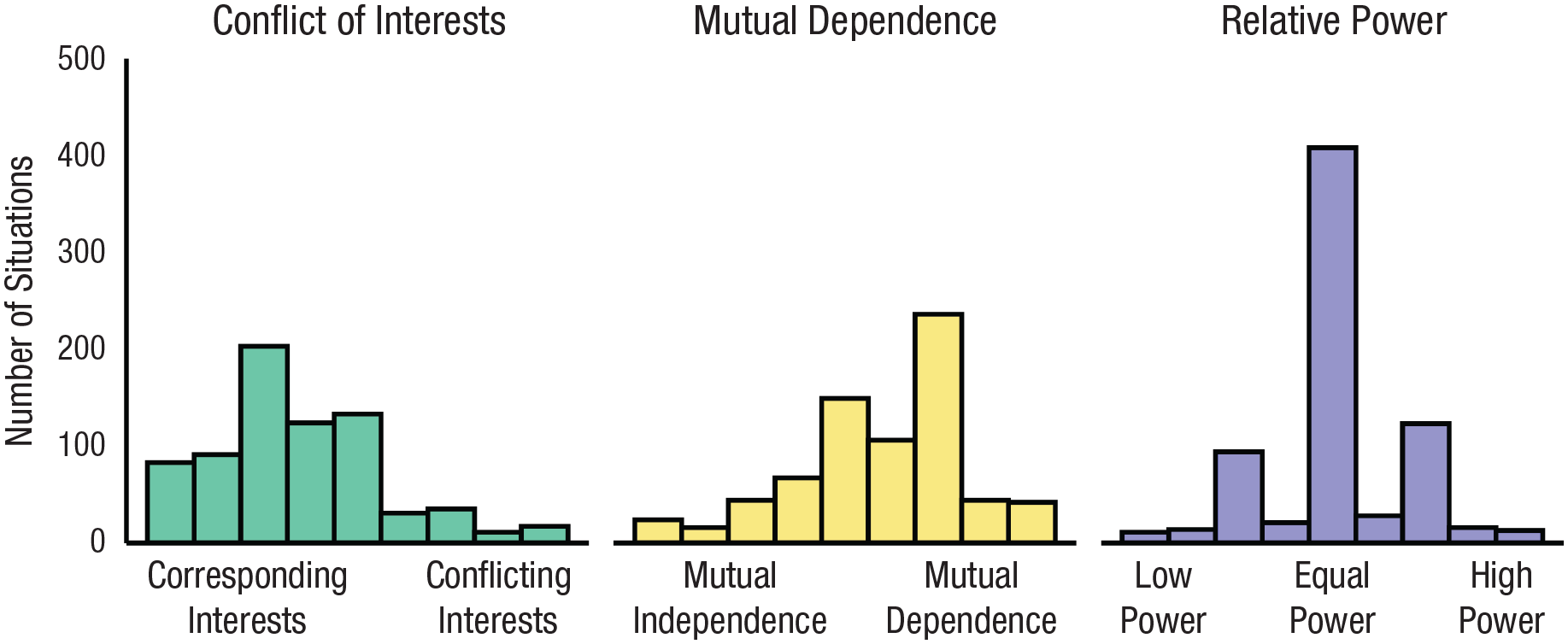
Perceptions of conflicts of interest, mutual dependence, and relative power in social situations with strangers in everyday life (k = 728 situations). Dutch participants reported everyday situations and rated each situation on a 5-point Likert scale using the Situational Interdependence Scale (Gerpott et al., 2018; mutual dependence and conflicts of interest: 1 = completely disagree, 5 = completely agree; relative power: 1 = completely the other, 5 = completely myself). Adapted from “Interdependence and Cooperation in Daily Life,” by S. Columbus, C. Molho, F. Righetti, and D. Balliet, 2021, Journal of Personality and Social Psychology, 120(3), p. 632.
Indeed, this pattern of interdependence is conducive to prosocial behavior and mutual cooperation. Both theory and laboratory experiments suggest that corresponding interests and mutual dependence may promote prosocial behavior (Columbus et al., 2021). In contrast, holding relatively more power over another person may lead to less prosocial behavior (Nieper et al., 2021). Indeed, in the Dutch experience-sampling study, perceived corresponding interests and mutual dependence were positively associated with prosocial behavior in everyday situations with strangers (Columbus et al., 2021). Moreover, this positive association of corresponding interests with cooperation was increased when the situation was characterized by greater mutual dependence and when an individual held more power over his or her interaction partner (Columbus et al., 2021).
Proposition 2: Most Strangers Are Benign
In most situations involving low conflict of interest, people are naturally kind—even in the absence of any history of social interaction or anticipation of social interaction in the future. A case in point comes from research on social mindfulness, defined as low-cost cooperation, or simply as “being thoughtful of others in the present moment, and considering their needs and wishes before making a decision” (Van Lange & Van Doesum, 2015, p. 18). This construct has been operationalized as “making other-regarding choices involving skill (‘to see’ the socially mindful option) and the will to act upon it (to make a socially mindful choice)”; Van Doesum et al., 2013, p. 86). An example of an opportunity for social mindfulness might occur at a hotel buffet. If there are several kinds of cold cuts, but only one slice of ham is left, a guest who takes the last slice of ham would deprive anybody who comes later of a choice. The socially mindful option would be to leave the last slice and pick something else.
As it turns out, about 65% to 70% of adults make the socially mindful choice in such scenarios (Van Doesum et al., 2013, 2020). Further, the percentage of people choosing the nonunique item is much lower when they believe there is no other person who will follow (52%) than when their choice will affect the option’s availability for a second person who is present (in which case, 78% choose the nonunique item). This latter finding clearly indicates that it is social mindfulness rather than a simple preference for a nonunique (or unique) item that guides this decision (Van Doesum et al., 2018).
The importance of a second person is also highlighted by a field study in which the salience of a second chooser was varied (Van Doesum et al., 2018, Study 2). Participants were invited to participate in a brief study after leaving an elevator and could choose one of three pens (one blue and two black) as a reward. In the specific-stranger condition, participants were greeted by a confederate in the elevator, and this confederate also participated in the study, but finished after them. In the abstract-stranger condition, there was not a specific other person next in line to receive a gift, but the experimenter pointed out that another participant would follow. The percentage of participants choosing one of the two black pens (the socially mindful option) was higher when the stranger was physically present (76%) than when the stranger was an abstraction (60%). This suggests that many people take into account the well-being of strangers in their decisions, especially if the stranger is physically present (and they met the stranger in a very brief face-to-face interaction).
Socially mindful choices, such as leaving a choice for another person, capture low-cost cooperation—acts that people may label as kindness. But are people also inclined to be helpful to others at a higher cost to themselves? Evidence from across the world indicates that people show significant levels of high-cost helpfulness or cooperation, especially when strangers are in need. They are willing to give to noble causes, to reward acts of kindness, and to cooperate in social dilemmas (e.g., Van Lange et al., 2013). When researchers dropped 17,000 wallets around the world, many of them were returned, although the proportion varied widely across countries. Perhaps most strikingly, in all but one country, the likelihood that a wallet would be returned was increased when it contained money (Cohn et al., 2019). People are also quite willing to donate money if that would help refugees who seek to integrate into a new country (Böhm et al., 2018). These findings suggest that many people are willing to forgo benefits and even to incur costs to help strangers.
What about helping when the need is urgent? In a recent study about donations to support the victims of Typhoon Haiyan in the Philippines in 2013 (Manesi et al., 2019), participants read a text about the disastrous impact of Haiyan in terms of key consequences, such as mortality, injury, and financial damage. Next, participants were asked if they wished to raise financial support for the typhoon victims by volunteering their time to complete some extra typing-task trials. Every extra task trial raised an amount of $0.05 (U.S. dollars) for the typhoon appeal. The large majority of participants (more than 78%) contributed, and individuals scoring higher on prosocial orientation and social mindfulness made larger donations. Other qualities, such as education or political orientation, mattered less. Taken together, these lines of research suggest that a good number of people are willing to help and cooperate with strangers even if they belong to an out-group.
Proposition 3: Most Interactions With Strangers Enhance Well-Being
Most research on social interaction and happiness has focused on people connected by a relationships, such as close partners, friends, or colleagues. However, there are a few exceptions. First, scientists who have advanced the importance of weak ties have shown that people who know quite a few people beyond their close network tend be happier than those with smaller networks of acquaintances. Possible reasons are that weak ties may facilitate connection with other people, may help a person obtain good advice or useful information, or may inspire a person to attain certain goals. For example, classic research showed that a large majority of people find a job through acquaintances that they have met only infrequently, and a quarter of those acquaintances are people they seldom see (Granovetter, 1973). And because people generally are in a good mood (Diener et al., 2015), encountering kindness is more likely than encountering unkindness, a phenomenon that may partially explain why people tend to be socially mindful and helpful toward strangers (Van Doesum et al., 2021). Recent studies on relational mobility similarly have found that people living in cultures in which it is easier to meet strangers and form new relationships tend to have greater well-being (e.g., Yuki & Schug, 2020).
Setting aside material or future benefits, we propose that social interactions with strangers fulfill the need for social contact. This idea is consistent with theoretical analyses emphasizing needs such as affiliation, need to belong, or relatedness (e.g., Baumeister & Leary, 1995; Van Lange & Rusbult, 2012). Various lines of research support this claim. For example, the strength of weak ties is supported in research on social exclusion, which has shown that explicit or implicit signs of exclusion by strangers cause stress or discomfort in people. Being excluded in a ball-tossing game, even one that is virtual, causes strong aversion (e.g., Williams et al., 2000), and being ignored as a passenger (“to be looked at as though air”) causes feelings of disconnection (Wesselmann et al., 2012). Thus, at the very least, feeling appreciated by and connected to strangers matters.
The literature on weak ties has traditionally focused on the instrumental value of networks or the personal and societal benefits derived from interactions with members of other social groups. However, even fleeting interactions as such may have benefits. For example, in a recent study, students and community members were asked to count the number of times they greeted another person, regardless of the duration of the interaction. This study showed the strength of weak ties in that having more day-to-day interactions with acquaintances was associated with greater feelings of belonging and subjective well-being (Sandstrom & Dunn, 2014a).
Moreover, experimental studies in which people are instructed to greet, smile, or initiate a very brief conversation—a single encounter—have demonstrated that such approach behaviors boost people’s happiness. Such benefits have been found in interactions with a bus driver, with fellow commuters on a bus or train, with a person selling cappuccino at a coffee shop, or simply with a fellow participant waiting to take part in an experiment (e.g., Epley & Schroeder, 2014; Gunaydin et al., 2021). Moreover, the short-term boost in happiness occurs not only in the person initiating the conversation, but also in the person whose social contact was sought (Epley & Schroeder, 2014).
Our basic premise has been that interactions among strangers are benign, because the situations are benign and the strangers are often benign, and because the gratification of social contact fulfills basic psychological needs. Figure 2 provides a graphic summary of these propositions. From this perspective, one may ask why people “need’ interaction with strangers, and how such interactions might complement interactions with family and friends. We propose three reasons that illustrate the added value of interactions with strangers. First, close others are often part of a network of family members or friends. Although such connections are psychologically safe in numerous ways, there is always a risk that sensitive, private information shared with one or two close others may be spread in the larger social network. Strangers are far less likely to spread private information because they are unlikely to be part of one’s social network.

Summary of the three propositions: Situations with strangers are benign (left panel), strangers are benign (middle panel), and situations with strangers contribute to happiness and psychological well-being (right panel).
Second, strangers are more likely than family or friends to be dissimilar in their background, attitudes, or opinions. This may yield gains in information (e.g., exposure to new perspectives) and amusement or excitement (e.g., exposure to unusual, novel events; Lewandowski & Aron, 2004). Also, when interactions with strangers elicit agreement in opinions, people may derive both enjoyment and confidence from having their opinions confirmed by others outside of their own network (e.g., Nickerson, 1998).
Third, and finally, compared with interactions with family or close friends, interactions with strangers may have the benefit of being more likely to provide opportunities, such as suggestions or advice regarding job opportunities, a chance to learn broader skills, or a starting point for beneficial exchange or extension of one’s social network (e.g., Granovetter, 1973).
Although the social benefits of interactions with strangers—Vitamin S—may be quite universal (e.g., Gunaydin et al., 2021), we acknowledge that individual differences matter. Some evidence suggests that extraverted individuals are more optimistic than introverted individuals about an interaction with strangers, even though the benefits after the actual experience do not differ much (Zelenski et al., 2013). The important implication of this finding is that some people might seek out new interactions with strangers to a lesser extent than others, and thus benefit less from opportunities for such interactions. This may be true not only for introverted people, but also for people who tend be less happy than average (e.g., Sandstrom & Dunn, 2014b). And last but not least, it is possible that there is an optimal level of Vitamin S for most people, that is, a level of social contact beyond which the benefits decline.
Concluding Remarks
Clearly, focusing on strangers and acquaintances as a source of happiness and well-being sets a variety of topics on the scientific agenda. One topic is whether mental and social benefits of interactions with close others generalize to the world of strangers. Do people enhance their mental fitness, and perhaps physical fitness, by approaching strangers, even if only for brief moments in a grocery store, a bus, or coffee shop? It seems plausible that preparing for interaction involves a variety of neural networks that one does not necessarily activate by reading, watching television, or even phoning. The fact that face-to-face social interaction includes so many activities, from response inhibition and timing to mentalizing, leaves little doubt that social interaction, even among strangers, helps keep people mentally fit. We do believe that in times of COVID-19, it is advisable to initiate brief interactions—even a smile—with strangers, especially when one is low on Vitamin S (i.e., when one has been deprived of social contact for a fair amount of time).
Another topic is the idea that an increased trend to urbanization makes interactions with acquaintances and strangers more prevalent. Social media may also reinforce the importance of weak ties. Hence, although humans’ ancestral and more recent past focused on small groups, the future of humankind is challenged more strongly by social interactions with strangers. What can a familiar stranger, whom one regularly sees on the bus or train, add to one’s life? Many readers’ gut feeling may be, “not so much.” But closer reflection suggests that strangers help serve basic needs, such as feeling connected and appreciated, perhaps along with the realization of personal growth. In short, it “may take a village of strangers” to achieve all the things one can never accomplish only by oneself. Strangers who are kind in the moment become readily dear—a process that supplies Vitamin S.
Recommended Reading
Columbus, S., Molho, C., Righetti, F., & Balliet, D. (2021). (See References). A recent article that provides an empirical analysis and test of interdependence theory, with a strong focus on how people perceive social situations in daily life.
Epley, N., & Schroeder, J. (2014). (See References). One of the first series of studies showing that brief social contact with strangers can enhance short-term happiness, even though people may underestimate such benefits.
Holt-Lunstad J., Smith T. B., & Layton J. B. (2010). (See References). A classic article on the health benefits of social relationships, containing a hint of the health benefits of social contact with familiar strangers and acquaintances.
Van Doesum, N. J., Van Lange, D. A., & Van Lange, P. A. M. (2013). (See References). An article that presents the first series of studies on social mindfulness, showing that most people make a socially mindful choice and that this choice is associated with empathy, perspective taking, and prosocial orientation.
Wesselmann, E. D., Cardoso, F. D., Slater, S., & Williams, K. D. (2012). (See References). An article reporting a strong study illustrating that a small signal of being overlooked as a stranger can undermine feelings of connection, which is central to well-being.
