




Abstract
The tendency to view groups as constituting essentially different categories emerges early in development. To date, most attempts at understanding the origins of this tendency have focused on cognitive processes. Drawing from social-psychological and evolutionary theory, I propose that motivations—in particular, a need to belong—may be foundational for the development of social essentialism. I review evidence indicating that this perspective not only is developmentally plausible but also may explain children’s tendency to consider intentional behaviors performed by in-group members as normative.
People tend to view natural categories, such as animals, in essentialistic terms (i.e., essentialize them). For instance, a tiger is a member of the category tiger because it was born to members of that species, that membership is unchangeable by environmental input, and membership is believed to be determined by some intrinsic essence that is causally responsible for many of its features (e.g., being ferocious), which are thus shared by all category members.
Essentialist beliefs are also applied to social groups, such as racial, ethnic, gender, and religious categories (Hirschfeld, 1996). The extent to which essentialism is applied to various social groups varies, as do the particular features of essentialism (Haslam et al., 2002). Thus, whereas certain social groups (e.g., gender) are construed as natural (i.e., as being biologically determined, immutable, and having sharp boundaries), others (e.g., religions) are particularly high on entitativity (i.e., are homogeneous and causally powerful). Crucially, social essentialism not only may tint how we construe other people but also may shape how we feel about and relate to others. By representing groups as stable homogeneous sets of inherently and inevitably different kinds of people, essentialism can function as a catalyzer for stereotyping, prejudice, and discrimination (Prentice & Miller, 2007). If we and them are essentially different kinds of people, then discrimination is natural and thus justified. Driven in part by these pernicious consequences of social essentialism, researchers have endeavored to find its foundations. Namely, why do children essentialize social groups?
The dominant responses to this question have referred to cognitive processes, such as reasoning biases or inferential tendencies, particularly when given certain linguistic inputs (e.g., Gelman, 2003; Keil, 1992). A corollary of this approach is that if we were to intervene in these processes, we would hinder the emergence of social essentialism, consequently alleviating its affective implications. And indeed, there are examples of successful interventions in which such a route has been adopted (Rhodes & Mandalaywala, 2017). Change the mind, and the heart will follow. This approach and its supporting evidence notwithstanding, this article describes an additional perspective that reverts the above causal direction. This perspective posits that social essentialism may not be solely a feature of our minds that when accidentally applied to social groups engenders severe intergroup attitudinal biases. Instead, social essentialism might be an immensely effective conceptual gadget readily construed by our minds, promoted for the optimal satisfaction of basic intergroup motivations and attitudes. It all starts with the heart (for a schematic display of these perspectives, see Fig. 1).
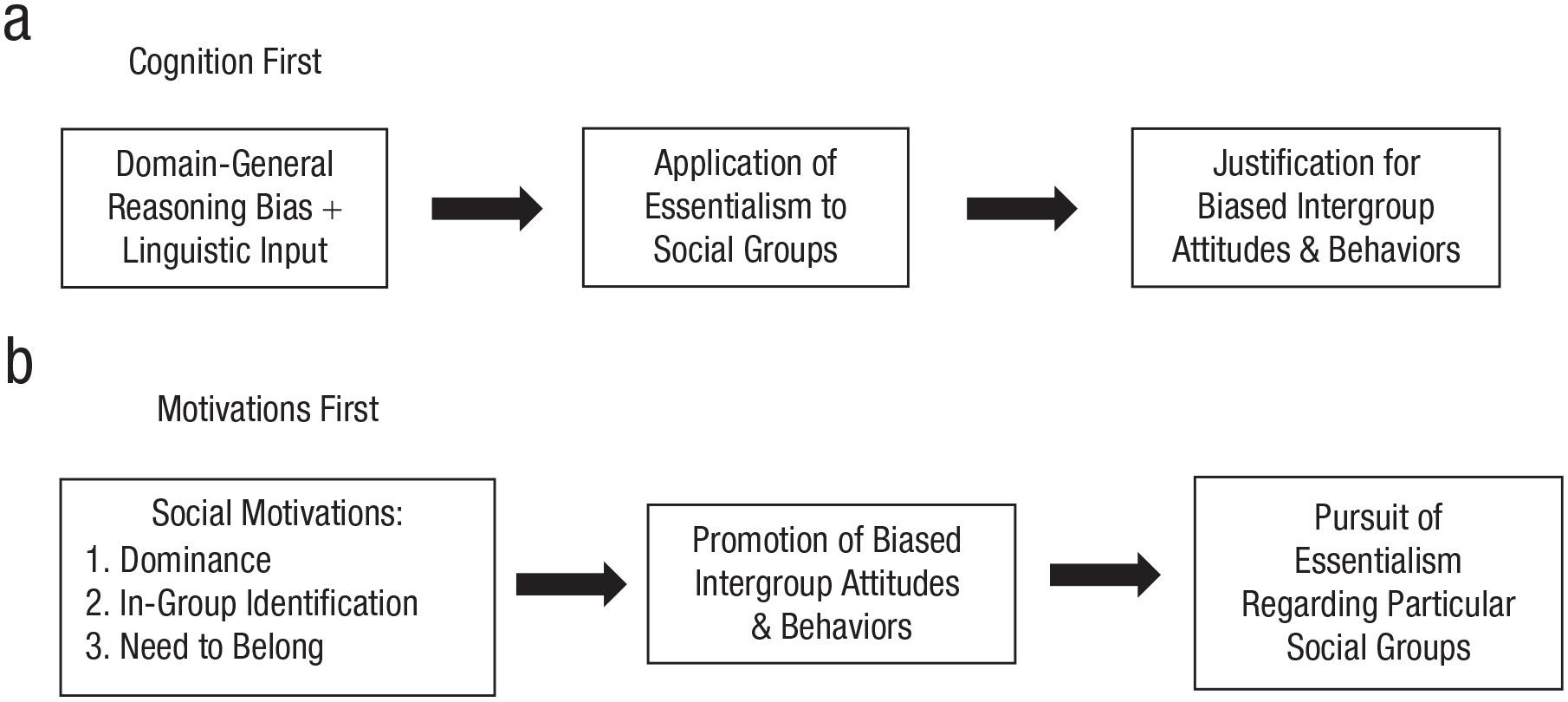
Different developmental paths relating social essentialism and intergroup attitudes: (a) cognition first and (b) motivations first.
Adults’ Motivations to Essentialize Others
By cynically portraying “the other” as essentially different, interested parties have mobilized societies throughout history to perform horrible atrocities and accept discriminatory policies. Indeed, research on adults reveals many basic motivations that can encourage the adoption of essentialist beliefs (Ryazanov & Christenfeld, 2018).
One such motivation is dominant groups’ interest in maintaining a social hierarchy, thus securing their privileged status (Sidanius & Pratto, 2001). In an example of how such a motivation endorses essentialism, Mahalingam (2003) argued that upper-caste Indian Brahmins believe their caste membership to be unalterable, even by radical transformations that would effectively alter lower-caste Dalits’ caste membership. By treating their essence as impervious, Brahmins assure the irrevocability of their position of power.
A second type of motivation relates to the positive effects resulting from identification with a particular group (Tajfel & Turner, 1979). A group enriches one’s sense of self and instrumentally provides shelter, collaboration, and resources. Arguably, given these benefits, people want to believe that their belongingness to a group cannot be arbitrarily annulled by others or circumstances and that it guarantees a high degree of commitment by the group to one’s own, and not others’, well-being. Essentialism ensures that this is the case.
An important implication of this affiliative motivation is that essentialism becomes beneficial not only for the privileged powerful but also for minorities. In what Spivak (1988) defined as “strategic essentialism,” minorities may invest in reifying their group identity for the sake of claiming rights or justifying their unique ways of living. Indeed, such a process has been found among members of lesbian, gay, bisexual, transgender, and queer (Morton & Postmes, 2009) and immigrant (Verkuyten, 2003) communities.
This brief review on adults’ motivation to essentialize social groups highlights two key points. First, differently from what would be expected from a nonpartisan conceptual belief (e.g., essentialism about animal categories), social essentialism is applied asymmetrically to various social categories such that in some cases, one category is essentialized to a larger extent than another (e.g., one’s in-group over one’s out-group, and sometimes vice versa). Second, essentialism may derive from distinct motivations, some endorsing the maintenance of power differences and thus catering primarily to privileged groups, others promoting in-group cohesiveness and thus pertinent to all groups. Arguably, the particular configuration of essentialism manifest in regard to various social categories is a function of the dynamic relation among these various motivations in the minds of particular believers. In the remainder of this review, I will argue that the above two signature characteristics are present from the earliest developmental stages of social-group concepts.
Asymmetries in Children’s Social Essentialism
There is a fair degree of agreement that social essentialism is present in children around the world at about 4 to 6 years of age. Given the multifaceted definition of essentialism, there are variations both in the timing and social target of the different components of essentialism. Thus, whereas in some cases the evidence refers to the tendency to treat social groups as homogeneous and causally deterministic, in others, it regards the naturalness of social categories (Rhodes & Mandalaywala, 2017). Given this caveat, the different manifestations of social-essentialist-like thinking in children is asymmetric in various adult-like ways, already at their very emergence.
First, children from majority groups essentialize out-groups more than in-groups. In a recent study, Israeli secular Jewish and nonimmigrant German 5- and 8-year-olds were asked to select either a homogeneous or a heterogeneous sample in order to draw a general inference about the biological properties of either their in-group (e.g., Jews) or an out-group (e.g., Arabs). Across ages and countries, children were less likely to select a heterogeneous sample when targets were out-group members than when they were in-group members (Shilo et al., 2019). “They” are more alike than “us.” In fact, in some cultural contexts, this asymmetry is observed more among majority children than minority children. For instance, Chilean 5-year-olds with high socioeconomic status were more likely than their counterparts with low socioeconomic status to believe in the inheritability and developmental stability of social status (del Río & Strasser, 2011).
There is also evidence that in certain regards, majority and minority members primarily essentialize their in-group to the same extent. For instance, Israeli Muslim Arab and secular Jewish 5-year-olds responded that a baby’s ethnicity would match that of the baby’s biological parents rather than the caretakers, especially when it corresponded to the participants’ own ethnicity (Diesendruck et al., 2013). Analogously, 5-year-olds from Israeli majority secular Jewish backgrounds, Israeli minority Muslim Arab backgrounds, and German majority nonimmigrant backgrounds were more likely to attribute out-group, compared with in-group, individuals’ behaviors to their group membership (e.g., “She does X because she is an Arab”; Essa et al., 2020). In other words, out-group membership most strongly determined its members’ behaviors.
Finally, there are also cases in which young minority children essentialize social categories more than majority ones. For instance, Kinzler and Dautel (2012) found that African American 5-year-olds were more likely than their European American age-mates to believe race is inheritable. Correspondingly, Israeli Muslim Arab 5-year-olds were more likely than secular Jewish 5-year-olds to generalize a target person’s characteristics on the basis of their ethnicity when the target’s ethnicity matched the child’s (Birnbaum et al., 2010). In other words, Arab children treated Arabness as more inductively powerful than Jewishness.
The studies reviewed above constitute a proof of concept. Whereas categories such as zebras and lions are essentialized to the same extent, the categories Jews and Arabs and Blacks and Whites are, from early on, asymmetrically essentialized. This suggests that the representation of the latter categories is affected by factors other than sheer cognitive ones. Motivational factors, such as the maintenance of power differences between groups or sheer confirmation of one’s group identity, are candidate alternatives. And although these have not yet been directly verified, there are grounds to believe that they are developmentally plausible. Interestingly, these motivations likely have different developmental trajectories. Thus, in addition to the point raised earlier about how the differential weights of the motivations likely shape the nature of adults’ deployment of essentialism, variance regarding when motivations become robustly available for children further affects this issue.
In the Beginning, There Were “Us”
By 4 to 5 years of age, children’s intergroup attitudes are influenced by perceived power differences between groups. For instance, in a racially diverse sample of South African children, awareness of the status difference between Blacks and Whites was positively correlated with children’s degree of pro-White preference (Olson et al., 2012). Evidently, in order for intergroup power differences to affect children’s tendency to essentialize social groups, children first need to differentiate between groups to which they belong from those they do not.
An awareness of social-group identity arguably takes years to congeal (Nesdale, 2004). This process may be expedited by contextual factors, such as living in a society with salient intergroup conflicts, in which schools (Deeb et al., 2011) or parents (Segall et al., 2015) may transmit to children the crucial group identities constituting their society. Thus, by the time they are 5 to 6 years old, their budding social identity may already impact their essentializing tendencies.
I propose that yet a third type of motivation that might be particularly effective for propelling social essentialism in the early years is the evolutionarily basic need to belong (Baumeister & Leary, 1995). It might take a few years for young children to map the social categories instituted by their culture and then figure out their power relations. But from earlier on, they need to find out whom they can trust for providing them sustenance, protection, and cultural knowledge (Pietraszewski et al., 2014). They need to know whom they should affiliate with.
Indeed, recent work indicates that such an affiliative motivation seems to affect even infants’ social preferences and concepts. For instance, 18-month-olds were more likely to help others after being cued for affiliative interactions (Over & Carpenter, 2009), and 14-month-olds were more likely to imitate arbitrary actions modeled by a speaker of their language than those modeled by a speaker of a foreign language (Buttelmann et al., 2013). Furthermore, whereas 10-month-olds have been found to hold positive associations regarding individuals familiar to them on some dimension, they did not evince a negative association regarding individuals unfamiliar to them (Pun et al., 2018). In other words, affect was attached to the in-group proxy, not the out-group, suggesting the primacy of a positive motivation—for example, affiliation—as a driver of intergroup attitudes. Finally, exposing White 14-month-olds to brief videos of an affiliative interaction between two White actresses boosted infants’ subsequent racial (White vs. Black) categorization of women (Ferera et al., 2018).
The above studies expose a certain conundrum affecting young children’s social-group cognition. On the one hand, they have a bursting need to belong to a group; on the other, they are at a loss as to how to define and conceptualize the group (Liberman et al., 2017). I propose that this tension drives young children to reify cues they regularly observe in similar social partners. In other words, in their pursuit to feel safe in their belongingness to a group, young children will be drawn to construe such observable cues as proxies for essences. I propose that children do exactly that, treating people’s intentional actions as such proxies.
Children’s Pursuit of Our Essence
If group essences are permanent, mandatory, inherent, and exclusive characteristics of distinct groups and if intentional behaviors are to serve as proxies for such essences, then children should treat intentional behaviors as having the above characteristics. It turns out that they do.
First, from a young age, children expect various intentional actions—even arbitrary ones—to be mandatory and actively complain when others deviate from a modeled action (Schmidt & Rakoczy, 2018). In fact, children expect other people to replicate causally irrelevant intentional actions with high fidelity, and they themselves do so—a phenomenon described as overimitation (Hoehl et al., 2019).
Second, children seem to be particularly zealous in their normativization of group-related arbitrary actions (Roberts et al., 2017). For instance, Hindu 9-year-olds judged that only Hindus should conform to Hindu norms and only Muslims to Muslim norms (Srinivasan et al., 2019). In other words, children endorse behavioral norms in a group-bounded fashion. In fact, anthropological, correlational, and experimental studies indicate that participation in ritualistic conventional actions may be particularly effective for fostering group affiliation (Watson-Jones & Legare, 2016).
Third and finally, the above zealousness is most strongly manifest for in-group norms. Infants are selectively adamant about overimitating in-group models (Buttelmann et al., 2013), and young children are automatically biased to imitate in-group models (Essa et al., 2019). Moreover, children are particularly judgmental about in-group members’ violations of conventional norms (Schmidt et al., 2012), a tendency that increases with children’s developing expectations about the cohesiveness of their group (Killen et al., 2013).
In young children’s eyes, everything “we” do is done because that is who we are. Children’s normativization of group-bound intentional actions provides them assurances that they belong to a group that is stable, unique, and exclusive, in other words, an essentialist-like group.
Conclusions
To date, most accounts of the origins of social essentialism have focused on cognitive factors. I propose that motivational considerations should be added to this arsenal. Not only are they developmentally plausible, but also, I submit that a need to belong drives group essentialism, making children adamant enforcers of group-bound intentional behavior. At this point this is a tentative proposal, one that attempts to integrate what have so far been considered disparate aspects of children’s social cognition. As such, it calls for further research in a range of directions. For instance, from a strictly cognitive perspective, one might expect children to essentialize any social category that satisfies certain conceptual and linguistic criteria (e.g., are described via generic statements). To what extent is this process indeed free from motivational factors? How does in-group membership affect this tendency? How do status differences affect it? A further direction regards the relations among essentialism, a need to belong, and normativization. For instance, would manipulating children’s need to belong influence their tendency to essentialize even minimal groups and normativize their group’s behavior?
On a final, more practical note, the proposed perspective offers a positive outlook on the origins of essentialism. Social essentialism has commonly been linked to its destructive consequences—prejudice, discrimination, and racism. The current proposal implies that the primary motivation for essentialism may be more benign. Rather than ensuring distancing from potential foes, essentialism may result from the yearning for potential friends.
Recommended Reading
Diesendruck, G. (2020). Why do children essentialize social groups? Advances in Child Development and Behavior, 59, 31–64. A more thorough presentation of the argument and evidence regarding the role of motivations in the development and maintenance of social essentialism.
Over, H. (2016). The origins of belonging: Social motivation in infants and young children. Philosophical Transactions of the Royal Society B: Biological Sciences, 371(1686), Article 20150072. https://doi.org/10.1098/rstb.2015.0072. A comprehensive review of children’s affiliative motivation, focusing primarily on the development of imitative behavior.
Rhodes, M., & Baron, A. (2019). The development of social categorization. Annual Review of Developmental Psychology, 1, 359–386. A comprehensive review of the development of social-group concepts from infancy to childhood, including reference to essentialism and intergroup attitudes.
Ryazanov, A. A., & Christenfeld, N. J. (2018). (See References). A review of the various motivations underlying both majority and minority adults’ essentializing tendencies.
Schmidt, M. F. H., & Rakoczy, H. (2018). (See References). A review of children’s tendency to normativize intentional actions.
