




Abstract
Contrary to popular belief, negative feedback occasionally hinders performance improvements. Investigations targeting this feedback-performance gap usually rest on two assumptions: (a) Feedback recipients want to improve their performance (have an improvement goal), and (b) feedback recipients engage with the negative feedback. We argue that people sometimes disengage from negative feedback for hedonic-goal attainment (to feel good). To explain such functional feedback disengagement, we conceptualize feedback processing from an emotion-regulation perspective, the model of motivated feedback disengagement. We posit that feedback-induced negative affect may render hedonic goals more salient than improvement goals, motivating emotion regulation. After forming the intention to regulate their emotions, feedback recipients select and implement an emotion-regulation strategy. We consider two common engagement strategies (reappraisal and feedback focus) and two common disengagement strategies (distraction and feedback removal). These strategies differentially impact recipients’ affect and feedback processing. Strategy-, person-, and situation-related factors influence strategy choice. Feedback processing is cyclical and dynamically unfolds over time. The model provides novel directions for future investigations and practical implications for stakeholders in negative-feedback contexts.
Imagine receiving an e-mail from a client. You open the e-mail: Your client is dissatisfied with your latest performance, and certain things need to change. You are starting to feel angry. Because you do not want to feel angrier, you decide to close the browser.
Negative performance feedback such as your client’s e-mail is an integral part of the modern workplace and other achievement domains (Cappelli & Tavis, 2016). It communicates that discrepancies exist between feedback recipients’ performance and a performance standard, thereby enabling recipients to reduce these discrepancies (Gnepp, Klayman, Williamson, & Barlas, 2020).
Yet contrary to popular belief (e.g., Buckingham & Goodall, 2019), null and reversed effects of negative feedback on individual performance have been observed (Eskreis-Winkler & Fishbach, 2019; Kluger & DeNisi, 1996). To explain this feedback-performance gap, scholars have focused on various aspects of the feedback situation—including sender, recipient, or message characteristics (e.g., perceived feedback accuracy; Gnepp et al., 2020; Smither, London, & Reilly, 2005) as well as contextual variables (e.g., feedback climate within organizations; London & Smither, 2002). Although these approaches provided initial insights into when negative feedback leads to performance improvements, they are largely guided by two assumptions that may not always hold. First, feedback recipients are thought to be motivated to improve their performance (have an improvement goal). Second, feedback recipients are thought to engage with the feedback when they receive it. Engagement refers to the allocation of resources to the processing of negative feedback (e.g., the extent of reading it; Beal, Weiss, Barros, & MacDermid, 2005). Although individuals are likely to be motivated to improve their performance and are thus likely to engage with the feedback most of the time, this may not always be the case (Jordan & Audia, 2012).
In this article, we posit that a hedonic goal (i.e., wanting to feel good) can motivate feedback recipients to disengage from negative feedback because of its contra-hedonic nature and that doing so can be functional under such circumstances. Disengagement refers to disruptions in feedback processing (e.g., closing the browser). By arguing that feedback recipients may disengage from negative feedback for hedonic-goal attainment, we qualify the two assumptions underlying most research on the feedback-performance gap. Because unattended feedback cannot be used, motivated feedback disengagement helps to explain improvement failures following negative feedback.
So far, no conceptual model explicitly allows for functional feedback disengagement. Therefore, we introduce the model of motivated feedback disengagement to offer a novel conceptualization of feedback processing from an emotion-regulation perspective. We outline how different emotion-regulation strategies (reappraisal, feedback focus, distraction, and feedback removal) influence affect as well as feedback processing and discuss factors influencing strategy selection. Moreover, we consider the temporal dynamics of feedback processing and highlight implications for future research and practice.
Negative Feedback Motivates Emotion Regulation
Negative feedback may benefit future performance by leading to error awareness, clarifying performance-related expectations, and outlining how adequate performance can be accomplished. Despite its instrumental value, “negative feedback is the conundrum of feedback” (Ilgen & Davis, 2000, p. 550). It is a mixed blessing because it elicits negative emotions such as sadness, disappointment, shame, and anger (Harley, Pekrun, Taxer, & Gross, 2019). These negative emotions can motivate actions aimed at changing them.
Emotion regulation refers to individuals’ attempts to influence the quantity or quality of their emotions (Gross, 2015). The extended-process model of emotion regulation maintains that emotion regulation consists of three interdependent stages. During the first stage, individuals acknowledge the unfolding of an emotion (i.e., becoming angry). If the emotion warrants regulation given currently salient goals, individuals form an intention to change their emotional experience. During the second stage, individuals first assess and then set the goal to select one of the available emotion-regulation strategies. During the final stage, the chosen strategy is tailored to the context and implemented (i.e., closing the browser). Following strategy implementation, individuals monitor the consequences of strategy implementation and continue, switch, or stop strategy use.
Two important decision forks in the emotion-regulation road pertain to emotion-regulation identification (forming the intention to regulate or not) and selection (how to regulate). Emotion-regulation identification depends on feedback recipients’ valuation of the emotion that, in turn, depends on their salient goals (Gross, 2015). In most cases, hedonic goals frame and guide emotion-regulatory efforts. For example, people across the age spectrum (range = 14–84 years) sought to maximize positive and minimize negative emotions 84% of the time (Riediger, Schmiedek, Wagner, & Lindenberger, 2009).
In negative-feedback contexts, negative affect thwarts hedonic goals. Therefore, recipients of negative feedback may engage in emotion regulation. Understanding how feedback recipients regulate their emotions in such situations (emotion-regulation selection) is crucial because the selected strategy has implications for their affect as well as for feedback processing. Yet no framework for emotion regulation and regulatory selection in negative-feedback contexts exists.
The Model of Motivated Feedback Disengagement
We offer a conceptualization of emotion regulation in negative-feedback contexts (for an overview, see Fig. 1). Feedback recipients’ allocation of resources to the processing of negative feedback is goal dependent (Beal et al., 2005). In achievement contexts, we expect improvement goals to be most salient by default (Taylor, Neter, & Wayment, 1995). Therefore, individuals initially engage with the feedback (Vuilleumier, 2015). The resulting negative affect increases hedonic-goal salience. Negative affect is aversive. The degree of averseness determines whether individuals want to respond to it, with low negative affect being more tolerable than high negative affect (similar to the notion of tipping points; O’Brien, 2019). Increases in hedonic-goal salience may render improvement goals relatively less salient. Under these circumstances, a hedonic goal may guide action (DeShon & Gillespie, 2005). This is consistent with findings that the activation of one goal deactivates others (i.e., goal shielding; Shah, Friedman, & Kruglanski, 2002). Because their affective state is discordant with a salient hedonic goal, feedback recipients may attempt to regulate their emotions.
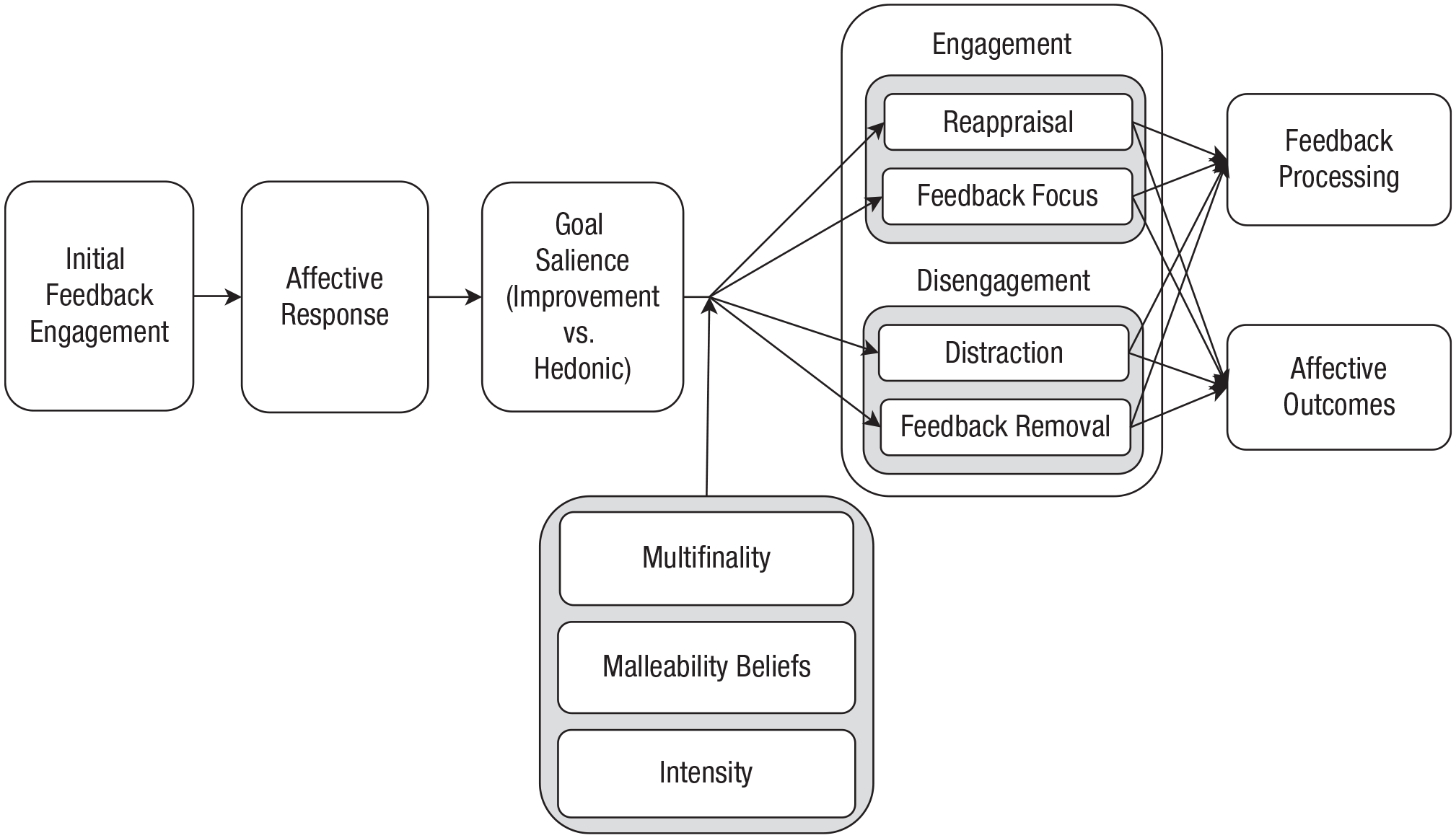
An overview of the components of feedback processing. Initial engagement with the negative feedback elicits negative affect. The negative affect influences hedonic-goal salience. If a hedonic goal is relatively more salient than an improvement goal, feedback recipients engage in emotion regulation. In that case, individuals choose and implement one of the strategies available to them: reappraisal, feedback focus, distraction, and feedback removal. Reappraisal and feedback focus are characterized by feedback engagement, whereas distraction and feedback removal are characterized by feedback disengagement. Which strategy feedback recipients choose is influenced by the multifinal character of the strategy, implicit beliefs related to the malleability of emotions, and the intensity of the feedback. Each strategy has different implications for the person’s affect and feedback processing.
Strategy selection in negative-feedback contexts
Negative feedback may instigate emotion regulation through its direct effect on individuals’ affect and its indirect effect on hedonic-goal salience. Once feedback recipients acknowledge that regulation is warranted, they select among the various regulatory options available to them (Gross, 2015). Our conceptualization includes four common emotion-regulation strategies: reappraisal, feedback focus, distraction, and feedback removal. These strategies differently relate to hedonic and improvement goals, serving a single goal or both (unifinality vs. multifinality; Kruglanski, Chernikova, Babush, Dugas, & Schumpe, 2015; for an overview, see Table 1). That is, they differentially impact individuals’ affect and feedback processing (engagement and disengagement; Sheppes et al., 2014). An emotion-regulation strategy is conducive to hedonic goals if it leads to more positive affect or less negative affect compared with not regulating. A strategy is conducive to improvement goals if it is associated with feedback engagement compared with disengagement. Feedback engagement serves improvement goals because feedback processing is more thorough.
Four Emotion-Regulation Strategies’ Potential to Serve Hedonic and Improvement Goals
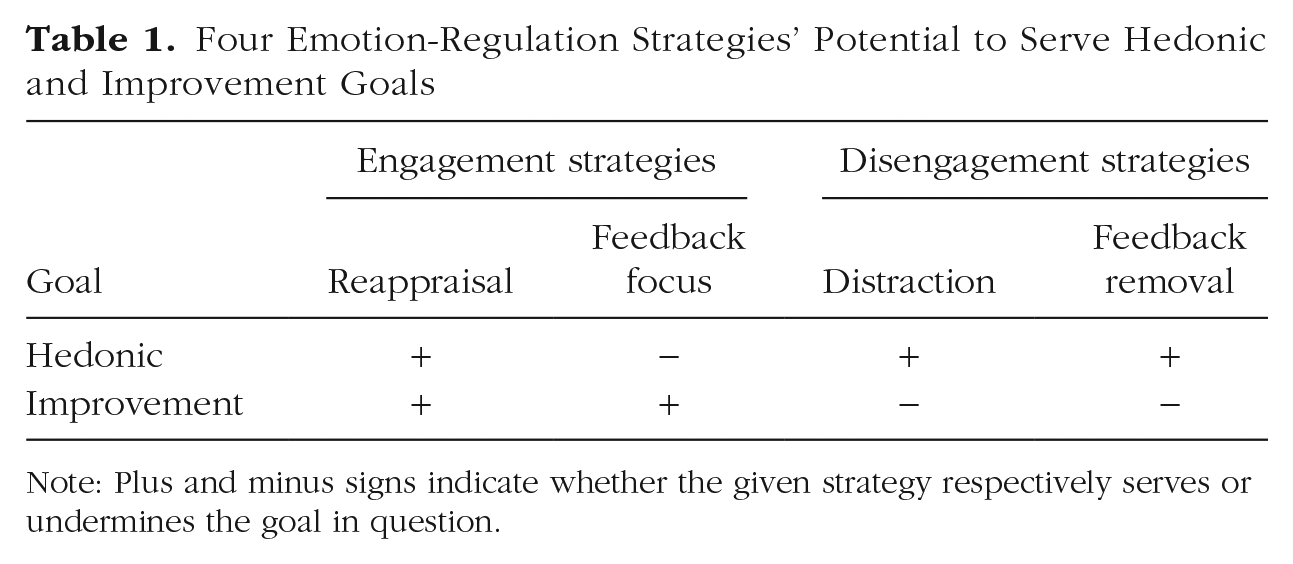
Note: Plus and minus signs indicate whether the given strategy respectively serves or undermines the goal in question.
The first strategy is reappraisal, which involves changing the meaning of the affective stimulus (Gross, 2015), for example, considering your client’s comments as a learning opportunity rather than a threat. Reappraisal serves hedonic goals because it effectively improves affect (Webb, Miles, & Sheeran, 2012). Because reappraisal comprises cognitions centered on the feedback, it is an engagement strategy and thus also serves improvement goals (Naragon-Gainey, McMahon, & Chacko, 2017). Indeed, participants instructed to use reappraisal during a learning task reported higher levels of positive affect and performed better, compared with participants who did not receive reappraisal instructions (Strain & D’Mello, 2015).
The second strategy is feedback focus, a form of rumination that involves recurrent cognitions about the feedback (Watkins, 2008). Because feedback focus implies increased feedback processing, it is an engagement strategy and serves improvement goals (Naragon-Gainey et al., 2017; for a discussion of the adaptive side of rumination, see Treynor, Gonzalez, & Nolen-Hoeksema, 2003). Typical thoughts in the context of below-standard performance are upward counterfactuals (Roese & Epstude, 2017). Upward counterfactuals are if-then statements outlining how the desired outcome could have been attained. Hence, feedback focus serves improvement goals by increasing feedback processing and by generating concrete action plans. At the same time, upward counterfactuals undermine hedonic goals by eliciting regret (Roese & Epstude, 2017).
The third strategy is distraction, pertaining to the reallocation of resources originally dedicated to stimulus processing. When receiving negative feedback, you may focus on background music instead of the feedback. Because distraction involves putting feedback out of one’s mind, it is a disengagement strategy (Naragon-Gainey et al., 2017). As a result, it undermines improvement goals. Yet distraction provides quick relief from negative affect and thus serves hedonic goals (Webb et al., 2012).
The fourth strategy is feedback removal, the elimination of the affective stimulus from one’s direct environment (akin to situation modification; Gross, 2015). Closing the browser as described in the introductory vignette exemplifies this. Because feedback removal prevents further feedback processing, it is a disengagement strategy and undermines improvement goals (Naragon-Gainey et al., 2017). Feedback removal serves hedonic goals because the modified situation no longer contains the feedback that lessens its affective impact.
Factors shaping strategy selection
Various strategy-, person-, and situation-related factors may influence which strategy feedback recipients select to regulate their emotions in negative-feedback contexts. Here, we consider the multifinal character of the emotion-regulation strategy, individuals’ beliefs about the malleability of emotions, and the intensity of the feedback (situation).
Hedonic and improvement goals usually guide individual action in feedback situations. Therefore, multifinal strategies should be preferred over unifinal strategies. Consequently, the multifinal strategy of reappraisal may be preferred over the unifinal strategies of feedback focus, distraction, and feedback removal. No study has yet examined unifinal and multifinal strategy properties in the context of emotion regulation or feedback processing. Importantly, multifinal means are not always preferred. Multifinal means are perceived as less likely than unifinal means to lead to goal attainment (Zhang, Fishbach, & Kruglanski, 2007) and, hence, may actually be less likely to be chosen.
A person-related factor may be recipients’ implicit theory about the malleability of emotions. Some people believe they cannot change their affect (entity theorists), whereas others think they can (incremental theorists; Tamir, John, Srivastava, & Gross, 2007). Perceiving affect as fixed may result in selecting a disengagement strategy. Perceiving affect as malleable may result in selecting an engagement strategy. Indeed, in a daily-diary study on malleability beliefs and strategy use, entity theorists were less likely than incremental theorists to use reappraisal (Ortner & Pennekamp, 2020). Interestingly, entity theorists were also less likely than incremental theorists to use reappraisal for high-importance stimuli. Future research may explore the interplay between malleability beliefs and stimulus importance in negative-feedback contexts. In such situations, reappraising high-importance feedback is crucial because it serves not only hedonic and improvement goals but also affective long-term adaptation (Sheppes, 2020).
A situational factor shaping strategy choice is feedback intensity. A large body of research demonstrates that people’s choice of emotion-regulation strategy is sensitive to stimulus intensity; individuals prefer engagement strategies for low-intensity stimuli and disengagement strategies for high-intensity stimuli (Sheppes et al., 2014). Applied to negative-feedback contexts, individuals may opt for reappraisal or feedback focus when feedback intensity is low and for distraction or feedback removal when feedback intensity is high. This is unfortunate because harsh feedback may hint at very poor performance, stressing the need for feedback engagement. Yet the literature on emotion-regulation choice predicts that disengagement strategies are selected instead (Sheppes et al., 2014).
Feedback processing over time
Feedback processing dynamically unfolds over time. After initial feedback engagement, feedback recipients engage in emotion regulation if a hedonic goal is relatively more salient than an improvement goal. The negative affect elicited by the initial feedback engagement increases hedonic-goal salience. If feedback recipients attempt to regulate their emotion and select an engagement strategy, feedback processing continues. This has additional affective consequences, influencing hedonic-goal salience and subsequent actions. Hence, feedback processing is iterative (see Fig. 2). Feedback processing ends if feedback processing is disrupted (e.g., because of disengagement-strategy selection). We refer to the period from initial feedback engagement to disengagement as a feedback-processing episode (akin to a performance episode; Beal et al., 2005). Feedback-processing episodes may repeat over time. Partial fulfillment of hedonic goals (e.g., because of regulatory efforts) decreases their salience (DeShon & Gillespie, 2005). This, in turn, may render improvement goals most salient, motivating feedback engagement once again. Such reengagement qualifies as initial feedback engagement and thus marks the beginning of a new feedback-processing episode.
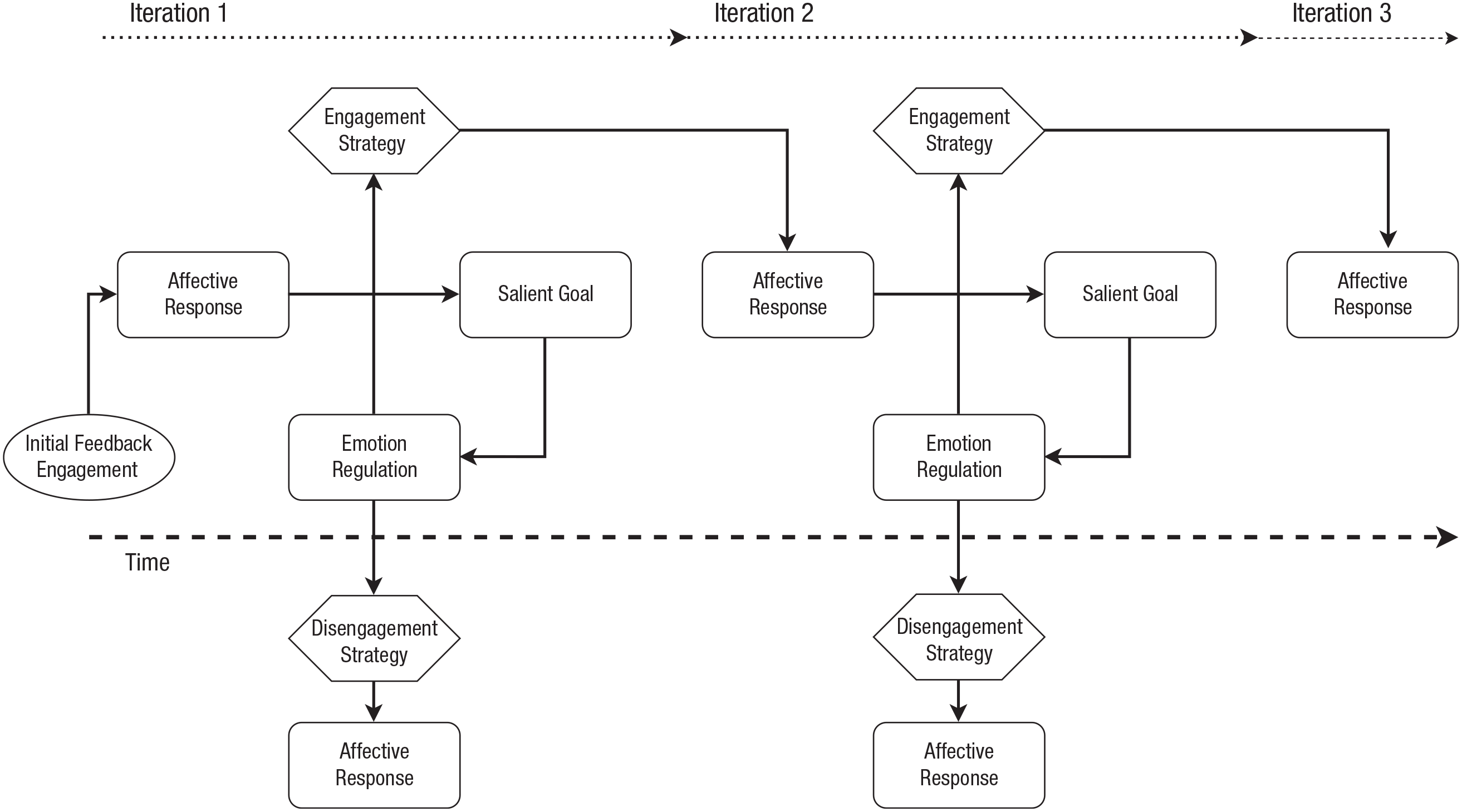
Emotion regulation within a feedback-processing episode. Feedback processing unfolds over time. Initial engagement with the negative feedback elicits negative affect. The negative affect increases hedonic-goal salience. If a hedonic goal is relatively more salient than an improvement goal, individuals attempt to regulate their emotions. Depending on the chosen emotion-regulation strategy, individuals continue to engage with the feedback (reappraisal, feedback focus) or disengage from the feedback (distraction, feedback removal). Continued engagement has additional affective consequences, shaping goal salience and subsequent actions. Feedback disengagement ends the feedback-processing episode. It also has affective implications. Feedback disengagement may occur for reasons other than the implementation of a disengagement strategy (e.g., one is finished reading the feedback). For ease of readability, strategies are shown in hexagons, and steps in the feedback chain are shown in rounded rectangles.
Implications
For researchers
Our conceptualization of feedback processing from an emotion-regulation perspective highlights the need to concurrently investigate feedback processing and emotion regulation. Moreover, in our model, we contrast improvement goals and hedonic goals. Emotion-regulation onset depends on the sufficient activation of a hedonic goal relative to an improvement goal. Hence, exploring factors shaping goal salience is crucial. Situation- and person-related factors may affect not only strategy selection but also decisions whether to regulate at all (i.e., identification; Gross, 2015). Regarding situational factors, whether individuals can implement the feedback may influence whether they want to improve and, thus, the salience of improvement goals (i.e., opportunity; Epstude & Roese, 2008). Regarding person factors, older adults, compared with younger adults, report hedonic goals more often in daily life (Riediger et al., 2009) and prefer strategies that provide short-term relief from negative emotions (Scheibe, Sheppes, & Staudinger, 2015). Hence, hedonic-goal salience may generally increase with age. Furthermore, feedback recipients who believe emotions are fixed may not attempt to regulate them (as suggested by Kneeland, Dovidio, Joormann, & Clark, 2016).
Scholars have stressed that effective emotion regulation entails flexible adaptation to the idiosyncrasies of the situation (Sheppes, 2020). According to our framework, successful self-regulation in negative-feedback contexts requires individuals to flexibly match their response to goals, which continuously change in salience. For example, during a performance-appraisal meeting, you may only barely listen to your manager (i.e., use distraction) at first. However, when your manager mentions that boosting your performance would entail a sizable bonus, your improvement goal may increase in salience. In this situation, stopping emotion regulation altogether or switching from distraction to an engagement strategy such as reappraisal or feedback focus would be functional. Yet individuals may vary in their capacity to do so. Thus, studying the capacity to launch, switch, and stop emotion regulation (and emotion-regulation strategies) in response to changing goal salience is an exciting area for future work.
In the opening vignette, a feedback sender administered feedback to a feedback recipient. This form of feedback is known as feedback from others; yet feedback can also be inherent to a task (i.e., feedback from job; Morgeson & Humphrey, 2006). If your syntax keeps returning an error, this serves as negative feedback. Future research should focus on to which extent our conceptualization is transferable to task-inherent negative feedback.
For practitioners
In achievement contexts, responses to negative feedback have important implications for all stakeholders. Adequate performance bolsters the organization’s economic competitiveness and benefits employees by increasing job security or their sense of competence. Although feedback facilitates performance improvements, if it is poorly processed, substandard performance is less likely to change. Hence, optimal performance requires feedback engagement. On the basis of our framework, we identify three ways in which feedback engagement can be facilitated.
First, emotion-regulation onset hinges on hedonic-goal salience. Because negative affect activates hedonic goals, feedback senders may want to minimize feedback’s affective impact. Alternatively, they may want to create a feedback situation that deactivates hedonic goals. Hedonic-goal attainment reduces hedonic-goal salience. Feedback senders may thus supplement feedback with praise and respect throughout the feedback meeting. Similarly, creating space for the feedback to be implemented or ensuring the feedback is perceived as accurate may also render hedonic goals less likely to guide action (Gnepp et al., 2020).
Second, if emotion-regulation onset cannot be avoided, feedback senders may want to encourage the use of engagement strategies rather than disengagement strategies. If immediate feedback processing is crucial, the preferred strategy is feedback focus. Yet if feedback senders need feedback recipients to review the feedback, then reappraisal is the preferred strategy (Sheppes, 2020). Senders may advocate the use of desired strategies during feedback meetings (as is often done in experimental studies).
Third, if the use of disengagement strategies cannot be avoided, at least initially, feedback senders can take advantage of the temporal dynamics of feedback processing and the notion of feedback-processing episodes. By making feedback accessible to recipients for an extended period, reengagement following disengagement becomes possible. This means that written or recorded feedback may be preferable to verbal feedback alone.
Conclusion
In this article, we present a novel conceptual account of the dynamics of negative-feedback processing, the model of motivated feedback disengagement. Integrating feedback theory with emotion regulation, we argue that a salient hedonic goal may motivate emotion regulation in negative-feedback contexts. Depending on the selected emotion-regulation strategy, feedback recipients disengage from or continue to engage with the feedback, influencing affect and feedback processing. By proposing that feedback recipients use disengagement strategies for hedonic ends, we not only posit that disengagement can be a functional response in negative-feedback contexts but also qualify two fundamental assumptions guiding most research on the feedback-performance gap. Qualifying the first assumption, a hedonic rather than an improvement goal may be salient in feedback situations. Qualifying the second assumption, a salient hedonic goal may motivate feedback recipients to disengage from the feedback. Overall, the model of motivated feedback disengagement complements investigations of the feedback-performance gap by offering a new perspective that highlights affect-driven regulatory processes elicited by negative feedback.
Recommended Reading
Beal, D. J., Weiss, H. M., Barros, E., & MacDermid, S. M. (2005). (See References). An article describing an episodic process model that highlights the importance of attention and affect for effective individual performance in an informative manner.
Eskreis-Winkler, L., & Fishbach, A. (2019). (See References). A recent empirical article illustrating the negative effect of failure feedback on learning.
Tamir, M. (2016). Why do people regulate their emotions? A taxonomy of motives in emotion regulation. Personality and Social Psychology Review, 20, 199–222. doi:10.1177/0956797619881133. An article presenting an accessible taxonomy of why individuals seek to experience certain emotions.
