




Abstract
Sleep’s beneficial role for memory is well documented, yet the translation of such fundamental memory processes into applications for improving memory function is limited so far. Although there are some commercial devices with varying levels of technical complexity that are claimed to improve sleep-dependent memory processing, none of them have been empirically validated. The main issue seems to be that there is basically no applied research in the field of sleep and memory. To change this, we identify the most promising targets for sleep-based memory-improvement applications. We outline the theoretical and technical aspects of the most promising memory-enhancing sleep interventions established in recent years and highlight potential targets of such interventions for different healthy and clinical populations. Finally, we propose a unifying framework that will lay the groundwork for a focused applied-research program in sleep and memory, bridging the gap between basic research and targeted application.
Over the past two decades, sleep’s important role for long-term memory formation has been studied intensely, and the detailed understanding of the processes underlying sleep-dependent memory consolidation has prompted hopes and promises of swift translation into applied contexts. Potential goals include the neuroenhancement of sleep beyond its natural limits, prompting supernatural memory in everyday life; facilitating key memories for pupils, students, and athletes; and compensating natural memory decline across aging. Additionally, there is the idea of harnessing sleep’s ability to transform memories to improve mental health symptoms and even treat psychiatric disorders. Even though the field has been stoking these hopes, there have been no evidence-based applications so far. In the following, we will broadly introduce the basic concepts underlying sleep’s role for memory and then provide insights into where sleep-related applications could come from in the future.
The formation of memories crucially relies on three distinct stages (Fig. 1). During learning, new information is processed, leading to plastic changes in the brain that encode the memory trace. During later retrieval, internal or external cuing reinstates the original information that is recalled. In between, there is another phase, called consolidation, during which the memory trace is retained and stored. Over the last century, it has been firmly established that the consolidation phase is not just a time of passive storage but also a stage during which the memory trace undergoes an active process of strengthening and transformation (McGaugh, 2000).
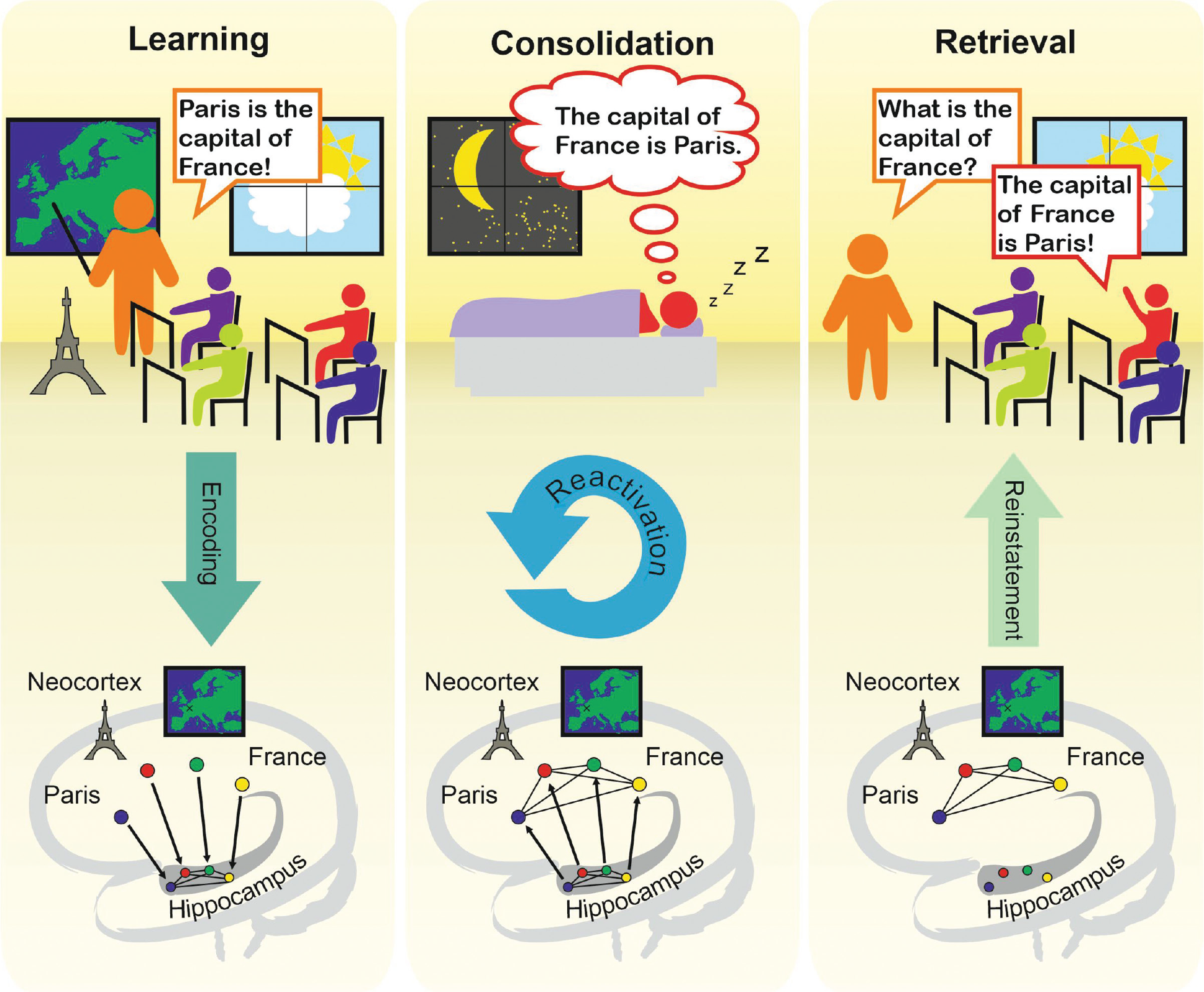
Schematic showing how sleep benefits memory. Long-term memory is formed in three discrete stages. In the first stage, learning, the memory is acquired by encoding information in initially labile memory traces. For memories of facts and events (declarative memories), this encoding is the result of the hippocampus binding together the individual elements of information. For example, pupils in a geography class may learn that the Eiffel Tower stands in Paris, Paris is the capital of France, and France is a country in Europe. During the class, this information is processed by the neocortex, but fast plastic processes in the hippocampus store the newly formed associations between the elements. In the second stage, the memory traces are strengthened and stabilized (consolidation) during sleep, which is achieved by the repeated time-compressed reactivation (“replay”) of the original traces. Over the course of multiple nights, this reactivation leads to a transfer of the associative binding from the hippocampus to the neocortex, a process called systems consolidation. In the third stage, retrieval, the bound information can be reinstated by activating only parts of the memory trace, for example through the question, “What is the capital of France?” After successful systems consolidation, the pupils no longer need to rely on the hippocampus to answer this question but can solve it by relying on the associative trace in the neocortex. As the trace becomes independent of the hippocampus, the pupils lose the ability to state where and when they learned that Paris is the capital of France, that is, they lose the episodic information and keep only the semantic memory. (Note that positions of representations in the neocortex are not intended to be anatomically accurate and that some memories may rely on the hippocampus for longer—potentially forever.)
Sleep plays an important role during this consolidation phase. Single-unit recordings that monitor the activity of place cells within the hippocampus of freely moving rats provide evidence that memory traces encoded during wakefulness undergo active replay during subsequent periods of sleep (Wilson & McNaughton, 1994). These place cells have an important function in space coding and are ideally suited to store memories (Eichenbaum, Dudchenko, Wood, Shapiro, & Tanila, 1999). The firing patterns of place cells that are present during awake learning are replayed during subsequent sleep, improving retrieval performance (Dupret, O’Neill, Pleydell-Bouverie, & Csicsvari, 2010). This replay occurs spontaneously during sleep but can also be triggered and manipulated by external learning-associated reminder cues, a process called targeted memory reactivation. A landmark study presented the smell of roses during learning to associate it with learning material in humans (Rasch, Büchel, Gais, & Born, 2007). When the same odor was presented during subsequent slow-wave sleep (SWS) but not during wakefulness or rapid eye movement (REM) sleep, retrieval performance was enhanced, indicating that replay of memory traces during sleep is causally linked to memory consolidation.
The physiological underpinnings of early SWS-rich non-REM sleep that promote replay have been subject to intense research efforts. On the one hand, the neuromodulatory milieu of early non-REM sleep differs distinctly from wakefulness and promotes consolidation (Feld & Born, 2020). On the other hand, coordinated electrophysiological oscillatory activity mainly during non-REM sleep is assumed to reflect the neurophysiological fingerprint of ongoing consolidation events, particularly the hierarchical nesting of sharp-wave ripples (markers of replay), sleep spindles, and slow oscillations (Diekelmann & Born, 2010; Staresina et al., 2015). Although these mechanisms of active systems consolidation are well researched, it should be noted that there are also important complementary accounts such as the synaptic-homeostasis hypothesis, which are not discussed in detail here (Tononi & Cirelli, 2014).
Techniques to Enhance Memory During Sleep
Sleep hygiene
The most basic and straightforward method to enhance sleep’s effect on memory is to improve natural sleep quality (Fig. 2). A simple but very effective method to improve sleep is sleep hygiene, which involves creating a context that is conducive to sleep (Brown, Buboltz, & Soper, 2002). This can be achieved by reducing arousing activities shortly before sleep, such as watching action movies or drinking caffeine and alcohol; adjusting the temperature and lighting in the bedroom; using the bedroom only for sleeping and not for other work or leisure activities; establishing regular bedtimes and sleep rituals; dimming the lights in the whole house before bedtime; and avoiding exposure to blue light. In addition, increasing the amount of time that is allocated to sleep is a promising strategy, as most people sleep less than they should (Roenneberg, Pilz, Zerbini, & Winnebeck, 2019). Relaxation methods such as progressive muscle relaxation, autogenic training, or meditation may also help to improve sleep.
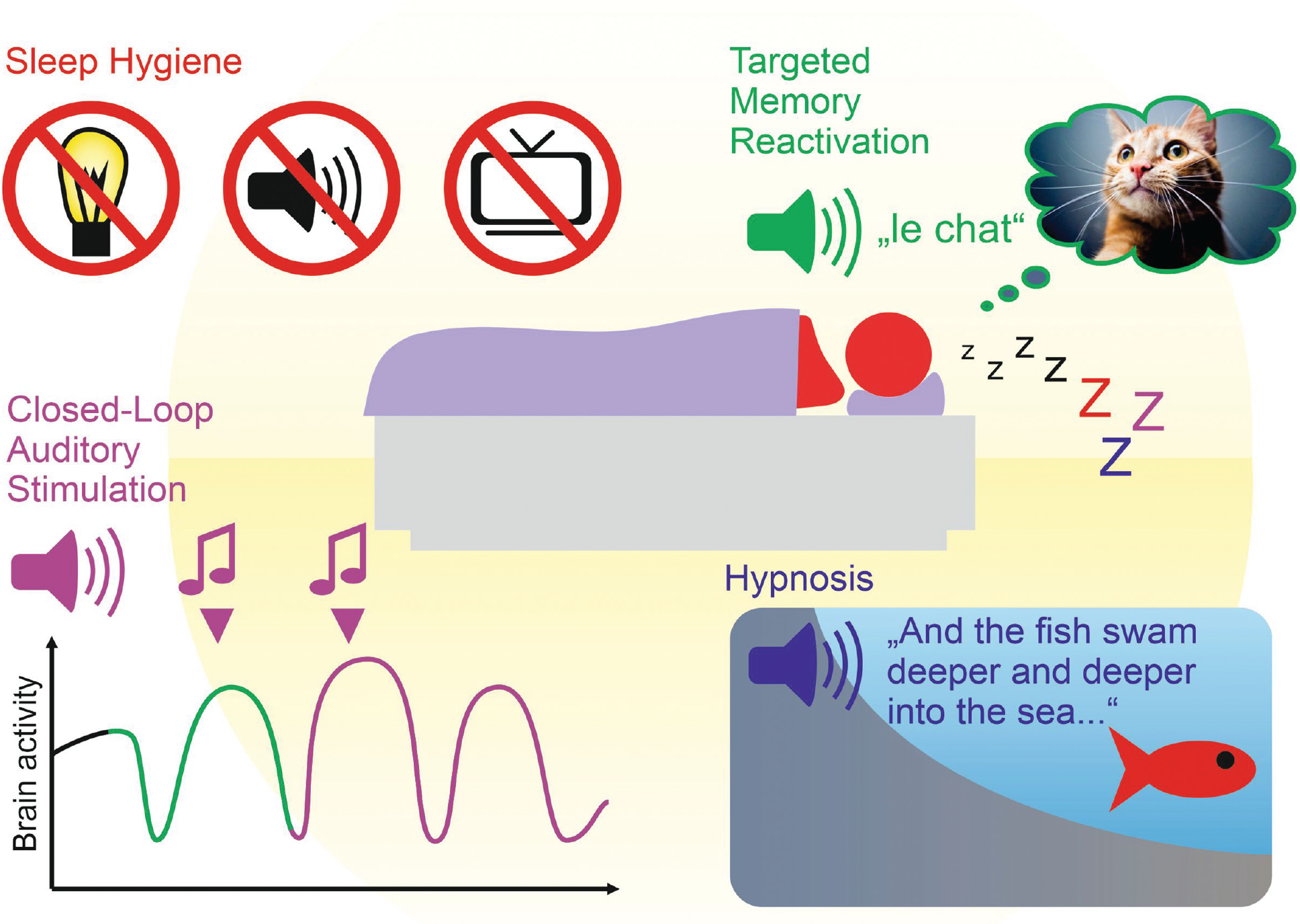
Methods to enhance sleep-dependent memory consolidation. The most natural method is to optimize sleep quality, which can be effectively achieved by improving sleep hygiene. This includes, for example, making the bedroom a dedicated sleeping place without disturbing levels of light or noise, minimizing bright light during the hours before bedtime, and avoiding exciting activities such as television, sports, and work. Additional methods specifically enhance sleep or memory processing during sleep. In targeted memory reactivation, information is paired with either an odor or a sound during learning, and this sensory stimulus is presented during subsequent sleep as a reminder cue to enhance reactivation. For example, during French vocabulary learning, the word “le chat” may be paired with the picture of a cat, and during later sleep, “le chat” would be played again to reactivate the associated meaning. Closed-loop auditory stimulation is a method that can be used to boost the influence of sleep on memory consolidation without relying on specific cues. Here, ongoing brain activity is recorded with an electroencephalogram to detect specific brain oscillations (e.g., slow oscillations, in green), and with an ideally timed pulse of pink noise, the ongoing oscillations can be amplified (in mauve), which boosts subsequent memory performance. Finally, hypnosis can be used to enhance deep slow-wave sleep, for example by playing a recording of a suggestion that includes the story of a fish swimming deeper and deeper into the sea.
Targeted memory reactivation
Going beyond the limits of natural sleep can be achieved by several additional methods. A recent meta-analysis showed that targeted memory reactivation can be used effectively to enhance different types of memory (Hu, Cheng, Chiu, & Paller, 2020). This method involves pairing sensory cues with the information during learning and presenting these cues again during subsequent sleep, which triggers the reactivation of the associated memory traces. As in the rose-smell study described above, odor cues have been used effectively as context cues that improve a whole learning session. Odors have the additional benefit of hardly disturbing sleep. However, sounds can also be used effectively if they are embedded in white noise to avoid arousals. Sounds have the additional benefit that they can enhance specific individual memories because during learning, they can be paired with individual items more easily than odors (for an in-depth discussion of advantages and disadvantages of different sensory cues, see Klinzing & Diekelmann, 2019). In fact, sounds have even been shown to improve motor memory that relies on different brain structures than memory for facts (Antony, Gobel, O’Hare, Reber, & Paller, 2012; Schönauer, Geisler, & Gais, 2014).
Brain stimulation
Another approach targets the electrophysiological oscillations that lie at the core of sleep’s memory function (for a more in-depth review, see Cellini & Mednick, 2019). One technique applies transcranial electrical stimulation to the scalp to entrain and enhance the oscillatory patterns that promote memory consolidation, such as slow oscillations and spindles (Marshall, Helgadottir, Mölle, & Born, 2006), although this technique has recently received criticism (Lafon et al., 2017; Sahlem et al., 2015). Essentially, it has been questioned whether the very low currents used for this stimulation are even able to reach the brain. Using an alternative closed-loop auditory stimulation, other researchers have found that it is possible to increase the occurrence of trains of slow oscillations and related sleep spindles, thereby increasing memory performance (Ngo, Martinetz, Born, & Mölle, 2013). For this method, a sleep electroencephalogram (EEG) is recorded, and whenever a slow oscillation is detected, a short burst of pink noise is played through in-ear headphones worn by the participant.
Hypnosis
Finally, hypnosis can be used to enhance sleep and particularly the amount of SWS (Cordi, Hirsiger, Merillat, & Rasch, 2015). Participants listen to a hypnosis-instruction recording that uses the metaphor of a fish swimming deeper into the sea and repeats the suggestion to sleep deeper. However, this method is effective only in highly suggestible people, and it has not yet been shown to improve memory consolidation during sleep.
Potential Applications in Healthy Populations
In healthy individuals, improving natural sleep through conventional means such as sleep hygiene is likely the most straightforward and cheapest method to improve sleep-dependent memory consolidation. Although there is no direct evidence for better memory with sleep hygiene, SWS has been shown to benefit memory consolidation in a dose-dependent manner (e.g., Diekelmann, Biggel, Rasch, & Born, 2012). In fact, the last couple of years have seen a stark rise in the use of activity monitors marketed as fitness trackers but also claiming to allow the assessment of sleep quality. Unfortunately, the producers of these trackers do not provide validity assessments, and there is a lack of correspondence between these consumer-grade devices and the gold standard of EEG in the sleep lab (e.g., Jumabhoy et al., 2020). Nevertheless, these devices may be useful in combination with sleep-hygiene measures to track and improve individual sleep quality.
Sleep hygiene can also be improved on a societal level by outreach activities that publicize a clear message about sleep’s beneficial effects for memory. In modern society, most people do not get enough sleep or sleep during the wrong time of day according to their inner clock (Roenneberg et al., 2019). Sleep need is also dependent on genetic factors and can differ substantially between people (Allebrandt et al., 2010). Two routes can generally address this problem. First, policymakers need to realize that sleep and sleep timing are highly variable, which should be reflected in flexible school and work scheduling. Second, the negative public image of sleep as idle time needs to be publicly reversed and transformed into a more appropriate healthy image. To achieve this, sleep scientists should actively engage with policymakers to highlight the importance of sleep for health and cognition. Dedicated training programs should already be established in schools to help people apply methods of sleep hygiene. Importantly, these should include debunking popular myths about sleep (e.g., sleep at least 8 hr, or time before midnight counts double) and scaremongering found in some prominent popular-science sleep books.
For some time, the neuroenhancement community has discovered sleep as a potential target. One of the most widely used tools is transcranial electrical stimulation, for which a number of consumer devices exist. Yet in addition to the aforementioned criticism of this technique, evidence whether these consumer devices provide similar results to those obtained with standard lab equipment is lacking. It is also unclear whether these devices are safe or may have unwanted adverse effects. Closed-loop auditory stimulation seems to be more effective than electrical stimulation, and there is also less concern about potential adverse effects. Although this method relies on the simultaneous recording and analysis of sleep EEG and thus necessitates quite elaborate technical equipment, it has been successfully tested using ambulatory dry-EEG devices (Debellemaniere et al., 2018). It may therefore be applicable in specialist populations such as professional gamers, athletes, and artists, and prototype consumer devices are already available.
In our view, the most promising candidate for neuroenhancement in healthy individuals is the method of targeted memory reactivation. Evidence for the efficacy of this method is robust, and it can be delivered as easily as through a smartphone speaker (for sound cues) or scent diffusers (for odor cues). In fact, odor cuing was successfully tested in a real-life school setting (Neumann, Oberhauser, & Kornmeier, 2020). Adolescents learned vocabulary with an incense stick on their desk, and those students that also placed the stick next to their bed during sleep showed a marked increase in subsequent memory performance.
Potential Applications in Clinical Populations
Rehabilitation
Sleep-enhancing methods may provide comparatively cheap and patient-friendly augmentation approaches. The positive effects of sleep on the consolidation of motor learning have already gained some attention in the rehabilitation field (Gudberg & Johansen-Berg, 2015). Considering sleep when optimizing rehabilitation care will surely benefit ongoing plastic processes, especially in stroke patients. In addition, targeted memory reactivation could be used to pair movements with sounds during training sessions, similar to dancing games. Playing these sounds again during subsequent sleep may improve the consolidation of relearned skills. In addition, sleep-enhancing methods such as closed-loop auditory stimulation and hypnosis could specifically enhance slow oscillation activity and associated consolidation processes after rehabilitation sessions. These approaches should be implemented as augmentation of the current care rather than stand-alone treatments.
Psychotherapy
In psychotherapy, sleep-enhancing methods may likewise augment treatment efficacy. An improvement of exposure therapy in spider phobia through sleep periods after exposure sessions has already been demonstrated (Kleim et al., 2013), although sleep less clearly improved social anxiety after exposure sessions (Pace-Schott et al., 2018). Closed-loop auditory stimulation or hypnosis could be used after successful therapy sessions to increase sleep quality and boost therapy outcomes. Additionally, there have been initial (albeit unsuccessful) attempts to combine odors and exposure therapy in spider phobia for targeted memory reactivation during sleep (Rihm, Sollberger, Soravia, & Rasch, 2016). In contrast, when the odor itself was used as a fear context or a tone was used as conditioned stimulus, sleep effectively enhanced the extinction of fear memories if the cue was presented during sleep (Hauner, Howard, Zelano, & Gottfried, 2013, He et al., 2015). Although studies in animals showed contradictory effects (discussed in Diekelmann & Born, 2015), future research may optimize the reactivation protocols and identify suitable disorders that could benefit from this method, for example alcohol use disorder or posttraumatic stress disorder.
Aging and dementia
In normal aging, declining sleep quality is linked to cortical atrophies and contributes to impaired sleep-dependent memory consolidation (Mander et al., 2013). The deterioration of sleep is accelerated in dementia, and there is a bidirectional link between impaired sleep and Alzheimer’s disease (Ju, Lucey, & Holtzman, 2014). Methods to improve sleep hygiene in healthy elderly people may help to prevent or slow down the reduction of sleep quality and associated cognitive decline. After the onset of dementia, it is likely that sleep-enhancing methods such as closed-loop auditory stimulation and hypnosis can be used to slow down the decline by compensating for the reduction in natural sleep depth. Targeted memory reactivation may be applicable in only a subgroup of these patients, for example, as part of a cognitive training program that could be paired with odor or sound cues.
Health behavior
Methods of improving sleep and associated memory processing, particularly targeted memory reactivation, also seem appropriate to improve health-related behavior. For smoking cessation, a special form of cuing during sleep can be applied that makes use of the fact that aversive conditioning is possible during sleep (Arzi et al., 2014). When the smell of smoke was paired with unpleasant odors during sleep, subjects showed a subsequent reduction in smoking. This type of procedure could also be used, for example, to reduce the intake of highly caloric food in the treatment and prevention of overweightness and obesity or to reduce the consumption of drugs.
Framework for Applied-Research Strategies
On the basis of the available evidence on sleep and memory, we would like to outline a framework that may serve as the basis for systematic applied-research efforts. In Table 1, we present an overview of the most promising areas of applied research and our personal account of the potential effectiveness of different methods for different applications. In our view, the most easy and straightforward strategy of sleep hygiene may be effectively applied for neuroenhancement in healthy populations as well as in aging populations, with additional potential for rehabilitation and psychotherapy. A very good starting point could be the application of sleep-hygiene training in schools and universities. This would have the added benefit of leveling the playing field for students struggling in higher education because of sleep problems. Directly manipulating memories through targeted memory reactivation may be most effective for neuroenhancement, rehabilitation, and the modification of health behaviors. An interesting starting point would be targeted memory reactivation in professional athletes aimed at improving specific movements coordinated with auditory cues that are then played during sleep. This approach could then be translated to rehabilitation after stroke. Improving sleep and associated memory processing through brain stimulation is potentially more effective than hypnosis and may be most promising for application in neuroenhancement as well as in rehabilitation, psychotherapy, and aging and dementia. For example, auditory closed-loop stimulation may be used to intensify sleep and stabilize memory performance in an elderly population. This should be performed in a longitudinal design to monitor protective effects of the treatment. However, these suggestions are not to say that other areas of applied research may yield similar promising results, and future basic research may change the picture.
Framework for Applied Research on Enhancing the Influence of Sleep on Memory via Different Applications
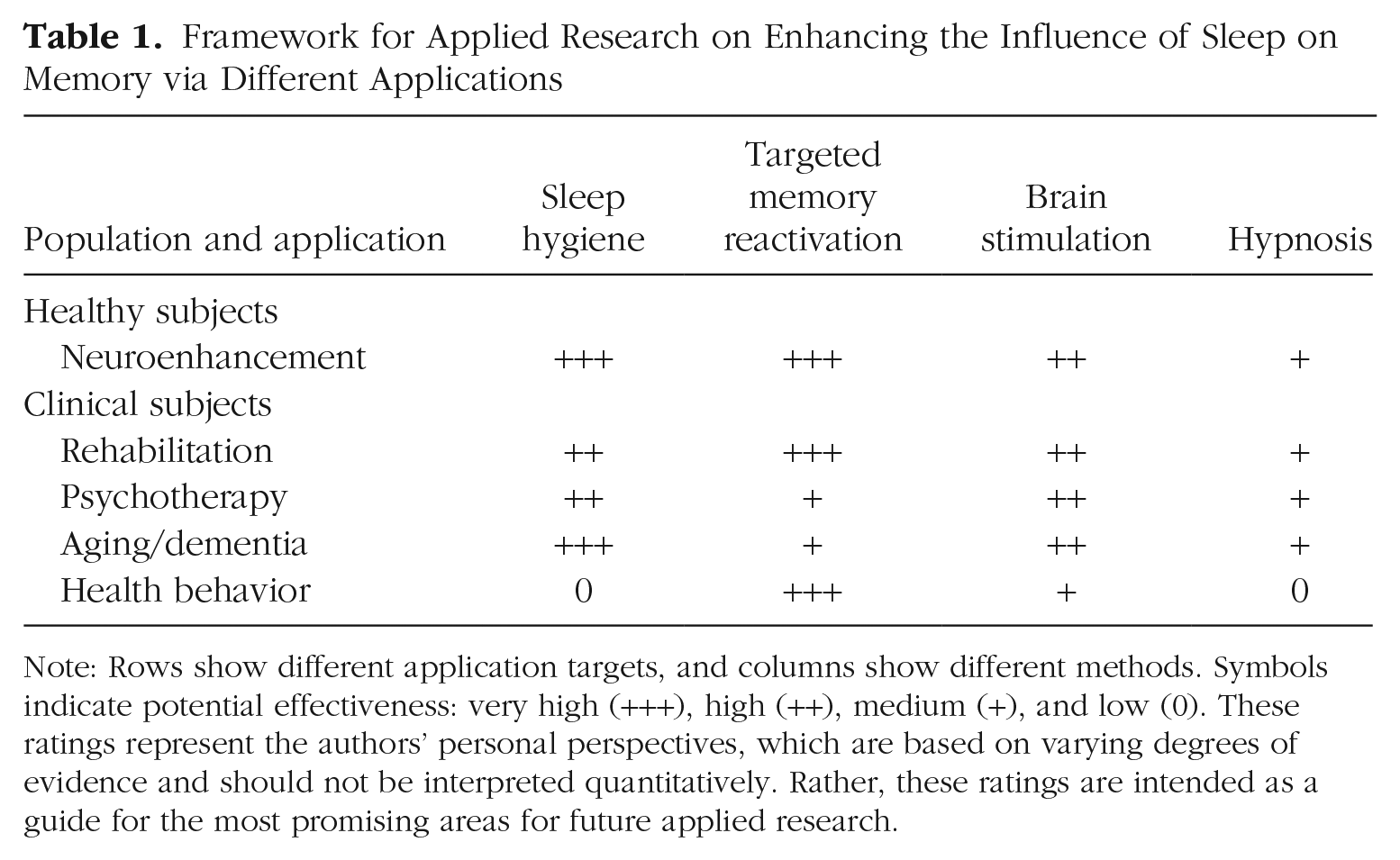
Note: Rows show different application targets, and columns show different methods. Symbols indicate potential effectiveness: very high (+++), high (++), medium (+), and low (0). These ratings represent the authors’ personal perspectives, which are based on varying degrees of evidence and should not be interpreted quantitatively. Rather, these ratings are intended as a guide for the most promising areas for future applied research.
The most promising strategy to initiate an applied sleep-and-memory research program may be to team up with the established basic science sleep-and-memory researchers. Initially, such a program should focus on robust and inexpensive intervention protocols and appliances for healthy participants to establish feasibility for widespread application as well as potential adverse side effects. In a second step, reasonably powered randomized controlled trials should be conducted to provide applied evidence of the efficacy of the aforementioned methods in clinical populations.
Limitations and Outlook
Despite the positive effects of an increased application of findings on sleep and memory, there are also potential drawbacks. One is the possibility of “inception” of external memories. At least regarding targeted memory reactivation, this seems unlikely so far, given that only memories that were learned before sleep are enhanced. However, sleep has been shown to enhance false memories (Diekelmann, Born, & Wagner, 2010; for a meta-analysis of moderating factors, see Newbury & Monaghan, 2019) and could thus be used or misused in such a way. Furthermore, it is plausible that the enhancement of a specific memory has detrimental effects on other memories because targeted memory reactivation biases neuronal replay toward the cued memory traces, reducing replay activity for uncued traces (Bendor & Wilson, 2012). Additionally, subtle changes in technical aspects of methods may have a tremendous impact on the outcome, sometimes even resulting in opposite effects than expected (Diekelmann & Born, 2015).
The outcome of applied sleep-and-memory research in the field may also depend on the use of different psychoactive substances, especially in clinical populations. We did not discuss approaches using pharmacological agents to manipulate sleep and memory here, which can be found elsewhere (Feld & Born, 2020). But note that memory consolidation can be positively or negatively affected by psychopharmacological interventions in ways that do not follow directly from their effects on learning. This should be considered when the target population of an application is chronically medicated.
Ethical considerations arise from dual use and misuse of sleep-enhancing methods. The military, for example, is already interested in testing the presented methods to improve combatant performance. Marketing campaigns may use pervasive tunes that could be presented during sleep to manipulate consumer behavior. To prevent such scenarios, we advocate sleep researchers beware of dual use/misuse potentials and publicly speak out against unintended use of their methods. An open discussion with the public and with policymakers is warranted in this regard.
An important aspect of the basic sleep-and-memory research discussed in this review is its relatively high resource intensity, which leads to two fundamental limitations. First, many of the studies have been conducted with a low number of participants, and second, there is a lack of direct replication in the field. Therefore, seemingly contradictory findings in the field cannot easily be ascribed to underlying differences in the design, fundamental processes, or false-positive and false-negative findings. Although meta-analyses can ameliorate this problem, it is essential that the field engages in a systematic appraisal of contradictory findings and follows them up with well-powered replication studies that need substantial financial support by funders. These efforts will help focus on the most promising fields of intensified applied-research programs as described above.
Conclusions
The pursuit of sleep and memory has matured into a broad field of neuroscience. It has provided ample basic science evidence and strong candidates for potential applications. However, there is a lack of large randomized controlled trials to evaluate evidence-based applications. Those applications that do exist are consumer-grade devices that have not been validated for their intended use. We believe that there is a huge potential in this field that must be harnessed by collaboration between basic and applied researchers. To this end, a concerted research program and sufficient funding will be vital.
Recommended Reading
Diekelmann, S. (2014). Sleep for cognitive enhancement. Frontiers in Systems Neuroscience, 8, Article 46. doi:10.3389/fnsys.2014.00046. An overview of the effects of sleep and memory geared specifically toward potential for cognitive enhancement.
Feld, G. B., & Diekelmann, S. (2015). Sleep smart–optimizing sleep for declarative learning and memory. Frontiers in Psychology, 6, Article 622. doi:10.3389/fpsyg.2015.00622. An introductory review on the role of sleep for memory processing.
Oudiette, D., & Paller, K. A. (2013). Upgrading the sleeping brain with targeted memory reactivation. Trends in Cognitive Sciences, 17, 142—149. doi:10.1016/j.tics.2013.01.006. An in-depth review discussing how targeted memory reactivation can be used to improve sleepdependent memory processing.
Rasch, B., & Born, J. (2013). About sleep’s role in memory. Physiological Reviews, 93, 681—766. doi:10.1152/physrev.00032.2012. A comprehensive review on the effects of sleep on memory that also covers the very beginnings of the field as well as the underlying neurophysiological mechanisms.
Footnotes
Acknowledgements
The idea for this article was born during the inaugural meeting of the Sleep, Oscillations and Memory Network (SOMNet) at Wissenschaftskolleg zu Berlin, and the authors would like to thank the inaugural members of this network, James W. Anthony, Scott Cairney, Chloe Newbury, Hong-Viet Ngo, Freyja Olafsdottir, Monika Schönauer, Thomas Schreiner, Jakke Tamminen, and Markus Werkle-Bergner for their critical remarks.
Transparency
Action Editor: Robert L. Goldstone
Editor: Robert L. Goldstone
