




Abstract
Although there is a rich literature on children’s strategies for remembering, little attention has been paid to characterizing developmental change within individual children and to examining mediators that may bring about such change. To address these issues, we assess children’s memory skills over time while simultaneously examining communicative interactions in the classroom. Children are not taught memory strategies in an explicit manner, but these skills emerge in the context of the elementary school classroom. Accordingly, we use longitudinal and experimental methodologies to examine the ways in which the language of instruction contributes to the development of children’s memory and cognitive skills. The basic findings are discussed here in terms of possible applications in the classroom that may impact teachers’ instruction and students’ learning.
Although much is known about children’s memory (e.g., Bauer & Fivush, 2014), the bulk of the research literature does not address questions of development. Given the central importance of memory for understanding who we are, what we know, and what we can know, it is of critical importance to examine the development of children’s abilities to remember. From a developmental-science perspective (e.g., Cairns, Elder, & Costello, 1996), the study of development requires longitudinal data and multilevel analyses that bridge methods and paradigms. Moreover, a developmental analysis of memory calls for (a) a detailed characterization of children’s skills at different ages, (b) an assessment of developmental change within individuals over time, and (c) an effort to identify mediators that can plausibly account for the observed changes in skill. Given these requirements, what can be said about continuing progress in understanding of the development of memory (Ornstein & Haden, 2001)?
Through the use of cross-sectional designs, steady progress has been made in characterizing the memory skills of children of different ages (Baker-Ward & Ornstein, 2014), and recent longitudinal studies have provided a basic understanding of developmental trajectories (e.g., Kron-Sperl, Schneider, & Hasselhorn, 2008; Sodian & Schneider, 1999). Although the longitudinal studies are very important, unfortunately, they provide relatively little information about the forces responsible for developmental changes in remembering (Schneider & Ornstein, 2015, 2019). Therefore, it is important to design longitudinal studies that elucidate factors—endogenous and exogenous—that serve to mediate developmental change. To illustrate, explorations in developmental-cognitive neuroscience (e.g., Ghetti & Lee, 2014) and studies of the socialization of cognition (e.g., Ornstein, Haden, & Coffman, 2011) can shed light—at different levels of analysis—on factors that serve to mediate developmental changes in memory. Each of these relatively new lines of research promotes a multilevel analysis of the development of memory and thus is consistent with the principles of developmental science.
In our work, we make use of a socialization-of-cognition perspective (see Fivush, 2011; Rogoff, 1990; Vygotsky, 1978) to help us resolve developmental questions concerning the origin and refinement of children’s strategies for remembering, such as rehearsal, organization, and elaboration. These deliberate strategic efforts impact the storage and retrieval of information and are important for the acquisition and application of organized bodies of knowledge and thus for adaptation in school. Our research program stems from a literature documenting that the use of strategies for remembering changes across the elementary school years in terms of complexity and effectiveness (e.g., Folds, Footo, Guttentag, & Ornstein, 1990; Schneider & Bjorklund, 1998) is associated in complex ways with children’s metamnemonic understanding (Paris, Newman, & McVey, 1982; Schneider, Schlagmüller, & Visé, 1998) and is causally linked to recall performance (e.g., Bjorklund, Dukes, & Brown, 2009). However, despite this wealth of information—and recent work on the dynamics of strategy use (e.g., Lehmann & Hasselhorn, 2012)—the literature is largely silent concerning the key questions of development (Ornstein, Baker-Ward, & Naus, 1988; Ornstein & Haden, 2001). Our approach to these issues involves the use of (a) tasks derived from the information-processing tradition to describe children’s changing skills over time and (b) analyses inspired by the social-constructivist perspective to help us characterize the language that teachers use as they teach language arts and mathematics.
Our choice of the classroom setting is consistent with calls to examine cognitive development in context (e.g., Rogoff, Dahl, & Callanan, 2018), but it also reflects the implications of earlier cross-cultural explorations of the cognitive skills of children who were matched in chronological age but differed in terms of whether or not they had participated in Western-style schooling. Thus, for example, children in Liberia, Morocco, and Mexico who attended school demonstrated superiority in basic memory and cognitive skills compared with their peers who did not have this experience (Rogoff, 1981; Scribner & Cole, 1978; Wagner, 1978). These findings suggest that something in the formal school context is likely important for the emergence of abilities thought to be important by Western teachers and researchers. Additional work indicating that the classroom setting is important for memory and cognitive development comes from the natural experiments that Morrison and his colleagues (e.g., Morrison, Kim, Connor, & Grammer, 2019; Morrison, Smith, & Dow-Ehrensberger, 1995) have carried out with children of approximately the same age but who nonetheless are assigned to different grades at school.
If participation in a Western-style school is linked to the development of children’s deliberate memory skills, what is it about the school context that is important? To examine this issue, we first carried out extensive observations in elementary school classrooms and had conversations with teachers about their beliefs and practices concerning memory. Consistent with the earlier cross-sectional work of Moely and her colleagues (1992), our investigations found that explicit instruction in mnemonic techniques is quite infrequent but that teachers believe that memory skills are important for success in school. This observation led us to focus on a critical question: If school is important in terms of the emergence and refinement of mnemonic techniques, and teachers value memory skills, but explicit instruction is an infrequent occurrence, then what is it about the classroom that influences the development of these skills?
It seems likely that teachers create a context for strategy discovery and utilization or for the generalization of techniques from one area—say, arithmetic or reading—to remembering. Indeed, we believe that the language teachers use when providing instruction in language arts and mathematics contributes to children’s success in this endeavor. Just as children’s autobiographical memory skills are thought to be honed through conversations with their parents about the past (Fivush, Haden, & Reese, 2006), the development of their deliberate memory skills is likely influenced by the language to which they are exposed during instruction. Therefore, on the basis of the memory literature, we developed a coding system—the taxonomy of Teacher Behaviors—through which we could identify aspects of teachers’ instructional language that would seem to prompt rich encoding and deep processing.
Our taxonomy included 23 codes for characterizing teachers’ instruction, but we identified five components of their language that seemed to be particularly relevant for understanding memory in the classroom. These codes are defined and illustrated in Table 1. Moreover, by combining these components, we (Coffman, Ornstein, McCall, & Curran, 2008) developed an index of teachers’ “mnemonic style” that reflected their use of cognitive-processing language (CPL), which is thought to be linked to successful remembering.
Component Codes From the Taxonomy Used to Index Cognitive-Processing Language and Data From First-Grade Classrooms
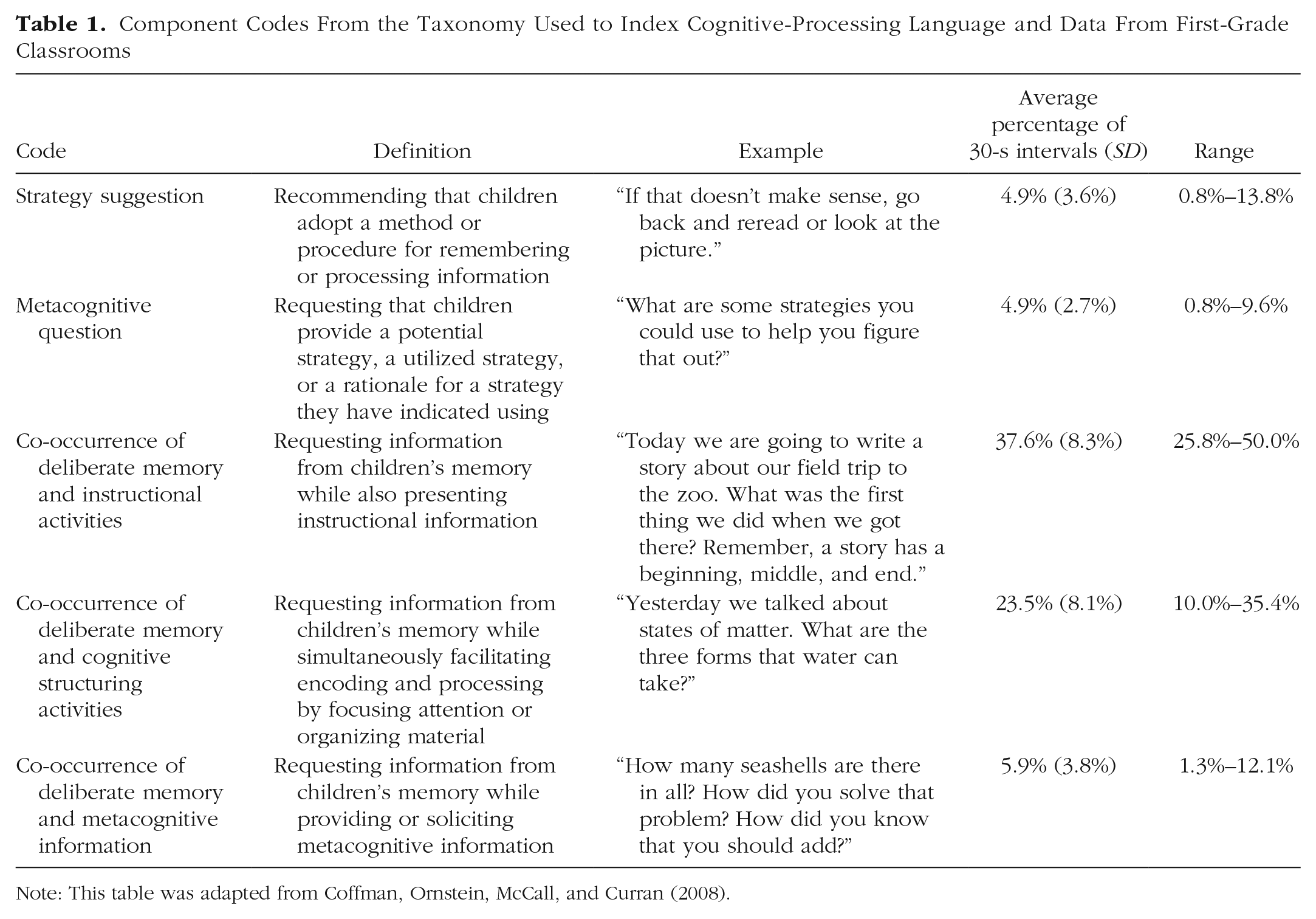
Note: This table was adapted from Coffman, Ornstein, McCall, and Curran (2008).
Initial Longitudinal Findings
Using the CPL measure to characterize the classroom—with observers coding 1 hr of teaching in language arts and 1 hr in mathematics—we set out to relate the instruction that children receive to their changing mnemonic skills. In an initial study (Coffman et al., 2019; Coffman et al., 2008), a sample of 107 first graders was recruited and followed for several years, with a set of assessments made multiple times each year.
One of the tasks in the multitask battery that we used in the early grades was an organizational-training and free-recall procedure developed by Moely et al. (1992). Before a recall test was administered, the children grouped pictures of familiar objects drawn from taxonomic categories, and baseline assessments were made prior to training in organized grouping and clustering. Generalization tests were administered following training. Assessments were also included at later data points in the first grade as well as in the second grade, where more difficult thematically related items replaced the taxonomic material.
In an initial report, we described the performance of the children at three points during the first grade, provided an overview of the instructional language used by the teachers, and also examined the children’s performance as a function of their teachers’ use of CPL. We found that, initially, the first graders grouped the pictures randomly, but we also noted that they responded to organizational training, as shown by their category-based sorting (as measured by the adjusted ratio of clustering; Roenker, Thompson, & Brown, 1971) and recall increasing across the year. We also observed that the CPL measure provided an interesting look at the mnemonic climate of the classroom. As can be seen in the right side of Table 1, relatively large amounts of classroom time were devoted to instructional activities (37.6% of the observational intervals) and to cognitive-structuring activities (23.5%) coupled with the expression of deliberate memory demands, whereas lower amounts of time involved strategy and metacognitive information.
Importantly, there was considerable variability across the first-grade teachers in the use of these CPL components, and this variability enabled the establishment of contrasting groups of teachers, some of whom used more and some of whom used less CPL in their instruction. As can be seen in the left column of Figure 1, only chance levels of organized sorting were observed in the fall of the first-grade year, and there was no differentiation between children assigned to higher or lower CPL teachers. However, by spring, children taught by high-CPL teachers evidenced better organizational strategies than did their peers who were taught by low-CPL teachers.
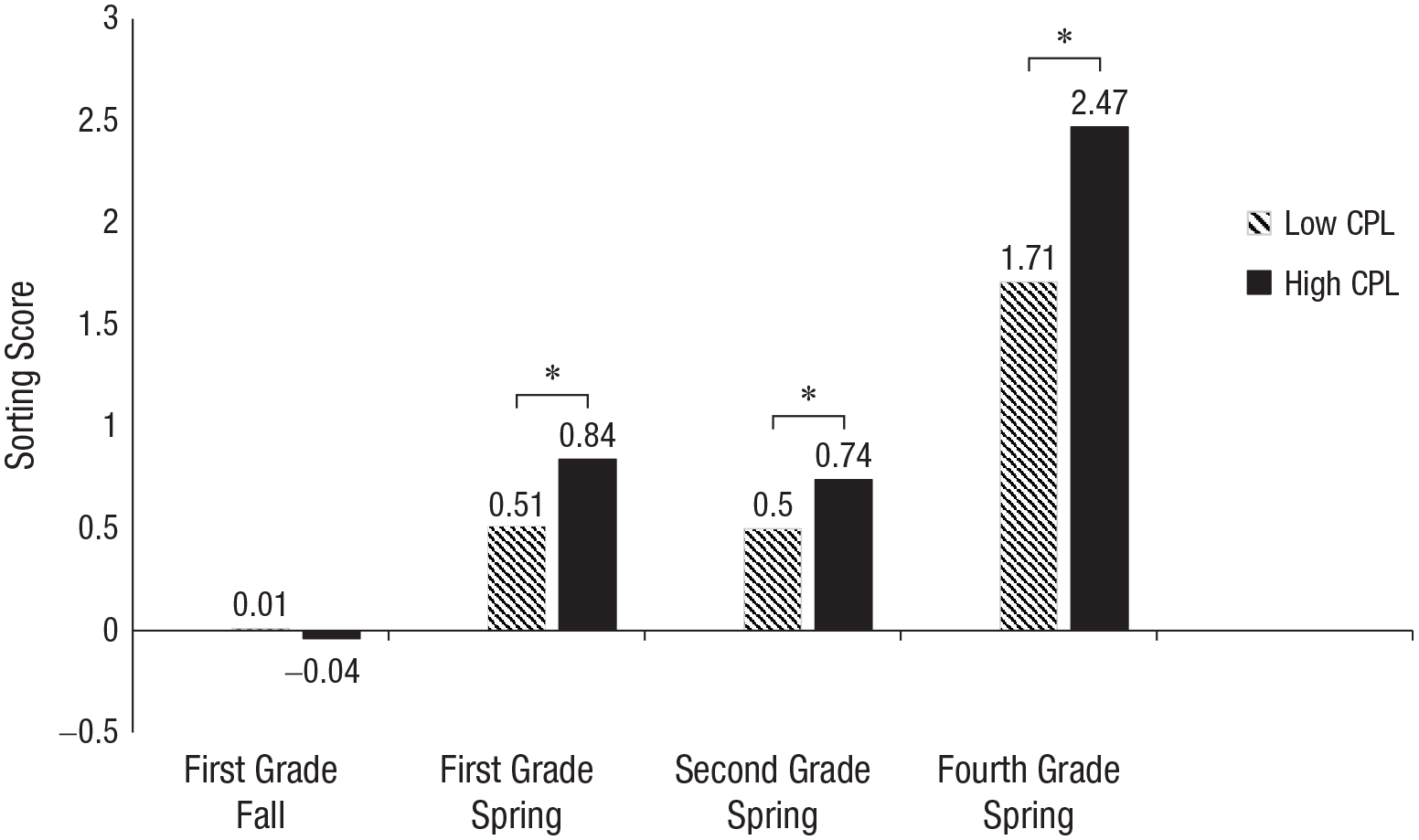
Children’s mean sorting score over time as a function of first-grade teachers’ use of cognitive-processing language (CPL). Asterisks indicate significant differences between the CPL groups (p < .05).
Additional Longitudinal Findings
Interestingly, the differences in children’s performance extended to their use of strategies during the second grade, even though they were taught by different teachers and were dealing with more difficult thematically organized material (Coffman et al., 2019; Ornstein, Coffman, & Grammer, 2009; Ornstein, Coffman, Grammer, San Souci, & McCall, 2010; Ornstein, Grammer, & Coffman, 2010). Moreover, these differences were sustained and observable in later years on a complex memory task involving the grouping of low-associated words (Bjorklund, Ornstein, & Haig, 1977), as can be seen in the right-hand column of Figure 1. Thus, it seems that there is something in the environment that is established by high-CPL teachers that supports children’s acquisition of memory skills that are important for success in school. Children with high-CPL teachers are exposed to greater memory demands and more strategic and metacognitive language than are their peers with low-CPL teachers, and perhaps this exposure is important for their emerging deliberate memory skills.
It is also essential, however, to consider other factors that may influence strategy use, including characteristics of the child that may interact with exposure to different levels of CPL. Our continuing analyses (see Ornstein, Coffman, et al., 2010) suggest that one factor may be the children’s self-regulation in the classroom. We assessed self-regulation by asking teachers to judge the participants in their classes in terms of setting goals, organizing materials, monitoring their own learning, and so forth, and we found a clear interaction between this characteristic of the child and exposure to different levels of CPL. Indeed, as can be seen in Figure 2, children who were rated as low in self-regulated learning and who were in the classes of high-CPL teachers showed markedly greater gains in organized sorting over the year than did low-self-regulated children taught by low-CPL teachers and were indistinguishable from their high-self-regulated peers. In contrast, high-self-regulated children sorted in a highly organized fashion regardless of the instructional style of their teachers. As can also be seen, this interaction between first-grade teachers’ style and children’s self-regulation extends through the second grade. Thus, exposure to higher levels of CPL may be especially important for particular subgroups of children.
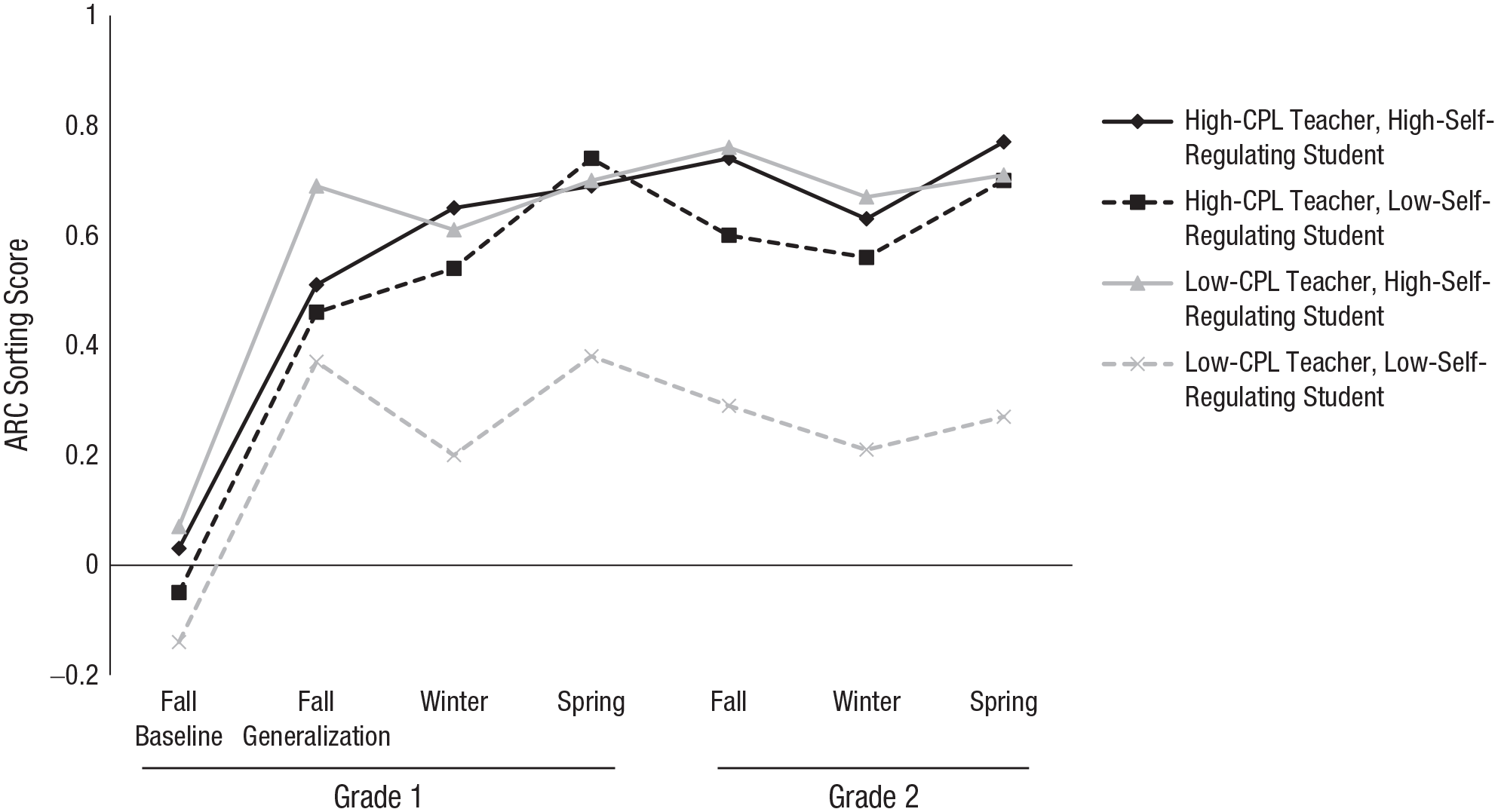
Children’s mean adjusted ratio of clustering (ARC) sorting score over time as a function of first-grade teachers’ use of cognitive-processing language (CPL) and children’s self-regulation.
Experimental Findings
The longitudinal findings reveal important associations between teachers’ use of cognitive-processing language and memory outcomes, but in order to make causal statements, we manipulated the teachers’ instructional language in a series of experiments that were staged in after-school programs with teachers who were hired to teach a specially constructed curriculum (Grammer, Coffman, & Ornstein, 2013; Ornstein, Thomas, Hudson, & Coffman, 2016). In one of these studies (Grammer et al., 2013), the children participated in a 2-week unit—“things that move”—in which they were exposed to simple physics and engineering principles, and their mastery of engineering facts and strategies was assessed before and after instruction, along with their ability to make strategic use of their new knowledge in a memory task involving curriculum-based material.
The teachers presented the unit to separate groups of children in styles that were modeled on the higher and lower levels of CPL observed in the longitudinal work. As can be seen in Table 2, the children had little knowledge of engineering facts and strategies at the start of instruction, and all children—regardless of condition—acquired the basic facts that were taught and maintained this new knowledge over a 1-month delay. However, the language of instruction was clearly associated with the acquisition of strategies within the engineering domain: Children in the high-CPL condition acquired and maintained more strategies than their peers in the low-CPL condition. Importantly, the language experienced during instruction was also linked to the ability to apply the new content knowledge in the service of a memory goal. As can also be seen in Table 2, the children in the high-CPL condition were better able to use this knowledge to perform conceptual grouping in a content-specific sort–recall task than their peers in the low-CPL condition.
Student Performance Scores as a Function of Experimental Condition
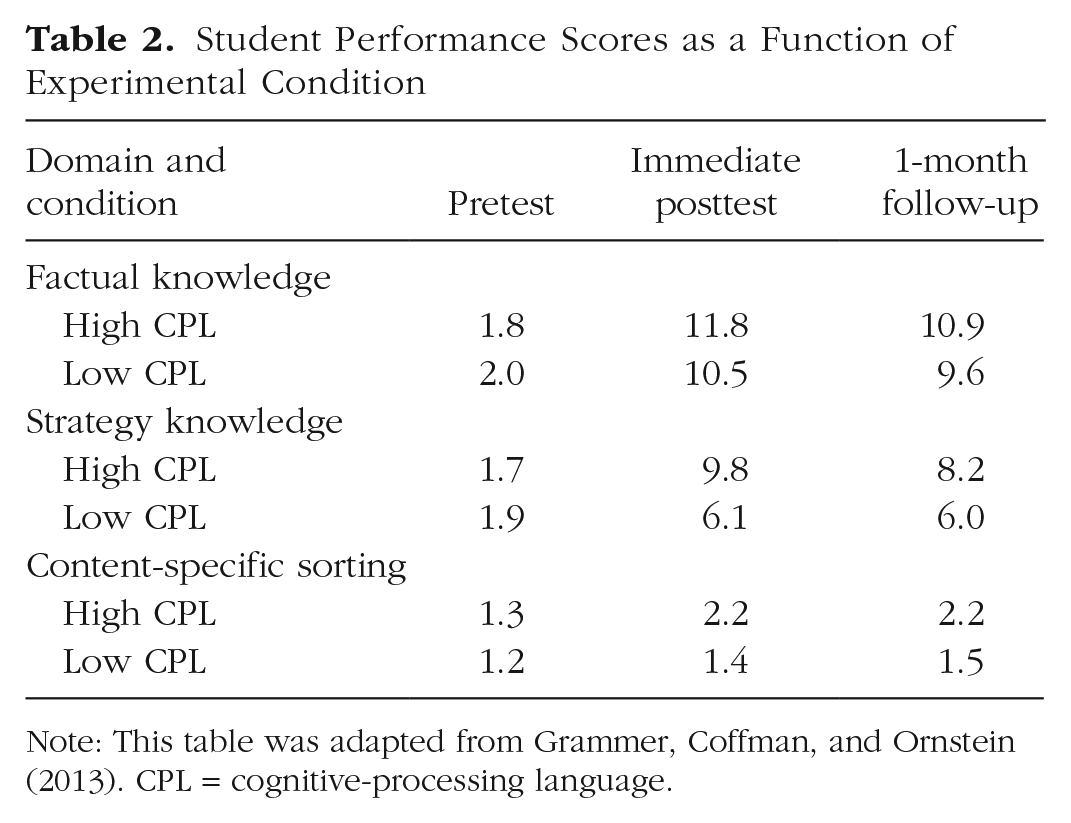
Note: This table was adapted from Grammer, Coffman, and Ornstein (2013). CPL = cognitive-processing language.
These findings suggest that teachers’ use of language is causally linked to children’s performance, but which features seem to be important in determining the outcomes? To examine this issue, we carried out two follow-up experiments in which students received instruction that emphasized contrasting components of CPL, and the findings indicated that metacognitive language is a key determinant of the outcomes that we have observed (Ornstein et al., 2016).
Current and Future Directions
Our findings shed some light on the issues of developmental change that motivated this research, and we are beginning to understand the impact of instructional language on children’s developing skills for remembering. Nonetheless, there is more to learn, and we are filling in gaps that remain in our understanding by increasing the set of cognitive outcomes that may be linked to exposure to CPL and also by exploring the nature of the language to which children are exposed at home.
In terms of additional outcomes, we have focused on both domain-general and domain-specific skills that are important for academic success. To examine domain-general skills, we have explored the study skills that children use when examining texts so that material can be remembered. Our findings indicate that in the fourth grade, differences exist in children’s use of study-oriented behaviors (Brown & Smiley, 1978) as a function of their first-grade teachers’ use of CPL. Moreover, to examine domain-specific skills, we have focused on early mathematics in studies that also illustrate our commitment to examining the contribution of language experienced at home. As we see it, the in-home language milieu may impact children’s skills at school entry and have implications for their ability to take advantage of the language environment in the classroom. In this regard, we have found that mothers’ language when reminiscing with their children—especially the inclusion of metamemory language—is related to children’s addition skills (both accuracy and strategy use) at kindergarten entry, perhaps because references to metamemory prompt basic search and retrieval processes that have implications for arithmetic as well as remembering. Further, teachers’ use of CPL is associated with performance at the end of the kindergarten year, with optimal performance being observed when children are exposed to both types of language (Hudson, Coffman, & Ornstein, 2018).
From a developmental-science perspective (Cairns et al., 1996), we have been able to advance our understanding of developmental processes by focusing on the importance of teachers’ instructional language for developmental change in children’s memory and other cognitive skills. In doing so, we recognize that a basic understanding of cognitive development requires that we attend to the key features of the context—in this case, the classroom setting—in which children’s skills emerge and undergo change. We also recognize that these basic findings may also have implications for instruction in the classroom, given that exposure to teaching that is rich in CPL is particularly important for low-self-regulated children and seems to have long-term effects. Of course, additional research is needed to understand the long-term linkages between exposure to high levels of CPL in the first grade and success on more complex tasks in later grades. Is it possible that the metacognitive emphasis of high-CPL instruction leads first graders to develop a strategic orientation that serves them well in later years on a range of tasks? Moreover, is it possible that there are contrasting developmental pathways across the early elementary school years and that the impact of early exposure to high-CPL language is reinforced for some students but not for others by their continued placement in classes taught by high-CPL teachers?
Although these and other questions remain to be addressed before we can recommend that teachers incorporate high levels of CPL into their instruction, it seems evident that research that is motivated by basic developmental questions can also have the potential to impact teachers’ instruction and their students’ learning.
Recommended Reading
Bauer, P. J., & Fivush, R. (2014). (See References). Outlines multiple approaches to the study of the development of memory and places this body of research in historical context.
Fivush, R., Haden, C. A., & Reese, E. (2006). (See References). Summarizes research on joint reminiscing, focusing on linkages between mothers’ conversational style and a range of child outcomes.
Ornstein, P. A., Coffman, J. L., Grammer, J., San Souci, P., & McCall, L. (2010). (See References). Presents several lines of evidence that document the importance of the classroom setting for the development of deliberate memory skills.
Footnotes
Acknowledgements
The authors express their appreciation to the participating teachers, administrators, children, and families for their support of this work, as well as to their students, research assistants, and collaborators for their many contributions to this research program. The authors are also grateful to three anonymous reviewers for their helpful critiques of the original version of this manuscript.
Transparency
Action Editor: Randall W. Engle
Editor: Randall W. Engle
