




Abstract
Intolerance appears to be commonplace worldwide. There are near-daily reports of intolerance toward refugees and immigrants, people from different religious and ethnic groups, and people who hold ideologically differing viewpoints. However, not all forms of intolerance are the same. In the present work, we discuss the psychology of three understandings of intolerance that are concealed within the literature: (a) prejudicial intolerance based on rigidity, closedmindedness, and antipathy toward a group of people; (b) intuitive intolerance involving disapproval of out-group beliefs or practices based on unreflective responding; and (c) deliberative intolerance, which involves interfering with specific beliefs or practices that are considered to violate moral principles and values. We argue that these three understandings have different implications for (a) how to respond to intolerance and (b) how disagreements on interpretation of examples of intolerance can result in irreconcilable differences among cultural, religious, and ideological groups.
Although intolerance is not new, current events suggest that we live in especially intolerant times. Across many countries, people are intolerant of migrants, refugees, and various minority groups, along with the cultural and religious practices they engage in. Furthermore, there is intolerance of viewpoint diversity resulting in disinvitations, deplatforming, firings, intimidation, and violence toward ideologically dissimilar people (see Ceci & Williams, 2018). Such incidents can raise difficult questions, such as whether antifascist activists assaulting far-right demonstrators are ever justified or whether it is acceptable for Western countries to enforce a “burka ban” on Muslim women or a ban on the building of new minarets.
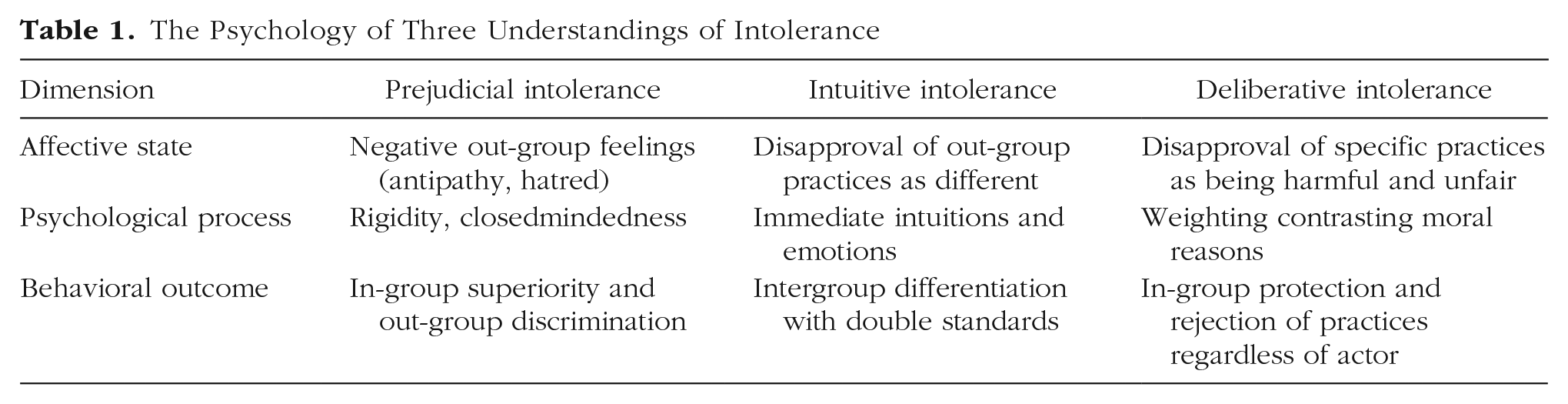
Although people refer to all of these examples as intolerance, there are important psychological distinctions that need to be made among them because not all these situations are the same. “Intolerance” is a familiar, superficial label that is easily pasted over various attitudes, beliefs, and behaviors, which highlights the importance of unpacking its variations for productive debates, systematic research, and successful interventions. Classic perspectives in social psychology highlight that our subjective construal of events influences our thoughts, feelings, and behaviors. Here, we argue that how individuals and groups construe others’ intolerance (and their own tolerance) can systematically shape the way they respond. A deeper understanding of the psychological processes underlying distinct forms of intolerance may be required before we can mend broken fences and create a more civil society made up of our cultural, religious, and ideological differences. We will discuss three understandings of intolerance that are concealed within the literature, what we call prejudicial intolerance, intuitive intolerance, and deliberative intolerance (see Table 1).
The Psychology of Three Understandings of Intolerance
Prejudicial Intolerance
Psychologists tend to equate tolerance with being nonjudgmental and open to differences, using the term to describe a “tendency to be generally free of prejudice” (Duckitt, 1992, p. 8). Intolerance is then equated with prejudice as generalized negativity or antipathy toward a group of people that is different from oneself in various respects, often because of feelings of threat. It is, for example, considered intolerant when neighbors or employees socially distance themselves from other residents or coworkers because of their race or religion.
Prejudicial intolerance is linked to rigid forms of thinking. Allport (1954) discussed intolerance of ambiguity as a key characteristic of the prejudiced personality. Prejudiced people are narrow-minded because of their need for structure and definiteness, whereas nonprejudiced people are characterized by mental flexibility and differentiation. Similarly, Rokeach (1960) argued that the intolerant person is characterized by a closed mind or dogmatic personality in contrast to the openmindedness of the tolerant person. The intolerant person has difficulty accepting different views, beliefs, and practices of other people because of a lack of openness to experience and feelings of fear and uncertainty. For example, a meta-analysis found a medium-sized negative association (r = −.30) between openness and prejudice-based intolerance (Sibley & Duckitt, 2008). In this conception, intolerance implies out-group antipathy driven by closedmindedness, resulting in in-group superiority and out-group discrimination.
Intuitive Intolerance
Although intolerance is often equated with prejudice, there is a different understanding that is based on the classical notion of tolerance (Cohen, 2004). In its classical form, tolerance is not defined by the absence of prejudice but rather involves restraint from obstructing or interfering with beliefs or practices that one dislikes or disapproves of despite having the ability to do so (Verkuyten & Yogeeswaran, 2017). According to dual-process theories of moral judgment (Greene, 2013), people’s moral responses can be guided by their immediate intuitions and emotions as opposed to reflective, effortful reasoning. Intuitive intolerance is based on the former process, whereby one’s immediate reaction is not overridden by the cognitive processing of reasons for showing self-restraint and tolerating something. With intuitive intolerance, people base their responses on their first reactions, and research has found that intuitive responding as well as experimentally promoting intuition decreases reflective reasoning in moral dilemmas (Greene, 2013).
In this understanding, intolerance differs from group-based prejudice, and research has demonstrated that intolerance of out-group practices and prejudicial attitudes are distinct phenomena (e.g., Crawford, 2014; Klein & Zick, 2013). For example, research across six nations found large country differences in the levels of opposition to the Islamic practice of wearing a headscarf but similar prejudicial attitudes toward Muslims across countries (Helbling, 2014). Furthermore, research has found that beliefs about worldview incompatibility drive intolerance of minority practices independently of minority-group prejudices (e.g., Sleijpen, Verkuyten, & Adelman, 2020). People who hold a strong conviction, be it cultural or religious, are more likely to be intolerant toward those who strongly subscribe to an alternative worldview (e.g., Brandt, Reyna, Chambers, Crawford, & Wetherell, 2014). What makes a cultural, religious, or ideological belief critical and psychologically meaningful is that it is taken to be true, and devout believers, for instance, may intuitively consider other faiths as being misguided.
Intuitive intolerance also means that people can apply a double standard, for example, by accepting practices of one group (i.e., specific Christian denominations in Western countries) but not of another minority group engaging in similar practices (e.g., Muslim minorities). For example, research in six West European countries found that 38% of West Europeans applied a double standard toward accepting identical Muslim and Christian practices (Dangubic, Verkuyten, & Stark, 2020). Intuitive intolerance implies intergroup differentiation whereby only some groups are denied their equal rights and freedoms as people reject their beliefs or practices. Such a double standard does not have to be driven by prejudicial attitudes or closedmindedness but rather results from a failure to sufficiently reflect on reasons to tolerate differences. For example, even people who claim to be openminded can be intolerant toward others who think differently. People who appreciate and celebrate ethnic, racial, and sexual minority communities can at the same time try to limit and restrict the freedoms and rights of their ideological opponents, whose views are treated as a modern-day form of heresy (Bizumic, Kenny, Iyer, Tanuwira, & Huxley, 2017).
Believing that all religions or cultures are not equally valid (e.g., “there is only one true faith”) or that some practices (e.g., ritual slaughter of animals) are wrong does not in itself have to be intuitively intolerant. It becomes intolerance when one does not recognize the right of others to dissent from one’s own strong views and argue their own case, thereby using a double standard that limits their equal rights and freedoms. This lack of recognition implies an incomplete consideration of others as being equal (autonomous person or citizen) with the same right to live the life that they want. Research has found, for example, that the disapproval of others’ beliefs and practices goes together with tolerance based on respect for others as equal fellow citizens (Simon et al., 2019).
Deliberative Intolerance
Although intolerance has a negative connotation, no individual or group can be tolerant of everything. Intolerance of drinking and driving is not considered a vice but a virtue. In the classical understanding, intolerance also implies that specific practices and beliefs are considered to deviate in an unacceptable way from a presupposed norm (Cohen, 2004). This intolerance has less to do with the out-group per se or with people’s immediate intuitions but rather with reflecting on the perceived normative deviance of particular practices and beliefs.
For example, one can be intolerant of specific beliefs and practices of individuals or groups toward whom one has no prejudicial feelings, including one’s in-group. People can find certain practices of in-group members normatively unacceptable (e.g., patriarchy), and it is possible to reject a specific practice (e.g., ritual slaughter of animals) regardless of who engages in the practice. People can also reject practices of groups toward whom one has neutral or positive feelings. For example, among national samples in the United Kingdom, France, Germany, and The Netherlands, a substantial portion of people with a positive attitude toward Muslims supported a ban on headscarves and also rejected Islamic education and the building of mosques (Van der Noll, 2010). Moreover, using an unobtrusive measure of prejudice, Sniderman and Hagendoorn (2007) showed that intolerance of some Muslim practices can be based on the disapproval of the practice rather than dislike of the group. Using latent profile analysis and four national samples in The Netherlands, Adelman and Verkuyten (2020) identified a group of people who rejected various Muslim practices without having prejudicial feelings toward Muslims.
Following the dual-process model of moral judgment (Greene, 2013), we argue that deliberative intolerance is based on a process of reflective reasoning. The reasoning involves a trade-off between weighting competing considerations such that the reasons for rejection (e.g., harm, injustice) of a dissenting practice or belief are considered more important than the reasons (e.g., free speech, freedom of religion) for putting up with these. It involves a dual form of thinking in which there are more important value-based reasons for rejecting than permitting the disapproved of practice (Verkuyten & Yogeeswaran, 2017). Obviously, what is considered a good reason will depend on social, cultural, and historical factors, but the importance of these circumstances does not preclude the fact that for people themselves, there are general principles and moral values that they use for thinking about what is and what is not considered acceptable. A particular practice might raise specific moral and normative concerns. For instance, wearing a burka might evoke the issue of gender equality, and religious education in public schools can evoke concerns about the secular nature of the state (Moss, Blodorn, Van Camp, & O’Brien, 2019). Majority members can reject the founding of Islamic schools because they dislike Muslims or also because they believe that religion has no place in education more broadly (Dangubic et al., 2020).
Experimental research in the United Kingdom (Helbling & Traunmüller, 2018) and The Netherlands (Sleijpen et al., 2020) demonstrates that people’s intolerance toward dissenting practices and beliefs of Muslim immigrants are more about strict forms of religiosity that are seen as incompatible with Western liberal norms and values than about negative attitudes toward Muslims as a group. And in the context of Quebec, Canada, where those who held prejudicial views supported a ban on religious symbols, a majority of the people supporting a ban on any religious symbols did so out of principled secularism rather than prejudice (Breton & Eady, 2015). In another study in Quebec, it was found that feelings of cultural threat and generalized prejudice predicted support for banning minority religious symbols, whereas holding liberal values predicted support to ban all religious symbols (Bilodeau, Turgeon, White, & Henderson, 2018).
Additionally, the moral domain is concerned with issues of fairness, justice, and other people’s welfare, and people tend to believe that matters of morality are objective, universally true, and thereby applicable regardless of group boundaries (Skitka, Bauman, & Mullen, 2008). Entities and activities that people perceive as having a moral basis (i.e., are moralized) tend to elicit avoidance and in-group-protection tendencies because of fears of moral contamination (Rozin, 1999). When people view a dissenting practice or belief as going against their moral views, they tend not to tolerate it in their personal life and in society regardless of who engages in it (e.g., Hirsch, Verkuyten, & Yogeeswaran, 2019; Wright, Cullum, & Schwab, 2008). Furthermore, stronger moral conviction about contemporary societal issues has been associated with lower political tolerance of people not sharing one’s views and also with lower intergroup tolerance (Skitka et al., 2013). Likewise, stronger perceived similarity in moral values of fairness and care has been associated with lower out-group intolerance (Obeid, Argo, & Ginges, 2017). Additionally, people became more intolerant of controversial acts by Muslim minorities (e.g., an imam calling homosexuals inferior people) when moral considerations against these practices (harm to people) were presented (Gieling, Thijs, & Verkuyten, 2012), and people are more intolerant when greater perceived harm is involved (Hirsch et al., 2019; Sleijpen et al., 2020). Intolerance of practices that are harmful to other people (e.g., female genital mutilation; persecution of the lesbian, gay, bisexual, transgender, and queer community; violent protests) are seen as immoral and therefore rejected by most people (e.g., Feinberg, Willer, & Kovacheff, 2020). Although it is considered important in liberal societies to allow people to live their own way, injustices and harm-doing are typically not tolerated. So it is understandable that many countries promote policy measures and strong pleas for zero tolerance of oppression, cruelty, and violence.
Conclusion
In our increasingly diverse societies, there is every reason to address and oppose intolerance and to promote tolerance. However, in doing so, it is important to be clear about the different understandings of intolerance that are concealed within the literature. How people construe actions as representing intolerance impacts their attitudinal and behavioral responses to the action and yields varying implications for how to address the intolerance in diverse societies (Verkuyten, Yogeeswaran, & Adelman, 2019). Prejudicial intolerance raises the question of how to change prejudicial attitudes and rigid ways of thinking. Intolerance in such a case is reduced when prejudiced people give up their prejudiced beliefs, become more openminded, and have a reduced sense of in-group superiority. By contrast, addressing intuitive intolerance implies that people reflect and recognize the civil liberties of others and acknowledge the democratic importance of freedom of expression and speech. Valuing the relegation of one’s own strongly held beliefs in favor of respecting others’ rights as autonomous persons and equal citizens is crucial for learning to accept beliefs and ways of life that we disapprove of. Furthermore, addressing deliberative intolerance requires a weighing of the reasons for not allowing dissenting practices and beliefs (e.g., harm and rights principle) that might trump those for accepting these (e.g., religious freedom). Here, making people aware of and inducing them to carefully think about the nature and relative importance of the reasons for why and when something cannot be tolerated is central (Verkuyten, Yogeeswaran, & Adelman, 2020). This sort of reflective reasoning decreases one’s reliance on intuition and therefore can lead to a more reflective than intuitive judgment about not tolerating something. This indicates that there are possible relations among the psychological processes underlying the three understandings of intolerance, similar to what has been argued and shown in research on dual-process theories of moral judgment (Greene, 2013).
The distinction among these differing understandings of intolerance highlights why it may be difficult for people to discuss and resolve conflict, leaving society in gridlock over differences, with increasing polarization that undermines societal cohesion and functioning. Whereas one individual may perceive the rejection of minority practices such as ritual slaughter of animals or wet markets as being an indicator of prejudicial intolerance, another may see it as being indicative of deliberative intolerance based on harm and right considerations. Similarly, whereas one individual may see deplatforming and obstructing individuals with differing ideological views as an exercise in deliberative intolerance to prevent harm and injustice, another may see it as intuitive intolerance based on not fully considering the equal rights of others.
In such cases, what exactly constitutes harm and should not be tolerated is not always easy to determine because the harm principle can be interpreted in a broader or narrower way (e.g., Haslam, 2016). For example, it can be argued that nonrecognition, misrecognition, microaggressions, and forms of free speech inflict harm to such a degree that they undermine people’s psychological well-being and the development of authenticity, self-respect, and personal autonomy (Lui & Quezada, 2019). This means that everything that can be perceived as a slight or considered offensive and could affect people’s feelings negatively should not be tolerated but restricted by speech codes and authorities. But in a narrower sense, it can be argued that not all criticisms, disagreements, objections, and forms of offense that cause discomfort are intolerable. Ethical disagreements and viewpoint differences can cause psychological discomfort and hurt feelings but may be considered intrinsically part of intellectual exchange, civil discourse, and critical debate in a free society (Ceci & Williams, 2018).
Intolerance is a major obstacle for establishing multicultural justice and peaceful coexistence (Verkuyten et al., 2019). However, the term is used in various ways in the research literature and in organizational and institutional settings, making it difficult to compare findings and propose adequate interventions. We have tried to show that the three understandings of intolerance raise different theoretical, empirical, and practical questions. In our view, systematic attention to the differences among these three understandings can enhance psychology’s contribution to the development of positive intergroup relations in different settings.
Recommended Reading
Cohen, A. J. (2004). (See References). A detailed and systematic conceptual discussion of the different aspects and dimensions of tolerance and intolerance.
Gibson, J. L. (2006). Enigmas of intolerance: Fifty years after Stouffer’s communism, conformity, and civil liberties. Perspectives on Politics, 4, 21—34. A discussion of the main findings and questions in political science, including whether intolerance and prejudice are distinct.
Helbling, M., & Traunmüller, R. (2018). (See References). An example of experimental research that tries to disentangle people’s prejudicial feelings and intolerance of religiousminority practices.
Jackman, M. R. (1977). Prejudice, tolerance, and attitudes toward ethnic groups. Social Science Research, 6, 145—169. One of the first psychological articles arguing that prejudice and tolerance are different and that social psychologists should study tolerance in addition to prejudice.
Verkuyten, M., Yogeeswaran, K., & Adelman, L. (2019). (See References). A discussion of the various issues involved in intergroup tolerance and an overview of existing research, with policy recommendations.
Footnotes

References
Supplementary Material
Please find the following supplemental material available below.
For Open Access articles published under a Creative Commons License, all supplemental material carries the same license as the article it is associated with.
For non-Open Access articles published, all supplemental material carries a non-exclusive license, and permission requests for re-use of supplemental material or any part of supplemental material shall be sent directly to the copyright owner as specified in the copyright notice associated with the article.
