




Abstract
There is now compelling evidence that people’s typical patterns of thinking, feeling, striving, and behaving are both consistent and malleable. Therefore, researchers have begun to examine the distinct sources of personality stability and change. In this article, we discuss traditional classifications of sources, review key findings, and highlight limitations and open questions in research on personality stability and change. We conclude by describing an integrative model and by outlining important directions for future research.
Keywords
The major mission of researchers in the field of personality psychology is to describe and explain individual differences in people’s typical thinking, feeling, striving, and behaving. Despite ongoing debates about which characteristics should be subsumed under the umbrella term personality, recent work has converged on general agreement about the necessity for a limited number of constructs to economically describe interindividual differences in key characteristics (Kandler, Zimmermann, & McAdams, 2014). Two further milestones characterize recent progress in the field of personality psychology. First, research has established that personality differences predict major life outcomes, such as educational achievement, work success, health, well-being, and even mortality (Soto, 2019). Second, the traditional view that adult personality traits are completely stable has been dismissed (Bleidorn et al., 2019). A compelling body of evidence shows that personality traits are characterized by both stability and change across the entire life span. This appears to be true with respect to rank-order, mean-level, and individual-level stability and change (Lucas & Donnellan, 2011; Wagner, Lüdtke, & Robitzsch, 2019). These insights naturally lead to a broad question: Why do personality traits change or remain stable?
Over the past two decades, a large number of methodologically sophisticated studies using longitudinal twin, cross-sequential panel, and dynamic daily-diary designs have focused on the examination of various sources of personality stability and change. Irrespective of the particular study design or trait measure, evidence has been mixed, and researchers have not yet come to convincing conclusions about the sources that underlie personality-trait change. To move forward, research on the sources of personality stability and change needs to become more integrative and dynamic. To illustrate, we first describe two traditional classifications of sources of personality stability and change and argue that an integrative scheme is needed to resolve current challenges related to traditional classifications. We then review established knowledge, equivocal findings, and blind spots in the literature on the sources of stability and change. Finally, we make a case for an evidence-based model that integrates multiple relevant sources that likely interact in synergetic and dynamic ways, and we provide specific recommendations for future research based on this model.
What Are the Sources of Personality Stability and Change?
There are at least two established classifications of sources of personality stability and change. The first involves the traditional differentiation between genetic and environmental sources. Behavioral-genetic studies have provided evidence that both genes and life experiences are involved in both stability and change (Bleidorn, Kandler, & Caspi, 2014). Although the interdependence of these two sources is well established (e.g., Plomin, DeFries, & Loehlin, 1977), empirical evidence for the interplay has been limited because of the limitations of data, designs, and methods. More recently, researchers have used improved epigenetic and behavioral-genetic approaches that illustrate that genetic sources are interwoven with environmental factors in various ways on the pathway from genetic differences to personality differences via biological differences. For example, environmental factors can alter genetic activity and shape gene expression without changing genes (i.e., environmental epigenetic regulation; Shah et al., 2014). Likewise, the effects of life experiences can depend on an individual’s genetic sensitivity to those influences (Byrd & Manuck, 2014).
The second traditional approach to classifying sources involves the differentiation between personal and situational or contextual sources (and resources) and how they interact and covary with each other (Rauthmann, Sherman, & Funder, 2015). However, two facts blur the distinction between the person and the environment. First, personality is clearly contextualized and situational in nature, as implied by its definition and measurement (Roberts, 2009). For example, extraverts are well aware of the fact that extraverted behavior is more appropriate at a party and less so at a funeral. Second, personal sources add the feature of self-concept and self-regulatory processes to the classification scheme. People set goals, follow needs, strive for enhancement, select or avoid situations, and manipulate or create environmental conditions—thus, people are often agents of their own stability and change (Hennecke, Bleidorn, Denissen, & Wood, 2014). That is, although people cannot change their genetic makeup by choice, other personal and environmental sources are subject to individual control. For example, research on volitional personality change shows that people who want to change specific aspects of their personality can develop in the direction of their desired trait levels (Hudson & Fraley, 2017). Accordingly, individuals’ personalities are themselves a source of stability and change as individuals select themselves into environments (e.g., through choice of a profession and workplace) and alter their behavioral styles to better fit into those environments (e.g., through becoming more reliable and organized in the workplace).
Despite the long-standing recognition that sources of personality stability and change interact and covary, empirical research has largely been limited to the dichotomies of these two classifications. From an integrative perspective, it is important to bear in mind that self-regulation is not independent from genetic predisposition and environmental sources but involves both (Mischel, 2004). Genetic differences in personality traits may affect individuals’ experiences of events and self-determined exposures to certain environments that may, in turn, affect the stability and change in those or other personality characteristics, consistent with research on personality–environment fit (Scarr & McCartney, 1983). In other words, innate differences can guide people to have differential experiences that in turn shape personality differences. As a consequence, each personal or contextual source (or resource) of personality stability and change will to some degree reflect both genetic and environmental causation (Briley, Livengood, & Derringer, 2018) as well as personal and situational factors. This complex interdependence highlights a major limitation of traditional classifications that attempted to sort sources into distinct categories of genetic versus environmental sources or personal versus situational or contextual sources. Thus, these interdependent sources of personal stability and change call for integration.
What Do We Know?
Despite many efforts, research has yet been unable to identify one particular gene, event, or situational or contextual circumstance that is a strong, replicable source of personality stability and change. For example, despite large-scale genome-wide association studies, effect sizes of any single genetic variant are generally very small and do not account for substantial proportions of variance in personality traits (de Moor et al., 2012). Because the genetic unfolding depends on environmental opportunities, the same genetic variant can result in different phenotypes, and different constellations of genes can produce the same phenotypic expression. This reduces the probability of robust main effects of single genes on personality traits.
Analogously, the main effects of specific life experiences on personality-trait change are very small (Bleidorn, Hopwood, & Lucas, 2018). Nevertheless, there are some robust effects of life events on personality change, which can be sorted into three major domains: work, love, and health. With regard to work, the transition from high school to college, university, or vocational training is associated with substantial normative increases in emotional stability, agreeableness, and conscientiousness (Lüdtke, Roberts, Trautwein, & Nagy, 2011). Moreover, work and career investments can lead to increases in agreeableness and conscientiousness (Hudson & Roberts, 2016). However, the evidence is less robust regarding several other work-related factors such as the transition into the first job (Deventer, Lüdtke, Nagy, Retelsdorf, & Wagner, 2019) or retirement (Schwaba & Bleidorn, 2019). Even less is known about conditions of developmental paths within the working context, such as transactional processes between work-role demands and personality change across the adult life span (Denissen, Ulferts, Lüdtke, Muck, & Gerstorf, 2014). Finally, we know almost nothing about the influence of contextual work characteristics (e.g., occupational prestige of someone’s job, income) or psychological work characteristics (e.g., autonomy, role complexity) on personality stability and change.
In the domain of love, a robust finding is the increase in emotional stability, extraversion, and self-esteem following the transition to the first romantic relationship (Luciano & Orth, 2017; Wagner, Becker, Lüdtke, & Trautwein, 2015). A second robust finding is that the experience of social inclusion can contribute to increases in self-esteem (Harris & Orth, 2019; Hutteman, Nestler, Wagner, Egloff, & Back, 2015). With regard to many other relationship transitions and characteristics, however, evidence is limited (Bleidorn et al., 2018). Finally, we know very little about the influence of family relationships during childhood on long-term personality development, including whether these early relationships have an enduring effect on personality that can still be observed in adulthood (e.g., see Orth, 2018).
Changes in the health domain are regarded as influential sources of personality stability and change, especially in late adulthood (Wagner & Mueller, 2017). Specifically, terminal declines across multiple facets of health, including cognitive, physical, and sensory functioning, can challenge older people’s ability to maintain their everyday routines and lifestyle. Accordingly, there are robust findings on reverse trends in maturity-related traits that may not be linked with negative consequences late in life but rather reflect developmental adaptations that help individuals to adjust their daily experiences and behavior in accordance with existing resources (Kandler, Kornadt, Hagemeyer, & Neyer, 2015; Mueller, Wagner, Smith, Voelkle, & Gerstorf, 2018). In contrast, the effects of nonnormative health-related events on personality changes, such as accident-related injuries or enduring health consequences, are less consistent. Although initial evidence associated the sheer number and onset of specific chronic diseases (e.g., stroke) with personality change, evidence for robust accident-related personality differences at a population level is weak. Finally, how normative and nonnormative health-related experiences and changes interact with further personality and environmental sources and resources has yet to be examined.
Where Do We Go From Here?
The predominant focus on distinctive sources of personality stability and change in theory and research has contributed to relatively few robust findings. Although it is generally established that seemingly different sources of personality stability and change do not operate independently of each other but may interact in complex ways, the following is still an open and pressing question: In what ways can different sources be integrated both theoretically and in research designs to examine their unique and joint effects on differential personality stability and change? To begin to address this question, we propose an evidence-based model that integrates various sources that might interact and transact synergistically and dynamically. Such a model needs to integrate both personal and environmental sources.
Figure 1 shows a simplistic scheme illustrating this kind of integrative model. This model proposes that the person can be characterized by means of more or less stable characteristics that give rise to individual differences in thoughts, feelings, strivings, and behaviors. An individual’s genetic makeup can be expressed via both relatively stable traits and momentary states. Through related cognitions, emotions, motivations, and behavior, genes can influence sources outside the person and thus guide the person through environmental conditions. The environment reflects different external circumstances, which can also be regarded as more or less stable contexts and short-term situational fluctuations. Environmental influences interact and transact both with each other and with internal sources. Within external sources, cultural contexts might differentially exert pressure on social roles (e.g., parent or spouse) and thus affect the specific realization of relationships (e.g., between spouses) as well as daily tasks (e.g., sharing of daily chores). To illustrate the expected complex interplay among sources, one could expect that affective states, motives, or trait levels of a person mold the experience of social roles, the realization of relationships, or the dealing with specific situations. The environment, in turn, provides opportunities and limits that reinforce or change personality characteristics. We propose that a comprehensive understanding of the factors that underlie personality stability and change requires an integration of these sources, which may be correlated and interact with each other.
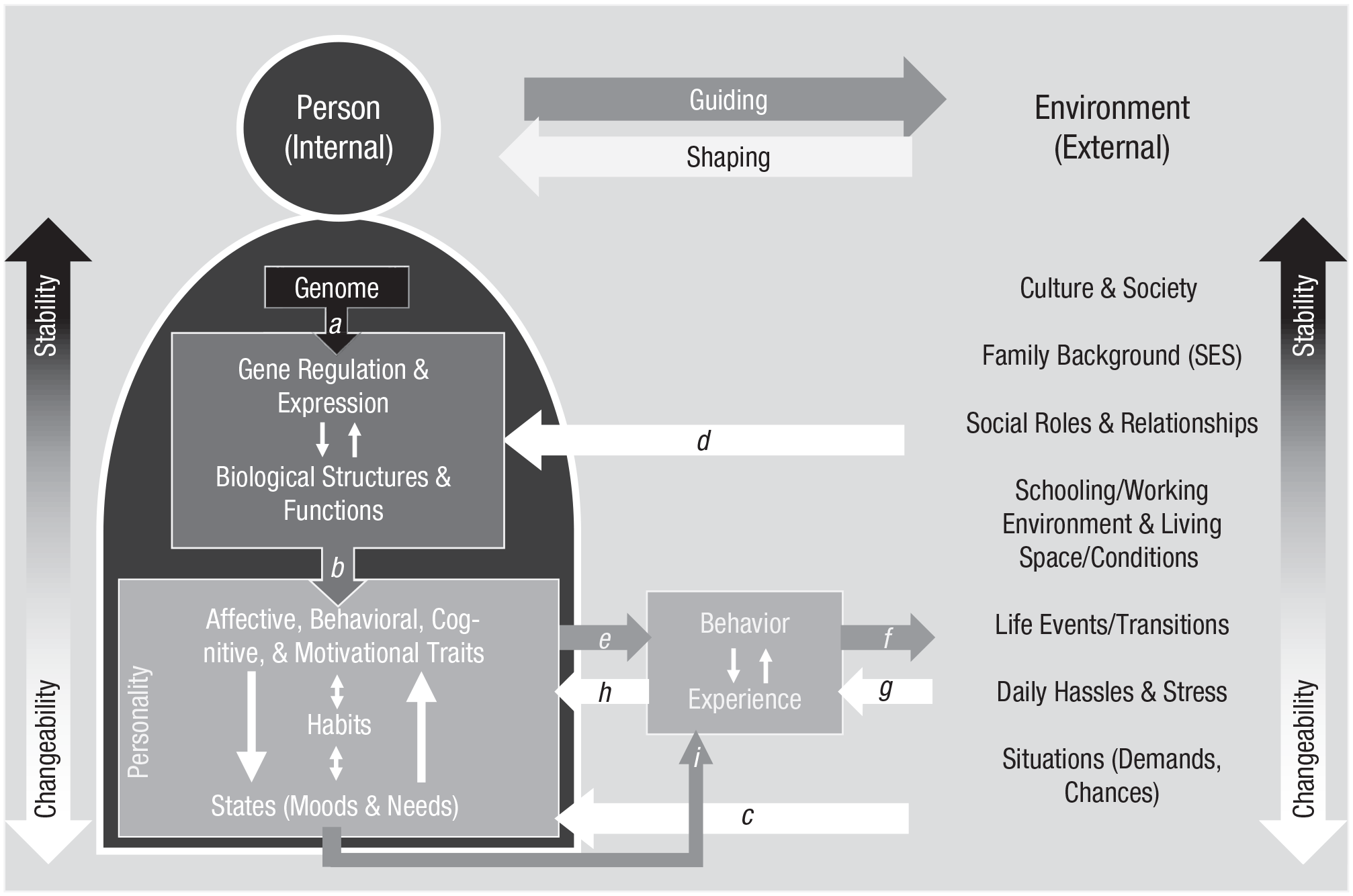
Integrative-source model illustrating the complex interplay between and within personal and environmental sources and resources that give rise to the stabilization and changeability of personality characteristics. Arrows represent directional relationships between variables. Stable genetic differences unfold their influences on personality variation indirectly via largely stable individual differences in gene expression, protein synthesis, morphological structures, nervous and endocrine systems, and their functions, f(a, b). Environments provide more or less stable (cultural, social, and physical) opportunities and limits for personality unfolding (c). Environments (e.g., chronic stress) can influence neural and hormonal activity as well as gene regulation and expression (d). Personality differences can influence the environment, f(e, f), and so can genetic differences, f(a, b, e, f), via characteristic patterns of behavior, which reflect the individual expression of personality characteristics in a situation (e) and increase the probability of exposure to specific environments (f). Environmental factors also act through the filter of the individual construction of experiences, f(g, h), which is more or less driven by personality characteristics (i). SES = socioeconomic status.
We close this article by outlining five recommendations for future research as well as further elaborations on the implications of such an integrative model.
Our first recommendation is for theory and research to consider the effects of multiple sources’ interactions and transactions shaping individuals’ personality. As an example of such a complex research approach, we refer to a study by Ge, Natsuaki, Neiderhiser, and Reiss (2009), in which a longitudinal, genetically informed sibling design was used to disentangle diverse sources (e.g., genes, events, social relationships) and illustrate that increased mother–child closeness in early adolescence buffers the detrimental influence of negative life events on developmental trajectories of negative emotionality in late adolescence.
Second, given that a person’s genetic sensitivity drives individual exposure and reactions to life experiences, future studies need to model this sensitivity. In an exemplary study accounting for gene–environment interplay, Kandler and Ostendorf (2016) found that genetic differences in proneness to depression among women were primarily mediated by individual differences in neuroticism and that a negative life-event balance (i.e., accumulation of negative experiences and absence of positive experiences) increased the risk of depression for women with a high level of neuroticism but not for emotionally stable women.
Third, integrative research is needed to understand how diverse sources interact and unfold over time. For example, Mueller and colleagues (2020) used experience-sampling data of older couples to examine the degree to which the coupling of momentary affect in couples differed depending on their levels of neuroticism and whether this spousal coupling of momentary affect contributed to differential changes in neuroticism 18 months later. Results illustrated stronger coupling in positive affect for individuals high in neuroticism and decreases in neuroticism over time in participants who showed a higher degree of coupling with their partner’s positive affect.
Fourth, most research on personality change is based on self-report measures. Because self-report data are heavily influenced by self-concepts and can thus depart from other types of data, differential stability and change in aspects of personality based on other forms of data is largely unknown. Although research using informant reports (e.g., from parents and peers) suggests comparable results on personality stability and change with respect to some traits (Göllner et al., 2017; Kandler et al., 2010), future studies on the interplay of sources and potential intervention studies should integrate diverse measures of personality.
Fifth, more attention should be paid to the processes and mechanisms at play. We see two broad avenues for taking future research in this direction. The first involves understanding the processes by which sources get under the skin and lead to actual personality change (Baumert et al., 2017). The second is examining the effect of interventions on certain personality characteristic in certain contextual conditions (Allemand & Flückiger, 2017). Personality-intervention research leads to a host of important practical questions, such as whether interventions in educational settings of adolescence and young adulthood are more or less effective during this highly dynamic time of personality development. Adolescence and young adulthood are characterized by a multitude of developmental tasks related to education, romantic relationships, identity formation, living conditions, and financial independence. These tasks do not necessarily occur in a fixed sequence but are interrelated and may interact to shape personality differences. Thus, interventions possibly buffer or amplify other changes, and their effects might additionally depend on personal sources (e.g., genetic sensitivity) and environmental sources (e.g., social support).
In summary, the predominant focus on main effects of distinctive sources of personality stability and change has constrained progress in the field of personality development. Future research needs to account for the complex, dynamic, and synergetic ways in which person and environment interact in shaping personality differences. We propose an integrative perspective on how different sources cascade to influence people’s personality development that leads to specific recommendations that we hope will guide future integrative research on the sources of personality stability and change.
Recommended Reading
Bleidorn, W., Hopwood, C. J., & Lucas, R. E. (2018). (See References). A review on life events and research on personality-trait change.
Briley, D. A., Livengood, J., & Derringer, J. (2018). (See References). A good overview of research on gene—environment interplay.
Ge, X., Natsuaki, M. N., Neiderhiser, J. M., & Reiss, D. (2009). (See References). An innovative study design to disentangle diverse sources on personality stability and change.
Kandler, C., & Ostendorf, F. (2016). (See References). A recent take on gene—environment interactions on depression.
Mueller, S., Wagner, J., Hueluer, G., Hoppmann, C. A., Ram, N., & Gerstorf, D. (2020). (See References). An integration of experience-sampling and longitudinal data on personality change in late-life couples.
