




Abstract
The measurement of individual differences in cognitive ability has a long and important history in psychology, but it has been impeded by the proprietary nature of most assessment measures. With the development of validated open-source measures of ability (collected in the International Cognitive Ability Resource, or ICAR, available at ICAR-project.com), it is now possible for many researchers to assess ability in large surveys or small, lab-based studies without the expenses associated with proprietary measures. We review the history of ability measurement and discuss how the growing set of items included in ICAR allows ability assessments to be more generally available to all researchers.
Ever since antiquity, people have used measures of cognitive ability for selection and prediction. The story is told in the Hebrew Bible (Judges 7) of Gideon, who rejected potential soldiers for showing fear and not having battle wisdom. Plato, in The Republic (VII: 534, 537), states that leaders should show exceptional ability and discusses principals of assessment. Theophrastus, in his Characters, depicts the “stupid man” as slow in speech and action. Given the belief that “Never before in the history of civilization was brain, as contrasted with brawn, so important; never before, the proper placement and utilization of brain power so essential to success” (Yoakum & Yerkes, 1920, p. vii.), U.S. Army recruits in World War I were screened for levels of intelligence deemed necessary to complete their training. An emphasis on cognitive performance continues to this day in the form of standardized testing, such as the SAT for admission to college and the GRE (and several similar tests) for selection to graduate and professional schools (Kuncel & Hezlett, 2007). Of course, successful outcomes have been shown to depend on much more than cognitive ability. Success in graduate training in clinical psychology requires a mix of ability, stability, and interests (Kelly & Fiske, 1950), and graduate-school performance is predicted better by the subject test than either the verbal or quantitative test, suggesting some combination of ability and motivation (Kuncel & Hezlett, 2007).
Although intelligence tests were initially designed to study “inferior states of intelligence” in children (Binet & Simon, 1916, p. 9), early test administrators began assessing “normal” children in terms of their mental age using test items ordered by average performance as a function of chronological age. This practice emerged from efforts to ensure that students received a level of education that was appropriate for their intellectual development (Binet, 1908; reprinted in Binet & Simon, 1916). 1 The introduction of the “intelligence quotient” led to an explosion of research examining its validity. Terman (1916), for example, demonstrated that children who scored at levels typical of older children were also rated by teachers as more intelligent. A test that had been developed to assess low levels of ability thus became one that could assess the entire range of cognitive ability.
Early research on intelligence also contributed to advances in measurement and theory. While still a graduate student, Charles Spearman (1904) published a fundamentally important article establishing the tradition of measuring general intelligence (g) that continues to this day (de la Fuente, Davies, Grotzinger, Tucker-Drob, & Deary, 2019). Spearman correlated psychophysical sensitivity to pitch, weight, and light with teacher ratings of “common sense” and cleverness in 24 village children and with school performance in the classics, French, English, and mathematics in the upper class of a preparatory school (N = 22). Although his samples were tiny by today’s standards, his correlations showed, when corrected for reliability, a “general function,” which he labeled “general intelligence.” (In 1904, Spearman also developed the fundamentals of reliability theory, as well as the basis of factor analysis.) Students’ performance in the classics correlated highly with performance in other subjects, as well as their psychophysical sensitivities.
There were several prominent applications of early intelligence research. For example, the notions of item difficulty and deviations from mean performance led to the creation of an index of competence used in the Army Alpha exam for placing U.S. Army recruits in World War I (Yoakum & Yerkes, 1920). In 1932, every 11-year-old school child in Scotland was assessed, laying the foundation for a remarkable follow-up study 69 years later showing the stability of ability measures (r = .66; Deary, Whiteman, Starr, Whalley, & Fox, 2004) as well as their use in predicting important life outcomes, such as mortality (Deary, 2008). Indeed, despite ongoing controversies about their use (Hunt & Carlson, 2007; Rindermann, Becker, & Coyle, 2020), ability measures are associated with living longer, success in school and in job performance, marital stability, and social mobility (Gottfredson, 1997).
Theories of Intelligence
Ever since Spearman’s (1904) work, it has been routinely noticed that all cognitive measures form a positive manifold (the correlations are all positive), which has been taken as an indication of a unified general factor of ability. The correlations of almost all cognitive-ability measures are not just positive but also may be arranged in a replicable three- or four-level hierarchy of specific tests of narrow abilities, groups of tests of broad abilities (e.g., fluid, crystallized, memory), and a higher factor known as g (Carroll, 1993). Alternatively, it has been proposed that the third level is better represented with factors for verbal, perceptual, and rotation ability below the higher-order g (Bouchard, 2014; Johnson & Bouchard, 2005).
However, it has been recognized for more than 100 years (e.g., Thomson, 1916) that the existence of such a positive manifold is a descriptive finding and should not be taken as having any necessary causal meaning, as there are several ways that such a positive manifold might be produced (Bartholomew, Deary, & Lawn, 2009; Kovacs & Conway, 2019). Sampling independent “bonds” (Bartholomew et al., 2009), dynamic mutualism (Van Der Maas et al., 2006), and overlapping processes (Kovacs & Conway, 2019) all results in the same set of positive correlations without a causal general factor. This can be seen via simulation of a genetic-factor model of independent genes with pleiotropic effects (simulated as cross loadings) that yields a positive manifold and a g factor, even though the underlying casual mechanisms are independent (for a demonstration, see the sim.bonds function in the psych package; Revelle, 2020).
By analogy, an equivalent positive manifold may be found in measures of body size. Whether measured by weight, height, chest circumference, or hundreds of more precise measures, adult humans differ in a general factor of size (e.g., see the U.S. Air Force, or USAF, data set in psych). Even among a homogenous group of male Air Force personnel, there is a clear general factor of size, with positive correlations across many anatomical features. The utility of this analogy to g can be extended further, for both general factors show (a) clear hierarchical structure, (b) additive effects among (and across) many genes, (c) high sensitivity to environmental effects (e.g., nutrition), and (d) robust age trends. Regrettably, changes in body size and g tend to drift in the opposite direction with age, though both reliably change with greater variability in more specific domains.
Developmentally, cognitive ability can be thought of as a propensity to acquire new information and new reasoning skills. It is analogous to differences in stickiness as snowballs roll downhill. Just as sticky snowballs become larger than those that are less sticky, so do high-ability individuals acquire more information than low-ability individuals as they experience life.
Classic Longitudinal Studies
The question of causality does not diminish the usefulness of the general factor as a predictor of real-world outcomes. Terman and Oden (1959) reported on the lifetime accomplishments of 1,528 “termites”; these were very bright 3rd- to 8th-grade Californians with Stanford-Binet scores mainly above 140 (roughly, the top 1% of the student population). The participants were psychologically healthy and showed impressive levels of accomplishment over their lifetimes (see Lubinski, 2016), contrary to the prevalent hypothesis when the study began that high ability was related to psychological fragility. In a more recent longitudinal study based on the representative sample of 440,000 U.S. high school students in Project Talent, 50-year follow-ups of 1,952 9th to 12th graders demonstrated the predictive validity of cognitive performance tests. Ability measures taken 50 years earlier correlated at .50, .35, and .35, respectively, with (subsequent) educational attainment levels, occupational level, and estimated income (Spengler, Damian, & Roberts, 2018), and the effects remained robust even when analyses controlled for parental social status (partial correlations were .40, .29, and .28).
The often-stated claim that differences in ability do not make much difference for the outcomes of the top 1% to 2% in ability is contradicted by differences in the achievement of participants in another 50-year longitudinal study of mathematically precocious youth (Lubinski & Benbow, 2006). Even among students identified by their SAT scores at age 14 to be among the top 1%, those students in the top 0.01% had even more accomplishments in the next 35 to 50 years than did those who were “merely” exceptional. Lubinski reminds us that there are 6 standard deviations of ability above the mean level and that one third of the total range is observed within the top 1% (Lubinski, 2016; Lubinski & Benbow, 2006.
Genetics of Cognitive Ability
Classic behavioral-genetics work comparing the similarities of identical twins with fraternal twins, as well as the lack of similarity of adopted siblings, shows that roughly 70% to 80% of the variance in ability as measured by conventional intelligence tests (among those siblings with a middle-class background) is under genetic influence (Bouchard, 2014). These findings show systematic increases with age. Sibling pairs, whether adopted, dizygotic, or monozygotic twins, are all very similar when 5 to 7 years old, but the adopted siblings become less similar, whereas the monozygotic twins become more similar as they age (Bouchard, 2014). Much lower estimates of heritability come from genome-wide-association studies, which examine common polymorphisms. Analyses of more than 1 million participants in the UK Biobank have shown that years of education (a proxy for cognitive ability and motivation) may be associated with 1,271 independent single-nucleotide polymorphisms (Lee et al., 2018). The implications of these findings are that ability and subsequent outcomes are substantially heritable, but this does not imply that environmental influences are not important. It also underscores the fact that heritability is a hodgepodge ratio of genetic variance to total variance (genetic plus environmental) for a particular sample, leaving many unanswered questions about the extent to which changes in the environment can affect phenotypic scores. Psychological and physical differences can be highly heritable but also highly malleable by the environment (e.g., height). Furthermore, in the United States, heritability-of-ability estimates vary as a function of social class (Giangrande et al., 2019), but this effect is not observed in Europe or Australia, which may be taken as a sign of greater socioeconomic inequality in the United States (Tucker-Drob & Bates, 2016).
Cognitive Ability and Cognitive Processes
Although research on g is problematic because of small samples and restriction of range when college students are studied, individual differences in g may be related to the basic cognitive processes studied in experimental psychology (Engle, 2018). Structural equation modeling of such cognitive tasks, along with more conventional psychometric tasks, shows remarkable agreement between the higher-order factors of each, with some evidence of moderation of loadings of basic cognitive tasks depending on the level of the higher-order g factor (Kovacs, Molenaar, & Conway, 2019). Some lower-level processes (e.g., object recognition) show smaller correlations with measures of g (Richler, Wilmer, & Gauthier, 2017) than do measures of working memory.
Measurement: The Development of the International Cognitive Ability Resource (ICAR)
Even though clearly important, the study of individual differences in cognitive ability has been limited by several constraints, including the related issues of cost, sample size, and scalability. The high costs of ability testing stem from the field’s reliance mainly on proprietary licensed measures. The expense of licensing tends to severely constrain researchers’ budgets, leading to the collection of smaller sample sizes than might otherwise be possible. Even the Educational Testing Service “French Kit” (Ekstrom, French, Harman, & Derman, 1976) is $0.15 per copy for graduate students and is not suitable for Web-based administration. It is also the case that the most widely used (“high stakes”) measures tend to require one-on-one or proctored, small-group administration. These problems are compounded by the tradition of relying on undergraduate samples, as this often leads to restriction of range and concerns about generalizability.
To alleviate these problems, we developed and validated an open-source ability test that is well suited for administration on the Web (the ICAR; Condon & Revelle, 2014; see Fig. 1). Although the original instrument had just 60 items spanning four constructs, with the help of an international consortium, 2 we have expanded the total item pool to more than 1,000 items and 19 lower-level constructs. Additional measures are currently under development for an increasingly broad range of constructs. For the sake of cross validation against other ICAR measures, subsets of each type are administered to large online samples using a massively missing completely at random design (Revelle et al., 2016). The original form (Condon & Revelle, 2014) was based on four subfactors (three-dimensional rotation, matrix reasoning, letter or number series, and verbal reasoning) with a clear hierarchical factor structure. The newer measures include a forced-choice remote-associates test, two-dimensional rotations, propositional reasoning, figural analogies, numeracy, map use, and more complex matrix-reasoning problems. Computer-generated number series have been validated against the original items and added to ICAR (Loe, Sun, Simonfy, & Doebler, 2018).
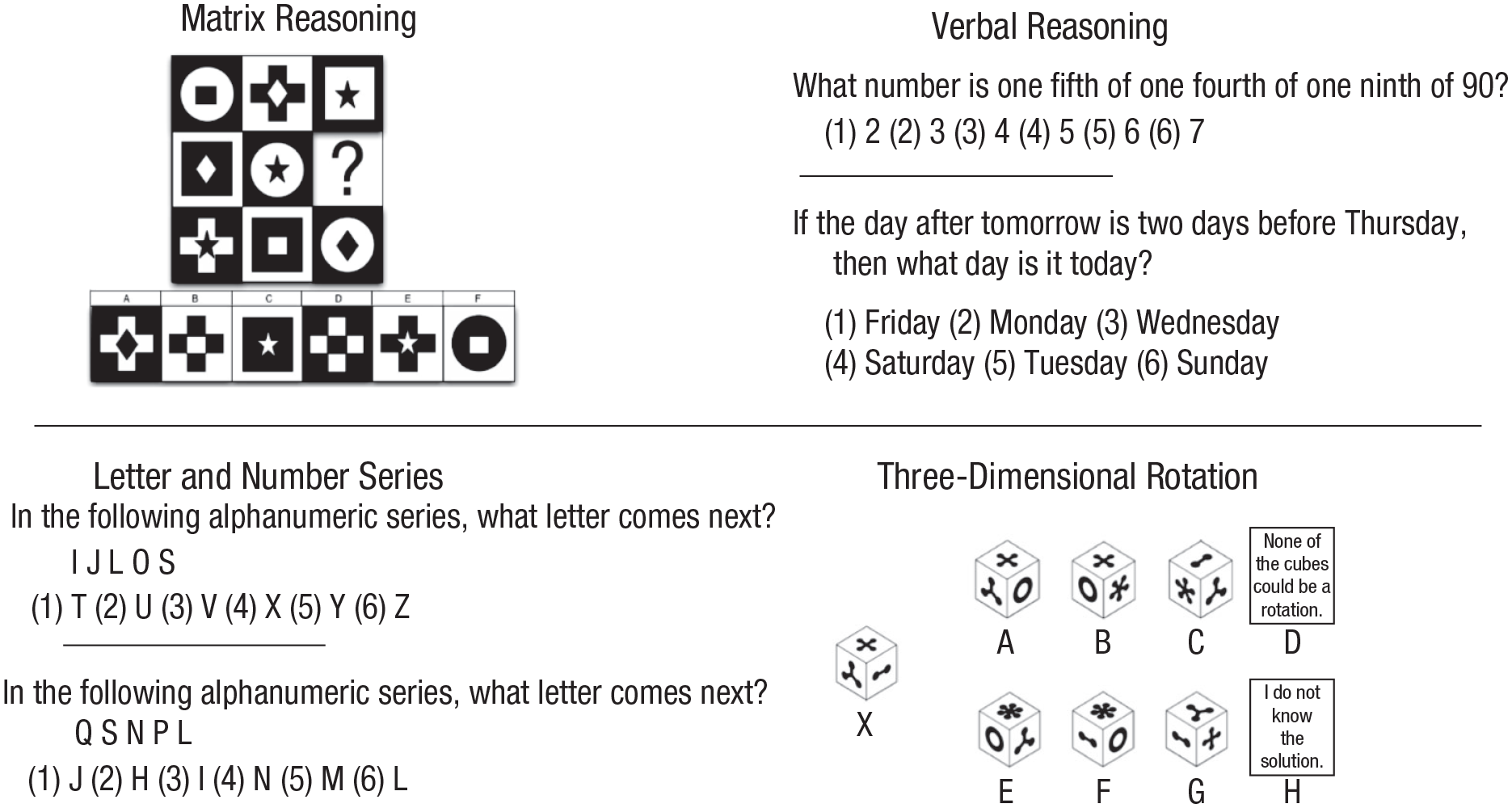
The original 60-item International Cognitive Ability Resource (ICAR). The original ICAR was composed of four item types (examples of which are shown here) and had a clear hierarchical factor structure. See Condon and Revelle (2014) for more example items, and join the ICAR project at ICAR-Project.com for access to all of the items.
Applications of ICAR
Although one reviewer suggested that to compare the ICAR with the Stanford-Binet is analogous to comparing a cheap rip-off to a Versace handbag, we view the utility of ICAR in terms of the wide range of applications in just the past few years. ICAR measures of cognitive ability have already been used in many studies and publications, with various real-world criteria and different item types (e.g., the 79 studies reviewed by Dworak, Revelle, Doebler, & Condon, 2020). Such projects include an online survey that utilized 35 verbal-reasoning and three-dimensional-rotation items to provide participant feedback and evaluate individual differences in a nationwide sample (Van Der Krieke et al., 2016). Other studies assessed how 46 verbal-reasoning and matrix-reasoning items related to genetic scores of education attainment and showed that large-scale genetic studies can rely on online collection of cognitive-ability measures (Liu et al., 2020). ICAR items have also been utilized with experience-sampling methods to test the relationship between cognitive ability and creativity. Cognitive ability was also found to moderate the relationship between everyday positive affect and everyday creativity (Karwowski, Lebuda, Szumski, & Firkowska-Mankiewicz, 2017). Using 16 items, one cross-sectional study found that higher cognitive ability was related to greater aptitude in discriminating between “pseudo-profound bullshit” and profound statements (Bainbridge, Quinlan, Mar, & Smillie, 2019). Research has used as few as 4 items to find that cognitive ability relates negatively to the political ideologies of right-wing authoritarianism, social-dominance orientation, and attitudes toward President Trump (Choma & Hanoch, 2017).
Future Directions
We have received requests for the use of ICAR items with younger subjects (under age 14) and as potential measures of cognitive decline in the elderly. The factor structure of the original 60 items of the ICAR was based on the responses of 96,958 participants with a median age of 22 but who ranged in age from 14 to 90 years. A subsequent validation against self-reported SAT and ACT scores was completed for those 34,229 participants between 18 and 22 years of age. Thus, there is a need to further validate the items with younger and older participants. Although some researchers have used as few as four items in their studies, and many have used just the 16 items from the sample test, we encourage users to go beyond these 16, and even the 60 described by Condon and Revelle (2014), and use items sampled from the larger (> 1,000) pool of items that are available at the ICAR project website.
Recommended Reading
Deary, I. J. (2000). Looking down on human intelligence: From psychometrics to the brain. Oxford, England: Oxford University Press. A thoughtful and well-integrated series of essays on the history, measurement, and correlates of intelligence.
Deary, I. J. (2001). Intelligence: A very short introduction. Oxford, England: Oxford University Press. One of the Oxford Very Short Introductions series, which offers a delightful and informative review of the meaning and importance of intelligence that is meant for the general reader.
Haier, R. J. (2016). The neuroscience of intelligence. Cambridge, England: Cambridge University Press. The current status of biological models of intelligence.
Lubinski, D. (2016). (See References). A very thoughtful review of intellectual precocity featuring the Terman and Stanley, Benbow, and Lubinski longitudinal studies.
Mackintosh, N. J. (2011). IQ and human intelligence. Oxford, England: Oxford University Press. A very useful review of the history of intelligence testing.
