




Abstract
We live and we think inside a world of things made and found. Still, psychological science has shown little interest in understanding the exact nature of the relation between cognition and material culture. As a result, the diachronic influence and transformative potential of things in human mental life remains little understood. Most psychologists would see things as external and passive: the lifeless objects of human consciousness, perception, and memory. On the contrary, my main argument in this article is that things matter to human psychology and should be taken seriously. Although things usually pass unnoticed, they are anything but trivial. Things have a special place in human cognitive life and evolution. We think “with” and “through” things, not simply “about” things. In that sense, things occupy the middle space in between what are usually referred to as mind and matter. Material-engagement theory provides a way to describe and study that middle space where brain, body, and culture are conflated.
Why should psychologists care about things? How are things (in the broadest anthropological sense of material forms, flows, and techniques) related to thinking? Examining the intersections of mind and matter is common practice in cognitive archaeology, which is the field dedicated to the comparative study of changing material ecologies and the modes of human becoming (Gosden & Malafouris, 2015; Iliopoulos & Malafouris, 2014; Knappett, 2005; Malafouris & Renfrew, 2008; Malafouris & Renfrew, 2010; Renfrew, Frith, & Malafouris, 2008; Wynn & Coolidge, 2017). Similar questions about the cognitive life of things are rare in psychological research. This comes as no surprise. Things exist on the “outside”; they are parts of the external world. By contrast, psychology is concerned with what exists on the “inside,” the parts of the mental world. No psychologists, of course, will deny that minds and things constantly interact. Yet this interaction (conscious or not) is happening at a distance. Things do not get inside the head like food gets in the stomach or air gets in the lungs. Instead, our thinking about things happens indirectly by means of inner substitutes. The technical term that psychologists use to describe those substitutes is mental or neural representations. Representations allow minds and things to meet and to exchange information, but they also impose an unhelpful opposition between knowing the world and engaging with it. Importantly, according to this representational ontology, the materiality of things does not matter.
If the subtitle of this article, which calls for a psychology “with” things, sounds strange, it is because of this common assumption that the mental phenomena that occupy the subject matter of psychology can only be “of” or “about” things. This “aboutness,” or intentionality, gives our thinking direction and reference to content; it is also what separates minds from the material world. There are many reasons for this split. Some reasons are well founded and should be respected. They instantiate pragmatic concerns about the neural and bodily basis of human cognitive processes as well as important methodological considerations about the right analytical units for the study of human psychology. The problem starts when we confuse this analytical separation of minds and things for an ontological one; that is, when we misconstrue the representational gap between the internal world of mental action and the external world of physical action, which is created by our own representational theories (e.g., Fodor, 1975), for the way things are. Closed boundaries and units of analysis are sometimes useful analytical means, but they should not be taken for granted or perceived as natural. In doing so, representation becomes a tyranny.
The Material-Engagement Approach
In this article, I argue that the borderline between people and things, mind and matter is anything but fixed or obvious. I am not the first or only person proposing this. There is a long ancestry of related ideas from different disciplines (Bateson, 1973; Clark, 1997; Gallagher, 2017; Hutchins, 2010; Ingold, 2013; Varela, Thompson, & Rosch, 1991). The boundaries of the mind have always been problematic. Material-engagement theory (Malafouris, 2013), the major postulates of which are summarized in Figure 1, builds on this long tradition and offers a new window into the study of human thought from the distinctive perspective of cognitive archaeology. Three major insights from material-engagement theory provide the foundation of my analysis.
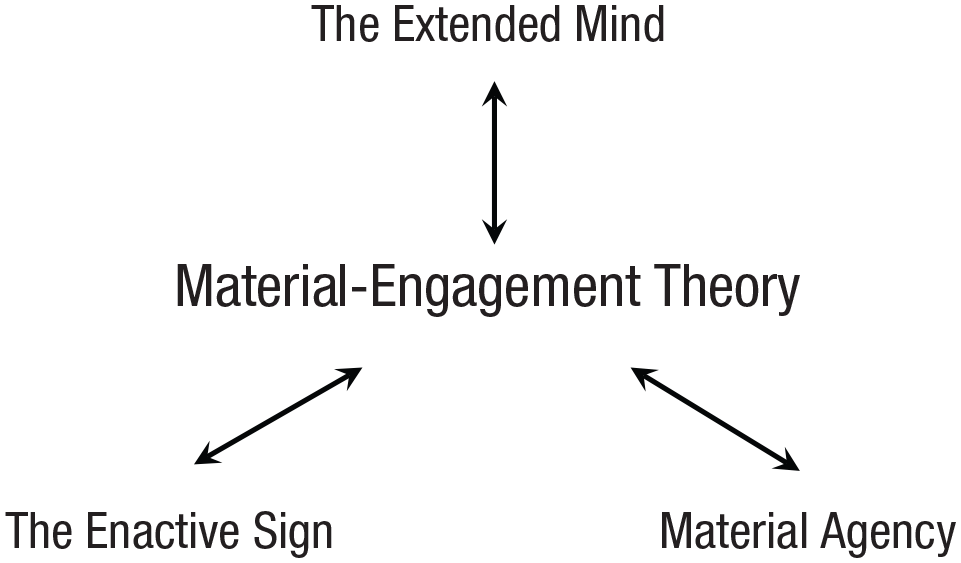
The major postulates of material-engagement theory. Things are consubstantial, continuous, and coextensive parts of minds in action (the extended mind), things have a causal efficacy in human thought and action (material agency), and things as material signs bring forth rather than simply represent preformed concepts or images as signifiers of a signified (the enactive sign).
Mind is not limited by the skin
As mentioned, the received view of the human mind has been that of an internal, brain-bound device operating primarily by constructing and manipulating internal representations of the outside world. But this neurocentric “cognitivist” view of the mind has been challenged and is changing (for a review, see Gallagher, 2017; Malafouris, 2013; Newen, De Bruin, & Gallagher, 2018). New theoretical developments and empirical findings about the enactive, distributed, and extended nature of human cognition allow us to rethink some old, persistent, and rather unhelpful assumptions about how to carve the mind at its joints (natural or artificial). The question is not really whether we should be looking beyond the brain but exactly where, when, and how we should be looking beyond the brain. These are difficult questions. If you just look at the brain, regions of interest, functional maps, networks, and patterns of activation (or deactivation) will guide you. Once on the outside, however, you need to understand the nature of material signs, lines, and traces. Material signs do not represent; they enact: They operate on the principle of participation rather than the principle of symbolic equivalency and substitution (Malafouris, 2013, p. 97). Nothing of what we see on the inside can explain away what we see on the outside, and vice versa. We need unified accounts that follow human cognitive life inside the world. Cognition and emotion are not realized in the brain but with a brain; that is, to think and to feel, we need more than a brain. Brain regions work in concert, but they are never alone; rather, they are always parts of broader systems extending beyond skin and skull.
Material things matter
We are used to thinking about things as inert and passive. Moreover, thinking is usually understood as something we do about things in the absence of things. Material-engagement theory proposes a radically alternative claim: that human mental life (cognition and affect) is a process genuinely mediated and often constituted by things. The presence of the simplest artifact has the potential to alter the relationships between humans and their environments. New artifacts create novel relations and understandings of the world. New materialities bring about new modes of acting and thinking (Knappett & Malafouris, 2008; Latour, 1992). The claim is that things actively participate in human cognitive life or that human thinking is better described as thinging. We think with and through things, not simply about things. In particular, for the material-engagement approach, withness and throughness take precedence over aboutness. Things such as minds are concepts we use to capture what can exist only as a process. Things are for thinging, and minds are for minding (see also Malafouris, 2019a).
We have a plastic mind inextricably intertwined with the plasticity of forms that we make
Most people think of our “sapient” minds, with all our unique capacities, as the apex of a long process of evolution that is complete and fixed (adapted to past environments that no longer exist; see Malafouris, 2016a, 2016b). The material-engagement approach, instead, sees the human mind as an unfinished process, amenable to drastic, deep reorganization by incorporating new technological innovations and prostheses and thus, potentially, in a permanent state of ongoing creative evolution. Humans evolve by making. We are homo faber (Ihde & Malafouris, 2019). This creative feature of human psychology complicates our traditional view of Darwinian evolution in the sense of variation under natural selection. Adaptation was never a one-way process, as niche-construction theory has long pointed out (Laland, 2017; Laland, Odling-Smee, & Feldman, 2000). We adapt the environment instead of ourselves (Kirsh, 1996). We create new things, embodied practices, and material cultures, which in turn make up our minds and constitute ourselves. Moreover, although we seem to be the only species capable of creatively transforming the conditions of its own evolution, there is nothing in our genome that seems to explain that. The capacity for creative material engagement is not some kind of static adaptation but is instead a biosocial process continuously generated and transformed in the constructive dialogue between maker and material. In this context of distributed intelligence, the conventional meaning of adaptation gives way to a more extensive and bidirectional view of plasticity—we may call it metaplasticity. According to that view, the plasticity of the brain is inextricably intertwined with the plasticity of culture (Gosden & Malafouris, 2015; Malafouris, 2009, 2013, 2015, 2016a, 2106b). This metaplastic process provides the basis for an ever-increasing representational flexibility due to external prosthetic means, techniques, and material signs, which then allow for culturally derived changes in the neural architecture. This often results in unusual epigenetic and ontogenetic dynamics potentially capable of altering the biological foundation of our minds and the ways we make sense of the world. Those changes, of course, far from being predetermined and unfolding in a linear fashion, are contingent on historical and sociomaterial forces.
How Do Acts of Imagination Relate to Acts of Making?
To illustrate those theoretical points, let us take one of the most diachronic examples of thinging: the craft of pottery making. Figure 2 depicts a ceramic vase that is being formed by the hands of the potter on the wheel. Where does the thinking of the potter end and the forming of clay begin? Where do we draw the lines that supposedly separate thoughts, feelings, perceptions, and actions?
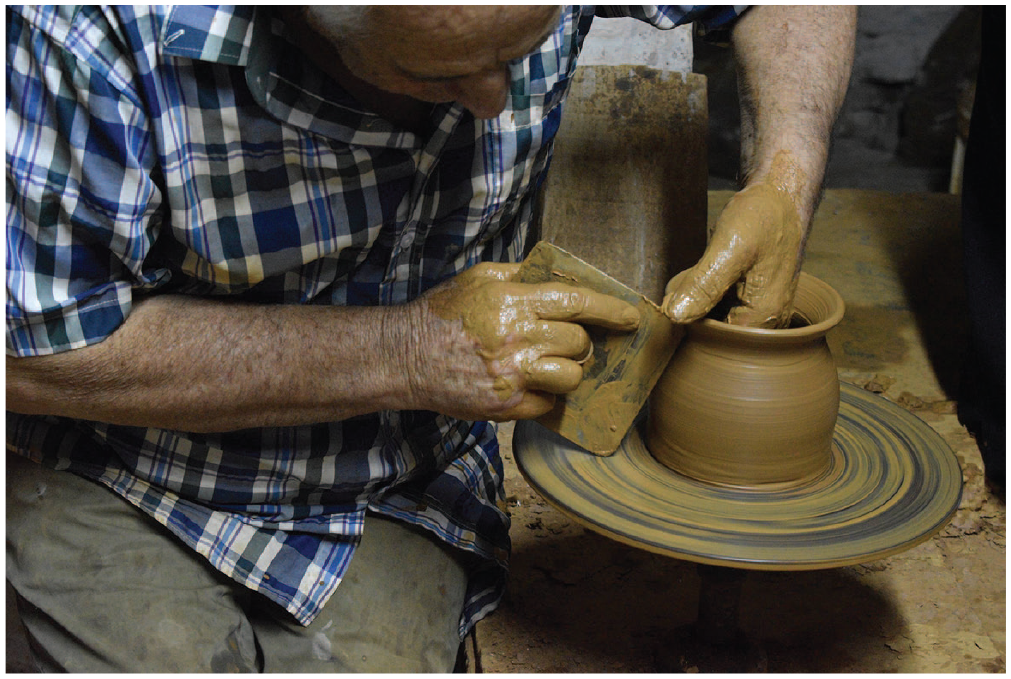
Thinging at the potter’s wheel.
Let us take a closer look at the process of making, focusing, for instance, on the moment that the potter creates a line that runs around the pot (Fig. 3). It makes good sense to think that the potter needs to imagine exactly where to place that line and to visualize what form the line will take: Is it going to be painted, engraved, or raised? Probably, the potter will also have to decide how thick that line should be and what kind of instrument he or she will need to use to achieve that thickness or flatness. Will it be a line that runs around the pot evenly? Will it finish exactly where it starts or perhaps spiral slightly? Those are situated projections (Suchman, 2007) or anticipations (van Dijk & Rietveld, 2018) that blend aesthetic and functional considerations.
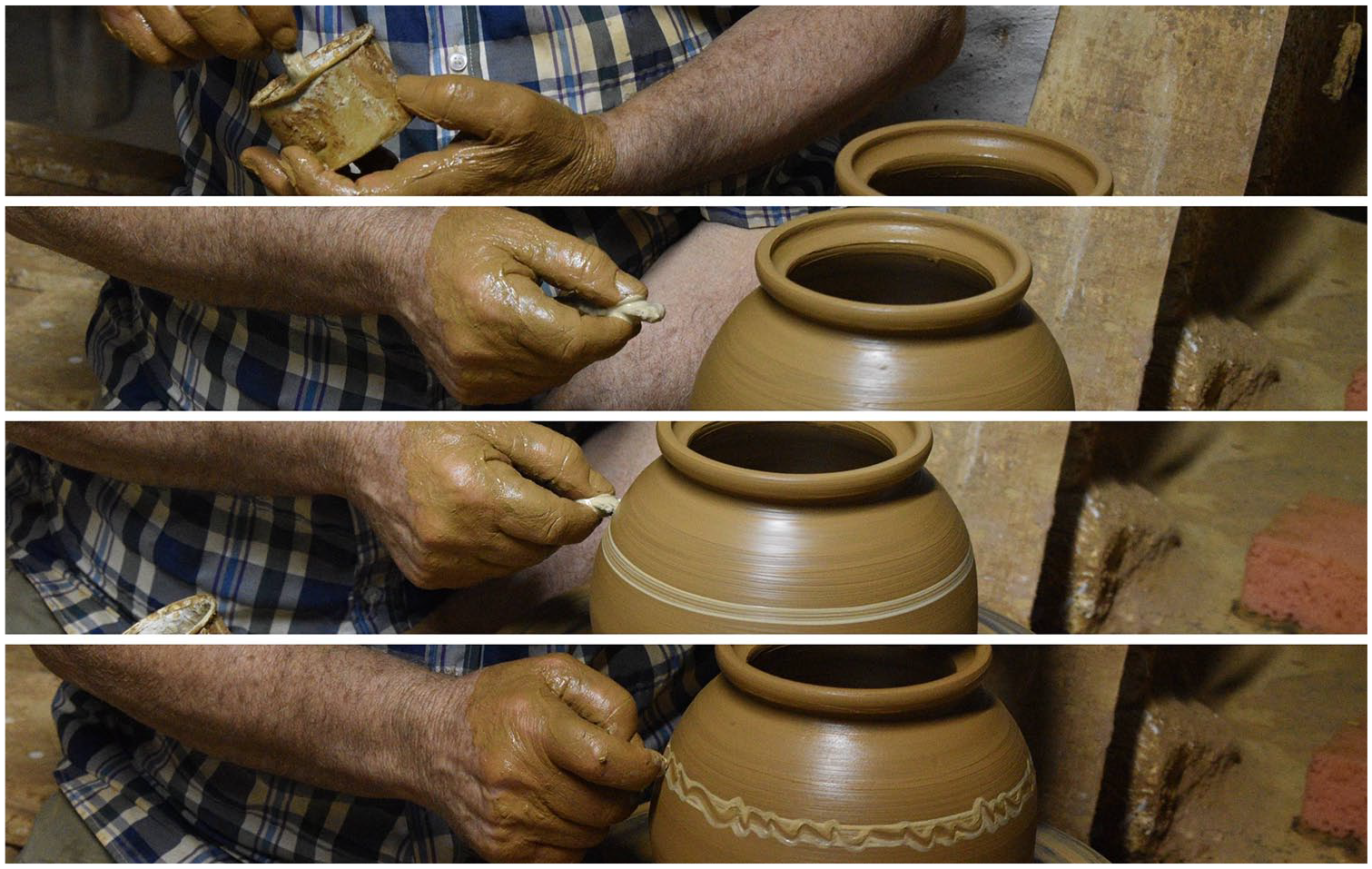
The forming of a line with clay.
How do we account for the cognitive life of this line? According to the representational view, the cognitive life of the line begins off-line as a mental image formed inside the head of the potter before the actual making of the line on the surface of the clay vase. The mental representation of the line precedes and causes the sequence of motor commands and the proprioceptive, tactile, and visual events as well as the perceptual and kinesthetic experiences that the actual process of making entails. This imaginary line can be only partial, carrying some relevant but general information about lines (e.g., about their possible width, size, color, or texture or the skills and tools needed to produce one). Nonetheless, this imaginary line relates (or anticipates) the form of the actual line to be produced with clay brought about by the potter’s actions and movements. In other words, everything that matters happens inside the potter’s head. This simple cognitivist narrative sounds convincing. But notice the underlying assumption: Forming and thinking are separate. Specifically, forming follows or obeys the potter’s thinking. Thinking is the kind of activity that happens inside the potter’s brain. Forming is the kind of activity that happens inside the world.
Why should we feel obliged to separate the imaginary potential of the brain from the form-generating potential of the materials, the tools, and other environmental scaffolds that allow the formation of this line of clay? Empirically speaking, it would be more precise to describe imagination as immanent in the creative process. This is also what we actually observe when we study pottery making firsthand, through sustained participant observation (for a more detailed treatment of this idea, see Koukouti & Malafouris, in press; Malafouris, 2008, 2013, 2014; Malafouris & Koukouti, 2017, 2018; March, 2019). In particular, what we see is a process that is profoundly embodied, situated, and assembled from a variety of material resources spanning the boundaries of the potter’s brain and body. Those resources can be easily misconstrued and talked about as being “mental” in the conventional internalist sense of memory and imagination. But careful observation “in the wild” reveals a heterogeneous mixture of bodily skills, affordances, techniques, materials, and tools that falsifies the usual analytical divides of subject/object, mind/matter, nature/culture, and so forth. Within such a process, the boundaries of the mind cannot be delimited and defined a priori; rather, they need to be discovered in action, taking into careful consideration the varieties of the resources (biological or nonbiological, mental or physical) that participate in the process of making. Put simply, we need to take seriously the materiality of mind stuff and try to expose its changing relations over time, as well as the effects that it has on the temporal structure of the potter’s experience.
Material-engagement theory proposes that forming and thinking are inseparable. The form that we see emerging is not the product of externalization. On the contrary, material form is folded into the mental. The potter’s projections and anticipations inhabit clay. Forms do not travel from mind to matter. Form making is more of a gift exchange than an imposition. Forms are mundane gifts that mind exchanges with matter, often without the need of linguistic inscription. The mind is not imposed or opposed to matter. Rather, mind and matter, “insights” and “outsights” (Vallée-Tourangeau & March, 2019) merge together in the situated activities that carry forward the process of creative thinging (Malafouris, 2014).
Perhaps to the untrained eye of the detached observer, the handling of clay may seem a very different process from those that are usually the focus of psychological study. Yet there is no deficiency of higher intelligence in pottery making. It is not the movement of clay that is mindless (Dreyfus, 2007), lacking memory, consciousness, or imagination. Most probably, it is our uneducated attention that lacks the ability to navigate the landscape of affordances (Rietveld & Brouwers, 2017; Rietveld & Kiverstein, 2014) and discover the cognitive life that the flow between the hand and the clay entails.
Conclusion
What is the place of things in human cognitive life? At present, the question is not well understood. Partly, this is because different disciplines, usually working in isolation, continue to give insufficient attention to the distinctive ways in which humans and things are entangled and to the cognitive ecologies in which they relate to, constrain, and create each other. This is not because the interactions are uninteresting or less important. Rather, it is because deeply entrenched neurocentric assumptions about the location and ontology of mind stuff make it difficult to study it. The brain is crucial but is only a part of the process. Other important bodily and sociomaterial constituents of human thought remain misrepresented or unrepresented. A major challenge for the cognitive sciences is to develop theories and methods that take into consideration the cultural specificity and material ecology of human thought.
Material-engagement theory focuses on how, in what ways, and through what kinds of processes the evolving embodied plasticity of the human mind becomes embedded and mutually dependent with the plasticity (or stability) of things. The focus is on understanding the nature of metaplastic changes not at the level of the individual, but at the broader level of cultural practices and material engagement. In this article, I explored this creative aspect of human cognitive becoming using the example of pottery making. I have approached this paradigmatic occurrence of making as an instance of enactive discovery and material imagination. The potter (brain and body) realizes the affordances of clay. The clay realizes the affordances of the potter. This meeting of mind and matter is not representational; it is transactional and participatory. Forms are the emergent products of this meeting in which the potter’s hand and the potter’s eye touch the clay. Forms are the thoughts of matter.
Recommended Reading
Malafouris, L. (2019a). (See References). Provides a useful introduction to a special issue on mind and material engagement but also discusses, in brief, recent developments in this field of research.
Malafouris, L. (2019b). Understanding the effects of materiality on mental health. BJPsych Bulletin. Advance online publication. doi:10.1192/bjb.2019.7. An editorial that more specifically discusses the possible links between material engagement and mental health.
Newen, A., De Bruin, L., & Gallagher, S. (Eds.). (2018). (See References). A thorough, far-reaching collection of papers on 4E (embodied, embedded, enactive, and extended) cognition.
Renfrew, C., Frith, C., & Malafouris, L. (2008). (See References). Provides a useful introduction and summary of all the contributions to a special issue on the intersection of archaeology and neuroscience.
Footnotes
Action Editor
Randall W. Engle served as action editor for this article.

Declaration of Conflicting Interests
The author(s) declared that there were no conflicts of interest with respect to the authorship or the publication of this article.
Funding
The research and writing of this article was supported by the European Research Council Consolidator Grant HANDMADE (No. 771997; European Union Horizon 2020 program) awarded to L. Malafouris.