




Abstract
Selective retrieval often impairs recall of nonretrieved items, a finding referred to as retrieval-induced forgetting. In this article, I review recent research showing that selective retrieval can also improve recall of other items. This research points to a critical role of context retrieval in selective memory retrieval. The concept of context retrieval, which has played a prominent role in other lines of memory research, suggests that selective retrieval can reactivate the retrieved items’ temporal context during study, facilitating recall of other items that had a similar context at study. Such facilitatory effects on recall can arise both when selective item repetition occurs via retrieval and when it occurs via restudy, which suggests a link to the reminding literature. The findings offer new perspectives for investigating and understanding the effects of selective memory retrieval.
Keywords
Selective retrieval of some studied items can induce forgetting of the nonretrieved items, a finding referred to as retrieval-induced forgetting (RIF). Evidence for RIF has been provided in the older output-interference task and the more recent retrieval-practice task. In the output-interference task, recall performance for a studied item has been shown to decline with its output position in the test sequence, indicating that selective retrieval of items that are tested earlier impairs recall of items that are tested later (Tulving & Arbuckle, 1966). In the retrieval-practice task, it has been shown that selective retrieval on some studied items during an intermediate practice phase can impair recall of related nonretrieved items during testing (Anderson, Bjork, & Bjork, 1994). RIF has often been attributed to blocking and inhibition processes. According to the blocking account, selective retrieval strengthens the retrieved material so that during later attempts to recall the nonretrieved items, the more strongly retrieved items are continually brought to mind, blocking access to the weaker nonretrieved items (Roediger & Neely, 1982). According to the inhibition account, the not-to-be-practiced items interfere during selective retrieval and are inhibited to reduce the interference, which impairs the memory representation of these items and reduces their accessibility on a later memory test (Anderson, 2003). Recent results suggest that both processes can contribute to RIF (for a review, see Bäuml & Kliegl, 2017).
Retrieval Can Reactivate Study Context
The finding that selective retrieval can induce RIF and that blocking and inhibition operate in response to selective retrieval may not tell the entire story of how selective retrieval influences recall performance. Rather, context retrieval may contribute to the effects of selective retrieval. Temporal context—the current pattern of activity in an individual’s mind that can be influenced by, among other things, both environmental and internal factors—changes gradually over time, and it is assumed that each studied item is associated with the temporal context in which it is shown (Bower, 1972; Estes, 1955). As a result, temporal context during later retrieval will often be different from the context during study and thus not be the optimal cue for studied items. However, as emphasized by Kahana and colleagues (Howard & Kahana, 2002; Polyn & Kahana, 2008), context during recall is not a static entity but changes in response to recall attempts: Recall of an item results in partial reactivation of the context that was present when that item was studied, and this retrieved context then serves as a retrieval cue for other items that had a similar context at study, facilitating recall of these items.
Context retrieval did not play a role in prior work on the effects of selective retrieval, which typically used experimental settings that minimize the contextual change between study and selective retrieval. Indeed, in most studies, short delays between study and selective retrieval were used without any major contextual change between the two experimental phases (see Bäuml & Kliegl, 2017). Possible effects of context retrieval therefore may have been small in these studies and masked by inhibition and blocking. In order to investigate whether context retrieval can contribute to the effects of selective retrieval and influence RIF, recent work from my lab, which will be described in more detail below, examined the effects of selective retrieval when the contextual overlap between study and selective retrieval was reduced. Such a reduction in overlap should enhance the role of context retrieval for the effects of selective retrieval, which may then attenuate the typical detrimental effect, eliminate it, or even reverse it into a beneficial effect.
Selective Retrieval Improves Recall When Study and Retrieval Contexts Differ
Changes in temporal context typically increase when the delay between study and retrieval is increased, which reduces the overlap between study and retrieval contexts (Estes, 1955; Howard & Kahana, 2002; Mensink & Raaijmakers, 1988). Bäuml and Schlichting (2014) examined in two experiments how the delay between study and retrieval influences the effects of selective retrieval. In Experiment 1 of their study, subjects studied a list of unrelated items and, after a delay of 5 min or 48 hr, were asked to recall predefined target items from the list either before or after selective retrieval of the remaining (nontarget) items; both target and nontarget retrieval were guided by providing the items’ unique initial letters as retrieval cues. Selective retrieval generated RIF after a short delay, which was expected, but it improved recall after a prolonged delay (see Fig. 1). Experiment 2 of the study replicated this pattern of results using coherent prose material for study (for further conceptual replications, see Abel & Bäuml, 2015; Aslan, Schlichting, John, & Bäuml, 2015).
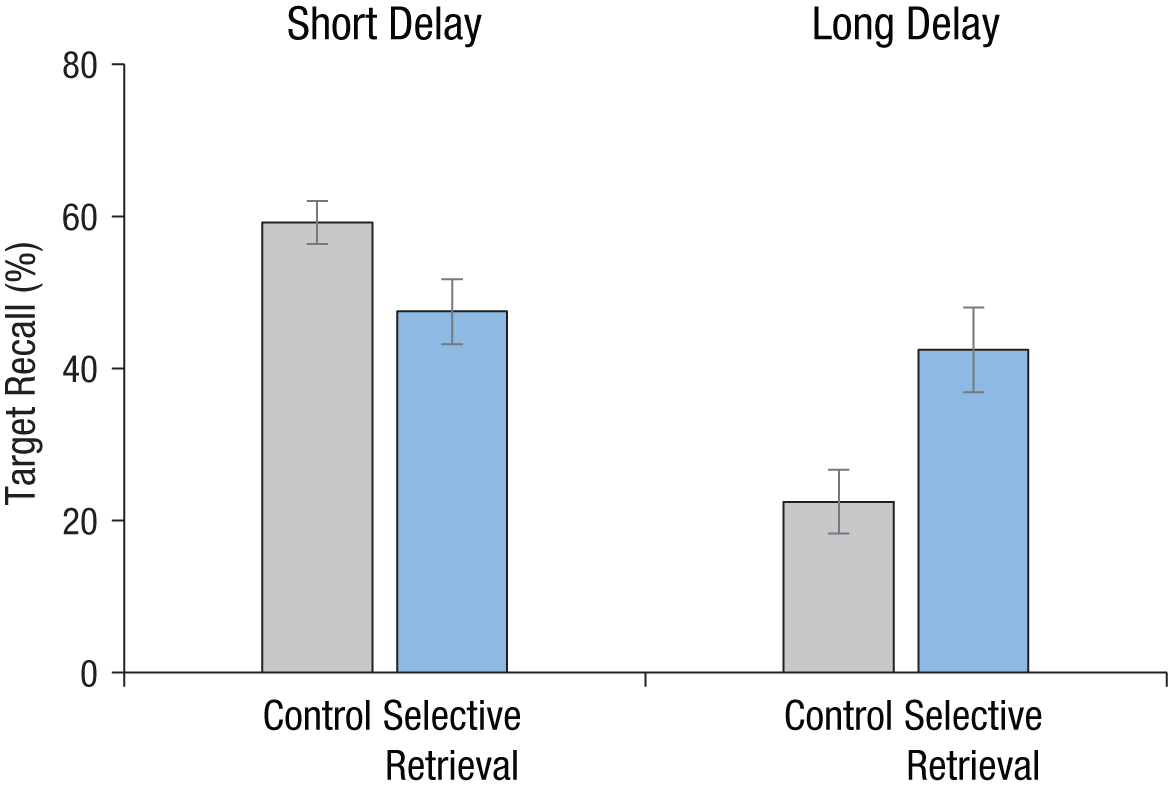
Effects of selective memory retrieval on recall of target items after a short delay (5 min) and a long delay (48 hr). Selective retrieval impaired target recall after a short delay but improved target recall after a long delay. Error bars represent ±1 SE. Adapted from Bäuml and Schlichting (2014, Experiment 1).
Wallner and Bäuml (2017, Experiment 1) improved our understanding of the beneficial effect. Using lists of unrelated items for study, they compared the effects of selective retrieval after a prolonged delay between two conditions that differed in whether or not the study context was mentally reinstated immediately before selective retrieval started. In the context-reinstatement condition, subjects were told to take a minute to recall their thoughts, feelings, and emotions prior to the beginning of the study phase (Sahakyan & Kelley, 2002), whereas in the no-context-reinstatement condition, participants solved arithmetic problems for the same duration of time. Mental context reinstatement should reduce the delay-induced mismatch between study and retrieval contexts and thus reduce the need for further (retrieval-induced) context retrieval. It should therefore attenuate the beneficial effect, eliminate it, or even reverse it—which might occur if the mental reinstatement was complete. As expected, mental reinstatement largely eliminated the delay-induced mismatch between study and retrieval contexts. More importantly, results showed the expected beneficial effect of selective retrieval when no preceding mental reinstatement had taken place but showed a reversal of the effect into a detrimental effect when participants engaged in mental context reinstatement (see Fig. 2).
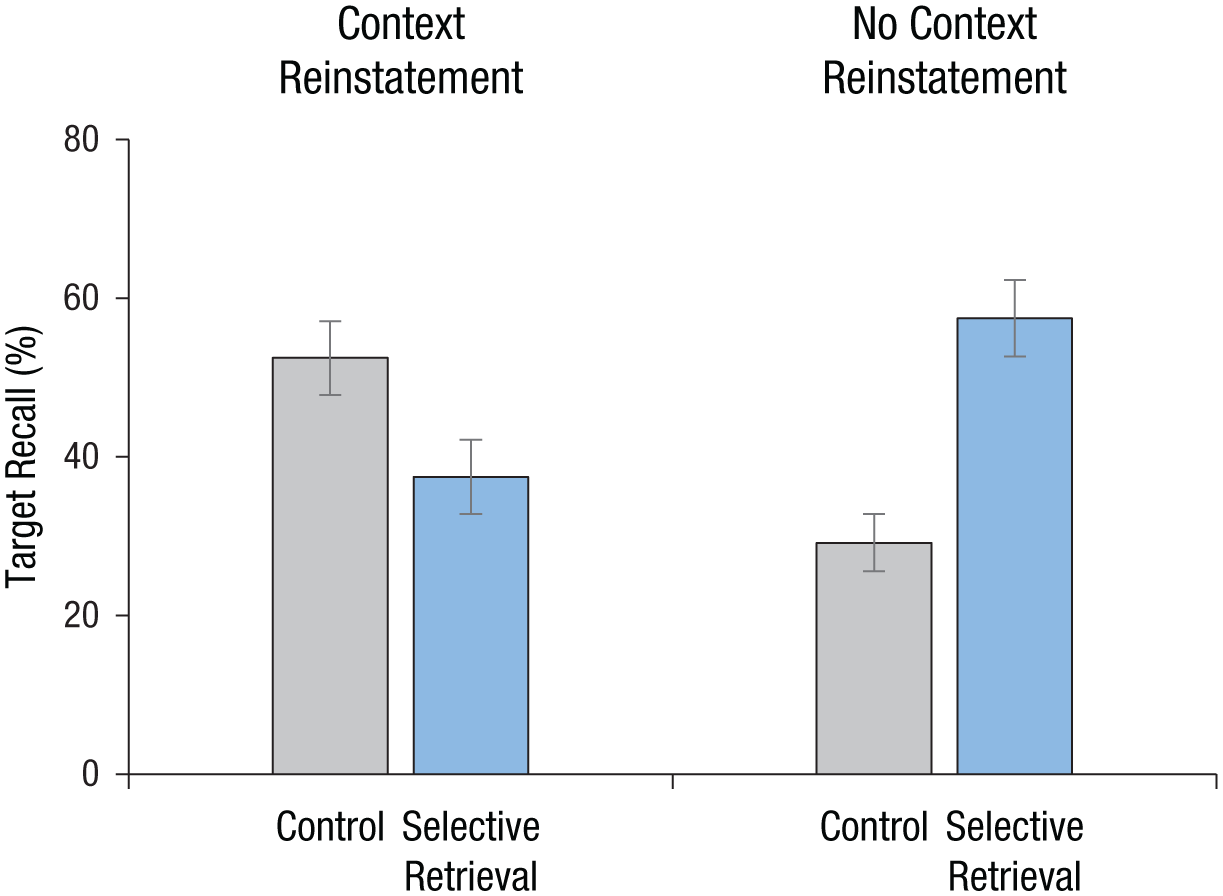
Effects of selective retrieval after prolonged delay in the presence and absence of mental context reinstatement. In the presence of mental context reinstatement, selective retrieval impaired target recall; in its absence, it improved target recall. Error bars represent ±1 SE. Adapted from Wallner and Bäuml (2017, Experiment 1).
The results of these studies are consistent with the view that selective retrieval generally triggers two types of processes: (a) inhibition and blocking and (b) context retrieval (Bäuml & Samenieh, 2012; Bäuml & Schlichting, 2014). The relative contribution of the two types of processes depends on the contextual overlap between study and selective retrieval. When the contextual overlap is high—as may occur after a short delay or a long delay when there is prior mental context reinstatement—interitem interference is high, and inhibition and blocking mainly operate, whereas there is not much need for context retrieval. When the contextual overlap is low—as may occur after a prolonged delay when there is no prior mental context reinstatement—context retrieval mainly operates, whereas inhibition and blocking may be reduced as a result of attenuated interitem interference. Differences in the relative contributions of the two types of processes then create the pattern of detrimental and beneficial effects of selective memory retrieval.
Selective Restudy Can Also Improve Recall
Context retrieval is often assumed not only to be restricted to retrieval but also to arise after restudy trials (Greene, 1989; Thios & D’Agostino, 1976), a proposal included in computational models (Howard & Kahana, 2002; Polyn, Norman, & Kahana, 2009). If so, the beneficial effect of selective retrieval, as observed in the delay experiments reported above, should generalize to selective restudy, and both selective retrieval and selective restudy improve recall of other items. Bäuml and Dobler (2015) addressed the issue and compared the effects of selective retrieval and selective restudy after both a short (5 min) and long (48 hr) delay between study and selective item repetition. Lists of unrelated items served as study material. Consistent with prior RIF work, results showed a detrimental effect after a short delay that was retrieval specific; that is, it arose in response to selective retrieval but not in response to selective restudy. In contrast, after a long delay, a beneficial effect emerged after both repetition formats, indicating that the detrimental effect but not the beneficial effect of selective retrieval is retrieval specific.
Wallner and Bäuml (2017) again compared the effects of selective retrieval and selective restudy and examined the influence of the difficulty of selective retrieval on the size of the beneficial effect. After studying a list of unrelated items (Experiments 2 and 3) or coherent prose material (Experiment 4) and after a delay of at least 30 min, subjects selectively retrieved some studied items after being given strong word-stem cues (app—for apple; easy retrieval), selectively retrieved some studied items after being given weak initial-letter cues (a—for apple; difficult retrieval), or selectively restudied the same items before they recalled the target items. Results showed beneficial effects after all three repetition formats, again indicating that the effect is not retrieval specific. The size of the effects, however, varied with the repetition format: They were larger after difficult than after easy selective retrieval, as well as after easy retrieval than after selective restudy (see Fig. 3). This pattern of results mimics research on desirable difficulties in learning, which has shown that variables that pose challenges for learners and make initial learning feel more difficult can provide a beneficial effect on long-term retention (Bjork, 1994). Likewise, variables that pose challenges during delayed retrieval of some memory contents may be beneficial for the recall of related memory contents.
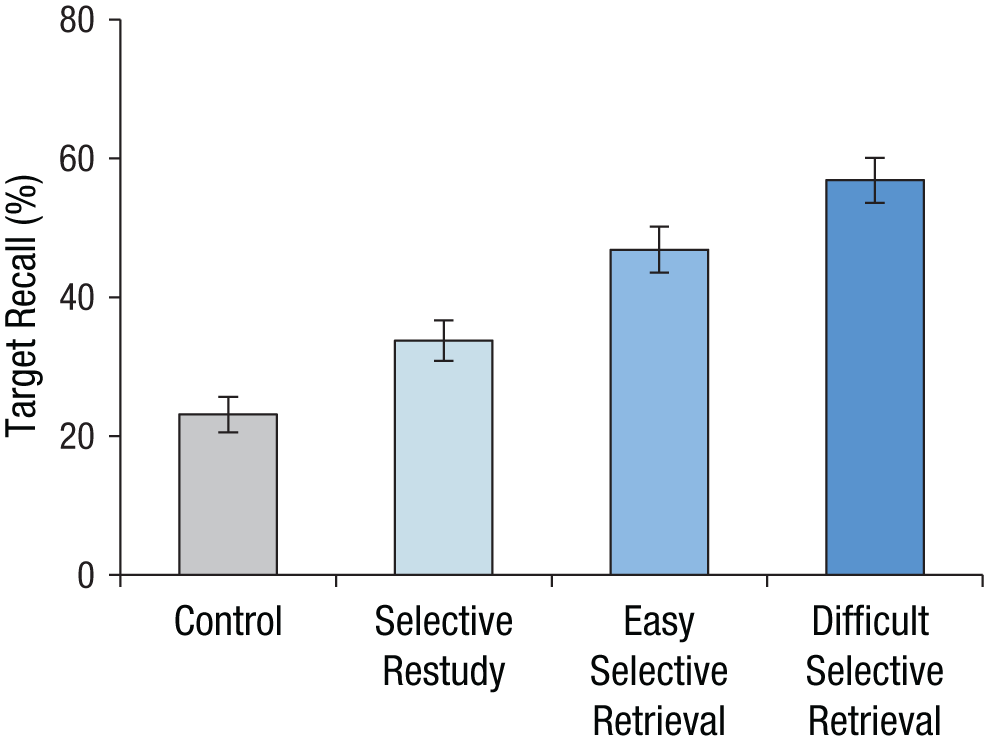
Beneficial effects of selective item repetition on target recall as a function of repetition format (control, restudy, easy selective retrieval, difficult selective retrieval). Beneficial effects were strongest after difficult retrieval and weakest after restudy. Error bars represent ±1 SE. Adapted from Wallner and Bäuml (2017, Experiment 3).
A Link to the Reminding and Context-Change Literature
The finding of beneficial effects of selective restudy and the suggested role of context retrieval for the effect fits with the reminding literature. In fact, context retrieval plays a key role in stimulus-repetition effects, in which the second presentation of an item is often assumed not only to be encoded in its own right but also to remind the subject of the first presentation (Hintzman, 2004). Such reminding, for instance, has been suggested to underlie the spacing effect—the beneficial mnemonic effect of spaced over massed learning—and judgments of the frequency or recency of an item’s occurrence during study (for an overview, see Benjamin & Tullis, 2010). Recently, the concept has also been applied to explain possible beneficial effects of the encoding of new material on the recall of previously encoded memory contents (Jacoby, Wahlheim, & Kelley, 2015; Putnam, Sungkhasettee, & Roediger, 2017). The restudy findings reviewed in the present article add to this list of studies indicating that delayed selective item repetition can serve as a reminder for the remaining, unrepeated items.
The suggested role of context retrieval for the beneficial effect of selective retrieval is consistent with the general view that retrieval can induce context change (Jang & Huber, 2008; Shiffrin, 1970). Indeed, the assumption that selective retrieval induces context retrieval implies that after selective retrieval has taken place, context has changed: Context is updated in response to selective retrieval and then includes a composite of the study and retrieval contexts (Polyn & Kahana, 2008). Importantly, such updating makes the context after selective retrieval more similar to the study context than in the absence of selective retrieval, and it is this similarity that is supposed to underlie the beneficial effect of selective retrieval.
As an alternative to the blocking and inhibition accounts of RIF, a context account of RIF was provided by Jonker, Seli, and MacLeod (2013). They argued that selective retrieval induces a distinct shift in context that makes context less rather than more similar to study context and, accordingly, induces a detrimental rather than a beneficial effect on the recall of the nonretrieved items. Although quite different, or even opposite, in character, the two context proposals may not be mutually exclusive. For instance, whereas context retrieval seems to influence recall mainly when the contextual overlap between study and retrieval is low (see above), context shift may influence recall mainly if the contextual overlap is high: When the contextual overlap is already low, retrieval-induced context shift may not reduce the overlap much further and will not have much influence on recall performance. I encourage researchers to consider the two context proposals and their relation in future work on the effects of selective retrieval.
Boundary Conditions
The results reviewed in this article suggest that when the contextual overlap between study and selective retrieval is low and recall relies largely on temporal context, then selective retrieval can improve recall performance through context retrieval. This effect may not arise under all circumstances. As shown by Wallner and Bäuml (2017), the beneficial effect of selective retrieval can turn into RIF if immediately preceding the retrieval phase, study context is mentally reinstated. Such preceding reinstatement of study context not only may arise through deliberate active reinstatement attempts but also may occur unintentionally, for instance, if an encoded event included particularly salient, exceptional, or emotional features. For example, once again seeing the pictures of the two passenger airliners crashing into the towers of the World Trade Center may immediately reinstate the context that one was in while becoming aware of the September 11 terrorist attacks, reducing the likelihood of further retrieval-induced context retrieval.
Conversely, when the contextual overlap between study and selective retrieval is high, selective retrieval may not always lead to RIF. Using prose material for study, a short delay between study and selective retrieval, and a long delay between selective retrieval and recall of the nonretrieved items, Chan, McDermott, and Roediger (2006) indeed found beneficial rather than detrimental effects of selective retrieval. These beneficial effects arose in response to selective retrieval but not selective restudy, indicating that they were retrieval specific and thus mediated by other cognitive mechanisms than the beneficial effects reviewed here (for suggestions for candidate mechanisms, see Chan, 2009). Thus, not only contextual overlap between study and selective retrieval but also a few other factors can influence whether selective retrieval is beneficial or detrimental for other memory contents.
Conclusions
Accounts of the effects of selective retrieval that focus on RIF and the underlying operation of blocking, inhibition, or context-shift processes are incomplete. Context retrieval can critically contribute to the effects of selective retrieval and, when the contextual overlap between study and retrieval is reduced, turn the typical RIF effect into a beneficial effect of selective retrieval. In everyday life, retrieval is often selective and delayed, such as when a teacher repeats some of the information from the last lecture or a person is interrogated by a police officer about a specific event that was witnessed a few days ago. The results reviewed in this article suggest that selective retrieval may not induce RIF in such situations but rather that retrieval of a particular memory aids and guides the retrieval of other memories. The findings therefore offer new perspectives for investigating and understanding the effects of selective retrieval.
Recommended Reading
Anderson, M. C., Bjork, R. A., & Bjork, E. L. (1994). (See References). A classic study that introduces the idea that retrieval-induced forgetting (RIF) may be mediated by inhibitory processes.
Bäuml, K.-H. T., Aslan, A., & Abel, M. (2017). The two faces of selective memory retrieval—cognitive, developmental, and social processes. In B. H. Ross (Ed.), The psychology of learning and motivation (Vol. 66, pp. 167—209). San Diego, CA: Academic Press. Places the ideas presented here in a broader context and provides developmental and social aspects of context retrieval.
Bäuml, K.-H. T., & Kliegl, O. (2017). (See References). A recent review of the RIF literature that summarizes important empirical findings, introduces the most prominent accounts of RIF, and evaluates the accounts against the empirical findings.
Jonker, T. R., Seli, P., & MacLeod, C. M. (2015). Retrieval-induced forgetting and context. Current Directions in Psychological Science, 24, 273—278. Provides a context account of RIF that is different from (and even opposite to) the ideas presented here and explains RIF through a distinct shift in context.
Polyn, S. M., & Kahana, M. J. (2008). (See References). A review of both behavioral and neural findings that indicates that context retrieval plays a key role in episodicmemory retrieval.
Footnotes
Acknowledgements
I thank M. Abel, O. Kliegl, L. Wallner, and M. Wirth for their comments on a previous version of the manuscript.
Action Editor
Randall W. Engel served as action editor for this article.
Declaration of Conflicting Interests
The author(s) declared that there were no conflicts of interest with respect to the authorship or the publication of this article.
Funding
Part of the research presented here was sponsored by Deutsche Forschungsgemeinschaft Grant BA-1382/10-1 (to K.-H. T. Bäuml).