




Abstract
Can psychological science offer evidence-based solutions to climate change? Using insights and principles derived from the literature on social dilemmas and human cooperation, we discuss evidence in support of three solutions: crossing the borders of thought, time, and space. First, borders of thought could be crossed by using persuasion that is concrete and tailored to local circumstances and by highlighting information about people’s efforts as evidence against the myth of self-interest. Second, borders of time could be crossed by using kinship cues, which can help make the future less distant, and relatively uninvolved advisors, who may help make the future salient. And third, borders of space could be crossed by showing group representatives how they might benefit from a frame of altruistic competition—focusing on the benefits of being seen as moral and global in orientation. Our overall conclusion is that psychological science can offer evidence-based solutions to climate change.
For some time, there has been a good deal of consensus among scientific experts that climate change is real and is caused by human behavior (e.g., Cook et al., 2016; Oreskes, 2004). The world has gotten warmer because of human consumption patterns, which have led to increases in carbon dioxide, other air pollutants, and greenhouse gasses in the atmosphere that, in turn, have absorbed sunlight and solar radiation reflecting off the earth’s surface. The consequences of climate change are immense, including threats from flooding, declines in agriculture, and decreasing biodiversity, to name a few (e.g., Battisti & Naylor, 2009; Leakey et al., 2009). Climate change is thus considered by many scientists and a growing number of policy makers and politicians to be one of the most critical issues of contemporary society.
Given that climate change is, at least in part, rooted in human behavior, an obvious question is whether psychological science can offer novel and useful solutions to climate change. We approach this question by proposing that climate change can be described as a pervasive social dilemma, involving (a) social conflicts between self-interests and collective interests (e.g., Milinski, Sommerfeld, Krambeck, Reed, & Marotzke, 2008) and (b) temporal conflicts between short-term interests and future interests (e.g., Jacquet et al., 2013; for a review on social dilemmas, see Van Lange, Joireman, Parks, & Van Dijk, 2013). Social dilemmas are quite complex because they pose a challenge to the human mind, which for many people is focused on short-term self-interest. But there is more to it. Climate change is also a social dilemma in which the collective constitutes a nation, a continent, or the globe, which is an abstraction of the face-to-face group for which cooperative traits have evolved. Moreover, perceived control and efficacy are low, and environmental uncertainty is large—not everybody agrees about the importance of climate change or what actions or policy measures are needed to help resolve the dilemma (e.g., Brucks & Van Lange, 2008). This also complicates solutions such as norm enforcement and punishment, which are often used for other large-scale social dilemmas, such as tax evasion or free riding on public transportation (e.g., Balliet, Mulder, & Van Lange, 2011; Kerr et al., 2009).
While people may have a strong concern about the environment (Steg & Vlek, 2009; van der Linden, Maibach, & Leiserowitz, 2015), we assume that the complexity of this particular social dilemma—its abstractness, time extendedness, and intergroup nature—tends to discourage actions that help reduce climate change. Abstractness and uncertainty often give rise to beliefs that other people are primarily self-interested. Time extendedness is complex because people tend to favor interests that operate in the “here and now” over future interests. And, in negotiations among nations, local group interests tend to outperform larger collective interests.
How then can the human mind be shaped in ways that promote actions that help secure a sustainable collective-future climate and environment? Classic research has addressed these questions by examining the roles of personality and attitudinal variables, social norms, and beliefs (e.g., Oskamp, 2000; Stern & Dietz, 1994), while the more recent literature has focused on promoting public engagement in or designing interventions to address climate change (e.g., Gifford, 2011; Steg & Vlek, 2009; van der Linden et al., 2015). We complement and extend this work by considering recent research on three critical issues pertaining to climate change: (a) how to promote beliefs in global climate change, (b) how to promote a longer time perspective, and (c) how to promote a broadened intergroup perspective (for an overview, see Table 1).
Overview of Specific Solutions to Cross the Three Borders Inhibiting Engagement With Climate Change
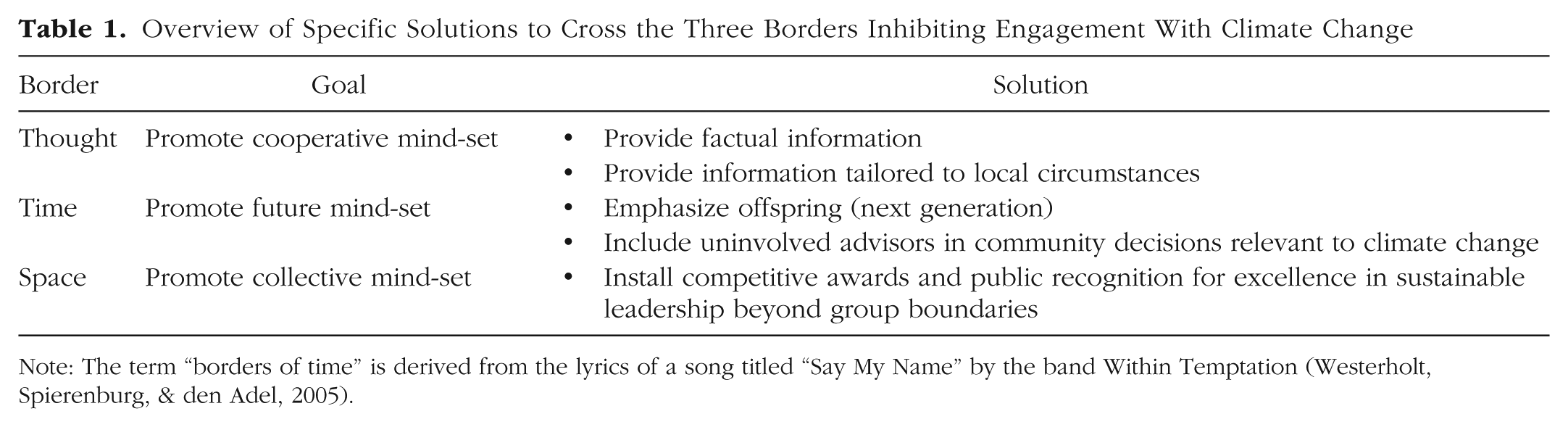
Note: The term “borders of time” is derived from the lyrics of a song titled “Say My Name” by the band Within Temptation (Westerholt, Spierenburg, & den Adel, 2005).
Borders of Thought
For the public, beliefs in climate change are fragile. They change from year to year, and in the United States, there has been increasing skepticism about climate change, even before Trump was elected president in 2016. For example, a FOX News panel revealed that the percentage of Americans who agree that there is solid evidence the earth is warming dropped from 82% in 2008 to 69% in 2009 (Blanton, 2009). From a social dilemma perspective, such skepticism is unfortunate because people are less likely to cooperate if they believe that their costly individual actions do not matter (perceived inefficacy) and that other people are not prepared to cooperate (distrust; Van Lange et al., 2013).
With abstract issues such as climate change—in terms of time and space—people may be prone to use their own favorite (often implicit) theories, heuristics, and accessible schemas and be susceptible to subtle influences such as primes (e.g., Steg & Vlek, 2009; van der Linden et al., 2015). One example that may well serve as a general heuristic is “the myth of self-interest,” the tendency to overestimate selfish behavior by other people (Miller, 1999). For example, people underestimate the prevalence of blood donations if they are not financially rewarded (Miller & Ratner, 1998). Even in concrete situations, people are more likely to overestimate other people’s selfish behavior (and underestimate other people’s fair behavior) if they have less information about another’s actual behavior or if uncertainty increases (Vuolevi & Van Lange, 2010, 2012). Applied to climate change, characterized by high abstraction and uncertainty, people are prone to remain pessimistic about other people’s willingness to contribute to reducing climate change, even if in the future such willingness becomes much stronger than it is at present.
Accessible schemas and primes may also underlie beliefs regarding global warming (Joireman, Truelove, & Duell, 2010, Studies 2 and 3). For example, recent experiences with warm weather (Joireman et al., 2010, Study 1), or extreme and harmful weather (Dai, Kesternich, Löschel, & Ziegler, 2015) are associated with stronger beliefs in climate change. These findings suggest that concrete experiences in the here and now are essential to people’s beliefs in climate change. From a social dilemma perspective, the above insights are both encouraging and discouraging. The discouraging news is that people have theories, such as the myth of self-interest, that do not support a willingness to make a contribution. The encouraging news is that beliefs relevant to climate change can be altered—even though it is not clear whether we can easily bring about sustainable change in such beliefs.
Our recommendation for policy makers is to provide factual information in a concrete manner. As a general rule, abstraction and uncertainty do not help (for some exceptions, see Brügger, Dessai, Devine-Wright, Morton, & Pidgeon, 2015). But concrete, factual information that is relevant to the local environment can help people develop theories that support sustainable behavior. For example, water flooding might be concrete to some people (e.g., those living in lower-altitude and coastal areas), while increasing heat might be more convincing to people living in hotter climates (e.g., people living in inland areas of tropical countries). Although climate change is a global social dilemma, concrete information relevant to the local circumstances is likely to be a key to motivating behavior to reduce and mitigate climate change.
Borders of Time
It seems quite natural for people to favor immediate interests over long-term interests. After all, survival and reproduction, and many specific goals rooted in these basic evolutionary needs, are often operating in the short term. One might assume a mismatch between ancestral conflicts and contemporary conflicts, in which the latter bring about many delayed effects of collective human behavior. Climate change is one of them (Jacquet et al., 2013), but so are efforts to reduce free riding in public transportation, depleting natural resources, or overpopulation (Van Lange & Joireman, 2008).
But how can one promote long-term thinking so that people in their actions effectively cross the borders of time? We offer two solutions. One is to emphasize that the young and vulnerable are the ones who deal with these futures. Indeed, the combination of “young” and “vulnerable” is especially able to trigger empathy—for example, the suffering of one young puppy can enhance empathy, sometimes even more than the suffering of other human beings (Batson, 2011). These tendencies are even stronger if the problem concerns the young and vulnerable who share our genes: our children. Kinship is indeed the first answer to the evolution of cooperation (e.g., Hamilton, 1964a, 1964b; Nowak, 2006), and therefore kinship cues should be relatively effective in crossing the borders of time (e.g., Krupp, DeBruine, & Barclay, 2008; Schelling, 1995). The recommendation therefore is to include children in public education campaigns for increasing awareness of climate change. Children serve the cue of vulnerability and trigger the need for caring and protection. In doing so, intergenerational unfairness could also be conveyed—the truism that irreversible harm is imposed by us on future generations (who have not harmed us in any way).
Another solution is based on tactics that promote the longer time perspective. For example, people are likely to fall prey to temporal discounting, the tendency to prioritize short-term over (larger) longer-term gains (e.g., Green & Myerson, 2004; Loewenstein & Thaler, 1989; see also Schelling, 1995; Trope & Liberman, 2010). Likewise, the well-known marshmallow experiment shows greater temporal discounting if the marshmallows are right in front of people rather than displayed in an abstract manner (e.g., on a computer screen; Mischel, 2014). “Distance” matters. Some recent research suggests that, perhaps for those reasons, advisors are better able to take the longer time perspective than the involved people themselves (Scholl, Bruk, & Van Lange, 2017). Our recommendation is, therefore, to include relatively uninvolved people, expert advisors, in discussions of climate change, especially in discussions over urban planning and infrastructure. For example, in the building of new communities, advice and recommendations from outside experts—who are less involved in the here and now of the community—are likely to be essential. Their reasoning from the longer time perspective, combined with a community focused on financial costs and practical matters, may yield integrative solutions that would be hard to obtain without outside experts who look ahead into the future (e.g., the collective implementation of solar energy systems).
Borders of Space
The fact that climate change is a global problem brings about many complexities. Because it is a global and intricate problem, it necessitates international negotiation. This is where the psychology of intergroup conflict becomes relevant.
In one line of recent work, researchers have started comparing cooperation among individuals with cooperation among group representatives. This work is rooted in classic research on the so-called individual-group discontinuity effect, which shows that groups are often less cooperative and more competitive than are individuals (e.g., Wildschut & Insko, 2007; Wildschut, Pinter, Vevea, Insko, & Schopler, 2003). For example, relative to people in interindividual interactions, group representatives are more fearful that other representatives are competitively motivated, seeking to obtain greater advantage over other representatives. Also, representatives are more strongly oriented to getting more than the other representatives (Reinders Folmer, Klapwijk, De Cremer, & Van Lange, 2012). Simply put, relative to individuals, group representatives have a stronger competitive mind-set, which includes both distrust and rivalry. To make things worse, group members tend to select representatives that have a competitive mind-set (Milinski, Hilbe, Semmann, Sommerfeld, & Marotzke, 2016).
Negotiations among group representatives, such as national leaders, can be strongly challenged by distrust and rivalry. Moreover, things are even more complex for two reasons. One is that the groups of representatives often are much larger than two people, and it seems likely that representatives fine-tune their contributions to the least cooperative member rather than the average or most cooperative member (e.g., Kerr et al., 2009). Another is that the national leaders represent nations that differ in several features relevant to climate change, such as the amount of pollution, population density, and national wealth, which undermine the comparability of the nations—these asymmetries challenge clear definitions (and agreements) of fairness.
Crossing the borders of space brings about basic challenges, largely psychological in nature—distrust, rivalry, and lack of clarity about fairness. Given such complexities, one might wonder whether international negotiation is a potential solution at all. We suggest the importance of a phenomenon that Roberts (1998) referred to as competitive altruism, the tendency to compete for prosocial or altruistic reputation (for applications, see Van Lange & Joireman, 2008). If national leaders tend to have a fair amount of pride (sometimes even narcissism) that they like to see reinforced by reputational gains, the challenge is to use the competitive mind-set of representatives to benefit the collective in the future. Moreover, if the people they represent increasingly see the importance for the future of climate change, representatives may boost their reputation by outperforming other representatives in terms of future orientation (e.g., expressed compassion for the next generations).
Rankings of subgroups (countries) in terms of their future orientation to climate change policy could further promote representatives to prioritize climate change. Several countries have installed a “cleanest city award” (48,400 hits in Google, September 7, 2017), along with public exposure of the rankings, an intervention that could be extended to representatives dealing with climate change. This should not only strengthen awareness of the concrete steps that people and countries can take to reduce climate change but also reinforce reputational concern in representatives as leaders concerned with the future of the entire race. After all, as research has shown, by virtue of their roles and accountability, representatives should be even more concerned than individuals about reputational gains and losses (e.g., Milinski, Sommerfeld, Krambeck, & Marotzke, 2006; Pinter et al., 2007).
Concluding Remarks
Social dilemmas are very challenging at the global level, where collective interests are abstract and primarily visible in the future rather than the present. Uncertainty tends to trigger heuristic thinking, such as the myth of self-interest; people are naturally oriented to self-interest or local interest rather than abstract global interests; and leaders are prone to adopt a competitive mind-set, characterized by distrust and rivalry, resulting in poor collective outcomes.
Facing challenges is often the real challenge. The future can become in many ways the present by highlighting issues or cues relevant to genetic outcomes: offspring, in particular. Another route is to highlight the future: Some distance may help us appreciate the future a little bit more. Advisors—especially those with no strong involvement or vested interest—may be ideally suited to do so. It is plausible that advisors, or mediators, may be in the best possible position to highlight reputational concerns in national leaders. Competitive altruism may well be one of the most powerful solutions to the complexities of intergroup conflict that our national leaders must face in negotiations about climate change.
Recommended Reading
Miller, D. T. (1999). (See References). A classic article providing an overview of the pervasive myth of self-interest, a biased but powerful theory that individuals often use when information about other people’s behavior and intentions is missing.
van der Linden, S., Maibach, E., & Leiserowitz, A. (2015). (See References). Provides an overview of suggestions and recommendations for how to appeal to the broader audience to improve engagement with climate change.
Van Lange, P. A. M., Joireman, J., Parks, C. D., & Van Dijk, E. (2013). (See References). Provides an up-to-date review of psychological (and some evolutionary) literature on social dilemmas and human cooperation.
Wildschut, T., Pinter, B., Vevea, J. L., Insko, C.A., & Schopler, J. (2003). (See References). A seminal article providing a meta-analysis of how and why individuals differ from group representatives in their interactions in social dilemmas and related mixed-motive situations.
Footnotes
Action Editor
Randall W. Engle served as action editor for this article.
Declaration of Conflicting Interests
The author(s) declared that there were no conflicts of interest with respect to the authorship or the publication of this article.