




Abstract
It has long been claimed that certain facial movements are universally perceived as emotional expressions. The critical tests of this universality thesis were conducted between 1969 and 1975 in small-scale societies in the Pacific using confirmation-based research methods. New studies conducted since 2008 have examined a wider sample of small-scale societies, including on the African and South American continents. They used more discovery-based research methods, providing an important opportunity for reevaluating the universality thesis. These new studies reveal diversity, rather than uniformity, in how perceivers make sense of facial movements, calling the universality thesis into doubt. Instead, they support a perceiver-constructed account of emotion perception that is consistent with the broader literature on perception.
That certain configurations of facial movements are universally perceived as expressing particular emotions (e.g., anger, disgust, fear, happiness, sadness, and surprise) is assumed to be one of psychology’s most basic “facts.” This view, which we refer to as the universality thesis (after Nelson & Russell, 2013), is part of psychology’s standard undergraduate curriculum and guides research within psychology and related disciplines, such as neuroscience, computer science, and engineering. The strongest evidence supporting the universality thesis comes from early reports published between 1969 and 1975 sampling participants from small-scale societies in the Pacific (see Fig. 1a). 1 These samples provided an opportunity for a critical test of universality: Participants typically had limited exposure to Western cultural practices and norms, including media, thereby minimizing alternative explanations for any cross-cultural consistencies that were observed (Norenzayan & Heine, 2005). No studies conducted in small-scale societies were published from 1976 to 2008. Since 2008, five additional small-scale societies were studied, again testing the universality thesis for facial expressions (see Fig. 1b). These new studies outnumber the old and included a greater diversity of research methods, sampled a greater diversity of social and ecological contexts, and were conducted by multiple research teams; in addition, the researchers behind these studies complied with newer standards for transparency and scientific rigor in reporting methods and data analysis.
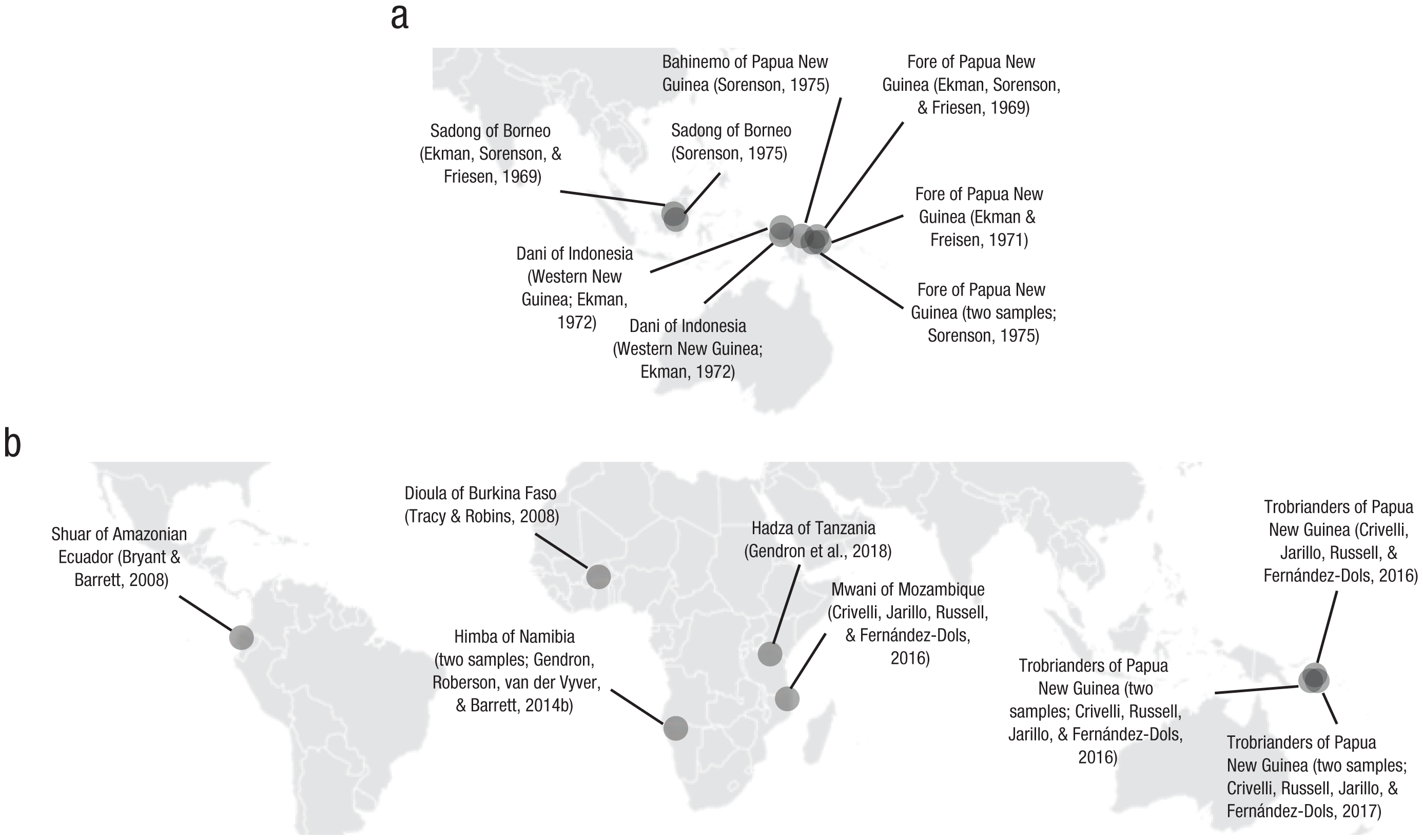
Maps showing the locations of studies that tested the universality thesis for facial movements in small-scale societies, separately for studies conducted (a) between 1969 and 1975 (Epoch 1) and (b) between 2008 and 2017 (Epoch 2). Small-scale societies typically have members numbering in the hundreds or low thousands and often maintain autonomy in social, political, and economic spheres. The studies conducted in Epoch 1 were geographically constrained to societies in the Pacific area. The studies conducted in Epoch 2 spanned a broader geographic range, including Africa and South America, resulting in increased diversity in the ecological and social contexts of the societies tested. This type of diversity is a necessary condition for discovering the extent of cultural variation in psychological phenomena (Medin, Ojalehto, Marin, & Bang, 2017).
In this article, we discuss how one of these innovations—increased diversity in research methods—provides new insights into the nature of emotion perception in small-scale societies. We propose that these new data fit with a perceiver-constructed view of emotion perception that is consistent with research on perception more generally: People are active perceivers who categorize facial movements using culturally learned emotion concepts (Barrett, 2017; Barrett, Lindquist, & Gendron, 2007). Affect concepts (e.g., for pleasure-displeasure) may be similarly used to categorize facial movements across cultures, whereas emotion concepts (e.g., for fear) may not be. Furthermore, people may not always infer a mental cause of facial movements. Alternative ways of conceptualizing facial movements as situated actions or social motives may also be observed across cultures.
Epoch 1: Constrained Tests of the Universality Thesis
Early tests of the universality thesis in small-scale societies used experimental tasks (Figs. 2a and 2b) 2 that required participants to match posed configurations of facial movements—such as scowls, pouts, and smiles (referred to as facial expressions)—with researcher-provided response options, such as emotion words or stories (Ekman, 1972; Ekman & Friesen, 1971; Ekman, Sorenson, & Friesen, 1969). These studies provided a liberal test of the universality thesis because their task features are now known to augment agreement (Nelson & Russell, 2013; Russell, 1994). For example, asking participants to label a face by choosing from a limited set of response options allows them to use a process-of-elimination strategy, in which unused options from prior trials are selected (DiGirolamo & Russell, 2017); response options can also be selected on the basis of broader affective qualities of valence (pleasure-displeasure) or arousal (high or low activation; Yik, Widen, & Russell, 2013). Information provided in stories (Fig. 2a) may inadvertently teach participants emotion concepts (Hoemann, Crittenden, Ruark, Gendron, & Barrett, 2018). As a result, in constrained tasks, participants are more likely to match scowls to “anger,” pouts to “sadness,” and so on than they would without those task constraints (Barrett et al., 2007; Crivelli & Gendron, 2017; Nelson & Russell, 2013; Russell, 1994), and, indeed, support for the universality thesis using these more constrained tasks was moderate to strong (see Table 1).
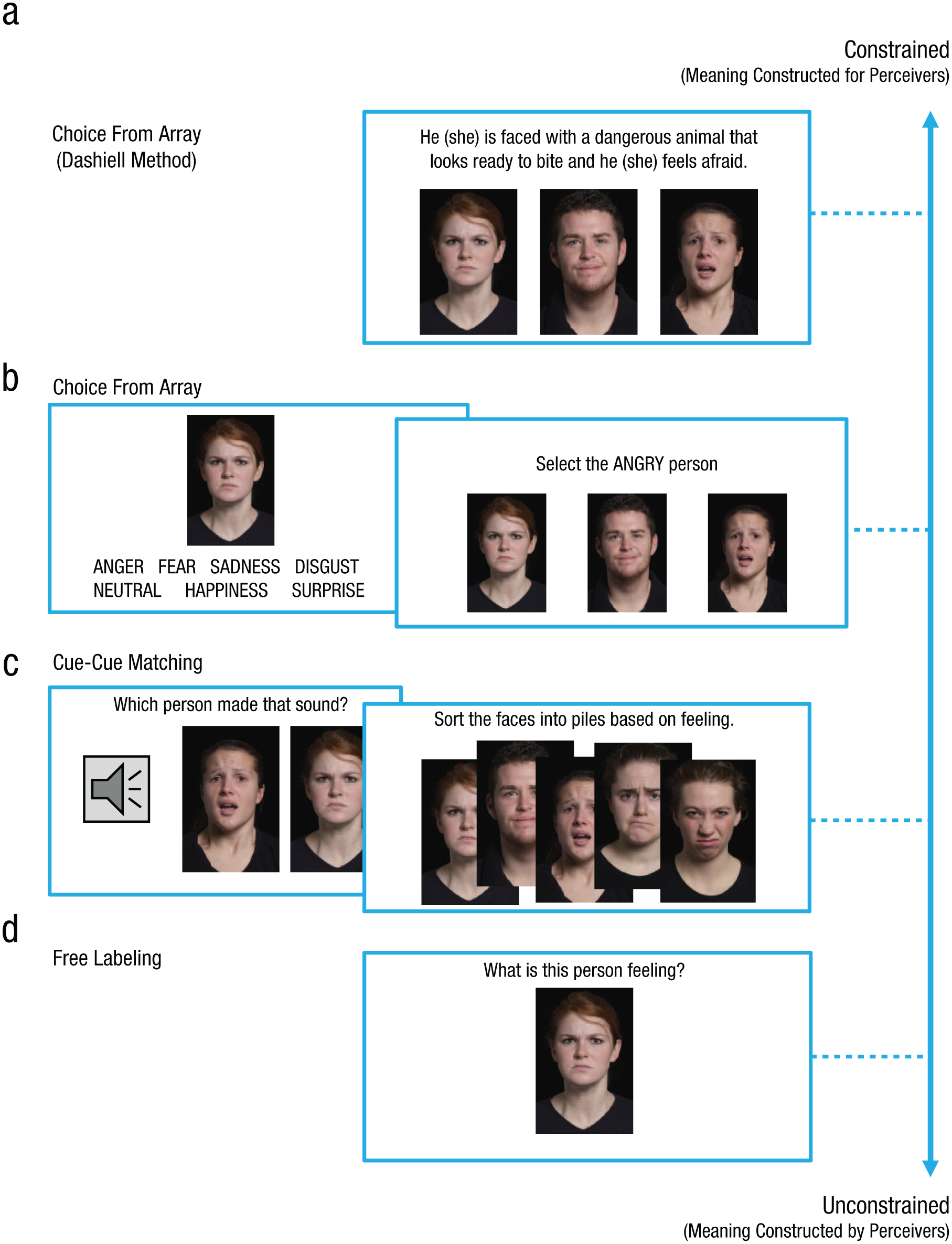
Experimental tasks employed in tests of the universality thesis over time, from more constrained (choice from array) to less constrained (cue-cue matching, free labeling). Notably, the constrained methods all introduce conceptual information to the perceiver, which may have primed a mode of inference (essentialism) or salient content (situated actions) that guided performance. Only data from some studies using constrained tasks met the Haidt and Keltner (1999) criterion for strong support of the universality thesis, with agreement in the 70% to 90% range. Less constrained methods sometimes (but not always) yielded above-chance agreement with universality-thesis predictions, the considerably weaker criterion for the universality thesis proposed by Ekman (1994). See Table 1 for a conceptual summary of study results. This figure depicts only one potential source of experimental constraint that has been identified in studies of emotion perception. Others (Table 1, far-right column) are too sparse to depict and analyze on a continuum. Other sources of context, including relational history, perceiver motivation, and affect should also be examined as important sources of variance in emotion perception across societies. Figure adapted from Gendron (2017).
Emotion-Perception Studies in Small-Scale Societies: Tests of the Universality Thesis and Alternative Hypotheses
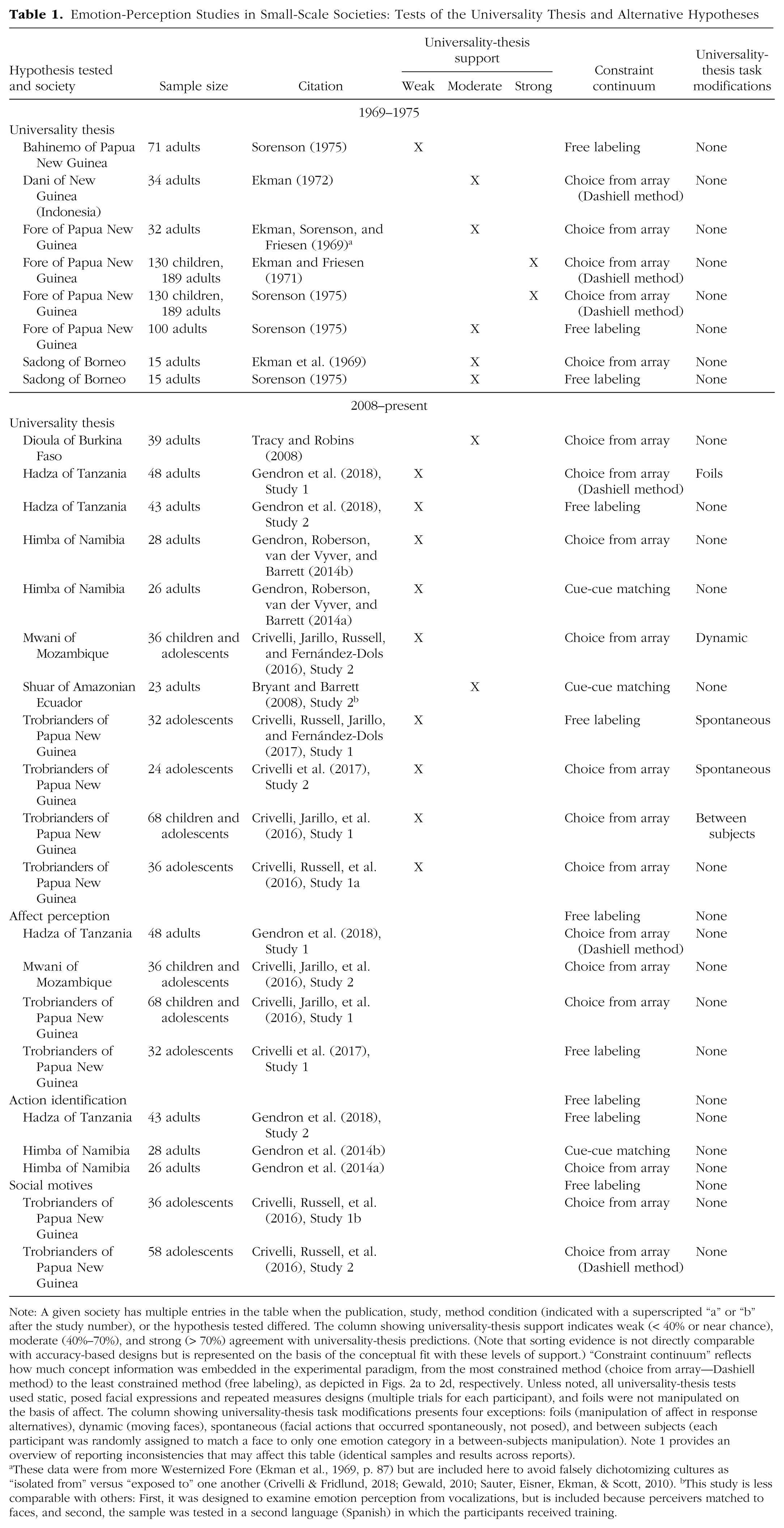
Note: A given society has multiple entries in the table when the publication, study, method condition (indicated with a superscripted “a” or “b” after the study number), or the hypothesis tested differed. The column showing universality-thesis support indicates weak (< 40% or near chance), moderate (40%–70%), and strong (> 70%) agreement with universality-thesis predictions. (Note that sorting evidence is not directly comparable with accuracy-based designs but is represented on the basis of the conceptual fit with these levels of support.) “Constraint continuum” reflects how much concept information was embedded in the experimental paradigm, from the most constrained method (choice from array—Dashiell method) to the least constrained method (free labeling), as depicted in Figs. 2a to 2d, respectively. Unless noted, all universality-thesis tests used static, posed facial expressions and repeated measures designs (multiple trials for each participant), and foils were not manipulated on the basis of affect. The column showing universality-thesis task modifications presents four exceptions: foils (manipulation of affect in response alternatives), dynamic (moving faces), spontaneous (facial actions that occurred spontaneously, not posed), and between subjects (each participant was randomly assigned to match a face to only one emotion category in a between-subjects manipulation). Note 1 provides an overview of reporting inconsistencies that may affect this table (identical samples and results across reports).
These data were from more Westernized Fore (Ekman et al., 1969, p. 87) but are included here to avoid falsely dichotomizing cultures as “isolated from” versus “exposed to” one another (Crivelli & Fridlund, 2018; Gewald, 2010; Sauter, Eisner, Ekman, & Scott, 2010). bThis study is less comparable with others: First, it was designed to examine emotion perception from vocalizations, but is included because perceivers matched to faces, and second, the sample was tested in a second language (Spanish) in which the participants received training.
Constrained tasks, such as those used in this initial phase of testing the universality thesis, do not provide a context for discovery and therefore allow other important phenomena to be overlooked. Methodological diversity, including less constrained, more discovery-based tasks, reveals sources of cross-cultural consistency and diversity, ultimately providing a more robust approach to mapping human behavior, perception, and thought across cultural contexts (Medin, Ojalehto, Marin, & Bang, 2017).
Epoch 2: Methodological Diversity
When tasks are designed to be less constrained, allowing participants more freedom in their responses (as in Figs. 2c and 2d), empirical support for the universality thesis from small-scale societies weakens considerably, calling the universality thesis into doubt (Table 1). For example, Himba, Hadza, and Trobriand participants presented with the typical facial poses used in studies of emotion perception rarely spontaneously offered the emotion labels predicted by the universality thesis (Crivelli, Russell, Jarillo, & Fernández-Dols, 2017; Gendron et al., 2018; Gendron, Roberson, van der Vyver, & Barrett, 2014b). The results of experiments designed to control for affective differences between targets and foils or process-of-elimination effects (Table 1, far-right column) also strongly call the universality thesis into doubt. Moreover, as expected, these studies have discovered additional sources of both cross-cultural consistencies and diversity.
Affect perception
Affective properties such as pleasantness-unpleasantness (i.e., valence) and high-low activation (i.e., arousal) are consistently perceived in facial movements across industrialized societies (Russell, 2003) and small-scale societies. This consistency is referred to as minimal universality (Russell, 1995). In recent tests of the universality thesis, Himba, Trobriand, and Hazda participants rarely confused normatively pleasant and unpleasant facial poses in free-sorting (Gendron et al., 2014b), free-labeling (Crivelli et al., 2017), word-matching (Crivelli, Jarillo, Russell, & Fernández-Dols, 2016), and choice-from-array (Gendron et al., 2018) tasks. Moreover, Trobrianders easily rated the valence and arousal in photos of spontaneous facial expressions in individuals from the Fore society (who also live in Papua New Guinea); their affect ratings largely agreed with those of U.S. participants, even as their emotion perceptions did not (Crivelli et al., 2017). Finally, Himba, Hadza, and Trobriand participants routinely offered labels for pleasant and unpleasant feelings when asked to freely describe the state of people in photographs (Crivelli et al., 2017; Gendron et al., 2018; Gendron et al., 2014b). 3
Perception of social motives
Inferences about social motives, such as another person’s intent to affiliate with or threaten someone, are another potential facet of how people make facial movements meaningful. Such mental inferences are consistent with the behavioral-ecology view of faces (Crivelli & Fridlund, 2018), an account of facial movements as context-dependent tools for social influence (i.e., a functionalist account). In the behavioral-ecology view, facial actions are flexible, context-dependent social signals contingent on the history of past interactions and are uninformative regarding the internal mental mechanisms that covary with these movements (i.e., an externalist view).
Trobriand adolescents, for example, perceived facial movements as signaling social motives and emotions, although their emotion perceptions differed significantly from those of U.S. participants and therefore did not support the universality thesis (Crivelli, Russell, Jarillo, & Fernández-Dols, 2016). For example, Trobriand participants consistently labeled wide-eyed gasping faces (the stipulated expression for fear) as signaling an intent to attack (i.e., an intent to threaten) rather than fear or submission (for additional evidence in carvings and masks, see Crivelli, Jarillo, & Fridlund, 2016). These findings are consistent with prior evidence that social motives are perceived from faces (Yik & Russell, 1999) but go further by demonstrating cultural diversity in the social motives inferred from a given set of muscle movements.
Mentalizing versus action identification
Discovery-oriented methods (specifically, free labeling; Fig. 2d) reveal that perceivers in small-scale societies do not always infer a specific mental feature (e.g., fear or pleasure) as the cause of facial movements (termed mentalizing). They also make sense of facial movements as behaviors (e.g., looking or smelling), referred to as action identification (e.g., Kozak, Marsh, & Wegner, 2006). 4 Action identifications emphasize the functions of behaviors rather than unobservable mental causes of movements. Himba, Hadza, and Trobriander participants all routinely described facial movements as behaviors rather than as expressions of internal, mental events (Crivelli et al., 2017; Gendron et al., 2018; Gendron et al., 2014b); facial poses were frequently described as “smiling,” “looking,” or “smelling.” These actions were sometimes placed in a situational context, such as “crying at a death.” 5 By comparison, U.S. participants offered very few behaviors or situations and more frequently engaged in mental state inference by labeling faces with emotion words (Gendron et al., 2018; Gendron et al., 2014b). Evidence for action identification also comes from a face-sorting task with Himba participants (Fig. 2c; Gendron et al., 2014a). 6
These findings are broadly consistent with the contemporary anthropological hypothesis that inferences for actions exist on a continuum across cultures, anchored by explicit inferences about other peoples’ minds at one end and opacity of mind at the other (Duranti, 2015). One’s place on this continuum is culturally learned (Heyes & Frith, 2014) and reinforced as a mode of social perception. 7 Action identification also provides an alternative explanation for data that was originally interpreted as empirical support for the universality thesis in Epoch 1: In research using the constrained choice-from-array task (Fig. 2a; Table 1), participants were presented with stories that may have primed knowledge of particular actions fitting the situation.
Implications for Psychological Science
To date, most research on emotion perception across cultures (extending beyond studies of small-scale societies) has been designed to validate the universality thesis rather than to discover or rule out diversity in how people make meaning of other people’s facial movements (e.g., Elfenbein & Ambady, 2002; Nelson & Russell, 2013). Studies of emotion perception in small-scale societies, as well as laboratory studies on U.S. samples (see Barrett, 2017; Barrett et al., 2007), consistently reveal that the constrained methods used in the studies of cross-cultural emotion perception (Figs. 2a and 2b) are not psychologically inert. For example, words often serve as placeholders for undefined mental essences that are thought to cause observable features (Gelman, 2003). Asking participants to apply emotion words to faces may lead participants to mentalize when they otherwise might not.
The research reviewed here reveals the need for more data-driven and discovery-oriented empirical approaches that allow for the capacity to discover cultural variation in emotion perception and examine how this variation might relate to specific cultural features. Of course, cultures are not static, bounded, and uniform; they are constantly in flux because of continual cultural learning and transmission (Boyd, Richerson, & Henrich, 2011), which implies that cultural variation in emotion perception may also be dynamic, evolving over time. Emotion-perception research will build a more robust, replicable body of scientific findings if it engages with broader cultural conversations (e.g., Brewer et al., 2017) concerning the flexibility of human brains to wire themselves to diverse social and ecological contexts (Barrett, 2017). A more discovery-based research agenda will necessitate using multidisciplinary research teams to implement a broader array of methodology (Crivelli & Gendron, 2017) that allows for a robust description of emotion dynamics in real-world contexts and interactions. Specifically, future work must map individual and situational patterning of facial movements and the use of social (including emotion) concepts in meaning making about those facial movements. Such research investments will result in a robust ecology of emotion in the wild, something that is sorely needed in basic and translational settings alike.
Conclusions
The experimental study of emotion perception in small-scale societies is consistent with a broader body of evidence that facial movements are not perceived to have uniform meanings as emotion expressions (Hassin, Aviezer, & Bentin, 2013; Jack & Schyns, 2017). Emotion perception is as much a product of meaning making by a perceiver as it is driven by the physical movements of a face (Barrett, 2017; Barrett, Mesquita, & Gendron, 2011). Continued development of a diverse, context-based science of emotion perception (and social perception more broadly) will have the potential to reshape policy and practice built on these basic science observations.
Recommended Reading
Barrett, L. F. (2017). (See References). Provides an in-depth but accessible account of how emotions (and perceptions) are perceiver-constructed phenomena constrained by culture, learning, and a biological imperative to regulate the body (allostasis).
Crivelli, C., & Fridlund, A. J. (2018). (See References). A recent article outlining the behavioral-ecology approach, which postulates that facial displays serve as social tools rather than readouts of internal states.
Crivelli, C., Russell, J. A., Jarillo, S., & Fernández-Dols, J. M. (2016). (See References). Provides the first evidence that a canonical facial expression can be associated with a distinct emotion on the basis of the cultural context.
Gendron, M., Roberson, D., van der Vyver, J. M., & Barrett, L. F. (2014b). (See References). The first published study to test an alternative account to the universality thesis using unconstrained research methods.
Footnotes
Acknowledgements
M. Gendron completed the research discussed in this article while at Northeastern University but is now at Yale University.
Action Editor
Randall W. Engle served as action editor for this article.

Declaration of Conflicting Interests
The author(s) declared that there were no conflicts of interest with respect to the authorship or the publication of this article.